

ASTM D2487-17e1
(Practice)Standard Practice for Classification of Soils for Engineering Purposes (Unified Soil Classification System)
General Information
- Abstract
SIGNIFICANCE AND USE
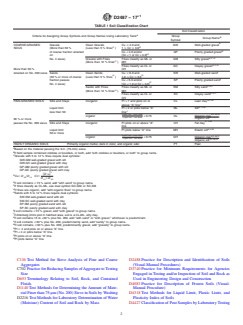
5.1 This standard classifies soils from any geographic location into categories representing the results of prescribed laboratory tests to determine the particle-size characteristics, the liquid limit, and the plasticity index.
5.2 The assigning of a group name and symbol(s) along with the descriptive information required in Practice D2488 can be used to describe a soil to aid in the evaluation of its significant properties for engineering use.
5.3 The various groupings of this classification system have been devised to correlate in a general way with the engineering behavior of soils. This standard provides a useful first step in any field or laboratory investigation for geotechnical engineering purposes.
5.4 This standard may also be used as an aid in training personnel in the use of Practice D2488.
5.5 This standard may be used in combination with Practice D4083 when working with frozen soils.
Note 5: Notwithstanding the statements on precision and bias contained in this standard: The precision of this test method is dependent on the competence of the personnel performing it and the suitability of the equipment and facilities used. Agencies that meet the criteria of Practice D3740 are generally considered capable of competent and objective testing. Users of this test method are cautioned that compliance with Practice D3740 does not in itself assure reliable testing. Reliable testing depends on several factors; Practice D3740 provides a means for evaluating some of those factors.
SCOPE
1.1 This practice describes a system for classifying mineral and organo-mineral soils for engineering purposes based on laboratory determination of particle-size characteristics, liquid limit, and plasticity index and shall be used when precise classification is required.
Note 1: Use of this standard will result in a single classification group symbol and group name except when a soil contains 5 to 12 % fines or when the plot of the liquid limit and plasticity index values falls into the crosshatched area of the plasticity chart. In these two cases, a dual symbol is used, for example, GP-GM, CL-ML. When the laboratory test results indicate that the soil is close to another soil classification group, the borderline condition can be indicated with two symbols separated by a slash. The first symbol should be the one based on this standard, for example, CL/CH, GM/SM, SC/CL. Borderline symbols are particularly useful when the liquid limit value of clayey soils is close to 50. These soils can have expansive characteristics and the use of a borderline symbol (CL/CH, CH/CL) will alert the user of the assigned classifications of expansive potential.
1.2 The group symbol portion of this system is based on laboratory tests performed on the portion of a soil sample passing the 3-in. (75-mm) sieve (see Specification E11).
1.3 As a classification system, this standard is limited to naturally occurring soils.
Note 2: The group names and symbols used in this test method may be used as a descriptive system applied to such materials as shale, claystone, shells, crushed rock, etc. See Appendix X2.
1.4 This standard is for qualitative application only.
Note 3: When quantitative information is required for detailed designs of important structures, this test method must be supplemented by laboratory tests or other quantitative data to determine performance characteristics under expected field conditions.
1.5 This standard is the ASTM version of the Unified Soil Classification System. The basis for the classification scheme is the Airfield Classification System developed by A. Casagrande in the early 1940s.2 It became known as the Unified Soil Classification System when several U.S. Government Agencies adopted a modified version of the Airfield System in 1952.
1.6 This standard does not purport to address all of the safety concerns, if any, associated with its use. It is the responsibility of...
- Status
- Published
- Publication Date
- 14-Dec-2017
- Technical Committee
- D18 - Soil and Rock
- Drafting Committee
- D18.07 - Identification and Classification of Soils
Overview
ASTM D2487-17e1: Standard Practice for Classification of Soils for Engineering Purposes (Unified Soil Classification System) establishes a widely recognized method for classifying mineral and organo-mineral soils based on laboratory measurements. Developed by ASTM International, this standard provides an effective framework for soil classification based on particle-size distribution, liquid limit, and plasticity index. The Unified Soil Classification System (USCS) is fundamental for geotechnical engineering, supporting consistent soil identification across projects and aiding in the evaluation of engineering properties and potential site performance.
Key Topics
Soil Classification Criteria
Soils are classified into groups based on laboratory results for:- Particle-size distribution
- Liquid limit (LL)
- Plasticity index (PI)
Soil Groups and Symbols
The standard defines group names and symbols (e.g., CL, CH, GW) for:- Coarse-grained soils (gravel, sand)
- Fine-grained soils (silt, clay)
- Highly organic soils (peat)
Dual and Borderline Classifications
- Soils with 5–12% fines or values near group boundaries may receive dual symbols (e.g., GP-GM, CL-ML).
- Dual classification helps indicate transitional or expansive behavior.
Qualitative Application
Classification according to ASTM D2487 is primarily qualitative and intended as a preliminary step before more detailed, project-specific testing. Quantitative data may be necessary for final design purposes.
Applications
The ASTM D2487-17e1 standard is integral to multiple civil engineering and geotechnical fields, providing guidance for:
Site Investigation and Design
- Supports initial site classification for engineering projects such as foundations, embankments, and earthworks.
- Useful in describing samples during field or laboratory investigations.
Geotechnical Reporting
- Establishes a standardized language for communicating soil conditions in engineering reports.
- Facilitates regulatory compliance and alignment with contract documents.
Training and Education
- Assists in training personnel in soil description and classification.
- Provides a reference for understanding soil engineering behavior.
Frozen and Reworked Soils
- Can be combined with other ASTM standards (such as ASTM D4083) for specialized cases, including frozen soils or reworked materials.
Material Processing
- The classification method can also be referenced for processed materials like crushed rock, shale, or shells, aiding in quality control and material assessment.
Related Standards
- ASTM D2488: Practice for Description and Identification of Soils (Visual-Manual Procedures)
- ASTM D4318: Test Methods for Liquid Limit, Plastic Limit, and Plasticity Index of Soils
- ASTM D6913: Test Methods for Particle-Size Distribution (Gradation) of Soils Using Sieve Analysis
- ASTM D3740: Practice for Minimum Requirements for Agencies Engaged in Testing and/or Inspection of Soil and Rock
- ASTM D2216: Test Methods for Laboratory Determination of Water (Moisture) Content
- ASTM D1140, C117, C136, C702, D4427: Various test methods for fine content, sieve analysis, and peat classification
Keywords: soil classification, Unified Soil Classification System, ASTM D2487, particle-size distribution, liquid limit, plasticity index, soil engineering, geotechnical investigation, soil group symbol, civil engineering standards.
Practical Value: ASTM D2487-17e1 ensures a consistent, internationally recognized approach to soil classification, vital for risk management, design safety, and communication among engineers, contractors, and regulators in all engineering projects involving soil materials.
Relations
- Effective Date
- 15-Dec-2017
- Effective Date
- 15-Nov-2023
- Effective Date
- 01-Nov-2023
- Effective Date
- 01-Oct-2019
- Effective Date
- 01-Mar-2019
- Effective Date
- 15-Jul-2017
- Refers
ASTM D4318-17 - Standard Test Methods for Liquid Limit, Plastic Limit, and Plasticity Index of Soils - Effective Date
- 01-Jun-2017
- Effective Date
- 01-Jun-2017
- Effective Date
- 01-May-2017
- Effective Date
- 01-Nov-2014
- Effective Date
- 01-Aug-2014
- Effective Date
- 01-Oct-2013
- Effective Date
- 01-Jul-2013
- Effective Date
- 01-Feb-2013
- Effective Date
- 01-May-2012
Get Certified
Connect with accredited certification bodies for this standard

Zavod za gradbeništvo Slovenije (ZAG) - Inšpekcija
ZAG inspection body for construction products, structures, and materials.
Sponsored listings
Frequently Asked Questions
ASTM D2487-17e1 is a standard published by ASTM International. Its full title is "Standard Practice for Classification of Soils for Engineering Purposes (Unified Soil Classification System)". This standard covers: SIGNIFICANCE AND USE 5.1 This standard classifies soils from any geographic location into categories representing the results of prescribed laboratory tests to determine the particle-size characteristics, the liquid limit, and the plasticity index. 5.2 The assigning of a group name and symbol(s) along with the descriptive information required in Practice D2488 can be used to describe a soil to aid in the evaluation of its significant properties for engineering use. 5.3 The various groupings of this classification system have been devised to correlate in a general way with the engineering behavior of soils. This standard provides a useful first step in any field or laboratory investigation for geotechnical engineering purposes. 5.4 This standard may also be used as an aid in training personnel in the use of Practice D2488. 5.5 This standard may be used in combination with Practice D4083 when working with frozen soils. Note 5: Notwithstanding the statements on precision and bias contained in this standard: The precision of this test method is dependent on the competence of the personnel performing it and the suitability of the equipment and facilities used. Agencies that meet the criteria of Practice D3740 are generally considered capable of competent and objective testing. Users of this test method are cautioned that compliance with Practice D3740 does not in itself assure reliable testing. Reliable testing depends on several factors; Practice D3740 provides a means for evaluating some of those factors. SCOPE 1.1 This practice describes a system for classifying mineral and organo-mineral soils for engineering purposes based on laboratory determination of particle-size characteristics, liquid limit, and plasticity index and shall be used when precise classification is required. Note 1: Use of this standard will result in a single classification group symbol and group name except when a soil contains 5 to 12 % fines or when the plot of the liquid limit and plasticity index values falls into the crosshatched area of the plasticity chart. In these two cases, a dual symbol is used, for example, GP-GM, CL-ML. When the laboratory test results indicate that the soil is close to another soil classification group, the borderline condition can be indicated with two symbols separated by a slash. The first symbol should be the one based on this standard, for example, CL/CH, GM/SM, SC/CL. Borderline symbols are particularly useful when the liquid limit value of clayey soils is close to 50. These soils can have expansive characteristics and the use of a borderline symbol (CL/CH, CH/CL) will alert the user of the assigned classifications of expansive potential. 1.2 The group symbol portion of this system is based on laboratory tests performed on the portion of a soil sample passing the 3-in. (75-mm) sieve (see Specification E11). 1.3 As a classification system, this standard is limited to naturally occurring soils. Note 2: The group names and symbols used in this test method may be used as a descriptive system applied to such materials as shale, claystone, shells, crushed rock, etc. See Appendix X2. 1.4 This standard is for qualitative application only. Note 3: When quantitative information is required for detailed designs of important structures, this test method must be supplemented by laboratory tests or other quantitative data to determine performance characteristics under expected field conditions. 1.5 This standard is the ASTM version of the Unified Soil Classification System. The basis for the classification scheme is the Airfield Classification System developed by A. Casagrande in the early 1940s.2 It became known as the Unified Soil Classification System when several U.S. Government Agencies adopted a modified version of the Airfield System in 1952. 1.6 This standard does not purport to address all of the safety concerns, if any, associated with its use. It is the responsibility of...
SIGNIFICANCE AND USE 5.1 This standard classifies soils from any geographic location into categories representing the results of prescribed laboratory tests to determine the particle-size characteristics, the liquid limit, and the plasticity index. 5.2 The assigning of a group name and symbol(s) along with the descriptive information required in Practice D2488 can be used to describe a soil to aid in the evaluation of its significant properties for engineering use. 5.3 The various groupings of this classification system have been devised to correlate in a general way with the engineering behavior of soils. This standard provides a useful first step in any field or laboratory investigation for geotechnical engineering purposes. 5.4 This standard may also be used as an aid in training personnel in the use of Practice D2488. 5.5 This standard may be used in combination with Practice D4083 when working with frozen soils. Note 5: Notwithstanding the statements on precision and bias contained in this standard: The precision of this test method is dependent on the competence of the personnel performing it and the suitability of the equipment and facilities used. Agencies that meet the criteria of Practice D3740 are generally considered capable of competent and objective testing. Users of this test method are cautioned that compliance with Practice D3740 does not in itself assure reliable testing. Reliable testing depends on several factors; Practice D3740 provides a means for evaluating some of those factors. SCOPE 1.1 This practice describes a system for classifying mineral and organo-mineral soils for engineering purposes based on laboratory determination of particle-size characteristics, liquid limit, and plasticity index and shall be used when precise classification is required. Note 1: Use of this standard will result in a single classification group symbol and group name except when a soil contains 5 to 12 % fines or when the plot of the liquid limit and plasticity index values falls into the crosshatched area of the plasticity chart. In these two cases, a dual symbol is used, for example, GP-GM, CL-ML. When the laboratory test results indicate that the soil is close to another soil classification group, the borderline condition can be indicated with two symbols separated by a slash. The first symbol should be the one based on this standard, for example, CL/CH, GM/SM, SC/CL. Borderline symbols are particularly useful when the liquid limit value of clayey soils is close to 50. These soils can have expansive characteristics and the use of a borderline symbol (CL/CH, CH/CL) will alert the user of the assigned classifications of expansive potential. 1.2 The group symbol portion of this system is based on laboratory tests performed on the portion of a soil sample passing the 3-in. (75-mm) sieve (see Specification E11). 1.3 As a classification system, this standard is limited to naturally occurring soils. Note 2: The group names and symbols used in this test method may be used as a descriptive system applied to such materials as shale, claystone, shells, crushed rock, etc. See Appendix X2. 1.4 This standard is for qualitative application only. Note 3: When quantitative information is required for detailed designs of important structures, this test method must be supplemented by laboratory tests or other quantitative data to determine performance characteristics under expected field conditions. 1.5 This standard is the ASTM version of the Unified Soil Classification System. The basis for the classification scheme is the Airfield Classification System developed by A. Casagrande in the early 1940s.2 It became known as the Unified Soil Classification System when several U.S. Government Agencies adopted a modified version of the Airfield System in 1952. 1.6 This standard does not purport to address all of the safety concerns, if any, associated with its use. It is the responsibility of...
ASTM D2487-17e1 is classified under the following ICS (International Classification for Standards) categories: 93.020 - Earthworks. Excavations. Foundation construction. Underground works. The ICS classification helps identify the subject area and facilitates finding related standards.
ASTM D2487-17e1 has the following relationships with other standards: It is inter standard links to ASTM D2487-17, ASTM C117-23, ASTM D3740-23, ASTM D3740-19, ASTM D2216-19, ASTM D2488-17, ASTM D4318-17, ASTM D4318-17e1, ASTM D4427-13(2017), ASTM D1140-14, ASTM D653-14, ASTM E11-13, ASTM D4427-13, ASTM C117-13, ASTM D3740-12a. Understanding these relationships helps ensure you are using the most current and applicable version of the standard.
ASTM D2487-17e1 is available in PDF format for immediate download after purchase. The document can be added to your cart and obtained through the secure checkout process. Digital delivery ensures instant access to the complete standard document.
Standards Content (Sample)
This international standard was developed in accordance with internationally recognized principles on standardization established in the Decision on Principles for the
Development of International Standards, Guides and Recommendations issued by the World Trade Organization Technical Barriers to Trade (TBT) Committee.
´1
Designation:D2487 −17
Standard Practice for
Classification of Soils for Engineering Purposes (Unified
Soil Classification System)
This standard is issued under the fixed designation D2487; the number immediately following the designation indicates the year of
original adoption or, in the case of revision, the year of last revision.Anumber in parentheses indicates the year of last reapproval.A
superscript epsilon (´) indicates an editorial change since the last revision or reapproval.
This standard has been approved for use by agencies of the U.S. Department of Defense.
ε NOTE—Footnote L in Table 1 was editorially corrected in April 2020.
1. Scope* is the Airfield Classification System developed by A. Casa-
grande in the early 1940s. It became known as the Unified
1.1 This practice describes a system for classifying mineral
Soil Classification System when several U.S. Government
and organo-mineral soils for engineering purposes based on
Agencies adopted a modified version of theAirfield System in
laboratory determination of particle-size characteristics, liquid
1952.
limit, and plasticity index and shall be used when precise
1.6 This standard does not purport to address all of the
classification is required.
safety concerns, if any, associated with its use. It is the
NOTE 1—Use of this standard will result in a single classification group
responsibility of the user of this standard to establish appro-
symbol and group name except when a soil contains 5 to 12% fines or
priate safety, health, and environmental practices and deter-
when the plot of the liquid limit and plasticity index values falls into the
crosshatchedareaoftheplasticitychart.Inthesetwocases,adualsymbol mine the applicability of regulatory limitations prior to use.
is used, for example, GP-GM, CL-ML. When the laboratory test results
1.7 This practice offers a set of instructions for performing
indicate that the soil is close to another soil classification group, the
one or more specific operations. This document cannot replace
borderline condition can be indicated with two symbols separated by a
education or experience and should be used in conjunction
slash. The first symbol should be the one based on this standard, for
withprofessionaljudgment.Notallaspectsofthispracticemay
example, CL/CH, GM/SM, SC/CL. Borderline symbols are particularly
usefulwhentheliquidlimitvalueofclayeysoilsiscloseto50.Thesesoils
be applicable in all circumstances. This ASTM standard is not
can have expansive characteristics and the use of a borderline symbol
intended to represent or replace the standard of care by which
(CL/CH, CH/CL) will alert the user of the assigned classifications of
the adequacy of a given professional service must be judged,
expansive potential.
nor should this document be applied without consideration of
1.2 The group symbol portion of this system is based on
a project’s many unique aspects. The word “Standard” in the
laboratory tests performed on the portion of a soil sample
title of this document means only that the document has been
passing the 3-in. (75-mm) sieve (see Specification E11).
approved through the ASTM consensus process.
1.3 As a classification system, this standard is limited to
1.8 This international standard was developed in accor-
naturally occurring soils.
dance with internationally recognized principles on standard-
ization established in the Decision on Principles for the
NOTE 2—The group names and symbols used in this test method may
Development of International Standards, Guides and Recom-
be used as a descriptive system applied to such materials as shale,
claystone, shells, crushed rock, etc. See Appendix X2.
mendations issued by the World Trade Organization Technical
Barriers to Trade (TBT) Committee.
1.4 This standard is for qualitative application only.
NOTE3—Whenquantitativeinformationisrequiredfordetaileddesigns
2. Referenced Documents
of important structures, this test method must be supplemented by
laboratory tests or other quantitative data to determine performance
2.1 ASTM Standards:
characteristics under expected field conditions.
C117Test Method for Materials Finer than 75-µm (No. 200)
1.5 This standard is the ASTM version of the Unified Soil Sieve in Mineral Aggregates by Washing
Classification System. The basis for the classification scheme
1 2
This practice is under the jurisdiction of ASTM Committee D18 on Soil and Casagrande, A., “Classification and Identification of Soils,” Transactions,
Rock and is the direct responsibility of Subcommittee D18.07 on Identification and ASCE, 1948 , p. 901.
Classification of Soils. For referenced ASTM standards, visit the ASTM website, www.astm.org, or
Current edition approved Dec. 15, 2017. Published January 2018. Originally contact ASTM Customer Service at service@astm.org. For Annual Book of ASTM
approved in 1966. Last previous edition approved in 2011 as D2487 – 11. DOI: Standards volume information, refer to the standard’s Document Summary page on
10.1520/D2487-17E01. the ASTM website.
*A Summary of Changes section appears at the end of this standard
Copyright © ASTM International, 100 Barr Harbor Drive, PO Box C700, West Conshohocken, PA 19428-2959. United States
´1
D2487−17
TABLE 1 Soil Classification Chart
Soil Classification
A
Criteria for Assigning Group Symbols and Group Names Using Laboratory Tests Group
B
Group Name
Symbol
E
COARSE-GRAINED Gravels Clean Gravels Cu $ 4.0 and GW Well-graded gravel
C D
SOILS (More than 50 % (Less than 5 % fines ) 1 # Cc # 3.0
E
of coarse fraction retained Cu < 4.0 and/or GP Poorly graded gravel
D
on [Cc<1orCc>3.0]
E,F,G
No. 4 sieve) Gravels with Fines Fines classify as ML or GM Silty gravel
C
(More than 12 % fines ) MH
E,F,G
Fines classify as CL or GC Clayey gravel
More than 50 % CH
I
retained on No. 200 sieve Sands Clean Sands Cu $ 6.0 and SW Well-graded sand
H D
(50 % or more of coarse (Less than 5 % fines ) 1.0 # Cc # 3.0
I
fraction passes Cu < 6.0 and/or SP Poorly graded sand
D
No. 4 sieve) [Cc < 1.0 or Cc > 3.0]
F,G,I
Sands with Fines Fines classify as ML or SM Silty sand
H
(More than 12 % fines ) MH
F,G,I
Fines classify as CL or SC Clayey sand
CH
K,L,M
FINE-GRAINED SOILS Silts and Clays inorganic PI > 7 and plots on or CL Lean clay
J
above “A” line
K ,L,M
Liquid limit PI < 4 or plots below “A” ML Silt
J
less than 50 line
Liquid limit − oven dried
K,L,M,N
organic <0.75 OL Organic clay
Liquid limit − not dried K,L,M,O
Organic silt
50 % or more
K ,L,M
passes the No. 200 sieve Silts and Clays inorganic PI plots on or above “A” CH Fat clay
line
K,L,M
Liquid limit PI plots below “A” line MH Elastic silt
50 or more
Liquid limit − oven dried K,L,M,P
organic <0.75 OH Organic clay
Liquid limit − not dried K,L,M,Q
Organic silt
HIGHLY ORGANIC SOILS Primarily organic matter, dark in color, and organic odor PT Peat
A
Based on the material passing the 3-in. (75-mm) sieve.
B
If field sample contained cobbles or boulders, or both, add “with cobbles or boulders, or both” to group name.
C
Gravels with 5 to 12 % fines require dual symbols:
GW-GM well-graded gravel with silt
GW-GC well-graded gravel with clay
GP-GM poorly graded gravel with silt
GP-GC poorly graded gravel with clay
D
s d
D
Cu5D /D Cc5
60 10
D 3D
10 60
E
If soil contains $15 % sand, add “with sand” to group name.
F
If fines classify as CL-ML, use dual symbol GC-GM, or SC-SM.
G
If fines are organic, add “with organic fines” to group name.
H
Sands with 5 to 12 % fines require dual symbols:
SW-SM well-graded sand with silt
SW-SC well-graded sand with clay
SP-SM poorly graded sand with silt
SP-SC poorly graded sand with clay
I
If soil contains $15 % gravel, add “with gravel” to group name.
J
If Atterberg limits plot in hatched area, soil is a CL-ML, silty clay.
K
If soil contains 15 to <30 % plus No. 200, add “with sand” or “with gravel,” whichever is predominant.
L
If soil contains $30 % plus No. 200, predominantly sand, add “sandy” to group name.
M
If soil contains $30 % plus No. 200, predominantly gravel, add “gravelly” to group name.
N
PI $ 4 and plots on or above “A” line.
O
PI < 4 or plots below “A” line.
P
PI plots on or above “A” line.
Q
PI plots below “A” line.
C136Test Method for Sieve Analysis of Fine and Coarse D2488Practice for Description and Identification of Soils
Aggregates (Visual-Manual Procedures)
C702PracticeforReducingSamplesofAggregatetoTesting D3740Practice for Minimum Requirements for Agencies
Size Engaged in Testing and/or Inspection of Soil and Rock as
D653Terminology Relating to Soil, Rock, and Contained Used in Engineering Design and Construction
Fluids D4083Practice for Description of Frozen Soils (Visual-
D1140Test Methods for Determining the Amount of Mate- Manual Procedure)
rialFinerthan75-µm(No.200)SieveinSoilsbyWashing D4318Test Methods for Liquid Limit, Plastic Limit, and
D2216Test Methods for Laboratory Determination ofWater Plasticity Index of Soils
(Moisture) Content of Soil and Rock by Mass D4427Classification of Peat Samples by LaboratoryTesting
´1
D2487−17
D6913Test Methods for Particle-Size Distribution (Grada- 3.2 Definitions of Terms Specific to This Standard:
tion) of Soils Using Sieve Analysis 3.2.1 coeffıcient of curvature, Cc—the ratio (D ) /
E11Specification forWovenWireTest Sieve Cloth andTest (D ×D ), where D ,D , and D are the particle sizes
10 60 60 30 10
Sieves corresponding to 60, 30, and 10% finer on the cumulative
particle-size distribution curve, respectively.
3. Terminology
3.2.2 coeffıcient of uniformity, Cu—theratioD /D ,where
60 10
3.1 Definitions:
D andD aretheparticlediameterscorrespondingto60and
60 10
3.1.1 Except as listed below, all definitions are in accor-
10% finer on the cumulative particle-size distribution curve,
dance with Terminology D653.
respectively.
NOTE 4—For particles retained on a 3-in. (75-mm) U.S. standard sieve,
the following definitions are suggested: 4. Summary
Cobbles—particles of rock that will pass a 12-in. (300-mm) square
4.1 As illustrated in Table 1, this classification system
opening and be retained on a 3-in. (75-mm) U.S. standard sieve, and
identifies three major soil divisions: coarse-grained soils,
Boulders—particlesofrockthatwillnotpassa12-in.(300-mm)square
opening. fine-grained soils, and highly organic soils. These three divi-
sionsarefurthersubdividedintoatotalof15basicsoilgroups.
3.1.2 clay—soil passing a No. 200 (75-µm) U.S. standard
sieve that can be made to exhibit plasticity (putty-like proper-
4.2 Based on the results of visual observations and pre-
ties) within a range of water contents and that exhibits
scribed laboratory tests, a soil is catalogued according to the
considerable strength when air dry. For classification, a clay is
basic soil groups, assigned a group symbol(s) and name, and
a fine-grained soil, or the fine-grained portion of a soil, with a
thereby classified. The flow charts, Figs. 1 and 2 for fine-
plasticity index equal to or greater than 4, and the plot of
grained soils, and Fig. 3 for coarse-grained soils, can be used
plasticity index versus liquid limit falls on or above the “A” to assign the appropriate group symbol(s) and name.
line.
3.1.3 gravel—particles of rock that will pass a 3-in. (75- 5. Significance and Use
mm)sieveandberetainedonaNo.4(4.75-mm)U.S.standard
5.1 This standard classifies soils from any geographic loca-
sieve with the following subdivisions:
tion into categories representing the results of prescribed
Coarse—passes 3-in. (75-mm) sieve and retained on ⁄4-in.
laboratory tests to determine the particle-size characteristics,
(19-mm) sieve, and
the liquid limit, and the plasticity index.
Fine—passes ⁄4-in. (19-mm) sieve and retained on No. 4
5.2 The assigning of a group name and symbol(s) along
(4.75-mm) sieve.
with the descriptive information required in Practice D2488
3.1.4 organic clay—a clay with sufficient organic content to
can be used to describe a soil to aid in the evaluation of its
influence the soil properties. For classification, an organic clay
significant properties for engineering use.
is a soil that would be classified as a clay except that its liquid
limitvalueafterovendryingislessthan75%ofitsliquidlimit
5.3 The various groupings of this classification system have
value before oven drying.
beendevisedtocorrelateinageneralwaywiththeengineering
3.1.5 organic silt—a silt with sufficient organic content to
behavior of soils. This standard provides a useful first step in
influence the soil properties. For classification, an organic silt
any field or laboratory investigation for geotechnical engineer-
is a soil that would be classified as a silt except that its liquid
ing purposes.
limitvalueafterovendryingislessthan75%ofitsliquidlimit
5.4 This standard may also be used as an aid in training
value before oven drying.
personnel in the use of Practice D2488.
3.1.6 peat—a soil composed of vegetable tissue in various
5.5 This standard may be used in combination with Practice
stages of decomposition usually with an organic odor, a
D4083 when working with frozen soils.
dark-brown to black color, a spongy consistency, and a texture
ranging from fibrous to amorphous.
NOTE 5—Notwithstanding the statements on precision and bias con-
3.1.7 sand—particles of rock that will pass a No. 4 (4.75- tained in this standard: The precision of this test method is dependent on
the competence of the personnel performing it and the suitability of the
mm)sieveandberetainedonaNo.200(75-µm)U.S.standard
equipment and facilities used. Agencies that meet the criteria of Practice
sieve with the following subdivisions:
D3740 are generally considered capable of competent and objective
Coarse—passes No. 4 (4.75-mm) sieve and retained on No.
testing. Users of this test method are cautioned that compliance with
10 (2.00-mm) sieve,
Practice D3740 does not in itself assure reliable testing. Reliable testing
Medium—passes No. 10 (2.00-mm) sieve and retained on depends on several factors; Practice D3740 provides a means for
evaluating some of those factors.
No. 40 (425-µm) sieve, and
Fine—passes No. 40 (425-µm) sieve and retained on No.
6. Apparatus
200 (75-µm) sieve.
3.1.8 silt—soil passing a No. 200 (75-µm) U.S. standard
6.1 A plasticity chart, similar to Fig. 4, and a cumulative
sievethatisnonplasticorveryslightlyplasticandthatexhibits
particle-size distribution curve, similar to Fig. 5, are required.
little or no strength when air dry. For classification, a silt is a
NOTE 6—The “U” line shown on Fig. 4 has been empirically deter-
fine-grained soil, or the fine-grained portion of a soil, with a
mined to be the approximate “upper limit” for natural soils. It is a good
plasticity index less than 4 or if the plot of plasticity index
check against erroneous data, and any test results that plot above or to the
versus liquid limit falls below the “A” line. left of it should be verified.
´1
D2487−17
FIG. 1Flow Chart for Classifying Fine-Grained Soil (50% or More Passes No. 200 Sieve)
FIG. 2Flow Chart for Classifying Organic Fine-Grained Soil (50% or More Passes No. 200 Sieve)
7. Classification of Peat amorphoustexture,adark-browntoblackcolor,andanorganic
odor shall be classified as peat, PT, and not subjected to the
7.1 Asamplethatiscomposedprimarilyofvegetativetissue
classification procedures described hereafter.
in various stages of decomposition and has a fibrous to
´1
D2487−17
FIG. 3Flow Chart for Classifying Coarse-Grained Soils (More Than 50% Retained on No. 200 Sieve)
7.2 If desired, classification of type of peat can be per- C117, if applicable. A semi-log plot of percent passing versus
formed in accordance with Classification D4427. partical-size or sieve size/sieve number is plotted as shown in
Fig. 5.
8. Preparation for Classification
8.4.2 For soils estimated to contain 5 to 15% fines, a
cumulative particle-size distribution curve, as described in
8.1 Beforeasoilcanbeclassifiedaccordingtothisstandard,
8.4.1, is required, and the liquid limit and plasticity index in
generally the particle-size distribution of the minus 3-in.
accordance with Test Method D4318 are required.
(75-mm)materialandtheplasticitycharacteristicsoftheminus
8.4.2.1 Ifsufficientmaterialisnotavailabletodeterminethe
No. 40 (425-µm) sieve material must be determined. See 8.4
liquid limit and plasticity index, the fines should be estimated
for the specific required tests.
to be either silty or clayey using the procedures described in
8.2 Although the test procedure used in determining the
Practice D2488 and so noted in the report.
particle-size distribution or other considerations may require a
8.4.3 For soils estimated to contain 15% or more fines, a
hydrometer analysis of the material, a hydrometer analysis is
determination of the percent fines, percent sand, and percent
not necessary for soil classification.
gravel is required, and the liquid limit and plasticity index, as
8.3 The percentage (by dry weight) of any plus 3-in.
described in 8.4.2, are required. For soils estimated to contain
(75-mm)materialmustbedeterminedandreportedasauxiliary
90%finesormore,thepercentfines,percentsand,andpercent
information. The maximum particle size shall be determined
gravel may be estimated instead, using the procedures de-
(mea
...