

ASTM D7944-22
(Practice)Standard Practice for Recovery of Emulsified Asphalt Residue Using a Vacuum Oven
General Information
- Abstract
SIGNIFICANCE AND USE
4.1 This practice can be used to obtain residues of emulsified asphalts. The residue may be used for further testing.
4.2 As approximately 5 g of residue is typically obtained, limited testing is possible.
Note 1: Rheological characterization as described in Test Methods D7175 and D7405 are suitable test methods. Additional test methods are being developed suited to the small amounts of residue obtained.
SCOPE
1.1 This practice is suitable for recovery of the residue of emulsified asphalts composed principally of a semisolid or liquid asphaltic base, water, and an emulsifying agent. Asphalt base may be pre-modified with polymeric modifiers or latex polymer modifiers may be incorporated into the emulsified asphalt through co-milling or post emulsified asphalt production blending.
1.2 The text of this standard references notes and footnotes which provide explanatory material. These notes and footnotes (excluding those in tables and figures) shall not be considered as requirements of the standard.
1.3 This standard does not purport to address all of the safety concerns, if any, associated with its use. It is the responsibility of the user of this standard to establish appropriate safety, health, and environmental practices and determine the applicability of regulatory limitations prior to use.
1.4 This international standard was developed in accordance with internationally recognized principles on standardization established in the Decision on Principles for the Development of International Standards, Guides and Recommendations issued by the World Trade Organization Technical Barriers to Trade (TBT) Committee.
- Status
- Published
- Publication Date
- 30-Jun-2022
- Technical Committee
- D04 - Road and Paving Materials
- Drafting Committee
- D04.42 - Emulsified Asphalt Test
Buy Documents
ASTM D7944-22 - Standard Practice for Recovery of Emulsified Asphalt Residue Using a Vacuum Oven
REDLINE ASTM D7944-22 - Standard Practice for Recovery of Emulsified Asphalt Residue Using a Vacuum Oven
Overview
ASTM D7944-22: Standard Practice for Recovery of Emulsified Asphalt Residue Using a Vacuum Oven outlines the recommended methodology for recovering residue from emulsified asphalt samples. This practice is widely implemented in laboratories to obtain stable asphalt residues from samples containing water, emulsifying agents, and modifiers. The residue collected can be utilized for further testing to evaluate essential pavement material properties. Typically, the procedure yields about 5 grams of residue per test, making it suitable for limited, targeted analyses.
This ASTM standard is recognized internationally and is developed under the guidance of ASTM Committee D04 on Road and Paving Materials, ensuring global alignment with best practices in emulsified asphalt evaluation.
Key Topics
Scope and Applicability
- Suitable for recovery of emulsified asphalt residues including those with polymeric or latex modifiers.
- Applicable to materials where the asphalt base is semisolid or liquid and is mixed with water and an emulsifying agent.
Vacuum Oven Recovery Process
- Utilizes a vacuum oven or similar device to gently remove water at controlled temperature and reduced pressure.
- Silicone rubber mats and specific supports are used to create thin films of asphalt for efficient moisture removal.
Sample Handling and Testing
- Residue typically weighs around 5 grams, restricting the amount and types of subsequent testing.
- Commonly referenced tests include rheological characterizations as described in ASTM D7175 and D7405.
- Procedure includes careful cleaning, preheating, calibration, and monitoring of temperature and pressure to ensure recovery consistency.
Safety and Compliance
- Users are responsible for following relevant safety, health, and environmental regulations when using this standard.
- The method is developed in line with World Trade Organization (WTO) principles for international standards.
Applications
ASTM D7944-22 is vital for professionals dealing with emulsified asphalt recovery, especially for pavement engineering, quality assurance, and research. Its key practical applications include:
Material Characterization
- Provides a protocol for producing asphalt residue samples suitable for further analysis, such as performance testing, classification, and quality control.
Quality Control in Pavement Construction
- Enables agencies and contractors to evaluate the properties of emulsified asphalts, particularly when polymer or latex modifications are used.
Research and Development
- Supports labs and researchers working to enhance or customize emulsified asphalts for specific environmental or durability requirements.
Regulatory and Specification Compliance
- Serves as a reference practice to meet state, national, and international specifications involving asphalt residues from emulsified products.
Related Standards
For comprehensive assessment and compatibility with other methodologies, consider these related ASTM and AASHTO standards:
- ASTM D244 - Test Methods and Practices for Emulsified Asphalts
- ASTM D7175 - Determining Rheological Properties of Asphalt Binder Using a Dynamic Shear Rheometer
- ASTM D7405 - Multiple Stress Creep and Recovery (MSCR) of Asphalt Binder
- AASHTO R28 - Accelerated Aging of Asphalt Binder Using a Pressurized Aging Vessel (PAV)
- AASHTO PP 72 - Practice for Recovery Residue from Emulsified Asphalt Using Low-Temperature Evaporative Techniques
Using ASTM D7944-22 in conjunction with these standards helps ensure a robust approach to asphalt binder residue recovery and testing, promoting consistency and reliability in pavement material evaluation.
Keywords: emulsified asphalt, asphalt residue recovery, vacuum oven, ASTM D7944-22, asphalt binder testing, paving materials, rheological testing.
Relations
- Effective Date
- 15-Dec-2023
- Effective Date
- 01-Oct-2023
- Effective Date
- 01-Mar-2020
- Effective Date
- 01-Oct-2017
- Effective Date
- 01-Dec-2015
- Effective Date
- 01-Jan-2010
- Effective Date
- 01-Jun-2009
- Effective Date
- 15-Jul-2008
- Effective Date
- 01-Jul-2008
- Effective Date
- 01-Feb-2008
- Effective Date
- 01-Dec-2007
- Effective Date
- 15-Sep-2005
- Effective Date
- 15-Sep-2005
- Effective Date
- 01-Dec-2004
- Effective Date
- 10-Jul-2000
Buy Documents
ASTM D7944-22 - Standard Practice for Recovery of Emulsified Asphalt Residue Using a Vacuum Oven
REDLINE ASTM D7944-22 - Standard Practice for Recovery of Emulsified Asphalt Residue Using a Vacuum Oven
Get Certified
Connect with accredited certification bodies for this standard

DIBt (Deutsches Institut für Bautechnik)
German Institute for Building Technology.
DIN CERTCO
DIN Group product certification.
Zavod za gradbeništvo Slovenije (ZAG) - Inšpekcija
ZAG inspection body for construction products, structures, and materials.
Sponsored listings
Frequently Asked Questions
ASTM D7944-22 is a standard published by ASTM International. Its full title is "Standard Practice for Recovery of Emulsified Asphalt Residue Using a Vacuum Oven". This standard covers: SIGNIFICANCE AND USE 4.1 This practice can be used to obtain residues of emulsified asphalts. The residue may be used for further testing. 4.2 As approximately 5 g of residue is typically obtained, limited testing is possible. Note 1: Rheological characterization as described in Test Methods D7175 and D7405 are suitable test methods. Additional test methods are being developed suited to the small amounts of residue obtained. SCOPE 1.1 This practice is suitable for recovery of the residue of emulsified asphalts composed principally of a semisolid or liquid asphaltic base, water, and an emulsifying agent. Asphalt base may be pre-modified with polymeric modifiers or latex polymer modifiers may be incorporated into the emulsified asphalt through co-milling or post emulsified asphalt production blending. 1.2 The text of this standard references notes and footnotes which provide explanatory material. These notes and footnotes (excluding those in tables and figures) shall not be considered as requirements of the standard. 1.3 This standard does not purport to address all of the safety concerns, if any, associated with its use. It is the responsibility of the user of this standard to establish appropriate safety, health, and environmental practices and determine the applicability of regulatory limitations prior to use. 1.4 This international standard was developed in accordance with internationally recognized principles on standardization established in the Decision on Principles for the Development of International Standards, Guides and Recommendations issued by the World Trade Organization Technical Barriers to Trade (TBT) Committee.
SIGNIFICANCE AND USE 4.1 This practice can be used to obtain residues of emulsified asphalts. The residue may be used for further testing. 4.2 As approximately 5 g of residue is typically obtained, limited testing is possible. Note 1: Rheological characterization as described in Test Methods D7175 and D7405 are suitable test methods. Additional test methods are being developed suited to the small amounts of residue obtained. SCOPE 1.1 This practice is suitable for recovery of the residue of emulsified asphalts composed principally of a semisolid or liquid asphaltic base, water, and an emulsifying agent. Asphalt base may be pre-modified with polymeric modifiers or latex polymer modifiers may be incorporated into the emulsified asphalt through co-milling or post emulsified asphalt production blending. 1.2 The text of this standard references notes and footnotes which provide explanatory material. These notes and footnotes (excluding those in tables and figures) shall not be considered as requirements of the standard. 1.3 This standard does not purport to address all of the safety concerns, if any, associated with its use. It is the responsibility of the user of this standard to establish appropriate safety, health, and environmental practices and determine the applicability of regulatory limitations prior to use. 1.4 This international standard was developed in accordance with internationally recognized principles on standardization established in the Decision on Principles for the Development of International Standards, Guides and Recommendations issued by the World Trade Organization Technical Barriers to Trade (TBT) Committee.
ASTM D7944-22 is classified under the following ICS (International Classification for Standards) categories: 91.100.50 - Binders. Sealing materials; 93.080.20 - Road construction materials. The ICS classification helps identify the subject area and facilitates finding related standards.
ASTM D7944-22 has the following relationships with other standards: It is inter standard links to ASTM D7175-23, ASTM D244-23, ASTM D7405-20, ASTM D244-09(2017), ASTM D7405-15, ASTM D7405-10, ASTM D244-09, ASTM D7175-08, ASTM D7405-08a, ASTM D7405-08, ASTM D7175-07, ASTM D7175-05, ASTM D7175-05e1, ASTM D244-04, ASTM D244-00. Understanding these relationships helps ensure you are using the most current and applicable version of the standard.
ASTM D7944-22 is available in PDF format for immediate download after purchase. The document can be added to your cart and obtained through the secure checkout process. Digital delivery ensures instant access to the complete standard document.
Standards Content (Sample)
This international standard was developed in accordance with internationally recognized principles on standardization established in the Decision on Principles for the
Development of International Standards, Guides and Recommendations issued by the World Trade Organization Technical Barriers to Trade (TBT) Committee.
Designation:D7944 −22
Standard Practice for
Recovery of Emulsified Asphalt Residue Using a Vacuum
Oven
This standard is issued under the fixed designation D7944; the number immediately following the designation indicates the year of
original adoption or, in the case of revision, the year of last revision. A number in parentheses indicates the year of last reapproval. A
superscript epsilon (´) indicates an editorial change since the last revision or reapproval.
1. Scope 2.2 AASHTO Standards:
R28 Accelerated Aging of Asphalt Binder Using a Pressur-
1.1 This practice is suitable for recovery of the residue of
ized Aging Vessel (PAV)
emulsified asphalts composed principally of a semisolid or
PP 72 Standard Practice for Recovery Residue from Emul-
liquid asphaltic base, water, and an emulsifying agent.Asphalt
sifiedAsphalt Using Low-Temperature Evaporative Tech-
base may be pre-modified with polymeric modifiers or latex
niques
polymer modifiers may be incorporated into the emulsified
asphalt through co-milling or post emulsified asphalt produc-
3. Summary of Practice
tion blending.
3.1 Asampleofemulsifiedasphaltisspreadinathinfilmon
1.2 The text of this standard references notes and footnotes
a silicone rubber mat and conditioned in a vacuum oven or
which provide explanatory material. These notes and footnotes
other suitable vacuum chamber to remove the water.
(excluding those in tables and figures) shall not be considered
as requirements of the standard.
4. Significance and Use
1.3 This standard does not purport to address all of the
4.1 This practice can be used to obtain residues of emulsi-
safety concerns, if any, associated with its use. It is the
fied asphalts. The residue may be used for further testing.
responsibility of the user of this standard to establish appro-
4.2 As approximately 5 g of residue is typically obtained,
priate safety, health, and environmental practices and deter-
limited testing is possible.
mine the applicability of regulatory limitations prior to use.
1.4 This international standard was developed in accor-
NOTE 1—Rheological characterization as described in Test Methods
D7175 and D7405 are suitable test methods. Additional test methods are
dance with internationally recognized principles on standard-
being developed suited to the small amounts of residue obtained.
ization established in the Decision on Principles for the
Development of International Standards, Guides and Recom-
5. Apparatus
mendations issued by the World Trade Organization Technical
5.1 Silicone rubber mat approximately 30 by 20 by 0.3 cm
Barriers to Trade (TBT) Committee.
(approximately 12 by 9 by 0.15 in.), minimum of 40A
2. Referenced Documents
durometer.
2.1 ASTM Standards:
5.2 Supports for Silicone Rubber Mat—Provide adequate
D244 Test Methods and Practices for Emulsified Asphalts
support of the silicone rubber mat during draw-down of the
D7175 Test Method for Determining the Rheological Prop-
film, while transporting to the vacuum oven or other suitable
erties of Asphalt Binder Using a Dynamic Shear Rheom-
vacuum conditioning chamber, and while recovering the emul-
eter
sified asphalt residue. The procedure uses two separate
D7405 Test Method for Multiple Stress Creep and Recovery
supports, one at ambient temperature for draw-down and
(MSCR) of Asphalt Binder Using a Dynamic Shear
transfer, and a second to support the silicone rubber mat and
Rheometer
emulsified asphalt during residue recovery. Adequate supports
This practice is under the jurisdiction of ASTM Committee D04 on Road and
Paving Materials and is the direct responsibility of Subcommittee D04.42 on Available from American Association of State Highway and Transportation
Emulsified Asphalt Test. Officials (AASHTO), 444 N. Capitol St., NW, Suite 249, Washington, DC 20001,
Current edition approved July 1, 2022. Published August 2022. Originally http://www.transportation.org.
approved in 2015. Last previous edition approved in 2015 as D7944 – 15. DOI: The sole source of supply of the apparatus (referred to as “Silicone Rubber
10.1520/D7944-22. Sheeting” in catalog) known to the committee at this time is McMaster Carr, 200
For referenced ASTM standards, visit the ASTM website, www.astm.org, or New Canton Way, Robbinsville, NJ 08691-2343, www.mcmaster.com. If you are
contact ASTM Customer Service at service@astm.org. For Annual Book of ASTM aware of alternative suppliers, please provide this information to ASTM Interna-
Standards volume information, refer to the standard’s Document Summary page on tional Headquarters.Your comments will receive careful consideration at a meeting
the ASTM website. of the responsible technical committee, which you may attend.
Copyright © ASTM International, 100 Barr Harbor Drive, PO Box C700, West Conshohocken, PA 19428-2959. United States
D7944−22
include but are not limited to a metal plate or tile with 7. Preparation of Apparatus
dimensions that are larger than the silicone rubber mat.
7.1 Preheatboththesupportmaterialusedduringemulsified
5.3 Draw-down applicator with the ability to draw down a
asphalt recovery and the vacuum oven or other suitable
wet film approximately 0.38 mm (15 mils) in thickness. (See pressure reduction vessel to 60 6 5 °C (140 6 10 °F) for a
Fig. 1.)
minimum of 30 min.
5.4 Vacuum oven or any suitable heated pressure reduction
NOTE 3—Preheating the vessel 10 to 15 °C above the 60 °C recovery
vessel,capableofmaintainingatemperatureof60 65 °C(140 temperaturecanbeusedtoreducethedropinchambertemperatureduring
loading and to minimize the time required to stabilize the system after
6 10 °F) and holding a vacuum of 1300 6 500 Pa (0.4 6 0.2
loading to attain the required temperature range. The specific preheat
in. Hg) absolute pressure for the specified test time.
temperature offset used is equipment specific, so select the preheat
temperature based on the value that minimizes the time delay between
5.5 Tool capable of removing the emulsified asphalt residue
sample loading and the system returning to the operating range provided
from the silicone rubber mat after recovery without the use of
in 7.1.
heat or chemical reagents. Recommended tools include a metal
7.2 Wipe clean the material that will support the silicone
spatula to scrape off the material or rolling by a glass rod. Use
rubber mat during draw-down of the emulsified asphalt film
removal tools with dimensions suitable for the area of the
and inspect to ensure the surface is absent of any particles or
drawn down emulsified asphalt film.
other irregularities. It is not necessary to preheat the support
6. Reagents and Materials material used for draw-down of the emulsified asphalt film.
6.1 Cleaning agent, capable of removing residual asphalt
8. Calibration and Standardization
and other oils from the silicone rubber mat. Halogenated
solventsshouldnotbeusedonthesiliconerubbermatmaterial. 8.1 Vacuum Oven:
8.1.1 Vacuum Oven Thermometric Device—Verify the ther-
6.2 Remove any remaining oils from the silicone rubber
mometric device used in the vacuum oven to within 60 65°C
mat. Do not use a soap-water solution.
(140 6 10 °F) at least every twelve months using a calibrated
6.2.1 Solvents should be avoided if possible when residue
thermometric device traceable to a national standard. Verifica-
will be tested for performance properties.
tion shall be performed at a temperature that is within 5 °C of
6.2.2 VM&P naptha, heptane, or other mineral spirits may
the use temperature.
be used to remove the residual asphalt from the silicone rubber
8.1.2 Absolute Pressure Gauge—Verify the absolute pres-
mat; however, following the use of these materials wipe the
sure gauge to equate to a reading within 1300 6 500 Pa (0.4 6
silicone rubber mat with acetone or warm at 60 6 5 °C (140 6
0.2 in. Hg) pressure at least every twelve months using a
10 °F) for at least 15 min to remove residual solvent traces.
calibrated vacuum or pressure indicator traceable to a national
NOTE2—Alternativemethodscanbeusedprovidedtheyareeffectiveat
standard.
removingresidualasphaltandtracesofsolventsormineralspiritsfromthe
8.1.2.1 If a vacuum pressure gauge is used, the gauge
silicone rubber mat.
readingrepresentsthedifferencebetweenatmosphericpressure
and the pressure in the vessel. This value must be converted to
absolute pressure by adding the atmospheric pressure to the
gauge pressure. Standard atmospheric pressure at sea level is
Known sources for applicators can be found at www.gardco.com (8 Path Wet
Film Applicator) and BYK Gardner USA, www.directindustry.com (stainless steel
101.3 kPa (29.92 in. Hg); correction for higher altitudes is
film applicator). If you are aware of alternative suppl
...
This document is not an ASTM standard and is intended only to provide the user of an ASTM standard an indication of what changes have been made to the previous version. Because
it may not be technically possible to adequately depict all changes accurately, ASTM recommends that users consult prior editions as appropriate. In all cases only the current version
of the standard as published by ASTM is to be considered the official document.
Designation: D7944 − 15 D7944 − 22
Standard Practice for
Recovery of Emulsified Asphalt Residue Using a Vacuum
Oven
This standard is issued under the fixed designation D7944; the number immediately following the designation indicates the year of
original adoption or, in the case of revision, the year of last revision. A number in parentheses indicates the year of last reapproval. A
superscript epsilon (´) indicates an editorial change since the last revision or reapproval.
1. Scope
1.1 This practice is suitable for recovery of the residue of emulsified asphalts composed principally of a semisolid or liquid
asphaltic base, water, and an emulsifying agent. Asphalt base may be pre-modified with polymeric modifiers or latex polymer
modifiers may be incorporated into the emulsified asphalt through co-milling or post emulsified asphalt production blending.
1.2 The text of this standard references notes and footnotes which provide explanatory material. These notes and footnotes
(excluding those in tables and figures) shall not be considered as requirements of the standard.
1.3 This standard does not purport to address all of the safety concerns, if any, associated with its use. It is the responsibility
of the user of this standard to establish appropriate safety safety, health, and healthenvironmental practices and determine the
applicability of regulatory limitations prior to use.
1.4 This international standard was developed in accordance with internationally recognized principles on standardization
established in the Decision on Principles for the Development of International Standards, Guides and Recommendations issued
by the World Trade Organization Technical Barriers to Trade (TBT) Committee.
2. Referenced Documents
2.1 ASTM Standards:
D244 Test Methods and Practices for Emulsified Asphalts
D7175 Test Method for Determining the Rheological Properties of Asphalt Binder Using a Dynamic Shear Rheometer
D7405 Test Method for Multiple Stress Creep and Recovery (MSCR) of Asphalt Binder Using a Dynamic Shear Rheometer
2.2 AASHTO Standards:
R28R 28 Accelerated Aging of Asphalt Binder Using a Pressurized Aging Vessel (PAV)
PP 72 Standard Practice for Recovery Residue from Emulsified Asphalt Using Low-Temperature Evaporative Techniques
3. Summary of Practice
3.1 A sample of emulsified asphalt is spread in a thin film on a silicone rubber mat and conditioned in a vacuum oven or other
suitable vacuum chamber to remove the water.
This practice is under the jurisdiction of ASTM Committee D04 on Road and Paving Materials and is the direct responsibility of Subcommittee D04.42 on Emulsified
Asphalt Test.
Current edition approved Oct. 1, 2015July 1, 2022. Published December 2015August 2022. Originally approved in 2015. Last previous edition approved in 2015 as
D7944 – 15. DOI: 10.1520/D7944-15.10.1520/D7944-22.
For referenced ASTM standards, visit the ASTM website, www.astm.org, or contact ASTM Customer Service at service@astm.org. For Annual Book of ASTM Standards
volume information, refer to the standard’s Document Summary page on the ASTM website.
Available from American Association of State Highway and Transportation Officials (AASHTO), 444 N. Capitol St., NW, Suite 249, Washington, DC 20001,
http://www.transportation.org.
Copyright © ASTM International, 100 Barr Harbor Drive, PO Box C700, West Conshohocken, PA 19428-2959. United States
D7944 − 22
4. Significance and Use
4.1 This practice can be used to obtain residues of emulsified asphalts. The residue may be used for further testing.
4.2 As approximately 5 g of residue is typically obtained, limited testing is possible.
NOTE 1—Rheological characterization as described in Test Methods D7175 and D7405 are suitable test methods. Additional test methods are being
developed suited to the small amounts of residue obtained.
5. Apparatus
5.1 Silicone rubber mat approximately 30 by 20 by 0.3 cm (approximately 12 by 9 by 0.15 in.), minimum of 40A durometer.
5.2 Supports for Silicone Rubber Mat—Provide adequate support of the silicone rubber mat during draw down draw-down of the
film, while transporting to the vacuum oven or other suitable vacuum conditioning chamber, and while recovering the emulsified
asphalt residue. The procedure uses two separate supports, one at ambient temperature for draw down draw-down and transfer, and
a second to support the silicone rubber mat and emulsified asphalt during residue recovery. Adequate supports include but are not
limited to a metal plate or tile with dimensions that are larger than the silicone rubber mat.
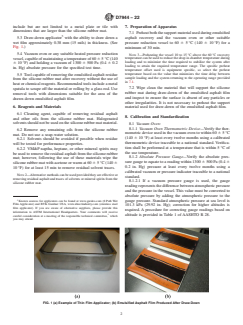
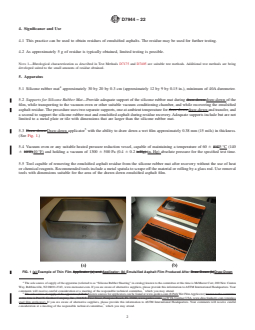
5.3 Draw down Draw-down applicator with the ability to draw down a wet film approximately 0.38 mm (15 mils) in thickness.
(See Fig. 1.)
5.4 Vacuum oven or any suitable heated pressure reduction vessel, capable of maintaining a temperature of 60 6 5°C5 °C (140
6 10°F)10 °F) and holding a vacuum of 1300 6 500 Pa (0.4 6 0.2 inHg) in. Hg) absolute pressure for the specified test time.
5.5 Tool capable of removing the emulsified asphalt residue from the silicone rubber mat after recovery without the use of heat
or chemical reagents. Recommended tools include a metal spatula to scrape off the material or rolling by a glass rod. Use removal
tools with dimensions suitable for the area of the drawn down emulsified asphalt film.
FIG. 1 (a) Example of Thin Film Applicator (a) and Applicator; (b) Emulsified Asphalt Film Produced After Draw Down (b)Draw-Down
The sole source of supply of the apparatus (referred to as “Silicone Rubber Sheeting” in catalog) known to the committee at this time is McMaster Carr, 200 New Canton
Way, Robbinsville, NJ 08691-2343, www.mcmaster.com. If you are aware of alternative suppliers, please provide this information to ASTM International Headquarters. Your
comments will receive careful consideration at a meeting of the responsible technical committee, which you may attend.
The sole source of supply of the apparatus (8-Path Known sources for applicators can be found at www.gardco.com (8 Path Wet Film Applicator) known to the committee
at this time is Paul N. Gardner Company, Inc., 316 N.E. First Street, Pompano Beach, FL 33060, www.gardco.com. and BYK Gardner USA, www.directindustry.com (stainless
steel film applicator). If you are aware of alternative suppliers, please provide this information to ASTM International Headquarters. Your comments will receive careful
consideration at a meeting of the responsible technical committee, which you may attend.
D7944 − 22
6. Reagents and Materials
6.1 Cleaning agent, capable of removing residual asphalt and other oils from the silicone rubber mat. Halogenated solvents should
not be used on the silicone rubber mat material.
6.2 Remove any remaining oils from the silicone rubber mat. Do not use a soap-water solution.
6.2.1 Solvents should be avoided if possible when residue will be tested for performance properties.
6.2.2 VM&P naptha, heptane, or other mineral spirits may be used to remove the residual asphalt from the silicone rubber mat;
however, following the use of these materials wipe the silicone rubber mat with acetone or warm at 60 6 5 °C (140 6 10 °F) for
at least 15 min to remove residual solvent traces.
NOTE 2—VM&P naptha, heptane, or other mineral spirits are suggested to remove the residual asphalt from the silicone rubber mat. Following the use
of these materials wipe the silicone rubber mat with acetone or warm at 60 6 5°C (140 6 10°F) for at least 15 min. Alternative methods can be used
provided they are effective at removing residual asphalt and traces of solvents or mineral spirits from the silicone rubber mat.
7. Preparation of Apparatus
7.1 Pre-heatPreheat both the support material used during emulsified asphalt recovery and the vacuum oven or other suitable
pressure reduction vessel to 60 6 5°C5 °C (140 6 10°F)10 °F) for a minimum of 30 min.
NOTE 3—Preheating the vessel 10 to 15°C15 °C above the 60°C60 °C recovery temperature can be used to reduce the drop in chamber temperature during
loading and to minimize the time required to stabilize the system after loading to attain the required temperature range. The specific pre-heatpreheat
temperature offset used is equipment specific, so select the pre-heatpreheat temperature based on the value that minimizes the time delay between sample
loading and the system returning to the operating range provided in 7.1.
7.2 Wipe clean the material that will support the silicone rubber mat during draw down draw-down of the emulsified asphalt film
and inspect to ensure the surface is absent of any particles or other irregularities. It is not necessary to preheat the support material
used for draw down draw-down of the emulsified asphalt film.
8. Calibration and Standardization
8.1 Vacuum Oven:
8.1.1 Vacuum Oven Thermometric Device—Verify the thermometric device used in the vacuum oven to within 60 6 5°C5 °C (140
6 10°F)10 °F) at least every twelve months using a calibrated thermometric device traceable to a national standard. Verification
shall be performed at a temperature that is within 5°C5 °C of the use temperature.
8.1.2 Absolute Pressure Gauge—Verify the absolute pressure gauge to equate to a reading within 1300 6 500 Pa (0.4 6 0.2 inHg)
in. Hg) pressure at least every twelve months using a calibrated vacuum or pressure indicator traceable to a national standard.
NOTE 4—If a vacuum pressure gauge is used, the gauge reading represents the difference between atmospheric pressure and the pressure in the vessel.
This value must be converted to absolute pressure by adding the atmospheric pressure to the gauge pressure. Standard atmospheric pressure at sea level
is 101.3 kPa (29.92 inHg), correction for higher altitudes is required. A procedure for correcting gauge readings based on altitude is provided in Table
1 of AASHTO R28.
8.1.2.1 If a vacuum pressure gauge is used, the gauge reading represents the difference between atmospheric pressure and the
pressure in the vessel. This value must be converted to absolute pressure by adding the atmospheric pressure to the gauge pressure.
Standard atmospheric pressure at sea level is 101.3 kPa (29.92 in. Hg); correction for higher altitudes is required. A procedure for
correcting gauge readings based on altitude is provided in Table 1 of AASHTO R 28.
9. Conditioning
9.1 Handle emulsions in accordance with Test Methods D244 subsection 3.1 with the following modifications: Increase the sample
heating temperature to 55 6 5°C5 °C (131 6 10°F)10 °F) for all emulsions regardless of emulsion viscosity testing requirements.
--
...