

ASTM D7405-20
(Test Method)Standard Test Method for Multiple Stress Creep and Recovery (MSCR) of Asphalt Binder Using a Dynamic Shear Rheometer
General Information
- Abstract
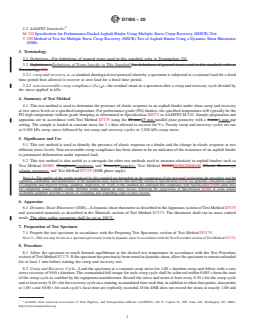
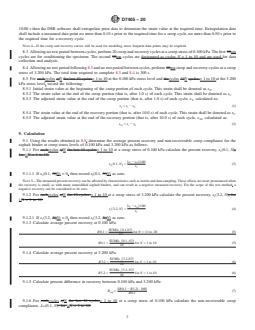
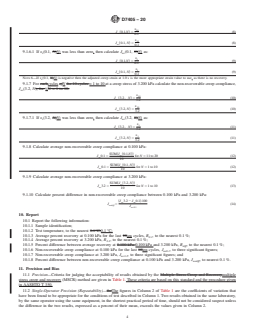
SIGNIFICANCE AND USE
5.1 This test method is used to identify the presence of elastic response in a binder and the change in elastic response at two different stress levels. Non-recoverable creep compliance has been shown to be an indicator of the resistance of an asphalt binder to permanent deformation under repeated load.
5.2 This test method is also useful as a surrogate for other test methods used to measure elasticity in asphalt binders such as Test Method D5801 (toughness and tenacity), Test Method D6084/D6084M (elastic recovery), and Test Method D7175 (DSR phase angle).
Note 2: The quality of the results produced by this standard are dependent on the competence of the personnel performing the procedure and the capability, calibration, and maintenance of the equipment used. Agencies that meet the criteria of Specification D3666 are generally considered capable of competent and objective testing, sampling, inspection, etc. Users of this standard are cautioned that compliance with Specification D3666 alone does not completely ensure reliable results. Reliable results depend on many factors; following the suggestions of Specification D3666 or some similar acceptable guideline provides a means of evaluating and controlling some of those factors.
SCOPE
1.1 This test method covers the determination of percent recovery and non-recoverable creep compliance of asphalt binders by means of multiple stress creep and recovery (MSCR) testing. The MSCR test is conducted using the dynamic shear rheometer (DSR) at a specified temperature.
1.2 This standard is appropriate for unaged material, material aged in accordance with Test Method D2872 (RTFOT), material aged in accordance with Practice D6521 (PAV), and material aged in accordance with both Test Method D2872 and Practice D6521.
Note 1: The majority of development work on this test method was performed on material aged in accordance with Test Method D2872 (RTFOT).
1.3 The percent recovery is intended to provide a means to determine the presence of elastic response and stress dependence of polymer-modified and unmodified asphalt binders.
1.4 The values stated in SI units are to be regarded as standard. No other units of measurement are included in this standard.
1.5 The text of this standard references notes and footnotes which provide explanatory material. These notes and footnotes (excluding those in tables and figures) shall not be considered as requirements of the standard.
1.6 This standard does not purport to address all of the safety concerns, if any, associated with its use. It is the responsibility of the user of this standard to establish appropriate safety, health, and environmental practices and determine the applicability of regulatory limitations prior to use.
1.7 This international standard was developed in accordance with internationally recognized principles on standardization established in the Decision on Principles for the Development of International Standards, Guides and Recommendations issued by the World Trade Organization Technical Barriers to Trade (TBT) Committee.
- Status
- Published
- Publication Date
- 29-Feb-2020
- Technical Committee
- D04 - Road and Paving Materials
- Drafting Committee
- D04.44 - Rheological Tests
Buy Documents

ASTM D7405-20 - Standard Test Method for Multiple Stress Creep and Recovery (MSCR) of Asphalt Binder Using a Dynamic Shear Rheometer
REDLINE ASTM D7405-20 - Standard Test Method for Multiple Stress Creep and Recovery (MSCR) of Asphalt Binder Using a Dynamic Shear Rheometer
Overview
ASTM D7405-20 is the Standard Test Method for Multiple Stress Creep and Recovery (MSCR) of Asphalt Binder Using a Dynamic Shear Rheometer. Developed by ASTM International, this standard specifies procedures to determine the percent recovery and non-recoverable creep compliance of asphalt binders through MSCR testing at controlled temperatures using a Dynamic Shear Rheometer (DSR). The method is an essential tool for evaluating asphalt binder properties related to permanent deformation (rutting), making it highly relevant for road and pavement industries.
The MSCR test is applicable to both unaged and aged asphalt binders, including those modified with polymers as well as unmodified materials. This method helps in identifying the elastic response of binders at two stress levels and provides insight into the stress dependence of different binders.
Key Topics
- Percent Recovery and Non-Recoverable Creep Compliance: The MSCR test determines two main parameters:
- Percent recovery assesses the elastic response of the asphalt binder.
- Non-recoverable creep compliance (Jnr) indicates the binder's resistance to permanent deformation under repeated load.
- Dynamic Shear Rheometer (DSR): The required equipment for this test, DSR is operated at a specified temperature using parallel plate geometry and stress-control mode.
- Testing on Aged and Unaged Materials: The test can be conducted on:
- Unaged asphalt binders
- Binders aged via Rolling Thin-Film Oven Test (RTFOT, ASTM D2872)
- Binders aged using the Pressurized Aging Vessel (PAV, ASTM D6521)
- Binders aged by both methods
- Comparison with Other Methods: The MSCR procedure serves as a surrogate for assessing elasticity compared to other ASTM standards such as:
- ASTM D5801 (Toughness and Tenacity)
- ASTM D6084/D6084M (Elastic Recovery)
- ASTM D7175 (Phase Angle measures)
- Precision and Bias: The standard includes precision statements for both single-operator and multilaboratory scenarios, supporting consistent results across various testing environments.
Applications
ASTM D7405-20 is widely applied in the quality control and specification of asphalt binders used in the construction and maintenance of flexible pavements. Key benefits and practical uses include:
- Performance Grading (PG) of Asphalt Binders: The results support binder selection in accordance with performance-based specifications, such as those in ASTM D6373 and AASHTO M 332.
- Evaluation of Polymer-Modified and Unmodified Binders: The test reliably differentiates between binders with and without polymer modifications, enabling better performance predictions.
- Assessment of Rutting Resistance: By quantifying non-recoverable creep compliance, agencies can predict long-term pavement performance and resistance to rutting under traffic loading.
- Surrogate for Other Elasticity Tests: The MSCR test can replace or complement other standard tests, streamlining laboratory workflows.
- Compliance Testing: DOTs, road agencies, and asphalt suppliers use this standard to ensure material meets contract requirements before paving projects.
Related Standards
For broader context and integrated quality assurance, ASTM D7405-20 should be considered alongside the following related standards:
- ASTM D2872 – Rolling Thin-Film Oven Test (RTFOT) for aging binders
- ASTM D6521 – Practice for Accelerated Aging of Asphalt Binder (PAV)
- ASTM D5801 – Toughness and Tenacity of Asphalt Materials
- ASTM D6084/D6084M – Elastic Recovery by Ductilometer
- ASTM D7175 – Determining Rheological Properties Using a DSR
- ASTM D6373 – Specification for Performance-Graded Asphalt Binder
- AASHTO M 332 and T 350 – Performance-graded binder specification and MSCR test procedure
- ASTM D3666 – Minimum requirements for agencies testing paving materials
These documents, used collectively, form a comprehensive framework for asphalt binder evaluation, ensuring high performance and durability in modern paving applications.
Keywords: ASTM D7405-20, MSCR, Asphalt Binder, Dynamic Shear Rheometer, Non-recoverable Creep Compliance, Percent Recovery, Pavement Rutting, Polymer-Modified Asphalt, Asphalt Testing Standards.
Relations
- Effective Date
- 01-Mar-2020
- Effective Date
- 01-Feb-2024
- Effective Date
- 15-Jan-2024
- Effective Date
- 01-Jan-2024
- Effective Date
- 15-Dec-2023
- Effective Date
- 01-Aug-2019
- Effective Date
- 01-Jul-2019
- Effective Date
- 15-Dec-2018
- Effective Date
- 15-Aug-2018
- Effective Date
- 01-Jul-2018
- Effective Date
- 01-Jul-2018
- Effective Date
- 01-Feb-2018
- Effective Date
- 15-Jul-2017
- Effective Date
- 15-Jun-2017
- Effective Date
- 01-Jun-2017
Buy Documents
ASTM D7405-20 - Standard Test Method for Multiple Stress Creep and Recovery (MSCR) of Asphalt Binder Using a Dynamic Shear Rheometer
REDLINE ASTM D7405-20 - Standard Test Method for Multiple Stress Creep and Recovery (MSCR) of Asphalt Binder Using a Dynamic Shear Rheometer
Get Certified
Connect with accredited certification bodies for this standard

DIBt (Deutsches Institut für Bautechnik)
German Institute for Building Technology.
DIN CERTCO
DIN Group product certification.

Aboma Certification B.V.
Specialized in construction, metal, and transport sectors.
Sponsored listings
Frequently Asked Questions
ASTM D7405-20 is a standard published by ASTM International. Its full title is "Standard Test Method for Multiple Stress Creep and Recovery (MSCR) of Asphalt Binder Using a Dynamic Shear Rheometer". This standard covers: SIGNIFICANCE AND USE 5.1 This test method is used to identify the presence of elastic response in a binder and the change in elastic response at two different stress levels. Non-recoverable creep compliance has been shown to be an indicator of the resistance of an asphalt binder to permanent deformation under repeated load. 5.2 This test method is also useful as a surrogate for other test methods used to measure elasticity in asphalt binders such as Test Method D5801 (toughness and tenacity), Test Method D6084/D6084M (elastic recovery), and Test Method D7175 (DSR phase angle). Note 2: The quality of the results produced by this standard are dependent on the competence of the personnel performing the procedure and the capability, calibration, and maintenance of the equipment used. Agencies that meet the criteria of Specification D3666 are generally considered capable of competent and objective testing, sampling, inspection, etc. Users of this standard are cautioned that compliance with Specification D3666 alone does not completely ensure reliable results. Reliable results depend on many factors; following the suggestions of Specification D3666 or some similar acceptable guideline provides a means of evaluating and controlling some of those factors. SCOPE 1.1 This test method covers the determination of percent recovery and non-recoverable creep compliance of asphalt binders by means of multiple stress creep and recovery (MSCR) testing. The MSCR test is conducted using the dynamic shear rheometer (DSR) at a specified temperature. 1.2 This standard is appropriate for unaged material, material aged in accordance with Test Method D2872 (RTFOT), material aged in accordance with Practice D6521 (PAV), and material aged in accordance with both Test Method D2872 and Practice D6521. Note 1: The majority of development work on this test method was performed on material aged in accordance with Test Method D2872 (RTFOT). 1.3 The percent recovery is intended to provide a means to determine the presence of elastic response and stress dependence of polymer-modified and unmodified asphalt binders. 1.4 The values stated in SI units are to be regarded as standard. No other units of measurement are included in this standard. 1.5 The text of this standard references notes and footnotes which provide explanatory material. These notes and footnotes (excluding those in tables and figures) shall not be considered as requirements of the standard. 1.6 This standard does not purport to address all of the safety concerns, if any, associated with its use. It is the responsibility of the user of this standard to establish appropriate safety, health, and environmental practices and determine the applicability of regulatory limitations prior to use. 1.7 This international standard was developed in accordance with internationally recognized principles on standardization established in the Decision on Principles for the Development of International Standards, Guides and Recommendations issued by the World Trade Organization Technical Barriers to Trade (TBT) Committee.
SIGNIFICANCE AND USE 5.1 This test method is used to identify the presence of elastic response in a binder and the change in elastic response at two different stress levels. Non-recoverable creep compliance has been shown to be an indicator of the resistance of an asphalt binder to permanent deformation under repeated load. 5.2 This test method is also useful as a surrogate for other test methods used to measure elasticity in asphalt binders such as Test Method D5801 (toughness and tenacity), Test Method D6084/D6084M (elastic recovery), and Test Method D7175 (DSR phase angle). Note 2: The quality of the results produced by this standard are dependent on the competence of the personnel performing the procedure and the capability, calibration, and maintenance of the equipment used. Agencies that meet the criteria of Specification D3666 are generally considered capable of competent and objective testing, sampling, inspection, etc. Users of this standard are cautioned that compliance with Specification D3666 alone does not completely ensure reliable results. Reliable results depend on many factors; following the suggestions of Specification D3666 or some similar acceptable guideline provides a means of evaluating and controlling some of those factors. SCOPE 1.1 This test method covers the determination of percent recovery and non-recoverable creep compliance of asphalt binders by means of multiple stress creep and recovery (MSCR) testing. The MSCR test is conducted using the dynamic shear rheometer (DSR) at a specified temperature. 1.2 This standard is appropriate for unaged material, material aged in accordance with Test Method D2872 (RTFOT), material aged in accordance with Practice D6521 (PAV), and material aged in accordance with both Test Method D2872 and Practice D6521. Note 1: The majority of development work on this test method was performed on material aged in accordance with Test Method D2872 (RTFOT). 1.3 The percent recovery is intended to provide a means to determine the presence of elastic response and stress dependence of polymer-modified and unmodified asphalt binders. 1.4 The values stated in SI units are to be regarded as standard. No other units of measurement are included in this standard. 1.5 The text of this standard references notes and footnotes which provide explanatory material. These notes and footnotes (excluding those in tables and figures) shall not be considered as requirements of the standard. 1.6 This standard does not purport to address all of the safety concerns, if any, associated with its use. It is the responsibility of the user of this standard to establish appropriate safety, health, and environmental practices and determine the applicability of regulatory limitations prior to use. 1.7 This international standard was developed in accordance with internationally recognized principles on standardization established in the Decision on Principles for the Development of International Standards, Guides and Recommendations issued by the World Trade Organization Technical Barriers to Trade (TBT) Committee.
ASTM D7405-20 is classified under the following ICS (International Classification for Standards) categories: 91.100.50 - Binders. Sealing materials. The ICS classification helps identify the subject area and facilitates finding related standards.
ASTM D7405-20 has the following relationships with other standards: It is inter standard links to ASTM D7405-15, ASTM C670-24a, ASTM D5801-24, ASTM C670-24, ASTM D7175-23, ASTM D8-19, ASTM D6521-19, ASTM D8-18c, ASTM D8-18b, ASTM D8-18a, ASTM D6521-18, ASTM D8-18, ASTM D8-17c, ASTM D8-17b, ASTM D5801-17. Understanding these relationships helps ensure you are using the most current and applicable version of the standard.
ASTM D7405-20 is available in PDF format for immediate download after purchase. The document can be added to your cart and obtained through the secure checkout process. Digital delivery ensures instant access to the complete standard document.
Standards Content (Sample)
This international standard was developed in accordance with internationally recognized principles on standardization established in the Decision on Principles for the
Development of International Standards, Guides and Recommendations issued by the World Trade Organization Technical Barriers to Trade (TBT) Committee.
Designation: D7405 − 20
Standard Test Method for
Multiple Stress Creep and Recovery (MSCR) of Asphalt
1,2
Binder Using a Dynamic Shear Rheometer
This standard is issued under the fixed designation D7405; the number immediately following the designation indicates the year of
original adoption or, in the case of revision, the year of last revision. A number in parentheses indicates the year of last reapproval. A
superscript epsilon (´) indicates an editorial change since the last revision or reapproval.
1. Scope mendations issued by the World Trade Organization Technical
Barriers to Trade (TBT) Committee.
1.1 This test method covers the determination of percent
recovery and non-recoverable creep compliance of asphalt
2. Referenced Documents
binders by means of multiple stress creep and recovery
2.1 ASTM Standards:
(MSCR) testing. The MSCR test is conducted using the
C670 Practice for Preparing Precision and Bias Statements
dynamic shear rheometer (DSR) at a specified temperature.
for Test Methods for Construction Materials
1.2 This standard is appropriate for unaged material, mate-
D8 Terminology Relating to Materials for Roads and Pave-
rial aged in accordance with Test Method D2872 (RTFOT),
ments
material aged in accordance with Practice D6521 (PAV), and
D2872 Test Method for Effect of Heat and Air on a Moving
material aged in accordance with both Test Method D2872 and
Film of Asphalt (Rolling Thin-Film Oven Test)
Practice D6521.
D3666 Specification for Minimum Requirements for Agen-
NOTE 1—The majority of development work on this test method was
cies Testing and Inspecting Road and Paving Materials
performed on material aged in accordance with Test Method D2872
D5801 Test Method for Toughness and Tenacity of Asphalt
(RTFOT).
Materials
1.3 The percent recovery is intended to provide a means to
D6084/D6084M Test Method for Elastic Recovery of As-
determine the presence of elastic response and stress depen-
phalt Materials by Ductilometer
dence of polymer-modified and unmodified asphalt binders.
D6373 Specification for Performance Graded Asphalt
1.4 The values stated in SI units are to be regarded as
Binder
standard. No other units of measurement are included in this
D6521 Practice for Accelerated Aging of Asphalt Binder
standard.
Using a Pressurized Aging Vessel (PAV)
1.5 The text of this standard references notes and footnotes D7175 Test Method for Determining the Rheological Prop-
erties of Asphalt Binder Using a Dynamic Shear Rheom-
which provide explanatory material. These notes and footnotes
(excluding those in tables and figures) shall not be considered eter
as requirements of the standard.
2.2 AASHTO Standards:
M 332 Specification for Performance-Graded Asphalt
1.6 This standard does not purport to address all of the
Binder Using Multiple Stress Creep Recovery (MSCR)
safety concerns, if any, associated with its use. It is the
Test
responsibility of the user of this standard to establish appro-
T 350 Method of Test for Multiple Stress Creep Recovery
priate safety, health, and environmental practices and deter-
(MSCR) Test of Asphalt Binder Using a Dynamic Shear
mine the applicability of regulatory limitations prior to use.
Rheometer (DSR)
1.7 This international standard was developed in accor-
dance with internationally recognized principles on standard-
3. Terminology
ization established in the Decision on Principles for the
Development of International Standards, Guides and Recom- 3.1 Definitions—Fordefinitionsofgeneraltermsusedinthis
standard, refer to Terminology D8.
This test method is under the jurisdiction of ASTM Committee D04 on Road
and Paving Materials and is the direct responsibility of Subcommittee D04.44 on For referenced ASTM standards, visit the ASTM website, www.astm.org, or
Rheological Tests. contact ASTM Customer Service at service@astm.org. For Annual Book of ASTM
Current edition approved March 1, 2020. Published March 2020. Originally Standards volume information, refer to the standard’s Document Summary page on
approved in 2008. Last previous edition approved in 2015 as D7405 – 15. DOI: the ASTM website.
10.1520/D7405-20. Available from American Association of State Highway and Transportation
This test method is based on a work product of the Federal Highway Officials (AASHTO), 444 N. Capitol St., NW, Suite 249, Washington, DC 20001,
Administration. A similar standard is published as AASHTO TP 70. http://www.transportation.org.
Copyright © ASTM International, 100 Barr Harbor Drive, PO Box C700, West Conshohocken, PA 19428-2959. United States
D7405 − 20
3.2 Definitions of Terms Specific to This Standard: 8. Procedure
3.2.1 creep and recovery, n—a standard rheological test
8.1 Allow the specimen to reach thermal equilibrium at the
protocolwherebyaspecimenissubjectedtoaconstantloadfor
desired test temperature in accordance with the Test Procedure
a fixed time period then allowed to recover at zero load for a
section of Test Method D7175. If the specimen has previously
fixed time period.
been tested in dynamic shear, allow the specimen to remain
3.2.2 non-recoverable creep compliance (J ), n—the re-
unloaded for at least 1 min before starting the creep and
nr
sidual strain in a specimen after a creep and recovery cycle
recovery test.
divided by the stress applied in kPa.
8.2 Creep and Recovery Cycle—Load the specimen at a
constant creep stress for 1.00 s duration creep and follow with
4. Summary of Test Method
a zero stress recovery of 9.00 s duration. The commanded full
4.1 This test method is used to determine the presence of
torque for each creep cycle shall be achieved within 0.003 s
elastic response in an asphalt binder under shear creep and
from the start of the creep cycle as certified by the equipment
recovery at two stress levels at a specified temperature. For
manufacturer. Record the stress and strain at least every 0.10 s
performance grade (PG) binders, the specified temperature will
for the creep cycle and at least every 0.45 s for the recovery
typicallybethePGhightemperaturewithoutgradebumpingas
cycle on a running accumulated time such that, in addition to
determined in Specification D6373 or AASHTO M 332.
other data points, data points at 1.00 s and 10.00 s for each
Sample preparation and apparatus are in accordance with Test
cycle’s local time are explicitly recorded. If the DSR does not
Method D7175 using the 25 mm parallel plate geometry with
record the strain at exactly 1.00 and 10.00 s then the DSR
a 1 mm gap setting. The sample is loaded at constant stress for
software shall extrapolate prior data to determine the strain
1 s then allowed to recover for 9 s. Twenty creep and recovery
value at the required time. Extrapolation data shall include a
cycles are run at 0.100 kPa creep stress followed by ten creep
measured data point no more than 0.10 s prior to the required
and recovery cycles at 3.200 kPa creep stress.
time for a creep cycle, no more than 0.50 s prior to the required
time for a recovery cycle.
5. Significance and Use
NOTE 4—If the creep and recovery curves will be used for modeling,
5.1 This test method is used to identify the presence of
more frequent data points may be required.
elastic response in a binder and the change in elastic response
8.3 Allowing no rest period between cycles, perform 20
at two different stress levels. Non-recoverable creep compli-
creep and recovery cycles at a creep stress of 0.100 kPa. The
ance has been shown to be an indicator of the resistance of an
first ten cycles are for conditioning the specimen. The second
asphalt binder to permanent deformation under repeated load.
ten cycles are designated as cycles N = 1 to 10 and are used for
5.2 This test method is also useful as a surrogate for other
data collection and analysis.
test methods used to measure elasticity in asphalt binders such
8.4 Allowing no rest period following 8.3 and no rest period
as Test Method D5801 (toughness and tenacity), Test Method
between cycles, perform ten creep and recovery cycles at a
D6084/D6084M (elastic recovery), and Test Method D7175
creep stress of 3.200 kPa. The total time required to complete
(DSR phase angle).
8.3 and 8.4 is 300 s.
NOTE 2—The quality of the results produced by this standard are
8.5 For cycles N = 1 to 10 at the 0.100 kPa stress level and
dependent on the competence of the personnel performing the procedure
cycles N = 1 to 10 at the 3.200 kPa stress level, record the
and the capability, calibration, and maintenance of the equipment used.
following:
Agencies that meet the criteria of Specification D3666 are generally
considered capable of competent and objective testing, sampling,
8.5.1 Initial strain value at the beginning of the creep
inspection, etc. Users of this standard are cautioned that compliance with
po
...
This document is not an ASTM standard and is intended only to provide the user of an ASTM standard an indication of what changes have been made to the previous version. Because
it may not be technically possible to adequately depict all changes accurately, ASTM recommends that users consult prior editions as appropriate. In all cases only the current version
of the standard as published by ASTM is to be considered the official document.
Designation: D7405 − 15 D7405 − 20
Standard Test Method for
Multiple Stress Creep and Recovery (MSCR) of Asphalt
1,2
Binder Using a Dynamic Shear Rheometer
This standard is issued under the fixed designation D7405; the number immediately following the designation indicates the year of
original adoption or, in the case of revision, the year of last revision. A number in parentheses indicates the year of last reapproval. A
superscript epsilon (´) indicates an editorial change since the last revision or reapproval.
1. Scope
1.1 This test method covers the determination of percent recovery and non-recoverable creep compliance of asphalt binders by
means of Multiple Stress Creep and Recoverymultiple stress creep and recovery (MSCR) testing. The MSCR test is conducted
using the Dynamic Shear Rheometerdynamic shear rheometer (DSR) at a specified temperature.
1.2 This standard is appropriate for unaged material, material aged in accordance with Test Method D2872 (RTFO),(RTFOT),
material aged in accordance with Practice D6521 (PAV), and material aged in accordance with both Test Method D2872 and
Practice D6521.
NOTE 1—The majority of development work on this test method was performed on material aged in accordance with Test Method D2872
(RTFO).(RTFOT).
1.3 The percent recovery is intended to provide a means to determine the presence of elastic response and stress dependence
of polymer modified polymer-modified and unmodified asphalt binders.
1.4 The values stated in SI units are to be regarded as standard. No other units of measurement are included in this standard.
1.5 The text of this standard references notes and footnotes which provide explanatory material. These notes and footnotes
(excluding those in tables and figures) shall not be considered as requirements of the standard.
1.6 This standard does not purport to address all of the safety concerns, if any, associated with its use. It is the responsibility
of the user of this standard to establish appropriate safety safety, health, and healthenvironmental practices and determine the
applicability of regulatory limitations prior to use.
1.7 This international standard was developed in accordance with internationally recognized principles on standardization
established in the Decision on Principles for the Development of International Standards, Guides and Recommendations issued
by the World Trade Organization Technical Barriers to Trade (TBT) Committee.
2. Referenced Documents
2.1 ASTM Standards:
C670 Practice for Preparing Precision and Bias Statements for Test Methods for Construction Materials
D8 Terminology Relating to Materials for Roads and Pavements
D2872 Test Method for Effect of Heat and Air on a Moving Film of Asphalt (Rolling Thin-Film Oven Test)
D3666 Specification for Minimum Requirements for Agencies Testing and Inspecting Road and Paving Materials
D5801 Test Method for Toughness and Tenacity of Asphalt Materials
D6084D6084/D6084M Test Method for Elastic Recovery of Asphalt Materials by Ductilometer
D6373 Specification for Performance Graded Asphalt Binder
D6521 Practice for Accelerated Aging of Asphalt Binder Using a Pressurized Aging Vessel (PAV)
D7175 Test Method for Determining the Rheological Properties of Asphalt Binder Using a Dynamic Shear Rheometer
This test method is under the jurisdiction of ASTM Committee D04 on Road and Paving Materials and is the direct responsibility of Subcommittee D04.44 on Rheological
Tests.
Current edition approved Dec. 1, 2015March 1, 2020. Published January 2016March 2020. Originally approved in 2008. Last previous edition approved in 20102015 as
D7405 – 10a.D7405 – 15. DOI: 10.1520/D7405-15.10.1520/D7405-20.
This test method is based on a work product of the Federal Highway Administration. A similar standard is published as AASHTO TP 70.
For referenced ASTM standards, visit the ASTM website, www.astm.org, or contact ASTM Customer Service at service@astm.org. For Annual Book of ASTM Standards
volume information, refer to the standard’s Document Summary page on the ASTM website.
Copyright © ASTM International, 100 Barr Harbor Drive, PO Box C700, West Conshohocken, PA 19428-2959. United States
D7405 − 20
2.2 AASHTO Standards:
M 332 Specification for Performance-Graded Asphalt Binder Using Multiple Stress Creep Recovery (MSCR) Test
T 350 Method of Test for Multiple Stress Creep Recovery (MSCR) Test of Asphalt Binder Using a Dynamic Shear Rheometer
(DSR)
3. Terminology
3.1 Definitions—For definitions of general terms used in this standard, refer to Terminology D8.
3.2 Definitions—Definitions of Terms Specific to This Standard:For definitions of general terms used in this standard, refer to
Terminology D8.
3.2.1 creep and recovery, n—a standard rheological test protocol whereby a specimen is subjected to a constant load for a fixed
time period then allowed to recover at zero load for a fixed time period.
3.2.2 non-recoverable creep compliance (J ), n—the residual strain in a specimen after a creep and recovery cycle divided by
nr
the stress applied in kPa.
4. Summary of Test Method
4.1 This test method is used to determine the presence of elastic response in an asphalt binder under shear creep and recovery
at two stress levels at a specified temperature. For performance grade (PG) binders, the specified temperature will typically be the
PG high temperature without grade bumping as determined in Specification D6373 or AASHTO M 332. Sample preparation and
apparatus are in accordance with Test Method D7175 using the 25-mm 25 mm parallel plate geometry with a 1-mm 1 mm gap
setting. The sample is loaded at constant stress for 1 s then allowed to recover for 9 s. Twenty creep and recovery cycles are run
at 0.100 kPa creep stress followed by ten creep and recovery cycles at 3.200 kPa creep stress.
5. Significance and Use
5.1 This test method is used to identify the presence of elastic response in a binder and the change in elastic response at two
different stress levels. Non-recoverable creep compliance has been shown to be an indicator of the resistance of an asphalt binder
to permanent deformation under repeated load.
5.2 This test method is also useful as a surrogate for other test methods used to measure elasticity in asphalt binders such as
Test Method D5801 (Toughness(toughness and Tenacity),tenacity), Test Method D6084D6084/D6084M (Elastic Recovery),
(elastic recovery), and Test Method D7175 (DSR phase angle).
NOTE 2—The quality of the results produced by this standard are dependent on the competence of the personnel performing the procedure and the
capability, calibration, and maintenance of the equipment used. Agencies that meet the criteria of Specification D3666 are generally considered capable
of competent and objective testing, sampling, inspection, etc. Users of this standard are cautioned that compliance with Specification D3666 alone does
not completely ensure reliable results. Reliable results depend on many factors; following the suggestions of Specification D3666 or some similar
acceptable guideline provides a means of evaluating and controlling some of those factors.
6. Apparatus
6.1 Dynamic Shear Rheometer (DSR)—A dynamic shear rheometer as described in the Apparatus section of Test Method D7175
and associated materials as described in the Materials section of Test Method D7175. The rheometer shall run in stress control
mode. The plate radius parameter shall be set at 100 %.
7. Preparation of Test Specimen
7.1 Prepare the test specimen in accordance with the Preparing Test Specimens section of Test Method D7175.
NOTE 3—This test may be run on a specimen previously tested in dynamic shear in accordance with the Test Procedure section of Test Method D7175.
8. Procedure
8.1 Allow the specimen to reach thermal equilibrium at the desired test temperature in accordance with the Test Procedure
section of Test Method D7175. If the specimen has previously been tested in dynamic shear, allow the specimen to remain unloaded
for at least 1 min before starting the creep and recovery test.
8.2 Creep and Recovery Cycle—Load the specimen at a constant creep stress for 1.00 s duration creep and follow with a zero
stress recovery of 9.00 s duration. The commanded full torque for each creep cycle shall be achieved within 0.003 s from the start
of the creep cycle as certified by the equipment manufacturer. Record the stress and strain at least every 0.10 s for the creep cycle
and at least every 0.45 s for the recovery cycle on a running accumulated time such that, in addition to other data points, data points
at 1.00 s and 10.00 s for each cycle’s local time are explicitly recorded. If the DSR does not record the strain at exactly 1.00 and
Available from American Association of State Highway and Transportation Officials (AASHTO), 444 N. Capitol St., NW, Suite 249, Washington, DC 20001,
http://www.transportation.org.
D7405 − 20
10.00 s then the DSR software shall extrapolate prior data to determine the strain value at the required time. Extrapolation data
shall include a measured data point no more than 0.10 s prior to the required time for a creep cycle, no more than 0.50 s prior to
the required time for a recovery cycle.
NOTE 4—If the creep and recovery curves will be used for modeling, more frequent data points may be required.
8.3 Allowing no rest period between cycles, perform 20 creep and recovery cycles at a creep stress of 0.100 kPa. The first 10ten
cycles are for conditioni
...