

ASTM D4034/D4034M-19
(Test Method)Standard Test Method for Resistance to Yarn Slippage at the Sewn Seam in Woven Upholstery Fabrics
General Information
- Abstract
SIGNIFICANCE AND USE
5.1 Test Method D4034 for measuring the resistance to fabric yarn slippage is considered satisfactory for acceptance testing of woven upholstery fabrics.
5.1.1 In case of disagreement arising from differences in values reported by the purchaser and the supplier when using this test method for acceptance testing, the statistical bias, if any, between the laboratory of the supplier and the laboratory of the purchaser should be determined with comparisons being based on the testing of specimens taken from a lot of material of the type evaluated to be as nearly homogeneous as possible and then randomly assigned in equal numbers to each of the laboratories.
5.2 This test method is intended to measure fabric yarn slippage at the sewn seam in upholstery fabrics under controlled conditions. This test method may not indicate actual field performance.
5.3 Fabrics that do not meet the requirements agreed upon between the purchaser and supplier should be classified as “delicate yarn slippage resistance” and the purchaser and furniture manufacturer so notified.
SCOPE
1.1 This test method measures the resistance to slippage of warp yarns over filling yarns, or filling yarns over warp yarns, in woven upholstery fabrics, using a specific standard seam assembly by comparing the differences in test curves from a sewn and unsewn sample.
Note 1: This test method is derived from Test Method D434, from which appropriate changes have been made to make the method more applicable for upholstery fabrics.
Note 2: This test method is designed to be a fabric test and is considered to be technically different than Test Method D1683, which is considered to be a yarn / seam test.
1.2 The values stated in either SI units or inch-pound units are to be regarded separately as standard. The values stated in each system are not necessarily exact equivalents; therefore, to ensure conformance with the standard, each system shall be used independently of the other, and values from the two systems shall not be combined.
1.3 This standard does not purport to address all of the safety concerns, if any, associated with its use. It is the responsibility of the user of this standard to establish appropriate safety, health, and environmental practices and determine the applicability of regulatory limitations prior to use.
1.4 This international standard was developed in accordance with internationally recognized principles on standardization established in the Decision on Principles for the Development of International Standards, Guides and Recommendations issued by the World Trade Organization Technical Barriers to Trade (TBT) Committee.
- Status
- Published
- Publication Date
- 31-Oct-2019
- Technical Committee
- D13 - Textiles
- Drafting Committee
- D13.59 - Fabric Physical Test Methods A
Overview
ASTM D4034/D4034M-19 is the internationally recognized standard test method for assessing resistance to yarn slippage at the sewn seam in woven upholstery fabrics. Developed by ASTM International, this standard is widely used by manufacturers, suppliers, and testing laboratories to determine the ability of upholstery fabrics to resist yarn displacement under controlled testing conditions. Yarn slippage at seams can compromise the structural integrity and appearance of textile products, making this test method valuable for ensuring product quality and customer satisfaction in the upholstery industry.
Key Topics
- Purpose: Measures resistance to the slippage of warp yarns over filling yarns (or vice versa) at the sewn seam using a specific standard seam assembly.
- Application: Primarily intended for woven upholstery fabrics, focusing on the fabric performance at seams rather than overall field performance.
- Testing Procedure: Involves comparing force-extension curves between unseamed and seamed fabric specimens, tested under tension until yarn slippage occurs.
- Sampling: Requires representative sampling from fabric lots, with swatches and multiple test specimens prepared parallel to both warp and filling directions.
- Acceptance Testing: Used as a basis for acceptance in commercial transactions between purchasers and suppliers, helping to establish minimum performance criteria.
- Statistical Validity: Provides guidance for resolving discrepancies between laboratories and encourages statistical comparison using homogeneous samples.
- Classification: Fabrics not meeting agreed requirements are classified as having "delicate yarn slippage resistance" and must be reported to relevant parties.
Applications
ASTM D4034/D4034M-19 is essential for textile testing, product development, and quality control of woven upholstery fabrics. It is commonly applied in:
- Furniture Manufacturing: Ensuring that upholstery fabrics possess adequate seam strength and resistance to yarn slippage, preventing premature seam failures in sofas, chairs, and other furniture items.
- Procurement and Supply Chain: Supporting buyers and suppliers in specifying and verifying fabric performance before mass production or large-scale purchase orders.
- Research and Development: Assisting textile engineers and designers in evaluating new fabric constructions or treatments for improved seam durability.
- Laboratory Testing: Routine use by accredited textile laboratories to provide standardized assessments for product certifications, regulatory compliance, and dispute resolution.
This test method helps organizations minimize warranty claims and returns due to seam weaknesses while boosting consumer confidence in the durability of finished products.
Related Standards
For comprehensive textile testing and evaluation, ASTM D4034/D4034M-19 should be considered alongside other relevant standards, including:
- ASTM D76/D76M: Specification for Tensile Testing Machines for Textiles
- ASTM D123: Terminology Relating to Textiles
- ASTM D1683: Test Method for Failure in Sewn Seams of Woven Fabrics (yarn/seam test)
- ASTM D1776: Practice for Conditioning and Testing Textiles
- ASTM D5034: Test Method for Breaking Strength and Elongation of Textile Fabrics (Grab Test)
- ASTM D6193: Practice for Stitches and Seams
- ASTM D4850: Terminology Relating to Fabrics and Fabric Test Methods
- ASTM E177: Practice for Use of the Terms Precision and Bias in ASTM Test Methods
- ASTM E691: Practice for Conducting an Interlaboratory Study to Determine the Precision of a Test Method
Summary
ASTM D4034/D4034M-19 provides a reliable, standardized approach for measuring resistance to seam yarn slippage in woven upholstery fabrics. Its practical applications in manufacturing, quality control, and procurement support improved fabric selection, enhanced product durability, and more consistent consumer experiences. By referencing related textile testing standards, industry professionals can ensure comprehensive fabric evaluation for upholstery applications.
Keywords: yarn slippage resistance, upholstery, woven fabric, textile seam strength, ASTM D4034, fabric quality control.
Relations
- Effective Date
- 01-Nov-2019
- Effective Date
- 01-Jul-2020
- Effective Date
- 15-Jul-2017
- Effective Date
- 01-Mar-2017
- Effective Date
- 01-Jan-2016
- Effective Date
- 15-Sep-2015
- Effective Date
- 01-Sep-2015
- Effective Date
- 01-Apr-2015
- Effective Date
- 01-May-2014
- Effective Date
- 01-Jul-2013
- Effective Date
- 01-Jul-2013
- Effective Date
- 15-Jun-2013
- Effective Date
- 15-Jun-2013
- Effective Date
- 15-May-2013
- Effective Date
- 01-May-2013
Get Certified
Connect with accredited certification bodies for this standard

Control Union Certifications
Global certification for agriculture and sustainability.

Hohenstein Institut
Textile testing and certification.

Bureau Veritas Bangladesh
Bureau Veritas certification services in Bangladesh.
Sponsored listings
Frequently Asked Questions
ASTM D4034/D4034M-19 is a standard published by ASTM International. Its full title is "Standard Test Method for Resistance to Yarn Slippage at the Sewn Seam in Woven Upholstery Fabrics". This standard covers: SIGNIFICANCE AND USE 5.1 Test Method D4034 for measuring the resistance to fabric yarn slippage is considered satisfactory for acceptance testing of woven upholstery fabrics. 5.1.1 In case of disagreement arising from differences in values reported by the purchaser and the supplier when using this test method for acceptance testing, the statistical bias, if any, between the laboratory of the supplier and the laboratory of the purchaser should be determined with comparisons being based on the testing of specimens taken from a lot of material of the type evaluated to be as nearly homogeneous as possible and then randomly assigned in equal numbers to each of the laboratories. 5.2 This test method is intended to measure fabric yarn slippage at the sewn seam in upholstery fabrics under controlled conditions. This test method may not indicate actual field performance. 5.3 Fabrics that do not meet the requirements agreed upon between the purchaser and supplier should be classified as “delicate yarn slippage resistance” and the purchaser and furniture manufacturer so notified. SCOPE 1.1 This test method measures the resistance to slippage of warp yarns over filling yarns, or filling yarns over warp yarns, in woven upholstery fabrics, using a specific standard seam assembly by comparing the differences in test curves from a sewn and unsewn sample. Note 1: This test method is derived from Test Method D434, from which appropriate changes have been made to make the method more applicable for upholstery fabrics. Note 2: This test method is designed to be a fabric test and is considered to be technically different than Test Method D1683, which is considered to be a yarn / seam test. 1.2 The values stated in either SI units or inch-pound units are to be regarded separately as standard. The values stated in each system are not necessarily exact equivalents; therefore, to ensure conformance with the standard, each system shall be used independently of the other, and values from the two systems shall not be combined. 1.3 This standard does not purport to address all of the safety concerns, if any, associated with its use. It is the responsibility of the user of this standard to establish appropriate safety, health, and environmental practices and determine the applicability of regulatory limitations prior to use. 1.4 This international standard was developed in accordance with internationally recognized principles on standardization established in the Decision on Principles for the Development of International Standards, Guides and Recommendations issued by the World Trade Organization Technical Barriers to Trade (TBT) Committee.
SIGNIFICANCE AND USE 5.1 Test Method D4034 for measuring the resistance to fabric yarn slippage is considered satisfactory for acceptance testing of woven upholstery fabrics. 5.1.1 In case of disagreement arising from differences in values reported by the purchaser and the supplier when using this test method for acceptance testing, the statistical bias, if any, between the laboratory of the supplier and the laboratory of the purchaser should be determined with comparisons being based on the testing of specimens taken from a lot of material of the type evaluated to be as nearly homogeneous as possible and then randomly assigned in equal numbers to each of the laboratories. 5.2 This test method is intended to measure fabric yarn slippage at the sewn seam in upholstery fabrics under controlled conditions. This test method may not indicate actual field performance. 5.3 Fabrics that do not meet the requirements agreed upon between the purchaser and supplier should be classified as “delicate yarn slippage resistance” and the purchaser and furniture manufacturer so notified. SCOPE 1.1 This test method measures the resistance to slippage of warp yarns over filling yarns, or filling yarns over warp yarns, in woven upholstery fabrics, using a specific standard seam assembly by comparing the differences in test curves from a sewn and unsewn sample. Note 1: This test method is derived from Test Method D434, from which appropriate changes have been made to make the method more applicable for upholstery fabrics. Note 2: This test method is designed to be a fabric test and is considered to be technically different than Test Method D1683, which is considered to be a yarn / seam test. 1.2 The values stated in either SI units or inch-pound units are to be regarded separately as standard. The values stated in each system are not necessarily exact equivalents; therefore, to ensure conformance with the standard, each system shall be used independently of the other, and values from the two systems shall not be combined. 1.3 This standard does not purport to address all of the safety concerns, if any, associated with its use. It is the responsibility of the user of this standard to establish appropriate safety, health, and environmental practices and determine the applicability of regulatory limitations prior to use. 1.4 This international standard was developed in accordance with internationally recognized principles on standardization established in the Decision on Principles for the Development of International Standards, Guides and Recommendations issued by the World Trade Organization Technical Barriers to Trade (TBT) Committee.
ASTM D4034/D4034M-19 is classified under the following ICS (International Classification for Standards) categories: 59.080.30 - Textile fabrics; 97.140 - Furniture. The ICS classification helps identify the subject area and facilitates finding related standards.
ASTM D4034/D4034M-19 has the following relationships with other standards: It is inter standard links to ASTM D4034-92, ASTM D6193-16(2020), ASTM D4850-13(2017), ASTM D123-17, ASTM D6193-16, ASTM D123-15b, ASTM D123-15a, ASTM D123-15, ASTM E177-14, ASTM D4850-13, ASTM D4850-13e1, ASTM D123-13ae1, ASTM D123-13a, ASTM D123-13, ASTM E177-13. Understanding these relationships helps ensure you are using the most current and applicable version of the standard.
ASTM D4034/D4034M-19 is available in PDF format for immediate download after purchase. The document can be added to your cart and obtained through the secure checkout process. Digital delivery ensures instant access to the complete standard document.
Standards Content (Sample)
This international standard was developed in accordance with internationally recognized principles on standardization established in the Decision on Principles for the
Development of International Standards, Guides and Recommendations issued by the World Trade Organization Technical Barriers to Trade (TBT) Committee.
Designation: D4034/D4034M − 19
Standard Test Method for
Resistance to Yarn Slippage at the Sewn Seam in Woven
Upholstery Fabrics
This standard is issued under the fixed designation D4034/D4034M; the number immediately following the designation indicates the
year of original adoption or, in the case of revision, the year of last revision. A number in parentheses indicates the year of last
reapproval. A superscript epsilon (´) indicates an editorial change since the last revision or reapproval.
1. Scope D76/D76M Specification for Tensile Testing Machines for
Textiles
1.1 This test method measures the resistance to slippage of
D123 Terminology Relating to Textiles
warp yarns over filling yarns, or filling yarns over warp yarns,
D434 Test Method for Resistance to Slippage of Yarns in
in woven upholstery fabrics, using a specific standard seam
Woven Fabrics Using a Standard Seam (Withdrawn
assembly by comparing the differences in test curves from a
2003)
sewn and unsewn sample.
D1683 Test Method for Failure in Sewn Seams of Woven
NOTE 1—This test method is derived from Test Method D434, from
Fabrics
which appropriate changes have been made to make the method more
applicable for upholstery fabrics.
D1776 Practice for Conditioning and Testing Textiles
NOTE 2—This test method is designed to be a fabric test and is
D4850 Terminology Relating to Fabrics and Fabric Test
considered to be technically different than Test Method D1683, which is
Methods
considered to be a yarn / seam test.
D5034 TestMethodforBreakingStrengthandElongationof
1.2 The values stated in either SI units or inch-pound units
Textile Fabrics (Grab Test)
are to be regarded separately as standard. The values stated in
D6193 Practice for Stitches and Seams
each system are not necessarily exact equivalents; therefore, to
E177 Practice for Use of the Terms Precision and Bias in
ensure conformance with the standard, each system shall be
ASTM Test Methods
used independently of the other, and values from the two
E691 Practice for Conducting an Interlaboratory Study to
systems shall not be combined.
Determine the Precision of a Test Method
1.3 This standard does not purport to address all of the
3. Terminology
safety concerns, if any, associated with its use. It is the
responsibility of the user of this standard to establish appro-
3.1 Definitions:
priate safety, health, and environmental practices and deter-
3.1.1 direction of slippage, n—at the seam, the line of
mine the applicability of regulatory limitations prior to use.
movement parallel to either the filling or the warp on a woven
1.4 This international standard was developed in accor-
fabric.
dance with internationally recognized principles on standard-
3.1.2 resistance to yarn slippage, n—the force in Newtons
ization established in the Decision on Principles for the
or pounds-force required to displace one or more yarns in a
Development of International Standards, Guides and Recom-
wovenfabricfromtheoriginalposition,resultingindifferences
mendations issued by the World Trade Organization Technical
in alignment, or spacing, or both.
Barriers to Trade (TBT) Committee.
3.1.3 sewn seam, n—in sewn fabrics, a juncture at which
two or more planar structures such as textile fabrics, are joined
2. Referenced Documents
2 by sewing, usually near the edge.
2.1 ASTM Standards:
3.2 For definitions of other textile terms used in this test
method, refer to Terminologies D123 and D4850.
This specification is under the jurisdiction of ASTM Committee D13 on
Textiles and is the direct responsibility of Subcommittee D13.59 on Fabric Test
4. Summary of Test Method
Methods, General.
4.1 Resistance to yarn slippage is determined on a specimen
Current edition approved Nov. 1, 2019. Published December 2019. Originally
approved in 1981. Last previous edition approved in 1992 as D4034 - 92 which was
made from pieces of the same fabric that have been stitched
withdrawn January 2001 and reinstated in November 2019. DOI: 10.1520/D4034_
together in a specified manner (see 9.3). First, tension is
D4034M-19.
For referenced ASTM standards, visit the ASTM website, www.astm.org, or
contact ASTM Customer Service at service@astm.org. For Annual Book of ASTM
Standards volume information, refer to the standard’s Document Summary page on The last approved version of this historical standard is referenced on
the ASTM website. www.astm.org.
Copyright © ASTM International, 100 Barr Harbor Drive, PO Box C700, West Conshohocken, PA 19428-2959. United States
D4034/D4034M − 19
applied to the unseamed part of the specimen using a constant thread shall be 380 denier [42 tex] and have a minimum
rate-of-extension (CRE) or a constant rate-of-traverse type breaking strength of 23 N [5 lbf].
(CRT) machine and the force-extension curve recorded. Next,
6.4 Dividers—One pair (Note 4).
tensionisappliedwiththeseamscenteredbetweenandparallel
6.5 Metal Clamp—An auxiliary clamp weighing 170 g [6
to the jaws and results are recorded on the same chart. The
oz] and having anvils at least 100 mm [4 in.] in width. (Note
distance between the recorded force-extension curves is mea-
4).
sured from the point where slippage began (see 12.1)
NOTE 4—Used for manual systems only.
5. Significance and Use
7. Sampling
5.1 Test Method D4034 for measuring the resistance to
7.1 Lot Sample—For acceptance testing, take at random the
fabric yarn slippage is considered satisfactory for acceptance
number of rolls of fabric directed in an applicable material
testing of woven upholstery fabrics.
specification or other agreement between the purchaser and the
5.1.1 In case of disagreement arising from differences in
supplier. Consider rolls of fabric to be the primary sampling
values reported by the purchaser and the supplier when using
units.
this test method for acceptance testing, the statistical bias, if
7.2 Laboratory Sample—Take a full width swatch1m[1
any, between the laboratory of the supplier and the laboratory
yd] long from the end of each roll of fabric in the lot sample,
of the purchaser should be determined with comparisons being
after first discarding a minimum of 1 m [1 yd] from the outside
based on the testing of specimens taken from a lot of material
of the roll.
of the type evaluated to be as nearly homogeneous as possible
and then randomly assigned in equal numbers to each of the
8. Number of Specimens
laboratories.
8.1 For testing, ten specimens are required, five with the
5.2 This test method is intended to measure fabric yarn
long dimension parallel to the warp and five with the long
slippage at the sewn seam in upholstery fabrics under con-
dimension parallel to the filling.
trolled conditions. This test method may not indicate actual
9. Preparation of Specimen
field performance.
9.1 Cuttwopiecesoffabric,one100by100mm[4by4in.]
5.3 Fabrics that do not meet the requirements agreed upon
and one 100 by 250 mm [4 by 10 in.].
between the purchaser and supplier should be classified as
“delicate yarn slippage resistance” and the purchaser and
9.2 Placethe100by100-mm[4by4-in.]pieceontopofthe
furniture manufacturer so notified.
100 by 250-mm [4 by 10-in.] piece, face to face, with one end
even with the end of the 100 by 250-mm piece. For testing
6. Apparatus
resistance to warp direction slippage, the warp yarn in both
6.1 Tensile Testing Machine—A constant rate-of-traverse
pieces should be lengthwise or perpendicular to the seam, and
(CRT) or constant rate-of-extension (CRE) type machine
for testing resistance to filling direction slippage, the filling
conforming to the requirements of Specification D76/D76M.
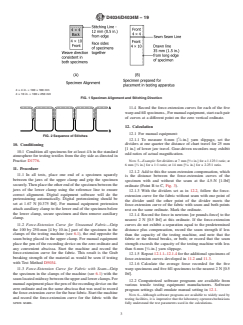
yarn in both pieces should run lengthwise. (See Fig. 1.)
The machine shall be equipped with an autographic recording
9.3 Stitch a seam across the short dimension of the
device or software and with clamps having front jaws 25 mm
specimens, placing the seam 12 mm [0.5 in.] from the edge of
[1 in.] in width with back jaws of 50 mm [2 in.] or more in
the specimen, using 7 6 0.5 stitches per 25 mm [1 in.] and a
width, except as otherwise provided (Note 2).The clamps shall
plain lockstitch.
be set 76 mm [3 in.] apart.The speed of the pulling clamp shall
9.3.1 The plain lockstitch used for the standard seam in this
be 5.0 6 0.2 mm/s [12.0 6 0.5 in./min].
test method shall conform to stitch Type 301 (Figure 11) in
NOTE 3—In comparing results with those from another laboratory, both
Practice D6193. This type of stitch shall be formed with two
laboratories should use the same type of tensile testing machine, or have
threads. A loop of one thread shall be passed through the
established the relationship between test results obtained using a CRT
material where it shall be entered by the mass supply of the
machine and those obtained using a CRE machine when testing fabrics of
other thread. The loop of the first thread then shall be drawn
the type being evaluated.
into the material to the extent that the concatenation is
6.1.1 Tensile Testing Machine (Other)—A tensile testing
approximately halfway between the two surfaces of the mate-
machine other than a CRT or CRE type that conforms to the
rial. These operations are repeated to form a sequence of
requirements of Specification D76/D76M and gives results that
stitches (see Fig. 2).
correlatewiththoseforCRTorCREtesters.Themachinemust
9.4 It is important that the stitches be made under uniform
be acceptable to both the purchaser and supplier if the results
tensionandthattheseambeperpendiculartothefillingorwarp
are to be used for acceptance testing of commercial shipments.
yarns.
6.2 Needle—Size 22 ball point needle.
9.5 Drawaline35mm[1.5in.]fromtheedgeparalleltothe
6.3 Sewing Thread—100 % nylon bonded monocord thread.
long direction to aid in the placement of the specimen in the
The needle thread shall be 513 denier [57 tex] and shall have
testing machine.
a minimum breaking strength of 35 N [8 lbf]. The bobbin
This sewing thread is commercially available.
4 6
This needle is commercially available. This cla
...