

ASTM D3597-02(2018)e1
(Specification)Standard Performance Specification for Woven Upholstery Fabrics—Plain, Tufted, or Flocked
General Information
- Abstract
ABSTRACT
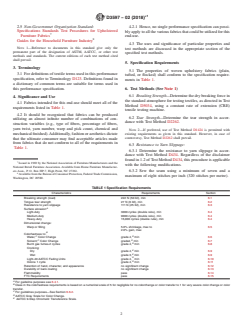
This performance specification covers the performance requirements for plain, tufted, or flocked woven upholstery fabrics as used in the manufacture of new indoor furniture. These requirements apply to both the warp and filling directions for those factors where each fabric direction is pertinent. Tests shall be made to determine the properties of the material in accordance with the following test methods: breaking strength; tear strength; resistance to yarn slippage; surface abrasion; dimensional change; colorfastness to water; colorfastness to solvent; colorfastness to burnt gas fumes; colorfastness to crocking; colorfastness to light; colorfastness to ozone; durability of back coating; flammability; and FTC requirements.
SIGNIFICANCE AND USE
4.1 Fabrics intended for this end-use should meet all of the requirements listed in Table 1. (A) For guideline purposes see 6.4.1.(B) Class in the colorfastness requirements is based on a numerical scale of 5 for negligible for no colorchange or color transfer to 1 for very severe color change or color transfer.(C) For guidelines purposes—See Section 6.6.2.(D) AATCC Gray Scale for Color Change.(E) AATCC 9-Step Chromatic Transference Scale.
4.2 It should be recognized that fabrics can be produced utilizing an almost infinite number of combinations of construction variables (e.g., type of fibers, percentage of fibers, yarn twist, yarn number, warp and pick count, chemical and mechanical finished). Additionally, fashion or aesthetics dictate that the ultimate consumer may find acceptable articles made from fabrics that do not conform to all of the requirements in Table 1.
4.2.1 Hence, no single performance specification can possibly apply to all the various fabrics that could be utilized for this end-use.
4.3 The uses and significance of particular properties and test methods are discussed in the appropriate section of the specified test methods.
SCOPE
1.1 This performance specification covers the performance requirements for plain, tufted, or flocked woven upholstery fabrics as used in the manufacture of new indoor furniture. These requirements apply to both the warp and filling directions for those factors where each fabric direction is pertinent.
1.2 This performance specification is not applicable to fabrics used in porch, deck, or lawn furniture; nor for knitted fabrics, bonded or laminated fabrics, or surface-coated fabrics (such as vinyls and urethanes).
1.3 The values stated in inch-pound units are to be regarded as standard. The values given in parentheses are mathematical conversions to SI units that are provided for information only and are not considered standard.
1.4 This standard does not purport to address all of the safety concerns, if any, associated with its use. It is the responsibility of the user of this standard to establish appropriate safety, health, and environmental practices and determine the applicability of regulatory limitations prior to use.
1.5 This international standard was developed in accordance with internationally recognized principles on standardization established in the Decision on Principles for the Development of International Standards, Guides and Recommendations issued by the World Trade Organization Technical Barriers to Trade (TBT) Committee.
- Status
- Published
- Publication Date
- 14-Dec-2018
- Technical Committee
- D13 - Textiles
- Drafting Committee
- D13.63 - Home Furnishings

Overview
ASTM D3597-02(2018)e1 is the internationally recognized standard performance specification for woven upholstery fabrics, including plain, tufted, or flocked types, as used in the manufacture of new indoor furniture. Developed by ASTM International, this standard specifies a comprehensive set of performance requirements that woven upholstery fabrics must meet to ensure their durability, aesthetic integrity, and safety in typical indoor environments. The focus is on fabrics in both warp and filling directions, as performance can vary based on fabric orientation within furniture applications.
This standard excludes fabrics used for outdoor furniture, knitted fabrics, bonded or laminated fabrics, and surface-coated fabrics such as vinyls and urethanes. It also emphasizes the importance of health, safety, and regulatory compliance in fabric selection and application.
Key Topics
ASTM D3597-02(2018)e1 provides a clear and consistent framework for evaluating the suitability of woven upholstery fabrics through a series of test methods and performance criteria, including:
- Breaking Strength: Ensuring the textile can withstand applied loads during use.
- Tear Strength: Resistance to tearing, essential for longevity.
- Yarn Slippage Resistance: Prevents seam separation and maintains fabric integrity.
- Surface Abrasion: Evaluates durability under repeated rubbing and classifies light, medium, and heavy duty accordingly.
- Dimensional Change: Measures shrinkage or gain after exposure to moisture or cleaning.
- Colorfastness: Assesses the fabric's ability to retain color after exposure to water, solvents, light, ozone, and burnt gas fumes. Also includes resistance to color transfer (crocking).
- Retention of Hand, Character, and Appearance: Ensures no unacceptable changes in feel or look after cleaning.
- Durability of Back Coating: Confirms backing materials remain intact and effective.
- Flammability: Must meet the requirements set by consumer safety regulations.
- FTC Requirements: Fabric must comply with labeling and advertising regulations regarding fiber content and performance claims.
Testing methods referenced within this standard include several ASTM and AATCC (American Association of Textile Chemists and Colorists) test procedures, providing a robust method for assessment of base textile performance.
Applications
This standard is invaluable throughout the indoor furniture manufacturing industry, particularly for:
- Furniture Manufacturers: Ensuring fabric selections meet expectations for longevity and aesthetics in sofas, chairs, and other upholstered furniture.
- Textile Producers: Providing design criteria and benchmarks during the development or marketing of woven fabrics for upholstery.
- Retailers and Specifiers: Informing buyers, specifiers, and architects on product claims, improving confidence and reducing post-purchase issues.
- Regulatory Compliance: Helping all stakeholders verify that products fulfill safety, health, and labeling requirements, particularly regarding flammability and fiber identification.
- Quality Assurance: Supporting consistent product performance and satisfaction through standardized test protocols.
By clearly defining performance criteria and testing methods, ASTM D3597-02(2018)e1 reduces risks of product failure and consumer complaints, making it a critical reference for purchasing, quality control, and specification.
Related Standards
Professionals using ASTM D3597-02(2018)e1 may also reference:
- ASTM D5034: Breaking Strength and Elongation of Textile Fabrics (Grab Test)
- ASTM D2262: Tearing Strength of Woven Fabrics by the Tongue Method
- ASTM D4157: Abrasion Resistance of Textile Fabrics (Oscillatory Cylinder Method)
- AATCC Test Method 8: Colorfastness to Crocking
- AATCC Test Method 16.3: Colorfastness to Light
- AATCC Test Method 23: Colorfastness to Burnt Gas Fumes
- 16 CFR Part 1610: Flammable Fabrics Act Regulation
These associated standards collectively underpin the robust technical evaluation and international acceptance of woven upholstery fabrics in the indoor furniture sector.
Relations
- Effective Date
- 15-Dec-2018
- Effective Date
- 01-Mar-2017
- Effective Date
- 15-Sep-2015
- Effective Date
- 01-Sep-2015
- Effective Date
- 01-Apr-2015
- Effective Date
- 01-Jul-2013
- Effective Date
- 01-Jul-2013
- Effective Date
- 01-Jul-2013
- Effective Date
- 15-Jun-2013
- Effective Date
- 15-Jun-2013
- Effective Date
- 15-May-2013
- Effective Date
- 01-Feb-2012
- Effective Date
- 01-Feb-2012
- Effective Date
- 01-Jun-2010
- Effective Date
- 15-Jan-2009
Get Certified
Connect with accredited certification bodies for this standard

Control Union Certifications
Global certification for agriculture and sustainability.

Hohenstein Institut
Textile testing and certification.

Bureau Veritas Bangladesh
Bureau Veritas certification services in Bangladesh.
Sponsored listings
Frequently Asked Questions
ASTM D3597-02(2018)e1 is a technical specification published by ASTM International. Its full title is "Standard Performance Specification for Woven Upholstery Fabrics—Plain, Tufted, or Flocked". This standard covers: ABSTRACT This performance specification covers the performance requirements for plain, tufted, or flocked woven upholstery fabrics as used in the manufacture of new indoor furniture. These requirements apply to both the warp and filling directions for those factors where each fabric direction is pertinent. Tests shall be made to determine the properties of the material in accordance with the following test methods: breaking strength; tear strength; resistance to yarn slippage; surface abrasion; dimensional change; colorfastness to water; colorfastness to solvent; colorfastness to burnt gas fumes; colorfastness to crocking; colorfastness to light; colorfastness to ozone; durability of back coating; flammability; and FTC requirements. SIGNIFICANCE AND USE 4.1 Fabrics intended for this end-use should meet all of the requirements listed in Table 1. (A) For guideline purposes see 6.4.1.(B) Class in the colorfastness requirements is based on a numerical scale of 5 for negligible for no colorchange or color transfer to 1 for very severe color change or color transfer.(C) For guidelines purposes—See Section 6.6.2.(D) AATCC Gray Scale for Color Change.(E) AATCC 9-Step Chromatic Transference Scale. 4.2 It should be recognized that fabrics can be produced utilizing an almost infinite number of combinations of construction variables (e.g., type of fibers, percentage of fibers, yarn twist, yarn number, warp and pick count, chemical and mechanical finished). Additionally, fashion or aesthetics dictate that the ultimate consumer may find acceptable articles made from fabrics that do not conform to all of the requirements in Table 1. 4.2.1 Hence, no single performance specification can possibly apply to all the various fabrics that could be utilized for this end-use. 4.3 The uses and significance of particular properties and test methods are discussed in the appropriate section of the specified test methods. SCOPE 1.1 This performance specification covers the performance requirements for plain, tufted, or flocked woven upholstery fabrics as used in the manufacture of new indoor furniture. These requirements apply to both the warp and filling directions for those factors where each fabric direction is pertinent. 1.2 This performance specification is not applicable to fabrics used in porch, deck, or lawn furniture; nor for knitted fabrics, bonded or laminated fabrics, or surface-coated fabrics (such as vinyls and urethanes). 1.3 The values stated in inch-pound units are to be regarded as standard. The values given in parentheses are mathematical conversions to SI units that are provided for information only and are not considered standard. 1.4 This standard does not purport to address all of the safety concerns, if any, associated with its use. It is the responsibility of the user of this standard to establish appropriate safety, health, and environmental practices and determine the applicability of regulatory limitations prior to use. 1.5 This international standard was developed in accordance with internationally recognized principles on standardization established in the Decision on Principles for the Development of International Standards, Guides and Recommendations issued by the World Trade Organization Technical Barriers to Trade (TBT) Committee.
ABSTRACT This performance specification covers the performance requirements for plain, tufted, or flocked woven upholstery fabrics as used in the manufacture of new indoor furniture. These requirements apply to both the warp and filling directions for those factors where each fabric direction is pertinent. Tests shall be made to determine the properties of the material in accordance with the following test methods: breaking strength; tear strength; resistance to yarn slippage; surface abrasion; dimensional change; colorfastness to water; colorfastness to solvent; colorfastness to burnt gas fumes; colorfastness to crocking; colorfastness to light; colorfastness to ozone; durability of back coating; flammability; and FTC requirements. SIGNIFICANCE AND USE 4.1 Fabrics intended for this end-use should meet all of the requirements listed in Table 1. (A) For guideline purposes see 6.4.1.(B) Class in the colorfastness requirements is based on a numerical scale of 5 for negligible for no colorchange or color transfer to 1 for very severe color change or color transfer.(C) For guidelines purposes—See Section 6.6.2.(D) AATCC Gray Scale for Color Change.(E) AATCC 9-Step Chromatic Transference Scale. 4.2 It should be recognized that fabrics can be produced utilizing an almost infinite number of combinations of construction variables (e.g., type of fibers, percentage of fibers, yarn twist, yarn number, warp and pick count, chemical and mechanical finished). Additionally, fashion or aesthetics dictate that the ultimate consumer may find acceptable articles made from fabrics that do not conform to all of the requirements in Table 1. 4.2.1 Hence, no single performance specification can possibly apply to all the various fabrics that could be utilized for this end-use. 4.3 The uses and significance of particular properties and test methods are discussed in the appropriate section of the specified test methods. SCOPE 1.1 This performance specification covers the performance requirements for plain, tufted, or flocked woven upholstery fabrics as used in the manufacture of new indoor furniture. These requirements apply to both the warp and filling directions for those factors where each fabric direction is pertinent. 1.2 This performance specification is not applicable to fabrics used in porch, deck, or lawn furniture; nor for knitted fabrics, bonded or laminated fabrics, or surface-coated fabrics (such as vinyls and urethanes). 1.3 The values stated in inch-pound units are to be regarded as standard. The values given in parentheses are mathematical conversions to SI units that are provided for information only and are not considered standard. 1.4 This standard does not purport to address all of the safety concerns, if any, associated with its use. It is the responsibility of the user of this standard to establish appropriate safety, health, and environmental practices and determine the applicability of regulatory limitations prior to use. 1.5 This international standard was developed in accordance with internationally recognized principles on standardization established in the Decision on Principles for the Development of International Standards, Guides and Recommendations issued by the World Trade Organization Technical Barriers to Trade (TBT) Committee.
ASTM D3597-02(2018)e1 is classified under the following ICS (International Classification for Standards) categories: 59.080.30 - Textile fabrics; 97.140 - Furniture. The ICS classification helps identify the subject area and facilitates finding related standards.
ASTM D3597-02(2018)e1 has the following relationships with other standards: It is inter standard links to ASTM D3597-02(2013), ASTM D123-17, ASTM D123-15b, ASTM D123-15a, ASTM D123-15, ASTM D4157-13, ASTM D1424-09(2013), ASTM D1424-09(2013)e1, ASTM D123-13a, ASTM D123-13ae1, ASTM D123-13, ASTM D123-12, ASTM D123-12e1, ASTM D4157-10, ASTM D123-09. Understanding these relationships helps ensure you are using the most current and applicable version of the standard.
ASTM D3597-02(2018)e1 is available in PDF format for immediate download after purchase. The document can be added to your cart and obtained through the secure checkout process. Digital delivery ensures instant access to the complete standard document.
Standards Content (Sample)
This international standard was developed in accordance with internationally recognized principles on standardization established in the Decision on Principles for the
Development of International Standards, Guides and Recommendations issued by the World Trade Organization Technical Barriers to Trade (TBT) Committee.
´1
Designation:D3597 −02 (Reapproved 2018)
Standard Performance Specification for
Woven Upholstery Fabrics—Plain, Tufted, or Flocked
This standard is issued under the fixed designation D3597; the number immediately following the designation indicates the year of
original adoption or, in the case of revision, the year of last revision. A number in parentheses indicates the year of last reapproval. A
superscript epsilon (´) indicates an editorial change since the last revision or reapproval.
ε NOTE—Editorial changes were made throughout in December 2018.
1. Scope D434 Test Method for Resistance to Slippage of Yarns in
Woven Fabrics Using a Standard Seam (Withdrawn
1.1 This performance specification covers the performance
2003)
requirements for plain, tufted, or flocked woven upholstery
D1424 Test Method for Tearing Strength of Fabrics by
fabrics as used in the manufacture of new indoor furniture.
Falling-Pendulum (Elmendorf-Type) Apparatus
These requirements apply to both the warp and filling direc-
D2262 Test Method for Tearing Strength of Woven Fabrics
tions for those factors where each fabric direction is pertinent.
by the Tongue (Single Rip) Method (Constant-Rate-of-
1.2 This performance specification is not applicable to
Traverse Tensile Testing Machine) (Withdrawn 1995)
fabrics used in porch, deck, or lawn furniture; nor for knitted
D4157 Test Method for Abrasion Resistance of Textile
fabrics, bonded or laminated fabrics, or surface-coated fabrics
Fabrics (Oscillatory Cylinder Method)
(such as vinyls and urethanes).
D5034 TestMethodforBreakingStrengthandElongationof
Textile Fabrics (Grab Test)
1.3 The values stated in inch-pound units are to be regarded
as standard. The values given in parentheses are mathematical 2.2 AATCC Test Methods:
Test Method 8 AATCC Colorfastness to Crocking:
conversions to SI units that are provided for information only
and are not considered standard. Crockmeter Method
Test Method 16.3 Colorfastness to Light: Xenon Arc
1.4 This standard does not purport to address all of the
Test Method 23 Colorfastness to Burnt Gas Fumes
safety concerns, if any, associated with its use. It is the
Test Method 107 Colorfastness to Water
responsibility of the user of this standard to establish appro-
Test Method 116 Colorfastness to Crocking: Rotary Vertical
priate safety, health, and environmental practices and deter-
Crockmeter Method
mine the applicability of regulatory limitations prior to use.
Test Method 129 Colorfastness to Ozone in theAtmosphere
1.5 This international standard was developed in accor-
Under High Humidities
dance with internationally recognized principles on standard-
Evaluation Procedure 1 Gray Scale for Color Change
ization established in the Decision on Principles for the
Evaluation Procedure 8 AATCC 9-Step Chromatic Transfer-
Development of International Standards, Guides and Recom-
ence Scale
mendations issued by the World Trade Organization Technical
2.3 Federal Standard:
Barriers to Trade (TBT) Committee.
16CFR, Chapter II-Consumer Product Safety Commission,
2. Referenced Documents Subchapter D-Flammable Fabrics Act Regulation
2.4 Military Standard:
2.1 ASTM Standards:
ASQ/ANSI Z1.4 Sampling Procedures and Tables for In-
D123 Terminology Relating to Textiles
spection by Attributes
This performance specification is under the jurisdiction of ASTM Committee
D13 on Textilesand is the direct responsibility of Subcommittee D13.63 on Home The last approved version of this historical standard is referenced on
Furnishings. www.astm.org.
Current edition approved Dec. 15, 2018. Published January 2019. Originally AATCC Technical Manual, available from American Association of Textile
approved in 1977. Last previous edition approved in 2013 as D3597 – 02 (2013). Chemists and Colorists (AATCC), P.O. Box 12215, Research Triangle Park, NC
DOI: 10.1520/D3597-02R18E01. 27709, http://www.aatcc.org.
2 5
For referenced ASTM standards, visit the ASTM website, www.astm.org, or Available from Superintendent of Documents, U.S. Government Printing
contact ASTM Customer Service at service@astm.org. For Annual Book of ASTM Office, Washington, DC 20402.
Standards volume information, refer to the standard’s Document Summary page on AvailablefromStandardizationDocumentsOrderDesk,Bldg.4SectionD,700
the ASTM website. Robbins Ave., Philadelphia, PA 19111-5094, Attn: NPODS.
Copyright © ASTM International, 100 Barr Harbor Drive, PO Box C700, West Conshohocken, PA 19428-2959. United States
´1
D3597−02 (2018)
2.5 Non-Governmnet Organization Standard: 4.2.1 Hence, no single performance specification can possi-
Specifications Standards Test Procedures for Upholstered blyapplytoallthevariousfabricsthatcouldbeutilizedforthis
Furniture Fabrics
end-use.
Guides for the Household Furniture Industry
4.3 The uses and significance of particular properties and
NOTE 1—Reference to documents in this standard give only the
test methods are discussed in the appropriate section of the
permanent part of the designation of ASTM, AATCC, or other test
specified test methods.
methods and standards. The current editions of each test method cited
shall prevail.
5. Specification Requirements
3. Terminology
5.1 The properties of woven upholstery fabrics (plain,
3.1 For definitions of textile terms used in this performance
tufted, or flocked) shall conform to the specification require-
specification, refer to Terminology D123. Definitions found in
ments in Table 1.
a dictionary of common terms are suitable for terms used in
this performance specification. 6. Test Methods (See Note 1)
6.1 BreakingStrength—Determine the dry breaking force in
4. Significance and Use
the standard atmosphere for testing textiles, as directed in Test
4.1 Fabrics intended for this end-use should meet all of the
Method D5034, using a constant rate of extension (CRE)
requirements listed in Table 1.
tensile testing machine.
4.2 It should be recognized that fabrics can be produced
6.2 Tear Strength—Determine the tear strength in accor-
utilizing an almost infinite number of combinations of con-
dance with Test Method D2262.
struction variables (e.g., type of fibers, percentage of fibers,
yarn twist, yarn number, warp and pick count, chemical and
NOTE 2—If preferred, use of Test Method D1424 is permitted with
mechanicalfinished).Additionally,fashionoraestheticsdictate
existing requirements as given in this standard. However, in case of
controversy, Test Method D2262 shall prevail.
that the ultimate consumer may find acceptable articles made
from fabrics that do not conform to all of the requirements in
6.3 Resistance to Yarn Slippage:
Table 1.
6.3.1 Determine the resistance to yarn slippage in accor-
dance with Test Method D434. Regardless of the disclaimer
found in 1.2 ofTest Method D434, this procedure is applicable
Issued in 1969 by the NationalAssociation of Furniture Manufacturers and the
with the following modifications.
National Retail FurnitureAssociation.Available from Home Furniture Manufactur-
ers Assn., P. O. Box HP-7, High Point, NC 27261.
6.3.2 Sew the seam using a minimum of seven and a
AvailablefromtheBureauofConsumerProtection,FederalTradeCommission,
maximum of eight stitches per inch (320 stitches per metre).
Washington, DC 20580.
TABLE 1 Specification Requirements
Characteristics Requirements Section
Breaking strength (load) 222 N (50 lbf), min 6.1
Tongue tear strength 27 N (6 lbf), min 6.2
Resistance to yarn slippage 111 N (25 lbf), min 6.3
A
Surface abrasion
Light-duty 3000 cycles (double rubs), min 6.4
Medium-duty 9000 cycles (double rubs), min 6.4
Heavy-duty 15,000 cycles (double rubs), min 6.4
Dimensional change:
Warp or filling 5.0% shrinkage, max to 6.5
2.0% gain, max
B
Colorfastness to:
C D
Water, Color Change grade 4, min 6.6
C D
Solvent, Color Change grade4, min 6.7
D
Burnt gas fumes-2 cycles grade 4, min 6.8
Crocking:
E
Dry grade 4, min 6.9
E
Wet grade 3, min 6.9
D
Light-40 AATCC Fading Units grade 4, min 6.10
D
Ozone 1 cycle grade 4, min 6.11
Retention of hand, character, and appearance no significant change 6.12
Durability of back coating no significant change 6.13
Flammability pass 6.14
FTC Requirements pass 6.15
A
For guideline purposes see 6.4.1.
B
Class in the colorfastness requirements is based on a numerical scale of 5 for negligible for no colorchange or color transfer to 1 for very severe color change or color
transfer.
C
For guidelines purposes—See Section 6.6.2.
D
AATCC Gray Scale for Color Change.
E
AATCC 9-Step Chromatic Transference Scale.
´1
D3597−02 (2018)
6.3.3 Use a chrome or nickel plated needle, 0.063 in. (1.60 in the prevailing room atmosphere (approximately 24 h). Do
mm) in diameter. not extract or wring out the specimens prior to drying.
6.3.4 Use a No. 24-4 hard finish “Z” twist white cotton
6.5.2.4 After drying, mea
...