

ASTM D4887/D4887M-11(2021)e1
(Practice)Standard Practice for Preparation of Viscosity Blends for Hot Recycled Asphalt Materials
General Information
- Abstract
SIGNIFICANCE AND USE
4.1 A standard procedure for blend preparation is essential to ensure material quality, specification compliance, and procedural uniformity.
SCOPE
1.1 This practice covers the procedure for preparation of hot recycled bituminous blends for testing in the laboratory. The procedure involves an iterative trial blend process followed by the preparation of batch blends.
1.2 The batch blends can be used for extensive evaluation such as viscosity, penetration, ductility, aging properties (such as Rolling Thin Film Oven or Thin-Film Oven tests, or both (RTFO/TFO)), composition analysis, solubility analysis, and other user-selected tests.
1.3 This practice assumes that a representative reclaimed asphalt pavement (RAP) sample is extracted and the aged binder recovered using Test Methods D2172/D2172M and Test Method D1856 (this practice may be modified by using a rotary evaporator which is extensively evaluated in the minutes of the 18th Pacific Coast Conference on Asphalt Specifications2) or any other acceptable test method.
1.4 The values stated in either SI units or inch-pound units are to be regarded separately as standard. The values stated in each system may not be exact equivalents; therefore, each system shall be used independently of the other. Combining values from the two systems may result in nonconformance with the standard.
1.5 The text of this standard references notes and footnotes which provide explanatory material. These notes and footnotes (excluding those in tables and figures) shall not be considered as requirements of the standard.
1.6 This standard does not purport to address all of the safety concerns, if any, associated with its use. It is the responsibility of the user of this standard to establish appropriate safety, health, and environmental practices and determine the applicability of regulatory limitations prior to use.
1.7 This international standard was developed in accordance with internationally recognized principles on standardization established in the Decision on Principles for the Development of International Standards, Guides and Recommendations issued by the World Trade Organization Technical Barriers to Trade (TBT) Committee.
- Status
- Published
- Publication Date
- 14-Dec-2021
- Technical Committee
- D04 - Road and Paving Materials
- Drafting Committee
- D04.25 - Analysis of Asphalt Mixtures
Overview
ASTM D4887/D4887M-11(2021)e1 is a recognized international standard developed by ASTM International for the preparation of viscosity blends from hot recycled asphalt materials. This standard practice provides a systematic laboratory procedure essential for achieving material quality, specification compliance, and procedural uniformity in the blending process. By following this guidance, laboratories and professionals can prepare bituminous blends that are representative and reliable for further testing and evaluation.
Key Topics
- Standardized Blend Preparation: Outlines an iterative laboratory procedure involving trial and batch blends for hot recycled asphalt.
- Testing Applications: Prepared blends are suitable for viscosity, penetration, ductility, aging properties (such as RTFO and TFO tests), composition, solubility, and other user-defined analyses.
- Method Requirements: Assumes extraction and recovery of reclaimed asphalt binder from reclaimed asphalt pavement (RAP) using test methods like ASTM D2172/D2172M and ASTM D1856.
- Viscosity and Performance Grading: Use of blending charts to determine the proportions of recycling agents, rejuvenating agents, or paving-grade asphalt necessary to achieve target viscosities or performance grades.
- Measurement Units: Recognizes both SI and inch-pound units as separate standards, specifying each system should be used independently to ensure compliance.
- Safety and Compliance: Emphasizes the need for appropriate safety, health, and environmental procedures when applying the standard.
Applications
ASTM D4887/D4887M-11(2021)e1 is widely utilized in:
- Laboratory Evaluation of Recycled Asphalt: Enables consistent and repeatable preparation of hot recycled bituminous blends for in-depth testing.
- Quality Control in Asphalt Recycling: Ensures recycled asphalt materials meet specific viscosity and performance criteria before field application.
- Material Characterization: Facilitates the analysis of properties such as viscosity, aging resistance, penetration, ductility, and overall blend composition.
- Specification Compliance: Assists agencies, contractors, and labs in meeting project and regulatory specifications related to reclaimed asphalt materials and their performance.
- Research and Development: Supports academic and industry research focusing on improving asphalt recycling processes and optimizing binder blends.
Related Standards
In support of its procedures, ASTM D4887/D4887M references and complements several related standards:
- ASTM D2172/D2172M: Test Methods for Quantitative Extraction of Asphalt Binder from Asphalt Mixtures
- ASTM D1856: Test Method for Recovery of Asphalt from Solution by Abson Method
- ASTM D2171/D2171M: Test Method for Viscosity of Asphalts by Vacuum Capillary Viscometer
- ASTM D3381/D3381M: Specification for Viscosity-Graded Asphalt Binder for Pavement Construction
- ASTM D6373: Specification for Performance-Graded Asphalt Binder
- ASTM D6816: Practice for Determining Low-Temperature Performance Grade of Asphalt Binders (Withdrawn)
- ASTM D7175: Test Method for Determining Rheological Properties of Asphalt Binder Using a Dynamic Shear Rheometer
These standards provide essential methodologies for binder extraction, recovery, testing, and specification, ensuring the traceability and reliability of hot recycled asphalt blend assessments.
Keywords: asphalt viscosity, binder preparation, recycled asphalt, laboratory testing, material quality, viscosity blend, performance-graded binder, reclaimed asphalt pavement (RAP), pave-grade asphalt, ASTM standard.
Relations
- Effective Date
- 15-Dec-2023
- Effective Date
- 01-Apr-2017
- Effective Date
- 01-Apr-2017
- Effective Date
- 01-Jan-2015
- Effective Date
- 01-Jun-2013
- Effective Date
- 01-Jun-2013
- Effective Date
- 01-Dec-2012
- Effective Date
- 01-Jul-2011
- Effective Date
- 01-Feb-2011
- Refers
ASTM D2171/D2171M-10 - Standard Test Method for Viscosity of Asphalts by Vacuum Capillary Viscometer - Effective Date
- 01-Jun-2010
- Effective Date
- 01-Dec-2009
- Effective Date
- 01-Jul-2009
- Effective Date
- 15-Jul-2008
- Effective Date
- 01-Dec-2007
- Effective Date
- 01-Aug-2007
Get Certified
Connect with accredited certification bodies for this standard

DIBt (Deutsches Institut für Bautechnik)
German Institute for Building Technology.
DIN CERTCO
DIN Group product certification.
Zavod za gradbeništvo Slovenije (ZAG) - Inšpekcija
ZAG inspection body for construction products, structures, and materials.
Sponsored listings
Frequently Asked Questions
ASTM D4887/D4887M-11(2021)e1 is a standard published by ASTM International. Its full title is "Standard Practice for Preparation of Viscosity Blends for Hot Recycled Asphalt Materials". This standard covers: SIGNIFICANCE AND USE 4.1 A standard procedure for blend preparation is essential to ensure material quality, specification compliance, and procedural uniformity. SCOPE 1.1 This practice covers the procedure for preparation of hot recycled bituminous blends for testing in the laboratory. The procedure involves an iterative trial blend process followed by the preparation of batch blends. 1.2 The batch blends can be used for extensive evaluation such as viscosity, penetration, ductility, aging properties (such as Rolling Thin Film Oven or Thin-Film Oven tests, or both (RTFO/TFO)), composition analysis, solubility analysis, and other user-selected tests. 1.3 This practice assumes that a representative reclaimed asphalt pavement (RAP) sample is extracted and the aged binder recovered using Test Methods D2172/D2172M and Test Method D1856 (this practice may be modified by using a rotary evaporator which is extensively evaluated in the minutes of the 18th Pacific Coast Conference on Asphalt Specifications2) or any other acceptable test method. 1.4 The values stated in either SI units or inch-pound units are to be regarded separately as standard. The values stated in each system may not be exact equivalents; therefore, each system shall be used independently of the other. Combining values from the two systems may result in nonconformance with the standard. 1.5 The text of this standard references notes and footnotes which provide explanatory material. These notes and footnotes (excluding those in tables and figures) shall not be considered as requirements of the standard. 1.6 This standard does not purport to address all of the safety concerns, if any, associated with its use. It is the responsibility of the user of this standard to establish appropriate safety, health, and environmental practices and determine the applicability of regulatory limitations prior to use. 1.7 This international standard was developed in accordance with internationally recognized principles on standardization established in the Decision on Principles for the Development of International Standards, Guides and Recommendations issued by the World Trade Organization Technical Barriers to Trade (TBT) Committee.
SIGNIFICANCE AND USE 4.1 A standard procedure for blend preparation is essential to ensure material quality, specification compliance, and procedural uniformity. SCOPE 1.1 This practice covers the procedure for preparation of hot recycled bituminous blends for testing in the laboratory. The procedure involves an iterative trial blend process followed by the preparation of batch blends. 1.2 The batch blends can be used for extensive evaluation such as viscosity, penetration, ductility, aging properties (such as Rolling Thin Film Oven or Thin-Film Oven tests, or both (RTFO/TFO)), composition analysis, solubility analysis, and other user-selected tests. 1.3 This practice assumes that a representative reclaimed asphalt pavement (RAP) sample is extracted and the aged binder recovered using Test Methods D2172/D2172M and Test Method D1856 (this practice may be modified by using a rotary evaporator which is extensively evaluated in the minutes of the 18th Pacific Coast Conference on Asphalt Specifications2) or any other acceptable test method. 1.4 The values stated in either SI units or inch-pound units are to be regarded separately as standard. The values stated in each system may not be exact equivalents; therefore, each system shall be used independently of the other. Combining values from the two systems may result in nonconformance with the standard. 1.5 The text of this standard references notes and footnotes which provide explanatory material. These notes and footnotes (excluding those in tables and figures) shall not be considered as requirements of the standard. 1.6 This standard does not purport to address all of the safety concerns, if any, associated with its use. It is the responsibility of the user of this standard to establish appropriate safety, health, and environmental practices and determine the applicability of regulatory limitations prior to use. 1.7 This international standard was developed in accordance with internationally recognized principles on standardization established in the Decision on Principles for the Development of International Standards, Guides and Recommendations issued by the World Trade Organization Technical Barriers to Trade (TBT) Committee.
ASTM D4887/D4887M-11(2021)e1 is classified under the following ICS (International Classification for Standards) categories: 91.100.50 - Binders. Sealing materials; 93.080.20 - Road construction materials. The ICS classification helps identify the subject area and facilitates finding related standards.
ASTM D4887/D4887M-11(2021)e1 has the following relationships with other standards: It is inter standard links to ASTM D7175-23, ASTM D2172/D2172M-17e1, ASTM D2172/D2172M-17, ASTM D6373-15, ASTM D3381/D3381M-13, ASTM D6373-13, ASTM D3381/D3381M-12, ASTM D6816-11, ASTM D2172/D2172M-11, ASTM D2171/D2171M-10, ASTM D3381/D3381M-09a, ASTM D1856-09, ASTM D7175-08, ASTM D7175-07, ASTM D6373-07e1. Understanding these relationships helps ensure you are using the most current and applicable version of the standard.
ASTM D4887/D4887M-11(2021)e1 is available in PDF format for immediate download after purchase. The document can be added to your cart and obtained through the secure checkout process. Digital delivery ensures instant access to the complete standard document.
Standards Content (Sample)
This international standard was developed in accordance with internationally recognized principles on standardization established in the Decision on Principles for the
Development of International Standards, Guides and Recommendations issued by the World Trade Organization Technical Barriers to Trade (TBT) Committee.
´1
Designation: D4887/D4887M − 11 (Reapproved 2021)
Standard Practice for
Preparation of Viscosity Blends for Hot Recycled Asphalt
Materials
This standard is issued under the fixed designation D4887/D4887M; the number immediately following the designation indicates the
year of original adoption or, in the case of revision, the year of last revision. A number in parentheses indicates the year of last
reapproval. A superscript epsilon (´) indicates an editorial change since the last revision or reapproval.
ε NOTE—Section 1 was updated editorially in December 2021.
1. Scope priate safety, health, and environmental practices and deter-
mine the applicability of regulatory limitations prior to use.
1.1 Thispracticecoverstheprocedureforpreparationofhot
1.7 This international standard was developed in accor-
recycled bituminous blends for testing in the laboratory. The
dance with internationally recognized principles on standard-
procedure involves an iterative trial blend process followed by
ization established in the Decision on Principles for the
the preparation of batch blends.
Development of International Standards, Guides and Recom-
1.2 The batch blends can be used for extensive evaluation
mendations issued by the World Trade Organization Technical
such as viscosity, penetration, ductility, aging properties (such
Barriers to Trade (TBT) Committee.
as Rolling Thin Film Oven or Thin-Film Oven tests, or both
(RTFO/TFO)), composition analysis, solubility analysis, and
2. Referenced Documents
other user-selected tests.
2.1 ASTM Standards:
1.3 This practice assumes that a representative reclaimed
D1856Test Method for Recovery of Asphalt from Solution
asphalt pavement (RAP) sample is extracted and the aged by Abson Method
binderrecoveredusingTestMethodsD2172/D2172MandTest
D2171/D2171MTest Method for Viscosity of Asphalts by
MethodD1856(thispracticemaybemodifiedbyusingarotary Vacuum Capillary Viscometer
evaporatorwhichisextensivelyevaluatedintheminutesofthe D2172/D2172MTestMethodsforQuantitativeExtractionof
18th Pacific Coast Conference on Asphalt Specifications)or Asphalt Binder from Asphalt Mixtures
any other acceptable test method. D3381/D3381MSpecification for Viscosity-Graded Asphalt
Binder for Use in Pavement Construction
1.4 The values stated in either SI units or inch-pound units
D6373 Specification for Performance-Graded Asphalt
are to be regarded separately as standard. The values stated in
Binder
each system may not be exact equivalents; therefore, each
D6816Practice for Determining Low-Temperature Perfor-
system shall be used independently of the other. Combining
manceGrade(PG)ofAsphaltBinders(Withdrawn2021)
values from the two systems may result in nonconformance
D7175Test Method for Determining the Rheological Prop-
with the standard.
erties of Asphalt Binder Using a Dynamic Shear Rheom-
1.5 The text of this standard references notes and footnotes
eter
which provide explanatory material.These notes and footnotes
(excluding those in tables and figures) shall not be considered
3. Summary of Practice
as requirements of the standard.
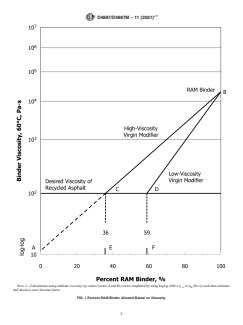
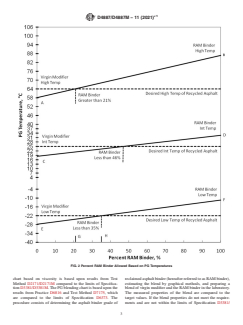
3.1 This specification covers the use of a viscosity blending
1.6 This standard does not purport to address all of the
chart shown in Fig. 1 or by a Performance Grade (PG)
safety concerns, if any, associated with its use. It is the
temperature blending chart shown in Fig. 2 to determine the
responsibility of the user of this standard to establish appro-
percentage of a recycling agent, rejuvenating agent, or paving-
gradeasphalt(hereafterreferredtoasvirginmodifier)required
to meet the target viscosity or PG temperature. The blending
This practice is under the jurisdiction of ASTM Committee D04 on Road and
Paving Materials and is the direct responsibility of Subcommittee D04.25 on
Analysis of Asphalt Mixtures. For referenced ASTM standards, visit the ASTM website, www.astm.org, or
Current edition approved Dec. 15, 2021. Published December 2021. Originally contact ASTM Customer Service at service@astm.org. For Annual Book of ASTM
approved in 1989. Last previous edition approved in 2016 as D4887/D4887M–11 Standards volume information, refer to the standard’s Document Summary page on
(2016). DOI: 10.1520/D4887_D4887M-11R21E01. the ASTM website.
2 4
Asphalt Recovery Subcommittee Report, San Francisco, CA, May 17–18, The last approved version of this historical standard is referenced on
1983. www.astm.org.
Copyright © ASTM International, 100 Barr Harbor Drive, PO Box C700, West Conshohocken, PA 19428-2959. United States
´1
D4887/D4887M − 11 (2021)
NOTE1—Calculationsusingordinateviscosity(η)values(scalesAandB)canbesimplifiedbyusingloglog(100× η orη (Pa·s))suchthatordinates
–A B
and abscisca axes become linear.
FIG. 1 Percent RAM Binder Allowed Based on Viscosity
´1
D4887/D4887M − 11 (2021)
FIG. 2 Percent RAM Binder Allowed Based on PG Temperatures
chart based on viscosity is based upon results from Test reclaimedasphaltbinder(hereafterreferredtoasRAMbinder),
Method D2171/D2171M compared to the limits of Specifica- estimating the blend by graphical methods, and preparing a
tionD3381/D3381M.ThePGblendingchartisbaseduponthe blend of virgin modifier and the RAM binder in the laboratory.
results from Practice D6816 and Test Method D7175, which The measured properties of the blend are compared to the
are compared to the limits of Specification D6373. The target values. If the blend properties do not meet the require-
procedure consists of determining the asphalt binder grade of ments and are not within the limits of Specification D3381/
´1
D4887/D4887M − 11 (2021)
D3381M or D6373, another trial blend is prepared using 5.3 Glass stirring rod.
adjusted proportions of the same or an alternate virgin
6. Procedure
modifier, or both, and the RAM binder. A batch blend larger
than the trial blend can then be prepared after the target
6.1 Weigh the RAP binder and recycling agent or paving-
viscosity is achieved to facilitate additional tests.
gradeasphaltinappropriateproportionsinaccordancewith3.1
in a 10.0 6 0.1-g specimen or larger for a trial blend. Prepare
NOTE 1—It is recognized that Test Method D2171/D2171M requires
...