

ASTM D228/D228M-21
(Test Method)Standard Test Methods for Sampling, Testing, and Analysis of Asphalt Roll Roofing, Cap Sheets, and Shingles Used in Roofing and Waterproofing
General Information
- Abstract
SIGNIFICANCE AND USE
4.1 These test methods include procedures for sampling, examination, physical testing, and analyses of asphalt roll roofing, cap sheets, and shingles used in roofing and waterproofing. Other components of these materials are allowed to include, but are not limited to: felts, mats, films, foils, mineral stabilizers, papers, and mineral surfacing.
4.2 These test methods include tests that are not required by every product standard that references Test Methods D228/D228M. The individual product standards are the authority for which tests are required for compliance. It is not prohibited to run tests in addition to those required in the product standards, but these test methods make no claim to their suitability or significance.
4.3 A minimum of five random samples are required from lots equal to or less than 1000 packages. See Section 7 for sampling details.
4.4 The results of a visual examination, physical testing, and compositional analysis are required for each sample. The analytical data are further used to compute the probable minimum and the probable range for the average mass of each of the components.
SCOPE
1.1 These test methods cover procedures for sampling, examination, physical testing, and analyses of asphalt-containing materials used in roofing and waterproofing. These materials include but are not limited to roll roofing, cap sheets, and shingles. Any of these materials is allowed to be partially or fully coated, surfaced, or laminated, or a combination thereof.
1.2 The test methods and procedures in this standard appear in the following order:
Section
Content
6
Types of Roofing
7
Sampling
8
Mass and Area Determination
9
Selection of Representative Specimens
10
Moisture
11
Pliability
12
Mass Loss and Behavior on Heating
13
Tear Strength
14
Fastener Pull-Through Resistance
15
Preparation and Selection of Small Test Specimens
for Analyses
16
Analysis of Glass Felt Products
17
Analysis of Roofing Products with Organic Felts
18
Ash of Desaturated Felt
19
Calculation
20
Adjusting Back Coating Fine Mineral Matter and
Back Surfacing
21
Report
22
Precision and Bias
1.3 The values stated in either SI units or inch-pound units are to be regarded separately as standard. The values stated in each system may not be exact equivalents; therefore, each system shall be used independently of the other. Combining values from the two systems may result in nonconformance with the standard.
1.4 This standard does not purport to address all of the safety concerns, if any, associated with its use. It is the responsibility of the user of this standard to establish appropriate safety, health, and environmental practices and determine the applicability of regulatory limitations prior to use.
1.5 This international standard was developed in accordance with internationally recognized principles on standardization established in the Decision on Principles for the Development of International Standards, Guides and Recommendations issued by the World Trade Organization Technical Barriers to Trade (TBT) Committee.
- Status
- Published
- Publication Date
- 14-Feb-2021
- Technical Committee
- D08 - Roofing and Waterproofing
- Drafting Committee
- D08.02 - Steep Roofing Products and Assemblies
Buy Documents
ASTM D228/D228M-21 - Standard Test Methods for Sampling, Testing, and Analysis of Asphalt Roll Roofing, Cap Sheets, and Shingles Used in Roofing and Waterproofing
REDLINE ASTM D228/D228M-21 - Standard Test Methods for Sampling, Testing, and Analysis of Asphalt Roll Roofing, Cap Sheets, and Shingles Used in Roofing and Waterproofing
Overview
ASTM D228/D228M-21: Standard Test Methods for Sampling, Testing, and Analysis of Asphalt Roll Roofing, Cap Sheets, and Shingles Used in Roofing and Waterproofing provides comprehensive procedures for the evaluation of bituminous roofing products. This standard, established by ASTM International, is widely used for quality assessment in roofing and waterproofing applications, ensuring the reliability and performance of asphalt-containing materials such as roll roofing, cap sheets, and shingles.
The methods outlined in ASTM D228/D228M-21 facilitate consistency and accuracy in the selection, physical testing, and analysis of roofing products. These procedures are recognized around the world and support industry compliance with national and international product standards.
Key Topics
ASTM D228/D228M-21 covers a broad range of critical aspects in the examination of asphalt roofing materials:
- Sampling: Procedures for random selection of representative material samples from production or shipment lots.
- Physical Testing: Methods for measuring mass, area, moisture content, pliability, mass loss upon heating, tear strength, and fastener pull-through resistance.
- Compositional Analysis: Steps to identify and quantify components such as felts, mats, mineral stabilizers, and surfacing materials.
- Material Types: Classification and evaluation of uniform, nonuniform, and multi-layer roofing product structures.
- Reporting and Calculations: Guidance for documenting test results, calculating averages, minimum values, and confidence intervals for product properties.
Testing includes five or more random samples per lot, detailed visual and physical inspections, and standardized calculations for reliable results. The standard requires use of either SI or inch-pound units consistently, avoiding combination of measurement systems.
Applications
ASTM D228/D228M-21 is applicable throughout the lifecycle of asphalt roofing and waterproofing materials, supporting multiple stakeholders:
- Manufacturers use these test methods for product development, process control, and verification of compliance with other ASTM product standards.
- Quality Assurance Laboratories rely on these procedures to assess batch consistency and determine physical and compositional properties.
- Roofing Contractors and Installers refer to these methods to confirm the suitability and integrity of materials for specific projects.
- Regulatory Bodies may reference this standard in codes and approvals to ensure materials meet defined safety and performance criteria.
The standard is especially valuable for testing products that are partially or fully coated, surfaced, laminated, or include additional components like felts, mats, films, foils, or mineral stabilizers. It accommodates the diversity found in modern asphalt-based roofing systems.
Related Standards
ASTM D228/D228M-21 is part of the broader suite of ASTM standards that specify test methods and requirements for roofing and waterproofing materials. Key related standards include:
- ASTM D95: Water in Petroleum Products and Bituminous Materials by Distillation.
- ASTM D146/D146M: Sampling and Testing Bitumen-Saturated Felts and Woven Fabrics.
- ASTM D1922: Propagation Tear Resistance of Plastic Film and Thin Sheeting.
- ASTM D3462/D3462M: Asphalt Shingles Made from Glass Felt and Surfaced with Mineral Granules.
- ASTM D3909/D3909M: Asphalt Roll Roofing (Glass Felt) Surfaced With Mineral Granules.
- ASTM D4601/D4601M: Asphalt-Coated Glass Fiber Base Sheet.
- ASTM D4932/D4932M: Fastener Rupture and Tear Resistance.
- ASTM D1079: Terminology Relating to Roofing and Waterproofing.
Together, these standards deliver a complete foundation for ensuring the performance, safety, and durability of asphalt roofing systems. ASTM D228/D228M-21 is internationally recognized and aligned with global trade and testing principles, supporting compliance for manufacturers and users worldwide.
Relations
- Effective Date
- 01-Oct-2023
- Effective Date
- 01-May-2020
- Effective Date
- 01-May-2020
- Effective Date
- 01-May-2020
- Effective Date
- 01-May-2019
- Effective Date
- 15-Dec-2018
- Effective Date
- 15-Dec-2018
- Effective Date
- 01-Sep-2018
- Effective Date
- 01-Mar-2017
- Effective Date
- 01-May-2016
- Effective Date
- 01-Feb-2016
- Effective Date
- 01-Sep-2015
- Effective Date
- 01-May-2015
- Effective Date
- 01-Nov-2014
- Effective Date
- 15-Dec-2013
Buy Documents
ASTM D228/D228M-21 - Standard Test Methods for Sampling, Testing, and Analysis of Asphalt Roll Roofing, Cap Sheets, and Shingles Used in Roofing and Waterproofing
REDLINE ASTM D228/D228M-21 - Standard Test Methods for Sampling, Testing, and Analysis of Asphalt Roll Roofing, Cap Sheets, and Shingles Used in Roofing and Waterproofing
Get Certified
Connect with accredited certification bodies for this standard

DIBt (Deutsches Institut für Bautechnik)
German Institute for Building Technology.
DIN CERTCO
DIN Group product certification.

Aboma Certification B.V.
Specialized in construction, metal, and transport sectors.
Sponsored listings
Frequently Asked Questions
ASTM D228/D228M-21 is a standard published by ASTM International. Its full title is "Standard Test Methods for Sampling, Testing, and Analysis of Asphalt Roll Roofing, Cap Sheets, and Shingles Used in Roofing and Waterproofing". This standard covers: SIGNIFICANCE AND USE 4.1 These test methods include procedures for sampling, examination, physical testing, and analyses of asphalt roll roofing, cap sheets, and shingles used in roofing and waterproofing. Other components of these materials are allowed to include, but are not limited to: felts, mats, films, foils, mineral stabilizers, papers, and mineral surfacing. 4.2 These test methods include tests that are not required by every product standard that references Test Methods D228/D228M. The individual product standards are the authority for which tests are required for compliance. It is not prohibited to run tests in addition to those required in the product standards, but these test methods make no claim to their suitability or significance. 4.3 A minimum of five random samples are required from lots equal to or less than 1000 packages. See Section 7 for sampling details. 4.4 The results of a visual examination, physical testing, and compositional analysis are required for each sample. The analytical data are further used to compute the probable minimum and the probable range for the average mass of each of the components. SCOPE 1.1 These test methods cover procedures for sampling, examination, physical testing, and analyses of asphalt-containing materials used in roofing and waterproofing. These materials include but are not limited to roll roofing, cap sheets, and shingles. Any of these materials is allowed to be partially or fully coated, surfaced, or laminated, or a combination thereof. 1.2 The test methods and procedures in this standard appear in the following order: Section Content 6 Types of Roofing 7 Sampling 8 Mass and Area Determination 9 Selection of Representative Specimens 10 Moisture 11 Pliability 12 Mass Loss and Behavior on Heating 13 Tear Strength 14 Fastener Pull-Through Resistance 15 Preparation and Selection of Small Test Specimens for Analyses 16 Analysis of Glass Felt Products 17 Analysis of Roofing Products with Organic Felts 18 Ash of Desaturated Felt 19 Calculation 20 Adjusting Back Coating Fine Mineral Matter and Back Surfacing 21 Report 22 Precision and Bias 1.3 The values stated in either SI units or inch-pound units are to be regarded separately as standard. The values stated in each system may not be exact equivalents; therefore, each system shall be used independently of the other. Combining values from the two systems may result in nonconformance with the standard. 1.4 This standard does not purport to address all of the safety concerns, if any, associated with its use. It is the responsibility of the user of this standard to establish appropriate safety, health, and environmental practices and determine the applicability of regulatory limitations prior to use. 1.5 This international standard was developed in accordance with internationally recognized principles on standardization established in the Decision on Principles for the Development of International Standards, Guides and Recommendations issued by the World Trade Organization Technical Barriers to Trade (TBT) Committee.
SIGNIFICANCE AND USE 4.1 These test methods include procedures for sampling, examination, physical testing, and analyses of asphalt roll roofing, cap sheets, and shingles used in roofing and waterproofing. Other components of these materials are allowed to include, but are not limited to: felts, mats, films, foils, mineral stabilizers, papers, and mineral surfacing. 4.2 These test methods include tests that are not required by every product standard that references Test Methods D228/D228M. The individual product standards are the authority for which tests are required for compliance. It is not prohibited to run tests in addition to those required in the product standards, but these test methods make no claim to their suitability or significance. 4.3 A minimum of five random samples are required from lots equal to or less than 1000 packages. See Section 7 for sampling details. 4.4 The results of a visual examination, physical testing, and compositional analysis are required for each sample. The analytical data are further used to compute the probable minimum and the probable range for the average mass of each of the components. SCOPE 1.1 These test methods cover procedures for sampling, examination, physical testing, and analyses of asphalt-containing materials used in roofing and waterproofing. These materials include but are not limited to roll roofing, cap sheets, and shingles. Any of these materials is allowed to be partially or fully coated, surfaced, or laminated, or a combination thereof. 1.2 The test methods and procedures in this standard appear in the following order: Section Content 6 Types of Roofing 7 Sampling 8 Mass and Area Determination 9 Selection of Representative Specimens 10 Moisture 11 Pliability 12 Mass Loss and Behavior on Heating 13 Tear Strength 14 Fastener Pull-Through Resistance 15 Preparation and Selection of Small Test Specimens for Analyses 16 Analysis of Glass Felt Products 17 Analysis of Roofing Products with Organic Felts 18 Ash of Desaturated Felt 19 Calculation 20 Adjusting Back Coating Fine Mineral Matter and Back Surfacing 21 Report 22 Precision and Bias 1.3 The values stated in either SI units or inch-pound units are to be regarded separately as standard. The values stated in each system may not be exact equivalents; therefore, each system shall be used independently of the other. Combining values from the two systems may result in nonconformance with the standard. 1.4 This standard does not purport to address all of the safety concerns, if any, associated with its use. It is the responsibility of the user of this standard to establish appropriate safety, health, and environmental practices and determine the applicability of regulatory limitations prior to use. 1.5 This international standard was developed in accordance with internationally recognized principles on standardization established in the Decision on Principles for the Development of International Standards, Guides and Recommendations issued by the World Trade Organization Technical Barriers to Trade (TBT) Committee.
ASTM D228/D228M-21 is classified under the following ICS (International Classification for Standards) categories: 91.100.60 - Thermal and sound insulating materials. The ICS classification helps identify the subject area and facilitates finding related standards.
ASTM D228/D228M-21 has the following relationships with other standards: It is inter standard links to ASTM D95-23, ASTM D1079-20, ASTM D2626/D2626M-04(2020), ASTM D4601/D4601M-04(2020), ASTM D4932/D4932M-89(2019), ASTM D1079-18e1, ASTM D1079-18, ASTM F1667-18, ASTM F1667-17, ASTM D3462/D3462M-16, ASTM D1079-16, ASTM F1667-15, ASTM D2178/D2178M-15, ASTM D2178/D2178M-14, ASTM D2178/D2178M-13a. Understanding these relationships helps ensure you are using the most current and applicable version of the standard.
ASTM D228/D228M-21 is available in PDF format for immediate download after purchase. The document can be added to your cart and obtained through the secure checkout process. Digital delivery ensures instant access to the complete standard document.
Standards Content (Sample)
This international standard was developed in accordance with internationally recognized principles on standardization established in the Decision on Principles for the
Development of International Standards, Guides and Recommendations issued by the World Trade Organization Technical Barriers to Trade (TBT) Committee.
Designation: D228/D228M −21
Standard Test Methods for
Sampling, Testing, and Analysis of Asphalt Roll Roofing,
Cap Sheets, and Shingles Used in Roofing and
Waterproofing
This standard is issued under the fixed designation D228/D228M; the number immediately following the designation indicates the year
of original adoption or, in the case of revision, the year of last revision.Anumber in parentheses indicates the year of last reapproval.
A superscript epsilon (´) indicates an editorial change since the last revision or reapproval.
1. Scope responsibility of the user of this standard to establish appro-
priate safety, health, and environmental practices and deter-
1.1 These test methods cover procedures for sampling,
mine the applicability of regulatory limitations prior to use.
examination, physical testing, and analyses of asphalt-
1.5 This international standard was developed in accor-
containing materials used in roofing and waterproofing. These
dance with internationally recognized principles on standard-
materials include but are not limited to roll roofing, cap sheets,
ization established in the Decision on Principles for the
and shingles. Any of these materials is allowed to be partially
Development of International Standards, Guides and Recom-
or fully coated, surfaced, or laminated, or a combination
mendations issued by the World Trade Organization Technical
thereof.
Barriers to Trade (TBT) Committee.
1.2 The test methods and procedures in this standard appear
in the following order:
2. Referenced Documents
Section Content
2.1 ASTM Standards:
6 Types of Roofing D95Test Method for Water in Petroleum Products and
7 Sampling
Bituminous Materials by Distillation
8 Mass and Area Determination
D146/D146M Test Methods for Sampling and Testing
9 Selection of Representative Specimens
10 Moisture Bitumen-Saturated Felts and Woven Fabrics for Roofing
11 Pliability
and Waterproofing
12 Mass Loss and Behavior on Heating
D225Specification forAsphalt Shingles (Organic Felt) Sur-
13 Tear Strength
14 Fastener Pull-Through Resistance faced With Mineral Granules (Withdrawn 2012)
15 Preparation and Selection of Small Test Specimens
D1079Terminology Relating to Roofing and Waterproofing
for Analyses
D1922Test Method for Propagation Tear Resistance of
16 Analysis of Glass Felt Products
17 Analysis of Roofing Products with Organic Felts
Plastic Film and Thin Sheeting by Pendulum Method
18 Ash of Desaturated Felt
D2178/D2178MSpecificationforAsphaltGlassFeltUsedin
19 Calculation
Roofing and Waterproofing
20 Adjusting Back Coating Fine Mineral Matter and
Back Surfacing D2626/D2626M Specification for Asphalt-Saturated and
21 Report
Coated Organic Felt Base Sheet Used in Roofing
22 Precision and Bias
D3462/D3462MSpecification for Asphalt Shingles Made
1.3 The values stated in either SI units or inch-pound units
from Glass Felt and Surfaced with Mineral Granules
are to be regarded separately as standard. The values stated in
D3909/D3909M Specification for Asphalt Roll Roofing
each system may not be exact equivalents; therefore, each
(Glass Felt) Surfaced With Mineral Granules
system shall be used independently of the other. Combining
D4601/D4601MSpecification for Asphalt-Coated Glass Fi-
values from the two systems may result in nonconformance
ber Base Sheet Used in Roofing
with the standard.
D4897/D4897M Specification for Asphalt-Coated Glass-
1.4 This standard does not purport to address all of the
Fiber Venting Base Sheet Used in Roofing
safety concerns, if any, associated with its use. It is the
1 2
These test methods are under the jurisdiction of ASTM Committee D08 on For referenced ASTM standards, visit the ASTM website, www.astm.org, or
Roofing and Waterproofing and are the direct responsibility of Subcommittee contact ASTM Customer Service at service@astm.org. For Annual Book of ASTM
D08.02 on Steep Roofing Products and Assemblies. Standards volume information, refer to the standard’s Document Summary page on
Current edition approved Feb. 15, 2021. Published February 2021. Originally the ASTM website.
approved in 1925. Last previous edition approved in 2019 as D228/D228M–19a. The last approved version of this historical standard is referenced on
DOI: 10.1520/D0228_D0228M-21. www.astm.org.
Copyright © ASTM International, 100 Barr Harbor Drive, PO Box C700, West Conshohocken, PA 19428-2959. United States
D228/D228M − 21
D4932/D4932MTest Method for Fastener Rupture and Tear material removed for appearance purposes (cutouts) but the
Resistance of Roofing and Waterproofing Sheets, Roll rest of the shingle is of uniform composition. See Fig. 1, Type
Roofing, and Shingles 1 or Type 2.
D6380/D6380MSpecification forAsphalt Roll Roofing (Or- 3.1.3 As referenced in 15.2, “Materials of Nonuniform
ganic Felt)
Composition” designates products that are intentionally manu-
F1667SpecificationforDrivenFasteners:Nails,Spikes,and facturedtohavedifferentthicknessormassperunitareawithin
Staples
different areas of the product. Examples of materials of
nonuniform composition are selvage edge rolls and overlaid or
3. Terminology
embossed shingles (where not all of the product has the same
thickness). See Fig. 1, Type 3.
3.1 Definitions:
3.1.1 Fordefinitionsoftermsusedinthesetestmethods,see 3.1.4 As referenced in 15.4, “Materials of Multiple Layer
Composition” designates products that are fabricated in mul-
Terminology D1079.
3.1.2 As referenced in 15.1, “Materials of Uniform Compo- tiple layers. See Fig. 1, Type 4.
sition” designates products that are manufactured to be the 3.1.5 As referenced in these test methods, “Machine Direc-
same thickness, ply count, and mass per unit area in all areas tion” (indicated as MD) is the direction running the long
ofthematerial.Thiswouldincludetraditionalmineralsurfaced dimension of a roll product (before samples or specimens are
rolls, “3 Tab” shingles, and other shingles that have areas of cut) or the long dimension of a shingle, unless otherwise
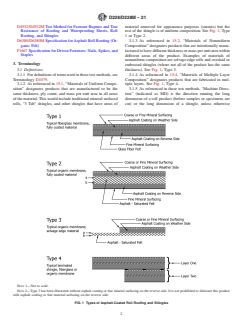
NOTE 1—Not to scale.
NOTE 2—Type 3 has been illustrated without asphalt coating or fine mineral surfacing on the reverse side. It is not prohibited to fabricate this product
with asphalt coating or fine material surfacing on the reverse side.
FIG. 1 Types of Asphalt-Coated Roll Roofing and Shingles
D228/D228M − 21
known and agreed to between supplier and purchaser. “Cross Fig. 1) shall be permitted to be any suitable material that
Direction” (indicated as CD) designates the direction perpen- preventstheseproductsfromstickingtogetherwhilepackaged.
dicular to the MD. 6.1.3 Type 3—Similar to Type 2, but asphalt-coated and
3.1.6 A production lot is defined as all material produced surfaced with mineral granules for part of one side of the
within one production shift of the same type, composition, and saturated felt such as in Specification D6380/D6380M, Class
color (where applicable). A delivery lot is defined as a WS.ThistypealsoincludesproductssimilartoType1orType
shipmentorfractionthereofrepresentingaproductofthesame 2 that have overlay or embossed areas. This does not include
type, composition, and color (where applicable). products that are fabricated in multiple layers.
6.1.4 Type 4—This material is comprised of multiple layers
4. Significance and Use
bonded with a suitable adhesive, typically a bituminous mate-
rial. Evaluation of the nature of the adhesive or quality of the
4.1 These test methods include procedures for sampling,
bond, or both, is outside the scope of this test method. Fig. 1
examination, physical testing, and analyses of asphalt roll
illustrates a typical configuration for Type 4. This “Type”
roofing, cap sheets, and shingles used in roofing and water-
description is provided to aid the user in understanding how to
proofing. Other components of these materials are allowed to
match a given product composition and assembly to its
include, but are not limited to: felts, mats, films, foils, mineral
corresponding Type. It is not intended to limit or exclude
stabilizers, papers, and mineral surfacing.
products with similar, but not identical constructions. Ex-
4.2 Thesetestmethodsincludeteststhatarenotrequiredby
amples of known variations, which shall not be prohibited
every product standard that references Test Methods D228/
include (but are not limited to):
D228M. The individual product standards are the authority for
6.1.4.1 Materials using other adhesives,
which tests are required for compliance. It is not prohibited to
6.1.4.2 Materials fabricated with more than two layers,
run tests in addition to those required in the product standards,
6.1.4.3 Materials that use different relative proportions for
but these test methods make no claim to their suitability or
the layers, and
significance.
6.1.4.4 Materials with other core compositions.
4.3 A minimum of five random samples are required from
7. Sampling
lots equal to or less than 1000 packages. See Section 7 for
7.1 The rolls or packages selected in accordance with this
sampling details.
section constitute the representative sample used in Sections 8
4.4 Theresultsofavisualexamination,physicaltesting,and
and 9.
compositional analysis are required for each sample. The
7.2 Select a minimum of five rolls or packages from the lot
analytical data are further used to compute the probable
at random. Do not select any material that shows visual
minimum and the probable range for the average mass of each
indications of damage from shipping or handling. Determine
of the components.
2 2
the average net mass in g/m [lb⁄100 ft ] and the standard
5. Materials
deviation in accordance with 8.1 – 8.8.
5.1 Filter Paper—The extractions for analysis of glass felt 7.3 If the lot is 1000 or fewer rolls or packages, proceed to
products (Section 16) and analysis of roofing products with
Section 8. If the lot is 1001 or greater in number, follow the
organic felt (Section 17) require the use of filter paper with a second part of the sampling plan in 7.4.
particle retention of 2.7 µm (see Note 1). This filter paper is
7.4 Calculate the required number of samples based on the
dried for 60 min 6 10% in an 80°C [176°F] oven and stored
standard deviation (s) of the preliminary sampling by:
until needed in a desiccator.
2 2
t s
n 5 (1)
NOTE 1—Whitman No. 50 filter paper [185 mm] has been found
d
satisfactory for this use.
where:
6. Types of Roofing
n = total number of samples required (n−5 more rolls or
packages must be selected at random as samples),
6.1 Asphalt-coatedrollroofingandshinglesaredividedinto
t = test statistic for number of samples in the preliminary
the following types for the purposes of these test methods (see
test series for 4° and a 95% confidence that the
Fig. 1).
calculated average mass will not exceed d (t=2.776),
6.1.1 Type 1—A single thickness of glass felt, coated with
and
asphalt and mineral surfacing such as in Specifications D2178/
2 2
d = 100 g/m [2 lb/100 ft ] (the mean mass obtained from
D2178M,D3462/D3462M,D3909/D3909M,D4601/D4601M,
the analysis should be within 6100 g/m of the true
and D4897/D4897M. The backing material (designated “Fine
value, with 95% confidence).
Mineral Surfacing” in Fig. 1) shall be permitted to be any
suitable material that prevents these products from sticking
7.5 See Fig. 2.
together while packaged.
8. As-Received Mass and Area Determinations, All Types
6.1.2 Type 2—A single thickness of asphalt-saturated felt
of Roofing
coated with asphalt and mineral surfacing such as in Specifi-
cationsD225,D2626/D2626M,andD6380/D6380M,ClassM. 8.1 Gross Mass—Determine and record the mass of each
The backing material (designated “Fine Mineral Surfacing” in representative sample to the nearest 0.1 kg [0.2 lb].
D228/D228M − 21
In Section 7, initial “Representative Samples” are selected (typically five per lot). These are full bundles or rolls. These are the samples used in Section 8.
In Section 9, one large “Specimen” is taken from each representative sample (full shingles from 8.5 or a portion of each roll selected in Section 7). These are confirmed
to be within 1.5 % of the mass per area (from 8.6) for the corresponding representative sample.
In Section 10 (where product standards require measurement of water content perTest Method D95), 50-g small test specimens are taken from each “Large Specimen”
for determination of water.
In Section 11, five MD and five CD small test specimens are cut from one of the “Large Specimens” for evaluation of pliability.
12, two small test specimens are cut from one of the “Large Specimens” for evaluation of behavior on heating.
In Section
In Section 15, small test specimens (three for glass felt, four for organic felt) are cut from each of the “Large Specimens” for analysis by Section 16 (for glass felt) or
by Section 17 (for organic felt).
FIG. 2 Sample Selection Summary and Flow Diagram
(see individual sections for sample selection details)
8.2 Net Mass—Disassemble each package or unroll each 2
X X
~ !
( (
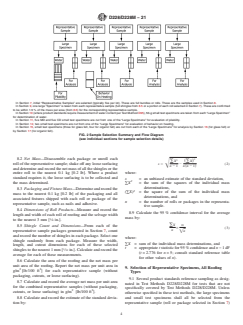
roll of the representative sample; shake off any loose surfacing s 5Π2 (2)
n 2 1 n n 2 1
~ !
anddetermineandrecordthenetmassofalltheshinglesorthe
where:
entire roll to the nearest 0.1 kg [0.2 lb]. Where a product
standard requires it, the loose surfacing is to be collected and
s = an unbiased estimate of the standard deviation,
the mass determined. ∑X = the sum of the squares of the individual mass
determinations,
8.3 Packaging and Fixture Mass—Determineandrecordthe
(∑X) = the square of the sum of the individual mass
mass to the nearest 0.1 kg [0.2 lb] of the packaging and all
determinations, and
associated fixtures shipped with each roll or package of the
n = the number of rolls or packages in the representa-
representative sample, such as nails and adhesive.
tive sample.
8.4 Dimensions of Roll Products—Measure and record the
8.9 Calculate the 95% confidence interval for the average
length and width of each roll of roofing and the selvage width
mass by:
to the nearest 3 mm [ ⁄8 in.].
X ts
(
8.5 Shingle Count and Dimensions—From each of the
6 (3)
n
representative sample packages generated in Section 7, count =n
and record the number of shingles in each package. Select one
where:
shingle randomly from each package. Measure the width,
∑X = sum of the individual mass determinations, and
length, and cutout dimensions for each of these selected
t = appropriatetstatisticfor95%confidenceandn−1dF
shingles to the nearest 1 mm [ ⁄32 in.]. Calculate and record the
(t=2.776 for n=5; consult standard reference table
average for each of these measurements.
for other values of n).
8.6 Calculate the area of the roofing and the net mass per
unit area of the roofing. Report the net mass per unit area in
9. Selection of Representative Specimens, All Roofing
2 2
g/m [lb⁄100 ft ] for each representative sample (without
Types
packaging, cutouts, or loose surfacing).
9.1 Several product standards reference sampling as desig-
8.7 Calculate and record the average net mass per unit area
nated in Test Methods D228/D228M for tests that are not
for the combined representative samples (without packaging,
specifically covered by Test Methods D228/D228M. Unless
2 2
cutouts, or loose surfacing) in g/m [lb/100 ft ].
otherwise specified in these test methods, the large specimens
8.8 Calculate and record the estimate of the standard devia- and small test specimens shall all be selected from the
tion by: representative sample (roll or package selected in Section 7)
D228/D228M − 21
that has the individual net mass per unit area closest to the a uniform speed through 90° in approximately 2 s over the
average net mass per unit area for the combined representative rounded edge of a block. If a water bath is needed to hold the
samples as determined in Section 8. If more than one roll or designated temperature, the samples are to be placed in a
package needs to be selected to provide sufficient specimens plastic bag before placing them in the water bath so that they
for all the tests dictated within the product standard, any can be tested dry. Evaluation of the sample for cracking is
additional specimens shall be selected from the representative much clearer when the sample does not have a wet surface.
sample that has the net mass per unit area that is next closest 11.1.1 The corner radius over which the small specimens
to the average net mass per unit area of the combined are to be tested is typically specified in the individual product
representative samples. standards. If not otherwise specified, the block will be 75 mm
minimum [3 in. minimum] square by 50 mm minimum [2 in.
NOTE 2—It is the intent of these test methods that whenever not
minimum] thick with rounded corners of 13 61mm[ ⁄2 6
specifically directed to select specimens in some other manner, specimens
0.04 in.] radius for Type 2 roofing and 19 61mm[ ⁄4 6
shall be selected from the representative sample that is the closest in mass
per unit area to the average mass per unit area of the combined
0.04in.] radius forTypes 1 and 3 roofing.When bending, hold
representative samples.
the specimens by hand tightly against the upper face of the
9.2 For roll products, select a specimen of roofing, the full block and bend the projecting end of the specimen over the
sheet width and at least1m[3ft]in length from each roll, rounded corner without exerting any stress other than that
starting a minimum of three wraps into the roll. For shingle required to keep the specimen in contact with the block and
products, the shingles from 8.5 shall be used. avoid kinking.
11.1.2 For coated products, failure of a specimen in this test
9.3 Determine the mass of each specimen and calculate the
2 2 is defined as cracking of the coating asphalt that exposes the
mass in g/m [lb/100 ft ].
reinforcement of the specimen (organic or fiberglass). The
9.4 For Type 1, 2, or 3, discard all specimens that differ by
cracking shall be visible to the naked eye when the specimen
more than 1.5% from the net mass determined in 8.6, select
is viewed in the bent condition on the mandrel block. Separa-
replacements, and determine the mass as in 9.3.
tion of granules or other superficial fissures that do not extend
9.5 Continue this process until five representative speci- through the coating asphalt surface to the reinforcement do not
constitute cracking. Fracture through the specimen is also
mensareobtained,nomorethanonefromeachpackageorroll,
that reflect that roll or package’s average net mass as deter- considered a failure. Report the number of specimens passing.
mined in 8.6.
NOTE 3—Some products require testing with granule surfacing up and
granule surfacing down. Those products shall have that additional
9.6 If fewer than five specimens are available, use all the
requirement clearly stated in their product standard. The additional
available specimens and adjust the final calculations to reflect
samples are to be selected in a manner consistent with the instructions
the lower number of samples tested.
above.Thistestmethodisintendedforuseonlywithcoatedproducts.See
Test Methods D146/D146M for pliability testing on non-coated products.
9.7 See Fig. 2.
11.2 See Fig. 2.
10. Moisture
12. Mass Loss and Behavior on Heating
10.1 Determinethewaterineachsampleinaccordancewith
12.1 Scope—This test method evaluates the behavior of
Test Method D95; use 50 g [0.11 lb] of product for each
products within the scope of this standard regarding mass loss
determination, cut up to fit in the flask. Report the water
and appearance changes when subjected to an elevated tem-
content as a percent of the dry (water-free) product mass.
perature for a designated length of time.
10.2 See Fig. 2.
12.2 Significance and Use—This test method is useful in
characterizing roofing products by the determination of their
11. Pliability
behavior upon heating.
11.1 From one of the large specimens selected in Section 9,
12.3 Specimen Preparation—Cut two test specimens, each
cuttensmalltestspecimens25.4 63mm[1 6 ⁄8in.]inwidth
approximately 100 by 100 mm [4 by 4 in.] from a large
by 200 6 50 mm [8 6 2 in.] in length, five MD and five CD.
specimen selected in accordance with Section 9. Punch a hole
ForType3materials,thesesmalltestspecimensaretobetaken
near one edge of each test specimen. If the test specimen
from the area that is asphalt-coated and surfaced with mineral
includes some portion with multiple layers (Type 4 material),
granules. For Type 4 (laminated) materials, unless the product
the hole shall be located through that multiple layer portion.
standard to be applied directs otherwise, the small test speci-
mensaretobecutfromasinglelayer.Itisnotprohibitedtouse 12.4 Procedure:
single-layer specimens from a multiple-layer section of the 12.4.1 Condition the smaller specimens for 24 h in a
shingle that has been separated into individual layers with desiccatorat23 62°C[73 64°F].Determinethemasstothe
suitable care. Any material damaged or significantly bent or nearest 0.1 g.
creasedduringtheseparationprocessistobediscarded.Unless 12.4.2 Suspend each test specimen by means of a thin wire
the product standard being evaluated directs testing at another fastened through the pre-punched hole vertically in an oven
temperature,conditionthesmallspecimensandtheblockat23 maintained at 80 6 3°C [176 6 5°F]. Position the test
6 2°C [73 6 4°F] for 2 6 0.1 h and perform the test at 23 6 specimens such that they are near the center in the oven and
2°C [73 6 4°F]. Perform the test with the weather side up, at spaced an equal distance from each other along a horizontal
D228/D228M − 21
lineperpendiculartothesamplefaces.Theinternaldimensions defined conditions in a specified test apparatus. See the
of the oven shall be not less than 300 by 300 by 300 mm [12 individualproductstandardsforthesignificanceanduseofthis
by 12 by 12 in.]. The oven shall be electrically heated with test.
forced draft. The oven temperature shall be monitored in the
14.2 Fasteners—Various fasteners suitable for application
center of the oven at such a depth as to be in line with the
of asphalt roofing materials shall not be prohibited in this test.
center of the specimens. Maintain the specimens at the pre-
The following instructions and procedures are based on a
scribed temperature for 2 h 6 5 min.
standard galvanized roofing nail with 9.5 mm [ ⁄8 in.] diameter
12.4.3 Cool the test specimens in a desiccator to room
head (as specified in Specification F1667, Table29). See Note
temperature and determine the mass of each specimen to the
4. The specific fastener(s) required or allowed is specified in
nearest 0.1 g.
the product standard where this test method is applied. When
this test method is not used for determining compliance to a
12.5 Report—Calculate and report the average mass loss of
product standard, the fastener employed must be reported with
volatile matter and the loss as a percentage of the final
the results and the orientation of any prominent geometric
specimen mass. Record any change in appearance of the
features of the fastener with respect to the roofing product
specimen such as blistering, absorption of the asphalt coatings,
orientation shall also be reported (for any fastener other than
orslidingofcoatingorgranularsurfacing.Recordtheextentof
the standard nail referenced above).
the latter to the nearest 2 mm [ ⁄16 in.].
12.6 See Fig. 2.
NOTE 4—When other fasteners, for example staples, are used with this
test method and apparatus, the effects of varying orientation of the staple
crown with the orientation of the specimen (parallel to machine direction
13. Tear Strength
or at some angle to the machine direction), or the effects of the staple
crown not being flat and flush relative to the specimen surface, will
13.1 Tear Strength—Use Test Method D1922 as modified
generally cause greater variability in the results than when using a roofing
here.
nail.
13.1.1 Specimens shall be rectangular, 76 by 63 mm [3 by
2.5 in.] 63%. 14.3 Specimens—For single-layer materials, prepare ten
7 1
specimens 98 63mm[3 ⁄8 6 ⁄8 in.] square for each test
13.1.2 Condition specimens at 23 6 2°C [73 6 4°F] for at
condition. If specimens include areas containing sealant
least 2 h prior to testing and conduct tests at 23 6 2°C [73 6
(factory-appliedadhesive)orreleasetape,orboth,becauseitis
4°F].
inherently located in the nailing area when the material is
13.1.3 Each specimen will be composed of a single layer.
applied in accordance with the application instructions, then it
Cut specimens from shingles in areas free of sealing resin and
shallbenotedinthereportsinceitcouldaffecttheresult.When
release tape. The 76-mm edges of the specimens shall be
testing materials with cutout areas, any specimen where the
parallel to the long dimension (machine direction) of the
cutoutisvisiblethroughtheopeningintheplate(see14.6)will
shingles so that the tears will run in the short dimension
have the effect of increasing the variability of the results.
(cross-machine direction) of the shingle. Enough specimens
shall be prepared so that ten results can be recorded after
14.4 For materials that include multiple layers, prepare ten
excluding any that must be rejected as prescribed in 13.1.4. 7 1
specimens 98 6 3mm[3 ⁄8 6 ⁄8 in.] square using the
13.1.4 Use an Elmendorf Tear Strength Tester with 3200 or
following procedure: these specimens shall be cut from the
6400 g [31 or 63 N] full-scale capacity. Make all tests with
manufacturer’s specified fastening position on the material.
granulesurfaceofspecimensfacingawayfromtheknifeblade.
First, determine the fastener placement position from the
Do not reject the results from specimens that tear through a
manufacturer’s application instructions. Once this position is
7 1
side edge as opposed to the top edge. Reject results of
determined, cut a 98 63mm[3 ⁄8 6 ⁄8 in.] wide strip of
specimens that tear in such a way that the portion of the
materialcenteredonthisfasteningposition.Typically,thisstrip
specimen that is in the stationary jaw rubs against the pendu-
will be cut from the long dimension, or length, of the shingle
lum.
or roll product. Use this strip to cut consecutive specimens 98
7 1
13.1.5 Reporttheaveragetearresistanceoftenspecimensto 63mm[3 ⁄8 6 ⁄8 in.] in length. These strips are cut from
the nearest 0.1 N [10 g]. multiplelargespecimenssuchthatnolessthanthreespecimens
in a row nor more than four specimens in a row are cut from
13.1.6 The following criteria shall be used to judge the
one large specimen when generating the ten specimens re-
acceptability of the results at the 95% confidence level:
quired for testing. If specimens include areas containing
13.1.6.1 Repeatability—Duplicate results by the same op-
sealant (factory-applied adhesive) or release tape, or both,
erator should be considered suspect if they differ by more than
because it is inherently located in the nailing area, then it shall
17%.
be noted in the report since it could affect the result.
13.1.6.2 Reproducibility—The results submitted by each of
NOTE 5—Specimens shall be permitted to include areas containing
two laboratories should be considered suspect if they differ by
factory-applied adhesive (sealant) or release tape, or both, if this is
more than 28%.
expected to be in the nailing area when the shingles are applied in
accordancewiththemanufacturers’/sellers’instructions.Ifthisisthecase,
14. Fastener Pull-Through Resistance it shall be noted in the report since it could affect the result. For normal
testing, the central area of the specimen where the nail penetrates shall be
14.1 Scope—This test method measures the force required
typical of the single thickness exposed area of the shingle under test. For
to pull a fastener head through a specimen of material under multi-layeredshingles,thetestshallbeperformedintheareaspecifiedfor
D228/D228M − 21
fastening in the manufacturers’/sellers’ instructions.
plate is centered over the specim
...
This document is not an ASTM standard and is intended only to provide the user of an ASTM standard an indication of what changes have been made to the previous version. Because
it may not be technically possible to adequately depict all changes accurately, ASTM recommends that users consult prior editions as appropriate. In all cases only the current version
of the standard as published by ASTM is to be considered the official document.
Designation: D228/D228M − 19a D228/D228M − 21
Standard Test Methods for
Sampling, Testing, and Analysis of Asphalt Roll Roofing,
Cap Sheets, and Shingles Used in Roofing and
Waterproofing
This standard is issued under the fixed designation D228/D228M; the number immediately following the designation indicates the year
of original adoption or, in the case of revision, the year of last revision. A number in parentheses indicates the year of last reapproval.
A superscript epsilon (´) indicates an editorial change since the last revision or reapproval.
1. Scope
1.1 These test methods cover procedures for sampling, examination, physical testing, and analyses of asphalt-containing materials
used in roofing and waterproofing. These materials include but are not limited to roll roofing, cap sheets, and shingles. Any of these
materials areis allowed to be partially or fully coated, surfaced, or laminated, or a combination thereof.
1.2 The test methods and procedures in this standard appear in the following order:
Section Content
6 Types of Roofing
7 Sampling
8 Mass and Area Determination
9 Selection of Representative Specimens
10 Moisture
11 Pliability
12 Mass Loss and Behavior on Heating
13 Tear Strength
14 Fastener Pull-Through Resistance
15 Preparation and Selection of Small Test Specimens
for Analyses
16 Analysis of Glass Felt Products
17 Analysis of Roofing Products with Organic Felts
18 Ash of Desaturated Felt
19 Calculation
20 Adjusting Back Coating Fine Mineral Matter and
Back Surfacing
21 Report
22 Precision and Bias
1.3 The values stated in either SI units or inch-pound units are to be regarded separately as standard. The values stated in each
system may not be exact equivalents; therefore, each system shall be used independently of the other. Combining values from the
two systems may result in nonconformance with the standard.
1.4 This standard does not purport to address all of the safety concerns, if any, associated with its use. It is the responsibility
of the user of this standard to establish appropriate safety, health, and environmental practices and determine the applicability of
regulatory limitations prior to use.
These test methods are under the jurisdiction of ASTM Committee D08 on Roofing and Waterproofing and are the direct responsibility of Subcommittee D08.02 on Steep
Roofing Products and Assemblies.
Current edition approved Nov. 1, 2019Feb. 15, 2021. Published December 2019February 2021. Originally approved in 1925. Last previous edition approved in 2019 as
D228/D228M – 19.D228/D228M – 19a. DOI: 10.1520/D0228_D0228M-19A.10.1520/D0228_D0228M-21.
Copyright © ASTM International, 100 Barr Harbor Drive, PO Box C700, West Conshohocken, PA 19428-2959. United States
D228/D228M − 21
1.5 This international standard was developed in accordance with internationally recognized principles on standardization
established in the Decision on Principles for the Development of International Standards, Guides and Recommendations issued
by the World Trade Organization Technical Barriers to Trade (TBT) Committee.
2. Referenced Documents
2.1 ASTM Standards:
D95 Test Method for Water in Petroleum Products and Bituminous Materials by Distillation
D146/D146M Test Methods for Sampling and Testing Bitumen-Saturated Felts and Woven Fabrics for Roofing and
Waterproofing
D225 Specification for Asphalt Shingles (Organic Felt) Surfaced With Mineral Granules (Withdrawn 2012)
D1079 Terminology Relating to Roofing and Waterproofing
D1922 Test Method for Propagation Tear Resistance of Plastic Film and Thin Sheeting by Pendulum Method
D2178/D2178M Specification for Asphalt Glass Felt Used in Roofing and Waterproofing
D2626/D2626M Specification for Asphalt-Saturated and Coated Organic Felt Base Sheet Used in Roofing
D3462/D3462M Specification for Asphalt Shingles Made from Glass Felt and Surfaced with Mineral Granules
D3909/D3909M Specification for Asphalt Roll Roofing (Glass Felt) Surfaced With Mineral Granules
D4601/D4601M Specification for Asphalt-Coated Glass Fiber Base Sheet Used in Roofing
D4897/D4897M Specification for Asphalt-Coated Glass-Fiber Venting Base Sheet Used in Roofing
D4932/D4932M Test Method for Fastener Rupture and Tear Resistance of Roofing and Waterproofing Sheets, Roll Roofing, and
Shingles
D6380/D6380M Specification for Asphalt Roll Roofing (Organic Felt)
F1667 Specification for Driven Fasteners: Nails, Spikes, and Staples
3. Terminology
3.1 Definitions:
3.1.1 For definitions of terms used in these test methods, see Terminology D1079.
3.1.2 As referenced in 15.1, “Materials of Uniform Composition” designates products that are manufactured to be the same
thickness, ply count, and mass per unit area in all areas of the material. This would include traditional mineral surfaced rolls, “3
Tab” shingles, and other shingles that have areas of material removed for appearance purposes (cutouts) but the rest of the shingle
is of uniform composition. See Fig. 1, Type 1 or Type 2.
3.1.3 As referenced in 15.2, “Materials of Nonuniform Composition” designates products that are intentionally manufactured to
have different thickness or mass per unit area within different areas of the product. Examples of materials of nonuniform
composition are selvage edge rolls and overlaid or embossed shingles (where not all of the product has the same thickness). See
Fig. 1, Type 3.
3.1.4 As referenced in 15.4, “Materials of Multiple Layer Composition” designates products that are fabricated in multiple layers.
See Fig. 1, Type 4.
3.1.5 As referenced in these test methods, “Machine Direction” (indicated as MD) is the direction running the long dimension of
a roll product (before samples or specimens are cut) or the long dimension of a shingle, unless otherwise known and agreed to
between supplier and purchaser. “Cross Direction” (indicated as CD) designates the direction perpendicular to the MD.
3.1.6 A production lot is defined as all material produced within one production shift of the same type, composition, and color
(where applicable). A delivery lot is defined as a shipment or fraction thereof representing a product of the same type, composition,
and color (where applicable).
4. Significance and Use
4.1 These test methods include procedures for sampling, examination, physical testing, and analyses of asphalt roll roofing, cap
For referenced ASTM standards, visit the ASTM website, www.astm.org, or contact ASTM Customer Service at service@astm.org. For Annual Book of ASTM Standards
volume information, refer to the standard’s Document Summary page on the ASTM website.
The last approved version of this historical standard is referenced on www.astm.org.
D228/D228M − 21
NOTE 1—Not to scale.
NOTE 2—Type 3 has been illustrated without asphalt coating or fine mineral surfacing on the reverse side. It is not prohibited to fabricate this product
with asphalt coating or fine material surfacing on the reverse side.
FIG. 1 Types of Asphalt-Coated Roll Roofing and Shingles
sheets, and shingles used in roofing and waterproofing. Other components of these materials are allowed to include, but are not
limited to,to: felts, mats, films, foils, mineral stabilizers, papers, and mineral surfacing.
4.2 These test methods include tests that are not required by every product standard that references Test Methods D228/D228M.
The individual product standards are the authority for which tests are required for compliance. It is not prohibited to run tests in
addition to those required in the product standards, but these test methods make no claim to their suitability or significance.
4.3 A minimum of five random samples are required from lots equal to or less than 1000 packages. See Section 7 for sampling
details.
4.4 The results of a visual examination, physical testing, and compositional analysis are required for each sample. The analytical
data are further used to compute the probable minimum and the probable range for the average mass of each of the components.
5. Materials
5.1 Filter Paper—The extractions for analysis of glass felt products (Section 16) and analysis of roofing products with organic
D228/D228M − 21
felt (Section 17) require the use of filter paper with a particle retention of 2.7 μm (see Note 1). This filter paper is dried for 60 min
6 10 % in an 80 °C [176 °F] oven and stored until needed in a desiccator.
NOTE 1—Whitman No. 50 filter paper [185 mm] has been found satisfactory for this use.
6. Types of Roofing
6.1 Asphalt-coated roll roofing and shingles are divided into the following types for the purposes of these test methods (see Fig.
1).
6.1.1 Type 1—A single thickness of glass felt, coated with asphalt and mineral surfacing such as in Specifications D2178/D2178M,
D3462/D3462M, D3909/D3909M, D4601/D4601M, and D4897/D4897M. The backing material (designated “Fine Mineral
Surfacing” in Fig. 1) shall be permitted to be any suitable material that prevents these products from sticking together while
packaged.
6.1.2 Type 2—A single thickness of asphalt-saturated felt coated with asphalt and mineral surfacing such as in Specifications D225,
D2626/D2626M, and D6380/D6380M, Class M. The backing material (designated “Fine Mineral Surfacing” in Fig. 1) shall be
permitted to be any suitable material that prevents these products from sticking together while packaged.
6.1.3 Type 3—Similar to Type 2, but asphalt-coated and surfaced with mineral granules for part of one side of the saturated felt
such as in Specification D6380/D6380M, Class WS. This type also includes products similar to Type 1 or Type 2 that have overlay
or embossed areas. This does not include products that are fabricated in multiple layers.
6.1.4 Type 4—This material is comprised of multiple layers bonded with a suitable adhesive, typically a bituminous material.
Evaluation of the nature of the adhesive or quality of the bond, or both, is outside the scope of this test method. Fig. 1 illustrates
a typical configuration for Type 4. This “Type” description is provided to aid the user in understanding how to match a given
product composition and assembly to its corresponding Type. It is not intended to limit or exclude products with similar, but not
identical constructions. Examples of known variations, which shall not be prohibited include (but are not limited to):
6.1.4.1 Materials using other adhesives,
6.1.4.2 Materials fabricated with more than two layers,
6.1.4.3 Materials that use different relative proportions for the layers, and
6.1.4.4 Materials with other core compositions.
7. Sampling
7.1 The rolls or packages selected in accordance with this section constitute the representative sample used in Sections 8 and 9.
7.2 Select a minimum of five rolls or packages from the lot at random. Do not select any material that shows visual indications
2 2
of damage from shipping or handling. Determine the average net mass in g/m [lb ⁄100 ft ] and the standard deviation in accordance
with 8.1 – 8.8.
7.3 If the lot is 1000 or fewer rolls or packages, proceed to Section 8. If the lot is 1001 or greater in number, follow the second
part of the sampling plan in 7.4.
7.4 Calculate the required number of samples based on the standard deviation (s) of the preliminary sampling by:
2 2
t s
n 5 (1)
d
where:
n = total number of samples required (n − 5 more rolls or packages must be selected at random as samples),
t = test statistic for number of samples in the preliminary test series for 4° and a 95 % confidence that the calculated average
mass will not exceed d (t = 2.776), and
D228/D228M − 21
2 2 2
d = 100 g/m [2 lb/100 ft ] (the mean mass obtained from the analysis should be within 6100 g/m of the true value, with 95 %
confidence).
7.5 See Fig. 2.
8. As-Received Mass and Area Determinations, All Types of Roofing
8.1 Gross Mass—Determine and record the mass of each representative sample to the nearest 0.1 kg [0.2 lb].
8.2 Net Mass—Disassemble each package or unroll each roll of the representative sample; shake off any loose surfacing and
determine and record the net mass of all the shingles or the entire roll to the nearest 0.1 kg [0.2 lb]. Where a product standard
requires it, the loose surfacing is to be collected and the mass determined.
8.3 Packaging and Fixture Mass—Determine and record the mass to the nearest 0.1 kg [0.2 lb] of the packaging and all associated
fixtures shipped with each roll or package of the representative sample, such as nails and adhesive.
8.4 Dimensions of Roll Products—Measure and record the length and width of each roll of roofing and the selvage width to the
nearest 3 mm [ ⁄8 in.].
8.5 Shingle Count and Dimensions—From each of the representative sample packages generated in Section 7, count and record
the number of shingles in each package. Select one shingle randomly from each package. Measure the width, length, and cutout
dimensions for each of these selected shingles to the nearest 1 mm [ ⁄32 in.]. Calculate and record the average for each of these
measurements.
8.6 Calculate the area of the roofing and the net mass per unit area of the roofing. Report the net mass per unit area in g/m [lb ⁄100
ft ] for each representative sample (without packaging, cutouts, or loose surfacing).
8.7 Calculate and record the average net mass per unit area for the combined representative samples (without packaging, cutouts,
2 2
or loose surfacing) in g/m [lb/100 ft ].
In Section 7, initial “Representative Samples” are selected (typically five per lot). These are full bundles or rolls. These are the samples used in Section 8.
In Section 9, one large “Specimen” is taken from each representative sample (full shingles from 8.5 or a portion of each roll selected in Section 7). These are confirmed
to be within 1.5 % of the mass per area (from 8.6) for the corresponding representative sample.
In Section 10 (where product standards require measurement of water content per Test Method D95), 50-g small test specimens are taken from each “Large Specimen”
for determination of water.
In Section 11, five MD and five CD small test specimens are cut from one of the “Large Specimens” for evaluation of pliability.
In Section 12, two small test specimens are cut from one of the “Large Specimens” for evaluation of behavior on heating.
In Section 15, small test specimens (three for glass felt, four for organic felt) are cut from each of the “Large Specimens” for analysis by Section 16 (for glass felt) or
by Section 17 (for organic felt).
FIG. 2 Sample Selection Summary and Flow Diagram
(See Individual Sections for Sample Selection Details)(see individual sections for sample selection details)
D228/D228M − 21
8.8 Calculate and record the estimate of the standard deviation by:
X ~ X!
( (
s 5Π2 (2)
n 2 1 n~n 2 1!
where:
s = an unbiased estimate of the standard deviation,
∑X = the sum of the squares of the individual mass determinations,
(∑X) = the square of the sum of the individual mass determinations, and
n = the number of rolls or packages in the representative sample.
8.9 Calculate the 95 % confidence interval for the average mass by:
X ts
(
6 (3)
n
=
n
where:
∑X = sum of the individual mass determinations, and
t = appropriate t statistic for 95 % confidence and n − 1 dF (t = 2.776 for n = 5; consult standard reference table for other
values of n).
9. Selection of Representative Specimens, All Roofing Types
9.1 Several product standards reference sampling as designated in Test Methods D228/D228M for tests that are not specifically
covered by Test Methods D228/D228M. Unless otherwise specified in these test methods, the large specimens and small test
specimens shall all be selected from the representative sample (roll or package selected in Section 7) that has the individual net
mass per unit area closest to the average net mass per unit area for the combined representative samples as determined in Section
8. If more than one roll or package needs to be selected to provide sufficient specimens for all the tests dictated within the product
standard, any additional specimens shall be selected from the representative sample that has the net mass per unit area that is next
closest to the average net mass per unit area of the combined representative samples.
NOTE 2—It is the intent of these test methods that whenever not specifically directed to select specimens in some other manner, specimens shall be selected
from the representative sample that is the closest in mass per unit area to the average mass per unit area of the combined representative samples.
9.2 For roll products, select a specimen of roofing, the full sheet width and at least 1 m [3 ft] in length from each roll, starting
a minimum of three wraps into the roll. For shingle products, the shingles from 8.5 shall be used.
2 2
9.3 Determine the mass of each specimen and calculate the mass in g/m [lb/100 ft ].
9.4 For Type 1, 2, or 3, discard all specimens that differ by more than 1.5 % from the net mass determined in 8.6, select
replacements, and determine the mass as in 9.3.
9.5 Continue this process until five representative specimens are obtained, no more than one from each package or roll, that reflect
that roll or package’s average net mass as determined in 8.6.
9.6 If fewer than five specimens are available, use all the available specimens and adjust the final calculations to reflect the lower
number of samples tested.
9.7 See Fig. 2.
10. Moisture
10.1 Determine the water in each sample in accordance with Test Method D95; use 50 g [0.11 lb] of product for each
determination, cut up to fit in the flask. Report the water content as a percent of the dry (water-free) product mass.
D228/D228M − 21
10.2 See Fig. 2.
11. Pliability
11.1 From one of the large specimens selected in Section 9, cut ten small test specimens 25.4 6 3 mm [1 6 ⁄8 in.] in width by
200 6 50 mm [8 6 2 in.] in length, five MD and five CD. For Type 3 materials, these small test specimens are to be taken from
the area that is asphalt-coated and surfaced with mineral granules. For Type 4 (laminated) materials, unless the product standard
to be applied directs otherwise, the small test specimens are to be cut from a single layer. It is not prohibited to use single-layer
specimens from a multiple-layer section of the shingle that has been separated into individual layers with suitable care. Any
material damaged or significantly bent or creased during the separation process is to be discarded. Unless the product standard
being evaluated directs testing at another temperature, condition the small specimens and the block at 23 6 2 °C [73 6 4 °F] for
2 6 0.1 h and perform the test at 23 6 2 °C [73 6 4 °F]. Perform the test with the weather side up, at a uniform speed through
90° in approximately 2 s over the rounded edge of a block. If a water bath is needed to hold the designated temperature, the samples
are to be placed in a plastic bag before placing them in the water bath so that they can be tested dry. Evaluation of the sample for
cracking is much clearer when the sample does not have a wet surface.
11.1.1 The corner radius over which the small specimens are to be tested is typically specified in the individual product standards.
If not otherwise specified, the block will be 75 mm minimum [3 in. minimum] square by 50 mm minimum [2 in. minimum] thick
1 3
with rounded corners of 13 6 1 mm [ ⁄2 6 0.04 in.] radius for Type 2 roofing and 19 6 1 mm [ ⁄4 6 0.04 in.] radius for Types
1 and 3 roofing. When bending, hold the specimens by hand tightly against the upper face of the block and bend the projecting
end of the specimen over the rounded corner without exerting any stress other than that required to keep the specimen in contact
with the block and avoid kinking.
11.1.2 For coated products, failure of a specimen in this test is defined as cracking of the coating asphalt that exposes the
reinforcement of the specimen (organic or fiberglass). The cracking shall be visible to the naked eye when the specimen is viewed
in the bent condition on the mandrel block. Separation of granules or other superficial fissures that do not extend through the
coating asphalt surface to the reinforcement do not constitute cracking. Fracture through the specimen is also considered a failure.
Report the number of specimens passing.
NOTE 3—Some products require testing with granulesgranule surfacing up and granule surfacing down. Those products shall have that additional
requirement clearly stated in their product standard. The additional samples are to be selected in a manner consistent with the instructions above. This
test method is intended for use only with coated products. See Test Methods D146/D146M for pliability testing on non-coated products.
11.2 See Fig. 2.
12. Mass Loss and Behavior on Heating
12.1 Scope—This test method evaluates the behavior of products within the scope of this standard regarding mass loss and
appearance changes when subjected to an elevated temperature for a designated length of time.
12.2 Significance and Use—This test method is useful in characterizing roofing products by the determination of their behavior
upon heating.
12.3 Specimen Preparation—Cut two test specimens, each approximately 100 by 100 mm [4 by 4 in.] from a large specimen
selected in accordance with Section 9. Punch a hole near one edge of each test specimen. If the test specimen includes some portion
with multiple layers (Type 4 material), the hole shall be located through that multiple layer portion.
12.4 Procedure:
12.4.1 Condition the smaller specimens for 24 h in a desiccator, determine desiccator at 23 6 2 °C [73 6 4 °F]. Determine the
mass to the nearest 0.1 g.
12.4.2 Suspend each test specimen by means of a thin wire fastened through the pre-punched hole vertically in an oven maintained
at 80 6 3 °C [176 6 5 °F]. Position the test specimens such that they are near the center in the oven and spaced an equal distance
from each other along a horizontal line perpendicular to the sample faces. The internal dimensions of the oven shall be not less
than 300 by 300 by 300 mm [12 by 12 by 12 in.]. The oven shall be electrically heated with forced draft. The oven temperature
D228/D228M − 21
shall be monitored in the center of the oven at such a depth as to be in line with the center of the specimens. Maintain the specimens
at the prescribed temperature for 2 h 6 5 min.
12.4.3 Cool the test specimens in a desiccator to room temperature and determine the mass of each specimen to the nearest 0.1
g.
12.5 Report—Calculate and report the average mass loss of volatile matter and the loss as a percentage of the final specimen mass.
Record any change in appearance of the specimen such as blistering, absorption of the asphalt coatings, or sliding of coating or
granular surfacing. Record the extent of the latter to the nearest 2 mm [ ⁄16 in.].
12.6 See Fig. 2.
13. Tear Strength
13.1 Tear Strength—Use Test Method D1922 as modified here.
13.1.1 Specimens shall be rectangular, 76 by 63 mm [3 by 2.5 in.] 6 3 %.
13.1.2 Condition specimens at 23 6 2 °C [73 6 4 °F] for at least 2 h prior to testing and conduct tests at 23 6 2 °C [73 6 4 °F].
13.1.3 Each specimen will be composed of a single layer. Cut specimens from shingles in areas free of sealing resin and release
tape. The 76-mm edges of the specimens shall be parallel to the long dimension (machine direction) of the shingles so that the tears
will run in the short dimension (cross-machine direction) of the shingle. Enough specimens shall be prepared so that ten results
can be recorded after excluding any that must be rejected as prescribed in 13.1.4.
13.1.4 Use an Elmendorf Tear Strength Tester with 3200 or 6400 g [31 or 63 N] full-scale capacity. Make all tests with granule
surface of specimens facing away from the knife blade. Do not reject the results from specimens that tear through a side edge as
opposed to the top edge. Reject results of specimens that tear in such a way that the portion of the specimen that is in the stationary
jaw rubs against the pendulum.
13.1.5 Report the average tear resistance of ten specimens to the nearest 0.1 N [10 g].
13.1.6 The following criteria shall be used to judge the acceptability of the results at the 95 % confidence level:
13.1.6.1 Repeatability—Duplicate results by the same operator should be considered suspect if they differ by more than 17 %.
13.1.6.2 Reproducibility—The results submitted by each of two laboratories should be considered suspect if they differ by more
than 28 %.
14. Fastener Pull-Through Resistance
14.1 Scope—This test method measures the force required to pull a fastener head through a specimen of material under defined
conditions in a specified test apparatus. See the individual product standards for the significance and use of this test.
14.2 Fasteners—Various fasteners suitable for application of asphalt roofing materials shall not be prohibited in this test. The
following instructions and procedures are based on a standard galvanized roofing nail with 9.5 mm [ ⁄8 in.] diameter head (as
specified in Specification F1667, Table 29). See Note 4. The specific fastener(s) required or allowed is specified in the product
standard where this test method is applied. When this test method is not used for determining compliance to a product standard,
the fastener employed must be reported with the results and the orientation of any prominent geometric features of the fastener
with respect to the roofing product orientation shall also be reported (for any fastener other than the standard nail referenced
above).
NOTE 4—When other fasteners, for example staples, are used with this test method and apparatus, the effects of varying orientation of the staple crown
with the orientation of the specimen (parallel to machine direction or at some angle to the machine direction), or the effects of the staple crown not being
flat and flush relative to the specimen surface, will generally cause greater variability in the results than when using a roofing nail.
7 1
14.3 Specimens—For single-layer materials, prepare ten specimens 98 6 3 mm [3 ⁄8 6 ⁄8 in.] square for each test condition. If
D228/D228M − 21
specimens include areas containing sealant (factory-applied adhesive) or release tape, or both, because it is inherently located in
the nailing area when the material is applied in accordance with the application instructions, then it shall be noted in the report
since it could affect the result. When testing materials with cutout areas, any specimen where the cutout is visible through the
opening in the plate (see 14.6) will have the effect of increasing the variability of the results.
7 1
14.4 For materials that include multiple layers, prepare ten specimens 98 6 3 mm [3 ⁄8 6 ⁄8 in.] square using the following
procedure: Thesethese specimens shall be cut from the manufacturer’s specified fastening position on the material. First, determine
the fastener placement position from the manufacturer’s application instructions. Once this position is determined, cut a 98 6 3
7 1
mm [3 ⁄8 6 ⁄8 in.] wide strip of material centered on this fastening position. Typically, this strip will be cut from the long
7 1
dimension, or length, of the shingle or roll product. Use this strip to cut consecutive specimens 98 6 3 mm [3 ⁄8 6 ⁄8 in.] in length.
These strips are cut from multiple large specimens such that no less than three specimens in a row nor more than four specimens
in a row are cut from one large specimen when generating the ten specimens required for testing. If specimens include areas
containing sealant (factory-applied adhesive) or release tape, or both, because it is inherently located in the nailing area, then it
shall be noted in the report since it could affect the result.
NOTE 5—Specimens shall be permitted to include areas containing factory-applied adhesive (sealant) or release tape, or both, if this is expected to be in
the nailing area when the shingles are applied in accordance with the manufacturers’/sellers’ instructions. If this is the case, it shall be noted in the report
since it could affect the result. For normal testing, the central area of the specimen where the nail penetrates shall be typical of the single thickness exposed
area of the shingle under test. For multi-layered shingles, the test shall be performed in the area specified for fastening in the manufacturers’/sellers’
instructions.
14.5 Conditioning—Condition specimens at the temperatures prescribed in the appropriate product standard for at least 2 h prior
to testing, and conduct the t
...