

ASTM C1630-24
(Guide)Standard Guide for Development of Coverage Charts for Loose-Fill Thermal Building Insulations
General Information
- Abstract
SIGNIFICANCE AND USE
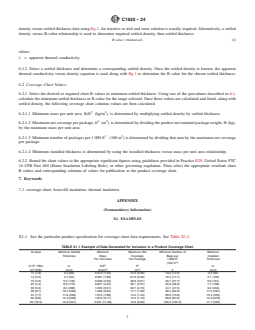
5.1 Coverage charts list the required installed and product in-service parameters of minimum thickness, maximum net coverage per package, and minimum mass per unit area to achieve each listed thermal performance (R-value) level. Chart information corresponds to numerous standard R-value levels representing common building codes, industry standards, or legislated requirements (see example in the Appendix X1) and therefore additional chart columns may be required, that is, number of packages per 1 000 ft2 (100m2), and initial installed thickness.
5.2 This guide applies to coverage charts for installations in open, horizontal attic floor spaces. Chart maximum net coverages are based upon net floor area; framing area deducted. Sloped ceilings, HVAC equipment and ductwork, and other factors can significantly influence product coverage and are to be considered by the manufacturer.
SCOPE
1.1 This guide provides information to manufacturers for the development of a loose-fill thermal insulation product coverage chart. This guide is limited to developing a coverage chart from density versus thickness, apparent thermal conductivity versus density, and thickness versus area mass relationships obtained through product testing.
1.2 This guide applies to a wide variety of loose-fill thermal insulation products including mineral fiber (Specification C764), or cellulosic fiber (Specification C739) materials; granular types including vermiculite (Specification C516) and perlite (Specification C549); pelletized products; and any other insulation materials that are installed pneumatically or poured in place.
1.3 Coverage charts for loose-fill insulation products are required by regulation under the United States Federal Trade Commission’s 16 CFR Part 460. Other countries or local governing agencies may have coverage chart requirements in addition to, or that differ from, those presented in this guide; see the Appendix for examples.
1.4 The values stated in inch-pound units are to be regarded as standard. The values given in parentheses are mathematical conversions to SI units that are provided for information only and are not considered standard.
1.5 This standard does not purport to address all of the safety concerns, if any, associated with its use. It is the responsibility of the user of this standard to establish appropriate safety, health, and environmental practices and determine the applicability of regulatory limitations prior to use.
1.6 This international standard was developed in accordance with internationally recognized principles on standardization established in the Decision on Principles for the Development of International Standards, Guides and Recommendations issued by the World Trade Organization Technical Barriers to Trade (TBT) Committee.
- Status
- Published
- Publication Date
- 29-Feb-2024
- Technical Committee
- C16 - Thermal Insulation
- Drafting Committee
- C16.23 - Blanket and Loose Fill Insulation
Buy Documents


ASTM C1630-24 - Standard Guide for Development of Coverage Charts for Loose-Fill Thermal Building Insulations

REDLINE ASTM C1630-24 - Standard Guide for Development of Coverage Charts for Loose-Fill Thermal Building Insulations
Overview
ASTM C1630-24 provides a comprehensive guide for manufacturers on the development of coverage charts for loose-fill thermal building insulations. This standard outlines the principles and methodologies required to create coverage charts that accurately specify installed parameters such as minimum thickness, maximum net coverage per package, and minimum mass per unit area-each aligned with specific thermal performance (R-value) levels. The guide supports compliance with both United States Federal Trade Commission (FTC) regulations under 16 CFR Part 460 and local or international codes regarding insulation labeling and performance.
Key Topics
- Thermal Performance Measurement: The guide details how to relate product density, thickness, and apparent thermal conductivity to R-value calculation. R-value is a critical parameter representing the insulation’s thermal resistance.
- Coverage Chart Development: Two primary procedures are included-either selecting an R-value and calculating the required settled thickness or selecting thickness and determining the corresponding R-value. Both approaches ensure data accuracy through product-specific performance testing.
- Chart Data Requirements: Coverage charts created under this guide typically include columns for R-value, minimum settled thickness, maximum net coverage per package, mass per unit area, initial installed thickness, and, where required, number of packages per standardized area (e.g., per 1,000 ft²).
- Loose-Fill Insulation Materials: The standard is applicable to a variety of loose-fill insulation products such as mineral fiber, cellulosic fiber, vermiculite, perlite, pelletized products, and other pneumatically applied or poured-in-place materials.
- Regulatory Compliance: Ensures that charts fulfill FTC Home Insulation Labeling Rule (16 CFR Part 460) requirements, which are enforced for accurate consumer product labeling and advertising. Local or country-specific guidelines may also apply.
- Applicability Limits: The recommended coverage charts are designed for open, horizontal attic floors. The guide notes that elements like sloped ceilings or installed HVAC components must be considered as they can affect coverage.
Applications
- Product Labeling and Compliance: Manufacturers use this standard to develop insulation product labels that accurately communicate the amount and type of coverage required for building code compliance and energy efficiency targets.
- Specification and Purchasing: Builders, architects, and contractors reference coverage charts to determine how much insulation material is required for a given area, ensuring proper thermal protection and cost-effective purchasing.
- Regulatory Submissions: The charts produced following ASTM C1630-24 streamline the preparation of documentation for regulatory review and approval, whether for U.S. or international agencies.
- Consumer Disclosure: Provides clarity for consumers, ensuring they are informed about the necessary thickness and quantity of insulation to achieve a desired thermal resistance (R-value), thus supporting informed purchasing decisions.
Related Standards
- ASTM C168: Terminology Relating to Thermal Insulation
- ASTM C516: Specification for Vermiculite Loose Fill Thermal Insulation
- ASTM C549: Specification for Perlite Loose Fill Insulation
- ASTM C739: Specification for Cellulosic Fiber Loose-Fill Thermal Insulation
- ASTM C764: Specification for Mineral Fiber Loose-Fill Thermal Insulation
- ASTM C687: Practice for Determination of Thermal Resistance of Loose-Fill Building Insulation
- ASTM C1374: Test Method for Determination of Installed Thickness of Pneumatically Applied Loose-Fill Building Insulation
- ASTM C1574: Guide for Determining Blown Density of Pneumatically Applied Loose-Fill Mineral Fiber Thermal Insulation
- ASTM E29: Practice for Using Significant Digits in Test Data
- 16 CFR Part 460: United States FTC Home Insulation Labeling Rule
By following ASTM C1630-24, manufacturers and building professionals ensure that coverage charts for loose-fill thermal building insulations are standardized, reliable, and fully aligned with regulatory and industry requirements, supporting better energy efficiency and compliance in building practice.
Relations
- Effective Date
- 01-Mar-2024
- Effective Date
- 15-Apr-2024
- Effective Date
- 01-Mar-2024
- Effective Date
- 01-May-2022
- Effective Date
- 01-Sep-2021
- Effective Date
- 01-Mar-2024
Buy Documents
ASTM C1630-24 - Standard Guide for Development of Coverage Charts for Loose-Fill Thermal Building Insulations
REDLINE ASTM C1630-24 - Standard Guide for Development of Coverage Charts for Loose-Fill Thermal Building Insulations
Get Certified
Connect with accredited certification bodies for this standard

DIBt (Deutsches Institut für Bautechnik)
German Institute for Building Technology.
DIN CERTCO
DIN Group product certification.

Aboma Certification B.V.
Specialized in construction, metal, and transport sectors.
Sponsored listings
Frequently Asked Questions
ASTM C1630-24 is a guide published by ASTM International. Its full title is "Standard Guide for Development of Coverage Charts for Loose-Fill Thermal Building Insulations". This standard covers: SIGNIFICANCE AND USE 5.1 Coverage charts list the required installed and product in-service parameters of minimum thickness, maximum net coverage per package, and minimum mass per unit area to achieve each listed thermal performance (R-value) level. Chart information corresponds to numerous standard R-value levels representing common building codes, industry standards, or legislated requirements (see example in the Appendix X1) and therefore additional chart columns may be required, that is, number of packages per 1 000 ft2 (100m2), and initial installed thickness. 5.2 This guide applies to coverage charts for installations in open, horizontal attic floor spaces. Chart maximum net coverages are based upon net floor area; framing area deducted. Sloped ceilings, HVAC equipment and ductwork, and other factors can significantly influence product coverage and are to be considered by the manufacturer. SCOPE 1.1 This guide provides information to manufacturers for the development of a loose-fill thermal insulation product coverage chart. This guide is limited to developing a coverage chart from density versus thickness, apparent thermal conductivity versus density, and thickness versus area mass relationships obtained through product testing. 1.2 This guide applies to a wide variety of loose-fill thermal insulation products including mineral fiber (Specification C764), or cellulosic fiber (Specification C739) materials; granular types including vermiculite (Specification C516) and perlite (Specification C549); pelletized products; and any other insulation materials that are installed pneumatically or poured in place. 1.3 Coverage charts for loose-fill insulation products are required by regulation under the United States Federal Trade Commission’s 16 CFR Part 460. Other countries or local governing agencies may have coverage chart requirements in addition to, or that differ from, those presented in this guide; see the Appendix for examples. 1.4 The values stated in inch-pound units are to be regarded as standard. The values given in parentheses are mathematical conversions to SI units that are provided for information only and are not considered standard. 1.5 This standard does not purport to address all of the safety concerns, if any, associated with its use. It is the responsibility of the user of this standard to establish appropriate safety, health, and environmental practices and determine the applicability of regulatory limitations prior to use. 1.6 This international standard was developed in accordance with internationally recognized principles on standardization established in the Decision on Principles for the Development of International Standards, Guides and Recommendations issued by the World Trade Organization Technical Barriers to Trade (TBT) Committee.
SIGNIFICANCE AND USE 5.1 Coverage charts list the required installed and product in-service parameters of minimum thickness, maximum net coverage per package, and minimum mass per unit area to achieve each listed thermal performance (R-value) level. Chart information corresponds to numerous standard R-value levels representing common building codes, industry standards, or legislated requirements (see example in the Appendix X1) and therefore additional chart columns may be required, that is, number of packages per 1 000 ft2 (100m2), and initial installed thickness. 5.2 This guide applies to coverage charts for installations in open, horizontal attic floor spaces. Chart maximum net coverages are based upon net floor area; framing area deducted. Sloped ceilings, HVAC equipment and ductwork, and other factors can significantly influence product coverage and are to be considered by the manufacturer. SCOPE 1.1 This guide provides information to manufacturers for the development of a loose-fill thermal insulation product coverage chart. This guide is limited to developing a coverage chart from density versus thickness, apparent thermal conductivity versus density, and thickness versus area mass relationships obtained through product testing. 1.2 This guide applies to a wide variety of loose-fill thermal insulation products including mineral fiber (Specification C764), or cellulosic fiber (Specification C739) materials; granular types including vermiculite (Specification C516) and perlite (Specification C549); pelletized products; and any other insulation materials that are installed pneumatically or poured in place. 1.3 Coverage charts for loose-fill insulation products are required by regulation under the United States Federal Trade Commission’s 16 CFR Part 460. Other countries or local governing agencies may have coverage chart requirements in addition to, or that differ from, those presented in this guide; see the Appendix for examples. 1.4 The values stated in inch-pound units are to be regarded as standard. The values given in parentheses are mathematical conversions to SI units that are provided for information only and are not considered standard. 1.5 This standard does not purport to address all of the safety concerns, if any, associated with its use. It is the responsibility of the user of this standard to establish appropriate safety, health, and environmental practices and determine the applicability of regulatory limitations prior to use. 1.6 This international standard was developed in accordance with internationally recognized principles on standardization established in the Decision on Principles for the Development of International Standards, Guides and Recommendations issued by the World Trade Organization Technical Barriers to Trade (TBT) Committee.
ASTM C1630-24 is classified under the following ICS (International Classification for Standards) categories: 91.100.60 - Thermal and sound insulating materials. The ICS classification helps identify the subject area and facilitates finding related standards.
ASTM C1630-24 has the following relationships with other standards: It is inter standard links to ASTM C1630-19, ASTM C168-24, ASTM C739-24, ASTM C168-22, ASTM C739-21a, ASTM C764-19. Understanding these relationships helps ensure you are using the most current and applicable version of the standard.
ASTM C1630-24 is available in PDF format for immediate download after purchase. The document can be added to your cart and obtained through the secure checkout process. Digital delivery ensures instant access to the complete standard document.
Standards Content (Sample)
This international standard was developed in accordance with internationally recognized principles on standardization established in the Decision on Principles for the
Development of International Standards, Guides and Recommendations issued by the World Trade Organization Technical Barriers to Trade (TBT) Committee.
Designation: C1630 − 24
Standard Guide for
Development of Coverage Charts for Loose-Fill Thermal
Building Insulations
This standard is issued under the fixed designation C1630; the number immediately following the designation indicates the year of
original adoption or, in the case of revision, the year of last revision. A number in parentheses indicates the year of last reapproval. A
superscript epsilon (´) indicates an editorial change since the last revision or reapproval.
1. Scope 2. Referenced Documents
1.1 This guide provides information to manufacturers for 2.1 ASTM Standards:
the development of a loose-fill thermal insulation product C168 Terminology Relating to Thermal Insulation
coverage chart. This guide is limited to developing a coverage C516 Specification for Vermiculite Loose Fill Thermal In-
chart from density versus thickness, apparent thermal conduc- sulation
tivity versus density, and thickness versus area mass relation- C549 Specification for Perlite Loose Fill Insulation
ships obtained through product testing. C739 Specification for Cellulosic Fiber Loose-Fill Thermal
Insulation
1.2 This guide applies to a wide variety of loose-fill thermal
C764 Specification for Mineral Fiber Loose-Fill Thermal
insulation products including mineral fiber (Specification
Insulation
C764), or cellulosic fiber (Specification C739) materials;
C687 Practice for Determination of Thermal Resistance of
granular types including vermiculite (Specification C516) and
Loose-Fill Building Insulation
perlite (Specification C549); pelletized products; and any other
C1374 Test Method for Determination of Installed Thick-
insulation materials that are installed pneumatically or poured
ness of Pneumatically Applied Loose-Fill Building Insu-
in place.
lation
1.3 Coverage charts for loose-fill insulation products are
C1574 Guide for Determining Blown Density of Pneumati-
required by regulation under the United States Federal Trade
cally Applied Loose-Fill Mineral Fiber Thermal Insulation
Commission’s 16 CFR Part 460. Other countries or local
E29 Practice for Using Significant Digits in Test Data to
governing agencies may have coverage chart requirements in
Determine Conformance with Specifications
addition to, or that differ from, those presented in this guide;
2.2 Other Referenced Documents:
see the Appendix for examples.
16 CFR Part 460 ,United States Federal Trade Commission
1.4 The values stated in inch-pound units are to be regarded
Labeling and Advertising of Home Insulation
as standard. The values given in parentheses are mathematical
conversions to SI units that are provided for information only
3. Terminology
and are not considered standard.
3.1 Definitions – For definitions of terms used in this guide,
1.5 This standard does not purport to address all of the
see Terminology C168.
safety concerns, if any, associated with its use. It is the
3.2 Definitions of Terms Specific to This Standard:
responsibility of the user of this standard to establish appro-
3.2.1 constant density—The uniformity in mass per unit
priate safety, health, and environmental practices and deter-
volume of a loose-fill insulation throughout its recommended
mine the applicability of regulatory limitations prior to use.
thickness installation range.
1.6 This international standard was developed in accor-
3.2.2 installed thickness—The thickness, as measured, im-
dance with internationally recognized principles on standard-
mediately after application of a loose-fill insulation.
ization established in the Decision on Principles for the
3.2.3 settled density—The mass per unit volume of a loose-
Development of International Standards, Guides and Recom-
fill insulation after which time and/or forces have exerted their
mendations issued by the World Trade Organization Technical
effect upon thickness.
Barriers to Trade (TBT) Committee.
This guide is under the jurisdiction of ASTM Committee C16 on Thermal
Insulation and is the direct responsibility of Subcommittee C16.23 on Blanket and For referenced ASTM standards, visit the ASTM website, www.astm.org, or
Loose Fill Insulation. contact ASTM Customer Service at service@astm.org. For Annual Book of ASTM
Current edition approved March 1, 2024. Published March 2024. Originally Standards volume information, refer to the standard’s Document Summary page on
approved in 2006. Last previous edition approved in 2019 as C1630 – 19. DOI: the ASTM website.
10.1520/C1630-24. United States Code of Federal Regulations, Title 16, Part 460.
Copyright © ASTM International, 100 Barr Harbor Drive, PO Box C700, West Conshohocken, PA 19428-2959. United States
C1630 − 24
3.2.4 settled thickness—The thickness, as measured, after measurements to have been made before product coverage is
which neither time nor forces effect a measurable change. calculated. The two procedures are as follows:
6.1.1 Select an R-value (usually from a standardized list)
4. Summary of Guide and determine what settled thickness will be necessary to
achieve the desired R-value. The settled thickness is deter-
4.1 This guide provides two procedures for use in develop-
mined by combining apparent thermal conductivity versus
ing loose-fill product coverage chart values from test-derived,
density data with settled density versus settled thickness data
best-fit settled density versus settled thickness, apparent ther-
using Eq 1. An iterative or trial and error solution is usually
mal conductivity versus density, and installed thickness versus
required. Alternatively, a settled density versus R-value rela-
mass per unit area relationships. The settled density versus
tionship is used to determine required settled density, then
settled thickness relationship is determined using long-term
settled thickness.
aging studies or other methods as identified in the material
R value 5 thickness/λ (1)
standard. The apparent thermal conductivity relationship is a
result from calculations within Practice C687. The installed
where:
thickness versus mass per unit area is determine
...
This document is not an ASTM standard and is intended only to provide the user of an ASTM standard an indication of what changes have been made to the previous version. Because
it may not be technically possible to adequately depict all changes accurately, ASTM recommends that users consult prior editions as appropriate. In all cases only the current version
of the standard as published by ASTM is to be considered the official document.
Designation: C1630 − 19 C1630 − 24
Standard Guide for
Development of Coverage Charts for Loose-Fill Thermal
Building Insulations
This standard is issued under the fixed designation C1630; the number immediately following the designation indicates the year of
original adoption or, in the case of revision, the year of last revision. A number in parentheses indicates the year of last reapproval. A
superscript epsilon (´) indicates an editorial change since the last revision or reapproval.
1. Scope
1.1 This guide provides information to manufacturers for the development of a loose-fill thermal insulation product coverage
chart. This guide is limited to developing a coverage chart from density versus thickness, apparent thermal conductivity versus
density, and thickness versus area mass relationships obtained through product testing.
1.2 This guide applies to a wide variety of loose-fill thermal insulation products including mineral fiber (Specification C764), or
cellulosic fiber (Specification C739) materials; granular types including vermiculite (Specification C516) and perlite (Specification
C549); pelletized products; and any other insulation materials that are installed pneumatically or poured in place.
1.3 Coverage charts for loose-fill insulation products are required by regulation under the United States Federal Trade
Commission’s 16 CFR Part 460. Other countries or local governing agencies may have coverage chart requirements in addition
to, or that differ from, those presented in this guide; see the Appendix for examples.
1.4 The values stated in inch-pound units are to be regarded as standard. The values given in parentheses are mathematical
conversions to SI units that are provided for information only and are not considered standard.
1.5 This standard does not purport to address all of the safety concerns, if any, associated with its use. It is the responsibility
of the user of this standard to establish appropriate safety, health, and environmental practices and determine the applicability of
regulatory limitations prior to use.
1.6 This international standard was developed in accordance with internationally recognized principles on standardization
established in the Decision on Principles for the Development of International Standards, Guides and Recommendations issued
by the World Trade Organization Technical Barriers to Trade (TBT) Committee.
2. Referenced Documents
2.1 ASTM Standards:
C168 Terminology Relating to Thermal Insulation
C516 Specification for Vermiculite Loose Fill Thermal Insulation
C549 Specification for Perlite Loose Fill Insulation
C739 Specification for Cellulosic Fiber Loose-Fill Thermal Insulation
C764 Specification for Mineral Fiber Loose-Fill Thermal Insulation
This guide is under the jurisdiction of ASTM Committee C16 on Thermal Insulation and is the direct responsibility of Subcommittee C16.23 on Blanket and Loose Fill
Insulation.
Current edition approved Dec. 1, 2019March 1, 2024. Published December 2019March 2024. Originally approved in 2006. Last previous edition approved in 20162019
as C1630 – 11 (2016).C1630 – 19. DOI: 10.1520/C1630-19.10.1520/C1630-24.
For referenced ASTM standards, visit the ASTM website, www.astm.org, or contact ASTM Customer Service at service@astm.org. For Annual Book of ASTM Standards
volume information, refer to the standard’s Document Summary page on the ASTM website.
Copyright © ASTM International, 100 Barr Harbor Drive, PO Box C700, West Conshohocken, PA 19428-2959. United States
C1630 − 24
C687 Practice for Determination of Thermal Resistance of Loose-Fill Building Insulation
C1374 Test Method for Determination of Installed Thickness of Pneumatically Applied Loose-Fill Building Insulation
C1574 Guide for Determining Blown Density of Pneumatically Applied Loose-Fill Mineral Fiber Thermal Insulation
E29 Practice for Using Significant Digits in Test Data to Determine Conformance with Specifications
2.2 Other Referenced Documents:
16 CFR Part 460 ,United States Federal Trade Commission Labeling and Advertising of Home Insulation
3. Terminology
3.1 Definitions – For definitions of terms used in this guide, see Terminology C168.
3.2 Definitions of Terms Specific to This Standard:
3.2.1 constant density—The uniformity in mass per unit volume of a loose-fill insulation throughout its recommended thickness
installation range.
3.2.2 installed thickness—The thickness, as measured, immediately after application of a loose-fill insulation.
3.2.3 settled density—The mass per unit volume of a loose-fill insulation after which time and/or forces have exerted their effect
upon thickness.
3.2.4 settled thickness—The thickness, as measured, after which neither time nor forces effect a measurable change.
4. Summary of Guide
4.1 This guide provides two procedures for use in developing loose-fill product coverage chart values from test-derived, best-fit
settled density versus settled thickness, apparent thermal conductivity versus density, and installed thickness versus mass per unit
area relationships. The settled density versus settled thickness relationship is determined using long-term aging studies or other
methods as identified in the material standard. The apparent thermal conductivity relationship is a result from calculations within
Practice C687. The installed thickness versus mass per unit area is determined from Test Method C1374, Guide C1574, or other
procedures as identified in the material standard.
NOTE 1—Initial installed thickness is a coverage chart column requirement of the United States Federal Trade Commission 16 CFR Part 460, Labeling
and Advertising of Home Insulation, revised and issued in 2005 Insulation (Home Insulation Labeling Rule). The values listed are to be derived using
Test Method C1374.
5. Significance and Use
5.1 Coverage charts list the required installed and product in-service parameters of minimum thickness, maximum net coverage
per package, and minimum mass per unit area to achieve each listed thermal performance (R-value) level. Chart info
...