

ASTM D4932/D4932M-89(2019)
(Test Method)Standard Test Method for Fastener Rupture and Tear Resistance of Roofing and Waterproofing Sheets, Roll Roofing, and Shingles
General Information
- Abstract
SIGNIFICANCE AND USE
4.1 Test values for the resistance of specific ply sheets, roll roofing, or shingles to selected fastener pull-through may assist in the determination of appropriate fastener spacing. The relative behavior of different fasteners and fasteners with and without caps may be evaluated.
4.2 Laboratory data will not permit prediction of field performance, particularly long-term performance, and if all test conditions are not the same, data may not be comparable.
SCOPE
1.1 This test method covers the determination of the force needed to pull a fastener through any type of roofing or waterproofing ply sheet, roll roofing, or shingle, or to cause fastener failure under specified laboratory conditions.
1.2 The values stated in either SI units or inch-pound units are to be regarded separately as standard. The values stated in each system may not be exact equivalents; therefore, each system shall be used independently of the other. Combining values from the two systems may result in non-conformance with the standard.
1.3 This standard does not purport to address all of the safety concerns, if any, associated with its use. It is the responsibility of the user of this standard to establish appropriate safety, health, and environmental practices and determine the applicability of regulatory limitations prior to use.
1.4 This international standard was developed in accordance with internationally recognized principles on standardization established in the Decision on Principles for the Development of International Standards, Guides and Recommendations issued by the World Trade Organization Technical Barriers to Trade (TBT) Committee.
- Status
- Published
- Publication Date
- 30-Apr-2019
- Technical Committee
- D08 - Roofing and Waterproofing
- Drafting Committee
- D08.20 - Roofing Membrane Systems

Overview
ASTM D4932/D4932M-89(2019) is a standard test method developed by ASTM International for determining the rupture and tear resistance of fasteners in roofing and waterproofing sheets, roll roofing, and shingles. This test method measures the force required to pull a fastener through various roofing or waterproofing materials or to cause fastener failure under controlled laboratory conditions. The results gained from this standard are critical for specifying proper fastener types, fastener spacing, and installation techniques in roofing systems.
This internationally recognized standard supports quality control and performance evaluation by providing standardized procedures for assessing material and fastener combinations. Although laboratory results cannot directly predict field performance, they offer valuable comparative data for product development and system design.
Key Topics
- Test Method Scope: Covers the evaluation of fastener pull-through resistance and tear strength in roofing systems, including single-ply, multi-ply, roll, and shingle materials.
- Units of Measurement: Both SI (metric) and inch-pound values are standard, but should not be combined in a single test.
- Specimen Preparation: Specifies dimensions and orientation for material samples in both machine and cross-machine directions.
- Testing Apparatus: Requires a universal or tensile testing machine with automatic load measurement, specialized grips, and a nailer holding jig for secure and repeatable testing.
- Test Procedures: Details precise procedures for positioning specimens, installing fasteners (with or without caps), and conducting the pull-through and tear resistance tests.
- Data Recording & Reporting: Emphasizes accurate measurement of maximum force and type of failure, and calculation of mean values and standard deviations for each condition.
- Repeatability and Reproducibility: Provides limits for evaluating the reliability and consistency of lab results.
Applications
This standard is essential for professionals involved in the design, manufacturing, testing, and quality assurance of roofing materials and systems. Applications include:
- Material Selection: Comparing the resistance of different roofing sheets, roll roofing, or shingles to fastener pull-through, aiding in material specification and system design.
- Fastener Evaluation: Assessing the performance of various fastener types and configurations, including evaluation of fasteners with and without caps.
- System Design: Assisting architects, engineers, and installers in determining optimal fastener spacing and layout to ensure roof system integrity.
- Quality Assurance: Verifying that roofing and waterproofing materials meet industry standards and performance expectations for tear resistance and fastener retention.
- Product Development: Providing manufacturers with benchmark data to engineer improved roofing and waterproofing products.
Note: While laboratory data is valuable for comparative analysis, it does not directly predict long-term or in-field performance. Consistency in test conditions is essential for meaningful data comparison.
Related Standards
- ASTM D226/D226M - Specification for Asphalt-Saturated Organic Felt Used in Roofing and Waterproofing
- Other relevant ASTM roofing standards within Committee D08 on Roofing and Waterproofing
These supporting standards help ensure a comprehensive understanding of roofing material properties and establish compatibility with the requirements of ASTM D4932/D4932M.
Keywords: ASTM D4932, fastener rupture, tear resistance, roofing membranes, waterproofing sheets, roll roofing, shingle testing, fastener pull-through, roofing material testing, quality assurance in roofing systems, roofing standards.
Relations
- Effective Date
- 01-May-2019
- Effective Date
- 01-Jul-2009
- Effective Date
- 01-May-2019
Get Certified
Connect with accredited certification bodies for this standard

DIBt (Deutsches Institut für Bautechnik)
German Institute for Building Technology.
DIN CERTCO
DIN Group product certification.

Aboma Certification B.V.
Specialized in construction, metal, and transport sectors.
Sponsored listings
Frequently Asked Questions
ASTM D4932/D4932M-89(2019) is a standard published by ASTM International. Its full title is "Standard Test Method for Fastener Rupture and Tear Resistance of Roofing and Waterproofing Sheets, Roll Roofing, and Shingles". This standard covers: SIGNIFICANCE AND USE 4.1 Test values for the resistance of specific ply sheets, roll roofing, or shingles to selected fastener pull-through may assist in the determination of appropriate fastener spacing. The relative behavior of different fasteners and fasteners with and without caps may be evaluated. 4.2 Laboratory data will not permit prediction of field performance, particularly long-term performance, and if all test conditions are not the same, data may not be comparable. SCOPE 1.1 This test method covers the determination of the force needed to pull a fastener through any type of roofing or waterproofing ply sheet, roll roofing, or shingle, or to cause fastener failure under specified laboratory conditions. 1.2 The values stated in either SI units or inch-pound units are to be regarded separately as standard. The values stated in each system may not be exact equivalents; therefore, each system shall be used independently of the other. Combining values from the two systems may result in non-conformance with the standard. 1.3 This standard does not purport to address all of the safety concerns, if any, associated with its use. It is the responsibility of the user of this standard to establish appropriate safety, health, and environmental practices and determine the applicability of regulatory limitations prior to use. 1.4 This international standard was developed in accordance with internationally recognized principles on standardization established in the Decision on Principles for the Development of International Standards, Guides and Recommendations issued by the World Trade Organization Technical Barriers to Trade (TBT) Committee.
SIGNIFICANCE AND USE 4.1 Test values for the resistance of specific ply sheets, roll roofing, or shingles to selected fastener pull-through may assist in the determination of appropriate fastener spacing. The relative behavior of different fasteners and fasteners with and without caps may be evaluated. 4.2 Laboratory data will not permit prediction of field performance, particularly long-term performance, and if all test conditions are not the same, data may not be comparable. SCOPE 1.1 This test method covers the determination of the force needed to pull a fastener through any type of roofing or waterproofing ply sheet, roll roofing, or shingle, or to cause fastener failure under specified laboratory conditions. 1.2 The values stated in either SI units or inch-pound units are to be regarded separately as standard. The values stated in each system may not be exact equivalents; therefore, each system shall be used independently of the other. Combining values from the two systems may result in non-conformance with the standard. 1.3 This standard does not purport to address all of the safety concerns, if any, associated with its use. It is the responsibility of the user of this standard to establish appropriate safety, health, and environmental practices and determine the applicability of regulatory limitations prior to use. 1.4 This international standard was developed in accordance with internationally recognized principles on standardization established in the Decision on Principles for the Development of International Standards, Guides and Recommendations issued by the World Trade Organization Technical Barriers to Trade (TBT) Committee.
ASTM D4932/D4932M-89(2019) is classified under the following ICS (International Classification for Standards) categories: 91.100.50 - Binders. Sealing materials. The ICS classification helps identify the subject area and facilitates finding related standards.
ASTM D4932/D4932M-89(2019) has the following relationships with other standards: It is inter standard links to ASTM D4932/D4932M-89(2014)e1, ASTM D226/D226M-09, ASTM D228/D228M-21. Understanding these relationships helps ensure you are using the most current and applicable version of the standard.
ASTM D4932/D4932M-89(2019) is available in PDF format for immediate download after purchase. The document can be added to your cart and obtained through the secure checkout process. Digital delivery ensures instant access to the complete standard document.
Standards Content (Sample)
This international standard was developed in accordance with internationally recognized principles on standardization established in the Decision on Principles for the
Development of International Standards, Guides and Recommendations issued by the World Trade Organization Technical Barriers to Trade (TBT) Committee.
Designation: D4932/D4932M −89 (Reapproved 2019)
Standard Test Method for
Fastener Rupture and Tear Resistance of Roofing and
Waterproofing Sheets, Roll Roofing, and Shingles
This standard is issued under the fixed designation D4932/D4932M; the number immediately following the designation indicates the
year of original adoption or, in the case of revision, the year of last revision. A number in parentheses indicates the year of last
reapproval. A superscript epsilon (´) indicates an editorial change since the last revision or reapproval.
1. Scope 3.2 The force parallel to the fastener shank to rupture the
sheet or to cause fastener failure is measured with the head
1.1 This test method covers the determination of the force
seated (rupture, head pull-through).
needed to pull a fastener through any type of roofing or
waterproofing ply sheet, roll roofing, or shingle, or to cause
4. Significance and Use
fastener failure under specified laboratory conditions.
4.1 Test values for the resistance of specific ply sheets, roll
1.2 The values stated in either SI units or inch-pound units
roofing,orshinglestoselectedfastenerpull-throughmayassist
are to be regarded separately as standard. The values stated in
in the determination of appropriate fastener spacing. The
each system may not be exact equivalents; therefore, each
relative behavior of different fasteners and fasteners with and
system shall be used independently of the other. Combining
without caps may be evaluated.
values from the two systems may result in non-conformance
4.2 Laboratory data will not permit prediction of field
with the standard.
performance,particularlylong-termperformance,andifalltest
1.3 This standard does not purport to address all of the
conditions are not the same, data may not be comparable.
safety concerns, if any, associated with its use. It is the
responsibility of the user of this standard to establish appro-
5. Apparatus
priate safety, health, and environmental practices and deter-
5.1 Testing Machine—Universal or tensile testing machine
mine the applicability of regulatory limitations prior to use.
with automatic load recording equipment, capable of cross-
1.4 This international standard was developed in accor-
head movement at a constant rate of 25.4 mm/min [1.00
dance with internationally recognized principles on standard-
in./min].
ization established in the Decision on Principles for the
5.2 Grips—Self-aligning grips or clamps for holding the
Development of International Standards, Guides and Recom-
free end of the test specimen and the nailer holding jig without
mendations issued by the World Trade Organization Technical
slippage during the test.
Barriers to Trade (TBT) Committee.
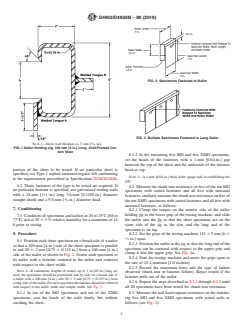
5.3 Nailer Holding Jig—100-mm [4-in.] length of cold-
2. Referenced Documents
formed carbon steel, rectangular structural tubing with outside
2.1 ASTM Standards:
nominal dimensions of 102 by 51 mm [4 by 2 in.] and 4.8-mm
D226/D226MSpecification for Asphalt-Saturated Organic
[ ⁄16-in.] wall thickness, fabricated as shown in Fig. 1.
Felt Used in Roofing and Waterproofing
5.4 Wood Nailers, 33 by 89−13,+1 by 102 mm [1.5 by
3.5−0.5,+0.05 by 4 in.] (nominal 2 by 4 in. lumber cut to 4
3. Summary of Test Method
in. length is appropriate). Thirty nailers are required per
3.1 The force perpendicular to the fastener shank to tear the
sample.
sheet or to cause fastener failure is measured with the fastener
NOTE 1—The wood nailers must hold the fastener securely and remain
head seated and not seated (tear).
secure in the nailer holding jig during the test. The 89-mm [3.5-in.]
dimension is critical for the nailer to be secure in the jig; the other
dimensions are not critical and may be varied so long as the nailer works.
ThistestmethodisunderthejurisdictionofASTMCommitteeD08onRoofing
If preferred, the operator may use continuous lengths of nailer stock up to
and Waterproofing and is the direct responsibility of Subcommittee D08.20 on
1 m [40 in.] long for multiple specimens as opposed to cutting separate
Roofing Membrane Systems.
nailers for each specimen.
Current edition approved May 1, 2019. Published June 2019. Originally
approved in 1989. Last previous edition approved in 2014 as D4932/D4932M–89
ɛ1
6. Sampling and Test Specimens
(2014) . DOI: 10.1520/D4932_D4932M-89R19.
For referenced ASTM standards, visit the ASTM website, www.astm.org, or
6.1 Cut 15 MD specimens, 175 by 100 mm [7 by 4 in.], in
contact ASTM Customer Service at service@astm.org. For Annual Book of ASTM
themachinedirection(MD)andanother15XMDspecimensin
Standards volume information, refer to the standard’s Document Summary page on
the ASTM website. the cross-machine direction (XMD) from a representative
Copyright © ASTM International, 100 Barr Harbor Drive, PO Box C700, West Conshohocken, PA 19428-2959. United States
D4932/D4932M − 89 (2019)
FIG. 2 Specimens Fastened to Nailer
FIG. 3 Multiple Specimens Fastened to Long Nailer
NOTE 1—Stock wall thickness is 5 mm [ ⁄16 in.].
FIG. 1 Nailer Holding Jig, 100 mm [4 in.] Long, Cold-Formed Car-
bon Steel
8.1.2 In the remaining five MD and five XMD specimens,
set the heads of the fasteners with a 1-mm [0.04-in.] gap
between the top of the sheet and the underside of the fastener
portion of the sheet to be tested. If no particular sheet is head or cap.
specified, useType 1 asphalt-saturated organic felt conforming
NOTE 3—A 1-mm [0.04-in.] thick feeler gauge aids in establishing the
to the requirements prescribed in Specification D226/D226M.
gap.
6.2 Thirty fasteners of the type to be tested are required. If
8.2 Measure the shank tear resistance on five of the ten MD
no particular fastener is specified, use galvanized roofing nails
specimens with seated fasteners and all five with unseated
with a 38-mm [1 ⁄2 in.] long 3.6-mm [0.1205-in.] diameter
fasteners;similarlymeasuretheshanktearresistanceonfiveof
straight shank and a 9.5-mm [ ⁄8-in.] diameter head.
the ten XMD specimens with seated fasteners and all five with
unseated fasteners, as follows:
7. Conditioning
8.2.1 Clamp the tongue on the narrow side of the
...