

ASTM D1970/D1970M-21
(Specification)Standard Specification for Self-Adhering Polymer Modified Bituminous Sheet Materials Used as Steep Roofing Underlayment for Ice Dam Protection
General Information
- Abstract
ABSTRACT
This specification covers the standards for polymer modified bituminous sheet materials proposed for use as underlayment on roof eaves, or valleys, or both, to prevent leakage of shingle, tile or metal roofs from water back-up due to ice dams. The underlayment sheet shall comply with the physical requirements which include thickness, maximum load, elongation, adhesion to plywood, thermal stability, flexibility, tear resistance, moisture vapor permeance, sealability, and slip resistance. The underlayment sheet shall not crack, as well, nor be too sticky as to cause damage upon being unrolled.
SCOPE
1.1 This specification covers polymer modified bituminous sheet materials intended for use as underlayment on roof eaves, or valleys, or both, to prevent leakage of shingle, tile, or metal roofs from water back-up due to ice dams.
1.2 These underlayment sheets have a sticky adhesive layer which is exposed by removal of a protective sheet. The top surface is suitable to work on during the application of the exposed roofing.
1.3 Table of Contents:
Section
Scope
1
Referenced Documents
2
Terminology
3
Workmanship, Finish, and Appearance
4
Physical Requirements
5
Sampling
6
Test Methods
7
Conditioning
7.1
Thickness
7.2
Maximum Load and Elongation at Break
7.3
Adhesion to Plywood
7.4
Thermal Stability
7.5
Flexibility at –29 °C [–20 °F]
7.6
Tear Resistance
7.7
Moisture Vapor Permeability
7.8
Capability to Seal Around Nail
(Head of Water Test)
7.9
Waterproof Integrity of Side Lap Seam
(Head of Water Test)
7.10
Inspection
8
Rejection and Rehearing
9
Packaging and Package Marking
10
Keywords
11
1.4 The values stated in either SI units or inch-pound units are to be regarded separately as standard. The values stated in each system may not be exact equivalents; therefore, each system shall be used independently of the other. Combining values from the two systems may result in nonconformance with the standard.
1.5 This standard does not purport to address all of the safety concerns, if any, associated with its use. It is the responsibility of the user of this standard to establish appropriate safety, health, and environmental practices and determine the applicability of regulatory limitations prior to use.
1.6 This international standard was developed in accordance with internationally recognized principles on standardization established in the Decision on Principles for the Development of International Standards, Guides and Recommendations issued by the World Trade Organization Technical Barriers to Trade (TBT) Committee.
- Status
- Published
- Publication Date
- 30-Apr-2021
- Technical Committee
- D08 - Roofing and Waterproofing
- Drafting Committee
- D08.02 - Steep Roofing Products and Assemblies
Buy Documents
ASTM D1970/D1970M-21 - Standard Specification for Self-Adhering Polymer Modified Bituminous Sheet Materials Used as Steep Roofing Underlayment for Ice Dam Protection
REDLINE ASTM D1970/D1970M-21 - Standard Specification for Self-Adhering Polymer Modified Bituminous Sheet Materials Used as Steep Roofing Underlayment for Ice Dam Protection
Overview
ASTM D1970/D1970M-21 is the standard specification developed by ASTM International for self-adhering polymer modified bituminous sheet materials intended for use as steep roofing underlayment for ice dam protection. These underlayment sheets are designed to be installed on roof eaves, valleys, or both, to prevent water leakage caused by ice damming beneath shingle, tile, or metal roofs. This standard outlines required physical properties, performance requirements, and testing procedures to ensure roofing underlayments offer reliable ice dam protection, secure adhesion, and safe, durable installation.
Key Topics
- Product Description: Self-adhering, polymer-modified bituminous sheets supplied in roll form, featuring a peel-away protective layer exposing an adhesive side, and a walkable top surface for safe application.
- Physical Requirements: Minimum thickness, load capability, elongation at break, adhesion to plywood at various temperatures, thermal stability, flexibility at low temperature (-29 °C), tear resistance, moisture vapor permeance, sealability around fasteners, and lap seam waterproof integrity.
- Workmanship and Appearance: Sheets must be free of visible defects (such as cracks, holes, or tears), maintain uniform thickness, and provide slip resistance for installers.
- Testing and Quality Assurance: Comprehensive test methods ensure compliance with performance benchmarks for durability, adhesion, flexibility, and water resistance.
- Packaging and Marking: Each roll must be securely packaged and clearly marked with the manufacturer and standard designation.
- Safety and Regulatory Compliance: Users are responsible for ensuring application meets local safety, health, and environmental regulations.
Applications
- Ice Dam Protection: The primary application is underlayment on roof eaves, valleys, and other vulnerable areas to prevent leaks due to ice damming and water back-up, especially in climates with freeze-thaw cycles.
- Roof Types: Suitable underlayment for shingle, tile, and metal roofs on steep slopes, enhancing the longevity and weather-resistance of roofing assemblies.
- Residential & Commercial Buildings: Used across new construction, reroofing, and repair of homes, multifamily developments, and commercial structures.
- Additional Protection: Provides supplemental moisture and water infiltration resistance, especially in regions subject to wind-driven rain or snow accumulation.
Related Standards
The performance and evaluation of self-adhering bituminous roofing underlayments are tightly integrated with the following ASTM standards:
- ASTM D228/D228M – Test methods for sampling and testing asphalt roll roofing and shingles.
- ASTM D903 – Test method for peel or stripping strength of adhesive bonds.
- ASTM D1204 – Test method for linear dimensional changes of nonrigid thermoplastic sheeting at elevated temperature.
- ASTM D2523/D2523M – Practice for testing load-strain properties of roofing membranes.
- ASTM D4073/D4073M – Test method for tensile-tear strength of bituminous roofing membranes.
- ASTM D5147/D5147M – Test methods for sampling and testing modified bituminous sheet material.
- ASTM D7349/D7349M – Method for determining the capability of roofing materials to seal around fasteners.
- ASTM E96/E96M – Test methods for water vapor transmission of materials.
- ASTM D1079 – Terminology relating to roofing and waterproofing.
Keywords: ASTM D1970, ice dam protection, steep roofing, bituminous sheet underlayment, self-adhering roofing membrane, waterproof underlayment, polymer modified bitumen, roofing standards, ASTM roofing, roof leak prevention, roof valleys underlayment, roofing installation safety.
Relations
- Effective Date
- 01-Mar-2024
- Effective Date
- 15-Nov-2023
- Effective Date
- 01-May-2020
- Effective Date
- 01-Apr-2020
- Effective Date
- 01-Nov-2019
- Effective Date
- 01-May-2019
- Effective Date
- 01-Jan-2019
- Effective Date
- 15-Dec-2018
- Effective Date
- 15-Dec-2018
- Effective Date
- 01-Nov-2018
- Effective Date
- 01-Jul-2018
- Effective Date
- 01-Nov-2017
- Effective Date
- 01-Nov-2016
- Effective Date
- 01-Feb-2016
- Effective Date
- 15-Dec-2015
Buy Documents
ASTM D1970/D1970M-21 - Standard Specification for Self-Adhering Polymer Modified Bituminous Sheet Materials Used as Steep Roofing Underlayment for Ice Dam Protection
REDLINE ASTM D1970/D1970M-21 - Standard Specification for Self-Adhering Polymer Modified Bituminous Sheet Materials Used as Steep Roofing Underlayment for Ice Dam Protection
Get Certified
Connect with accredited certification bodies for this standard

DIBt (Deutsches Institut für Bautechnik)
German Institute for Building Technology.
DIN CERTCO
DIN Group product certification.

Aboma Certification B.V.
Specialized in construction, metal, and transport sectors.
Sponsored listings
Frequently Asked Questions
ASTM D1970/D1970M-21 is a technical specification published by ASTM International. Its full title is "Standard Specification for Self-Adhering Polymer Modified Bituminous Sheet Materials Used as Steep Roofing Underlayment for Ice Dam Protection". This standard covers: ABSTRACT This specification covers the standards for polymer modified bituminous sheet materials proposed for use as underlayment on roof eaves, or valleys, or both, to prevent leakage of shingle, tile or metal roofs from water back-up due to ice dams. The underlayment sheet shall comply with the physical requirements which include thickness, maximum load, elongation, adhesion to plywood, thermal stability, flexibility, tear resistance, moisture vapor permeance, sealability, and slip resistance. The underlayment sheet shall not crack, as well, nor be too sticky as to cause damage upon being unrolled. SCOPE 1.1 This specification covers polymer modified bituminous sheet materials intended for use as underlayment on roof eaves, or valleys, or both, to prevent leakage of shingle, tile, or metal roofs from water back-up due to ice dams. 1.2 These underlayment sheets have a sticky adhesive layer which is exposed by removal of a protective sheet. The top surface is suitable to work on during the application of the exposed roofing. 1.3 Table of Contents: Section Scope 1 Referenced Documents 2 Terminology 3 Workmanship, Finish, and Appearance 4 Physical Requirements 5 Sampling 6 Test Methods 7 Conditioning 7.1 Thickness 7.2 Maximum Load and Elongation at Break 7.3 Adhesion to Plywood 7.4 Thermal Stability 7.5 Flexibility at –29 °C [–20 °F] 7.6 Tear Resistance 7.7 Moisture Vapor Permeability 7.8 Capability to Seal Around Nail (Head of Water Test) 7.9 Waterproof Integrity of Side Lap Seam (Head of Water Test) 7.10 Inspection 8 Rejection and Rehearing 9 Packaging and Package Marking 10 Keywords 11 1.4 The values stated in either SI units or inch-pound units are to be regarded separately as standard. The values stated in each system may not be exact equivalents; therefore, each system shall be used independently of the other. Combining values from the two systems may result in nonconformance with the standard. 1.5 This standard does not purport to address all of the safety concerns, if any, associated with its use. It is the responsibility of the user of this standard to establish appropriate safety, health, and environmental practices and determine the applicability of regulatory limitations prior to use. 1.6 This international standard was developed in accordance with internationally recognized principles on standardization established in the Decision on Principles for the Development of International Standards, Guides and Recommendations issued by the World Trade Organization Technical Barriers to Trade (TBT) Committee.
ABSTRACT This specification covers the standards for polymer modified bituminous sheet materials proposed for use as underlayment on roof eaves, or valleys, or both, to prevent leakage of shingle, tile or metal roofs from water back-up due to ice dams. The underlayment sheet shall comply with the physical requirements which include thickness, maximum load, elongation, adhesion to plywood, thermal stability, flexibility, tear resistance, moisture vapor permeance, sealability, and slip resistance. The underlayment sheet shall not crack, as well, nor be too sticky as to cause damage upon being unrolled. SCOPE 1.1 This specification covers polymer modified bituminous sheet materials intended for use as underlayment on roof eaves, or valleys, or both, to prevent leakage of shingle, tile, or metal roofs from water back-up due to ice dams. 1.2 These underlayment sheets have a sticky adhesive layer which is exposed by removal of a protective sheet. The top surface is suitable to work on during the application of the exposed roofing. 1.3 Table of Contents: Section Scope 1 Referenced Documents 2 Terminology 3 Workmanship, Finish, and Appearance 4 Physical Requirements 5 Sampling 6 Test Methods 7 Conditioning 7.1 Thickness 7.2 Maximum Load and Elongation at Break 7.3 Adhesion to Plywood 7.4 Thermal Stability 7.5 Flexibility at –29 °C [–20 °F] 7.6 Tear Resistance 7.7 Moisture Vapor Permeability 7.8 Capability to Seal Around Nail (Head of Water Test) 7.9 Waterproof Integrity of Side Lap Seam (Head of Water Test) 7.10 Inspection 8 Rejection and Rehearing 9 Packaging and Package Marking 10 Keywords 11 1.4 The values stated in either SI units or inch-pound units are to be regarded separately as standard. The values stated in each system may not be exact equivalents; therefore, each system shall be used independently of the other. Combining values from the two systems may result in nonconformance with the standard. 1.5 This standard does not purport to address all of the safety concerns, if any, associated with its use. It is the responsibility of the user of this standard to establish appropriate safety, health, and environmental practices and determine the applicability of regulatory limitations prior to use. 1.6 This international standard was developed in accordance with internationally recognized principles on standardization established in the Decision on Principles for the Development of International Standards, Guides and Recommendations issued by the World Trade Organization Technical Barriers to Trade (TBT) Committee.
ASTM D1970/D1970M-21 is classified under the following ICS (International Classification for Standards) categories: 91.100.60 - Thermal and sound insulating materials. The ICS classification helps identify the subject area and facilitates finding related standards.
ASTM D1970/D1970M-21 has the following relationships with other standards: It is inter standard links to ASTM E96/E96M-24, ASTM E96/E96M-23, ASTM D1079-20, ASTM D1204-14(2020), ASTM D7349/D7349M-15(2019), ASTM D228/D228M-19, ASTM D4073/D4073M-06(2019)e1, ASTM D1079-18e1, ASTM D1079-18, ASTM D228/D228M-18, ASTM D5147/D5147M-18, ASTM D903-98(2017), ASTM D228/D228M-16, ASTM D1079-16, ASTM D7349/D7349M-15. Understanding these relationships helps ensure you are using the most current and applicable version of the standard.
ASTM D1970/D1970M-21 is available in PDF format for immediate download after purchase. The document can be added to your cart and obtained through the secure checkout process. Digital delivery ensures instant access to the complete standard document.
Standards Content (Sample)
This international standard was developed in accordance with internationally recognized principles on standardization established in the Decision on Principles for the
Development of International Standards, Guides and Recommendations issued by the World Trade Organization Technical Barriers to Trade (TBT) Committee.
Designation:D1970/D1970M −21
Standard Specification for
Self-Adhering Polymer Modified Bituminous Sheet Materials
Used as Steep Roofing Underlayment for Ice Dam
Protection
This standard is issued under the fixed designation D1970/D1970M; the number immediately following the designation indicates the
year of original adoption or, in the case of revision, the year of last revision. A number in parentheses indicates the year of last
reapproval. A superscript epsilon (´) indicates an editorial change since the last revision or reapproval.
1. Scope 1.5 This standard does not purport to address all of the
safety concerns, if any, associated with its use. It is the
1.1 This specification covers polymer modified bituminous
responsibility of the user of this standard to establish appro-
sheetmaterialsintendedforuseasunderlaymentonroofeaves,
priate safety, health, and environmental practices and deter-
or valleys, or both, to prevent leakage of shingle, tile, or metal
mine the applicability of regulatory limitations prior to use.
roofs from water back-up due to ice dams.
1.6 This international standard was developed in accor-
1.2 These underlayment sheets have a sticky adhesive layer
dance with internationally recognized principles on standard-
which is exposed by removal of a protective sheet. The top
ization established in the Decision on Principles for the
surface is suitable to work on during the application of the
Development of International Standards, Guides and Recom-
exposed roofing.
mendations issued by the World Trade Organization Technical
1.3 Table of Contents: Barriers to Trade (TBT) Committee.
Section
2. Referenced Documents
Scope 1
Referenced Documents 2
2.1 ASTM Standards:
Terminology 3
Workmanship, Finish, and Appearance 4 D228/D228MTest Methods for Sampling, Testing, and
Physical Requirements 5
Analysis of Asphalt Roll Roofing, Cap Sheets, and
Sampling 6
Shingles Used in Roofing and Waterproofing
Test Methods 7
Conditioning 7.1 D903Test Method for Peel or Stripping Strength of Adhe-
Thickness 7.2
sive Bonds
Maximum Load and Elongation at Break 7.3
D1079Terminology Relating to Roofing and Waterproofing
Adhesion to Plywood 7.4
Thermal Stability 7.5
D1204Test Method for Linear Dimensional Changes of
Flexibility at –29 °C [–20 °F] 7.6
Nonrigid Thermoplastic Sheeting or Film at Elevated
Tear Resistance 7.7
Temperature
Moisture Vapor Permeability 7.8
Capability to Seal Around Nail 7.9 D4073/D4073MTest Method for Tensile-Tear Strength of
(Head of Water Test)
Bituminous Roofing Membranes
Waterproof Integrity of Side Lap Seam 7.10
D5147/D5147MTest Methods for Sampling and Testing
(Head of Water Test)
Inspection 8
Modified Bituminous Sheet Material
Rejection and Rehearing 9
D7349/D7349MTest Method for Determining the Capabil-
Packaging and Package Marking 10
ity of Roofing and Waterproofing Materials to Seal
Keywords 11
Around Fasteners
1.4 The values stated in either SI units or inch-pound units
E96/E96MTest Methods for Water Vapor Transmission of
are to be regarded separately as standard. The values stated in
Materials
each system may not be exact equivalents; therefore, each
system shall be used independently of the other. Combining
3. Terminology
values from the two systems may result in nonconformance
3.1 Definitions—For definitions of terms used in this
with the standard.
specification, refer to Terminology D1079.
This specification is under the jurisdiction of ASTM Committee D08 on
RoofingandWaterproofingandisthedirectresponsibilityofSubcommitteeD08.02
on Steep Roofing Products and Assemblies. For referenced ASTM standards, visit the ASTM website, www.astm.org, or
Current edition approved May 1, 2021. Published June 2021. Originally contact ASTM Customer Service at service@astm.org. For Annual Book of ASTM
approved in 1990. Last previous edition approved in 2020 as D1970/D1970M–20. Standards volume information, refer to the standard’s Document Summary page on
DOI: 10.1520/D1970_D1970M-21. the ASTM website.
Copyright © ASTM International, 100 Barr Harbor Drive, PO Box C700, West Conshohocken, PA 19428-2959. United States
D1970/D1970M−21
3.2 Definitions of Terms Specific to This Standard: 7. Test Methods
3.2.1 lot—for the purpose of sampling, a lot shall consist of
7.1 Conditioning:
all material manufactured in one production run (not to exceed
7.1.1 Unless otherwise specified, condition test specimens
24 h) using the same source of raw materials.
for at least4hat23 6 2°C [73.4 6 3.6°F] and 50 65%
relative humidity prior to testing.
4. Workmanship, Finish, and Appearance
7.2 Thickness:
4.1 The underlayment sheet shall be supplied in roll form.
7.2.1 Measure the thickness of the roofing underlayment in
4.2 The underlayment sheet shall be substantially uniform
accordance with Test Methods D5147/D5147M.
in thickness and appearance. It shall be free of visible defects
7.2.2 Report the number of measurements, the average, and
such as holes, ragged or untrue edges, breaks, cracks, tears,
standard deviation across the sheet.
protuberances, and indentations, except for those perforations
7.3 Maximum Load and Elongation at Break:
or protuberances which are intentional.
7.3.1 This test method covers the determination of the
4.3 The surface of the underlayment sheet shall be designed
maximum load and elongation at break of the underlayment
to provide traction and slip resistance to the applicator.
sheets,assetforthintheLoadStrainPropertiessectionofTest
NOTE 1—The intent of 4.3 is to recognize that surface slipperiness is Methods D5147/D5147M, except as noted below.
important when working on a roof and, while no test method is specified
7.3.2 Specimens—Prepare five specimens from each sample
in this standard, several methods for assessing the relative slipperiness of
roll in both the longitudinal and transverse directions. Speci-
surfaces are available. It is the further intent of this paragraph to ensure
mens shall be 25 mm [1 in.] 6 5% wide by a minimum of
that, whatever method is used, the friction coefficient or resistance to
150 mm [6 in.] 6 5 % long. For materials with high
slipping of the surface of these products should be at least as great as
asphalt-saturated felt shingle underlayment tested under the same condi-
elongation, it is permitted to reduce the length of the specimen
tions of temperature and wetness as agreed between purchaser and seller.
to 100 mm [4 in.] 6 5% if necessary to avoid limitations
4.4 Sheet sections shall be suitable for joining by the
imposed by dimensions of the test machine.
manufacturer’s recommended procedure. The entire lower 7.3.3 Procedure—Perform the following procedure.
surface of the underlayment sheet shall be capable of being
7.3.3.1 Condition each specimen at least2hat23 62°C
fully adhered to the roof deck.
[73.4 6 3.6°F].
7.3.3.2 The initial clamp separation shall be a minimum of
5. Physical Requirements
75 mm [3 in.] 6 5% for sheets having an ultimate elongation
5.1 The underlayment sheet shall conform to the physical
of75%orlessat23.9°C[75°F]and50mm[2in.] 65%for
requirements prescribed in Table 1.
sheets having an ultimate elongation greater than 75% at
23.9°C [75°F].
5.2 The underlayment sheet shall not crack nor be so sticky
7.3.3.3 Record the percent elongation of each specimen at
as to cause tearing or other damage upon being unrolled at
the visual break of the modified bitumen portion using an
material temperatures between 4.4 and 60°C [40 and 140°F].
extensiometer, or mark the extension at visual break of the
6. Sampling
modified bitumen portion from the chart of the stress versus
time (knowing the speed of the chart drive and the jaw
6.1 Fromeachlotofunderlaymentsheet,selectsamplerolls
separation rate).
in accordance with Test Methods D228/D228M.
7.3.3.4 Record the maximum load attained by each speci-
6.2 The rolls so selected shall constitute the representative
men.
sample used for all subsequent observations and tests pertain-
7.3.4 Calculation—Determine the percent elongation at
ing to the lot of material being examined.
break of the modified bitumen portion obtained from the
extensiometer in accordance with the manufacturer’s
TABLE 1 Physical Requirements of Self-Adhering Polymer
instructions, or read directly. Calculate the percent elongation
Modified Bituminous Sheet Materials Used as Steep Roofing
from the chart as follows:
Underlayment for Ice Dam Protection
a
Property SI Inch-Pound
%Elongation 5 3100% (1)
b
Thickness, min 1.0 mm 40 mils
Maximum load, min
where:
Longitudinal 4.4 kN/m 25 lbf/in.
Transverse 4.4 kN/m 25 lbf/in.
a = extensionatmodifiedbitumenbreak(extensionatbreak
Elongation at break, min of modified 10 %
on chart×jaw separation rate divided by chart speed),
bitumen portion
Adhesion to plywood, min at 40 °F 0.92 kgf/30.5 cm 2.0 lbf/ft width
and
Adhesion to plywood, min at 75 °F 5.44 kgf/30.5 cm 12.0 lbf/ft width
b = initial jaw separation.
Thermal stability, max 3 mm 0.1 in.
Flexibility at –29 °C [–20 °F] pass
7.3.4.1 Determine the average percent elongation at break
Tear resistance
of the modified bitumen portion in each direction.
Longitudinal, min 89 N 20 lbf
7.3.4.2 Calculate the average maximum load in each direc-
Transverse, min 89 N 20 lbf
Moisture vapor permeance, max 5.7 ng/Pa.S.M. 0.1 U.S. Perms
tion.
Sealability around nail pass
7.3.5 Report—For each set of five specimens in each direc-
Waterproof integrity of lap seam pass
tion report the individual measurements, the average and
D1970/D1970M−21
standard deviation for the size of specimen (initial length 7.4.7 Reporting—For each series of tests, report the number
between jaws), maximum load in kN/m [lbf/in.], percent ofmeasurements,theaverage,andthestandarddeviationofall
elongation at modified bitumen break, and method of deter- the test values in kg/30.5 cm width [lb/ft of width].
mining elongation.
7.5 Thermal Stability:
7.5.1 This test method determines the thermal stability of
7.4 Adhesion to Plywood:
the underlayment sheets as set forth in Test Method D1204,
7.4.1 This test method covers the determination of the
except as noted below.
adhesive properties of the underlayment sheets to plywood, as
7.5.2 Specimens—Prepare test specimens as described.
set forth in Test Method D903 except as noted below.
7.5.2.1 The test specimen shall consist of one piece of
7.4.2 Specimen Preparation—Prepare test specimens as de-
underlayment sheet, 100 62by100 62mm[4 6 0.125 by
scribed.
4 60.125in.],centeredandbonded(asdescribedin7.4.2.2)to
7.4.2.1 The test specimen shall consist of one piece of
one piece of 6 mm [ ⁄4 in.] minimum thick plywood, (APA
underlayment sheet, 75 62by200 62mm[3 6 0.125 by 8
2 Grade, Exposure 1) 150 62by200 62mm[6 6 0.125 by 8
6 0.125 in.], bonded for 15 in. (75 by 125 mm) [3 by 5 in.]
6 0.125 in.].
to one piece of 6 mm [ ⁄4in.] minimum thick plywood, APA
7.5.2.2 At least five specimens shall be tested for each
Grade, Exposure 1, 75 by 150 mm [3 by 6 in.]. The plywood
sample roll.
must not be reused for testing.
7.5.3 Procedure—Perform the following procedure.
7.4.2.2 Roll test specimen three times back and forth with a
7.5.3.1 Set specimens at a 45° angle in a hot air circulating
roller which has a mass of 11.8 kg [26 lb] 6 0.5%, diameter
oven maintained at 70 6 2°C [158 6 4°F] for 14 days.
of 125 mm [5 in.] 6 5%, and width of 125 mm [5 in.] 65%
7.5.3.2 At the end of the oven-exposure period, allow
(2 to 3 s per cycle).
specimens to equilibrate to 23.9 6 1.1°C [75 6 2°F] and 50
7.4.2.3 At least five specimens shall be tested for each test
6 5% relative humidity for at least 4 h.
temperature.
7.5.3.3 From the lower edge of the sheet measure to the
7.4.2.4 It is recommended that specimens be assembled
nearest 2.5 mm [0.1 in.] the furthest point of modified bitumen
individually. Cutting specimens to size after assembly may
flow. Estimate the average flow across the entire lower edge of
influence the test results.
the sample.
7.4.3 Conditioning—The test shall be performed at 23 6
7.5.4 Report—Report the individual specimen values, the
2°C [73.4 6 3.6°F] and 4 6 2°C [39.2 6 3.6°F]. Materials
average, and the standard deviation.
used to construct test specimens and the roller must be
7.6 Flexibility at –29 °C [–20 °F]:
conditioned at the test temperature for at least 4 h prior to
7.6.1 Scope—This test method is a qualitative procedure
assembly. Similarly, test specimens must be conditioned at the
performed in a laboratory that determines the low temperature
test temperatures for at least 1 h prior to testing.
flexibility of the underlayment sheets. For the sheet material to
NOTE 2—Adhesion to other potential wood deck materials may be
be given a pass rating in this test, the material must demon-
determined by this test method, but it has been observed that substrates
strate either no visible signs of cracking after bending at the
such as APA-approved nonveneer sheets typically give greater adhesion
testtemperaturethroughanangleof180 65°arounda25mm
values than the minimum specified in this standard for plywood.
[1 in.] 6 5% diameter mandrel in 2 6 1 s, or cracking is
7.4.4 Apparatus—Perform the test in a constant rate of
visible in one or more specimens that have been bent over the
extension type tester. The rate of travel of the power-actuated
mandrel and a head of water confirmation, performed on a
grip shall be 50 mm [2 in.]/min 6 3%. This rate which
sheetofmaterialthathasbeensubjectedtothisbending,yields
providesalaminateseparationrateof25mm[1in.]/min 63%
a passing result.
shall be uniform throughout the test.
7.6.2 Significance and Use—Ice dam protective sheet mate-
7.4.5 Procedure—Perform the following procedure.
rials are expected to accommodate some reasonable amount of
7.4.5.1 Conduct the test after the test specimens have been
strain. This test method establishes a threshold expectation by
conditioned at the test temperature (in the environmental
screening for flexibility at –29°C [–20°F].
chamber) for 15 min.
7.6.3 Specimens—Prepare five specimens from each roll in
7.4.5.2 Separatethefreeendoftheunderlaymentsheetfrom
both the longitudinal and transverse direction. Specimens shall
the plywood for a distance of about 50 mm [2 in.] leaving
be 25 mm [1 in.] 6 5% wide by 150 mm [6 in.] 6 5% long.
about 75 mm [3 in.] of bonded length. Place the specimen in
Remove the release liner from each specimen.
thetestingmachinebyclampingthefreeendoftheplywoodin
7.6.4 Conditioning—Condition specimens and mandrel in a
one grip, turning back the free end of the sheet, and clamping
refrigeration unit for a minimum of2hat–29
...
This document is not an ASTM standard and is intended only to provide the user of an ASTM standard an indication of what changes have been made to the previous version. Because
it may not be technically possible to adequately depict all changes accurately, ASTM recommends that users consult prior editions as appropriate. In all cases only the current version
of the standard as published by ASTM is to be considered the official document.
Designation: D1970/D1970M − 20 D1970/D1970M − 21
Standard Specification for
Self-Adhering Polymer Modified Bituminous Sheet Materials
Used as Steep Roofing Underlayment for Ice Dam
Protection
This standard is issued under the fixed designation D1970/D1970M; the number immediately following the designation indicates the
year of original adoption or, in the case of revision, the year of last revision. A number in parentheses indicates the year of last
reapproval. A superscript epsilon (´) indicates an editorial change since the last revision or reapproval.
1. Scope
1.1 This specification covers polymer modified bituminous sheet materials intended for use as underlayment on roof eaves, or
valleys, or both, to prevent leakage of shingle, tile, or metal roofs from water back-up due to ice dams.
1.2 These underlayment sheets have a sticky adhesive layer which is exposed by removal of a protective sheet. The top surface
is suitable to work on during the application of the exposed roofing.
1.3 Table of Contents:
Section
Scope 1
Referenced Documents 2
Terminology 3
Workmanship, Finish, and Appearance 4
Physical Requirements 5
Sampling 6
Test Methods 7
Conditioning 7.1
Thickness 7.2
Maximum Load and Elongation at Break 7.3
Adhesion to Plywood 7.4
Thermal Stability 7.5
Flexibility at –29 °C [–20 °F] 7.6
Tear Resistance 7.7
Moisture Vapor Permeability 7.8
Capability to Seal Around Nail 7.9
(Head of Water Test)
Waterproof Integrity of Side Lap Seam 7.10
(Head of Water Test)
Inspection 8
Rejection and Rehearing 9
Packaging and Package Marking 10
Keywords 11
1.4 The values stated in either SI units or inch-pound units are to be regarded separately as standard. The values stated in each
This specification is under the jurisdiction of ASTM Committee D08 on Roofing and Waterproofing and is the direct responsibility of Subcommittee D08.02 on Steep
Roofing Products and Assemblies.
Current edition approved July 15, 2020May 1, 2021. Published July 2020June 2021. Originally approved in 1990. Last previous edition approved in 20192020 as
D1970/D1970M – 19.D1970/D1970M – 20. DOI: 10.1520/D1970_D1970M-20.10.1520/D1970_D1970M-21.
Copyright © ASTM International, 100 Barr Harbor Drive, PO Box C700, West Conshohocken, PA 19428-2959. United States
D1970/D1970M − 21
system may not be exact equivalents; therefore, each system shall be used independently of the other. Combining values from the
two systems may result in nonconformance with the standard.
1.5 This standard does not purport to address all of the safety concerns, if any, associated with its use. It is the responsibility
of the user of this standard to establish appropriate safety, health, and environmental practices and determine the applicability of
regulatory limitations prior to use.
1.6 This international standard was developed in accordance with internationally recognized principles on standardization
established in the Decision on Principles for the Development of International Standards, Guides and Recommendations issued
by the World Trade Organization Technical Barriers to Trade (TBT) Committee.
2. Referenced Documents
2.1 ASTM Standards:
D228/D228M Test Methods for Sampling, Testing, and Analysis of Asphalt Roll Roofing, Cap Sheets, and Shingles Used in
Roofing and Waterproofing
D903 Test Method for Peel or Stripping Strength of Adhesive Bonds
D1079 Terminology Relating to Roofing and Waterproofing
D1204 Test Method for Linear Dimensional Changes of Nonrigid Thermoplastic Sheeting or Film at Elevated Temperature
D2523/D2523M Practice for Testing Load-Strain Properties of Roofing Membranes
D4073/D4073M Test Method for Tensile-Tear Strength of Bituminous Roofing Membranes
D5147/D5147M Test Methods for Sampling and Testing Modified Bituminous Sheet Material
D7349/D7349M Test Method for Determining the Capability of Roofing and Waterproofing Materials to Seal Around Fasteners
E96/E96M Test Methods for Water Vapor Transmission of Materials
3. Terminology
3.1 Definitions—For definitions of terms used in this specification, refer to Terminology D1079.
3.2 Definitions of Terms Specific to This Standard:
3.2.1 lot—for the purpose of sampling, a lot shall consist of all material manufactured in one production run (not to exceed 24
h) using the same source of raw materials.
4. Workmanship, Finish, and Appearance
4.1 The underlayment sheet shall be supplied in roll form.
4.2 The underlayment sheet shall be substantially uniform in thickness and appearance. It shall be free of visible defects such as
holes, ragged or untrue edges, breaks, cracks, tears, protuberances, and indentations, except for those perforations or protuberances
which are intentional.
4.3 The surface of the underlayment sheet shall be designed to provide traction and slip resistance to the applicator.
NOTE 1—The intent of 4.3 is to recognize that surface slipperiness is important when working on a roof and, while no test method is specified in this
standard, several methods for assessing the relative slipperiness of surfaces are available. It is the further intent of this paragraph to ensure that, whatever
method is used, the friction coefficient or resistance to slipping of the surface of these products should be at least as great as asphalt-saturated felt shingle
underlayment tested under the same conditions of temperature and wetness as agreed between purchaser and seller.
4.4 Sheet sections shall be suitable for joining by the manufacturer’s recommended procedure. The entire lower surface of the
underlayment sheet shall be capable of being fully adhered to the roof deck.
5. Physical Requirements
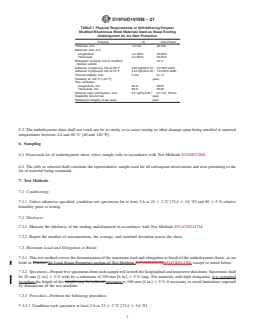
5.1 The underlayment sheet shall conform to the physical requirements prescribed in Table 1.
For referenced ASTM standards, visit the ASTM website, www.astm.org, or contact ASTM Customer Service at service@astm.org. For Annual Book of ASTM Standards
volume information, refer to the standard’s Document Summary page on the ASTM website.
D1970/D1970M − 21
TABLE 1 Physical Requirements of Self-Adhering Polymer
Modified Bituminous Sheet Materials Used as Steep Roofing
Underlayment for Ice Dam Protection
Property SI Inch-Pound
Thickness, min 1.0 mm 40 mils
Maximum load, min
Longitudinal 4.4 kN/m 25 lbf/in.
Transverse 4.4 kN/m 25 lbf/in.
Elongation at break, min of modified 10 %
bitumen portion
Adhesion to plywood, min at 40 °F 0.92 kgf/30.5 cm 2.0 lbf/ft width
Adhesion to plywood, min at 75 °F 5.44 kgf/30.5 cm 12.0 lbf/ft width
Thermal stability, max 3 mm 0.1 in.
Flexibility at –29 °C [–20 °F] pass
Tear resistance
Longitudinal, min 89 N 20 lbf
Transverse, min 89 N 20 lbf
Moisture vapor permeance, max 5.7 ng/Pa.S.M. 0.1 U.S. Perms
Sealability around nail pass
Waterproof integrity of lap seam pass
5.2 The underlayment sheet shall not crack nor be so sticky as to cause tearing or other damage upon being unrolled at material
temperatures between 4.4 and 60 °C [40 and 140 °F].
6. Sampling
6.1 From each lot of underlayment sheet, select sample rolls in accordance with Test Methods D228/D228M.
6.2 The rolls so selected shall constitute the representative sample used for all subsequent observations and tests pertaining to the
lot of material being examined.
7. Test Methods
7.1 Conditioning:
7.1.1 Unless otherwise specified, condition test specimens for at least 4 h at 23 6 2 °C [73.4 6 3.6 °F] and 50 6 5 % relative
humidity prior to testing.
7.2 Thickness:
7.2.1 Measure the thickness of the roofing underlayment in accordance with Test Methods D5147/D5147M.
7.2.2 Report the number of measurements, the average, and standard deviation across the sheet.
7.3 Maximum Load and Elongation at Break:
7.3.1 This test method covers the determination of the maximum load and elongation at break of the underlayment sheets, as set
forth in Practice the Load Strain Properties section of Test Methods D2523/D2523MD5147/D5147M, except as noted below.
7.3.2 Specimens—Prepare five specimens from each sample roll in both the longitudinal and transverse directions. Specimens shall
be 25 mm [1 in.] 6 5 % wide by a minimum of 150 mm [6 in.] 6 5 % long. For materials with high elongation, it is permitted
to reduce the length of the sample may be reduced specimen to 100 mm [4 in.] 6 5 % if necessary to avoid limitations imposed
by dimensions of the test machine.
7.3.3 Procedure—Perform the following procedure.
7.3.3.1 Condition each specimen at least 2 h at 23 6 2 °C [73.4 6 3.6 °F].
D1970/D1970M − 21
7.3.3.2 Use a constant rate of elongation (CRE) tension testing machine, preferably with automatic load and strain recording
equipment and clamps that permit a uniform clamping pressure on the specimen without slipping. The initial clamp separation shall
be a minimum of 75 mm [3 in.] 6 5 % for sheets having an ultimate elongation of 75 % or less at 23.9 °C [75 °F] and 50 mm
[2 in.] 6 5 % for sheets having an ultimate elongation greater than 75 % at 23.9 °C [75 °F].
7.3.3.3 Maintain a rate of separation of 50 mm [2 in.] 6 3 % per min.
7.3.3.3 Record the percent elongation of each specimen at the visual break of the modified bitumen portion using an extensiometer,
or mark the extension at visual break of the modified bitumen portion from the chart of the stress versus time (knowing the speed
of the chart drive and the jaw separation rate).
7.3.3.4 Record the maximum load attained by each specimen.
7.3.4 Calculation—Determine the percent elongation at break of the modified bitumen portion obtained from the extensiometer
in accordance with the manufacturer’s instructions, or read directly. Calculate the percent elongation from the chart as follows:
a
%Elongation 5 3100 % (1)
b
where:
a = extension at modified bitumen break (extension at break on chart × jaw separation rate divided by chart speed), and
b = initial jaw separation.
7.3.4.1 Determine the average percent elongation at break of the modified bitumen portion in each direction.
7.3.4.2 Calculate the average maximum load in each direction.
7.3.5 Report—For each set of five specimens in each direction report the individual measurements, the average and standard
deviation for the size of specimen (initial length between jaws), maximum load in kN/m [lbf/in.], percent elongation at modified
bitumen break, and method of determining elongation.
7.4 Adhesion to Plywood:
7.4.1 This test method covers the determination of the adhesive properties of the underlayment sheets to plywood, as set forth in
Test Method D903 except as noted below.
7.4.2 Specimen Preparation—Prepare test specimens as described.
7.4.2.1 The test specimen shall consist of one piece of underlayment sheet, 75 6 2 by 200 6 2 mm [3 6 0.125 by 8 6 0.125
in.], bonded for 15 in. (75 by 125 mm) [3 by 5 in.] to one piece of 6 mm [ ⁄4 in.] minimum thick plywood, APA Grade, Exposure
1, 75 by 150 mm [3 by 6 in.]. The plywood must not be reused for testing.
7.4.2.2 Roll test specimen three times back and forth with a roller which has a mass of 11.8 kg [26 lb] 6 0.5 %, diameter of 125
mm [5 in.] 6 5 %, and width of 125 mm [5 in.] 6 5 % (2 to 3 s per cycle).
7.4.2.3 At least five specimens shall be tested for each test temperature.
7.4.2.4 It is recommended that specimens be assembled individually. Cutting specimens to size after assembly may influence the
test results.
7.4.3 Conditioning—The test shall be performed at 23 6 2 °C [73.4 6 3.6 °F] and 4 6 2 °C [39.2 6 3.6 °F]. Materials used to
construct test specimens and the roller must be conditioned at the test temperature for at least 4 h prior to assembly. Similarly, test
specimens must be conditioned at the test temperatures for at least 1 h prior to testing.
NOTE 2—Adhesion to other potential wood deck materials may be determined by this test method, but it has been observed that substrates such as
APA-approved nonveneer sheets typically give greater adhesion values than the minimum specified in this standard for plywood.
D1970/D1970M − 21
7.4.4 Apparatus—Perform the test in a constant rate of extension type tester. The rate of travel of the power-actuated grip shall
be 50 mm [2 in.]/min 6 3 %. This rate which provides a laminate separation rate of 25 mm [1 in.]/min 6 3 % shall be uniform
throughout the test.
7.4.5 Procedure—Perform the following procedure.
7.4.5.1 Conduct the test after the test specimens have been conditioned at the test temperature (in the environmental chamber) for
15 min.
7.4.5.2 Separate the free end of the underlayment sheet from the plywood for a distance of about 50 mm [2 in.] leaving about 75
mm [3 in.] of bonded length. Place the specimen in the testing machine by clamping the free end of the plywood in one grip,
turning back the free end of the sheet, and clamping it in the other grip. Maintain the specimen in the approximate plane of the
clamps during the test. Peel at least three quarters of the bonded area, even though a peel or stripping value may be indicated before
this point.
7.4.6 Calculation—Determine the peel strength on the chart as the average load line that will visually accommodate the recorded
curve. Record the load so indicated, corrected for tare.
7.4.7 Reporting—For each series of tests, report the number of measurements, the average, and the standard deviation of all the
test values in kg/30.5 cm width [lb/ft of width].
7.5 Thermal Stability:
7.5.1 This test method determines the thermal stability of the underlayment sheets as set forth in Test Method D1204, except as
noted below.
7.5.2 Specimens—Prepare test specimens as described.
7.5.2.1 The test specimen shall consist of one piece of underlayment sheet, 100 6 2 by 100 6 2 mm [4 6 0.125 by 4 6 0.125
in.], centered and bonded (as described in 7.4.2.2) to one piece of 6 mm [ ⁄4 in.] minimum thick plywood, (APA Grade, Exposure
1) 150 6 2 by 200 6 2 mm [6 6 0.125 by 8 6 0.125 in.].
7.5.2.2 At least five specimens shall be tested for each sample roll.
7.5.3 Procedure—Perform the following procedure.
7.5.3.1 Set specimens at a 45° angle in a hot air circulating oven maintained at 70 6 2 °C [158 6 4 °F] for 14 days.
7.5.3.2 At the end of the oven-exposure period, allow specimens to equilibrate to 23.9 6 1.1 °C [75 6 2 °F] and 50 6 5 % relative
humidity for at least 4 h.
7.5.3.3 From the lower edge of the sheet measure to the nearest 2.5 mm [0.1 in.] the furthest point of modified bitumen flow.
Estimate the average flow across the entire lower edge of the sample.
7.5.4 Report—Report the individual specimen values, the average, and the standard deviation.
7.6 Flexibility at –29 °C [–20 °F]:
7.6.1 Scope—This test method is a qualitative procedure performed in a laboratory that determines the low temperature flexibility
of the underlayment sheets. For the sheet material to be given a pass rating in this test, the material must demonstrate either no
visible signs of cracking after bending at the test temperature through an angle of 180 6 5° around a 25 mm [1 in.] 6 5 % diameter
mandrel in 2 6 1 s, or cracking is visible in one or more specimens that have been bent over the
...