

ASTM E2963-22
(Test Method)Standard Test Method for Laboratory Measurement of Acoustical Effectiveness of Ship Noise Treatments Laboratory Measurement of Acoustical Effectiveness for Marine Bulkhead and Deck Treatments
General Information
- Abstract
SIGNIFICANCE AND USE
5.1 To fully understand the effects of a given treatment, five acoustical factors (transmission loss, acceptance, radiation efficiency, absorption, and damping) must be characterized. For example, only knowing the effect of a given treatment on transmission loss will not allow the acoustical designer or engineer to assess its impacts on propagation of vibration (among other effects), which is an important path to consider for large machinery items and propeller excitation.
5.2 It is necessary to have a common definition of acoustical performance and test procedure to determine all five acoustical factors for ship’s treatments so that the performance of different treatment types, as well as the same treatment type from different manufacturers, can be compared.
5.3 In some cases, particularly for damping treatments, the effect of the treatment will be dependent on the non-treated structure’s material and geometry and other non-acoustic factors such as environmental conditions (that is, temperature). To fully characterize a treatment it may be necessary to test a range of base constructions. For reasons of practicality, convenience, or economy, it may be sufficient to test only one to three constructions to achieve an understanding of the material performance in a range of practical situations. Additional discussion is provided in Annex A1.
SCOPE
1.1 This test method covers the laboratory measurement of the acoustical effectiveness of treatments installed on ship bulkheads, decks, and side shells. Measurements are focused on assessing changes in transmission loss, radiation efficiency, and acceptance that occur when treatments are applied. Measurements of changes to absorption and damping are addressed in Appendix X1 and Appendix X2, respectively.
1.2 The values stated in SI units are to be regarded as standard. No other units of measurement are included in this standard.
1.3 This standard does not purport to address all of the safety concerns, if any, associated with its use. It is the responsibility of the user of this standard to establish appropriate safety, health, and environmental practices and determine the applicability of regulatory limitations prior to use.
1.4 Any material that is to be installed on a marine division must meet appropriate fire, combustibility, and other applicable SOLAS, USCG, IMO, Navy, or other required non-acoustical standards and specifications. See Appendix X3 for additional information.
1.5 This international standard was developed in accordance with internationally recognized principles on standardization established in the Decision on Principles for the Development of International Standards, Guides and Recommendations issued by the World Trade Organization Technical Barriers to Trade (TBT) Committee.
- Status
- Published
- Publication Date
- 31-Mar-2022
- Technical Committee
- E33 - Building and Environmental Acoustics
- Drafting Committee
- E33.10 - Structural Acoustics and Vibration
Buy Documents
ASTM E2963-22 - Standard Test Method for Laboratory Measurement of Acoustical Effectiveness of Ship Noise Treatments Laboratory Measurement of Acoustical Effectiveness for Marine Bulkhead and Deck Treatments
REDLINE ASTM E2963-22 - Standard Test Method for Laboratory Measurement of Acoustical Effectiveness of Ship Noise Treatments Laboratory Measurement of Acoustical Effectiveness for Marine Bulkhead and Deck Treatments
Overview
ASTM E2963-22: Standard Test Method for Laboratory Measurement of Acoustical Effectiveness of Ship Noise Treatments provides a comprehensive laboratory procedure for evaluating the acoustical effectiveness of treatments applied to marine bulkheads, decks, and side shells. This ASTM standard helps ensure consistent, repeatable testing and objective comparison of noise reduction materials intended for use aboard ships. The method builds upon established test procedures such as ASTM E90 for airborne sound transmission loss and incorporates parameters necessary for the unique demands of marine applications.
Key Topics
ASTM E2963-22 focuses on five fundamental acoustical parameters essential for the effective assessment of marine noise control treatments:
- Transmission Loss: Quantifies the reduction in airborne sound as it passes through treated ship structures, measured in decibels according to ASTM E90.
- Radiation Efficiency: Assesses how efficiently a vibrating surface radiates sound, crucial for understanding noise propagation from sources like machinery.
- Acceptance: Measures vibration velocity levels induced in a structure exposed to a diffuse sound field.
- Absorption: Evaluates how much sound energy is absorbed by the treatment material (discussed further in ASTM C423 and Appendix X1).
- Damping: Determines the material’s ability to reduce vibrational energy within the structure (aligned with ASTM E756 and Appendix X2).
The standard emphasizes that characterizing all five parameters is vital, as focusing on a single factor like transmission loss does not fully represent a treatment's noise reduction capabilities-especially in complex marine environments where vibration and radiated noise are significant concerns.
Applications
ASTM E2963-22 is essential for a range of marine noise control applications, including:
- Ship Design and Engineering: Enables naval architects, marine engineers, and acoustical consultants to select and verify the effectiveness of noise control treatments for compliance with regulatory and operational requirements.
- Equipment Procurement: Allows shipbuilders and procurement specialists to compare different insulation and damping products both across types and manufacturers, supporting informed choices for optimal noise and vibration control.
- Regulatory Compliance: Supports fulfillment of industry standards such as SOLAS, USCG, IMO, and Navy requirements, by defining procedures to test and certify products under controlled laboratory conditions.
- Research and Development: Provides manufacturers with a standardized method to evaluate and improve new sound-damping products or insulation materials for marine use.
Testing under ASTM E2963-22 ensures materials are assessed for their combined acoustic barriers and vibration mitigation properties, directly addressing common marine noise problems stemming from propulsion systems, onboard machinery, and external environments.
Related Standards
ASTM E2963-22 references and aligns with several important standards to ensure comprehensive acoustical testing:
- ASTM E90 – Laboratory Measurement of Airborne Sound Transmission Loss of Building Partitions and Elements
- ASTM C423 – Sound Absorption and Sound Absorption Coefficients by the Reverberation Room Method
- ASTM E756 – Measuring Vibration-Damping Properties of Materials
- ANSI S1.4 – Sound Level Meters Specification
- ANSI S1.6 – Preferred Frequencies for Acoustical Measurements
- ISO 16063-1 – Methods for the Calibration of Vibration and Shock Transducers
By leveraging these related standards, ASTM E2963-22 ensures reliable, internationally recognized testing protocols for marine noise treatments.
Keywords: ASTM E2963-22, ship noise treatments, marine acoustics, laboratory test, transmission loss, radiation efficiency, acceptance, sound absorption, damping, marine insulation, vibration control, ship bulkhead acoustics, noise reduction, ISO, SOLAS compliance.
Relations
- Effective Date
- 01-Dec-2023
- Refers
ASTM E756-05(2023) - Standard Test Method for Measuring Vibration-Damping Properties of Materials - Effective Date
- 01-Nov-2023
- Refers
ASTM E756-05(2017) - Standard Test Method for Measuring Vibration-Damping Properties of Materials - Effective Date
- 01-Sep-2017
- Effective Date
- 01-Dec-2016
- Effective Date
- 01-Sep-2013
- Effective Date
- 01-Dec-2011
- Effective Date
- 01-Sep-2010
- Effective Date
- 01-Jun-2010
- Refers
ASTM E756-05(2010) - Standard Test Method for Measuring Vibration-Damping Properties of Materials - Effective Date
- 01-May-2010
- Effective Date
- 15-Oct-2009
- Effective Date
- 01-Oct-2009
- Effective Date
- 01-Jul-2009
- Effective Date
- 01-Apr-2009
- Effective Date
- 01-Oct-2008
- Effective Date
- 01-Sep-2008
Buy Documents
ASTM E2963-22 - Standard Test Method for Laboratory Measurement of Acoustical Effectiveness of Ship Noise Treatments Laboratory Measurement of Acoustical Effectiveness for Marine Bulkhead and Deck Treatments
REDLINE ASTM E2963-22 - Standard Test Method for Laboratory Measurement of Acoustical Effectiveness of Ship Noise Treatments Laboratory Measurement of Acoustical Effectiveness for Marine Bulkhead and Deck Treatments
Get Certified
Connect with accredited certification bodies for this standard

BSMI (Bureau of Standards, Metrology and Inspection)
Taiwan's standards and inspection authority.
Sponsored listings
Frequently Asked Questions
ASTM E2963-22 is a standard published by ASTM International. Its full title is "Standard Test Method for Laboratory Measurement of Acoustical Effectiveness of Ship Noise Treatments Laboratory Measurement of Acoustical Effectiveness for Marine Bulkhead and Deck Treatments". This standard covers: SIGNIFICANCE AND USE 5.1 To fully understand the effects of a given treatment, five acoustical factors (transmission loss, acceptance, radiation efficiency, absorption, and damping) must be characterized. For example, only knowing the effect of a given treatment on transmission loss will not allow the acoustical designer or engineer to assess its impacts on propagation of vibration (among other effects), which is an important path to consider for large machinery items and propeller excitation. 5.2 It is necessary to have a common definition of acoustical performance and test procedure to determine all five acoustical factors for ship’s treatments so that the performance of different treatment types, as well as the same treatment type from different manufacturers, can be compared. 5.3 In some cases, particularly for damping treatments, the effect of the treatment will be dependent on the non-treated structure’s material and geometry and other non-acoustic factors such as environmental conditions (that is, temperature). To fully characterize a treatment it may be necessary to test a range of base constructions. For reasons of practicality, convenience, or economy, it may be sufficient to test only one to three constructions to achieve an understanding of the material performance in a range of practical situations. Additional discussion is provided in Annex A1. SCOPE 1.1 This test method covers the laboratory measurement of the acoustical effectiveness of treatments installed on ship bulkheads, decks, and side shells. Measurements are focused on assessing changes in transmission loss, radiation efficiency, and acceptance that occur when treatments are applied. Measurements of changes to absorption and damping are addressed in Appendix X1 and Appendix X2, respectively. 1.2 The values stated in SI units are to be regarded as standard. No other units of measurement are included in this standard. 1.3 This standard does not purport to address all of the safety concerns, if any, associated with its use. It is the responsibility of the user of this standard to establish appropriate safety, health, and environmental practices and determine the applicability of regulatory limitations prior to use. 1.4 Any material that is to be installed on a marine division must meet appropriate fire, combustibility, and other applicable SOLAS, USCG, IMO, Navy, or other required non-acoustical standards and specifications. See Appendix X3 for additional information. 1.5 This international standard was developed in accordance with internationally recognized principles on standardization established in the Decision on Principles for the Development of International Standards, Guides and Recommendations issued by the World Trade Organization Technical Barriers to Trade (TBT) Committee.
SIGNIFICANCE AND USE 5.1 To fully understand the effects of a given treatment, five acoustical factors (transmission loss, acceptance, radiation efficiency, absorption, and damping) must be characterized. For example, only knowing the effect of a given treatment on transmission loss will not allow the acoustical designer or engineer to assess its impacts on propagation of vibration (among other effects), which is an important path to consider for large machinery items and propeller excitation. 5.2 It is necessary to have a common definition of acoustical performance and test procedure to determine all five acoustical factors for ship’s treatments so that the performance of different treatment types, as well as the same treatment type from different manufacturers, can be compared. 5.3 In some cases, particularly for damping treatments, the effect of the treatment will be dependent on the non-treated structure’s material and geometry and other non-acoustic factors such as environmental conditions (that is, temperature). To fully characterize a treatment it may be necessary to test a range of base constructions. For reasons of practicality, convenience, or economy, it may be sufficient to test only one to three constructions to achieve an understanding of the material performance in a range of practical situations. Additional discussion is provided in Annex A1. SCOPE 1.1 This test method covers the laboratory measurement of the acoustical effectiveness of treatments installed on ship bulkheads, decks, and side shells. Measurements are focused on assessing changes in transmission loss, radiation efficiency, and acceptance that occur when treatments are applied. Measurements of changes to absorption and damping are addressed in Appendix X1 and Appendix X2, respectively. 1.2 The values stated in SI units are to be regarded as standard. No other units of measurement are included in this standard. 1.3 This standard does not purport to address all of the safety concerns, if any, associated with its use. It is the responsibility of the user of this standard to establish appropriate safety, health, and environmental practices and determine the applicability of regulatory limitations prior to use. 1.4 Any material that is to be installed on a marine division must meet appropriate fire, combustibility, and other applicable SOLAS, USCG, IMO, Navy, or other required non-acoustical standards and specifications. See Appendix X3 for additional information. 1.5 This international standard was developed in accordance with internationally recognized principles on standardization established in the Decision on Principles for the Development of International Standards, Guides and Recommendations issued by the World Trade Organization Technical Barriers to Trade (TBT) Committee.
ASTM E2963-22 is classified under the following ICS (International Classification for Standards) categories: 17.140.20 - Noise emitted by machines and equipment. The ICS classification helps identify the subject area and facilitates finding related standards.
ASTM E2963-22 has the following relationships with other standards: It is inter standard links to ASTM E90-23, ASTM E756-05(2023), ASTM E756-05(2017), ASTM E90-09(2016), ASTM C634-13, ASTM C634-11, ASTM C634-10a, ASTM C634-10, ASTM E756-05(2010), ASTM C423-09a, ASTM C423-09, ASTM E90-09, ASTM C634-09, ASTM C423-08a, ASTM C634-08a. Understanding these relationships helps ensure you are using the most current and applicable version of the standard.
ASTM E2963-22 is available in PDF format for immediate download after purchase. The document can be added to your cart and obtained through the secure checkout process. Digital delivery ensures instant access to the complete standard document.
Standards Content (Sample)
This international standard was developed in accordance with internationally recognized principles on standardization established in the Decision on Principles for the
Development of International Standards, Guides and Recommendations issued by the World Trade Organization Technical Barriers to Trade (TBT) Committee.
Designation: E2963 − 22
Standard Test Method for
Laboratory Measurement of Acoustical Effectiveness of
Ship Noise Treatments Laboratory Measurement of
Acoustical Effectiveness for Marine Bulkhead and Deck
Treatments
This standard is issued under the fixed designation E2963; the number immediately following the designation indicates the year of
original adoption or, in the case of revision, the year of last revision. A number in parentheses indicates the year of last reapproval. A
superscript epsilon (´) indicates an editorial change since the last revision or reapproval.
INTRODUCTION
This test method is designed to measure the acoustical effectiveness of treatments that are intended
to reduce airborne noise on ships. Such treatments would be applied to compartment structural
partitions such as bulkheads, decks, and side shells. To fully characterize the acoustical performance
of a treatment, five parameters must be assessed: transmission loss, radiation efficiency, acceptance,
absorption, and damping. This test method focuses on the assessment of the first three of these
parameters. Tests discussed in this method are based on the Test Method E90 setup and procedure.
This test method is not intended to be a replacement of Test Method E90; conversely, this method
builds on the E90 method that is now well established. Similarly, this test method does not replace
absorption testing discussed in Test Method C423, nor damping testing discussed in Test Method
E756. The use of these standards is strongly encouraged to assess absorption and damping,
respectively, if these are the primary features of the noise control material.
1. Scope SOLAS, USCG, IMO, Navy, or other required non-acoustical
standards and specifications. See Appendix X3 for additional
1.1 This test method covers the laboratory measurement of
information.
the acoustical effectiveness of treatments installed on ship
1.5 This international standard was developed in accor-
bulkheads, decks, and side shells. Measurements are focused
dance with internationally recognized principles on standard-
on assessing changes in transmission loss, radiation efficiency,
ization established in the Decision on Principles for the
and acceptance that occur when treatments are applied. Mea-
Development of International Standards, Guides and Recom-
surements of changes to absorption and damping are addressed
mendations issued by the World Trade Organization Technical
in Appendix X1 and Appendix X2, respectively.
Barriers to Trade (TBT) Committee.
1.2 The values stated in SI units are to be regarded as
standard. No other units of measurement are included in this
2. Referenced Documents
standard.
2.1 ASTM Standards:
1.3 This standard does not purport to address all of the
C423 Test Method for SoundAbsorption and SoundAbsorp-
safety concerns, if any, associated with its use. It is the
tion Coefficients by the Reverberation Room Method
responsibility of the user of this standard to establish appro-
C634 Terminology Relating to Building and Environmental
priate safety, health, and environmental practices and deter-
Acoustics
mine the applicability of regulatory limitations prior to use.
E90 Test Method for Laboratory Measurement of Airborne
1.4 Any material that is to be installed on a marine division
Sound Transmission Loss of Building Partitions and
mustmeetappropriatefire,combustibility,andotherapplicable
Elements
E756 Test Method for Measuring Vibration-Damping Prop-
erties of Materials
ThistestmethodisunderthejurisdictionofASTMCommitteeE33onBuilding
and Environmental Acoustics and is the direct responsibility of Subcommittee
E33.10 on Structural Acoustics and Vibration. For referenced ASTM standards, visit the ASTM website, www.astm.org, or
Current edition approved April 1, 2022. Published April 2022. Originally contact ASTM Customer Service at service@astm.org. For Annual Book of ASTM
approved in 2014. Last previous edition approved in 2016 as E2963 – 16. DOI: Standards volume information, refer to the standard’s Document Summary page on
10.1520/E2963-22. the ASTM website.
Copyright © ASTM International, 100 Barr Harbor Drive, PO Box C700, West Conshohocken, PA 19428-2959. United States
E2963 − 22
2.2 ANSI Standards:
L = sound pressure level, dB re: 20 µPa. Lv – velocity
p
-8
ANSI S1.4-1983 (R2006) Specification for Sound Level
level, dB re: 10 nm/s (that is, 10 m/s)
Meters
L = acceptance in decibels referenced to 20 µPa/10 nm/s
Λ
ANSI S1.6-1984 (R2011) Preferred Frequencies, Frequency L = radiation efficiency in decibels
σ
Levels, and Band Number for Acoustical Measurements TL = transmission loss in decibels
∆X = change in the quantity “X” between treated and
ANSI S1.8-1989 (R2011) ,Reference Quantities for Acous-
non-treated test cases
tical Levels
α = sound absorption coefficient
ANSI S1.11-2004 (R2009) Specification for Octave-Band
η = loss factor, (no dimensions)
and Fractional-Octave-Band Analog and Digital Filters
ρ = density, kg/m
ANSI S1.43-1997 (R2007) Specifications for Integrating-
Averaging Sound Level Meters
3.4 All levels expressed in decibels have a reference quan-
2.3 ISO Stadnard:
tity. A level expressed in decibels is 10 times the common
ISO16063-1:1998 ,MethodsfortheCalibrationofVibration
logarithm of the ratio of a squared quantity divided by a
and Shock Transducers
squaredreferencequantity.Forexample,thereferencequantity
for sound pressure level is 20 micropascals. The abbreviated
3. Terminology
level is written as dB re: 20 µPa
3.1 Definitions—Terms used in this standard are defined
4. Summary of Test Method
either in Terminology C634 or within this standard. The
definition of terms explicitly given within this standard take
4.1 The effectiveness of a given treatment is determined by
precedence over definitions given in Terminology C634. The
comparing the acoustical properties of a given structure with
definitions within Terminology C634 and this standard take
and without the treatment applied. Measurements are first
precedenceoveranyotherdefinitionsofdefinedtermsfoundin
performed on a ‘baseline’ test structure (that is, without the
any other documents, including other documents that may be
treatmentinplace).Thetreatmentisthenaddedtothestructure
referenced in this standard.
and tests are repeated.The differences in acoustical parameters
between the treated and non-treated structures determine the
3.2 Definitions of Terms Specific to This Standard:
acoustical effectiveness of the treatment.
3.2.1 acceptance, n—a measure of the vibration velocity
level induced in a structure that is exposed to a diffuse sound
4.2 The general test setup discussed in Test Method E90
field composed of one or more frequencies (see Eq 6). shall be used. Two adjacent reverberation rooms are arranged
with an opening between them in which a test partition is
3.2.2 acousticaleffectiveness,n—ameasureofthechangein
installed.
a particular acoustical parameter that is created by the addition
of a material to the base structure.
4.3 Transmission loss, acceptance, and radiation efficiency
(as well as absorption and damping) are all functions of
3.2.3 radiation effıciency, n—a measure relating the sound
frequency,andmeasurementsaremadeinaseriesoffrequency
pressure level in a diffuse sound field that is produced by a
bands.
vibrating structural surface, referenced to a specified vibration
velocity level, when that surface is moving in an oscillatory
4.4 For measurement of transmission loss,Test Method E90
motion at one or more frequencies (see Eq 8).
shall be used to test both the treated and non-treated structures.
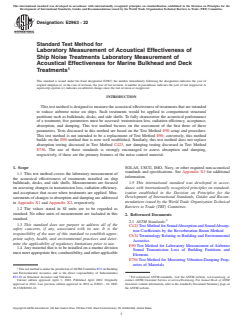
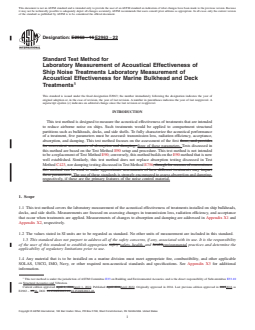
3.2.4 test or ‘base’structure, n—The structure representing Fig. 1 presents a schematic diagram of the test setup, for
a bulkhead, deck, or shell of a ship. reference purposes.
3.2.4.1 Discussion—The base structure is typically con-
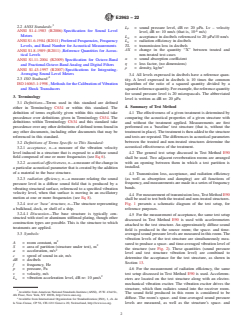
4.5 For the measurement of acceptance, the same test setup
structed with steel or aluminum stiffened plating, though other
discussed in Test Method E90 is used with accelerometers
construction types are possible. This is the structure to which
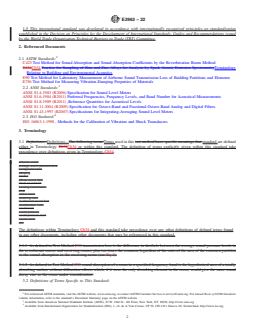
attached to the test structure. An approximately diffuse sound
treatments are applied.
field is produced in the source room; the space- and time-
3.3 Symbols: averaged sound pressure levels are measured in this room. The
vibration levels of the test structure are simultaneously mea-
A = room constant, m
sured to produce a space- and time-averaged vibration level of
S = area of partition (structure under test), m
the structure (see Fig. 2). These quantities (sound pressure
a = acceleration, m/s
level and test structure vibration level) are combined to
c = speed of sound in air, m/s
determine the acceptance for the test structure, as shown in
dB = decibels
Section 13.
f = frequency, Hz
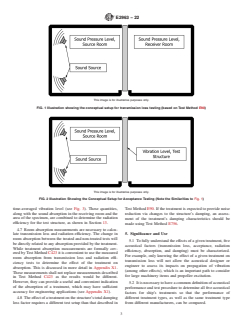
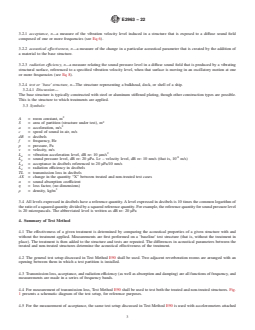
p = pressure, Pa 4.6 For the measurement of radiation efficiency, the same
v = velocity, m/s
test setup discussed in Test Method E90 is used. Accelerom-
L = vibration acceleration level, dB re: 10 µm/s
a eters are located on the test structure along with an electro-
mechanical vibration exciter. The vibration exciter drives the
structure, which then radiates sound into the receiver room.
Available fromAmerican National Standards Institute (ANSI), 25 W. 43rd St.,
The sound field produced in this room is considered to be
4th Floor, New York, NY 10036, http://www.ansi.org.
diffuse. The room’s space- and time-averaged sound pressure
Available from International Organization for Standardization (ISO), 1, ch. de
la Voie-Creuse, CP 56, CH-1211 Geneva 20, Switzerland, http://www.iso.org. levels are measured, as well as the structure’s space- and
E2963 − 22
This image is for illustrative purposes only.
FIG. 1 Illustration showing the conceptual setup for transmission loss testing (based on Test Method E90)
This image is for illustrative purposes only.
FIG. 2 Illustration Showing the Conceptual Setup for Acceptance Testing (Note the Similarities to Fig. 1)
time-averaged vibration level (see Fig. 3). These quantities, Test Method E90. If the treatment is expected to provide noise
along with the sound absorption in the receiving room and the reduction via changes to the structure’s damping, an assess-
area of the specimen, are combined to determine the radiation
ment of the treatment’s damping characteristics should be
efficiency for the test structure, as shown in Section 13.
made using Test Method E756.
4.7 Room absorption measurements are necessary to calcu-
5. Significance and Use
late transmission loss and radiation efficiency. The change in
room absorption between the treated and non-treated tests will
5.1 To fully understand the effects of a given treatment, five
be directly related to any absorption provided by the treatment.
acoustical factors (transmission loss, acceptance, radiation
While treatment absorption measurements are formally cov-
efficiency, absorption, and damping) must be characterized.
ered byTest Method C423 it is convenient to use the measured
For example, only knowing the effect of a given treatment on
room absorption from transmission loss and radiation effi-
transmission loss will not allow the acoustical designer or
ciency tests to determine the effect of the treatment on
engineer to assess its impacts on propagation of vibration
absorption. This is discussed in more detail in Appendix X1.
(among other effects), which is an important path to consider
These measurements shall not replace measurements described
for large machinery items and propeller excitation.
in Test Method C423 as the results would be different.
However, they can provide a useful and convenient indication
5.2 Itisnecessarytohaveacommondefinitionofacoustical
of the absorption of a treatment, which may have sufficient
performance and test procedure to determine all five acoustical
accuracy for engineering applications (see Appendix X1).
factors for ship’s treatments so that the performance of
different treatment types, as well as the same treatment type
4.8 Theeffectofatreatmentonthestructure’stotaldamping
loss factor requires a different test setup than that described in from different manufacturers, can be compared.
E2963 − 22
This image is for illustrative purposes only.
FIG. 3 Illustration Showing the Conceptual Setup for Acceptance Testing (Note the Similarities to Fig. 1)
5.3 In some cases, particularly for damping treatments, the 6.5 Aging of Specimens—Treatments that incorporate mate-
effect of the treatment will be dependent on the non-treated rialsforwhichthereisacuringprocessshallageforasufficient
structure’s material and geometry and other non-acoustic interval before testing, as recommended by the manufacturer.
factors such as environmental conditions (that is, temperature). In these cases, it may be convenient and practical to use
To fully characterize a treatment it may be necessary to test a separate test structures of identical construction to test the
range of base constructions. For reasons of practicality, treated and non-treated conditions.
convenience, or economy, it may be sufficient to test only one
to three constructions to achieve an understanding of the
7. Test Signal Sources
material performance in a range of practical situations. Addi-
7.1 Signal Spectrum—The sound and vibration signals used
tional discussion is provided in Annex A1.
for these tests shall be random noise having a continuous
spectrum within each test frequency band.
6. Test Apparatus
7.2 Sound Sources—Sound is generated in the rooms using
6.1 The room requirements of Test Method E90 shall be
loudspeaker systems. The requirements for sound sources
used for the testing of transmission loss, acceptance, and
defined in Test Method E90 shall be followed.
radiation efficiency. Special attention may be needed when
7.3 Vibration Sources—An electro-mechanical vibration ex-
testingthetreatedstructuretomeetthesignal-to-noiseratioper
Test Method E90. citer capable of producing vibration in the test frequency band
shall be used. Note that multiple vibration exciters may be
6.2 Where the test structure is smaller than the opening
necessary to cover the entire test frequency range (see 11.2).
between the source and receiver rooms, a filler wall shall be
Signals can be produced over the entire test frequency range or
constructed as described in Test Method E90. Meeting the
brokenupintomultiplefrequencyrangesasneededtomeetthe
transmission loss requirements for this filler wall shall consti-
test requirements of this test method.
tute meeting related requirements for acceptance and radiation
7.3.1 The vibration exciter must provide enough power to
efficiency.
sufficiently excite the test structure to (a) generate noise levels
6.3 Thestructureshallbeconstructedtoberepresentativeof
in the receiver room that are at least 10 dB above background
actual bulkhead, deck, or shell structure to which the treatment
noiselevelsand (b)generatevibrationlevelsthatareatleast10
will be applied. Often, a single treatment can be applied to
dB above the background vibration levels of the test structure.
many different structures and construction types; therefore, not
7.3.2 Attach or mount the vibration exciter to a stiffener
all constructions can be practically tested. In such cases it is
located away from the edge of the test structure. The closest
recommended that one to three ‘reference’bulkheads be tested,
distance between the vibration exciter and the edge of the
as discussed in Annex A1, to establish a baseline material
structure shall be no smaller than the distance between stiff-
performance to which other materials can be readily compared.
eners. A location near the middle of the stiffener is preferable
If treatment effectiveness is expected to change significantly
for most test structures.
with different bulkhead constructions then additional construc-
7.3.3 If the ‘unstiffened’side of the structure is excited, the
tions shall be tested to better define the performance of the
vibration exciter should be mounted as close as possible to the
material.
location of a stiffener instead of between stiffeners.
6.4 Treatments shall be applied to the test structure as they 7.3.4 Excitation should be oriented normal to the plating.
would be in an actual ship installation.This includes the use of The vibration exciter location must be the same for tests of
special mounting hardware or edge treatments, as applicable. treated and non-treated structures.
E2963 − 22
Note that stiffener spacing is approximately the same as the accelerometer spacing.
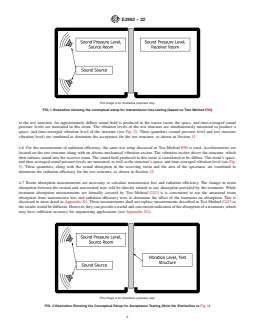
FIG. 4 Example of accelerometer measurement locations
7.3.5 When treatments are applied to only one side, the 9.4 Calibration—Each accelerometer shall have been cali-
vibration exciter shall be attached to the non-treated side. brated over the range of test frequencies to ensure the required
Whentreatmentsareappliedtobothsides,thevibrationexciter accuracy per ISO 16063. A record shall be kept of the
shall be attached directly to the base structure. Minimal calibrationdataanddatesofcalibration.Fieldcalibrationofthe
movement or removal of treatments should be employed to entire measurement system for at least one frequency shall be
accommodate vibration exciter attachment.
made at least once during each day of testing.
9.5 Field calibration shall be made using a vibration cali-
8. Microphone Requirements
brator. The reading of the acceleration level should match the
8.1 Microphone requirements and placement described in
output of the calibrator, adjusted for any gains or sensitivities
Test Method E90 shall be followed.
of the system. Accelerometer sensitivity differences greater
than10%relativetothenominalmanufacturersensitivityshall
9. Accelerometer Requirements
not be used.
9.1 Accelerometers are used to measure the vibration of the
9.6 Accelerometer Positions—Accelerometers shall be
structure to determine the acceptance and radiation efficiency.
mounted to the test structure itself, not to the treatment. When
Systems employing single or multiple accelerometers can be
necessary, portions of the treatment can be moved or removed
used, though multiple accelerometer systems are recom-
toallowforaccelerometeraccess,aslongassuchremovaldoes
mended.
not account for more than1%ofthe total treatment surface
9.2 Accelerometer Performance Requirements—Use accel-
area and does not otherwise compromise its effectiveness.
erometers and data acquisition systems that are stable (as
Whentreatmentsareappliedtoonlyonesideofateststructure,
defined in ANSI S1.4, Section 3.10 for a Type 1 measurement
accelerometers should be applied to the untreated side.
system) and have a uniform response in the frequency range of
9.6.1 Primary accelerometer positions shall be on plating
measurement. Where multiple accelerometers are used, they
between stiffeners.
should be of the same model.
9.6.2 Accelerometer locations may be spaced by approxi-
9.3 Accelerometer Mass—Accelerometersshouldbeaslight
mately the same distance as the smallest distance between
as possible in order to avoid mass loading effects (1).
adjacent stiffeners.Accelerometers should be located no closer
Accelerometers must have a mass of 15 g or less.
than half the stiffener spacing from the edges of the test
structure. For practical bulkhead configurations (see Annex
A1), this would result in approximately 10 to 20 locations.An
The boldface numbers in parentheses refer to a list of references at the end of
this standard. example is shown in Fig. 4.
E2963 − 22
9.6.3 Alternatively, a pseudo-random placement can be 11. Frequency Range and Bandwidth for Analysis
used, as shown in Fig. 5. This involves dividing the test
11.1 The frequency range and bandwidth for all tests shall
structure into “Accelerometer PlacementAreas” and randomly
be the same as that specified in Test Method E90, except as
locating one accelerometer within each area. The Accelerom-
specified below.
eter PlacementAreas should have dimensions that are approxi-
11.2 Standard Test Frequencies—Measurements shall be
mately equal to the stiffener spacing; a buffer of at least 10 %
made in one-third-octave bands with mid-band frequencies
of the stiffener spacing shall be provided adjacent to any
specified in ANSI S1.6 from 100 to 10 000 Hz. It is often
stiffeners and the edge of the test structure. This will ensure
desirablethatthefrequencyrangebeextendedtoincludebands
that accelerometers are not placed directly on stiffeners.
below 100 Hz. Many applications require information on low
9.6.4 Additional accelerometer locations can be used as
frequency acoustical performance and laboratory operators are
deemed necessary. Additional locations would be employed if
encouraged to collect and report information down to at least
significant variations in vibration levels were seen in any
63 Hz where feasible. Note that larger room volumes are
frequency band between adjacent accelerometer locations (that
recommended when measuring at lower frequencies (see Test
is, variations that would cause deviations to the measured
Method E90).
changes that are greater than the expected accuracy discussed
inSection15).Inaddition,measurementlocationsonstiffeners
12. Procedure
can be utilized if deemed to have significant vibration levels
relative to plating locations. All accelerometer locations must
12.1 Measurement Overview—Measurements of transmis-
be identical for tests of treated and non-treated test structures.
sion loss and acceptance can be performed simultaneously.
9.6.5 During radiation efficiency testing, measurements
Measurements of radiation efficiency must be performed sepa-
shall not be performed directly at or immediately adjacent to
rately. Measurements of sound absorption and damping are
the vibration exciter position. Accelerometers should be lo-
performed separately, as discussed in Appendix X1 and Ap-
cated at least ⁄2 of the stiffener spacing away from the
pendix X2, respectively. Sound sources and vibration exciters
vibration exciter.
must not be used at the same time during a test.
12.1.1 Measurements of transmission loss are performed in
9.7 Accelerometer Measurement Direction—
Accelerometers should be applied to the structure so that they accordance with Test Method E90.
measure vibration in the direction normal to the plate surface 12.1.2 Measurements of acceptance are performed by gen-
(that is, out-of-plane direction). eratinganacousticsignalinthesourceroomandmeasuringthe
resulting sound pressure level in the source room as well as the
10. Hazards
vibration of the test structure. Note that when performing a
10.1 Test structures will be heavy. Care must be taken when measurement of acceptance of the treated test structure, the
treated side is typically in the source room.
assembling, moving, and installing test structures. Proper
mechanical lifting equipment shall be used at all times when 12.1.3 Measurements of radiation efficiency are performed
moving test structures. All personnel shall maintain a safe by energizing the vibration exciter and measuring the resulting
distance from test structures while they are being moved. vibration of the test structure as well as the sound pressure
level in the receiver room. Note that when performing a
When stationary, test structures must be properly secured in
place. measurement of radiation efficiency of the treated test
FIG. 5 Example of pseudo-random accelerometer measurement locations
E2963 − 22
structure, the treated side is typically in the receiver room 12.5 Determination of Room Absorption, A—The room
unless significant changes to damping loss factor are expected. absorption in the receiver room must be measured to calculate
The vibration exciter must not be located in the receiver room, transmission loss and radiation efficiency. As noted in 4.7,a
as noise from the vibration exciter itself may adversely impact measurement of absorption can be used to assist with the
the test results. definition of the acoustical performance of a treatment. The
measurement of room absorption shall follow Test Method
12.1.4 Given the above test descriptions, it will be advan-
E90. The receiver room may be different for tests of transmis-
tageous to allow both test rooms to be used interchangeably as
sion loss and radiation efficiency. In either case, it will be
the source and receiver room. For example, if a treatment is
desirable to measure the room constant in the room containing
appliedtoonesideofateststructure,thetreatedsideshouldbe
the treatment (see Appendix X1).
in the source room for the acceptance test and the receiver
roomfortheradiationefficiencytest.Thiscanbeaccomplished
13. Calculation
byapplyingthetreatmentonthesideoftheteststructurefacing
the room containing the sound source and using microphones
13.1 All calculations shall be performed for each one-third-
in both rooms. In these
...
This document is not an ASTM standard and is intended only to provide the user of an ASTM standard an indication of what changes have been made to the previous version. Because
it may not be technically possible to adequately depict all changes accurately, ASTM recommends that users consult prior editions as appropriate. In all cases only the current version
of the standard as published by ASTM is to be considered the official document.
Designation: E2963 − 16 E2963 − 22
Standard Test Method for
Laboratory Measurement of Acoustical Effectiveness of
Ship Noise Treatments Laboratory Measurement of
Acoustical Effectiveness for Marine Bulkhead and Deck
Treatments
This standard is issued under the fixed designation E2963; the number immediately following the designation indicates the year of
original adoption or, in the case of revision, the year of last revision. A number in parentheses indicates the year of last reapproval. A
superscript epsilon (´) indicates an editorial change since the last revision or reapproval.
INTRODUCTION
This test method is designed to measure the acoustical effectiveness of treatments that are intended
to reduce airborne noise on ships. Such treatments would be applied to compartment structural
partitions such as bulkheads, decks, and side shells. To fully characterize the acoustical performance
of a treatment, five parameters must be assessed: transmission loss, radiation efficiency, acceptance,
absorption, and damping. This test method focuses on the assessment of the first three, and provides
for convenient assessments of absorption and damping. three of these parameters. Tests discussed in
this method are based on the Test Method E90 setup and procedure. This test method is not intended
to be a replacement of Test Method E90; conversely, this method builds on the E90 method that is now
well established. Similarly, this test method does not replace absorption testing discussed in Test
Method C423, nor damping testing discussed in Test Method E756, though for reasons of convenience
this method can be used to make approximate assessments of how different treatments may impact
these parameters. The use of these standards is strongly encouraged to assess absorption and damping,
respectively, if these are the primary features of the noise control material.
1. Scope
1.1 This test method covers the laboratory measurement of the acoustical effectiveness of treatments installed on ship bulkheads,
decks, and side shells. Measurements are focused on assessing changes in transmission loss, radiation efficiency, and acceptance
that occur when treatments are applied. Measurements of changes to absorption and damping are addressed in Appendix X1 and
Appendix X2, respectively.
1.2 The values stated in SI units are to be regarded as standard. No other units of measurement are included in this standard.
1.3 This standard does not purport to address all of the safety concerns, if any, associated with its use. It is the responsibility
of the user of this standard to establish appropriate safety safety, health, and healthenvironmental practices and determine the
applicability of regulatory limitations prior to use.
1.4 Any material that is to be installed on a marine division must meet appropriate fire, combustibility, and other applicable
SOLAS, USCG, IMO, Navy, or other required non-acoustical standards and specifications. See Appendix X3 for additional
information.
This test method is under the jurisdiction of ASTM Committee E33 on Building and Environmental Acoustics and is the direct responsibility of Subcommittee E33.10
on Structural Acoustics and Vibration.
Current edition approved April 1, 2016April 1, 2022. Published April 2016April 2022. Originally approved in 2014. Last previous edition approved in 20152016 as
E2963 – 15.16. DOI: 10.1520/E2963-16.10.1520/E2963-22.
Copyright © ASTM International, 100 Barr Harbor Drive, PO Box C700, West Conshohocken, PA 19428-2959. United States
E2963 − 22
1.5 This international standard was developed in accordance with internationally recognized principles on standardization
established in the Decision on Principles for the Development of International Standards, Guides and Recommendations issued
by the World Trade Organization Technical Barriers to Trade (TBT) Committee.
2. Referenced Documents
2.1 ASTM Standards:
C423 Test Method for Sound Absorption and Sound Absorption Coefficients by the Reverberation Room Method
E634C634 Practice for Sampling of Zinc and Zinc Alloys for Analysis by Spark Atomic Emission SpectrometryTerminology
Relating to Building and Environmental Acoustics
E90 Test Method for Laboratory Measurement of Airborne Sound Transmission Loss of Building Partitions and Elements
E756 Test Method for Measuring Vibration-Damping Properties of Materials
2.2 ANSI Standards:
ANSI S1.4-1983 (R2006) Specification for Sound Level Meters
ANSI S1.6-1984 (R2011) Preferred Frequencies, Frequency Levels, and Band Number for Acoustical Measurements
ANSI S1.8-1989 (R2011) ,Reference Quantities for Acoustical Levels
ANSI S1.11-2004 (R2009) Specification for Octave-Band and Fractional-Octave-Band Analog and Digital Filters
ANSI S1.43-1997 (R2007) Specifications for Integrating-Averaging Sound Level Meters
2.3 ISO Stadnard:
ISO 16063-1:1998 , Methods for the Calibration of Vibration and Shock Transducers
3. Terminology
3.1 Definitions: Definitions—The following terms Terms used in this test method have specific meanings that standard are defined
either in Terminology E634C634 or within this standard. The definition of terms explicitly given within this standard take
precedence over definitions given in Terminology C634.
airborne sound
average sound pressure level
background noise
damping
decibel
diffuse sound field
direct sound field
flanking transmission
level
octave band
receiving room
reverberant sound field
reverberation room
sound level
sound pressure
sound pressure level
source room
unit
The definitions within Terminology C634 and this standard take precedence over any other definitions of defined terms found
in any other documents, including other documents that may be referenced in this standard.
3.1.1 As defined in Test Method E90 transmission loss is the difference in decibels between the average sound pressure levels in
the reverberant source and receiving rooms, plus ten times the common logarithm of the ratio of the area of the common partition
to the sound absorption in the receiving room (see Eq 4).
3.1.2 As defined in Test Method E90 sound absorption of a room in a specified frequency band is the hypothetical area of a totally
absorbing surface without diffraction effects which, if it were the only absorbing element in the room, would give the same sound
decay rate as the room under consideration.
3.2 Definitions of Terms Specific to This Standard:
For referenced ASTM standards, visit the ASTM website, www.astm.org, or contact ASTM Customer Service at service@astm.org. For Annual Book of ASTM Standards
volume information, refer to the standard’s Document Summary page on the ASTM website.
Available from American National Standards Institute (ANSI), 25 W. 43rd St., 4th Floor, New York, NY 10036, http://www.ansi.org.
Available from International Organization for Standardization (ISO), 1, ch. de la Voie-Creuse, CP 56, CH-1211 Geneva 20, Switzerland, http://www.iso.org.
E2963 − 22
3.2.1 acceptance, n—a measure of the vibration velocity level induced in a structure that is exposed to a diffuse sound field
composed of one or more frequencies (see Eq 6).
3.2.2 acoustical effectiveness, n—a measure of the change in a particular acoustical parameter that is created by the addition of
a material to the base structure.
3.2.3 radiation effıciency, n—a measure relating the sound pressure level in a diffuse sound field that is produced by a vibrating
structural surface, referenced to a specified vibration velocity level, when that surface is moving in an oscillatory motion at one
or more frequencies (see Eq 8).
3.2.4 test or ‘base’ structure, n—The structure representing a bulkhead, deck, or shell of a ship.
3.2.4.1 Discussion—
The base structure is typically constructed with steel or aluminum stiffened plating, though other construction types are possible.
This is the structure to which treatments are applied.
3.3 Symbols:
A = room constant, m
S = area of partition (structure under test), m
a = acceleration, m/s
c = speed of sound in air, m/s
dB = decibels
f = frequency, Hz
p = pressure, Pa
v = velocity, m/s
L = vibration acceleration level, dB re: 10 μm/s
a
-8
L = sound pressure level, dB re: 20 μPa. Lv – velocity level, dB re: 10 nm/s (that is, 10 m/s)
p
L = acceptance in decibels referenced to 20 μPa/10 nm/s
Λ
L = radiation efficiency in decibels
σ
TL = transmission loss in decibels
ΔX = change in the quantity “X” between treated and non-treated test cases
α = sound absorption coefficient
η = loss factor, (no dimensions)
ρ = density, kg/m
3.4 All levels expressed in decibels have a reference quantity. A level expressed in decibels is 10 times the common logarithm of
the ratio of a squared quantity divided by a squared reference quantity. For example, the reference quantity for sound pressure level
is 20 micropascals. The abbreviated level is written as dB re: 20 μPa
4. Summary of Test Method
4.1 The effectiveness of a given treatment is determined by comparing the acoustical properties of a given structure with and
without the treatment applied. Measurements are first performed on a ‘baseline’ test structure (that is, without the treatment in
place). The treatment is then added to the structure and tests are repeated. The differences in acoustical parameters between the
treated and non-treated structures determine the acoustical effectiveness of the treatment.
4.2 The general test setup discussed in Test Method E90 shall be used. Two adjacent reverberation rooms are arranged with an
opening between them in which a test partition is installed.
4.3 Transmission loss, acceptance, and radiation efficiency (as well as absorption and damping) are all functions of frequency, and
measurements are made in a series of frequency bands.
4.4 For measurement of transmission loss, Test Method E90 shall be used to test both the treated and non-treated structures. Fig.
1 presents a schematic diagram of the test setup, for reference purposes.
4.5 For the measurement of acceptance, the same test setup discussed in Test Method E90 is used with accelerometers attached
E2963 − 22
This image is for illustrative purposes only.
FIG. 1 Illustration showing the conceptual setup for transmission loss testing (based on Test Method E90)
to the test structure. An approximately diffuse sound field is produced in the source room; the space- and time-averaged sound
pressure levels are measured in this room. The vibration levels of the test structure are simultaneously measured to produce a
space- and time-averaged vibration level of the structure (see Fig. 2). These quantities (sound pressure level and test structure
vibration level) are combined to determine the acceptance for the test structure, as shown in Section 13.
4.6 For the measurement of radiation efficiency, the same test setup discussed in Test Method E90 is used. Accelerometers are
located on the test structure along with an electro-mechanical vibration exciter. The vibration exciter drives the structure, which
then radiates sound into the receiver room. The sound field produced in this room is considered to be diffuse. The room’s space-
and time-averaged sound pressure levels are measured, as well as the structure’s space- and time-averaged vibration level (see Fig.
3). These quantities, along with the sound absorption in the receiving room and the area of the specimen, are combined to
determine the radiation efficiency for the test structure, as shown in Section 13.
4.7 Room absorption measurements are necessary to calculate transmission loss and radiation efficiency. The change in room
absorption between the treated and non-treated tests will be directly related to any absorption provided by the treatment. While
treatment absorption measurements are formally covered by Test Method C423 it is convenient to use the measured room
absorption from transmission loss and radiation efficiency tests to determine the effect of the treatment on absorption. This is
discussed in more detail in Appendix X1. These measurements shall not replace measurements described in Test Method C423 as
the results would be different. However, they can provide a useful and convenient indication of the absorption of a treatment, which
may have sufficient accuracy for engineering applications (see Appendix X1).
This image is for illustrative purposes only.
FIG. 2 Illustration Showing the Conceptual Setup for Acceptance Testing (Note the Similarities to Fig. 1)
E2963 − 22
This image is for illustrative purposes only.
FIG. 3 Illustration Showing the Conceptual Setup for Acceptance Testing (Note the Similarities to Fig. 1)
4.8 The effect of a treatment on the structure’s total damping loss factor formally requires a different test setup than that described
in Test Method E90. However, the same structures used for the tests described above can be used to estimate damping
effectiveness. Options for measuring damping are discussed inIf the treatment is expected to provide noise reduction via changes
to the structure’s damping, an assessment of the treatment’s damping characteristics should be made using Test Method E756 more
detail in Appendix X2.
5. Significance and Use
5.1 To fully understand the effects of a given treatment, five acoustical factors (transmission loss, acceptance, radiation efficiency,
absorption, and damping) must be characterized. For example, only knowing the effect of a given treatment on transmission loss
will not allow the acoustical designer or engineer to assess its impacts on propagation of vibration (among other effects), which
is an important path to consider for large machinery items and propeller excitation.
5.2 It is necessary to have a common definition of acoustical performance and test procedure to determine all five acoustical
factors for ship’s treatments so that the performance of different treatment types, as well as the same treatment type from different
manufacturers, can be compared.
5.3 In some cases, particularly for damping treatments, the effect of the treatment will be dependent on the non-treated structure’s
material and geometry and other non-acoustic factors such as environmental conditions (that is, temperature). To fully characterize
a treatment it may be necessary to test a range of base constructions. For reasons of practicality, convenience, or economy, it may
be sufficient to test only one to three constructions to achieve an understanding of the material performance in a range of practical
situations. Additional discussion is provided in Annex A1.
6. Test Apparatus
6.1 The room requirements of Test Method E90 shall be used for the testing of transmission loss, acceptance, and radiation
efficiency. Special attention may be needed when testing the treated structure to meet the signal-to-noise ratio per Test Method E90.
6.2 Where the test structure is smaller than the opening between the source and receiver rooms, a filler wall shall be constructed
as described in Test Method E90. Meeting the transmission loss requirements for this filler wall shall constitute meeting related
requirements for acceptance and radiation efficiency.
6.3 The structure shall be constructed to be representative of actual bulkhead, deck, or shell structure to which the treatment will
be applied. Often, a single treatment can be applied to many different structures and construction types; therefore, not all
constructions can be practically tested. In such cases it is recommended that one to three ‘reference’ bulkheads be tested, as
discussed in Annex A1, to establish a baseline material performance to which other materials can be readily compared. If treatment
E2963 − 22
effectiveness is expected to change significantly with different bulkhead constructions then additional constructions shall be tested
to better define the performance of the material.
6.4 Treatments shall be applied to the test structure as they would be in an actual ship installation. This includes the use of special
mounting hardware or edge treatments, as applicable.
6.5 Aging of Specimens—Treatments that incorporate materials for which there is a curing process shall age for a sufficient interval
before testing, as recommended by the manufacturer. In these cases, it may be convenient and practical to use separate test
structures of identical construction to test the treated and non-treated conditions.
7. Test Signal Sources
7.1 Signal Spectrum—The sound and vibration signals used for these tests shall be random noise having a continuous spectrum
within each test frequency band.
7.2 Sound Sources—Sound is generated in the rooms using loudspeaker systems. The requirements for sound sources defined in
Test Method E90 shall be followed.
7.3 Vibration Sources—An electro-mechanical vibration exciter capable of producing vibration in the test frequency band shall be
used. Note that multiple vibration exciters may be necessary to cover the entire test frequency range (see 11.2). Signals can be
produced over the entire test frequency range or broken up into multiple frequency ranges as needed to meet the test requirements
of this test method.
7.3.1 The vibration exciter must provide enough power to sufficiently excite the test structure to (a) generate noise levels in the
receiver room that are at least 10 dB above background noise levels and (b) generate vibration levels that are at least 10 dB above
the background vibration levels of the test structure.
7.3.2 Attach or mount the vibration exciter to a stiffener located away from the edge of the test structure. The closest distance
between the vibration exciter and the edge of the structure shall be no smaller than the distance between stiffeners. A location near
the middle of the stiffener is preferable for most test structures.
7.3.3 If the ‘unstiffened’ side of the structure is excited, the vibration exciter should be mounted as close as possible to the location
of a stiffener instead of between stiffeners.
7.3.4 Excitation should be oriented normal to the plating. The vibration exciter location must be the same for tests of treated and
non-treated structures.
7.3.5 When treatments are applied to only one side, the vibration exciter shall be attached to the non-treated side. When treatments
are applied to both sides, the vibration exciter shall be attached directly to the base structure. Minimal movement or removal of
treatments should be employed to accommodate vibration exciter attachment.
8. Microphone Requirements
8.1 Microphone requirements and placement described in Test Method E90 shall be followed.
9. Accelerometer Requirements
9.1 Accelerometers are used to measure the vibration of the structure to determine the acceptance, radiation efficiency, and
damping properties (discussed in acceptance and radiation efficiency. Appendix X2). Systems employing single or multiple
accelerometers can be used, though multiple accelerometer systems are recommended.
9.2 Accelerometer Performance Requirements—Use accelerometers and data acquisition systems that are stable (as defined in
ANSI S1.4, Section 3.10 for a Type 1 measurement system) and have a uniform response in the frequency range of measurement.
Where multiple accelerometers are used, they should be of the same model.
E2963 − 22
9.3 Accelerometer Mass—Accelerometers should be as light as possible in order to avoid mass loading effects (1).
Accelerometers must have a mass of 15 g or less.
9.4 Calibration—Each accelerometer shall have been calibrated over the range of test frequencies to ensure the required accuracy
per ISO 16063. A record shall be kept of the calibration data and dates of calibration. Field calibration of the entire measurement
system for at least one frequency shall be made at least once during each day of testing.
9.5 Field calibration shall be made using a vibration calibrator. The reading of the acceleration level should match the output of
the calibrator, adjusted for any gains or sensitivities of the system. Accelerometer sensitivity differences greater than 10 % relative
to the nominal manufacturer sensitivity shall not be used.
9.6 Accelerometer Positions—Accelerometers shall be mounted to the test structure itself, not to the treatment. When necessary,
portions of the treatment can be moved or removed to allow for accelerometer access, as long as such removal does not account
for more than 1 % of the total treatment surface area and does not otherwise compromise its effectiveness. When treatments are
applied to only one side of a test structure, accelerometers should be applied to the untreated side.
9.6.1 Primary accelerometer positions shall be on plating between stiffeners.
9.6.2 Accelerometer locations may be spaced by approximately the same distance as the smallest distance between adjacent
stiffeners. Accelerometers should be located no closer than half the stiffener spacing from the edges of the test structure. For
practical bulkhead configurations (see Annex A1), this would result in approximately 10 to 20 locations. An example is shown in
Fig. 4.
9.6.3 Alternatively, a pseudo-random placement can be used, as shown in Fig. 5. This involves dividing the test structure into
“Accelerometer Placement Areas” and randomly locating one accelerometer within each area. The Accelerometer Placement Areas
Note that stiffener spacing is approximately the same as the accelerometer spacing.
FIG. 4 Example of accelerometer measurement locations
The boldface numbers in parentheses refer to a list of references at the end of this standard.
E2963 − 22
FIG. 5 Example of pseudo-random accelerometer measurement locations
should have dimensions that are approximately equal to the stiffener spacing; a buffer of at least 10 % of the stiffener spacing shall
be provided adjacent to any stiffeners and the edge of the test structure. This will ensure that accelerometers are not placed directly
on stiffeners.
9.6.4 Additional accelerometer locations can be used as deemed necessary. Additional locations would be employed if significant
variations in vibration levels were seen in any frequency band between adjacent accelerometer locations (that is, variations that
would cause deviations to the measured changes that are greater than the expected accuracy discussed in Section 15). In addition,
measurement locations on stiffeners can be utilized if deemed to have significant vibration levels relative to plating locations. All
accelerometer locations must be identical for tests of treated and non-treated test structures.
9.6.5 During radiation efficiency testing, measurements shall not be performed directly at or immediately adjacent to the vibration
exciter position. Accelerometers should be located at least ⁄2 of the stiffener spacing away from the vibration exciter.
9.7 Accelerometer Measurement Direction—Accelerometers should be applied to the structure so that they measure vibration in
the direction normal to the plate surface (that is, out-of-plane direction).
10. Hazards
10.1 Test structures will be heavy. Care must be taken when assembling, moving, and installing test structures. Proper mechanical
lifting equipment shall be used at all times when moving test structures. All personnel shall maintain a safe distance from test
structures while they are being moved. When stationary, test structures must be properly secured in place.
11. Frequency Range and Bandwidth for Analysis
11.1 The frequency range and bandwidth for all tests shall be the same as that specified in Test Method E90, except as specified
below.
11.2 Standard Test Frequencies—Measurements shall be made in one-third-octave bands with mid-band frequencies specified in
ANSI S1.6 from 100 to 10 000 Hz. It is often desirable that the frequency range be extended to include bands below 100 Hz. Many
applications require information on low frequency acoustical performance and laboratory operators are encouraged to collect and
report information down to at least 63 Hz where feasible. Note that larger room volumes are recommended when measuring at
lower frequencies (see Test Method E90).
E2963 − 22
12. Procedure
12.1 Measurement Overview—Measurements of transmission loss and acceptance can be performed simultaneously. Measure-
ments of radiation efficiency must be performed separately. Measurements of sound absorption and damping are performed
separately, as discussed in Appendix X1 and Appendix X2, respectively. Sound sources and vibration exciters must not be used
at the same time during a test.
12.1.1 Measurements of transmission loss are performed in accordance with Test Method E90.
12.1.2 Measurements of acceptance are performed by generating an acoustic signal in the source room and measuring the resulting
sound pressure level in the source room as well as the vibration of the test structure. Note that when performing a measurement
of acceptance of the treated test structure, the treated side is typically in the source room.
12.1.3 Measurements of radiation efficiency are performed by energizing the vibration exciter and measuring the resulting
vibration of the test structure as well as the sound pressure level in the receiver room. Note that when performing a measurement
of radiation efficiency of the treated test structure, the treated side is typically in the receiver room unless significant changes to
damping loss factor are expected. The vibration exciter must not be located in the receiver room, as noise from the vibration exciter
itself may adversely impact the test results.
12.1.4 Given the above test descriptions, it will be advantageous to allow both test rooms to be used interchangeably as the source
and receiver room. For example, if a treatment is applied to one side of a test structure, the treated side should be in the source
room for the acceptance test and the receiver room for the radiation efficiency test. This can be accomplished by applying the
treatment on the side of the test structure facing the room containing the sound source and using microphones in both rooms. In
these tests, the vibration exciter and accelerometers would be located on the non-treated side of the test structure. It may be
convenient to install sound sources in both rooms, as room absorption measurements would need to be performed in both spaces.
12.2 Measurement of Average Sound Pressure Levels and —Measurements of sound pressure levels within the source
1 2
room , and room shall be performed in accordance with Test Standard E90.
1 2
12.3 Measurement of Time Average Vibration Acceleration Levels, L —Acceleration levels at all positions shall be measured and
a
averaged over the same minimum averaging time used for stationary microphone measurements, as described in Test Method E90.
This shall be done for both acceptance and radiation efficiency measurements.
12.4 Background Noise and Vibration—Background noise shall be measured in the source and receiver rooms in accordance with
Test Method E90. Background vibration levels shall be measured using a similar procedure. It is important that background noise
be measured using the same gain or ‘range’ settings in the data acquisition system as is used during measurements with sound or
vibration sources operational, as this will include any electrical noise in the system.
12.4.1 Noise and vibration levels measured with the sound or vibration sources operational must be corrected for background
noise if the measured levels are less than 10 dB above background. All measurements should be at least 5 dB above background.
Corrections for sound levels within 5 to 10 dB of background shall use the following formula:
L ⁄10 L ⁄10
sb b
L 5 10Log 10 2 10 (1)
@ #
s
where:
= background level, dB
L
b
L = level of signal and background combined, dB, and
sb
L = adjusted signal level, dB.
s
12.4.2 If the output of the sound sources cannot be increased so the combined level is at least 5 dB above the background level,
then subtract 2 dB from the combined level and use this as the corrected signal level. In this case, the measurements can be used
only to provide an estimate of the lower limit of the measured acoustical parameter. Identify such measurements in the test report.
12.5 Determination of Room Absorption, A—The room absorption
...