

ASTM E750-15(2020)
(Practice)Standard Practice for Characterizing Acoustic Emission Instrumentation
General Information
- Abstract
ABSTRACT
This practice deals with the testing and measurement of operating characteristics of acoustic emission (AE) electronic components or units. This practice is not intended for routine checks of acoustic emission instrumentation, but rather for periodic evaluation or in the event of a malfunction. The sensor is not addressed in this document other than suggesting methods for standardizing system gains (equalizing them channel to channel) when sensors are present. The test methods and measurement techniques used and their corresponding results should be recorded in documentation, which consists of photographs, charts or graphs, calculations, and tabulations where applicable. This practice does not cover the testing of the computer or computer peripherals used in conjunction with AE systems that use them to control the collection, storage, display, and analysis of data. Instead a manufacturer's specification should be provided for such purpose.
SIGNIFICANCE AND USE
5.1 This practice provides information necessary to document the accuracy and performance of an Acoustic Emission system. This information is useful for reference purposes to assure that the instrumentation performance remains consistent with time and use, and provides the information needed to adjust the system to maintain its consistency.
5.2 The methods set forth in this practice are not intended to be either exclusive or exhaustive.
5.3 Difficult or questionable instrumentation measurements should be referred to electronics engineering personnel.
5.4 It is recommended that personnel responsible for carrying out instrument measurements using this practice should be experienced in instrumentation measurements, as well as all the required test equipment being used to make the measurements.
SCOPE
1.1 This practice is recommended for use in testing and measuring operating characteristics of acoustic emission electronic components or units. (See Appendix X1 for a description of components and units.) It is not intended that this practice be used for routine checks of acoustic emission instrumentation, but rather for periodic evaluation or in the event of a malfunction. The sensor is not addressed in this document other than suggesting methods for standardizing system gains (equalizing them channel to channel) when sensors are present.
1.2 Where the manufacturer provides testing and measuring details in an operating and maintenance manual, the manufacturer's methods should be used in conjunction with the methods described in this practice.
1.3 The methods (techniques) used for testing and measuring the components or units of acoustic emission instrumentation, and the results of such testing and measuring should be documented. Documentation should consist of photographs, screenshots, charts or graphs, calculations, and tabulations where applicable.
1.4 AE systems that use computers to control the collection, storage, display, and data analysis, might include waveform collection as well as a wide selection of measurement parameters (features) relating to the AE signal. The manufacturer provides a specification for each system that specifies the operating range and conditions for the system. All calibration and acceptance testing of computer-based AE systems must use the manufacturer's specification as a guide. This practice does not cover testing of the computer or computer peripherals.
1.5 The values stated in SI units are to be regarded as standard. No other units of measurement are included in this standard.
1.6 This standard does not purport to address all of the safety concerns, if any, associated with its use. It is the responsibility of the user of this standard to establish appropriate safety, health, and environmental practices and determine the applicability of regulatory limitations prior to use.
1.7 This international standard was developed in accordance with internationally recognized principles on standardiz...
- Status
- Published
- Publication Date
- 31-May-2020
- Technical Committee
- E07 - Nondestructive Testing
- Drafting Committee
- E07.04 - Acoustic Emission Method
Overview
ASTM E750-15(2020), "Standard Practice for Characterizing Acoustic Emission Instrumentation," published by ASTM International, outlines standardized procedures for testing and measuring the operating characteristics of acoustic emission (AE) electronic components or units. This practice is essential for ensuring the reliability and performance consistency of AE instrumentation, particularly during periodic evaluations or in the event of a suspected malfunction. It does not cover routine checks or the computer and peripheral devices used with AE systems, and only briefly addresses AE sensors in the context of system gain standardization.
Key Topics
- Purpose and Scope: ASTM E750-15(2020) is designed for periodic or incident-driven assessment of AE instrumentation, not for routine verification. It covers the testing and measurement of non-sensor AE electronic units, ensuring that performance metrics are well-documented.
- Types of AE Instrumentation Components:
- Preamplifiers
- Filters (active & passive)
- Power amplifiers
- Threshold and counting instrumentation
- Signal cables
- Measurement and Documentation:
- Comprehensive documentation methods including photographs, charts, calculations, and tabulations
- Procedures for measuring key characteristics such as gain, bandwidth, frequency response, signal overload, noise levels, threshold, dynamic range, and counter accuracy
- Best Practices:
- Reference to manufacturer’s methods and specifications where applicable
- Recommendations for experienced personnel to conduct measurements using appropriate, calibrated test equipment
- Clear, repeatable procedures for documenting both the methodology and results
Applications
- Acoustic Emission System Validation: Used by maintenance and reliability engineers to periodically verify that AE instrumentation, such as preamplifiers and filters, operates within specified tolerances, especially before important monitoring tasks or after a device malfunction.
- Quality Assurance in Nondestructive Testing (NDT): Serves as a guideline for quality managers and NDT professionals to establish traceable records, demonstrating that instrumentation used for AE analysis is performing consistently as part of compliance or certification efforts.
- Research and Development: Provides a benchmark for developers and engineers designing new AE systems, helping compare new designs against standardized references for performance characteristics.
- Troubleshooting AE Systems: When AE equipment malfunctions or produces questionable results, this practice assists electronic technicians and engineers in systematically isolating and evaluating the performance of each component except for the sensor and computing unit.
Related Standards
- ASTM E1316: Terminology for Nondestructive Examinations - defines key terminology used in AE and other NDT standards.
- Manufacturer's Manuals: For systems incorporating computer-based data collection, storage, or analysis, all testing and calibration should reference the manufacturer’s detailed specifications and procedures.
- ANSI/IEEE 100-1984: Dictionary of Electrical and Electronic Terms - referenced for standardized definitions.
Keywords: acoustic emission instrumentation, ASTM E750, nondestructive testing, AE system calibration, performance measurement, gain standardization, electronic component evaluation, dynamic range, threshold measurement, quality assurance, reliability testing
Practical Note: ASTM E750-15(2020) helps ensure that AE instrumentation provides trustworthy data by guiding periodic, structured audits of non-sensor components, thereby supporting asset integrity and regulatory compliance in industries relying on acoustic emission monitoring as part of their NDT toolkit.
Relations
- Effective Date
- 01-Jun-2020
- Effective Date
- 01-Feb-2024
- Effective Date
- 01-Dec-2019
- Effective Date
- 01-Mar-2019
- Effective Date
- 01-Jan-2018
- Effective Date
- 15-Jun-2017
- Effective Date
- 01-Feb-2017
- Effective Date
- 01-Aug-2016
- Effective Date
- 01-Feb-2016
- Effective Date
- 01-Dec-2015
- Effective Date
- 01-Sep-2015
- Effective Date
- 01-Jun-2014
- Effective Date
- 01-Jun-2014
- Effective Date
- 01-Dec-2013
- Effective Date
- 15-Jun-2013
Get Certified
Connect with accredited certification bodies for this standard

BSMI (Bureau of Standards, Metrology and Inspection)
Taiwan's standards and inspection authority.
Sponsored listings
Frequently Asked Questions
ASTM E750-15(2020) is a standard published by ASTM International. Its full title is "Standard Practice for Characterizing Acoustic Emission Instrumentation". This standard covers: ABSTRACT This practice deals with the testing and measurement of operating characteristics of acoustic emission (AE) electronic components or units. This practice is not intended for routine checks of acoustic emission instrumentation, but rather for periodic evaluation or in the event of a malfunction. The sensor is not addressed in this document other than suggesting methods for standardizing system gains (equalizing them channel to channel) when sensors are present. The test methods and measurement techniques used and their corresponding results should be recorded in documentation, which consists of photographs, charts or graphs, calculations, and tabulations where applicable. This practice does not cover the testing of the computer or computer peripherals used in conjunction with AE systems that use them to control the collection, storage, display, and analysis of data. Instead a manufacturer's specification should be provided for such purpose. SIGNIFICANCE AND USE 5.1 This practice provides information necessary to document the accuracy and performance of an Acoustic Emission system. This information is useful for reference purposes to assure that the instrumentation performance remains consistent with time and use, and provides the information needed to adjust the system to maintain its consistency. 5.2 The methods set forth in this practice are not intended to be either exclusive or exhaustive. 5.3 Difficult or questionable instrumentation measurements should be referred to electronics engineering personnel. 5.4 It is recommended that personnel responsible for carrying out instrument measurements using this practice should be experienced in instrumentation measurements, as well as all the required test equipment being used to make the measurements. SCOPE 1.1 This practice is recommended for use in testing and measuring operating characteristics of acoustic emission electronic components or units. (See Appendix X1 for a description of components and units.) It is not intended that this practice be used for routine checks of acoustic emission instrumentation, but rather for periodic evaluation or in the event of a malfunction. The sensor is not addressed in this document other than suggesting methods for standardizing system gains (equalizing them channel to channel) when sensors are present. 1.2 Where the manufacturer provides testing and measuring details in an operating and maintenance manual, the manufacturer's methods should be used in conjunction with the methods described in this practice. 1.3 The methods (techniques) used for testing and measuring the components or units of acoustic emission instrumentation, and the results of such testing and measuring should be documented. Documentation should consist of photographs, screenshots, charts or graphs, calculations, and tabulations where applicable. 1.4 AE systems that use computers to control the collection, storage, display, and data analysis, might include waveform collection as well as a wide selection of measurement parameters (features) relating to the AE signal. The manufacturer provides a specification for each system that specifies the operating range and conditions for the system. All calibration and acceptance testing of computer-based AE systems must use the manufacturer's specification as a guide. This practice does not cover testing of the computer or computer peripherals. 1.5 The values stated in SI units are to be regarded as standard. No other units of measurement are included in this standard. 1.6 This standard does not purport to address all of the safety concerns, if any, associated with its use. It is the responsibility of the user of this standard to establish appropriate safety, health, and environmental practices and determine the applicability of regulatory limitations prior to use. 1.7 This international standard was developed in accordance with internationally recognized principles on standardiz...
ABSTRACT This practice deals with the testing and measurement of operating characteristics of acoustic emission (AE) electronic components or units. This practice is not intended for routine checks of acoustic emission instrumentation, but rather for periodic evaluation or in the event of a malfunction. The sensor is not addressed in this document other than suggesting methods for standardizing system gains (equalizing them channel to channel) when sensors are present. The test methods and measurement techniques used and their corresponding results should be recorded in documentation, which consists of photographs, charts or graphs, calculations, and tabulations where applicable. This practice does not cover the testing of the computer or computer peripherals used in conjunction with AE systems that use them to control the collection, storage, display, and analysis of data. Instead a manufacturer's specification should be provided for such purpose. SIGNIFICANCE AND USE 5.1 This practice provides information necessary to document the accuracy and performance of an Acoustic Emission system. This information is useful for reference purposes to assure that the instrumentation performance remains consistent with time and use, and provides the information needed to adjust the system to maintain its consistency. 5.2 The methods set forth in this practice are not intended to be either exclusive or exhaustive. 5.3 Difficult or questionable instrumentation measurements should be referred to electronics engineering personnel. 5.4 It is recommended that personnel responsible for carrying out instrument measurements using this practice should be experienced in instrumentation measurements, as well as all the required test equipment being used to make the measurements. SCOPE 1.1 This practice is recommended for use in testing and measuring operating characteristics of acoustic emission electronic components or units. (See Appendix X1 for a description of components and units.) It is not intended that this practice be used for routine checks of acoustic emission instrumentation, but rather for periodic evaluation or in the event of a malfunction. The sensor is not addressed in this document other than suggesting methods for standardizing system gains (equalizing them channel to channel) when sensors are present. 1.2 Where the manufacturer provides testing and measuring details in an operating and maintenance manual, the manufacturer's methods should be used in conjunction with the methods described in this practice. 1.3 The methods (techniques) used for testing and measuring the components or units of acoustic emission instrumentation, and the results of such testing and measuring should be documented. Documentation should consist of photographs, screenshots, charts or graphs, calculations, and tabulations where applicable. 1.4 AE systems that use computers to control the collection, storage, display, and data analysis, might include waveform collection as well as a wide selection of measurement parameters (features) relating to the AE signal. The manufacturer provides a specification for each system that specifies the operating range and conditions for the system. All calibration and acceptance testing of computer-based AE systems must use the manufacturer's specification as a guide. This practice does not cover testing of the computer or computer peripherals. 1.5 The values stated in SI units are to be regarded as standard. No other units of measurement are included in this standard. 1.6 This standard does not purport to address all of the safety concerns, if any, associated with its use. It is the responsibility of the user of this standard to establish appropriate safety, health, and environmental practices and determine the applicability of regulatory limitations prior to use. 1.7 This international standard was developed in accordance with internationally recognized principles on standardiz...
ASTM E750-15(2020) is classified under the following ICS (International Classification for Standards) categories: 17.140.20 - Noise emitted by machines and equipment. The ICS classification helps identify the subject area and facilitates finding related standards.
ASTM E750-15(2020) has the following relationships with other standards: It is inter standard links to ASTM E750-15, ASTM E1316-24, ASTM E1316-19b, ASTM E1316-19, ASTM E1316-18, ASTM E1316-17a, ASTM E1316-17, ASTM E1316-16a, ASTM E1316-16, ASTM E1316-15a, ASTM E1316-15, ASTM E1316-14e1, ASTM E1316-14, ASTM E1316-13d, ASTM E1316-13c. Understanding these relationships helps ensure you are using the most current and applicable version of the standard.
ASTM E750-15(2020) is available in PDF format for immediate download after purchase. The document can be added to your cart and obtained through the secure checkout process. Digital delivery ensures instant access to the complete standard document.
Standards Content (Sample)
This international standard was developed in accordance with internationally recognized principles on standardization established in the Decision on Principles for the
Development of International Standards, Guides and Recommendations issued by the World Trade Organization Technical Barriers to Trade (TBT) Committee.
Designation:E750 −15 (Reapproved 2020)
Standard Practice for
Characterizing Acoustic Emission Instrumentation
This standard is issued under the fixed designation E750; the number immediately following the designation indicates the year of
original adoption or, in the case of revision, the year of last revision. A number in parentheses indicates the year of last reapproval. A
superscript epsilon (´) indicates an editorial change since the last revision or reapproval.
1. Scope* priate safety, health, and environmental practices and deter-
mine the applicability of regulatory limitations prior to use.
1.1 This practice is recommended for use in testing and
1.7 This international standard was developed in accor-
measuring operating characteristics of acoustic emission elec-
dance with internationally recognized principles on standard-
troniccomponentsorunits.(SeeAppendixX1foradescription
ization established in the Decision on Principles for the
ofcomponentsandunits.)Itisnotintendedthatthispracticebe
Development of International Standards, Guides and Recom-
used for routine checks of acoustic emission instrumentation,
mendations issued by the World Trade Organization Technical
but rather for periodic evaluation or in the event of a malfunc-
Barriers to Trade (TBT) Committee.
tion. The sensor is not addressed in this document other than
suggesting methods for standardizing system gains (equalizing
2. Referenced Documents
them channel to channel) when sensors are present.
2.1 ASTM Standards:
1.2 Where the manufacturer provides testing and measuring
E1316 Terminology for Nondestructive Examinations
details in an operating and maintenance manual, the manufac-
turer’s methods should be used in conjunction with the 2.2 ANSI Standard:
methods described in this practice. ANSI/IEEE 100-1984 Dictionary of Electrical and Elec-
tronic Terms
1.3 The methods (techniques) used for testing and measur-
ing the components or units of acoustic emission 2.3 Other Documents:
Manufacturer’s Operating and Maintenance Manuals perti-
instrumentation, and the results of such testing and measuring
should be documented. Documentation should consist of nent to the specific instrumentation or component
photographs, screenshots, charts or graphs, calculations, and
tabulations where applicable. 3. Terminology
3.1 Definitions—For definitions of additional terms relating
1.4 AE systems that use computers to control the collection,
storage, display, and data analysis, might include waveform to acoustic emission, refer to Terminology E1316.
collection as well as a wide selection of measurement param-
eters (features) relating to the AE signal. The manufacturer 4. Summary of Practice
provides a specification for each system that specifies the
4.1 Tests and measurements should be performed to deter-
operating range and conditions for the system. All calibration
mine the instrumentation bandwidth, frequency response, gain,
andacceptancetestingofcomputer-basedAEsystemsmustuse
noise level, threshold level, dynamic range, signal overload
the manufacturer’s specification as a guide. This practice does
point, dead time, and counter accuracy.
not cover testing of the computer or computer peripherals.
4.2 Where acoustic emission test results depend upon the
1.5 The values stated in SI units are to be regarded as
reproduced accuracy of the temporal, spatial, or spectral
standard. No other units of measurement are included in this
histories, additional measurements of instrumentation param-
standard.
eters should be performed to determine the specific limits of
1.6 This standard does not purport to address all of the
instrumentation performance. Examples of such measurements
safety concerns, if any, associated with its use. It is the
may include amplifier slew rate, gate window width and
responsibility of the user of this standard to establish appro-
position, and spectral analysis.
1 2
This practice is under the jurisdiction of ASTM Committee E07 on Nonde- For referenced ASTM standards, visit the ASTM website, www.astm.org, or
structive Testing and is the direct responsibility of Subcommittee E07.04 on contact ASTM Customer Service at service@astm.org. For Annual Book of ASTM
Acoustic Emission Method. Standards volume information, refer to the standard’s Document Summary page on
CurrenteditionapprovedJune1,2020.PublishedJuly2020.Originallyapproved the ASTM website.
in 1980. Last previous edition approved in 2015 as E750 – 15. DOI: 10.1520/ Available fromAmerican National Standards Institute (ANSI), 25 W. 43rd St.,
E0750-15R20. 4th Floor, New York, NY 10036.
*A Summary of Changes section appears at the end of this standard
Copyright © ASTM International, 100 Barr Harbor Drive, PO Box C700, West Conshohocken, PA 19428-2959. United States
E750−15 (2020)
4.3 Tests and measurements should be performed to deter- 6. Apparatus
mine the loss in effective sensor sensitivity resulting from the
6.1 The basic test instruments required for measuring the
capacitive loading of the cable between the preamplifier and
operating characteristics of acoustic emission instrumentation
the sensor. The cable and preamplifier should be the same as
include:
that used for the acoustic emission tests without substitution.
6.1.1 Variable Sine Wave Generator or Oscillator,
(See also Appendix Appendix X2.)
6.1.2 True RMS Voltmeter,
4.3.1 Important tests of a computer-based AE system in-
6.1.3 Oscilloscope,
clude the evaluation of limits and linearity of the available
6.1.4 Variable Attenuator, graduated in decibels, and
parameters such as:
6.1.5 Tone Burst Generator.
(a) Amplitude,
6.2 Additional test instruments may be used for more
(b) Duration,
specialized measurements of acoustic emission instrumenta-
(c) Rise Time,
tions or components. They are as follows:
(d) Energy, and
6.2.1 Variable-Function Generator,
(e) AE Arrival Time.
6.2.2 Time Interval Meter,
4.3.2 The processing speed of these data should be mea-
6.2.3 Frequency Meter, or Counter,
sured as described in 7.4.3 for both single- and multiple-
6.2.4 Random Noise Generator,
channel operation.
6.2.5 Spectrum Analyzer,
4.3.3 The data storage capability should be tested against
6.2.6 D-C Voltmeter,
the specification for single- and multiple-channel operation.
6.2.7 Pulse-Modulated Signal Generator,
Processing speed is a function of number of channels, param-
6.2.8 Variable Pulse Generator,
eters being measured, timing parameter settings, AE signal
6.2.9 Phase Meter, and
duration, front-end filtering, storage device (RAM, disk), and
6.2.10 Electronic AE Simulator (or an Arbitrary Waveform
on-line analysis settings (number of graphs, data listings,
Generator (AWG) can be used providing an automated evalu-
location algorithms, and more). If waveform recording is used,
ation).
this may influence the processing speed further.
6.3 An electronic AE simulator (or AWG) is necessary to
5. Significance and Use
evaluate the operation of computer-based AE instruments. A
5.1 This practice provides information necessary to docu- detailed example of the use of an electronic AE simulator (or
ment the accuracy and performance of an Acoustic Emission AWG) is given in 7.4.3 under dead time measurement. The
system. This information is useful for reference purposes to instruction manual for the electronic AE simulator provides
assure that the instrumentation performance remains consistent details on the setup and adjustment of the simulator. Control of
with time and use, and provides the information needed to pulse frequency, rise time, decay, repetition rate, and peak
adjust the system to maintain its consistency. amplitude in the simulator makes it possible to simulate a wide
range of AE signal conditions.
5.2 Themethodssetforthinthispracticearenotintendedto
be either exclusive or exhaustive.
7. Measurement Procedure
5.3 Difficult or questionable instrumentation measurements
7.1 Frequency Response and Bandwidth Measurements:
should be referred to electronics engineering personnel.
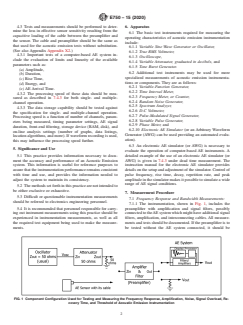
7.1.1 The instrumentation, shown in Fig. 1, includes the
5.4 It is recommended that personnel responsible for carry- preamplifier with amplification and signal filters, possibly
ing out instrument measurements using this practice should be connectedtotheAEsystemwhichmighthaveadditionalsignal
experienced in instrumentation measurements, as well as all filters, amplification, and interconnecting cables. All measure-
the required test equipment being used to make the measure- ments and tests should be documented. If the preamplifier is to
ments. be tested without the AE system connected, it should be
FIG. 1 Component Configuration Used for Testing and Measuring the Frequency Response, Amplification, Noise, Signal Overload, Re-
covery Time, and Threshold of Acoustic Emission Instrumentation
E750−15 (2020)
terminated with the normal working load as shown on the white noise generator or sweep generator and spectrum or FFT
bottom right of Fig. 1. analyzer may be used in place of the oscillator and RMS
7.1.2 An acceptable frequency response should be flat voltmeter.
between cutoff frequencies within 3 dB of the reference
NOTE 1—If the input impedance of the preamplifier is not both resistive
frequency. The reference frequency is the geometric mean of
and equal to the required load impedance of the attenuator, proper
the nominal bandwidth of the instrumentation. The mean
compensation should be made.
frequency is calculated as follows:
7.3 Dynamic Range Measurements:
f 5 f f 2 7.3.1 The criterion used for establishing dynamic range
~ !
M L H
should be documented as the signal overload point, referenced
where:
to the instrumentation noise amplitude, while keeping like
f = mean frequency,
M
measurements for both readings (for example, peak voltage to
f = nominal lower cutoff, and
L
peak voltage, peak-peak voltage or RMS to RMS readings).
f = nominal upper cutoff.
H
Alternatively, the reference amplitude may be the threshold
7.1.3 The bandwidth should include all contiguous frequen-
level if the instrumentation includes a voltage comparator for
cieswithamplitudevariationsasspecifiedbythemanufacturer.
signal detection. The total harmonic distortion criterion should
Instruments that include signal processing of amplitude as a
be used for signal processing involving spectrum analysis. All
function of frequency should have bandwidth amplitude varia-
other signal processing may be performed with the signal
tions as specified by the manufacturer. overload point criterion.
7.1.4 With the instrumentation connected to the oscillator
7.3.2 The dynamic range (DR) in decibels should be deter-
and attenuator, see Fig. 1 and the sine wave oscillator set well
mined as follows:
within the instrumentation’s specified dynamic range, the
DR 5 20 log signal overload point voltage/background noise voltage
~ !
frequency response should be measured between frequency
limits specified in 7.1.2. The oscillator is maintained at a fixed 7.3.2.1 The dynamic range of instrumentation exclusive of
amplitude and the frequency is swept through the frequency threshold or voltage comparator circuits, is a ratio of the signal
limits. The preamplifier or AE system voltage output is overload level to the noise amplitude. (A brief description of
monitored with an RMS voltmeter. Values of amplitude are noise sources appears in Appendix X4). An oscilloscope is
recorded for each of several frequencies within and beyond the usually required as an adjunct to determine the characteristics
nominal cutoff frequencies. The recorded values should be of noise and to monitor the signal overload point.
plotted.The amplitude scale may be converted to decibels.The
7.3.2.2 Afield measurement of dynamic range may produce
frequency scale may be plotted either linearly or logarithmi-
substantially different results when compared with a laboratory
cally. Appendix X2 provides further discussion of wave
measurement. This difference is caused by an increase in the
shaping components.
reference voltage output, and may result from noise impulses
7.1.5 Aspectrum analyzer may be used in conjunction with of electrical origin, or ground faults.
a white noise source or an oscilloscope may be used in
7.3.2.3 For an amplifier that has a threshold comparator as
conjunction with a sweep frequency oscillator to determine
its output device, the dynamic range is the ratio of maximum
bandwidth. With a white noise source connected to the input, a
threshold level to input noise level at the comparator. Excess
spectrum analyzer connected to the output will record the
amplitude range in the amplifier contributes to overload
frequency response.
immunity but not to the dynamic range. The following mea-
7.1.6 The measured bandwidth is the difference between the
surement will give the effective dynamic range:
corner frequencies at which the response is 3 dB less than the
DR 5 20log MaxTh/MinTh
~ !
e 10
response at the reference frequency.
where:
7.2 Gain Measurements:
DR = the effective dynamic range of the system,
e
7.2.1 The electronic amplification is comprised of the pre-
MaxTh = the highest settable threshold value that just
amplifier gain, the wave filters insertion gains or losses and the
passes the largest undistorted peak signal input,
AE system’s gains or losses. (See Appendix X2 for an
and
explanation of gain measurements.)
MinTh = the threshold value that passes less than 1 count/s
7.2.2 The electronic amplification may be measured with
with no input signal.
thetestsetupshowninFig.1,withtheoscillatorandattenuator
This dynamic range is the difference between the largest and
connected. The sine wave oscillator is set to the reference
the smallest AE input that can be reliably detected by the
frequency. The oscillator amplitude is set well within the
system.
dynamicrangeoftheinstrumentationtoavoiddistortiondueto
overload. With the voltmeter at V , oscillator amplitude is set 7.3.3 Measurement of instrument electronic noise is accom-
osc
to 1 V. The attenuator is set for a value greater than the plished by replacing the oscillator/attenuator of Fig. 1, with the
anticipated electronic amplification. Next, the voltmeter is sensor that will be used, including its cable (or with a lumped
moved to V (preamplifier or AE system voltage output equivalent capacitance). A lumped capacitance represents the
out
depending on the test being performed). The attenuator is now electrical characteristic of the sensor and cable combination
adjusted until the voltmeter again reads 1 V. The electronic without adding mechanical noise interference. The RMS noise
amplification is equal to the new setting on the attenuator. A voltage is measured with a true RMS voltmeter (see 6.1.2)at
E750−15 (2020)
the instrumentation (preamplifier or AE system) output (V ) 7.4.4 The dead time (Td) is given by:
out
per Fig. 1.Alternatively, a peakAE system noise measurement
Td 51/R 2 D
B B
can be measured by setting the lowest possible AE threshold
where:
which passes less than one false hit within ten seconds or by
setting theAE system threshold below the noise and recording D = the selected burst duration, and
B
R = the repetition rate of the simulator where the limit was
the peakAE amplitude of hits detected in a ten second period.
B
found.
7.3.4 Thesignaloverloadlevelismeasuredbyreplacingthe
sensor with the sine wave oscillator as shown in Fig. 1. The
This dead time measurement procedure should be performed
frequency is set to the mid-band frequency of the instrumen-
for each AE hit-based parameter of the AE system.
tation. The oscillator amplitude is fixed at 1 V peak to peak
7.5 Threshold Level (Threshold of Detection) Measure-
monitored at V . The attenuator is adjusted to increase the
osc
ments:
signal level to the preamplifier until the instrumentation output
7.5.1 Various acoustic emission signal processing instru-
(V ) is 0.5 dB less than the computed output.
out
ments rely upon the signal exceeding a comparator voltage
7.3.5 Should the peak amplitude of acoustic emission activ-
level to register a hit. This level may be fixed, adjustable,
ity exceed the dynamic range, several deleterious effects may
floating and fixed, or floating and adjustable. The floating
be produced; these include clipping, saturation, and overload
threshold may be called automatic threshold. Signal recogni-
recovery time-related phenomena. (See Appendix X2 for a
tion (or hit) does not occur until the threshold is exceeded.
discussion of overload recovery.) The instrumentation gain
7.5.2 The nonautomatic threshold level should be measured
should be adjusted to limit these effects to an absolute
with the instrumentation assembled as shown in Fig. 1 and the
minimum in order to increase the reliability of the data.
signal processors attached to the point V . The signal proces-
out
7.4 Dead Time Measurements:
sors are frequently digital electronic counters that may follow
7.4.1 The instrumentation dead time may include variable
the secondary amplifier. Increasing the oscillator amplitude
and fixed components, depending on the instrumentation de-
will result in an increasing signal level at V . The counters
out
sign for handling the routine of the input and output data
will begin counting when the signal at the comparator reaches
processing. The components included in dead time are process
the preset threshold level. This level measured with an oscil-
time and lock-out time. Process time varies from system to
loscope connected to V multiplied by the gain of the
out
system and usually depends on the number of parameters
secondary amplifier is equal to the threshold voltage. Some
processed for each AE hit. Lock-out time, which may be
counters and other signal processors utilizing threshold detec-
operator controlled, is used to force a time delay before
tion are frequency sensitive. Therefore, the threshold level
accepting new AE hits.
should be measured over the instrumentation bandwidth.
7.4.2 Dead time measurement in a counter type AE instru-
7.5.3 The automatic threshold cannot be measured with a
ment should be conducted as follows: Set the instrument to the
continuous-wave generator because the automatic threshold
count rate mode. Set the oscillator frequency to the mid-band
level is usually derived from the rectified and averaged input
frequency of the instrument. Set the oscillator amplitude to
signal. The tone burst generator provides an adjustable burst
achieve a count rate equal to the oscillator frequency. Increase
amplitude duration and repetition rate that may be used to
the oscillator frequency until the count rate ceases to equal the
establish the threshold level using the same technique that is
oscillator frequency. Record the frequency as the maximum
used in 7.5.2. The automatic threshold level’s affected by the
count rate. (If the frequency is equal to or greater than the
tone burst amplitude, duration, and repetition rate.
specifiedupperfrequencylimitoftheinstrument,thedeadtime
7.6 Counter Accuracy Measurements:
of the counter is zero.) Dead time (Td) is given by:
7.6.1 Counters are of two types: summation counters and
Td 5 1/Fm 21/Fu
rate counters. Counters that tally signals for fixed repetitive
where:
periods of time during an acoustic emission test are known as
rate counters. The tallied signals may be a count of acoustic
Fm = the measured frequency, and
Fu = the upper bandwidth limit of the instrument. emission signals, loading cycles, or amplitude levels.
7.6.2 The accuracy of the counting function of the instru-
7.4.3 Where the dead time in question is related to AE hit
mentation should be measured using a tone burst generator set
processing such as measurement of source location, energy,
as follows: (1) the amplitude should be well above the
duration, or amplitude, the measurement is best accomplished
threshold level, but well within the dynamic range of the
by using an electronic AE simulator as follows:
instrumentation; (2) the tone burst frequency should be within
7.4.3.1 SelectanAEhitparametertoevaluatethedeadtime.
the instrumentation nominal bandwidth; (3) the tone burst
7.4.3.2 Set the electronic AE simulator frequency, rise,
duration should be at least one cycle, but fewer cycles than
decay, duration, and repetition rate such that the observed AE
would cause the automatic threshold to take effect; (4) the tone
hit rate in the selected parameter equals the repetition rate of
burst repetition rate should be adjusted for a period that does
the simulator.
not cause the automatic threshold to interfere with the count
7.4.3.3 Increase the repetition rate of the simulator until the
function. The counting accuracy is assured by comparing the
observed AE hit rate falls below the simulator rate.
emission count with the tone burst count.
7.4.3.4 Record this value as maximumAE hit rate (process-
ing speed) for the selected parameter. 7.7 Computer-Measured Parameters:
E750−15 (2020)
7.7.1 The limits and linearity ofAE parameters recorded by tropic materials where velocity is not constant, other source
computer-based systems may be measured by means of an locationalgorithmsexistsuchasarealocationbasedonfirsthit
electronicAE simulator. The electronicAE simulator provides sensor.
individually adjustable amplitude, duration, rise time, and
7.7.3.1 Set up the AE system for source location in accor-
relative arrival time. Burst energy from the AE simulator may
dance with the operator’s manual.
be calculated from the parameters given.
7.7.3.2 Set up the multichannel electronic AE simulator to
7.7.2 The limits or dynamic range and linearity of each
provide simulated AE inputs to the appropriate number of
parameter should be measured as follows for amplitude,
channels.
duration, and rise time:
7.7.3.3 Using the appropriate velocity of sound for the
7.7.2.1 Connect the AE simulator to the preamplifier input simulated structure, compute the times of flight from the
of the channel to be tested.
simulated AE source position to each sensor of the source
location array. The differences between the times of flight give
7.7.2.2 Set up the AE system to record and display the
relative arrival times (delta T) for the simulated AE sensor
parameter to be tested.
positions.
7.7.2.3 Adjust the AE simulator to produce a mid range
7.7.3.4 Record the displayed location coordinates for this
simulated AE signal where the displayed amplitude, duration,
initialsimulatedinput.Computeandinputanewdelta Tsetfor
and rise time are 10 % of their maximum value as specified by
a nearby point. Record the difference between input position
the AE system manufacturer.
anddisplayedposition.Continuethisincrementalmovementof
7.7.2.4 Record the value of each parameter at the electronic
the simulated AE source away from the sensor array center
AE simulator output and at the AE system display.
untiltheoutputpositiondiffersfromtheinputpositionby10 %
7.7.2.5 Tomeasureupperlimitsforeachparameter,increase
or the source location range specified by the AE system
the measured input in equal increments (for example, 10 % of
manufacturer is exceeded. Evaluate any error with respect to
maximum) and record the displayed value for that parameter
theAE system manufacturer’s specification for source location
until the output differs from the input by 10 % or the specified
linearity.
maximum value is exceeded.
7.7.3.5 The source location test procedure should be re-
7.7.2.6 To measure lower limits for each parameter, adjust
peated for two additional rays extending in different directions
input-output condition as in 7.7.2.3, then decrease the input in
from the array center.
equal increments (for example, 10 % of the initial value) and
7.7.3.6 The source location procedure should be repeated
record the displayed value until the output differs from the
for each multichannel array of the system.
input by 10 % or the minimum value specified by the AE
system manufacturer is reached.
7.8 Evaluating Waveform Accuracy in Digital AE Systems:
7.7.2.7 To test the computer-derived energy per AE hit
7.8.1 DigitalAE systems work by digitizing and processing
parameter,itisnecessarytocalculatetheinputenergyfromthe
the AE waveform, using high performance analog-to-digital
electronicAEsimulatorinaccordancewiththemethodusedby
converters (ADC) and digital signal processors (DSP). The
the AE system. For example, one method used in some AE
accuracy of the processed and stored AE waveforms is impor-
systems computes approximate burst pulse AE hit energy (E)
tant for post processing and may be evaluated using an
as follows:
electronicAE simulator. The electronicAE simulator provides
adjustable amplitude and frequency for evaluating waveforms.
E>DV /2
7.8.2 The limits or dynamic range and distortion-free output
where:
should be evaluated as follows for waveform amplitude and
D = burst duration, and
frequency:
V = peak a
...