

ASTM E970-23
(Test Method)Standard Test Method for Critical Radiant Flux of Exposed Attic Floor Insulation Using a Radiant Heat Energy Source
General Information
- Abstract
SIGNIFICANCE AND USE
5.1 This fire-test-response standard is designed to provide a basis for estimating one aspect of the fire exposure behavior to exposed insulation installed on the floors of building attics. The test environment is intended to simulate conditions that have been observed and defined in full-scale attic experiments.
5.2 The test is intended to be suitable for regulatory statutes, specification acceptance, design purposes, or development and research.
5.3 The fundamental assumption inherent in the test is that critical radiant flux is one measure of the surface burning characteristics of exposed insulation on floors or between joists of attics.
5.4 The test is applicable to attic floor insulation specimens that follow or simulate accepted installation practice.
5.5 In this procedure, the specimens are subjected to one or more specific sets of laboratory fire test exposure conditions. If different test conditions are substituted or the anticipated end-use conditions are changed, caution should be used to predict changes in the performance characteristics measured by or from this test. Therefore, the results are strictly valid only for the fire test exposure conditions described in this procedure.
5.5.1 If the test results obtained by this test method are to be considered in the total assessment of fire hazard in a building structure, then all pertinent established criteria for fire hazard assessment developed by Committee E-5 must be included in the consideration.
SCOPE
1.1 This fire-test-response standard describes a procedure for measuring the critical radiant flux of exposed attic floor insulation subjected to a flaming ignition source in a graded radiant heat energy environment in a test chamber. The specimen is any attic floor insulation. This test method is not applicable to those insulations that melt or shrink away when exposed to the radiant heat energy environment or the pilot burner.
1.2 This fire-test-response standard measures the critical radiant flux at the point at which the flame advances the farthest. It provides a basis for estimating one aspect of fire exposure behavior for exposed attic floor insulation. The imposed radiant flux simulates the thermal radiation levels likely to impinge on the floors of attics whose upper surfaces are heated by the sun through the roof or by flames from an incidental fire in the attic. This fire-test-response standard was developed to simulate an important fire exposure component of fires that develop in attics, but is not intended for use in estimating flame spread behavior of insulation installed other than on the attic floor.
1.3 The values stated in SI units are to be regarded as standard. The values given in parentheses are for information only.
1.4 The text of this standard references notes and footnotes that provide explanatory information. These notes and footnotes, excluding those in tables and figures, shall not be considered as requirements of this standard.
1.5 This standard is used to measure and describe the response of materials, products, or assemblies to heat and flame under controlled conditions, but does not by itself incorporate all factors required for fire hazard or fire risk assessment of the materials, products, or assemblies under actual fire conditions.
1.6 This standard does not purport to address all of the safety concerns, if any, associated with its use. It is the responsibility of the user of this standard to establish appropriate safety, health, and environmental practices and determine the applicability of regulatory limitations prior to use.
1.7 The text of this standard references notes and footnotes which provide explanatory material. These notes and footnotes (excluding those in tables and figures) shall not be considered as requirements of the standard.
1.8 This international standard was developed in accordance with internationally recognized principles on standardizatio...
- Status
- Published
- Publication Date
- 30-Sep-2023
- Technical Committee
- E05 - Fire Standards
- Drafting Committee
- E05.22 - Surface Burning
Buy Documents
ASTM E970-23 - Standard Test Method for Critical Radiant Flux of Exposed Attic Floor Insulation Using a Radiant Heat Energy Source
REDLINE ASTM E970-23 - Standard Test Method for Critical Radiant Flux of Exposed Attic Floor Insulation Using a Radiant Heat Energy Source
Overview
ASTM E970-23: Standard Test Method for Critical Radiant Flux of Exposed Attic Floor Insulation Using a Radiant Heat Energy Source is a key fire-test-response standard developed by ASTM International. The purpose of the standard is to establish a laboratory procedure for measuring the critical radiant flux - the minimum level of incident radiant heat energy that supports flame spread - of insulation installed on exposed attic floors. This method simulates fire exposure conditions present in attics, considering sources of thermal radiation such as sunlight heating or flames from accidental fires.
The test is applicable to attic floor insulation installed according to accepted practices, excluding materials that melt or shrink away from the heat source. Results from this standard provide valuable data for assessing the surface burning characteristics of insulation products but are only valid within the defined test conditions.
Key Topics
- Critical Radiant Flux Measurement: The standard details procedures to determine the critical radiant flux - an important metric for fire safety evaluations of insulation in attic applications.
- Simulated Fire Exposure: The laboratory setup uses a radiant heat energy source and a pilot flame to replicate realistic fire exposure circumstances found in building attics.
- Material Suitability: Only insulation types that do not melt or recede from the heat source are suitable for testing under ASTM E970-23, making this method ideal for traditional and modern insulation materials, including loose-fill, batt, and board types.
- Controlled Test Conditions: The procedure ensures that each sample is prepared and conditioned according to standardized temperature, humidity, and installation practices to mirror actual use as closely as possible.
- Fire Hazard Assessment Relevance: While the test measures material performance under specific controlled conditions, users must combine these results with comprehensive fire hazard assessments for complete risk evaluation.
Applications
The practical applications of ASTM E970-23 are diverse and significant within the building materials and fire safety sectors:
- Product Certification and Regulatory Compliance: Manufacturers and building code officials use critical radiant flux data when certifying insulation products for compliance with fire safety standards and local regulations.
- Design and Specification: Architects, engineers, and building designers utilize test results to assess insulation options and specify materials that meet safety performance needs for attic installations.
- Research and Development: Product developers and researchers apply this standard to test new or modified insulation materials as part of innovation or improving existing offerings.
- Quality Assurance: Routine testing using ASTM E970-23 helps manufacturers maintain consistent fire performance in their insulation products.
- Building Safety Assessments: Fire risk evaluators reference ASTM E970-23 results to estimate one aspect of the potential fire behavior of installed attic insulation, aiding in holistic risk management strategies for residential and commercial buildings.
Related Standards
Several ASTM standards are related to or referenced in ASTM E970-23, providing a comprehensive framework for fire safety and insulation material testing:
- ASTM E84: Test Method for Surface Burning Characteristics of Building Materials
- ASTM E648: Test Method for Critical Radiant Flux of Floor-Covering Systems Using a Radiant Heat Energy Source
- ASTM C739 / ASTM C764: Specifications for loose-fill cellulosic and mineral fiber insulation, respectively
- ASTM C167: Test Methods for Thickness and Density of Blanket or Batt Thermal Insulations
- ASTM E176: Terminology of Fire Standards
Integrating ASTM E970-23 with these related standards enables industry professionals to perform thorough evaluations of building insulation materials, supporting safe and compliant construction practices.
Keywords: ASTM E970-23, attic floor insulation, critical radiant flux, fire-test-response standard, insulation fire performance, building safety standards, radiant heat energy, fire hazard assessment, thermal insulation testing, attic insulation fire test.
Relations
- Effective Date
- 01-Oct-2023
- Effective Date
- 01-Mar-2024
- Effective Date
- 01-Jan-2024
- Effective Date
- 01-Dec-2023
- Effective Date
- 01-Nov-2023
- Effective Date
- 01-Sep-2023
- Effective Date
- 01-Aug-2023
- Effective Date
- 01-Dec-2019
- Effective Date
- 01-Oct-2023
- Referred By
ASTM E1321-18 - Standard Test Method for Determining Material Ignition and Flame Spread Properties - Effective Date
- 01-Oct-2023
- Effective Date
- 01-Oct-2023
- Referred By
ASTM C1497-16 - Standard Specification for Cellulosic Fiber Stabilized Thermal Insulation - Effective Date
- 01-Oct-2023
- Effective Date
- 01-Oct-2023
- Effective Date
- 01-Oct-2023
- Referred By
ASTM C739-21a - Standard Specification for Cellulosic Fiber Loose-Fill Thermal Insulation - Effective Date
- 01-Oct-2023
Buy Documents
ASTM E970-23 - Standard Test Method for Critical Radiant Flux of Exposed Attic Floor Insulation Using a Radiant Heat Energy Source
REDLINE ASTM E970-23 - Standard Test Method for Critical Radiant Flux of Exposed Attic Floor Insulation Using a Radiant Heat Energy Source
Get Certified
Connect with accredited certification bodies for this standard

DIBt (Deutsches Institut für Bautechnik)
German Institute for Building Technology.
DIN CERTCO
DIN Group product certification.

Aboma Certification B.V.
Specialized in construction, metal, and transport sectors.
Sponsored listings
Frequently Asked Questions
ASTM E970-23 is a standard published by ASTM International. Its full title is "Standard Test Method for Critical Radiant Flux of Exposed Attic Floor Insulation Using a Radiant Heat Energy Source". This standard covers: SIGNIFICANCE AND USE 5.1 This fire-test-response standard is designed to provide a basis for estimating one aspect of the fire exposure behavior to exposed insulation installed on the floors of building attics. The test environment is intended to simulate conditions that have been observed and defined in full-scale attic experiments. 5.2 The test is intended to be suitable for regulatory statutes, specification acceptance, design purposes, or development and research. 5.3 The fundamental assumption inherent in the test is that critical radiant flux is one measure of the surface burning characteristics of exposed insulation on floors or between joists of attics. 5.4 The test is applicable to attic floor insulation specimens that follow or simulate accepted installation practice. 5.5 In this procedure, the specimens are subjected to one or more specific sets of laboratory fire test exposure conditions. If different test conditions are substituted or the anticipated end-use conditions are changed, caution should be used to predict changes in the performance characteristics measured by or from this test. Therefore, the results are strictly valid only for the fire test exposure conditions described in this procedure. 5.5.1 If the test results obtained by this test method are to be considered in the total assessment of fire hazard in a building structure, then all pertinent established criteria for fire hazard assessment developed by Committee E-5 must be included in the consideration. SCOPE 1.1 This fire-test-response standard describes a procedure for measuring the critical radiant flux of exposed attic floor insulation subjected to a flaming ignition source in a graded radiant heat energy environment in a test chamber. The specimen is any attic floor insulation. This test method is not applicable to those insulations that melt or shrink away when exposed to the radiant heat energy environment or the pilot burner. 1.2 This fire-test-response standard measures the critical radiant flux at the point at which the flame advances the farthest. It provides a basis for estimating one aspect of fire exposure behavior for exposed attic floor insulation. The imposed radiant flux simulates the thermal radiation levels likely to impinge on the floors of attics whose upper surfaces are heated by the sun through the roof or by flames from an incidental fire in the attic. This fire-test-response standard was developed to simulate an important fire exposure component of fires that develop in attics, but is not intended for use in estimating flame spread behavior of insulation installed other than on the attic floor. 1.3 The values stated in SI units are to be regarded as standard. The values given in parentheses are for information only. 1.4 The text of this standard references notes and footnotes that provide explanatory information. These notes and footnotes, excluding those in tables and figures, shall not be considered as requirements of this standard. 1.5 This standard is used to measure and describe the response of materials, products, or assemblies to heat and flame under controlled conditions, but does not by itself incorporate all factors required for fire hazard or fire risk assessment of the materials, products, or assemblies under actual fire conditions. 1.6 This standard does not purport to address all of the safety concerns, if any, associated with its use. It is the responsibility of the user of this standard to establish appropriate safety, health, and environmental practices and determine the applicability of regulatory limitations prior to use. 1.7 The text of this standard references notes and footnotes which provide explanatory material. These notes and footnotes (excluding those in tables and figures) shall not be considered as requirements of the standard. 1.8 This international standard was developed in accordance with internationally recognized principles on standardizatio...
SIGNIFICANCE AND USE 5.1 This fire-test-response standard is designed to provide a basis for estimating one aspect of the fire exposure behavior to exposed insulation installed on the floors of building attics. The test environment is intended to simulate conditions that have been observed and defined in full-scale attic experiments. 5.2 The test is intended to be suitable for regulatory statutes, specification acceptance, design purposes, or development and research. 5.3 The fundamental assumption inherent in the test is that critical radiant flux is one measure of the surface burning characteristics of exposed insulation on floors or between joists of attics. 5.4 The test is applicable to attic floor insulation specimens that follow or simulate accepted installation practice. 5.5 In this procedure, the specimens are subjected to one or more specific sets of laboratory fire test exposure conditions. If different test conditions are substituted or the anticipated end-use conditions are changed, caution should be used to predict changes in the performance characteristics measured by or from this test. Therefore, the results are strictly valid only for the fire test exposure conditions described in this procedure. 5.5.1 If the test results obtained by this test method are to be considered in the total assessment of fire hazard in a building structure, then all pertinent established criteria for fire hazard assessment developed by Committee E-5 must be included in the consideration. SCOPE 1.1 This fire-test-response standard describes a procedure for measuring the critical radiant flux of exposed attic floor insulation subjected to a flaming ignition source in a graded radiant heat energy environment in a test chamber. The specimen is any attic floor insulation. This test method is not applicable to those insulations that melt or shrink away when exposed to the radiant heat energy environment or the pilot burner. 1.2 This fire-test-response standard measures the critical radiant flux at the point at which the flame advances the farthest. It provides a basis for estimating one aspect of fire exposure behavior for exposed attic floor insulation. The imposed radiant flux simulates the thermal radiation levels likely to impinge on the floors of attics whose upper surfaces are heated by the sun through the roof or by flames from an incidental fire in the attic. This fire-test-response standard was developed to simulate an important fire exposure component of fires that develop in attics, but is not intended for use in estimating flame spread behavior of insulation installed other than on the attic floor. 1.3 The values stated in SI units are to be regarded as standard. The values given in parentheses are for information only. 1.4 The text of this standard references notes and footnotes that provide explanatory information. These notes and footnotes, excluding those in tables and figures, shall not be considered as requirements of this standard. 1.5 This standard is used to measure and describe the response of materials, products, or assemblies to heat and flame under controlled conditions, but does not by itself incorporate all factors required for fire hazard or fire risk assessment of the materials, products, or assemblies under actual fire conditions. 1.6 This standard does not purport to address all of the safety concerns, if any, associated with its use. It is the responsibility of the user of this standard to establish appropriate safety, health, and environmental practices and determine the applicability of regulatory limitations prior to use. 1.7 The text of this standard references notes and footnotes which provide explanatory material. These notes and footnotes (excluding those in tables and figures) shall not be considered as requirements of the standard. 1.8 This international standard was developed in accordance with internationally recognized principles on standardizatio...
ASTM E970-23 is classified under the following ICS (International Classification for Standards) categories: 91.120.10 - Thermal insulation of buildings. The ICS classification helps identify the subject area and facilitates finding related standards.
ASTM E970-23 has the following relationships with other standards: It is inter standard links to ASTM E970-17e1, ASTM C739-24, ASTM E176-24, ASTM E84-23d, ASTM E648-23, ASTM E84-23c, ASTM E84-23b, ASTM E648-19ae1, ASTM E1317-19, ASTM E1321-18, ASTM E176-21ae1, ASTM C1497-16, ASTM C665-23, ASTM C764-19, ASTM C739-21a. Understanding these relationships helps ensure you are using the most current and applicable version of the standard.
ASTM E970-23 is available in PDF format for immediate download after purchase. The document can be added to your cart and obtained through the secure checkout process. Digital delivery ensures instant access to the complete standard document.
Standards Content (Sample)
This international standard was developed in accordance with internationally recognized principles on standardization established in the Decision on Principles for the
Development of International Standards, Guides and Recommendations issued by the World Trade Organization Technical Barriers to Trade (TBT) Committee.
Designation: E970 − 23 An American National Standard
Standard Test Method for
Critical Radiant Flux of Exposed Attic Floor Insulation Using
a Radiant Heat Energy Source
This standard is issued under the fixed designation E970; the number immediately following the designation indicates the year of
original adoption or, in the case of revision, the year of last revision. A number in parentheses indicates the year of last reapproval. A
superscript epsilon (´) indicates an editorial change since the last revision or reapproval.
1. Scope 1.6 This standard does not purport to address all of the
safety concerns, if any, associated with its use. It is the
1.1 This fire-test-response standard describes a procedure
responsibility of the user of this standard to establish appro-
for measuring the critical radiant flux of exposed attic floor
priate safety, health, and environmental practices and deter-
insulation subjected to a flaming ignition source in a graded
mine the applicability of regulatory limitations prior to use.
radiant heat energy environment in a test chamber. The
1.7 The text of this standard references notes and footnotes
specimen is any attic floor insulation. This test method is not
which provide explanatory material. These notes and footnotes
applicable to those insulations that melt or shrink away when
(excluding those in tables and figures) shall not be considered
exposed to the radiant heat energy environment or the pilot
as requirements of the standard.
burner.
1.8 This international standard was developed in accor-
1.2 This fire-test-response standard measures the critical
dance with internationally recognized principles on standard-
radiant flux at the point at which the flame advances the
ization established in the Decision on Principles for the
farthest. It provides a basis for estimating one aspect of fire
Development of International Standards, Guides and Recom-
exposure behavior for exposed attic floor insulation. The
mendations issued by the World Trade Organization Technical
imposed radiant flux simulates the thermal radiation levels
Barriers to Trade (TBT) Committee.
likely to impinge on the floors of attics whose upper surfaces
are heated by the sun through the roof or by flames from an
2. Referenced Documents
incidental fire in the attic. This fire-test-response standard was
2.1 ASTM Standards:
developed to simulate an important fire exposure component of
C167 Test Methods for Thickness and Density of Blanket or
fires that develop in attics, but is not intended for use in
Batt Thermal Insulations
estimating flame spread behavior of insulation installed other
C665 Specification for Mineral-Fiber Blanket Thermal Insu-
than on the attic floor.
lation for Light Frame Construction and Manufactured
1.3 The values stated in SI units are to be regarded as
Housing
standard. The values given in parentheses are for information
C739 Specification for Cellulosic Fiber Loose-Fill Thermal
only.
Insulation
C764 Specification for Mineral Fiber Loose-Fill Thermal
1.4 The text of this standard references notes and footnotes
Insulation
that provide explanatory information. These notes and
E84 Test Method for Surface Burning Characteristics of
footnotes, excluding those in tables and figures, shall not be
Building Materials
considered as requirements of this standard.
E122 Practice for Calculating Sample Size to Estimate, With
1.5 This standard is used to measure and describe the
Specified Precision, the Average for a Characteristic of a
response of materials, products, or assemblies to heat and
Lot or Process
flame under controlled conditions, but does not by itself
E176 Terminology of Fire Standards
incorporate all factors required for fire hazard or fire risk
E177 Practice for Use of the Terms Precision and Bias in
assessment of the materials, products, or assemblies under
ASTM Test Methods
actual fire conditions.
E631 Terminology of Building Constructions
E648 Test Method for Critical Radiant Flux of Floor-
Covering Systems Using a Radiant Heat Energy Source
This test method is under the jurisdiction of ASTM Committee E05 on Fire
Standards and is the direct responsibility of Subcommittee E05.22 on Surface
Burning. For referenced ASTM standards, visit the ASTM website, www.astm.org, or
Current edition approved Oct. 1, 2023. Published October 2023. Originally contact ASTM Customer Service at service@astm.org. For Annual Book of ASTM
ɛ1
approved in 1983. Last previous edition approved in 2017 as E970 –17 . DOI: Standards volume information, refer to the standard’s Document Summary page on
10.1520/E0970-23. the ASTM website.
Copyright © ASTM International, 100 Barr Harbor Drive, PO Box C700, West Conshohocken, PA 19428-2959. United States
E970 − 23
E691 Practice for Conducting an Interlaboratory Study to 5.3 The fundamental assumption inherent in the test is that
Determine the Precision of a Test Method critical radiant flux is one measure of the surface burning
E2653 Practice for Conducting an Interlaboratory Study to characteristics of exposed insulation on floors or between joists
Determine Precision Estimates for a Test Method with of attics.
Fewer Than Six Participating Laboratories
5.4 The test is applicable to attic floor insulation specimens
2.2 Federal Specifications:
that follow or simulate accepted installation practice.
HH-I-515 Insulation Thermal (Loose Fill for Pneumatic or
3 5.5 In this procedure, the specimens are subjected to one or
Poured Application), Cellulosic or Wood Fiber
more specific sets of laboratory fire test exposure conditions. If
HH-I-521, Insulation Blankets, Thermal (Mineral Fiber, for
3 different test conditions are substituted or the anticipated
Ambient Temperature)
end-use conditions are changed, caution should be used to
HH-I-1030 Insulation, Thermal (Mineral Fiber, for Pneu-
3 predict changes in the performance characteristics measured by
matic or Poured Application)
or from this test. Therefore, the results are strictly valid only
for the fire test exposure conditions described in this procedure.
3. Terminology
5.5.1 If the test results obtained by this test method are to be
3.1 For definitions of terms used in this test method and
considered in the total assessment of fire hazard in a building
associated with fire issues refer to the terminology contained in
structure, then all pertinent established criteria for fire hazard
Terminology E176.
assessment developed by Committee E-5 must be included in
3.2 Definitions:
the consideration.
3.2.1 attic, n—an accessible enclosed space in a building
6. Apparatus
immediately below the roof and wholly or partly within the
roof framing.
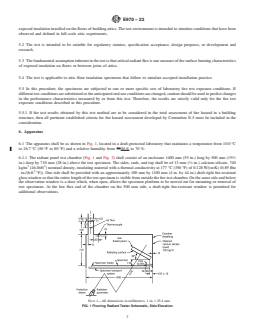
6.1 The apparatus shall be as shown in Fig. 1, located in a
3.2.2 See Terminology E631 for additional definitions of draft-protected laboratory that maintains a temperature from
terms used in this test method. 10.0 °C to 26.7 °C (50 °F to 80 °F) and a relative humidity
3.3 Definitions of Terms Specific to This Standard: from 30 % to 70 %:
3.3.1 critical radiant flux, n—the level of incident radiant 6.1.1 The radiant panel test chamber (Fig. 1 and Fig. 2) shall
heat energy on the attic floor insulation system at the most consist of an enclosure 1400 mm (55 in.) long by 500 mm
2 2
distant flame-out point. It is reported as W/cm (or Btu/ft ·s). (19 ⁄2 in.) deep by 710 mm (28 in.) above the test specimen.
The sides, ends, and top shall be of 13 mm ( ⁄2-in.) calcium
3.3.2 radiant flux profile, n—the graph relating incident
3 3
silicate, 740 kg/m (46-lb/ft ) nominal density, insulating
radiant heat energy on the specimen plane to distance from the
material with a thermal conductivity at 177 °C (350 °F) of
point of initiation of flaming ignition, that is, 0 mm.
0.128 W/(m·K) (0.89 Btu · in./(h·ft ·°F)). One side shall be
3.3.3 total flux metre, n—the instrument used to measure the
provided with an approximately 100 mm by 1100 mm (4 in. by
level of radiant heat energy incident on the specimen plane at
44 in.) draft-tight fire-resistant glass window so that the entire
any point.
length of the test specimen is visible from outside the fire test
chamber. On the same side and below the observation window
4. Summary of Test Method
is a door which, when open, allows the specimen platform to be
4.1 A horizontally mounted insulation specimen is exposed
to the heat from an air-gas radiant heat energy panel located
above and inclined at 30° 6 5° to the specimen. After a short
preheat, the hottest end of the specimen is ignited with a small
calibrated flame. The distance to the farthest advance of
flaming is measured, converted to kilowatts per square meter
from a previously prepared radiant flux profile graph, and
reported as the critical radiant flux.
5. Significance and Use
5.1 This fire-test-response standard is designed to provide a
basis for estimating one aspect of the fire exposure behavior to
exposed insulation installed on the floors of building attics. The
test environment is intended to simulate conditions that have
been observed and defined in full-scale attic experiments.
5.2 The test is intended to be suitable for regulatory statutes,
specification acceptance, design purposes, or development and
research.
Available from Standardization Documents Order Desk, DODSSP, Bldg. 4,
NOTE 1—All dimensions in millimetres. 1 in. = 25.4 mm.
Section D, 700 Robbins Ave., Philadelphia, PA 19111-5098, http://
www.dodssp.daps.mil. FIG. 1 Flooring Radiant Tester Schematic, Side Elevation
E970 − 23
and suitable instrumentation for monitoring and controlling the
flow of fuel to the panel.
6.2.1 The radiant heat energy panel is mounted in the
chamber at 30° 6 5° to the horizontal specimen plane. The
radiant energy panel angle shall be adjusted to obtain the flux
profile within the limits specified in accordance with 10.6. The
horizontal distance from the 0 mark on the specimen fixture to
the bottom edge (projected) of the radiating surface of the
panel is 89 mm 6 3 mm (3.5 in. 6 0.13 in.). The panel-to-
specimen vertical distance is 140 mm 6 3 mm (5.5 in. 6
0.13 in.) (Fig. 1).
6.2.2 Radiation Pyrometer for standardizing the thermal
output of the panel, suitable for viewing a circular area 254 mm
(10 in.) in diameter at a range of about 1.37 m (54 in.). It shall
be calibrated over the 460 °C to 510 °C (860 °F to 950 °F)
operating blackbody temperature range in accordance with the
procedure described in Annex A1.
6.2.3 Voltmeter, high-impedance or potentiometric, with a
suitable millivolt range shall be used to monitor the output of
the radiation pyrometer described in 6.2.2.
6.3 Dummy Specimen Holder (Fig. 3 and Fig. 4), con-
structed from heat-resistant stainless steel (UNS N08330 (AISI
Type 330) or equivalent) having a thickness of 1.98 mm
(0.078 in.) and an overall dimension of 1140 mm by 320 mm
(45 in. by 12 ⁄4 in.) with a specimen opening of 200 mm by
NOTE 1—All dimensions in millimetres. 1 in. = 25.4 mm.
1000 mm (7.9 in. by 39.4 in.). Six slots shall be cut in the
FIG. 2 Flooring Radiant Panel Tester Schematic Low Flux End,
flange on either side of the holder to reduce warping. The
Elevation
holder shall be fastened to the platform with two stud bolts at
each end.
6.4 Dummy Specimen, used in the flux profile
moved out for mounting or removal of test specimens. At the
determination, made of 19 mm ( ⁄4-in.) inorganic 740 kg ⁄m
low flux end of the chamber on the 500 mm side, a draft-tight
(46-lb/ft ) nominal density calcium silicate board (Fig. 3 and
fire-resistant window is permitted for additional observations.
6.1.2 The bottom of the test chamber shall consist of a
sliding steel platform which has provisions for rigidly securing
the test specimen holder in fixed and level position. The free,
or air access, area around the platform shall be in the range
2 2 2 2
from 0.2580 m to 0.3225 m (400 in. to 500 in. ).
6.1.3 When the flame front advance is to be measured, a
metal scale marked with 10 mm intervals shall be installed on
the back of the platform or on the back wall of the chamber.
6.1.4 The top of the chamber shall have an exhaust stack
with interior dimensions of 102 mm 6 3 mm (4 in. 6 0.13 in.)
wide by 380 mm 6 3 mm (15.00 in. 6 0.13 in.) deep by
318 mm 6 3 mm (12.50 in. 6 0.13 in.) high at the opposite end
of the chamber from the radiant energy source.
6.2 Radiant Heat Energy Source, a panel of porous material
mounted in a cast iron or steel frame, with a radiation surface
of 305 mm by 457 mm (12 in. by 18 in.). It shall be capable of
operating at temperatures up to 816 °C (1500 °F). The panel
fuel system shall consist of a venturi-type aspirator for mixing
gas and air at approximately atmospheric pressure, a clean dry
3 3
air supply capable of providing 28.3 m /h (1000 f t/h) at
standard temperature and pressure at 76 mm (3.0 in.) of water,
Gas used in this test method shall be either commercial grade propane having
3 3
NOTE 1—All dimensions in millimetres. 1 in. = 25.4 mm.
a heating value of approximately 83.1 MJ/m (2500 Btu/ft ), or natural gas, or
commercial grade methane having a minimum purity of 96 %. FIG. 3 Zero Reference Point Related to Detecting Plane
E970 − 23
6.5 Total Heat Flux Transducer, to determine the flux profile
of the chamber in conjunction with the dummy specimen (Fig.
3), shall be of the Schmidt-Boelter type, have a range from
2 2 2 2
0 W ⁄cm to 1.5 W/cm (0 Btu ⁄ft ·s to 1.32 Btu/ft ·s) and shall
be calibrated over the operating flux level range from
2 2
0.01 W ⁄cm to 1.5 W/cm in accordance with the procedure
outlined in Annex A1. A source of 15 °C to 25 °C cooling
water shall be provided for this instrument.
6.5.1 Voltmeter, high-impedance or potentiometric, with a
range from 0 mV to 10 mV and reading to 0.01 mV shall be
used to measure the output of the total heat flux transducer
during the flux profile determination.
6.6 Specimen Tray (Fig. 5), constructed from 14-gage heat-
resistant stainless steel (UNS-N08330 (AISI Type 330) or
equivalent), thickness 1.98 mm (0.078 in.). The depth of the
tray is 50 mm (2 in.). The flanges of the specimen tray are
drilled to accommodate two stud bolts at each end; the bottom
surface of the flange is 21 mm (0.83 in.) below the top edge of
the specimen tray. The overall dimensions of the tray and the
width of the flanges shall be such that the tray fills the open
space in the sliding platform. The tray must be adequate to
contain a specimen at least 1000 mm (40 in.) long and 250 mm
NOTE 1—All dimensions in millimetres. 1 in. = 25.4 mm.
(10 in.) wide. The zero reference point on the dummy specimen
FIG. 4 Dummy Specimen in Specimen Holder
shall coincide with the pilot burner flame impingement point
(Fig. 3).
6.7 Pilot Burner, used to ignite the specimen, is a nominal
1 3
Fig. 4). It is 250 mm (10 in.) wide by 1070 mm (42 in.) long
6 mm ( ⁄4 in.) inside diameter, 10 mm ( ⁄8 in.) outside diameter
with 27 mm (1 ⁄16-in.) diameter holes centered on and along the
stainless steel tube line burner having 19 evenly spaced 0.7 mm
centerline at the 100 mm, 200 mm, 300 mm, . . . , 900 mm, and
(0.028 in.) diameter (No. 70 drill) holes drilled radially along
980 mm locations measured from the maximum flux end of the
the centerline and 16 evenly spaced 0.7 mm (0.028 in.)
specimen.
diameter (No. 70 drill) holes drilled radially 60 below the
6.4.1 To provide proper and consistent seating of the flux
centerline (Fig. 6).
4 2
meter in the hole openings, a stainless steel or galvanized steel
6.7.1 In operation, the gas flow is adjusted to 0.85 m /h to
bearing plate (Fig. 3 and Fig. 4) shall be mounted and firmly
0.115 m /h (3.0 SCFH to 4.0 SCFH) (air scale) flow rate. With
secured to the underside of the calcium silicate board with
the gas flow properly adjusted and the pilot burner in the test
holes corresponding to those specified above. The bearing plate
shall run the length of the dummy specimen board and have a
The sole source of supply of the apparatus known to the committtee at this time
width of 76 mm (3.0 in.). The thickness of the bearing plate
is Medtherm Corp., P.O. Box 412, Huntsville, Al 35804. If you are aware of
shall be set in order to maintain the flux meter height specified
alternative suppliers, please provide this information to ASTM headquarters. Your
in 10.5. The maximum thickness of the bearing plate shall not
commnents will receive careful consideration at a meeting of the responsible
1 1
exceed 3 mm ( ⁄8 in.). technical committee, which you may attend.
NOTE 1—All dimensions in millimetres. 1 in. = 25.4 mm.
FIG. 5 Specimen Tray
E970 − 23
FIG. 6 Pilot Burner
position, the pilot flame will extend from approximately ture and pressure decoupled from the chamber stack by at least
63.5 mm (2.5 in.) at the ends to approximately 127 mm (5 in.) 76 mm (3 in.) on all sides and with an effective area of the
at the center. canopy slightly larger than plane area of the chamber with the
6.7.2 The holes in the pilot burner shall be kept clean. One specimen platform in the OUT position, is used to remove
means for opening the holes in the pilot burner is to use combustion products from the chamber. With the panel turned
nickel-chromium or stainless steel wire that has a diameter of on and the dummy specimen in place, the air flow through the
0.5 mm (0.020 in.). Surface contaminants shall be removed stack shall be 76.2 m/min 6 15.2 m/min (250 ft/min. 6
from the burner. One means for removing contaminants is the 50 ft ⁄min.) when measured with a calibrated hot-wire an-
use of a soft wire brush. emometer. The reading is taken about 30 s after insertion of the
6.7.3 The pilot burner is positioned no more than 5° from probe into the center of the stack opening at a distance of
the horizontal so that the flame generated will impinge on, and 152 mm (6 in.) down from the top of the stack opening (Fig. 1
reach out over the specimen from the zero distance point (see and Fig. 2).
Fig. 1 and Fig. 2). The burner must have the capability of being
6.10 A timing device with a minimum resolution of
moved at least 50 mm (2 in.) away from the specimen when not
0.10 min shall be used to measure preheat, pilot contact, time
in use.
of maximum flame travel, and when all flaming goes out.
6.8 Thermocouples—A 3.2 mm ( ⁄8-in.) stainless steel
7. Hazards
sheathed grounded junction Chromel-Alumel thermocouple
(6.8.1) shall be located in the radiant panel test chamber (Fig. 7.1 Suitable safeguards following sound engineering prac-
1 and Fig. 2). The chamber thermocouple is located in the tices shall be installed in the panel fuel supply to guard against
longitudinal central vertical plane of the chamber 25 mm (1 in.) a gas-air explosion in the test chamber. Consideration shall be
down from the top and 102 mm (4 in.) back from the inside of given, but not limited to the following : (1) a gas feed cutoff
the exhaust stack. activated when the air supply fails, (2) a fire sensor directed at
6.8.1 The thermocouple shall be kept clean to ensure the panel surface that stops fuel flow when the panel flame goes
accuracy of readout. out, and (3) a commercial gas water heater or gas-fired furnace
6.8.2 An indicating potentiometer with a range from 100 °C pilot burner control thermostatic shut-off that is activated when
to 500 °C (212 °F to 932 °F) shall be used to determine the the gas supply fails or other suitable and approved device.
chamber temperature prior to a test. Manual reset is a requirement of any safeguard system used.
6.9 Exhaust Duct, with a capacity of 28.3 m /min to 7.2 In view of the potential hazard from products of
3 3 3
85 m /min (1000 ft /min to 3000 ft /min) at standard tempera- combustion, the exhaust system must be so designed and
E970 − 23
operated that the laboratory environment is protected from (1) Blow the material through a commercial blower using a
smoke and gas. The operator shall be instructed to minimize his minimum length of 30.5 m (100 ft) length of hose, with a hose
exposure to combustion products by following sound safety diameter as recommended per manufacturer installation re-
practice; for example, ensure that the exhaust system is quirements. Blow into a sample receiver while holding the
working properly, wear appropriate clothing including gloves, hose horizontally at a height of 4 ft.
etc. (2) Load the specimen tray by hand with the amount of
insulation measured by weight that corresponds to the density
8. Sampling of insulation. Gently shake the specimen to settle the insulation
while loading. The top of the insulation is to be level with the
8.1 The samples selected for testing shall be representative
top of the tray.
of the product.
(3) Be careful not to compact the insulation.
8.2 Standard ASTM sampling practice shall be followed
9.5.3.2 Method B—Blowing the material into the specimen
where applicable; see Practice E122 for choice of sample size
trays.
to estimate the average quality of a lot or process.
(1) Blow the material through a commercial blower using a
minimum length of 30.5 m (100 ft) length of hose, with a hose
9. Test Specimens
diameter as recommended per manufacture installation require-
ments. While holding the hose horizontally at a height of 4 ft,
9.1 The test specimen shall be attic floor insulation sized to
blow the test sample into the test specimen trays.
provide for adequate filling of the specimen tray (see Fig. 5).
(2) Gently shake specimen, removing excess and over-
9.2 A minimum of three specimens per sample shall be
blown insulation. The specimen shall then be gently screeded
tested.
with a metal straight edge in one direction so that the specimen
9.3 The insulation specimen to be used for the test shall
is level across the top of the tray. Take care not to compact the
simulate actual installation practice.
insulation.
(3) As an alternative to screeding, the specimen tray may
9.4 The insulation specimen shall be representative of the
be gently dropped onto a hard level surface until the specimen
manufacturer’s recommended design density for loose-fill
is level with the sides of the specimen tray. Holding the
insulation, or the manufactured density for board and batt type
specimen tray at a height of 1 in., drop the tray. Repeat as
insulation.
needed.
9.5 The following are specific instructions for some indi-
(4) Surface irregularities shall not exceed 4.8 mm ( ⁄16 in.).
vidual types of materials. The materials discussed under 9.5.1
Additional material may be added to fill any voids or valleys
through 9.5.4 represent some materials typically used with this
around the periphery of the specimen tray.
test method. Sections 9.5.1 through 9.5.4 do not exclude other
(5) Weigh each of the specimen trays to validate that the
materials, which shall also be permitted to be tested in
material is at design density.
accordance with this test method.
9.5.4 Insulation Batts or Boards
9.5.1 Cellulosic Fiber Loose-Fill
9.5.4.1 Cut the batts or boards to a thickness of 50 mm
9.5.1.1 The test shall be conducted at the design density per
(2 in.) and cut to fit into the specimen tray.
Specification C739.
9.5.4.2 The test density for the batt or board specimens shall
9.5.1.2 If the design density is not provided by product
be determined in accordance with Section 8 of Test Method
label, determine the product design density in accordance with
C167 prior to the test.
Section 8 procedures of Specification C739.
9.5.1.3 Determine the weight of insulation required to fill
10. Radiant Heat Energy Flux Profile Standardization
the specimen tray to achieve the design density determined
10.1 In a continuing program of tests, the flux profile shall
above.
be determined not less than once a week. Where the time
9.5.1.4 Specimen trays shall be prepared for testing by one
interval between tests is greater than one week, the flux profile
of the following two methods described in 9.5.3.
shall be determined at the start of the test series.
9.5.2 Mineral Fiber Loose-Fill
9.5.2.1 The test shall be conducted at the design density as
10.2 Mount the dummy specimen in the mounting frame,
defined in Specification C764.
and attach the assembly to the sliding platform.
9.5.2.2 If no design density is provided by the product label
10.3 With the sliding platform out of the chamber, turn on
then the test shall be conducted at the as-blown density. The
the exhaust, and ignite the radiant panel. Allow the unit to heat
report shall indicate that the as-blown density was used for the
for 1.5 h. The pilot burner is off during this determination.
test.
Adjust the fuel mixture to give an air-rich flame. Make fuel
9.5.2.3 Determine the weight of insulation required to fill
flow settings to bring the panel blackbody temperature to
the specimen tray to achieve the design density determined
485 °C 6 25 °C (839 °F 6 45 °F) and record the chamber
above.
temperature. After the panel blackbody temperature has
9.5.2.4 Specimen trays shall be prepared for testing by one
stabilized, move the specimen platform into the chamber and
of the following two methods described in 9.5.3.
close the door.
9.5.3 Preparing Loose-Fill Specimen Trays
9.5.3.1 Method A – Hand Loading 10.4 Allow 0.5 h for the closed chamber to equilibrate.
E970 − 23
10.5 Measure the radiant heat energy flux level at the 10.10 Once per test day, prior to testing, ignite the panel and
400 mm point with the total flux meter instrumentation. This is allow unit to heat for 1.5 h. If less than one week has passed
done by inserting the flux meter in the opening so that its since the heat flux profile was established, the heat flux at the
1 1
detecting plane is 1.6 mm to 3.2 mm ( ⁄16 in. to ⁄8 in.) above 200 mm, 400 mm, and 600 mm positions shall be verified. If
and parallel to the plane of the dummy specimen and reading the values do not fall in the ranges specified in 10.6, a complete
its output after 30 s 6 10 s. If the level is within the limits heat flux profile shall be performed prior to testing.
specified in 10.6, start the flux profile determination. If it is not,
adjust the panel fuel flow as required to bring the level within 11. Conditioning
the limits specified in 10.6. A suggested flux profile data log
11.1 Condition test specimens to equilibrium or a minimum
format is shown in Fig. 7.
of 48 h, whichever is greater, at 21 °C 6 3 °C (69.8 °F 6
10.6 Run the test under chamber operating conditions that
5.4 °F) and a relative humidity of 50 % 6 5 % immediately
give a flux profile as shown i
...
This document is not an ASTM standard and is intended only to provide the user of an ASTM standard an indication of what changes have been made to the previous version. Because
it may not be technically possible to adequately depict all changes accurately, ASTM recommends that users consult prior editions as appropriate. In all cases only the current version
of the standard as published by ASTM is to be considered the official document.
´1
Designation: E970 − 17 E970 − 23 An American National Standard
Standard Test Method for
Critical Radiant Flux of Exposed Attic Floor Insulation Using
a Radiant Heat Energy Source
This standard is issued under the fixed designation E970; the number immediately following the designation indicates the year of
original adoption or, in the case of revision, the year of last revision. A number in parentheses indicates the year of last reapproval. A
superscript epsilon (´) indicates an editorial change since the last revision or reapproval.
ε NOTE—Fig. 5 and SI units were updated editorially in July 2022.
1. Scope*Scope
1.1 This fire-test-response standard describes a procedure for measuring the critical radiant flux of exposed attic floor insulation
subjected to a flaming ignition source in a graded radiant heat energy environment in a test chamber. The specimen is any attic
floor insulation. This test method is not applicable to those insulations that melt or shrink away when exposed to the radiant heat
energy environment or the pilot burner.
1.2 This fire-test-response standard measures the critical radiant flux at the point at which the flame advances the farthest. It
provides a basis for estimating one aspect of fire exposure behavior for exposed attic floor insulation. The imposed radiant flux
simulates the thermal radiation levels likely to impinge on the floors of attics whose upper surfaces are heated by the sun through
the roof or by flames from an incidental fire in the attic. This fire-test-response standard was developed to simulate an important
fire exposure component of fires that develop in attics, but is not intended for use in estimating flame spread behavior of insulation
installed other than on the attic floor.
1.3 The values stated in SI units are to be regarded as standard. The values given in parentheses are for information only.
1.4 The text of this standard references notes and footnotes that provide explanatory information. These notes and footnotes,
excluding those in tables and figures, shall not be considered as requirements of this standard.
1.5 This standard is used to measure and describe the response of materials, products, or assemblies to heat and flame under
controlled conditions, but does not by itself incorporate all factors required for fire hazard or fire risk assessment of the materials,
products, or assemblies under actual fire conditions.
1.6 This standard does not purport to address all of the safety concerns, if any, associated with its use. It is the responsibility
of the user of this standard to establish appropriate safety and healthsafety, health, and environmental practices and determine
the applicability of regulatory limitations prior to use.
1.7 The text of this standard references notes and footnotes which provide explanatory material. These notes and footnotes
(excluding those in tables and figures) shall not be considered as requirements of the standard.
1.8 This international standard was developed in accordance with internationally recognized principles on standardization
established in the Decision on Principles for the Development of International Standards, Guides and Recommendations issued
by the World Trade Organization Technical Barriers to Trade (TBT) Committee.
This test method is under the jurisdiction of ASTM Committee E05 on Fire Standards and is the direct responsibility of Subcommittee E05.22 on Surface Burning.
Current edition approved July 1, 2017Oct. 1, 2023. Published July 2017October 2023. Originally approved in 1983. Last previous edition approved in 20142017 as
ɛ1
E970 –14. –17 . DOI: 10.1520/E0970-17E01.10.1520/E0970-23.
*A Summary of Changes section appears at the end of this standard
Copyright © ASTM International, 100 Barr Harbor Drive, PO Box C700, West Conshohocken, PA 19428-2959. United States
E970 − 23
2. Referenced Documents
2.1 ASTM Standards:
C167 Test Methods for Thickness and Density of Blanket or Batt Thermal Insulations
C665 Specification for Mineral-Fiber Blanket Thermal Insulation for Light Frame Construction and Manufactured Housing
C739 Specification for Cellulosic Fiber Loose-Fill Thermal Insulation
C764 Specification for Mineral Fiber Loose-Fill Thermal Insulation
E84 Test Method for Surface Burning Characteristics of Building Materials
E122 Practice for Calculating Sample Size to Estimate, With Specified Precision, the Average for a Characteristic of a Lot or
Process
E176 Terminology of Fire Standards
E177 Practice for Use of the Terms Precision and Bias in ASTM Test Methods
E631 Terminology of Building Constructions
E648 Test Method for Critical Radiant Flux of Floor-Covering Systems Using a Radiant Heat Energy Source
E691 Practice for Conducting an Interlaboratory Study to Determine the Precision of a Test Method
E2653 Practice for Conducting an Interlaboratory Study to Determine Precision Estimates for a Test Method with Fewer Than
Six Participating Laboratories
2.2 Federal Specifications:
HH-I-515 Insulation Thermal (Loose Fill for Pneumatic or Poured Application), Cellulosic or Wood Fiber
HH-I-521, Insulation Blankets, Thermal (Mineral Fiber, for Ambient Temperature)
HH-I-1030 Insulation, Thermal (Mineral Fiber, for Pneumatic or Poured Application)
3. Terminology
3.1 For definitions of terms used in this test method and associated with fire issues refer to the terminology contained in
Terminology E176.
3.2 Definitions:
3.2.1 attic, n—an accessible enclosed space in a building immediately below the roof and wholly or partly within the roof framing.
3.2.2 See Terminology E631 for additional definitions of terms used in this test method.
3.3 Definitions of Terms Specific to This Standard:
3.3.1 critical radiant flux, n—the level of incident radiant heat energy on the attic floor insulation system at the most distant
2 2
flame-out point. It is reported as W/cm (or Btu/ft ·s).
3.3.2 radiant flux profile, n—the graph relating incident radiant heat energy on the specimen plane to distance from the point of
initiation of flaming ignition, that is, 0 mm.
3.3.3 total flux metre, n—the instrument used to measure the level of radiant heat energy incident on the specimen plane at any
point.
4. Summary of Test Method
4.1 A horizontally mounted insulation specimen is exposed to the heat from an air-gas radiant heat energy panel located above
and inclined at 3030° 6 5° to the specimen. After a short preheat, the hottest end of the specimen is ignited with a small calibrated
flame. The distance to the farthest advance of flaming is measured, converted to kilowatts per square meter from a previously
prepared radiant flux profile graph, and reported as the critical radiant flux.
5. Significance and Use
5.1 This fire-test-response standard is designed to provide a basis for estimating one aspect of the fire exposure behavior to
For referenedreferenced ASTM standards, visit the ASTM website, www.astm.org, or contact ASTM Customer Service at service@astm.org. For Annual Book of ASTM
Standards volume information, refer to the standard’s Document Summary page on the ASTM website.
Available from Standardization Documents Order Desk, DODSSP, Bldg. 4, Section D, 700 Robbins Ave., Philadelphia, PA 19111-5098, http://www.dodssp.daps.mil.
E970 − 23
exposed insulation installed on the floors of building attics. The test environment is intended to simulate conditions that have been
observed and defined in full-scale attic experiments.
5.2 The test is intended to be suitable for regulatory statutes, specification acceptance, design purposes, or development and
research.
5.3 The fundamental assumption inherent in the test is that critical radiant flux is one measure of the surface burning characteristics
of exposed insulation on floors or between joists of attics.
5.4 The test is applicable to attic floor insulation specimens that follow or simulate accepted installation practice.
5.5 In this procedure, the specimens are subjected to one or more specific sets of laboratory fire test exposure conditions. If
different test conditions are substituted or the anticipated end-use conditions are changed, caution should be used to predict changes
in the performance characteristics measured by or from this test. Therefore, the results are strictly valid only for the fire test
exposure conditions described in this procedure.
5.5.1 If the test results obtained by this test method are to be considered in the total assessment of fire hazard in a building
structure, then all pertinent established criteria for fire hazard assessment developed by Committee E-5 must be included in the
consideration.
6. Apparatus
6.1 The apparatus shall be as shown in Fig. 1, located in a draft-protected laboratory that maintains a temperature from 10.0 °C
to 26.7 °C (50 °F to 80 °F) and a relative humidity from 3030 % to 70 %:
6.1.1 The radiant panel test chamber (Fig. 1 and Fig. 2) shall consist of an enclosure 1400 mm (55 in.) long by 500 mm (19 ⁄2
in.) deep by 710 mm (28 in.) above the test specimen. The sides, ends, and top shall be of 13 mm ( ⁄2-in.) calcium silicate, 740
3 3
kg/m (46-lb/ft ) nominal density, insulating material with a thermal conductivity at 177 °C (350 °F) of 0.128 W/(m·K) (0.89 Btu
· in./(h·ft ·°F)). One side shall be provided with an approximately 100 mm by 1100 mm (4 in. by 44 in.) draft-tight fire-resistant
glass window so that the entire length of the test specimen is visible from outside the fire test chamber. On the same side and below
the observation window is a door which, when open, allows the specimen platform to be moved out for mounting or removal of
test specimens. At the low flux end of the chamber on the 500 mm side, a draft-tight fire-resistant window is permitted for
additional observations.
NOTE 1—All dimensions in millimetres. 1 in. = 25.4 mm.
FIG. 1 Flooring Radiant Tester Schematic, Side Elevation
E970 − 23
NOTE 1—All dimensions in millimetres. 1 in. = 25.4 mm.
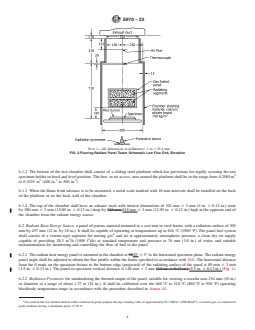
FIG. 2 Flooring Radiant Panel Tester Schematic Low Flux End, Elevation
6.1.2 The bottom of the test chamber shall consist of a sliding steel platform which has provisions for rigidly securing the test
specimen holder in fixed and level position. The free, or air access, area around the platform shall be in the range from 0.2580 m
2 2 2
to 0.3225 m (400 in. to 500 in. ).
6.1.3 When the flame front advance is to be measured, a metal scale marked with 10 mm intervals shall be installed on the back
of the platform or on the back wall of the chamber.
6.1.4 The top of the chamber shall have an exhaust stack with interior dimensions of 102 mm 6 3 mm (4 in. 6 0.13 in.) wide
by 380 mm 6 3 mm (15.00 in. 6 0.13 in.) deep by 318 mm 318 mm 6 3 mm (12.50 in. 6 0.13 in.) high at the opposite end of
the chamber from the radiant energy source.
6.2 Radiant Heat Energy Source, a panel of porous material mounted in a cast iron or steel frame, with a radiation surface of 305
mm by 457 mm (12 in. by 18 in.). It shall be capable of operating at temperatures up to 816 °C (1500 °F). The panel fuel system
shall consist of a venturi-type aspirator for mixing gas and air at approximately atmospheric pressure, a clean dry air supply
3 3
capable of providing 28.3 m /h (1000 f t/h) at standard temperature and pressure at 76 mm (3.0 in.) of water, and suitable
instrumentation for monitoring and controlling the flow of fuel to the panel.
6.2.1 The radiant heat energy panel is mounted in the chamber at 3030° 6 5° to the horizontal specimen plane. The radiant energy
panel angle shall be adjusted to obtain the flux profile within the limits specified in accordance with 10.6. The horizontal distance
from the 0 mark on the specimen fixture to the bottom edge (projected) of the radiating surface of the panel is 89 mm 6 3 mm
(3.5 in. 6 0.13 in.). The panel-to-specimen vertical distance is 140 mm 6 3 mm (5.5 in. 6 0.13 in.) (5.5 in. 6 0.13 in.) (Fig. 1).
6.2.2 Radiation Pyrometer for standardizing the thermal output of the panel, suitable for viewing a circular area 254 mm (10 in.)
in diameter at a range of about 1.37 m (54 in.). It shall be calibrated over the 460 °C to 510 °C (860 °F to 950 °F) operating
blackbody temperature range in accordance with the procedure described in Annex A1.
3 3
Gas used in this test method shall be either commercial grade propane having a heating value of approximately 83.1 MJ/m (2500 Btu/ft ), or natural gas, or commercial
grade methane having a minimum purity of 96 %.
E970 − 23
6.2.3 Voltmeter, high-impedance or potentiometric, with a suitable millivolt range shall be used to monitor the output of the
radiation pyrometer described in 6.2.2.
6.3 Dummy Specimen Holder (Fig. 3 and Fig. 4), constructed from heat-resistant stainless steel (UNS N08330 (AISI Type 330)
or equivalent) having a thickness of 1.98 mm (0.078 in.) (0.078 in.) and an overall dimension of 11401140 mm by 320 mm
(45(45 in. by 12 ⁄4 in.) with a specimen opening of 200 mm by 1000 mm 1000 mm (7.9 in. by 39.4 in.). Six slots shall be cut in
the flange on either side of the holder to reduce warping. The holder shall be fastened to the platform with two stud bolts at each
end.
3 3
6.4 Dummy Specimen, used in the flux profile determination, made of 19 mm ( ⁄4-in.) inorganic 740-kg/m740 kg ⁄m (46-lb/ft )
nominal density calcium silicate board (Fig. 3 and Fig. 4). It is 250 mm (10 in.) wide by 1070 mm (42 in.) long with 27 mm
(1 ⁄16-in.) diameter holes centered on and along the centerline at the 100, 200, 300, . . . , 900, and 980-mm100 mm, 200 mm,
300 mm, . . . , 900 mm, and 980 mm locations measured from the maximum flux end of the specimen.
6.4.1 To provide proper and consistent seating of the flux meter in the hole openings, a stainless steel or galvanized steel bearing
plate (Fig. 3 and Fig. 4) shall be mounted and firmly secured to the underside of the calcium silicate board with holes corresponding
to those specified above. The bearing plate shall run the length of the dummy specimen board and have a width of 76 mm (3.0
in.). The thickness of the bearing plate shall be set in order to maintain the flux meter height specified in 10.5. The maximum
thickness of the bearing plate shall not exceed 3 mm ( ⁄8 in.).
6.5 Total Heat Flux Transducer, to determine the flux profile of the chamber in conjunction with the dummy specimen (Fig. 3),
5 2 2 2 2
shall be of the Schmidt-Boelter type, have a range from 00 W ⁄cm to 1.5 W/cm (0(0 Btu ⁄ft ·s to 1.32 Btu/ft ·s) and shall be
2 2
calibrated over the operating flux level range from 0.010.01 W ⁄cm to 1.5 W/cm in accordance with the procedure outlined in
Annex A1. A source of 15 to 25°C15 °C to 25 °C cooling water shall be provided for this instrument.
6.5.1 Voltmeter, high-impedance or potentiometric, with a range from 00 mV to 10 mV and reading to 0.01 mV shall be used to
measure the output of the total heat flux transducer during the flux profile determination.
NOTE 1—All dimensions in millimetres. 1 in. = 25.4 mm.
FIG. 3 Zero Reference Point Related to Detecting Plane
The sole source of supply of the apparatus known to the committtee at this time is Medtherm Corp., P.O. Box 412, Huntsville, Al 35804. If you are aware of alternative
suppliers, please provide this information to ASTM headquarters. Your commnents will receive careful consideration at a meeting of the responsible technical committee,
which you may attend.
E970 − 23
NOTE 1—All dimensions in millimetres. 1 in. = 25.4 mm.
FIG. 4 Dummy Specimen in Specimen Holder
6.6 Specimen Tray (Fig. 5), constructed from 14-gage heat-resistant stainless steel (UNS-N08330 (AISI Type 330) or equivalent),
thickness 1.98 mm (0.078 in.). The depth of the tray is 50 mm (2 in.). The flanges of the specimen tray are drilled to accommodate
two stud bolts at each end; the bottom surface of the flange is 21 mm (0.83 in.) below the top edge of the specimen tray. The overall
dimensions of the tray and the width of the flanges shall be such that the tray fills the open space in the sliding platform. The tray
must be adequate to contain a specimen at least 1000 mm (40 in.) long and 250 mm (10 in.) wide. The zero reference point on
the dummy specimen shall coincide with the pilot burner flame impingement point (Fig. 3).
1 3
6.7 Pilot Burner, used to ignite the specimen, is a nominal 6 mm 6 mm ( ⁄4 in.) inside diameter, 10 mm ( ⁄8 in.) outside diameter
stainless steel tube line burner having 19 evenly spaced 0.7 mm (0.028 in.) diameter (No. 70 drill) holes drilled radially along the
centerline and 16 evenly spaced 0.7 mm (0.028 in.) diameter (No. 70 drill) holes drilled radially 60 below the centerline (Fig. 6).
4 2 2
6.7.1 In operation, the gas flow is adjusted to 0.850.85 m /h to 0.115 m /h (3.0(3.0 SCFH to 4.0 SCFH) (air scale) flow rate. With
the gas flow properly adjusted and the pilot burner in the test position, the pilot flame will extend from approximately 63.5 mm
63.5 mm (2.5 in.) at the ends to approximately 127 mm (5 in.) at the center.
NOTE 1—All dimensions in millimetres. 1 in. = 25.4 mm.
FIG. 5 Specimen Tray
E970 − 23
FIG. 6 Pilot Burner
6.7.2 The holes in the pilot burner shall be kept clean. One means for opening the holes in the pilot burner is to use
nickel-chromium or stainless steel wire that has a diameter of 0.5 mm (0.020 in.). Surface contaminants shall be removed from
the burner. One means for removing contaminants is the use of a soft wire brush.
6.7.3 The pilot burner is positioned no more than 5° from the horizontal so that the flame generated will impinge on, and reach
out over the specimen from the zero distance point (see Fig. 1 and Fig. 2). The burner must have the capability of being moved
at least 50 mm (2 in.) away from the specimen when not in use.
6.8 Thermocouples—A 3.2-mm3.2 mm ( ⁄8-in.) stainless steel sheathed grounded junction Chromel-Alumel thermocouple (6.8.1)
shall be located in the radiant panel test chamber (Fig. 1 and Fig. 2). The chamber thermocouple is located in the longitudinal
central vertical plane of the chamber 25 mm (1 in.) down from the top and 102 mm (4 in.) back from the inside of the exhaust
stack.
6.8.1 The thermocouple shall be kept clean to ensure accuracy of readout.
6.8.2 An indicating potentiometer with a range from 100 °C to 500 °C (212 °F to 932 °F) shall be used to determine the chamber
temperature prior to a test.
3 3 3 3
6.9 Exhaust Duct, with a capacity of 28.3m28.3 m /min to 85 m85 m /min (1000 ft /min to 3000 ft /min) at standard temperature
and pressure decoupled from the chamber stack by at least 76 mm 76 mm (3 in.) on all sides and with an effective area of the
canopy slightly larger than plane area of the chamber with the specimen platform in the OUT position, is used to remove
combustion products from the chamber. With the panel turned on and the dummy specimen in place, the air flow through the stack
shall be 76.2 m/min 6 15.2 m/min (250 ft/min. 6 5050 ft ft/min.) ⁄min.) when measured with a calibrated hot-wire anemometer.
The reading is taken about 30 s after insertion of the probe into the center of the stack opening at a distance of 152 mm (6 in.)
152 mm (6 in.) down from the top of the stack opening (Fig. 1 and Fig. 2).
6.10 A timing device with a minimum resolution of 0.10 min 0.10 min shall be used to measure preheat, pilot contact, time of
maximum flame travel, and when all flaming goes out.
E970 − 23
7. Hazards
7.1 Suitable safeguards following sound engineering practices shall be installed in the panel fuel supply to guard against a gas-air
explosion in the test chamber. Consideration shall be given, but not limited to the following : (1) a gas feed cutoff activated when
the air supply fails, (2) a fire sensor directed at the panel surface that stops fuel flow when the panel flame goes out, and (3) a
commercial gas water heater or gas-fired furnace pilot burner control thermostatic shut-off that is activated when the gas supply
fails or other suitable and approved device. Manual reset is a requirement of any safeguard system used.
7.2 In view of the potential hazard from products of combustion, the exhaust system must be so designed and operated that the
laboratory environment is protected from smoke and gas. The operator shall be instructed to minimize his exposure to combustion
products by following sound safety practice; for example, ensure that the exhaust system is working properly, wear appropriate
clothing including gloves, etc.
8. Sampling
8.1 The samples selected for testing shall be representative of the product.
8.2 Standard ASTM sampling practice shall be followed where applicable; see Practice E122 for choice of sample size to estimate
the average quality of a lot or process.
9. Test Specimens
9.1 The test specimen shall be attic floor insulation sized to provide for adequate filling of the specimen tray (see Fig. 5).
9.2 A minimum of three specimens per sample shall be tested.
9.3 The insulation specimen to be used for the test shall simulate actual installation practice.
9.4 The insulation specimen shall be representative of the manufacturer’s recommended design density for loose-fill insulation,
or the manufactured density for board and batt type insulation.
9.5 The following are specific instructions for some individual types of materials. The materials discussed under 9.5.1 through
9.5.4 represent some materials typically used with this test method. Sections 9.5.1 through 9.5.4 do not exclude other materials,
which shall also be permitted to be tested in accordance with this test method.
9.5.1 Cellulosic Fiber Loose-Fill
9.5.1.1 The test shall be conducted at the design density per Specification C739.
9.5.1.2 If the design density is not provided by product label, determine the product design density in accordance with Section
8 procedures of Specification C739.
9.5.1.3 Determine the weight of insulation required to fill the specimen tray to achieve the design density determined above.
9.5.1.4 Specimen trays shall be prepared for testing by one of the following two methods described in 9.5.3.
9.5.2 Mineral Fiber Loose-Fill—Loose-Fill
9.5.2.1 The test shall be conducted at the design density as defined in Specification C764.
9.5.2.2 If no design density is provided by the product label then the test shall be conducted at the as-blown density. The report
shall indicate that the as-blown density was used for the test.
9.5.2.3 Determine the weight of insulation required to fill the specimen tray to achieve the design density determined above.
9.5.2.4 Specimen trays shall be prepared for testing by one of the following two methods described in 9.5.3.
E970 − 23
9.5.3 Preparing Loose-Fill Specimen Trays
9.5.3.1 Method A – Hand Loading
(1) Blow the material through a commercial blower using a minimum length of 30.5 m (100 ft) length of hose, with a hose
diameter as recommended per manufacturer installation requirements. Blow into a sample receiver while holding the hose
horizontally at a height of 4 ft.
(2) Load the specimen tray by hand with the amount of insulation measured by weight that corresponds to the density of
insulation. Gently shake the specimen to settle the insulation while loading. The top of the insulation is to be level with the top
of the tray.
(3) Be careful not to compact the insulation.
9.5.3.2 Method B—Blowing the material into the specimen trays.
(1) Blow the material through a commercial blower using a minimum length of 30.5 m (100 ft) length of hose, with a hose
diameter as recommended per manufacture installation requirements. While holding the hose horizontally at a height of 4 ft, blow
the test sample into the test specimen trays.
(2) Gently shake specimen, removing excess and overblown insulation. The specimen shall then be gently screeded with a
metal straight edge in one direction so that the specimen is level across the top of the tray. Take care not to compact the insulation.
(3) As an alternative to screeding, the specimen tray may be gently dropped onto a hard level surface until the specimen is level
with the sides of the specimen tray. Holding the specimen tray at a height of 1 in., drop the tray. Repeat as needed.
(4) Surface irregularities shall not exceed 4.8 mm ( ⁄16 in.). Additional material may be added to fill any voids or valleys around
the periphery of the specimen tray.
(5) Weigh each of the specimen trays to validate that the material is at design density.
9.5.4 Insulation Batts or Boards
9.5.4.1 Cut the batts or boards to a thickness of 50 mm (2 in.) (2 in.) and cut to fit into the specimen tray.
9.5.4.2 The test density for the batt or board specimens shall be determined in accordance with Section 8 of Test Method C167
prior to the test.
10. Radiant Heat Energy Flux Profile Standardization
10.1 In a continuing program of tests, the flux profile shall be determined not less than once a week. Where the time interval
between tests is greater than one week, the flux profile shall be determined at the start of the test series.
10.2 Mount the dummy specimen in the mounting frame, and attach the assembly to the sliding platform.
10.3 With the sliding platform out of the chamber, turn on the exhaust, and ignite the radiant panel. Allow the unit to heat for 1.5
h. The pilot burner is off during this determination. Adjust the fuel mixture to give an air-rich flame. Make fuel flow settings to
bring the panel blackbody temperature to 485 °C 6 25 °C (839 °F 6 45 °F) and record the chamber temperature. After the panel
blackbody temperature has stabilized, move the specimen platform into the chamber and close the door.
10.4 Allow 0.5 h for the closed chamber to equilibrate.
10.5 Measure the radiant heat energy flux level at the 400 mm 400 mm point with the total flux meter instrumentation. This is done
1 1
by inserting the flux meter in the opening so that its detecting plane is 1.6 mm to 3.2 mm ( ⁄16 in. to ⁄8 in.) above and parallel to
the plane of the dummy specimen and reading its output after 3030 s 6 10 s. If the level is within the limits specified in 10.6, start
the flux profile determination. If it is not, adjust the panel fuel flow as required to bring the level within the limits specified in 10.6.
A suggested flux profile data log format is shown in Fig. 7.
10.6 Run the test under chamber operating conditions that give a flux profile as shown in Fig. 8. The radiant heat energy incident
2 2 2 2
on the dummy specimen shall be between 0.87 W/cm to 0.95 W/cm (0.77 Btu/ft ·s and 0.83 Btu/ft ·s) at the 200 mm point,
2 2 2 2 2
between 0.48 W/cm to 0.52 W/cm (0.42 Btu/ft ·s and 0.46 Btu/ft ·s) at the 400 mm point, and between 0.22 W/cm to 0.26
2 2 2
W/cm (0.19 Btu/ft ·s and 0.23 Btu/ft ·s) at the 600 mm point.
E970 − 23
Radiant Flux Profile
Date ______
Blackbody Temperature ______ mV. ______ °C (°F)
3 3
Gas Flow ______ NTP m /h (SCFH) Air Flow ______ NTP m /h (SCFH)
Room Temperature ______ °C
...