

ASTM C1859-23
(Practice)Standard Practice for Determination of Thermal Resistance of Pneumatically Installed Loose-Fill Building Insulation (Behind Netting) for Enclosed Applications of the Building Thermal Envelope
General Information
- Abstract
SIGNIFICANCE AND USE
4.1 The thermal resistance, R, of an insulation is used to describe its thermal performance.
4.2 The thermal resistance of an insulation is related to the density and thickness of the insulation. It is desirable to obtain test data on thermal resistances at thicknesses and densities related to the end uses of the product.
4.3 In normal use, the thickness of these products range from less than 100 mm (4 in.) to greater than 150 mm (6 in.). Installed densities depend upon the product type, the installed thickness, the installation equipment used, the installation techniques, and the geometry of the insulated space.
4.4 Loose-fill insulations provide coverage information using densities selected by manufacturers to represent the product installed densities. Generally, it is necessary to know the product thermal performance at a representative density.
4.5 When applicable specifications or codes do not specify the nominal thermal resistance level to be used for comparison purposes, a recommended practice is to use the Rsi (metric) = 2.65 m F/Btu]) label density and thickness for that measurement.
4.6 If the density for test purposes is not available from the coverage chart, a test density shall be established by use of applicable specifications and codes or, if none apply, agreement between the requesting body and the testing organization.
4.7 Generally, thin sections of these materials are not uniform. Thus, the test thickness must be greater than or equal to the product’s representative thickness if the results are to be consistent and typical of use.
Note 1: The representative thickness is specific for each product and is determined by running a series of tests in which the density is held constant but the thickness is increased. The representative thickness is defined here as that thickness above which there is no more than a 2 % change in the resistivity of the product. The representative thickness is a function of product blown density. In gene...
SCOPE
1.1 This practice presents a laboratory guide to determine the thermal resistance of pneumatically installed loose-fill building insulations for enclosed applications of the building thermal envelope behind netting at mean temperatures between –10 and 35°C (14 to 95°F).
1.2 This practice applies to a wide variety of loose-fill thermal insulation products including but not limited to fibrous glass, rock/slag wool, or cellulosic fiber materials and any other insulation material that can be installed pneumatically. It does not apply to products that change their character after installation either by chemical reaction or the application of binders, adhesives or other materials that are not used in the sample preparation described in this practice, nor does it consider the effects of structures, containments, facings, or air films.
1.3 Since this practice is designed for reproducible product comparison, it measures the thermal resistance of an insulation material which has been preconditioned to a relatively dry state. Consideration of changes of thermal performance of a hygroscopic insulation by sorption of water is beyond the scope of this practice.
1.4 The sample preparation techniques outlined in this practice do not cover the characterization of loose-fill materials intended for open applications and not intended for spray-applied applications.
1.5 The values stated in SI units are to be regarded as the standard. The values given in parentheses are for information only.
1.6 This standard does not purport to address all of the safety concerns, if any, associated with its use. It is the responsibility of the user of this standard to establish appropriate safety, health, and environmental practices and determine the applicability of regulatory limitations prior to use.
1.7 This international standard was developed in accordance with internationally recognized principles on standardization established in t...
- Status
- Published
- Publication Date
- 30-Apr-2023
- Technical Committee
- C16 - Thermal Insulation
- Drafting Committee
- C16.30 - Thermal Measurement
Buy Documents
ASTM C1859-23 - Standard Practice for Determination of Thermal Resistance of Pneumatically Installed Loose-Fill Building Insulation (Behind Netting) for Enclosed Applications of the Building Thermal Envelope
REDLINE ASTM C1859-23 - Standard Practice for Determination of Thermal Resistance of Pneumatically Installed Loose-Fill Building Insulation (Behind Netting) for Enclosed Applications of the Building Thermal Envelope
Overview
ASTM C1859-23: Standard Practice for Determination of Thermal Resistance of Pneumatically Installed Loose-Fill Building Insulation (Behind Netting) for Enclosed Applications of the Building Thermal Envelope provides a laboratory guide to assess the thermal resistance (R-value) of loose-fill insulation materials that are pneumatically installed behind netting within building envelope cavities. Developed by ASTM Committee C16, this standard supports reproducible product comparisons, helping manufacturers, laboratories, and code officials evaluate the energy efficiency contribution of loose-fill building insulation for enclosed applications.
Thermal resistance is a key parametro describe insulation performance, significantly impacting energy savings, comfort, and compliance with building codes. ASTM C1859-23 ensures that the measurement process captures realistic installation conditions and thicknesses for the final application.
Key Topics
Thermal Resistance (R-value):
The standard focuses on determining the R-value of loose-fill insulations, dependent on product density, installed thickness, and installation method. This enables accurate specification and comparison across various building insulation products.Applicable Materials:
It applies to a broad array of loose-fill thermal insulation products, such as fibrous glass, mineral wool (rock/slag), cellulosic fiber, and other pneumatic-installation insulation types. It explicitly excludes materials that alter properties post-installation due to chemical reactions or additives.Test Apparatus & Conditions:
- Tests are performed on insulation preconditioned to a dry state, at mean temperatures between –10°C and 35°C (14°F to 95°F).
- The preferred test method is ASTM C518 (heat flow meter apparatus), though other ASTM test methods (C177, C1114, C1363) are acceptable.
- Thermal resistance is determined at thicknesses and densities corresponding to end-use scenarios, with a standard minimum test thickness of 87.5 mm (3 1/2 in.).
Sample Preparation:
Procedures specify blowing insulation behind netting according to manufacturer’s guidelines using representative equipment, followed by appropriate specimen conditioning for reproducible results.Reporting Requirements:
Test reports must include information such as product and test identification, specimen preparation methods, apparatus used, installation details, test results (R-value, density), and conditions to ensure transparency and replicability.
Applications
Product Quality Assurance:
Manufacturers utilize ASTM C1859-23 to verify and communicate the thermal performance of loose-fill insulation, supporting labeling claims and product selection.Building Code Compliance:
Building officials and inspectors use the standard to evaluate whether installed insulation meets required thermal performance standards for energy efficiency and sustainability.Design and Specification Support:
Architects, engineers, and builders reference test data produced according to this standard for specifying suitable insulation materials for enclosed applications, such as wall cavities, attics, and floors.Laboratory Testing:
Accredited laboratories deploy this practice to provide precise and comparable R-value data for different loose-fill insulation products.
Related Standards
- ASTM C168 – Terminology Relating to Thermal Insulation
- ASTM C177 – Test Method for Steady-State Heat Flux Measurements by Guarded-Hot-Plate Apparatus
- ASTM C518 – Test Method for Steady-State Thermal Transmission by Heat Flow Meter Apparatus (preferred for C1859-23)
- ASTM C1045 – Practice for Calculating Thermal Transmission Properties Under Steady-State Conditions
- ASTM C1114 – Test Method by Means of the Thin-Heater Apparatus
- ASTM C1363 – Test Method for Thermal Performance of Building Materials and Envelope Assemblies by Means of a Hot Box Apparatus
ASTM C1859-23 is a critical standard ensuring the accuracy and reliability of R-value measurements for pneumatically installed, loose-fill insulated building envelopes, supporting energy-efficient construction and informed material selection.
Relations
- Effective Date
- 15-Apr-2024
- Effective Date
- 01-Mar-2024
- Effective Date
- 01-Sep-2019
- Effective Date
- 01-Apr-2019
- Effective Date
- 01-Mar-2019
- Effective Date
- 15-Apr-2018
- Effective Date
- 01-Jun-2017
- Effective Date
- 15-Oct-2015
- Effective Date
- 01-Sep-2015
- Effective Date
- 01-Jun-2015
- Effective Date
- 01-Sep-2013
- Effective Date
- 01-Sep-2013
- Effective Date
- 01-Apr-2013
- Effective Date
- 15-May-2011
- Effective Date
- 01-Jun-2010
Buy Documents
ASTM C1859-23 - Standard Practice for Determination of Thermal Resistance of Pneumatically Installed Loose-Fill Building Insulation (Behind Netting) for Enclosed Applications of the Building Thermal Envelope
REDLINE ASTM C1859-23 - Standard Practice for Determination of Thermal Resistance of Pneumatically Installed Loose-Fill Building Insulation (Behind Netting) for Enclosed Applications of the Building Thermal Envelope
Get Certified
Connect with accredited certification bodies for this standard

DIBt (Deutsches Institut für Bautechnik)
German Institute for Building Technology.
DIN CERTCO
DIN Group product certification.

Aboma Certification B.V.
Specialized in construction, metal, and transport sectors.
Sponsored listings
Frequently Asked Questions
ASTM C1859-23 is a standard published by ASTM International. Its full title is "Standard Practice for Determination of Thermal Resistance of Pneumatically Installed Loose-Fill Building Insulation (Behind Netting) for Enclosed Applications of the Building Thermal Envelope". This standard covers: SIGNIFICANCE AND USE 4.1 The thermal resistance, R, of an insulation is used to describe its thermal performance. 4.2 The thermal resistance of an insulation is related to the density and thickness of the insulation. It is desirable to obtain test data on thermal resistances at thicknesses and densities related to the end uses of the product. 4.3 In normal use, the thickness of these products range from less than 100 mm (4 in.) to greater than 150 mm (6 in.). Installed densities depend upon the product type, the installed thickness, the installation equipment used, the installation techniques, and the geometry of the insulated space. 4.4 Loose-fill insulations provide coverage information using densities selected by manufacturers to represent the product installed densities. Generally, it is necessary to know the product thermal performance at a representative density. 4.5 When applicable specifications or codes do not specify the nominal thermal resistance level to be used for comparison purposes, a recommended practice is to use the Rsi (metric) = 2.65 m F/Btu]) label density and thickness for that measurement. 4.6 If the density for test purposes is not available from the coverage chart, a test density shall be established by use of applicable specifications and codes or, if none apply, agreement between the requesting body and the testing organization. 4.7 Generally, thin sections of these materials are not uniform. Thus, the test thickness must be greater than or equal to the product’s representative thickness if the results are to be consistent and typical of use. Note 1: The representative thickness is specific for each product and is determined by running a series of tests in which the density is held constant but the thickness is increased. The representative thickness is defined here as that thickness above which there is no more than a 2 % change in the resistivity of the product. The representative thickness is a function of product blown density. In gene... SCOPE 1.1 This practice presents a laboratory guide to determine the thermal resistance of pneumatically installed loose-fill building insulations for enclosed applications of the building thermal envelope behind netting at mean temperatures between –10 and 35°C (14 to 95°F). 1.2 This practice applies to a wide variety of loose-fill thermal insulation products including but not limited to fibrous glass, rock/slag wool, or cellulosic fiber materials and any other insulation material that can be installed pneumatically. It does not apply to products that change their character after installation either by chemical reaction or the application of binders, adhesives or other materials that are not used in the sample preparation described in this practice, nor does it consider the effects of structures, containments, facings, or air films. 1.3 Since this practice is designed for reproducible product comparison, it measures the thermal resistance of an insulation material which has been preconditioned to a relatively dry state. Consideration of changes of thermal performance of a hygroscopic insulation by sorption of water is beyond the scope of this practice. 1.4 The sample preparation techniques outlined in this practice do not cover the characterization of loose-fill materials intended for open applications and not intended for spray-applied applications. 1.5 The values stated in SI units are to be regarded as the standard. The values given in parentheses are for information only. 1.6 This standard does not purport to address all of the safety concerns, if any, associated with its use. It is the responsibility of the user of this standard to establish appropriate safety, health, and environmental practices and determine the applicability of regulatory limitations prior to use. 1.7 This international standard was developed in accordance with internationally recognized principles on standardization established in t...
SIGNIFICANCE AND USE 4.1 The thermal resistance, R, of an insulation is used to describe its thermal performance. 4.2 The thermal resistance of an insulation is related to the density and thickness of the insulation. It is desirable to obtain test data on thermal resistances at thicknesses and densities related to the end uses of the product. 4.3 In normal use, the thickness of these products range from less than 100 mm (4 in.) to greater than 150 mm (6 in.). Installed densities depend upon the product type, the installed thickness, the installation equipment used, the installation techniques, and the geometry of the insulated space. 4.4 Loose-fill insulations provide coverage information using densities selected by manufacturers to represent the product installed densities. Generally, it is necessary to know the product thermal performance at a representative density. 4.5 When applicable specifications or codes do not specify the nominal thermal resistance level to be used for comparison purposes, a recommended practice is to use the Rsi (metric) = 2.65 m F/Btu]) label density and thickness for that measurement. 4.6 If the density for test purposes is not available from the coverage chart, a test density shall be established by use of applicable specifications and codes or, if none apply, agreement between the requesting body and the testing organization. 4.7 Generally, thin sections of these materials are not uniform. Thus, the test thickness must be greater than or equal to the product’s representative thickness if the results are to be consistent and typical of use. Note 1: The representative thickness is specific for each product and is determined by running a series of tests in which the density is held constant but the thickness is increased. The representative thickness is defined here as that thickness above which there is no more than a 2 % change in the resistivity of the product. The representative thickness is a function of product blown density. In gene... SCOPE 1.1 This practice presents a laboratory guide to determine the thermal resistance of pneumatically installed loose-fill building insulations for enclosed applications of the building thermal envelope behind netting at mean temperatures between –10 and 35°C (14 to 95°F). 1.2 This practice applies to a wide variety of loose-fill thermal insulation products including but not limited to fibrous glass, rock/slag wool, or cellulosic fiber materials and any other insulation material that can be installed pneumatically. It does not apply to products that change their character after installation either by chemical reaction or the application of binders, adhesives or other materials that are not used in the sample preparation described in this practice, nor does it consider the effects of structures, containments, facings, or air films. 1.3 Since this practice is designed for reproducible product comparison, it measures the thermal resistance of an insulation material which has been preconditioned to a relatively dry state. Consideration of changes of thermal performance of a hygroscopic insulation by sorption of water is beyond the scope of this practice. 1.4 The sample preparation techniques outlined in this practice do not cover the characterization of loose-fill materials intended for open applications and not intended for spray-applied applications. 1.5 The values stated in SI units are to be regarded as the standard. The values given in parentheses are for information only. 1.6 This standard does not purport to address all of the safety concerns, if any, associated with its use. It is the responsibility of the user of this standard to establish appropriate safety, health, and environmental practices and determine the applicability of regulatory limitations prior to use. 1.7 This international standard was developed in accordance with internationally recognized principles on standardization established in t...
ASTM C1859-23 is classified under the following ICS (International Classification for Standards) categories: 91.120.10 - Thermal insulation of buildings. The ICS classification helps identify the subject area and facilitates finding related standards.
ASTM C1859-23 has the following relationships with other standards: It is inter standard links to ASTM C168-24, ASTM C1363-24, ASTM C1363-19, ASTM C1045-19, ASTM C1114-06(2019), ASTM C168-18, ASTM C168-17, ASTM C168-15a, ASTM C518-15, ASTM C168-15, ASTM C1045-07(2013), ASTM C1114-06(2013), ASTM C168-13, ASTM C1363-11, ASTM C177-10. Understanding these relationships helps ensure you are using the most current and applicable version of the standard.
ASTM C1859-23 is available in PDF format for immediate download after purchase. The document can be added to your cart and obtained through the secure checkout process. Digital delivery ensures instant access to the complete standard document.
Standards Content (Sample)
This international standard was developed in accordance with internationally recognized principles on standardization established in the Decision on Principles for the
Development of International Standards, Guides and Recommendations issued by the World Trade Organization Technical Barriers to Trade (TBT) Committee.
Designation: C1859 − 23
Standard Practice for
Determination of Thermal Resistance of Pneumatically
Installed Loose-Fill Building Insulation (Behind Netting) for
Enclosed Applications of the Building Thermal Envelope
This standard is issued under the fixed designation C1859; the number immediately following the designation indicates the year of
original adoption or, in the case of revision, the year of last revision. A number in parentheses indicates the year of last reapproval. A
superscript epsilon (´) indicates an editorial change since the last revision or reapproval.
1. Scope priate safety, health, and environmental practices and deter-
mine the applicability of regulatory limitations prior to use.
1.1 This practice presents a laboratory guide to determine
1.7 This international standard was developed in accor-
the thermal resistance of pneumatically installed loose-fill
dance with internationally recognized principles on standard-
building insulations for enclosed applications of the building
ization established in the Decision on Principles for the
thermal envelope behind netting at mean temperatures be-
Development of International Standards, Guides and Recom-
tween –10 and 35°C (14 to 95°F).
mendations issued by the World Trade Organization Technical
1.2 This practice applies to a wide variety of loose-fill
Barriers to Trade (TBT) Committee.
thermal insulation products including but not limited to fibrous
2. Referenced Documents
glass, rock/slag wool, or cellulosic fiber materials and any
other insulation material that can be installed pneumatically. It 2
2.1 ASTM Standards:
does not apply to products that change their character after
C168 Terminology Relating to Thermal Insulation
installation either by chemical reaction or the application of
C177 Test Method for Steady-State Heat Flux Measure-
binders, adhesives or other materials that are not used in the
ments and Thermal Transmission Properties by Means of
sample preparation described in this practice, nor does it
the Guarded-Hot-Plate Apparatus
consider the effects of structures, containments, facings, or air
C518 Test Method for Steady-State Thermal Transmission
films.
Properties by Means of the Heat Flow Meter Apparatus
C1045 Practice for Calculating Thermal Transmission Prop-
1.3 Since this practice is designed for reproducible product
comparison, it measures the thermal resistance of an insulation erties Under Steady-State Conditions
C1114 Test Method for Steady-State Thermal Transmission
material which has been preconditioned to a relatively dry
state. Consideration of changes of thermal performance of a Properties by Means of the Thin-Heater Apparatus
C1363 Test Method for Thermal Performance of Building
hygroscopic insulation by sorption of water is beyond the
scope of this practice. Materials and Envelope Assemblies by Means of a Hot
Box Apparatus
1.4 The sample preparation techniques outlined in this
practice do not cover the characterization of loose-fill materials
3. Terminology
intended for open applications and not intended for spray-
3.1 Unless otherwise stated, the terms and definitions found
applied applications.
in Terminology C168 are applicable herein.
1.5 The values stated in SI units are to be regarded as the
standard. The values given in parentheses are for information 4. Significance and Use
only.
4.1 The thermal resistance, R, of an insulation is used to
1.6 This standard does not purport to address all of the
describe its thermal performance.
safety concerns, if any, associated with its use. It is the
4.2 The thermal resistance of an insulation is related to the
responsibility of the user of this standard to establish appro-
density and thickness of the insulation. It is desirable to obtain
test data on thermal resistances at thicknesses and densities
related to the end uses of the product.
This practice is under the jurisdiction of ASTM Committee C16 on Thermal
Insulation and is the direct responsibility of Subcommittee C16.30 on Thermal
Measurement. For referenced ASTM standards, visit the ASTM website, www.astm.org, or
Current edition approved May 1, 2023. Published June 2023. Originally contact ASTM Customer Service at service@astm.org. For Annual Book of ASTM
approved in 2017. Last previous edition approved in 2021 as C1859 – 21. DOI: Standards volume information, refer to the standard’s Document Summary page on
10.1520/C1859-23. the ASTM website.
Copyright © ASTM International, 100 Barr Harbor Drive, PO Box C700, West Conshohocken, PA 19428-2959. United States
C1859 − 23
4.3 In normal use, the thickness of these products range matic installation behind netting shall be pneumatically applied
from less than 100 mm (4 in.) to greater than 150 mm (6 in.). (blown) using the manufacturer’s installation instructions and
Installed densities depend upon the product type, the installed netting specified.
thickness, the installation equipment used, the installation
5. Apparatus
techniques, and the geometry of the insulated space.
5.1 Thermal test apparatus used for this practice shall meet
4.4 Loose-fill insulations provide coverage information us-
these requirements.
ing densities selected by manufacturers to represent the product
5.1.1 Conformance to Standards—The apparatus shall con-
installed densities. Generally, it is necessary to know the
form to all requirements of the ASTM thermal test method
product thermal performance at a representative density.
used.
4.5 When applicable specifications or codes do not specify
5.1.2 Size and Error—The apparatus shall be capable of
the nominal thermal resistance level to be used for comparison
testing specimens up to at least 150-mm (6-in.) thickness with
purposes, a recommended practice is to use the Rsi (met-
an estimated error not greater than 1 % attributed to thickness/
ric) = 2.65 m F/Btu]) label density and thickness for that
guard dimensions. (Parametric studies using a mathematical
measurement.
model of the proposed apparatus will give insight to this
4.6 If the density for test purposes is not available from the
evaluation. For example, see Table 1 in the 1976 edition of Test
coverage chart, a test density shall be established by use of Method C518.
applicable specifications and codes or, if none apply, agreement
NOTE 2—Thermal test apparatus in use for this practice shall have
between the requesting body and the testing organization.
overall plate dimensions of 457 to 1220 mm (18 to 48 in.) square with
metering areas 152 to 457 mm (6 to 18 in.) square. Other sizes are
4.7 Generally, thin sections of these materials are not
acceptable if proper consideration of the size-thickness restrictions as
uniform. Thus, the test thickness must be greater than or equal
outlined in the test method are observed in their design. (See Practice
to the product’s representative thickness if the results are to be
C1045 for additional discussion.)
consistent and typical of use.
5.1.3 Temperature—As a minimum, the apparatus shall be
NOTE 1—The representative thickness is specific for each product and capable of testing at a mean temperature of 23.9°C (75°F) with
is determined by running a series of tests in which the density is held
a temperature difference of 20 to 28°C (36 to 50°F). The
constant but the thickness is increased. The representative thickness is
equipment shall be calibrated at the same temperatures as the
defined here as that thickness above which there is no more than a 2 %
test conditions. Some existing test apparatus have been de-
change in the resistivity of the product. The representative thickness is a
signed to provide measurements over a range of mean tem-
function of product blown density. In general, as the density decreases, the
representative thickness increases. Fortunately, most products are de-
peratures from –20 to 55°C (–4 to 131°F) and for a wider range
signed to be blown over a small range of densities. This limited range
of temperature differences.
yields a range of representative thicknesses between 75 to 150 mm (3 to
5.1.4 Humidity—The absolute humidity within the test ap-
6 in.) for most products. To simplify the process for this practice, the
paratus shall be maintained low enough to prevent condensa-
representative thickness for the C1859 tests is considered 87.5 mm (3 ⁄2
tion within the specimen or on the cold plate(s). A maximum
in). All thermal testing on this product is conducted at a thickness that is
greater or equal to the representative thickness.
9°C (48°F) dew point is consistent with the recommended
material conditioning levels.
4.7.1 For this practice, the minimum test thickness shall be
1 5.1.5 Orientation and Direction of Heat Flow—The thermal
87.5 mm (3 ⁄2 in.). If the test is to represent an installation at
test apparatus shall be capable of testing horizontal specimens
a lesser thickness, the installed thickness shall be used.
with heat flow-up. This orientation represents the most adverse
4.8 For purposes of this practice, it is acceptable to estimate
heat flow condition for testing between two solid boundaries.
the thermal resistance at any thickness from the thermal
5.1.6 Thermal Test Specimen Frame—The test frame shall
resistivity obtained from tests on the product at the minimum
be sized to match the test apparatus and shall be made of
test thickness (see 4.7.1) and at the density expected for the
materials having low thermal conductivity (<0.12 W/m K) and
proposed thickness.
minimum thickness. A thin, thermally insignificant, screen or
4.9 In principle, any of the standard methods for the membrane is stretched across the bottom to support the
determination of thermal resistance are suitable for loose-fill material. To simulate the actual installation process, a frame
products. These include Test Methods C177, C518, C1114, and holder, test frames (top and bottom half), and a cover assembly
C1363. This practice was developed in relationship to Test are recommended. The frame holder, test frames and cover
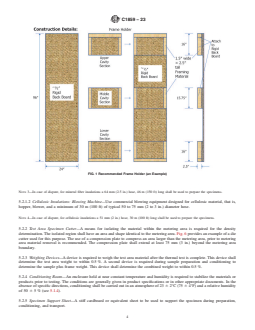
Method C518 specimen size and geometry. For this reason, assembly shall have fixed rigid sides (see Figs. 1-5).
Test Method C518 is preferred. Test Methods C177, C1114,
5.2 Specimen Preparation Equipment:
and C1363 are acceptable but changes to specimen size and
5.2.1 Blowing Machine—A blowing apparatus is required
geometry are possible.
when pneumatically applied specimens are to be tested.
Choose the combination of hopper, blower, and hose size and
4.10 The thermal resistance of low-density insulations de-
length that is representative of common use for the application
pend upon the direction of heat flow. Unless otherwise
specified, tests shall be performed for the maximum heat flow
condition, that is, a horizontal specimen with heat flow-up.
See Table 1, “Maximum Spacing Between Warm and Cold Plates of Heat
4.11 Specimens shall be prepared in a manner consistent
Flowmeter Apparatus,” of Test Method C518 – 76 published in 1985 Annual Book
with the intended installation procedure. Products for pneu- of ASTM Standards, Vol 04.06.
C1859 − 23
FIG. 1 Recommended Frame Holder (an Example)
NOTE 4—In case of dispute, for cellulosic insulations a 51 mm (2 in.)
of the material to be tested. The following machine specifica-
hose, 30 m (100 ft) long shall be used to prepare the specimens.
tions have been developed for use with mineral wool and
cellulosic materials.
5.2.2 Test Area Specimen Cutter—A means for isolating the
5.2.1.1 Mineral Fiber Insulations:
material within the metering area is required for the density
(1) Blowing Machine—A commercial blowing machine
determination. The isolated region shall have an area and shape
with a design capacity for delivering the subject material at a
identical to the metering area. Fig. 6 provides an example of a
rate between 4 and 15 kg (9 to 33 lb)/min.
die cutter used for this purpose. The use of a compression plate
(2) Blowing Hose—The machine shall utilize a minimum
to compress an area larger than the metering area, prior to
of 30 m (100 ft) of typical 75 to 100 mm (3 to 4 in.) diameter
metering area material removal is recommended. The compres-
flexible, internally corrugated blowing hose. The hose shall
sion plate shall extend at least 75 mm (3 in.) beyond the
have no more than eight 90° bends and all bends shall be
metering area boundary.
greater than 1.2-m (4-ft) radius. Before each sample prepara-
5.2.3 Weighing Devices—A device is required to weigh the
tion session, examine the hose for material remaining from
test area material after the thermal test is complete. This device
previous blows. Dislodge any remaining material by mechani-
shall determine the test area weight to within 0.5 %. A second
cally agitating the hose when the machine is running. Repeat as
device is required during sample preparation and conditioning
necessary to maintain a clean hose for each specimen.
(3) Insertion Device—The machine shall use a transition to determine the sample plus frame weight. This device shall
coupler to reduce the hose diameter down to 50 to 64 mm (2 to determine the combined weight to within 0.5 %.
2.5 in.), with a recommended minimum length of 6 m (20 ft).
5.2.4 Conditioning Room—An enclosure held at near con-
stant temperature and humidity is required to stabilize the
NOTE 3—In case of dispute, for mineral fiber insulations a 64 mm (2.5
in.) hose, 46 m (150 ft) long shall be used to prepare the specimens.
materials or products prior to testing. The conditions are
generally given in product specifications or in other appropriate
5.2.1.2 Cellulosic Insulations: Blowing Machine—Use
documents. In the absence of specific directions, conditioning
commercial blowing equipment designed for cellulosic
shall be carried out in an atmosphere of 23 6 2°C (75 6 4°F)
material, that is, hopper, blower, and a minimum of 30 m (100
ft) of typical 50 to 75 mm (2 to 3 in.) diameter hose. and a relative humidity of 50 6 5 % (see 5.1.4).
C1859 − 23
FIG. 2 Recommended Top and Bottom Test Frame (an Example)
C1859 − 23
FIG. 3 Recommended Frame with installed Test Frames (an Example)
5.2.5 Specimen Support Sheet—A stiff cardboard or equiva- 6.2 The insulation material shall
...
This document is not an ASTM standard and is intended only to provide the user of an ASTM standard an indication of what changes have been made to the previous version. Because
it may not be technically possible to adequately depict all changes accurately, ASTM recommends that users consult prior editions as appropriate. In all cases only the current version
of the standard as published by ASTM is to be considered the official document.
Designation: C1859 − 21 C1859 − 23
Standard Practice for
Determination of Thermal Resistance of Pneumatically
Installed Loose-Fill Building Insulation (Behind Netting) for
Enclosed Applications of the Building Thermal Envelope
This standard is issued under the fixed designation C1859; the number immediately following the designation indicates the year of
original adoption or, in the case of revision, the year of last revision. A number in parentheses indicates the year of last reapproval. A
superscript epsilon (´) indicates an editorial change since the last revision or reapproval.
1. Scope
1.1 This practice presents a laboratory guide to determine the thermal resistance of pneumatically installed loose-fill building
insulations for enclosed applications of the building thermal envelope behind netting at mean temperatures between –10 and 35°C
(14 to 95°F).
1.2 This practice applies to a wide variety of loose-fill thermal insulation products including but not limited to fibrous glass,
rock/slag wool, or cellulosic fiber materials and any other insulation material that can be installed pneumatically. It does not apply
to products that change their character after installation either by chemical reaction or the application of binders, adhesives or other
materials that are not used in the sample preparation described in this practice, nor does it consider the effects of structures,
containments, facings, or air films.
1.3 Since this practice is designed for reproducible product comparison, it measures the thermal resistance of an insulation
material which has been preconditioned to a relatively dry state. Consideration of changes of thermal performance of a hygroscopic
insulation by sorption of water is beyond the scope of this practice.
1.4 The sample preparation techniques outlined in this practice do not cover the characterization of loose-fill materials intended
for open applications and not intended for spray-applied applications.
1.5 The values stated in SI units are to be regarded as the standard. The values given in parentheses are for information only.
1.6 This standard does not purport to address all of the safety concerns, if any, associated with its use. It is the responsibility
of the user of this standard to establish appropriate safety, health, and environmental practices and determine the applicability of
regulatory limitations prior to use.
1.7 This international standard was developed in accordance with internationally recognized principles on standardization
established in the Decision on Principles for the Development of International Standards, Guides and Recommendations issued
by the World Trade Organization Technical Barriers to Trade (TBT) Committee.
2. Referenced Documents
2.1 ASTM Standards:
This practice is under the jurisdiction of ASTM Committee C16 on Thermal Insulation and is the direct responsibility of Subcommittee C16.30 on Thermal Measurement.
Current edition approved Oct. 1, 2021May 1, 2023. Published October 2021June 2023. Originally approved in 2017. Last previous edition approved in 20192021 as
C1859 – 19.C1859 – 21. DOI: 10.1520/C1859-21.10.1520/C1859-23.
For referenced ASTM standards, visit the ASTM website, www.astm.org, or contact ASTM Customer Service at service@astm.org. For Annual Book of ASTM Standards
volume information, refer to the standard’s Document Summary page on the ASTM website.
Copyright © ASTM International, 100 Barr Harbor Drive, PO Box C700, West Conshohocken, PA 19428-2959. United States
C1859 − 23
C168 Terminology Relating to Thermal Insulation
C177 Test Method for Steady-State Heat Flux Measurements and Thermal Transmission Properties by Means of the
Guarded-Hot-Plate Apparatus
C518 Test Method for Steady-State Thermal Transmission Properties by Means of the Heat Flow Meter Apparatus
C1045 Practice for Calculating Thermal Transmission Properties Under Steady-State Conditions
C1114 Test Method for Steady-State Thermal Transmission Properties by Means of the Thin-Heater Apparatus
C1363 Test Method for Thermal Performance of Building Materials and Envelope Assemblies by Means of a Hot Box Apparatus
3. Terminology
3.1 Unless otherwise stated, the terms and definitions found in Terminology C168 are applicable herein.
4. Significance and Use
4.1 The thermal resistance, R, of an insulation is used to describe its thermal performance.
4.2 The thermal resistance of an insulation is related to the density and thickness of the insulation. It is desirable to obtain test
data on thermal resistances at thicknesses and densities related to the end uses of the product.
4.3 In normal use, the thickness of these products range from less than 100 mm (4 in.) to greater than 150 mm (6 in.). Installed
densities depend upon the product type, the installed thickness, the installation equipment used, the installation techniques, and the
geometry of the insulated space.
4.4 Loose-fill insulations provide coverage information using densities selected by manufacturers to represent the product installed
densities. Generally, it is necessary to know the product thermal performance at a representative density.
4.5 When applicable specifications or codes do not specify the nominal thermal resistance level to be used for comparison
purposes, a recommended practice is to use the Rsi (metric) = 2.65 m F/Btu]) label density and thickness for that measurement.
4.6 If the density for test purposes is not available from the coverage chart, a test density shall be established by use of applicable
specifications and codes or, if none apply, agreement between the requesting body and the testing organization.
4.7 Generally, thin sections of these materials are not uniform. Thus, the test thickness must be greater than or equal to the
product’s representative thickness if the results are to be consistent and typical of use.
NOTE 1—The representative thickness is specific for each product and is determined by running a series of tests in which the density is held constant but
the thickness is increased. The representative thickness is defined here as that thickness above which there is no more than a 2 % change in the resistivity
of the product. The representative thickness is a function of product blown density. In general, as the density decreases, the representative thickness
increases. Fortunately, most products are designed to be blown over a small range of densities. This limited range yields a range of representative
thicknesses between 75 to 150 mm (3 to 6 in.) for most products. To simplify the process for this practice, the representative thickness for the C1859
tests is considered 87.5 mm (3 ⁄2 in). All thermal testing on this product is conducted at a thickness that is greater or equal to the representative thickness.
4.7.1 For this practice, the minimum test thickness shall be 87.5 mm (3 ⁄2 in.). If the test is to represent an installation at a lesser
thickness, the installed thickness shall be used.
4.8 For purposes of this practice, it is acceptable to estimate the thermal resistance at any thickness from the thermal resistivity
obtained from tests on the product at the minimum test thickness (see 4.7.1) and at the density expected for the proposed thickness.
4.9 In principle, any of the standard methods for the determination of thermal resistance are suitable for loose-fill products. These
include Test Methods C177, C518, C1114, and C1363. Of these test methods, the heat flow meter apparatus, This practice was
developed in relationship to Test Method C518 specimen size and geometry. For this reason, Test Method C518 is preferred. Test
Methods C177, C1114is preferred because, and C1363 of its lower cost and shorter testing time.are acceptable but changes to
specimen size and geometry are possible.
4.10 The thermal resistance of low-density insulations depend upon the direction of heat flow. Unless otherwise specified, tests
shall be performed for the maximum heat flow condition, that is, a horizontal specimen with heat flow-up.
C1859 − 23
4.11 Specimens shall be prepared in a manner consistent with the intended installation procedure. Products for pneumatic
installation behind netting shall be pneumatically applied (blown) using the manufacturer’s installation instructions and netting
specified.
5. Apparatus
5.1 Thermal test apparatus used for this practice shall meet these requirements.
5.1.1 Conformance to Standards—The apparatus shall conform to all requirements of the ASTM thermal test method used.
5.1.2 Size and Error—The apparatus shall be capable of testing specimens up to at least 150-mm (6-in.) thickness with an
estimated error not greater than 1 % attributed to thickness/guard dimensions. (Parametric studies using a mathematical model of
the proposed apparatus will give insight to this evaluation. For example, see Table 1 in the 1976 edition of Test Method C518.
NOTE 2—Thermal test apparatus in use for this practice shall have overall plate dimensions of 457 to 1220 mm (18 to 48 in.) square with metering areas
152 to 457 mm (6 to 18 in.) square. Other sizes are acceptable if proper consideration of the size-thickness restrictions as outlined in the test method are
observed in their design. (See Practice C1045 for additional discussion.)
5.1.3 Temperature—As a minimum, the apparatus shall be capable of testing at a mean temperature of 23.9°C (75°F) with a
temperature difference of 20 to 28°C (36 to 50°F). The equipment shall be calibrated at the same temperatures as the test
conditions. Some existing test apparatus have been designed to provide measurements over a range of mean temperatures from –20
to 55°C (–4 to 131°F) and for a wider range of temperature differences.
5.1.4 Humidity—The absolute humidity within the test apparatus shall be maintained low enough to prevent condensation within
the specimen or on the cold plate(s). A maximum 9°C (48°F) dew point is consistent with the recommended material conditioning
levels.
5.1.5 Orientation and Direction of Heat Flow—The thermal test apparatus shall be capable of testing horizontal specimens with
heat flow-up. This orientation represents the most adverse heat flow condition for testing between two solid boundaries.
5.1.6 Thermal Test Specimen Frame—The test frame shall be sized to match the test apparatus and shall be made of materials
having low thermal conductivity (<0.12 W/m K) and minimum thickness. A thin, thermally insignificant, screen or membrane is
stretched across the bottom to support the material. To simulate the actual installation process, a frame holder, test frames (top and
bottom half), and a cover assembly are recommended. The frame holder, test frames and cover assembly shall have fixed rigid sides
(see Figs. 1-5).
5.2 Specimen Preparation Equipment:
5.2.1 Blowing Machine—A blowing apparatus is required when pneumatically applied specimens are to be tested. Choose the
combination of hopper, blower, and hose size and length that is representative of common use for the application of the material
to be tested. The following machine specifications have been developed for use with mineral wool and cellulosic materials.
5.2.1.1 Mineral Fiber Insulations:
(1) Blowing Machine—A commercial blowing machine with a design capacity for delivering the subject material at a rate
between 4 and 15 kg (9 to 33 lb)/min.
(2) Blowing Hose—The machine shall utilize a minimum of 30 m (100 ft) of typical 75 to 100 mm (3 to 4 in.) diameter flexible,
internally corrugated blowing hose. The hose shall have no more than eight 90° bends and all bends shall be greater than 1.2-m
(4-ft) radius. Before each sample preparation session, examine the hose for material remaining from previous blows. Dislodge any
remaining material by mechanically agitating the hose when the machine is running. Repeat as necessary to maintain a clean hose
for each specimen.
(3) Insertion Device—The machine shall use a transition coupler to reduce the hose diameter down to 50 to 64 mm (2 to 2.5
in.), with a recommended minimum length of 6 m (20 ft).
See Table 1, “Maximum Spacing Between Warm and Cold Plates of Heat Flowmeter Apparatus,” of Test Method C518 – 76 published in 1985 Annual Book of ASTM
Standards, Vol 04.06.
C1859 − 23
FIG. 1 Recommended Frame Holder (an Example)
NOTE 3—In case of dispute, for mineral fiber insulations a 64 mm (2.5 in.) hose, 46 m (150 ft) long shall be used to prepare the specimens.
5.2.1.2 Cellulosic Insulations: Blowing Machine—Use commercial blowing equipment designed for cellulosic material, that is,
hopper, blower, and a minimum of 30 m (100 ft) of typical 50 to 75 mm (2 to 3 in.) diameter hose.
NOTE 4—In case of dispute, for cellulosic insulations a 51 mm (2 in.) hose, 30 m (100 ft) long shall be used to prepare the specimens.
5.2.2 Test Area Specimen Cutter—A means for isolating the material within the metering area is required for the density
determination. The isolated region shall have an area and shape identical to the metering area. Fig. 6 provides an example of a die
cutter used for this purpose. The use of a compression plate to compress an area larger than the metering area, prior to metering
area material removal is recommended. The compression plate shall extend at least 75 mm (3 in.) beyond the metering area
boundary.
5.2.3 Weighing Devices—A device is required to weigh the test area material after the thermal test is complete. This device shall
determine the test area weight to within 0.5 %. A second device is required during sample preparation and conditioning to
determine the sample plus frame weight. This device shall determine the combined weight to within 0.5 %.
5.2.4 Conditioning Room—An enclosure held at near constant temperature and humidity is required to stabilize the materials or
products prior to testing. The conditions are generally given in product specifications or in other appropriate documents. In the
absence of specific directions, conditioning shall be carried out in an atmosphere of 23 6 2°C (75 6 4°F) and a relative humidity
of 50 6 5 % (see 5.1.4).
5.2.5 Specimen Support Sheet—A stiff cardboard or equivalent sheet to be used to support the specimen during preparation,
conditioning, and transport.
C1859 − 23
FIG. 2 Recommended Top
...