

ASTM C1919-22
(Practice)Standard Practice for Measurement of the Steady-State Thermal Transmission Properties of Small Specimens Using the Heat Flow Meter Apparatus
General Information
- Abstract
SIGNIFICANCE AND USE
5.1 Thermal conductivity measurements on small insulation specimens are important during new product development processes or when larger specimens cannot be collected during forensic investigation (that is, failure analysis) (1, 2).
5.2 Numerous research projects have recently been initiated to develop insulation materials that have very high thermal resistivities (greater than 83 (m K)/W). Projects ranging from coatings to improve the thermal performance of single pane/layer glazing systems to the development of novel insulation products for building envelopes are being undertaken (1-4). All these projects have struggled in the development of new material technologies due to the difficulty associated with the measurement of thermal conductivity of small sections (approximately 0.025 m by 0.025 m) of high thermal resistance materials. As new materials are being developed, the size of each test specimen impacts the cost of development. Most of the existing test equipment and the methods do not align with the researcher’s need; the equipment requires a large specimen size is time consuming, and expensive to produce.
5.3 This practice provides a standardized procedure to enable the thermal characterization of small specimens of insulation materials. Accurate, and reliable thermal metrology to assess thermal properties of new insulation materials, such as novel very low thermal conductivity (
5.4 The ratio of the area of the specimen and the heat flux transducer has a significant impact on the uncertainty of the results obtained from this practice. As the specimen area decreases this ratio decreases, a smaller percentage of the total heat flow is associated with the unknown specimen. Information from the literature (4) shows that some heat-flow-meter apparatus, generally not available commercially and used by the research laboratories only, can be modified to change out the heat flux transducer so that transducers of varying sizes can be deployed. The observat...
SCOPE
1.1 This practice covers the measurement of steady state thermal transmission properties of the small flat slab thermal insulation specimen using a heat-flow-meter apparatus.
1.2 This practice provides a supplemental procedure for use in conjunction with Test Method C518 for testing a small specimen. This practice is limited to only small specimens and, in all other particulars, the requirements of Test Method C518 apply.
1.3 This practice characterizes small specimens having lateral dimensions less than the lateral dimensions of the heat flux transducer used to measure the heat flow. The procedure in Test Method C518 shall be used for specimens having lateral dimensions equal to or larger than the lateral dimensions of the heat flux transducer.
Note 1: The lower limit for specimen size is typically determined by the user for their particular material. As an example, Ref. (1)2 established a lower limit for specimen dimensions of 0.1 m by 0.1 m for several different thermal insulation materials for a 0.3 m by 0.3 m heat-flow-meter apparatus having a heat flux transducer 0.15 m by 0.15 m.
1.4 This practice is intended only for research purposes, in particular, when larger specimens are unavailable. This practice shall not be used in conjunction with Test Method C518 for certification testing of products; compliance with ASTM Specifications; or compliance with regulatory or building code requirements.
1.5 The values stated in SI units are to be regarded as the standard. No other units of measurement are included in this practice.
1.6 This standard does not purport to address all of the safety concerns, if any, associated with its use. It is the responsibility of the user of this standard to establish appropriate safety, health, and environmental practices and determine the applicability of regulatory limitations prior to use.
1.7 This international standard was developed in accordance with internationall...
- Status
- Published
- Publication Date
- 30-Nov-2022
- Technical Committee
- C16 - Thermal Insulation
- Drafting Committee
- C16.30 - Thermal Measurement
Overview
ASTM C1919-22: Standard Practice for Measurement of the Steady-State Thermal Transmission Properties of Small Specimens Using the Heat Flow Meter Apparatus outlines a specialized approach for the accurate measurement of thermal conductivity, thermal resistance, and related properties in small insulation specimens. Developed by ASTM International, this standard addresses the need for reliable and reproducible thermal testing when specimen size is limited, a challenge common in research, new product development, and forensic analysis.
This practice supplements ASTM Test Method C518, providing detailed procedures for evaluating small, flat slab insulation specimens whose dimensions are less than those of the heat flux transducer used in heat flow meter apparatus. The use of a surrounding mask ensures proper heat flow measurement, making the method ideal for characterizing novel insulation materials, advanced nanomaterials, or bio-based foams developed in limited quantities.
Key Topics
- Measurement Scope: Focuses on steady-state thermal transmission properties-thermal conductivity, resistance, and conductance-for small insulation specimens.
- Mask and Apparatus Configuration: Uses a thermally homogeneous mask surrounding the test specimen, matching its thickness and providing consistent heat flow patterns for higher measurement accuracy.
- Area Ratio Impact: Discusses the influence of the ratio between specimen area and the heat flux transducer area on the uncertainty of results. Smaller specimens increase uncertainty due to less captured heat flow.
- Supplemental Use: Intended for research, product development, and forensic investigations, not for certification or regulatory compliance.
- Measurement Uncertainty: Details methods for propagating uncertainties in heat flow measurements across the specimen, mask, and perimeter to obtain reliable results.
- SI Units: All data and calculations are standardized in International System of Units (SI).
Applications
This standard practice is particularly valuable in the following scenarios:
- Material Research and Development: Enables precise thermal characterization during the design and evaluation of new insulation materials, especially when only small amounts are available or scalable production is not yet possible.
- Forensic Analysis: Provides methods to evaluate thermal properties where only small material samples can be obtained during failure analysis or investigations.
- High-Performance Insulation: Supports testing of innovative materials with extremely high thermal resistivity, such as aerogels, nano-insulations, or advanced bio-based foams.
- Limited Sample Availability: Facilitates accurate testing when specimen size is restricted due to material cost, availability, or physical constraints.
By using the heat flow meter apparatus with a precisely manufactured mask, laboratories can efficiently obtain steady-state thermal conductivity data from small specimens-critical for advancing building envelope technology, energy-efficient materials, and climate-adaptive solutions.
Related Standards
- ASTM C518 - Standard Test Method for Steady-State Thermal Transmission Properties by Means of the Heat Flow Meter Apparatus: The foundational method for thermal property measurement, required for both large and small specimens.
- ASTM C1045 - Practice for Calculating Thermal Transmission Properties Under Steady-State Conditions: Provides calculation guidelines that complement results from C1919 and C518.
- ASTM C168 - Terminology Relating to Thermal Insulation: Defines technical terms applied throughout the standard.
Key terms: heat flow meter apparatus, small specimen thermal testing, steady-state thermal transmission, insulation material characterization, thermal conductivity measurement, research and development, building material standards
Adhering to international WTO TBT principles, ASTM C1919-22 helps ensure consistent, scientifically robust approaches to thermal measurement for small insulation samples-strengthening innovation and reliability in the insulation materials industry.
Relations
- Effective Date
- 15-Apr-2024
- Effective Date
- 01-Apr-2019
- Effective Date
- 15-Apr-2018
- Effective Date
- 01-Jun-2017
- Effective Date
- 15-Oct-2015
- Effective Date
- 01-Sep-2015
- Effective Date
- 01-Jun-2015
- Effective Date
- 01-Sep-2013
- Effective Date
- 01-Apr-2013
- Effective Date
- 01-May-2010
- Effective Date
- 01-Jan-2010
- Effective Date
- 15-Dec-2008
- Effective Date
- 01-Sep-2008
- Effective Date
- 01-Jun-2008
- Effective Date
- 01-Nov-2007
Get Certified
Connect with accredited certification bodies for this standard

DIBt (Deutsches Institut für Bautechnik)
German Institute for Building Technology.
DIN CERTCO
DIN Group product certification.

Aboma Certification B.V.
Specialized in construction, metal, and transport sectors.
Sponsored listings
Frequently Asked Questions
ASTM C1919-22 is a standard published by ASTM International. Its full title is "Standard Practice for Measurement of the Steady-State Thermal Transmission Properties of Small Specimens Using the Heat Flow Meter Apparatus". This standard covers: SIGNIFICANCE AND USE 5.1 Thermal conductivity measurements on small insulation specimens are important during new product development processes or when larger specimens cannot be collected during forensic investigation (that is, failure analysis) (1, 2). 5.2 Numerous research projects have recently been initiated to develop insulation materials that have very high thermal resistivities (greater than 83 (m K)/W). Projects ranging from coatings to improve the thermal performance of single pane/layer glazing systems to the development of novel insulation products for building envelopes are being undertaken (1-4). All these projects have struggled in the development of new material technologies due to the difficulty associated with the measurement of thermal conductivity of small sections (approximately 0.025 m by 0.025 m) of high thermal resistance materials. As new materials are being developed, the size of each test specimen impacts the cost of development. Most of the existing test equipment and the methods do not align with the researcher’s need; the equipment requires a large specimen size is time consuming, and expensive to produce. 5.3 This practice provides a standardized procedure to enable the thermal characterization of small specimens of insulation materials. Accurate, and reliable thermal metrology to assess thermal properties of new insulation materials, such as novel very low thermal conductivity ( 5.4 The ratio of the area of the specimen and the heat flux transducer has a significant impact on the uncertainty of the results obtained from this practice. As the specimen area decreases this ratio decreases, a smaller percentage of the total heat flow is associated with the unknown specimen. Information from the literature (4) shows that some heat-flow-meter apparatus, generally not available commercially and used by the research laboratories only, can be modified to change out the heat flux transducer so that transducers of varying sizes can be deployed. The observat... SCOPE 1.1 This practice covers the measurement of steady state thermal transmission properties of the small flat slab thermal insulation specimen using a heat-flow-meter apparatus. 1.2 This practice provides a supplemental procedure for use in conjunction with Test Method C518 for testing a small specimen. This practice is limited to only small specimens and, in all other particulars, the requirements of Test Method C518 apply. 1.3 This practice characterizes small specimens having lateral dimensions less than the lateral dimensions of the heat flux transducer used to measure the heat flow. The procedure in Test Method C518 shall be used for specimens having lateral dimensions equal to or larger than the lateral dimensions of the heat flux transducer. Note 1: The lower limit for specimen size is typically determined by the user for their particular material. As an example, Ref. (1)2 established a lower limit for specimen dimensions of 0.1 m by 0.1 m for several different thermal insulation materials for a 0.3 m by 0.3 m heat-flow-meter apparatus having a heat flux transducer 0.15 m by 0.15 m. 1.4 This practice is intended only for research purposes, in particular, when larger specimens are unavailable. This practice shall not be used in conjunction with Test Method C518 for certification testing of products; compliance with ASTM Specifications; or compliance with regulatory or building code requirements. 1.5 The values stated in SI units are to be regarded as the standard. No other units of measurement are included in this practice. 1.6 This standard does not purport to address all of the safety concerns, if any, associated with its use. It is the responsibility of the user of this standard to establish appropriate safety, health, and environmental practices and determine the applicability of regulatory limitations prior to use. 1.7 This international standard was developed in accordance with internationall...
SIGNIFICANCE AND USE 5.1 Thermal conductivity measurements on small insulation specimens are important during new product development processes or when larger specimens cannot be collected during forensic investigation (that is, failure analysis) (1, 2). 5.2 Numerous research projects have recently been initiated to develop insulation materials that have very high thermal resistivities (greater than 83 (m K)/W). Projects ranging from coatings to improve the thermal performance of single pane/layer glazing systems to the development of novel insulation products for building envelopes are being undertaken (1-4). All these projects have struggled in the development of new material technologies due to the difficulty associated with the measurement of thermal conductivity of small sections (approximately 0.025 m by 0.025 m) of high thermal resistance materials. As new materials are being developed, the size of each test specimen impacts the cost of development. Most of the existing test equipment and the methods do not align with the researcher’s need; the equipment requires a large specimen size is time consuming, and expensive to produce. 5.3 This practice provides a standardized procedure to enable the thermal characterization of small specimens of insulation materials. Accurate, and reliable thermal metrology to assess thermal properties of new insulation materials, such as novel very low thermal conductivity ( 5.4 The ratio of the area of the specimen and the heat flux transducer has a significant impact on the uncertainty of the results obtained from this practice. As the specimen area decreases this ratio decreases, a smaller percentage of the total heat flow is associated with the unknown specimen. Information from the literature (4) shows that some heat-flow-meter apparatus, generally not available commercially and used by the research laboratories only, can be modified to change out the heat flux transducer so that transducers of varying sizes can be deployed. The observat... SCOPE 1.1 This practice covers the measurement of steady state thermal transmission properties of the small flat slab thermal insulation specimen using a heat-flow-meter apparatus. 1.2 This practice provides a supplemental procedure for use in conjunction with Test Method C518 for testing a small specimen. This practice is limited to only small specimens and, in all other particulars, the requirements of Test Method C518 apply. 1.3 This practice characterizes small specimens having lateral dimensions less than the lateral dimensions of the heat flux transducer used to measure the heat flow. The procedure in Test Method C518 shall be used for specimens having lateral dimensions equal to or larger than the lateral dimensions of the heat flux transducer. Note 1: The lower limit for specimen size is typically determined by the user for their particular material. As an example, Ref. (1)2 established a lower limit for specimen dimensions of 0.1 m by 0.1 m for several different thermal insulation materials for a 0.3 m by 0.3 m heat-flow-meter apparatus having a heat flux transducer 0.15 m by 0.15 m. 1.4 This practice is intended only for research purposes, in particular, when larger specimens are unavailable. This practice shall not be used in conjunction with Test Method C518 for certification testing of products; compliance with ASTM Specifications; or compliance with regulatory or building code requirements. 1.5 The values stated in SI units are to be regarded as the standard. No other units of measurement are included in this practice. 1.6 This standard does not purport to address all of the safety concerns, if any, associated with its use. It is the responsibility of the user of this standard to establish appropriate safety, health, and environmental practices and determine the applicability of regulatory limitations prior to use. 1.7 This international standard was developed in accordance with internationall...
ASTM C1919-22 is classified under the following ICS (International Classification for Standards) categories: 91.120.10 - Thermal insulation of buildings. The ICS classification helps identify the subject area and facilitates finding related standards.
ASTM C1919-22 has the following relationships with other standards: It is inter standard links to ASTM C168-24, ASTM C1045-19, ASTM C168-18, ASTM C168-17, ASTM C168-15a, ASTM C518-15, ASTM C168-15, ASTM C1045-07(2013), ASTM C168-13, ASTM C518-10, ASTM C168-10, ASTM C168-08b, ASTM C168-08a, ASTM C168-08, ASTM C1045-07. Understanding these relationships helps ensure you are using the most current and applicable version of the standard.
ASTM C1919-22 is available in PDF format for immediate download after purchase. The document can be added to your cart and obtained through the secure checkout process. Digital delivery ensures instant access to the complete standard document.
Standards Content (Sample)
This international standard was developed in accordance with internationally recognized principles on standardization established in the Decision on Principles for the
Development of International Standards, Guides and Recommendations issued by the World Trade Organization Technical Barriers to Trade (TBT) Committee.
Designation:C1919 −22
Standard Practice for
Measurement of the Steady-State Thermal Transmission
Properties of Small Specimens Using the Heat Flow Meter
Apparatus
This standard is issued under the fixed designation C1919; the number immediately following the designation indicates the year of
original adoption or, in the case of revision, the year of last revision.Anumber in parentheses indicates the year of last reapproval.A
superscript epsilon (´) indicates an editorial change since the last revision or reapproval.
1. Scope priate safety, health, and environmental practices and deter-
mine the applicability of regulatory limitations prior to use.
1.1 This practice covers the measurement of steady state
1.7 This international standard was developed in accor-
thermal transmission properties of the small flat slab thermal
dance with internationally recognized principles on standard-
insulation specimen using a heat-flow-meter apparatus.
ization established in the Decision on Principles for the
1.2 This practice provides a supplemental procedure for use
Development of International Standards, Guides and Recom-
in conjunction with Test Method C518 for testing a small
mendations issued by the World Trade Organization Technical
specimen.Thispracticeislimitedtoonlysmallspecimensand,
Barriers to Trade (TBT) Committee.
in all other particulars, the requirements of Test Method C518
2. Referenced Documents
apply.
2.1 ASTM Standards:
1.3 This practice characterizes small specimens having
C168Terminology Relating to Thermal Insulation
lateral dimensions less than the lateral dimensions of the heat
C518Test Method for Steady-State Thermal Transmission
fluxtransducerusedtomeasuretheheatflow.Theprocedurein
Properties by Means of the Heat Flow Meter Apparatus
Test Method C518 shall be used for specimens having lateral
C1045Practice for Calculating Thermal Transmission Prop-
dimensionsequaltoorlargerthanthelateraldimensionsofthe
erties Under Steady-State Conditions
heat flux transducer.
NOTE 1—The lower limit for specimen size is typically determined by
3. Terminology
the user for their particular material.As an example, Ref. (1) established
a lower limit for specimen dimensions of 0.1 m by 0.1 m for several
3.1 Definitions—For definitions of terms and symbols used
differentthermalinsulationmaterialsfora0.3mby0.3mheat-flow-meter
in this test method, refer to Terminology C168 and to the
apparatus having a heat flux transducer 0.15 m by 0.15 m.
following subsections.
1.4 This practice is intended only for research purposes, in
3.2 Definitions of Terms Specific to This Standard:
particular, when larger specimens are unavailable. This prac-
3.2.1 mask, n—themaskisauniformthermalinsulation(for
ticeshallnotbeusedinconjunctionwithTestMethodC518for
example,mediumdensityfoam(≈25610kg/m ),aerogeletc.)
certificationtestingofproducts;compliancewithASTMSpeci-
having stable structural and thermal properties that covers the
fications; or compliance with regulatory or building code
entire heat-flow-meter plate area with a central section cut out
requirements.
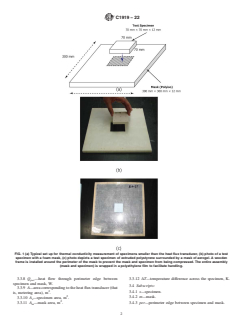
representing the area covered by the specimen (see Fig. 1).
1.5 The values stated in SI units are to be regarded as the
3.3 Symbols and Units—The symbols used in this test
standard. No other units of measurement are included in this
method have the following significance:
practice.
3.3.1 λ —apparent thermal conductivity, W/(m·K).
a
1.6 This standard does not purport to address all of the 2
3.3.2 C—thermal conductance, W/(m ·K).
safety concerns, if any, associated with its use. It is the 2
3.3.3 R—thermal resistance, (m ·K)/W.
responsibility of the user of this standard to establish appro- 2
3.3.4 R —mask thermal resistance, (m ·K)/W.
m
3.3.5 Q—heat flow determined from Test Method C518,W.
3.3.6 Q —heat flow through the specimen area A,W.
s s
This practice is under the jurisdiction of ASTM Committee C16 on Thermal 3.3.7 Q —heat flow through the mask area A ,W.
m m
Insulation and is the direct responsibility of Subcommittee C16.30 on Thermal
Measurement.
Current edition approved Dec. 1, 2022. Published January 2023. DOI: 10.1520/ For referenced ASTM standards, visit the ASTM website, www.astm.org, or
C1919-22. contact ASTM Customer Service at service@astm.org. For Annual Book of ASTM
Theboldfacenumbersinparenthesesrefertothelistofreferencesattheendof Standards volume information, refer to the standard’s Document Summary page on
this standard. the ASTM website.
Copyright © ASTM International, 100 Barr Harbor Drive, PO Box C700, West Conshohocken, PA 19428-2959. United States
C1919−22
FIG. 1 (a) Typical set up for thermal conductivity measurement of specimens smaller than the heat flux transducer, (b) photo of a test
specimen with a foam mask, (c) photo depicts a test specimen of extruded polystyrene surrounded by a mask of aerogel. A wooden
frame is installed around the perimeter of the mask to prevent the mask and specimen from being compressed. The entire assembly
(mask and specimen) is wrapped in a polyethylene film to facilitate handling.
3.3.8 Q —heat flow through perimeter edge between 3.3.12 ∆T—temperature difference across the specimen, K.
per
specimen and mask, W.
3.4 Subscripts:
3.3.9 A—areacorrespondingtotheheatfluxtransducer(that
2 3.4.1 s—specimen.
is, metering area), m .
3.4.2 m—mask.
3.3.10 A —specimen area, m .
s
3.3.11 A —mask area, m . 3.4.3 per—perimeter edge between specimen and mask.
m
C1919−22
4. Summary of Practice resistivities (greater than 83 (m K)/W). Projects ranging from
coatings to improve the thermal performance of single pane/
4.1 This practice provides guidance on the impact of speci-
layer glazing systems to the development of novel insulation
men size, thickness, thermal conductance, and surrounding
productsforbuildingenvelopesarebeingundertaken (1-4).All
mask material of thermal insulation, on the uncertainty of the
these projects have struggled in the development of new
measurement when using a heat-flow meter apparatus to
material technologies due to the difficulty associated with the
determine the thermal transmission properties of specimens
measurement of thermal conductivity of small sections (ap-
that are smaller in area than that of the heat flux transducer
proximately 0.025 m by 0.025 m) of high thermal resistance
contained in the apparatus.
materials. As new materials are being developed, the size of
4.2 The practice evaluates the impact of testing specimens
each test specimen impacts the cost of development. Most of
smaller than the heat flux transducer (HFT) and to assess the
the existing test equipment and the methods do not align with
relative importance of having a surrounding mask. The mask
the researcher’s need; the equipment requires a large specimen
material shall be thermally stable, homogeneous, and have a
size is time consuming, and expensive to produce.
thermal conductivity and texture as close as possible to the
5.3 This practice provides a standardized procedure to
specimen being tested. The mask surrounds the test specimen
enable the thermal characterization of small specimens of
and provides a uniform, reproducible heat flow pattern at the
insulation materials. Accurate, and reliable thermal metrology
edges of the metering area perimeter.
to assess thermal properties of new insulation materials, such
4.3 Thispracticeprovidesaprocedureforthedetermination
as novel very low thermal conductivity (< 0.01 W/ (m K))
of the steady-state heat flow through a small specimen, Q,by
s
nanomaterials or bio-based foam insulations, in small material
determination of the measured heat flow, Q, and related heat
sample sections, and minimal data analysis requirements is the
flows through the surrounding mask area, Q , and through the
m
desired outcome of this practice.
perimeter edge between the specimen and mask, Q .
per
5.4 The ratio of the area of the specimen and the heat flux
4.4 The measurement result, Q , obtained from this practice
s
transducer has a significant impact on the uncertainty of the
is intended to be used with Test Method C518 and Practice
results obtained from this practice. As the specimen area
C1045 to determine steady-state thermal transmission proper-
decreases this ratio decreases, a smaller percentage of the total
ties of the small specimen.
heat flow is associated with the unknown specimen. Informa-
tion from the literature (4) shows that some heat-flow-meter
5. Significance and Use
apparatus, generally not available commercially and used by
5.1 Thermalconductivitymeasurementsonsmallinsulation
the research laboratories only, can be modified to change out
specimens are important during new product development
theheatfluxtransducersothattransducersofvaryingsizescan
processes or when larger specimens cannot be collected during
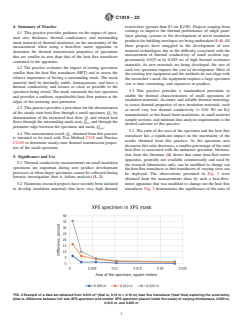
be deployed. The observations presented in Fig. 2 were
forensic investigation (that is, failure analysis) (1, 2).
obtained from the measurements done by such a heat-flow-
5.2 Numerous research projects have recently been initiated meter apparatus that was modified to change out the heat flux
to develop insulation materials that have very high thermal transducer. Fig. 2 demonstrates the significance of the ratio of
FIG. 2 Example of a data set obtained from 0.010 m (thatis,0.10m×0.10m) heat flux transducer (heat flow) exploring the uncertainty
(that is, difference between full size XPS specimen and smaller XPS specimen placed inside the mask) of varying thicknesses, 0.005 m,
0.010 m, and 0.020 m
C1919−22
surrogate material to mask material of 0.33, 0.25, and 0.17 are recom-
the area of the specimen and the heat flux transducer on the
mended. The resulting data are curve-fit to predict Q as function of the
per
accuracy of the thermal conductivity measurement using this
thermal conductivity ratio.
Practice.ThisexerciseisnotarequiredpartofthisPracticeand
6.5 Replace the surrogate small specimen in the mask with
Fig. 2 is for information only.
the unknown small test specimen.
6. Procedure
6.6 Determine the steady-state heat flow of the composite
6.1 Selectarigidorsemi-rigidmaterialforthemaskhaving specimen (that is, mask with unknown small test specimen)
over the temperature range of interest following the procedure
a low thermal conductance. Prepare the mask to have the same
lateral dimensions as the apparatus plate size and the same in Test Method C518.
thickness as the small test specimen.
6.7 Calculate Q , the heat flow through the small test
s
NOTE 2—Acceptable mask materials are aged cellular polystyrene,
specimen, from the difference of the measured quantity Q in
aerogel, fiberglass, or other similar type material.
6.6 and the heat flow through the mask Q determined in 6.2
m
6.2 Determine the steady-state thermal transmission proper-
and perimeter interface heat flow Q determined in 6.4.
per
ties of the mask over the temperature range of interest
6.8 Use the results from 6.7 with Test Method C518 and
following the procedure in Test Method C518.
Practice C1045 to determine the steady-state thermal transmis-
6.3 Cut a central aperture from the mask to accommodate
sion properties of the small test specimen.
the small test specimen as shown in Fig. 1.
6.4 Determine Q ,theflankingheatflowattheinterfaceof
7. Calculation
per
the mask and specimen, over the temperature range of interest
7.1 Calculate A , the area of the mask (m ), as follows:
m
experimentally, using Test Method C518 with modifications
A 5 A 2 A (1)
describedin6.4.1through6.4.7.Thisisthepreferredapproach.
m s
Analternativeprocedureistoemploysimulationstodetermine
where:
Q . A summary of the process is described in Annex A1.
per 2
A and A = the lateral surface areas (m ) corresponding to
s
6.4.1 Select a rigid or semi-rigid material for the surrogate
the heat flux transducer and the small specimen,
specimen having a low thermal conductivity. Prepare the
respectively.
surrogate specimen to have the same lateral dimensions as the
7.2 Calculateλ ,thearea-weightedaveragethermalconduc-
apparatus plate size and the same thickness as the small test
c
specimen. tivity of the composite specimen (W/m·K), as follows:
λ 5 λ A 1 λ A ⁄ A (2)
~ !
NOTE 3—An acceptable surrogate specimen material ideally has the c m m s s
same or similar thermal conductivity as the unknown test specimen. An
where:
iterativeapproachforselectionofthesurrogatematerialmaybenecessary
to reduce the measurement uncertainty.
λ and λ = the thermal conductivities (W/m·K) of the mask
m s
and small specimen, respectively.
6.4.2 Determine the steady-state thermal transmission prop-
erties of the surrogate specimen over the temperature range of
7.3 Calculate Q or Q (W) as follows:
per s
interest following the procedure in Test Method C518.
Q 5 Q 2 Q 2 Q (3)
per m s
6.4.3 Prepare the small surrogate specimen by cutting a
Q 5 Q 2 Q 2 Q (4)
centrally located sample to fit securely in the mask aperture as s m per
shown in Fig. 1.
where:
6.4.4 Determine the steady-state heat flow of the composite
Q = theflankingheatflowattheinterfaceofthemaskand
per
specimen (that is, mask with small surrogate specimen) over
small test specimen, W,
the temperature range of interest following the procedure in
Q = the heat flow determined fromTest Method C518,W,
Test Method C518.
Q = the heat flow normal to the small test specimen, W,
s
and
NOTE 4—The measured quantity, Q, obtained from Test Method C518
includes contributing heat flows through the mask (Q ), small specimen Q = theheatflownormaltothemaskcorrespondingtothe
m m
(Q ), and perimeter interface between the mask and small surrogate
s
area encompassed by the apparatus heat flux
specimen (Q ).
per
transducer, W.
6.4.5 Compute the area-weighted thermal conductivity of
7.4 Alternatively, calculate Q from the computer simula-
per
the composite specimen assuming parallel heat flow paths in
...