

ASTM D971-20
(Test Method)Standard Test Method for Interfacial Tension of Insulating Liquids Against Water by the Ring Method
General Information
- Abstract
SIGNIFICANCE AND USE
4.1 Interfacial tension measurements on electrical insulating liquids provide a sensitive means of detecting small amounts of soluble polar contaminants and products of oxidation. A high value for new mineral insulating oil indicates the absence of most undesirable polar contaminants. The test is frequently applied to service-aged mineral oils as an indication of the degree of deterioration.
Note 1: Different liquid matrixes are reviewed in Appendix X1.
SCOPE
1.1 This test method covers the measurement of the interfacial tension between insulating liquid that has a relative density (specific gravity) less than water and water, under non-equilibrium conditions.
1.2 This standard does not purport to address all of the safety concerns, if any, associated with its use. It is the responsibility of the user of this standard to establish appropriate safety, health, and environmental practices and determine the applicability of regulatory limitations prior to use. See 7.2 for a specific warning statement.
1.3 This international standard was developed in accordance with internationally recognized principles on standardization established in the Decision on Principles for the Development of International Standards, Guides and Recommendations issued by the World Trade Organization Technical Barriers to Trade (TBT) Committee.
- Status
- Published
- Publication Date
- 31-Mar-2020
- Technical Committee
- D27 - Electrical Insulating Liquids and Gases
- Drafting Committee
- D27.07 - Physical Test
Buy Documents

ASTM D971-20 - Standard Test Method for Interfacial Tension of Insulating Liquids Against Water by the Ring Method
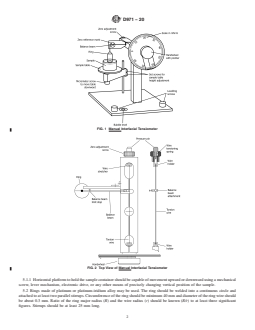
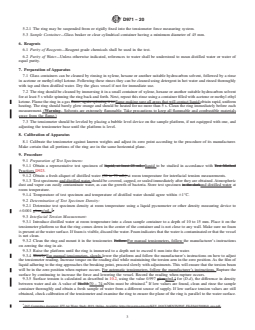
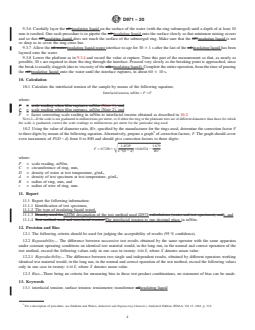
REDLINE ASTM D971-20 - Standard Test Method for Interfacial Tension of Insulating Liquids Against Water by the Ring Method
Overview
ASTM D971-20, titled Standard Test Method for Interfacial Tension of Insulating Liquids Against Water by the Ring Method, is a globally recognized standard developed by ASTM International. This standard outlines a precise procedure to measure the interfacial tension (IFT) between an electrical insulating liquid-such as new or service-aged mineral oil-and water. The measurement provides valuable insights into the purity and aging of insulating fluids, which is critical for applications like transformers and high-voltage electrical equipment. By employing the ring method, this test helps identify the presence of polar contaminants and products of oxidation, offering a sensitive indication of product quality and fluid deterioration.
Key Topics
Significance of Interfacial Tension
Measuring IFT in electrical insulating liquids is a proven technique for:- Detecting soluble polar contaminants
- Assessing degrees of oxidation and aging
- Ensuring fluid suitability for high-voltage equipment
Test Methodology
- Utilizes a Du Noüy ring method with a calibrated tensiometer
- Measures the force required to detach a platinum or platinum-iridium ring from the liquid interface
- Strict adherence to standardized temperature and time controls to ensure repeatability
Interpretation of Results
- High interfacial tension in new mineral oil suggests minimal contamination
- Lower IFT values in service-aged oils indicate the presence of oxidation products or polar compounds
- Provides an ongoing assessment tool for in-service oils to prevent equipment failure
Applicability to Different Liquid Types
- Mineral oil: Non-polar, high IFT when uncontaminated; lower IFT signals deterioration
- Ester-based fluids: Naturally lower IFT due to their polar nature; not suitable for exact limit specification currently
- Silicone fluids: IFT measurement generally not relevant due to different degradation mechanisms
Applications
Diagnostic Tool in Electrical Utilities
Widely used for monitoring the quality of transformer oil and other insulating liquids in power generation, distribution, and transmission systems.Quality Control for Manufacturers
Essential for oil producers and electrical equipment manufacturers to ensure product compliance with industry standards and extend asset life.Asset Management and Predictive Maintenance
Regular IFT measurements assist facility managers and maintenance teams in identifying fluid degradation early, thus preventing unplanned outages and costly repairs.Research and Development
Supports R&D activities focused on formulating more resilient and pure insulating liquids for demanding industrial environments.
Related Standards
Several ASTM standards are closely related to D971-20 and are often referenced alongside it:
- ASTM D117: Guide for Sampling, Test Methods, and Specifications for Electrical Insulating Liquids
- ASTM D923: Practices for Sampling Electrical Insulating Liquids
- ASTM D2285: (Withdrawn) Test Method for Interfacial Tension of Electrical Insulating Oils of Petroleum Origin Against Water by the Drop-Weight Method
Additionally, this standard was developed in line with internationally recognized principles, ensuring its acceptance and use across global markets.
Keywords: interfacial tension, insulating liquid, ring method, ASTM D971, transformer oil, surface tension, tensiometer, oil quality, fluid contamination, electrical insulation testing.
Relations
- Replaces
ASTM D971-12 - Standard Test Method for Interfacial Tension of Oil Against Water by the Ring Method - Effective Date
- 01-Apr-2020
- Effective Date
- 01-Dec-2023
- Effective Date
- 01-Oct-2015
- Effective Date
- 15-Jul-2007
- Effective Date
- 10-Oct-1997
- Effective Date
- 01-Apr-2020
- Effective Date
- 01-Apr-2020
- Referred By
ASTM F3349-18 - Standard Guide for Use of Herding Agents in Conjunction with In-Situ Burning - Effective Date
- 01-Apr-2020
- Effective Date
- 01-Apr-2020
- Effective Date
- 01-Apr-2020
- Effective Date
- 01-Apr-2020
- Effective Date
- 01-Apr-2020
- Referred By
ASTM E3282-22 - Standard Guide for NAPL Mobility and Migration in Sediments – Evaluation Metrics - Effective Date
- 01-Apr-2020
- Effective Date
- 01-Apr-2020
- Effective Date
- 01-Apr-2020
Buy Documents
ASTM D971-20 - Standard Test Method for Interfacial Tension of Insulating Liquids Against Water by the Ring Method
REDLINE ASTM D971-20 - Standard Test Method for Interfacial Tension of Insulating Liquids Against Water by the Ring Method
Get Certified
Connect with accredited certification bodies for this standard

Element Materials Technology
Materials testing and product certification.

ABS Group Brazil
ABS Group certification services in Brazil.

ABS Quality Evaluations Inc.
American Bureau of Shipping quality certification.
Sponsored listings
Frequently Asked Questions
ASTM D971-20 is a standard published by ASTM International. Its full title is "Standard Test Method for Interfacial Tension of Insulating Liquids Against Water by the Ring Method". This standard covers: SIGNIFICANCE AND USE 4.1 Interfacial tension measurements on electrical insulating liquids provide a sensitive means of detecting small amounts of soluble polar contaminants and products of oxidation. A high value for new mineral insulating oil indicates the absence of most undesirable polar contaminants. The test is frequently applied to service-aged mineral oils as an indication of the degree of deterioration. Note 1: Different liquid matrixes are reviewed in Appendix X1. SCOPE 1.1 This test method covers the measurement of the interfacial tension between insulating liquid that has a relative density (specific gravity) less than water and water, under non-equilibrium conditions. 1.2 This standard does not purport to address all of the safety concerns, if any, associated with its use. It is the responsibility of the user of this standard to establish appropriate safety, health, and environmental practices and determine the applicability of regulatory limitations prior to use. See 7.2 for a specific warning statement. 1.3 This international standard was developed in accordance with internationally recognized principles on standardization established in the Decision on Principles for the Development of International Standards, Guides and Recommendations issued by the World Trade Organization Technical Barriers to Trade (TBT) Committee.
SIGNIFICANCE AND USE 4.1 Interfacial tension measurements on electrical insulating liquids provide a sensitive means of detecting small amounts of soluble polar contaminants and products of oxidation. A high value for new mineral insulating oil indicates the absence of most undesirable polar contaminants. The test is frequently applied to service-aged mineral oils as an indication of the degree of deterioration. Note 1: Different liquid matrixes are reviewed in Appendix X1. SCOPE 1.1 This test method covers the measurement of the interfacial tension between insulating liquid that has a relative density (specific gravity) less than water and water, under non-equilibrium conditions. 1.2 This standard does not purport to address all of the safety concerns, if any, associated with its use. It is the responsibility of the user of this standard to establish appropriate safety, health, and environmental practices and determine the applicability of regulatory limitations prior to use. See 7.2 for a specific warning statement. 1.3 This international standard was developed in accordance with internationally recognized principles on standardization established in the Decision on Principles for the Development of International Standards, Guides and Recommendations issued by the World Trade Organization Technical Barriers to Trade (TBT) Committee.
ASTM D971-20 is classified under the following ICS (International Classification for Standards) categories: 75.100 - Lubricants, industrial oils and related products. The ICS classification helps identify the subject area and facilitates finding related standards.
ASTM D971-20 has the following relationships with other standards: It is inter standard links to ASTM D971-12, ASTM D923-15(2023), ASTM D923-15, ASTM D923-07, ASTM D923-97, ASTM D8180-23, ASTM F2709-19, ASTM F3349-18, ASTM F3337-19, ASTM F631-15(2020), ASTM D117-22, ASTM D3455-11(2019), ASTM E3282-22, ASTM F3350-18, ASTM F2084/F2084M-01(2018). Understanding these relationships helps ensure you are using the most current and applicable version of the standard.
ASTM D971-20 is available in PDF format for immediate download after purchase. The document can be added to your cart and obtained through the secure checkout process. Digital delivery ensures instant access to the complete standard document.
Standards Content (Sample)
This international standard was developed in accordance with internationally recognized principles on standardization established in the Decision on Principles for the
Development of International Standards, Guides and Recommendations issued by the World Trade Organization Technical Barriers to Trade (TBT) Committee.
Designation: D971 − 20
Standard Test Method for
Interfacial Tension of Insulating Liquids Against Water by
the Ring Method
This standard is issued under the fixed designation D971; the number immediately following the designation indicates the year of
original adoption or, in the case of revision, the year of last revision.Anumber in parentheses indicates the year of last reapproval.A
superscript epsilon (´) indicates an editorial change since the last revision or reapproval.
This standard has been approved for use by agencies of the U.S. Department of Defense.
1. Scope rigidly standardized nonequilibrium conditions in which the
measurement is completed within 60 s after formation of the
1.1 This test method covers the measurement of the inter-
interface.
facial tension between insulating liquid that has a relative
density (specific gravity) less than water and water, under
4. Significance and Use
non-equilibrium conditions.
4.1 Interfacialtensionmeasurementsonelectricalinsulating
1.2 This standard does not purport to address all of the
liquidsprovideasensitivemeansofdetectingsmallamountsof
safety concerns, if any, associated with its use. It is the
soluble polar contaminants and products of oxidation. A high
responsibility of the user of this standard to establish appro-
value for new mineral insulating oil indicates the absence of
priate safety, health, and environmental practices and deter-
most undesirable polar contaminants. The test is frequently
mine the applicability of regulatory limitations prior to use.
applied to service-aged mineral oils as an indication of the
See 7.2 for a specific warning statement.
degree of deterioration.
1.3 This international standard was developed in accor-
NOTE 1—Different liquid matrixes are reviewed in Appendix X1.
dance with internationally recognized principles on standard-
5. Apparatus (Figs. 1 and 2)
ization established in the Decision on Principles for the
Development of International Standards, Guides and Recom-
5.1 Tensiometer —Force measurement on the tensiometer
mendations issued by the World Trade Organization Technical
maybemadeusingatorsionwire,loadcell,oranyothermeans
Barriers to Trade (TBT) Committee.
of linearly determining tension in the range of 0 to 100 mN/m.
5.1.1 Horizontal platform to hold the sample container
2. Referenced Documents
should be capable of movement upward or downward using a
2.1 ASTM Standards:
mechanical screw, lever mechanism, electronic drive, or any
D923Practices for Sampling Electrical Insulating Liquids
other means of precisely changing vertical position of the
sample.
3. Summary of Test Method
5.2 Rings made of platinum or platinum-iridium alloy may
3.1 InterfacialTensionisdeterminedbymeasuringtheforce
beused.Theringshouldbeweldedintoacontinuouscircleand
necessary to detach a planar ring of platinum wire from the
attached to at least two parallel stirrups. Circumference of the
surface of the liquid of higher surface tension, that is, upward
ring should be minimum 40 mm and diameter of the ring wire
from the water insulating liquid interface. To calculate the
shouldbeabout0.3mm.Ratiooftheringmajorradius(R)and
interfacial tension, the force so measured is corrected by an
the wire radius (r) should be known (R/r) to at least three
empirically determined factor which depends upon the force
significant figures. Stirrups should be at least 25 mm long.
applied, the densities of both the insulating liquid and water,
5.2.1 The ring may be suspended from or rigidly fixed into
and the dimensions of the ring. Measurements are made under
the tensiometer force measuring system.
5.3 Sample Container—Glass beaker or clear cylindrical
This test method is under the jurisdiction of ASTM Committee D27 on container having a minimum diameter of 45 mm.
Electrical Insulating Liquids and Gasesand is the direct responsibility of Subcom-
mittee D27.07 on Physical Test.
6. Reagents
Current edition approved April 1, 2020. Published May 2020. Originally
6.1 Purity of Reagents—Reagent grade chemicals shall be
approved in 1948 as D971–48 T. Last previous edition approved in 2012 as
D971–12. DOI: 10.1520/D0971-20.
used in the test.
For referenced ASTM standards, visit the ASTM website, www.astm.org, or
contact ASTM Customer Service at service@astm.org. For Annual Book of ASTM
Standards volume information, refer to the standard’s Document Summary page on Tensiometers that use the Du Nouy principle for measuring interfacial and
the ASTM website. surface tension should be used.
Copyright © ASTM International, 100 Barr Harbor Drive, PO Box C700, West Conshohocken, PA 19428-2959. United States
D971 − 20
rinse in acetone or methyl ethyl ketone. Following these rinses
they can be cleaned using detergent in hot water and rinsed
thoroughly with tap and then distilled water. Dry the glass
vessel if not for immediate use.
7.2 The ring should be cleaned by immersing it in a small
container of xylene, hexane or another suitable hydrocarbon
solvent for at least 5 s while spinning the ring back and forth.
Next, repeat this rinse using a container filled with acetone or
methylethylketone.Flametheringinagasflamemakingsure
all areas that will contact liquid obtain rapid, uniform heating.
The ring should barely glow orange and should be heated for
no more than 5 s. Clean the ring immediately before each
measurement. (Warning– Solvents are extremely flammable.
Take precautions to keep all flammable and combustible
materials away from the flame.)
7.3 The tensiometer should be leveled by placing a bubble
level device on the sample platform, if not equipped with one,
and adjusting the tensiometer base until the platform is level.
8. Calibration of Apparatus
8.1 Calibrate the tensiometer against known weights and
FIG. 1 Manual Interfacial Tensiometer
adjust its zero point according to the procedure of its manu-
facturer. Make certain that all portions of the ring are in the
same horizontal plane.
9. Procedure
9.1 Preparation of Test Specimens:
9.1.1 Obtain a representative test specimen of liquid to be
studied in accordance with Practices D923.
9.1.2 Obtain a fresh aliquot of distilled water at room
temperature for interfacial tension measurements.
9.1.3 Test specimens and distilled water should be covered,
capped, or sealed immediately after they are obtained. Atmo-
sphericdustandvaporcaneasilycontaminatewater,ascanthe
growth of bacteria. Store test specimen and distilled water at
room temperature.
9.1.4 Temperature of test specimen and temperature of
distilled water should agree within 61°C.
9.2 Determination of Test Specimen Density:
9.2.1 Determine test specimen density at room temperature
usingaliquidpycnometerorotherdensitymeasuringdeviceto
60.001 g/mL.
9.3 Interfacial Tension Measurement:
9.3.1 Introduce distilled water at room temperature into a
clean sample container to a depth of 10 to 15 mm. Place it on
the tensiometer platform so that the ring comes down in the
center of the container and is not close to any wall. Make sure
no foam is present at the water surface. If foam is visible,
discard the water. Foam indicates that the water is contami-
FIG. 2 Top View of Manual Interfacial Tensiometer
nated or that the vessel is not clean.
9.3.2 Clean the ring and mount it in the tensiometer. For
6.2 Purity of Water—Unless otherwise indicated, references
manualtensiometers,followthemanufacturer’sinstructionson
towatershallbeunderstoodtomeandistilledwaterorwaterof
zeroing the ring in air.
eq
...
This document is not an ASTM standard and is intended only to provide the user of an ASTM standard an indication of what changes have been made to the previous version. Because
it may not be technically possible to adequately depict all changes accurately, ASTM recommends that users consult prior editions as appropriate. In all cases only the current version
of the standard as published by ASTM is to be considered the official document.
Designation: D971 − 12 D971 − 20
Standard Test Method for
Interfacial Tension of Oil Insulating Liquids Against Water
by the Ring Method
This standard is issued under the fixed designation D971; the number immediately following the designation indicates the year of
original adoption or, in the case of revision, the year of last revision. A number in parentheses indicates the year of last reapproval. A
superscript epsilon (´) indicates an editorial change since the last revision or reapproval.
This standard has been approved for use by agencies of the U.S. Department of Defense.
1. Scope
1.1 This test method covers the measurement of the interfacial tension between mineral oil insulating liquid that has a relative
density (specific gravity) less than water and water, under non-equilibrium conditions.
1.2 This standard does not purport to address all of the safety concerns, if any, associated with its use. It is the responsibility
of the user of this standard to establish appropriate safety safety, health, and healthenvironmental practices and determine the
applicability of regulatory limitations prior to use. See 7.2 for a specific warning statement.
1.3 This international standard was developed in accordance with internationally recognized principles on standardization
established in the Decision on Principles for the Development of International Standards, Guides and Recommendations issued
by the World Trade Organization Technical Barriers to Trade (TBT) Committee.
2. Referenced Documents
2.1 ASTM Standards:
D117 Guide for Sampling, Test Methods, and Specifications for Electrical Insulating Liquids
D923 Practices for Sampling Electrical Insulating Liquids
D2285 Test Method for Interfacial Tension of Electrical Insulating Oils of Petroleum Origin Against Water by the Drop-Weight
Method (Withdrawn 2008)
3. Summary of Test Method
3.1 Interfacial Tension is determined by measuring the force necessary to detach a planar ring of platinum wire from the surface
of the liquid of higher surface tension, that is, upward from the water-oil water insulating liquid interface. To calculate the
interfacial tension, the force so measured is corrected by an empirically determined factor which depends upon the force applied,
the densities of both oil the insulating liquid and water, and the dimensions of the ring. Measurements are made under rigidly
standardized nonequilibrium conditions in which the measurement is completed within 60 s after formation of the interface.
4. Significance and Use
4.1 Interfacial tension measurements on electrical insulating oilsliquids provide a sensitive means of detecting small amounts
of soluble polar contaminants and products of oxidation. A high value for new mineral insulating oil indicates the absence of most
undesirable polar contaminants. The test is frequently applied to service-aged mineral oils as an indication of the degree of
deterioration.
NOTE 1—Different liquid matrixes are reviewed in Appendix X1.
5. Apparatus (Figs. 1 and 2)
5.1 Tensiometer —Force measurement on the tensiometer may be made using a torsion wire, load cell, or any other means of
linearly determining tension in the range of 0 to 100 mN/m.
This test method is under the jurisdiction of ASTM Committee D27 on Electrical Insulating Liquids and Gasesand is the direct responsibility of Subcommittee D27.07
on Physical Test.
Current edition approved May 1, 2012April 1, 2020. Published May 2012May 2020. Originally approved in 1948 as D971 – 48 T. Last previous edition approved in
20042012 as D971 – 99aD971 – 12.(2004). DOI: 10.1520/D0971-12.10.1520/D0971-20.
For referenced ASTM standards, visit the ASTM website, www.astm.org, or contact ASTM Customer Service at service@astm.org. For Annual Book of ASTM Standards
volume information, refer to the standard’s Document Summary page on the ASTM website.
Tensiometers that use the Du Nouy principle for measuring interfacial and surface tension should be used.
Copyright © ASTM International, 100 Barr Harbor Drive, PO Box C700, West Conshohocken, PA 19428-2959. United States
D971 − 20
FIG. 1 Manual Interfacial Tensiometer
FIG. 2 Top View of Manual Interfacial Tensiometer
5.1.1 Horizontal platform to hold the sample container should be capable of movement upward or downward using a mechanical
screw, lever mechanism, electronic drive, or any other means of precisely changing vertical position of the sample.
5.2 Rings made of platinum or platinum-iridium alloy may be used. The ring should be welded into a continuous circle and
attached to at least two parallel stirrups. Circumference of the ring should be minimum 40 mm and diameter of the ring wire should
be about 0.3 mm. Ratio of the ring major radius (R) and the wire radius (r) should be known (R/r) to at least three significant
figures. Stirrups should be at least 25 mm long.
D971 − 20
5.2.1 The ring may be suspended from or rigidly fixed into the tensiometer force measuring system.
5.3 Sample Container—Glass beaker or clear cylindrical container having a minimum diameter of 45 mm.
6. Reagents
6.1 Purity of Reagents—Reagent grade chemicals shall be used in the test.
6.2 Purity of Water—Unless otherwise indicated, references to water shall be understood to mean distilled water or water of
equal purity.
7. Preparation of Apparatus
7.1 Glass containers can be cleaned by rinsing in xylene, hexane or another suitable hydrocarbon solvent, followed by a rinse
in acetone or methyl ethyl ketone. Following these rinses they can be cleaned using detergent in hot water and rinsed thoroughly
with tap and then distilled water. Dry the glass vessel if not for immediate use.
7.2 The ring should be cleaned by immersing it in a small container of xylene, hexane or another suitable hydrocarbon solvent
for at least 5 s while spinning the ring back and forth. Next, repeat this rinse using a container filled with acetone or methyl ethyl
ketone. Flame the ring in a gas flame, again spinning it to flame making sure all areas that will contact liquid obtain rapid, uniform
heating. The ring should barely glow orange and should be heated for no more than 5 s. Clean the ring immediately before each
measurement. (Warning– Solvents are extremely flammable. Take precautions to keep all flammable and combustible materials
away from the flame.)
7.3 The tensiometer should be leveled by placing a bubble level device on the sample platform, if not equipped with one, and
adjusting the tensiometer base until the platform is level.
8. Calibration of Apparatus
8.1 Calibrate the tensiometer against known weights and adjust its zero point according to the procedure of its manufacturer.
Make certain that all portions of the ring are in the same horizontal plane.
9. Procedure
9.1 Preparation of Test Specimens:
9.1.1 Obtain a representative test specimen of liquid, at least 25 mL, liquid to be studied in accordance with Test Method
Practices D923.
9.1.2 Obtain a fresh aliquot of distilled water (50 to 75 mL) at room temperature for interfacial tension measurements.
9.1.3 Test specimens and distilled water should be covered, capped, or sealed immediately after they are obtained. Atmospheric
dust and vapor can easily contaminate water, as can the growth of bacteria. Store test specimen in the darkand distilled water at
room temperature.
9.1.4 Temperature of test specimen and temperature of distilled water should agree within 61°C.
9.2 Determination of Test Specimen Density:
9.2.1 Determine test specimen density at room temperature using a liquid pycnometer or other density measuring device to
60.001 g/cmg/mL. .
9.3 Interfacial Tension Measurement:
9.3.1 Introduce distilled water at room temperature into a clean sample container to a depth of 10 to 15 mm. Place it on the
tensiometer platform so that the ring comes down in the center of the container and is not close to any wa
...