

ASTM D8180-23
(Specification)Standard Specification for Rerefined Mineral Insulating Liquid Used in Electrical Apparatus
General Information
- Abstract
SCOPE
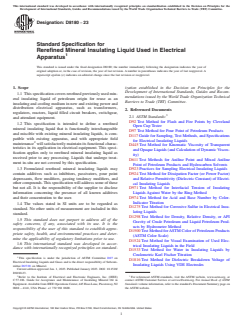
1.1 This specification covers rerefined previously used mineral insulating liquid of petroleum origin for reuse as an insulating and cooling medium in new and existing power and distribution electrical apparatus, such as transformers, regulators, reactors, liquid filled circuit breakers, switchgear, and attendant equipment.
1.2 This specification is intended to define a rerefined mineral insulating liquid that is functionally interchangeable and miscible with existing mineral insulating liquids, is compatible with existing apparatus, and with appropriate field maintenance2 will satisfactorily maintain its functional characteristics in its application in electrical equipment. This specification applies only to rerefined mineral insulating liquid as received prior to any processing. Liquids that undergo treatment in-situ are not covered by this specification.
1.3 Formulated rerefined mineral insulating liquids may contain additives such as inhibitors, passivators, pour point depressants, flow modifiers, gassing tendency modifiers, and other compounds. This specification will address some of these but not all. It is the responsibility of the supplier to disclose information concerning the presence of all known additives and their concentration to the user.
1.4 The values stated in SI units are to be regarded as standard. No other units of measurement are included in this standard.
1.5 This standard does not purport to address all of the safety concerns, if any, associated with its use. It is the responsibility of the user of this standard to establish appropriate safety, health, and environmental practices and determine the applicability of regulatory limitations prior to use.
1.6 This international standard was developed in accordance with internationally recognized principles on standardization established in the Decision on Principles for the Development of International Standards, Guides and Recommendations issued by the World Trade Organization Technical Barriers to Trade (TBT) Committee.
- Status
- Published
- Publication Date
- 31-Dec-2022
- Technical Committee
- D27 - Electrical Insulating Liquids and Gases
- Drafting Committee
- D27.01 - Mineral
Overview
ASTM D8180-23: Standard Specification for Rerefined Mineral Insulating Liquid Used in Electrical Apparatus is an internationally recognized standard developed by ASTM to ensure the quality and performance of rerefined mineral insulating liquids. This specification applies to rerefined, previously used mineral insulating liquids of petroleum origin intended for reuse as insulating and cooling media in electrical equipment, including power and distribution transformers, circuit breakers, switchgear, and related apparatus.
The standard assures that rerefined mineral insulating liquids are functionally interchangeable, compatible, and miscible with existing mineral insulating liquids. It emphasizes the importance of supplier disclosure regarding additives and encourages best practices for safety, health, and environmental considerations.
Key Topics
- Scope and Coverage: Applies to rerefined mineral insulating liquids received prior to any further processing. Does not cover liquids treated in-situ.
- Performance Requirements: Ensures rerefined liquids meet key performance criteria for use in electrical insulation, such as dielectric strength, thermal stability, viscosity, flash point, and chemical purity.
- Additives and Disclosure: Specifies that formulated rerefined liquids may include additives (inhibitors, passivators, pour point depressants, etc.), and suppliers must disclose their presence and concentration.
- Testing and Quality Control: Requires rigorous sampling and testing according to referenced ASTM and international methods, including standards for physical, electrical, and chemical properties.
- Health, Safety, and Environmental Responsibility: Users are responsible for implementing appropriate safety measures, environmental practices, and regulatory compliance.
Applications
Rerefined mineral insulating liquids specified by ASTM D8180-23 provide significant functional and sustainability benefits for the power industry, including:
- Transformers: Used as a dielectric and coolant medium in both new and existing transformers, ensuring reliable electrical insulation and thermal management.
- Switchgear and Circuit Breakers: Suitable for use in liquid-filled switchgear and circuit breakers, maintaining the necessary insulation and arc-quenching properties.
- Regulators and Reactors: Provide effective cooling and insulation in voltage regulators and reactors found in power distribution and industrial settings.
- Maintenance and Retrofill Projects: Enables utilities and facility managers to safely reuse and recycle insulating liquids, reducing environmental impact while maintaining device performance.
- Sustainability Initiatives: Supports circular economy principles by promoting the reuse of existing mineral insulating fluids, limiting waste and reducing the demand for virgin petroleum-based products.
Related Standards
Several key test methods and related standards are referenced for compliance with ASTM D8180-23, including but not limited to:
- ASTM D923: Practices for Sampling Electrical Insulating Liquids
- ASTM D1816 & D3300: Test Methods for Dielectric Breakdown Voltage
- ASTM D445 & D7042: Test Methods for Viscosity
- ASTM D924: Test Method for Dissipation Factor and Relative Permittivity
- ASTM D1275: Test Method for Corrosive Sulfur
- ASTM D4059: Analysis of Polychlorinated Biphenyls (PCB) Content
- IEC 60666: Detection and Determination of Specific Additives in Mineral Insulating Oils
Additional related standards cover tests for acid number, water content, oxidation stability, aniline point, PCA (Polycyclic Aromatic) content, and more. Cross-referencing these standards ensures thorough quality and safety assurance for rerefined mineral insulating liquids.
Keywords: ASTM D8180-23, rerefined mineral insulating liquid, electrical apparatus, transformer oil standard, insulating oil specification, dielectric fluids, sustainability, recycled insulating oil, ASTM standards, electrical equipment maintenance.
Relations
- Effective Date
- 01-Apr-2024
- Effective Date
- 01-Mar-2024
- Effective Date
- 15-Jan-2024
- Effective Date
- 01-Dec-2023
- Effective Date
- 01-Dec-2023
- Effective Date
- 01-Dec-2023
- Effective Date
- 01-Dec-2023
- Effective Date
- 01-Nov-2023
- Effective Date
- 01-May-2020
- Effective Date
- 01-Apr-2020
- Effective Date
- 01-Dec-2019
- Effective Date
- 01-Oct-2019
- Effective Date
- 01-Dec-2018
- Effective Date
- 01-Mar-2017
- Effective Date
- 01-Feb-2017
Get Certified
Connect with accredited certification bodies for this standard

IMQ S.p.A. (Certification)
Italian electrical product certification.

SLG Prüf- und Zertifizierungs GmbH
German testing and certification body.

UL Solutions
Global safety science company with testing, inspection and certification.
Sponsored listings
Frequently Asked Questions
ASTM D8180-23 is a technical specification published by ASTM International. Its full title is "Standard Specification for Rerefined Mineral Insulating Liquid Used in Electrical Apparatus". This standard covers: SCOPE 1.1 This specification covers rerefined previously used mineral insulating liquid of petroleum origin for reuse as an insulating and cooling medium in new and existing power and distribution electrical apparatus, such as transformers, regulators, reactors, liquid filled circuit breakers, switchgear, and attendant equipment. 1.2 This specification is intended to define a rerefined mineral insulating liquid that is functionally interchangeable and miscible with existing mineral insulating liquids, is compatible with existing apparatus, and with appropriate field maintenance2 will satisfactorily maintain its functional characteristics in its application in electrical equipment. This specification applies only to rerefined mineral insulating liquid as received prior to any processing. Liquids that undergo treatment in-situ are not covered by this specification. 1.3 Formulated rerefined mineral insulating liquids may contain additives such as inhibitors, passivators, pour point depressants, flow modifiers, gassing tendency modifiers, and other compounds. This specification will address some of these but not all. It is the responsibility of the supplier to disclose information concerning the presence of all known additives and their concentration to the user. 1.4 The values stated in SI units are to be regarded as standard. No other units of measurement are included in this standard. 1.5 This standard does not purport to address all of the safety concerns, if any, associated with its use. It is the responsibility of the user of this standard to establish appropriate safety, health, and environmental practices and determine the applicability of regulatory limitations prior to use. 1.6 This international standard was developed in accordance with internationally recognized principles on standardization established in the Decision on Principles for the Development of International Standards, Guides and Recommendations issued by the World Trade Organization Technical Barriers to Trade (TBT) Committee.
SCOPE 1.1 This specification covers rerefined previously used mineral insulating liquid of petroleum origin for reuse as an insulating and cooling medium in new and existing power and distribution electrical apparatus, such as transformers, regulators, reactors, liquid filled circuit breakers, switchgear, and attendant equipment. 1.2 This specification is intended to define a rerefined mineral insulating liquid that is functionally interchangeable and miscible with existing mineral insulating liquids, is compatible with existing apparatus, and with appropriate field maintenance2 will satisfactorily maintain its functional characteristics in its application in electrical equipment. This specification applies only to rerefined mineral insulating liquid as received prior to any processing. Liquids that undergo treatment in-situ are not covered by this specification. 1.3 Formulated rerefined mineral insulating liquids may contain additives such as inhibitors, passivators, pour point depressants, flow modifiers, gassing tendency modifiers, and other compounds. This specification will address some of these but not all. It is the responsibility of the supplier to disclose information concerning the presence of all known additives and their concentration to the user. 1.4 The values stated in SI units are to be regarded as standard. No other units of measurement are included in this standard. 1.5 This standard does not purport to address all of the safety concerns, if any, associated with its use. It is the responsibility of the user of this standard to establish appropriate safety, health, and environmental practices and determine the applicability of regulatory limitations prior to use. 1.6 This international standard was developed in accordance with internationally recognized principles on standardization established in the Decision on Principles for the Development of International Standards, Guides and Recommendations issued by the World Trade Organization Technical Barriers to Trade (TBT) Committee.
ASTM D8180-23 is classified under the following ICS (International Classification for Standards) categories: 29.040.10 - Insulating oils. The ICS classification helps identify the subject area and facilitates finding related standards.
ASTM D8180-23 has the following relationships with other standards: It is inter standard links to ASTM D445-24, ASTM D1500-24, ASTM D1275-24, ASTM D924-23, ASTM D923-15(2023), ASTM D5837-15(2023), ASTM D2112-15(2023), ASTM D445-23, ASTM D6892-03(2020), ASTM D971-20, ASTM D4768-11(2019), ASTM D1816-12(2019), ASTM D4059-00(2018), ASTM D2864-17a, ASTM D2864-17. Understanding these relationships helps ensure you are using the most current and applicable version of the standard.
ASTM D8180-23 is available in PDF format for immediate download after purchase. The document can be added to your cart and obtained through the secure checkout process. Digital delivery ensures instant access to the complete standard document.
Standards Content (Sample)
This international standard was developed in accordance with internationally recognized principles on standardization established in the Decision on Principles for the
Development of International Standards, Guides and Recommendations issued by the World Trade Organization Technical Barriers to Trade (TBT) Committee.
Designation:D8180 −23
Standard Specification for
Rerefined Mineral Insulating Liquid Used in Electrical
Apparatus
This standard is issued under the fixed designation D8180; the number immediately following the designation indicates the year of
original adoption or, in the case of revision, the year of last revision. A number in parentheses indicates the year of last reapproval. A
superscript epsilon (´) indicates an editorial change since the last revision or reapproval.
1. Scope ization established in the Decision on Principles for the
Development of International Standards, Guides and Recom-
1.1 This specification covers rerefined previously used min-
mendations issued by the World Trade Organization Technical
eral insulating liquid of petroleum origin for reuse as an
Barriers to Trade (TBT) Committee.
insulating and cooling medium in new and existing power and
distribution electrical apparatus, such as transformers,
2. Referenced Documents
regulators, reactors, liquid filled circuit breakers, switchgear,
2.1 ASTM Standards:
and attendant equipment.
D92 Test Method for Flash and Fire Points by Cleveland
1.2 This specification is intended to define a rerefined
Open Cup Tester
mineral insulating liquid that is functionally interchangeable
D97 Test Method for Pour Point of Petroleum Products
and miscible with existing mineral insulating liquids, is com-
D117 Guide for Sampling, Test Methods, and Specifications
patible with existing apparatus, and with appropriate field
for Electrical Insulating Liquids
maintenance will satisfactorily maintain its functional charac-
D445 Test Method for Kinematic Viscosity of Transparent
teristics in its application in electrical equipment. This speci-
and Opaque Liquids (and Calculation of Dynamic Viscos-
fication applies only to rerefined mineral insulating liquid as
ity)
received prior to any processing. Liquids that undergo treat-
D611 Test Methods for Aniline Point and Mixed Aniline
ment in-situ are not covered by this specification.
Point of Petroleum Products and Hydrocarbon Solvents
1.3 Formulated rerefined mineral insulating liquids may D923 Practices for Sampling Electrical Insulating Liquids
contain additives such as inhibitors, passivators, pour point
D924 Test Method for Dissipation Factor (or Power Factor)
depressants, flow modifiers, gassing tendency modifiers, and and Relative Permittivity (Dielectric Constant) of Electri-
other compounds.This specification will address some of these
cal Insulating Liquids
but not all. It is the responsibility of the supplier to disclose
D971 Test Method for Interfacial Tension of Insulating
information concerning the presence of all known additives Liquids Against Water by the Ring Method
and their concentration to the user.
D974 Test Method for Acid and Base Number by Color-
Indicator Titration
1.4 The values stated in SI units are to be regarded as
D1275 Test Method for Corrosive Sulfur in Electrical Insu-
standard. No other units of measurement are included in this
lating Liquids
standard.
D1298 Test Method for Density, Relative Density, or API
1.5 This standard does not purport to address all of the
Gravity of Crude Petroleum and Liquid Petroleum Prod-
safety concerns, if any, associated with its use. It is the
ucts by Hydrometer Method
responsibility of the user of this standard to establish appro-
D1500 Test Method forASTM Color of Petroleum Products
priate safety, health, and environmental practices and deter-
(ASTM Color Scale)
mine the applicability of regulatory limitations prior to use.
D1524 Test Method for Visual Examination of Used Elec-
1.6 This international standard was developed in accor-
trical Insulating Liquids in the Field
dance with internationally recognized principles on standard-
D1533 Test Method for Water in Insulating Liquids by
Coulometric Karl Fischer Titration
This specification is under the jurisdiction of ASTM Committee D27 on
D1816 Test Method for Dielectric Breakdown Voltage of
Electrical Insulating Liquids and Gases and is the direct responsibility of Subcom-
Insulating Liquids Using VDE Electrodes
mittee D27.01 on Mineral.
Current edition approved Jan. 1, 2023. Published January 2023. DOI: 10.1520/
D8180-23.
2 3
Refer to the Institute of Electrical and Electronic Engineers, Inc. (IEEE) For referenced ASTM standards, visit the ASTM website, www.astm.org, or
C 57.106. Guide for Acceptance and Maintenance of Insulating Mineral Oil in contact ASTM Customer Service at service@astm.org. For Annual Book of ASTM
Equipment.AvailablefromIEEEOperationsCenter,445HoesLane,Piscataway,NJ Standards volume information, refer to the standard’s Document Summary page on
0888 – 4141, USA Phone: +1 732 981 0600. the ASTM website.
Copyright © ASTM International, 100 Barr Harbor Drive, PO Box C700, West Conshohocken, PA 19428-2959. United States
D8180−23
D1903 Practice for Determining the Coefficient of Thermal 3.1.1 additives, n—chemical compounds added to an insu-
Expansion of Electrical Insulating Liquids of Petroleum lating liquid for the purpose of imparting new properties or
Origin, and Askarels altering properties which the liquid already has.
D2112 Test Method for Oxidation Stability of Inhibited
3.1.1.1 Discussion—Furtherinformationonadditivescanbe
Mineral Insulating Oil by Pressure Vessel
found in IEC 60666.
D2300 Test Method for Gassing of Electrical Insulating
3.1.2 properties, n—those characteristics of mineral insulat-
Liquids Under Electrical Stress and Ionization (Modified
ing liquid which are required for the design, manufacture, and
Pirelli Method)
operation of the apparatus.
D2440 Test Method for Oxidation Stability of Mineral
3.1.2.1 Discussion—ThesepropertiesarelistedinSection5.
Insulating Oil
D2668 Test Method for 2,6-di-tert-Butyl- p-Cresol and 2,6-
3.1.3 reclaimed mineral insulating liquid, n—reference Ter-
di-tert-Butyl Phenol in Electrical Insulating Oil by Infra-
minology D2864 for more information.
red Absorption
3.1.4 reconditioned mineral insulating liquid, n—reference
D2717 Test Method for Thermal Conductivity of Liquids
Terminology D2864 for more information.
(Withdrawn 2018)
D2766 Test Method for Specific Heat of Liquids and Solids
3.1.5 rerefined mineral insulating liquid, n—reference Ter-
(Withdrawn 2018)
minology D2864 for more information.
D2864 Terminology Relating to Electrical Insulating Liq-
3.1.6 Type I rerefined mineral liquid, n—liquidforapparatus
uids and Gases
where normal oxidation resistance is required; some liquids
D3300 Test Method for Dielectric Breakdown Voltage of
may require the addition of a suitable oxidation inhibitor to
Insulating Liquids Under Impulse Conditions
achieve this.
D4052 Test Method for Density, Relative Density, and API
Gravity of Liquids by Digital Density Meter
3.1.7 Type II rerefined mineral liquid, n—liquid for appara-
D4059 Test Method for Analysis of Polychlorinated Biphe-
tus where greater oxidation resistance is required; this is
nyls in Insulating Liquids by Gas Chromatography
usually achieved with the addition of a suitable oxidation
D4768 Test Method for Analysis of 2,6-Ditertiary-Butyl
inhibitor.
Para-Cresol and 2,6-Ditertiary-Butyl Phenol in Insulating
3.1.7.1 Discussion—During processing of inhibited mineral
Liquids by Gas Chromatography
insulating liquid under vacuum and elevated temperatures,
D5837 Test Method for Furanic Compounds in Electrical
partial loss of inhibitor and volatile portions of mineral liquid
Insulating Liquids by High-Performance Liquid Chroma-
may occur. The common inhibitors, 2,6-ditertiary-butyl para-
tography (HPLC)
cresol(DBPC/BHT)and2,6-ditertiary-butylphenol(DBP),are
D5949 Test Method for Pour Point of Petroleum Products
more volatile than transformer liquid. If processing conditions
(Automatic Pressure Pulsing Method)
are too severe, oxidation stability of the liquid may be
D5950 Test Method for Pour Point of Petroleum Products
decreased due to loss of inhibitor. The selectivity for removal
(Automatic Tilt Method)
of moisture and air in preference to loss of inhibitor and liquid
D6892 Test Method for Pour Point of Petroleum Products
is improved by use of a low processing temperature.
(Robotic Tilt Method)
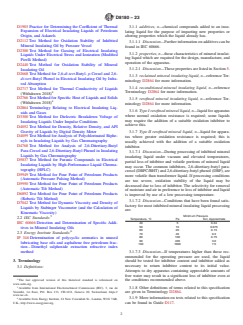
3.1.7.2 Discussion—Conditions that have been found satis-
D7042 Test Method for Dynamic Viscosity and Density of
factory for most inhibited mineral insulating liquid processing
Liquids by Stabinger Viscometer (and the Calculation of
are:
Kinematic Viscosity)
Minimum Pressure
2.2 IEC Standards:
Temperature, °C Pa Torr, Approximate
IEC 60666 Detection and Determination of Specific Addi- 40 5 0.04
50 10 0.075
tives in Mineral Insulating Oils
60 20 0.15
2.3 Energy Institute Standards:
70 40 0.3
80 100 0.75
IP 346 Determination of polycyclic aromatics in unused
90 400 3.0
lubricating base oils and asphaltene free petroleum frac-
100 1000 7.5
tion – Dimethyl sulphoxide extraction refractive index
3.1.7.3 Discussion—If temperatures higher than those rec-
method
ommended for the operating pressure are used, the liquid
3. Terminology
should be tested for inhibitor content and inhibitor added as
necessary to return inhibitor content to its initial value.
3.1 Definitions:
Attempts to dry apparatus containing appreciable amounts of
free water may result in a significant loss of inhibitor even at
The last approved version of this historical standard is referenced on the conditions recommended above.
www.astm.org.
Available from International Electrotechnical Commission (IEC), 3, rue de 3.1.8 Other definitions of terms related to this specification
Varembé, 1st floor, P.O. Box 131, CH-1211, Geneva 20, Switzerland, https://
are given in Terminology D2864.
www.iec.ch.
3.1.9 More information on tests related to this specification
Available from Energy Institute, 61 New Cavendish St., London, W1G 7AR,
U.K., http://www.energyinst.org. can be found in Guide D117.
D8180−23
4. Sampling and Testing 4.4 The supplier shall make known to the user the generic
type and amount of any additive used, for assessing any
4.1 Take all liquid samples in accordance with Practices
potential detrimental reaction with other materials in contact
D923.
with the liquid.
4.2 Make each test in accordance with the latest revision of
the ASTM or IP test method specified in Section 5. 4.5 Due to differences in rerefining processes, some rere-
fined liquids could contain levels of metals subject to regula-
4.3 The liquid shall meet the requirements of Section 5 at
tion under local, state, and national regulations. The need for
the unloading point.
this testing should be discussed between supplier and user.
NOTE 1—Because of the different needs of the various users, items
relatingtopackaging,labeling,andinspectionareconsideredtobesubject
5. Property Requirements
to supplier and user’s agreement.
NOTE 2—In addition to all other tests listed herein, it is sound
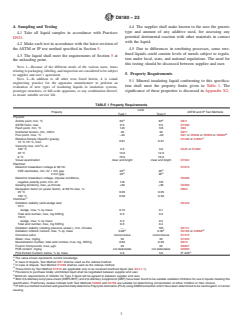
5.1 Mineral insulating liquid conforming to this specifica-
engineering practice for the apparatus manufacturer to perform an
tion shall meet the property limits given in Table 1. The
evaluation of new types of insulating liquids in insulation systems,
prototype structures, or full-scale apparatus, or any combination thereof,
significance of these properties is discussed in Appendix X2.
to ensure suitable service life.
TABLE 1 Property Requirements
Limit
Property ASTM and IP Test Methods
Type I Type II
Physical:
A A
Aniline point, min, °C 63 63 D611
ASTM Color, max 0.5 0.5 D1500
Flash point, min, °C 145 145 D92
Interfacial tension, min, mN/m 40 40 D971
B
Pour point, max, °C –40 –40 D97 or D5949 or D5950 or D6892
C
Relative Density (Specific gravity), D1298 or D4052
0.91 0.91
15 °C ⁄15 °C, max
Viscosity max, mm /s, at:
100 °C 3.0 3.0 D445 or D7042
40 °C 12.0 12.0
0°C 76.0 76.0
Visual examination clear and bright clear and bright D1524
Electrical:
Dielectric breakdown voltage at 60 Hz: D1816
D D
VDE electrodes, min, kV 1 mm gap 20 20
D D
2 mm gap 35 35
Dielectric breakdown voltage, impulse conditions, D3300
negative polarity point, min, kV 145 145
Gassing tendency, max, µL/minute +30 +30 D2300
Dissipation factor (or power factor), at 60 Hz max, %: D924
25 °C 0.05 0.05
100 °C 0.30 0.30
F
Chemical:
Oxidation stability (acid-sludge test) D2440
72 h:
sludge, max, % by mass 0.15 0.1
Total acid number, max, mg KOH/g 0.5 0.3
164 h:
sludge, max, % by mass 0.3 0.2
Total acid number, max, mg KOH/g 0.6 0.4
Oxidation stability (rotating pre
...