

ASTM D5222-23
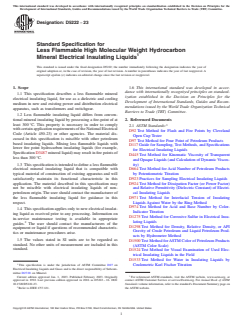
(Specification)Standard Specification for Less Flammable High Molecular Weight Hydrocarbon Mineral Electrical Insulating Liquids
General Information
- Abstract
ABSTRACT
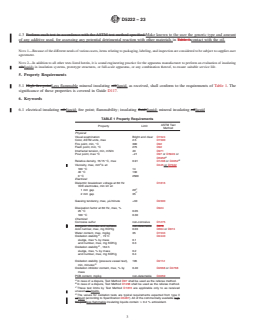
This specification describes a high fire-point mineral oil based electrical insulating fluid, for use as a dielectric and cooling medium in new and existing power and distribution electrical apparatuses, such as transformers and switchgear. The material discussed here is miscible with other petroleum based insulating oils, and may not be miscible with electrical insulating liquids of non-petroleum origin. The insulating oils shall be compatible with typical material of construction of existing apparatus and will satisfactorily maintain its functional characteristic in its application. This specification applies only to new insulating material oil as received prior to any processing. Sampled specimens shall undergo appropriate tests, and shall conform correspondingly to specified physical (appearance upon visual examination, color in ASTM units, fire point, flash point, aniline point, interfacial tension, pour point, relative density, and kinematic viscosity), electrical (dielectric breakdown voltage, gassing tendency, and dissipation factor), and chemical (corrosion behavior against sulfur, inorganic chlorides and sulfates content, acid number, water content, oxidation stability, oxidation inhibitor content, and PCB content) property requirements.
SCOPE
1.1 This specification describes a less flammable mineral electrical insulating liquid, for use as a dielectric and cooling medium in new and existing power and distribution electrical apparatus, such as transformers and switchgear.
1.2 Less flammable insulating liquid differs from conventional mineral insulating liquid by possessing a fire-point of at least 300 °C. This property is necessary in order to comply with certain application requirements of the National Electrical Code (Article 450-23) or other agencies. The material discussed in this specification is miscible with other petroleum based insulating liquids. Mixing less flammable liquids with lower fire point hydrocarbon insulating liquids (for example, Specification D3487 mineral liquid) may result in fire points of less than 300 °C.
1.3 This specification is intended to define a less flammable electrical mineral insulating liquid that is compatible with typical material of construction of existing apparatus and will satisfactorily maintain its functional characteristic in this application. The material described in this specification may not be miscible with electrical insulating liquids of non-petroleum origin. The user should contact the manufacturer of the less flammable insulating liquid for guidance in this respect.
1.4 This specification applies only to new electrical insulating liquid as received prior to any processing. Information on in-service maintenance testing is available in appropriate guides.2 The user should contact the manufacturers of the equipment or liquid if questions of recommended characteristics or maintenance procedures arise.
1.5 The values stated in SI units are to be regarded as standard. No other units of measurement are included in this standard.
1.6 This international standard was developed in accordance with internationally recognized principles on standardization established in the Decision on Principles for the Development of International Standards, Guides and Recommendations issued by the World Trade Organization Technical Barriers to Trade (TBT) Committee.
- Status
- Published
- Publication Date
- 31-Dec-2022
- Technical Committee
- D27 - Electrical Insulating Liquids and Gases
- Drafting Committee
- D27.01 - Mineral
Buy Documents


ASTM D5222-23 - Standard Specification for Less Flammable High Molecular Weight Hydrocarbon Mineral Electrical Insulating Liquids

REDLINE ASTM D5222-23 - Standard Specification for Less Flammable High Molecular Weight Hydrocarbon Mineral Electrical Insulating Liquids
Overview
ASTM D5222-23 is the internationally recognized standard specification for less flammable, high molecular weight hydrocarbon mineral electrical insulating liquids. Published by ASTM, this standard defines the requirements for mineral oil-based insulating liquids used as dielectric and cooling media in both new and existing electrical power apparatus such as transformers and switchgear. These specialty insulating fluids possess a high fire-point (at least 300°C), significantly enhancing fire safety compared to conventional mineral oils and meeting key requirements for critical infrastructure safety codes, such as the National Electrical Code (NEC, Article 450-23).
This specification is intended for new insulating liquids before any on-site processing or use and focuses on ensuring compatibility with existing equipment materials and satisfactory long-term operational performance.
Key Topics
- Fire Safety: Specifies a fire point minimum of 300°C, categorizing these fluids as less flammable and helping utilities and manufacturers comply with stringent fire safety standards.
- Physical Properties: Standardizes crucial characteristics including color, interfacial tension, pour point, relative density, and kinematic viscosity to ensure reliability during operation.
- Electrical Properties: Outlines requirements such as dielectric breakdown voltage, gassing tendency, and dissipation factor for optimal dielectric performance and minimal energy losses.
- Chemical Stability: Sets benchmarks for corrosion, inhibitor content, acid number, water and PCB content, and oxidation stability, ensuring longevity and compatibility with equipment materials.
- Testing & Sampling: Mandates the use of approved ASTM and IEEE testing methodologies for performance verification and quality assurance.
Applications
The ASTM D5222-23 standard is integral in the specification, procurement, and maintenance of electrical insulating liquids for:
- Power and Distribution Transformers: Enhances the fire resistance of critical grid infrastructure, especially in urban, industrial, or indoor installations with strict safety regulations.
- Switchgear and Related Power Equipment: Offers improved fire protection for both new and retrofitted systems, enabling safer operation in confined or sensitive environments.
- Utility & Industrial Power Systems: Provides manufacturers, utilities, and facilities with a clear pathway to higher fire safety while maintaining electrical and thermal performance expectations.
- Compatibility with Petroleum-based Oils: The material is designed to be miscible with most other petroleum-derived insulating oils, supporting flexible equipment upgrades and maintenance initiatives.
Note: Use of ASTM D5222-23 fluids with non-petroleum insulating liquids is not recommended without direct manufacturer guidance due to potential incompatibility.
Related Standards
ASTM D5222-23 refers to several key industry standards and test methods for quality and safety assurance, including:
- ASTM D3487: Specification for mineral insulating oil used in electrical apparatus.
- IEEE C57.121: Guide for acceptance and maintenance of less-flammable hydrocarbon fluid in transformers.
- ASTM D923: Practices for sampling electrical insulating liquids.
- ASTM D1816, D924, D971, D664, D1275, D4059: Various test methods for assessing breakdown voltage, permittivity, tension, acidity, sulfur content, and PCB presence.
- National Electrical Code, Article 450-23: Pertinent fire safety requirements for electrical equipment installations.
- ASTM D117, D1500, D97, D92: Guidance on sampling, color, pour point, and fire/flash points testing.
By adhering to these referenced standards, users can ensure that insulating liquids provide consistent performance, reliability, and safety in demanding electrical applications.
Keywords: ASTM D5222-23, less flammable mineral insulating liquids, high fire-point insulating oil, transformer insulating oil, mineral electrical insulating liquid, dielectric fluid, electrical apparatus safety, transformer fire safety.
Relations
- Effective Date
- 01-Apr-2024
- Effective Date
- 01-Mar-2024
- Effective Date
- 15-Jan-2024
- Effective Date
- 01-Dec-2023
- Effective Date
- 01-Dec-2023
- Effective Date
- 01-Dec-2023
- Effective Date
- 01-Nov-2023
- Effective Date
- 01-Apr-2020
- Effective Date
- 01-Dec-2019
- Effective Date
- 01-Oct-2019
- Effective Date
- 01-Dec-2018
- Effective Date
- 01-May-2017
- Effective Date
- 01-Mar-2017
- Effective Date
- 01-Feb-2017
- Effective Date
- 01-Jan-2017
Buy Documents
ASTM D5222-23 - Standard Specification for Less Flammable High Molecular Weight Hydrocarbon Mineral Electrical Insulating Liquids
REDLINE ASTM D5222-23 - Standard Specification for Less Flammable High Molecular Weight Hydrocarbon Mineral Electrical Insulating Liquids
Get Certified
Connect with accredited certification bodies for this standard

IMQ S.p.A. (Certification)
Italian electrical product certification.

SLG Prüf- und Zertifizierungs GmbH
German testing and certification body.

UL Solutions
Global safety science company with testing, inspection and certification.
Sponsored listings
Frequently Asked Questions
ASTM D5222-23 is a technical specification published by ASTM International. Its full title is "Standard Specification for Less Flammable High Molecular Weight Hydrocarbon Mineral Electrical Insulating Liquids". This standard covers: ABSTRACT This specification describes a high fire-point mineral oil based electrical insulating fluid, for use as a dielectric and cooling medium in new and existing power and distribution electrical apparatuses, such as transformers and switchgear. The material discussed here is miscible with other petroleum based insulating oils, and may not be miscible with electrical insulating liquids of non-petroleum origin. The insulating oils shall be compatible with typical material of construction of existing apparatus and will satisfactorily maintain its functional characteristic in its application. This specification applies only to new insulating material oil as received prior to any processing. Sampled specimens shall undergo appropriate tests, and shall conform correspondingly to specified physical (appearance upon visual examination, color in ASTM units, fire point, flash point, aniline point, interfacial tension, pour point, relative density, and kinematic viscosity), electrical (dielectric breakdown voltage, gassing tendency, and dissipation factor), and chemical (corrosion behavior against sulfur, inorganic chlorides and sulfates content, acid number, water content, oxidation stability, oxidation inhibitor content, and PCB content) property requirements. SCOPE 1.1 This specification describes a less flammable mineral electrical insulating liquid, for use as a dielectric and cooling medium in new and existing power and distribution electrical apparatus, such as transformers and switchgear. 1.2 Less flammable insulating liquid differs from conventional mineral insulating liquid by possessing a fire-point of at least 300 °C. This property is necessary in order to comply with certain application requirements of the National Electrical Code (Article 450-23) or other agencies. The material discussed in this specification is miscible with other petroleum based insulating liquids. Mixing less flammable liquids with lower fire point hydrocarbon insulating liquids (for example, Specification D3487 mineral liquid) may result in fire points of less than 300 °C. 1.3 This specification is intended to define a less flammable electrical mineral insulating liquid that is compatible with typical material of construction of existing apparatus and will satisfactorily maintain its functional characteristic in this application. The material described in this specification may not be miscible with electrical insulating liquids of non-petroleum origin. The user should contact the manufacturer of the less flammable insulating liquid for guidance in this respect. 1.4 This specification applies only to new electrical insulating liquid as received prior to any processing. Information on in-service maintenance testing is available in appropriate guides.2 The user should contact the manufacturers of the equipment or liquid if questions of recommended characteristics or maintenance procedures arise. 1.5 The values stated in SI units are to be regarded as standard. No other units of measurement are included in this standard. 1.6 This international standard was developed in accordance with internationally recognized principles on standardization established in the Decision on Principles for the Development of International Standards, Guides and Recommendations issued by the World Trade Organization Technical Barriers to Trade (TBT) Committee.
ABSTRACT This specification describes a high fire-point mineral oil based electrical insulating fluid, for use as a dielectric and cooling medium in new and existing power and distribution electrical apparatuses, such as transformers and switchgear. The material discussed here is miscible with other petroleum based insulating oils, and may not be miscible with electrical insulating liquids of non-petroleum origin. The insulating oils shall be compatible with typical material of construction of existing apparatus and will satisfactorily maintain its functional characteristic in its application. This specification applies only to new insulating material oil as received prior to any processing. Sampled specimens shall undergo appropriate tests, and shall conform correspondingly to specified physical (appearance upon visual examination, color in ASTM units, fire point, flash point, aniline point, interfacial tension, pour point, relative density, and kinematic viscosity), electrical (dielectric breakdown voltage, gassing tendency, and dissipation factor), and chemical (corrosion behavior against sulfur, inorganic chlorides and sulfates content, acid number, water content, oxidation stability, oxidation inhibitor content, and PCB content) property requirements. SCOPE 1.1 This specification describes a less flammable mineral electrical insulating liquid, for use as a dielectric and cooling medium in new and existing power and distribution electrical apparatus, such as transformers and switchgear. 1.2 Less flammable insulating liquid differs from conventional mineral insulating liquid by possessing a fire-point of at least 300 °C. This property is necessary in order to comply with certain application requirements of the National Electrical Code (Article 450-23) or other agencies. The material discussed in this specification is miscible with other petroleum based insulating liquids. Mixing less flammable liquids with lower fire point hydrocarbon insulating liquids (for example, Specification D3487 mineral liquid) may result in fire points of less than 300 °C. 1.3 This specification is intended to define a less flammable electrical mineral insulating liquid that is compatible with typical material of construction of existing apparatus and will satisfactorily maintain its functional characteristic in this application. The material described in this specification may not be miscible with electrical insulating liquids of non-petroleum origin. The user should contact the manufacturer of the less flammable insulating liquid for guidance in this respect. 1.4 This specification applies only to new electrical insulating liquid as received prior to any processing. Information on in-service maintenance testing is available in appropriate guides.2 The user should contact the manufacturers of the equipment or liquid if questions of recommended characteristics or maintenance procedures arise. 1.5 The values stated in SI units are to be regarded as standard. No other units of measurement are included in this standard. 1.6 This international standard was developed in accordance with internationally recognized principles on standardization established in the Decision on Principles for the Development of International Standards, Guides and Recommendations issued by the World Trade Organization Technical Barriers to Trade (TBT) Committee.
ASTM D5222-23 is classified under the following ICS (International Classification for Standards) categories: 29.040.10 - Insulating oils. The ICS classification helps identify the subject area and facilitates finding related standards.
ASTM D5222-23 has the following relationships with other standards: It is inter standard links to ASTM D445-24, ASTM D1500-24, ASTM D1275-24, ASTM D924-23, ASTM D2112-15(2023), ASTM D923-15(2023), ASTM D445-23, ASTM D971-20, ASTM D4768-11(2019), ASTM D1816-12(2019), ASTM D4059-00(2018), ASTM D664-11a(2017), ASTM D2864-17a, ASTM D2864-17, ASTM D2300-08(2017). Understanding these relationships helps ensure you are using the most current and applicable version of the standard.
ASTM D5222-23 is available in PDF format for immediate download after purchase. The document can be added to your cart and obtained through the secure checkout process. Digital delivery ensures instant access to the complete standard document.
Standards Content (Sample)
This international standard was developed in accordance with internationally recognized principles on standardization established in the Decision on Principles for the
Development of International Standards, Guides and Recommendations issued by the World Trade Organization Technical Barriers to Trade (TBT) Committee.
Designation: D5222 − 23
Standard Specification for
Less Flammable High Molecular Weight Hydrocarbon
Mineral Electrical Insulating Liquids
This standard is issued under the fixed designation D5222; the number immediately following the designation indicates the year of
original adoption or, in the case of revision, the year of last revision. A number in parentheses indicates the year of last reapproval. A
superscript epsilon (´) indicates an editorial change since the last revision or reapproval.
1. Scope 1.6 This international standard was developed in accor-
dance with internationally recognized principles on standard-
1.1 This specification describes a less flammable mineral
ization established in the Decision on Principles for the
electrical insulating liquid, for use as a dielectric and cooling
Development of International Standards, Guides and Recom-
medium in new and existing power and distribution electrical
mendations issued by the World Trade Organization Technical
apparatus, such as transformers and switchgear.
Barriers to Trade (TBT) Committee.
1.2 Less flammable insulating liquid differs from conven-
tional mineral insulating liquid by possessing a fire-point of at 2. Referenced Documents
least 300 °C. This property is necessary in order to comply 3
2.1 ASTM Standards:
with certain application requirements of the National Electrical
D92 Test Method for Flash and Fire Points by Cleveland
Code (Article 450-23) or other agencies. The material dis-
Open Cup Tester
cussed in this specification is miscible with other petroleum
D97 Test Method for Pour Point of Petroleum Products
based insulating liquids. Mixing less flammable liquids with
D117 Guide for Sampling, Test Methods, and Specifications
lower fire point hydrocarbon insulating liquids (for example,
for Electrical Insulating Liquids
Specification D3487 mineral liquid) may result in fire points of
D445 Test Method for Kinematic Viscosity of Transparent
less than 300 °C.
and Opaque Liquids (and Calculation of Dynamic Viscos-
1.3 This specification is intended to define a less flammable ity)
electrical mineral insulating liquid that is compatible with D664 Test Method for Acid Number of Petroleum Products
typical material of construction of existing apparatus and will by Potentiometric Titration
satisfactorily maintain its functional characteristic in this D923 Practices for Sampling Electrical Insulating Liquids
application. The material described in this specification may D924 Test Method for Dissipation Factor (or Power Factor)
not be miscible with electrical insulating liquids of non- and Relative Permittivity (Dielectric Constant) of Electri-
cal Insulating Liquids
petroleum origin. The user should contact the manufacturer of
the less flammable insulating liquid for guidance in this D971 Test Method for Interfacial Tension of Insulating
Liquids Against Water by the Ring Method
respect.
D974 Test Method for Acid and Base Number by Color-
1.4 This specification applies only to new electrical insulat-
Indicator Titration
ing liquid as received prior to any processing. Information on
D1275 Test Method for Corrosive Sulfur in Electrical Insu-
in-service maintenance testing is available in appropriate
lating Liquids
guides. The user should contact the manufacturers of the
D1298 Test Method for Density, Relative Density, or API
equipment or liquid if questions of recommended characteris-
Gravity of Crude Petroleum and Liquid Petroleum Prod-
tics or maintenance procedures arise.
ucts by Hydrometer Method
1.5 The values stated in SI units are to be regarded as
D1500 Test Method for ASTM Color of Petroleum Products
standard. No other units of measurement are included in this
(ASTM Color Scale)
standard.
D1524 Test Method for Visual Examination of Used Elec-
trical Insulating Liquids in the Field
D1533 Test Method for Water in Insulating Liquids by
Coulometric Karl Fischer Titration
This specification is under the jurisdiction of ASTM Committee D27 on
Electrical Insulating Liquids and Gases and is the direct responsibility of Subcom-
mittee D27.01 on Mineral.
Current edition approved Jan. 1, 2023. Published February 2023. Originally For referenced ASTM standards, visit the ASTM website, www.astm.org, or
approved in 1992. Last previous edition approved in 2016 as D5222 – 16. DOI: contact ASTM Customer Service at service@astm.org. For Annual Book of ASTM
10.1520/D5222-23. Standards volume information, refer to the standard’s Document Summary page on
Refer to IEEE C57.121. the ASTM website.
Copyright © ASTM International, 100 Barr Harbor Drive, PO Box C700, West Conshohocken, PA 19428-2959. United States
D5222 − 23
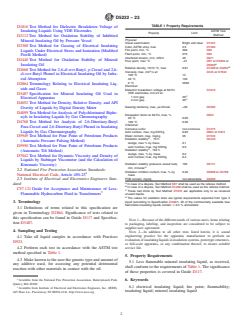
TABLE 1 Property Requirements
D1816 Test Method for Dielectric Breakdown Voltage of
Insulating Liquids Using VDE Electrodes ASTM Test
Property Limit
Method
D2112 Test Method for Oxidation Stability of Inhibited
Physical:
Mineral Insulating Oil by Pressure Vessel
Visual examination Bright and clear D1524
D2300 Test Method for Gassing of Electrical Insulating
Color, ASTM units, max 2.5 D1500
Liquids Under Electrical Stress and Ionization (Modified Fire point, min, °C 300 D92
Flash point, min, °C 275 D92
Pirelli Method)
Interfacial tension, min, mN/m 40 D971
D2440 Test Method for Oxidation Stability of Mineral
Pour point, max °C −21 D97 or D5949 or
A
Insulating Oil
...
This document is not an ASTM standard and is intended only to provide the user of an ASTM standard an indication of what changes have been made to the previous version. Because
it may not be technically possible to adequately depict all changes accurately, ASTM recommends that users consult prior editions as appropriate. In all cases only the current version
of the standard as published by ASTM is to be considered the official document.
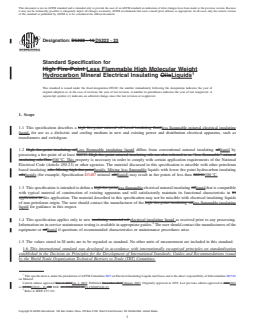
Designation: D5222 − 16 D5222 − 23
Standard Specification for
High Fire-Point Less Flammable High Molecular Weight
Hydrocarbon Mineral Electrical Insulating OilsLiquids
This standard is issued under the fixed designation D5222; the number immediately following the designation indicates the year of
original adoption or, in the case of revision, the year of last revision. A number in parentheses indicates the year of last reapproval. A
superscript epsilon (´) indicates an editorial change since the last revision or reapproval.
1. Scope
1.1 This specification describes a high fire-point mineral oil based insulating fluid,less flammable mineral electrical insulating
liquid, for use as a dielectric and cooling medium in new and existing power and distribution electrical apparatus, such as
transformers and switchgear.
1.2 High fire-point insulating oilLess flammable insulating liquid differs from conventional mineral insulating oilliquid by
possessing a fire-point of at least 300°C. High fire-point mineral insulating oils are also referred to as “less flammable” mineral
insulating oils.This 300 °C. This property is necessary in order to comply with certain application requirements of the National
Electrical Code (Article 450-23) or other agencies. The material discussed in this specification is miscible with other petroleum
based insulating oils. Mixing high fire-pointliquids. Mixing less flammable liquids with lower fire point hydrocarbon insulating
oilsliquids (for example, Specification D3487 mineral oil)liquid) may result in fire points of less than 300°C.300 °C.
1.3 This specification is intended to define a high fire-pointless flammable electrical mineral insulating oilliquid that is compatible
with typical material of construction of existing apparatus and will satisfactorily maintain its functional characteristic in its
application in this application. The material described in this specification may not be miscible with electrical insulating liquids
of non-petroleum origin. The user should contact the manufacturer of the high fire-point insulating oilless flammable insulating
liquid for guidance in this respect.
1.4 This specification applies only to new insulating material oil electrical insulating liquid as received prior to any processing.
Information on in-service maintenance testing is available in appropriate guides. The user should contact the manufacturers of the
equipment or oilliquid if questions of recommended characteristics or maintenance procedures arise.
1.5 The values stated in SI units are to be regarded as standard. No other units of measurement are included in this standard.
1.6 This international standard was developed in accordance with internationally recognized principles on standardization
established in the Decision on Principles for the Development of International Standards, Guides and Recommendations issued
by the World Trade Organization Technical Barriers to Trade (TBT) Committee.
This specification is under the jurisdiction of ASTM Committee D27 on Electrical Insulating Liquids and Gases and is the direct responsibility of Subcommittee D27.01
on Mineral.
Current edition approved Nov. 1, 2016Jan. 1, 2023. Published December 2016February 2023. Originally approved in 1992. Last previous edition approved in 20082016
as D5222D5222 – 16.–08. DOI: 10.1520/D5222-16.10.1520/D5222-23.
Refer to IEEE C57.121.
Copyright © ASTM International, 100 Barr Harbor Drive, PO Box C700, West Conshohocken, PA 19428-2959. United States
D5222 − 23
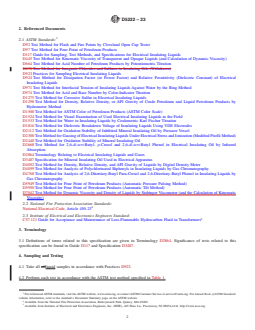
2. Referenced Documents
2.1 ASTM Standards:
D92 Test Method for Flash and Fire Points by Cleveland Open Cup Tester
D97 Test Method for Pour Point of Petroleum Products
D117 Guide for Sampling, Test Methods, and Specifications for Electrical Insulating Liquids
D445 Test Method for Kinematic Viscosity of Transparent and Opaque Liquids (and Calculation of Dynamic Viscosity)
D664 Test Method for Acid Number of Petroleum Products by Potentiometric Titration
D878 Test Method for Inorganic Chlorides and Sulfates in Insulating Oils (Withdrawn)
D923 Practices for Sampling Electrical Insulating Liquids
D924 Test Method for Dissipation Factor (or Power Factor) and Relative Permittivity (Dielectric Constant) of Electrical
Insulating Liquids
D971 Test Method for Interfacial Tension of Insulating Liquids Against Water by the Ring Method
D974 Test Method for Acid and Base Number by Color-Indicator Titration
D1275 Test Method for Corrosive Sulfur in Electrical Insulating Liquids
D1298 Test Method for Density, Relative Density, or API Gravity of Crude Petroleum and Liquid Petroleum Products by
Hydrometer Method
D1500 Test Method for ASTM Color of Petroleum Products (ASTM Color Scale)
D1524 Test Method for Visual Examination of Used Electrical Insulating Liquids in the Field
D1533 Test Method for Water in Insulating Liquids by Coulometric Karl Fischer Titration
D1816 Test Method for Dielectric Breakdown Voltage of Insulating Liquids Using VDE Electrodes
D2112 Test Method for Oxidation Stability of Inhibited Mineral Insulating Oil by Pressure Vessel
D2300 Test Method for Gassing of Electrical Insulating Liquids Under Electrical Stress and Ionization (Modified Pirelli Method)
D2440 Test Method for Oxidation Stability of Mineral Insulating Oil
D2668 Test Method for 2,6-di-tert-Butyl- p-Cresol and 2,6-di-tert-Butyl Phenol in Electrical Insulating Oil by Infrared
Absorption
D2864 Terminology Relating to Electrical Insulating Liquids and Gases
D3487 Specification for Mineral Insulating Oil Used in Electrical Apparatus
D4052 Test Method for Density, Relative Density, and API Gravity of Liquids by D
...