

ASTM D1816-12(2019)
(Test Method)Standard Test Method for Dielectric Breakdown Voltage of Insulating Liquids Using VDE Electrodes
General Information
- Abstract
SIGNIFICANCE AND USE
3.1 The dielectric breakdown voltage of an insulating liquid is of importance as a measure of the liquid's ability to withstand electric stress without failure. The dielectric breakdown voltage serves to indicate the presence of contaminating agents such as water, dirt, cellulosic fibers, or conducting particles in the liquid, one or more of which may be present in significant concentrations when low breakdown voltages are obtained. However, a high dielectric breakdown voltage does not necessarily indicate the absence of all contaminants; it may merely indicate that the concentrations of contaminants that are present in the liquid between the electrodes are not large enough to deleteriously affect the average breakdown voltage of the liquid when tested by this test method (see Appendix X1.)
3.2 This test method is used in laboratory or field tests. For field breakdown results to be comparable to laboratory results, all criteria including room temperature (20 to 30 °C) must be met.
SCOPE
1.1 This test method covers the determination of the dielectric breakdown voltage of insulating liquids (oils of petroleum origin, silicone fluids, high fire-point mineral electrical insulating oils, synthetic ester fluids and natural ester fluids). This test method is applicable to insulating liquids commonly used in cables, transformers, oil circuit breakers, and similar apparatus as an insulating and cooling medium. Refer to Terminology D2864 for definitions used in this test method.
1.2 This test method is sensitive to the deleterious effects of moisture in solution especially when cellulosic fibers are present in the liquid. It has been found to be especially useful in diagnostic and laboratory investigations of the dielectric breakdown strength of insulating liquid in insulating systems.2
1.3 This test method is used to judge if the VDE electrode breakdown voltage requirements are met for insulating liquids. This test method should be used as recommended by professional organization standards such as IEEE C57.106.
1.4 This test method may be used to obtain the dielectric breakdown of silicone fluid as specified in Test Method D2225, Specification D4652, or Specification D6871, provided that the discharge energy into the sample is less than 20 mJ (milli joule) per breakdown for five consecutive breakdowns.
1.5 Both the metric and the alternative inch-pound units are acceptable.
1.6 This standard does not purport to address all of the safety concerns, if any, associated with its use. It is the responsibility of the user of this standard to establish appropriate safety, health, and environmental practices and determine the applicability of regulatory limitations prior to use.
1.7 This international standard was developed in accordance with internationally recognized principles on standardization established in the Decision on Principles for the Development of International Standards, Guides and Recommendations issued by the World Trade Organization Technical Barriers to Trade (TBT) Committee.
- Status
- Published
- Publication Date
- 30-Sep-2019
- Technical Committee
- D27 - Electrical Insulating Liquids and Gases
- Drafting Committee
- D27.05 - Electrical Test
Overview
ASTM D1816-12(2019) is an established international standard published by ASTM for determining the dielectric breakdown voltage of insulating liquids using VDE (Verband Deutscher Elektrotechniker) electrodes. This test method applies to a wide range of insulating liquids, including petroleum-based oils, silicone fluids, high fire-point mineral oils, synthetic ester fluids, and natural ester fluids. These liquids are commonly used in the electrical power industry as both insulating and cooling media in transformers, cables, oil circuit breakers, and similar apparatus.
The dielectric breakdown voltage is a crucial measure of an insulating liquid’s ability to withstand electrical stress without failure. This test provides valuable insight into the presence of contaminants, such as water, dirt, fibers, or conducting particles. The method is applicable for both laboratory and field testing, provided criteria-such as ambient temperature-are strictly met to ensure comparable results.
Key Topics
- Dielectric Breakdown Voltage Measurement: The standard details the measurement of the voltage at which an insulating liquid fails electrically under controlled conditions using VDE electrodes.
- Contamination Detection: The method is sensitive to deleterious effects caused by contaminants like moisture and cellulosic fibers, providing diagnostic value in determining fluid condition.
- Applicability: The test method is applicable to fluids used in electrical equipment, including transformer oils and environmentally-friendly ester fluids.
- Testing Protocols: Procedures are defined for equipment calibration, electrode care, test cell preparation, sampling, and conducting repeatable breakdown tests.
- Field and Laboratory Use: Ensures reliable results in both environments when standardized criteria-including temperature and electrode spacing-are maintained.
- Precision and Reporting: Outlines requirements for reporting results and expected test variances within and between laboratories.
Applications
The ASTM D1816-12(2019) standard is widely used for:
- Quality Assurance: Ensuring the dielectric strength of new and in-service insulating liquids meets established operational thresholds.
- Maintenance Planning: Supporting the maintenance and acceptance programs for equipment such as transformers and circuit breakers, helping to identify degradation or contamination in insulating oils and fluids.
- Regulatory Compliance: Providing an internationally recognized testing method referenced by standards organizations, such as IEEE, ensuring compliance with technical and safety requirements.
- Diagnostic Testing: Assisting in laboratory investigations and field diagnostics where changes in breakdown voltage can signal the deterioration or contamination of the liquid insulation system.
- Product Development: Used by manufacturers of insulating fluids and electrical apparatus to qualify new products or formulations.
- Incident Investigation: Supporting root cause analysis in cases of electrical failures related to insulation breakdown.
Related Standards
This standard is closely connected to a number of other key documents in the field of insulating liquid testing and maintenance:
- ASTM D923 - Practices for Sampling Electrical Insulating Liquids
- ASTM D2225 - Test Methods for Silicone Fluids Used for Electrical Insulation
- ASTM D2864 - Terminology Relating to Electrical Insulating Liquids and Gases
- ASTM D3487 - Specification for Mineral Insulating Oil Used in Electrical Apparatus
- ASTM D4652 - Specification for Silicone Fluid Used for Electrical Insulation
- ASTM D6871 - Specification for Natural (Vegetable Oil) Ester Fluids Used in Electrical Apparatus
- IEEE C57.106 - Guide for Acceptance and Maintenance of Insulating Oil in Equipment
- IEEE Standard 4 - Techniques for High Voltage Testing
These standards collectively address essential aspects of testing, terminology, sampling, and specifications for insulating liquids, ensuring best practices and reliable results in the assessment and maintenance of electrical insulation systems.
Keywords: ASTM D1816, dielectric breakdown voltage, insulating liquids, VDE electrodes, transformer oil testing, electrical insulation, contamination detection, insulating fluid standards.
Relations
- Effective Date
- 01-Oct-2019
- Effective Date
- 01-Dec-2023
- Effective Date
- 01-Mar-2017
- Effective Date
- 01-Feb-2017
- Refers
ASTM D3487-16 - Standard Specification for Mineral Insulating Oil Used in Electrical Apparatus - Effective Date
- 15-Jun-2016
- Refers
ASTM D3487-16e1 - Standard Specification for Mineral Insulating Oil Used in Electrical Apparatus - Effective Date
- 15-Jun-2016
- Effective Date
- 01-Oct-2015
- Effective Date
- 15-May-2010
- Effective Date
- 15-May-2010
- Refers
ASTM D3487-09 - Standard Specification for Mineral Insulating Oil Used in Electrical Apparatus - Effective Date
- 01-Dec-2009
- Effective Date
- 01-Jan-2009
- Refers
ASTM D3487-08 - Standard Specification for Mineral Insulating Oil Used in Electrical Apparatus - Effective Date
- 01-Nov-2008
- Effective Date
- 01-Oct-2008
- Effective Date
- 15-Jul-2007
- Effective Date
- 01-Jul-2007
Get Certified
Connect with accredited certification bodies for this standard

IMQ S.p.A. (Certification)
Italian electrical product certification.

SLG Prüf- und Zertifizierungs GmbH
German testing and certification body.

UL Solutions
Global safety science company with testing, inspection and certification.
Sponsored listings
Frequently Asked Questions
ASTM D1816-12(2019) is a standard published by ASTM International. Its full title is "Standard Test Method for Dielectric Breakdown Voltage of Insulating Liquids Using VDE Electrodes". This standard covers: SIGNIFICANCE AND USE 3.1 The dielectric breakdown voltage of an insulating liquid is of importance as a measure of the liquid's ability to withstand electric stress without failure. The dielectric breakdown voltage serves to indicate the presence of contaminating agents such as water, dirt, cellulosic fibers, or conducting particles in the liquid, one or more of which may be present in significant concentrations when low breakdown voltages are obtained. However, a high dielectric breakdown voltage does not necessarily indicate the absence of all contaminants; it may merely indicate that the concentrations of contaminants that are present in the liquid between the electrodes are not large enough to deleteriously affect the average breakdown voltage of the liquid when tested by this test method (see Appendix X1.) 3.2 This test method is used in laboratory or field tests. For field breakdown results to be comparable to laboratory results, all criteria including room temperature (20 to 30 °C) must be met. SCOPE 1.1 This test method covers the determination of the dielectric breakdown voltage of insulating liquids (oils of petroleum origin, silicone fluids, high fire-point mineral electrical insulating oils, synthetic ester fluids and natural ester fluids). This test method is applicable to insulating liquids commonly used in cables, transformers, oil circuit breakers, and similar apparatus as an insulating and cooling medium. Refer to Terminology D2864 for definitions used in this test method. 1.2 This test method is sensitive to the deleterious effects of moisture in solution especially when cellulosic fibers are present in the liquid. It has been found to be especially useful in diagnostic and laboratory investigations of the dielectric breakdown strength of insulating liquid in insulating systems.2 1.3 This test method is used to judge if the VDE electrode breakdown voltage requirements are met for insulating liquids. This test method should be used as recommended by professional organization standards such as IEEE C57.106. 1.4 This test method may be used to obtain the dielectric breakdown of silicone fluid as specified in Test Method D2225, Specification D4652, or Specification D6871, provided that the discharge energy into the sample is less than 20 mJ (milli joule) per breakdown for five consecutive breakdowns. 1.5 Both the metric and the alternative inch-pound units are acceptable. 1.6 This standard does not purport to address all of the safety concerns, if any, associated with its use. It is the responsibility of the user of this standard to establish appropriate safety, health, and environmental practices and determine the applicability of regulatory limitations prior to use. 1.7 This international standard was developed in accordance with internationally recognized principles on standardization established in the Decision on Principles for the Development of International Standards, Guides and Recommendations issued by the World Trade Organization Technical Barriers to Trade (TBT) Committee.
SIGNIFICANCE AND USE 3.1 The dielectric breakdown voltage of an insulating liquid is of importance as a measure of the liquid's ability to withstand electric stress without failure. The dielectric breakdown voltage serves to indicate the presence of contaminating agents such as water, dirt, cellulosic fibers, or conducting particles in the liquid, one or more of which may be present in significant concentrations when low breakdown voltages are obtained. However, a high dielectric breakdown voltage does not necessarily indicate the absence of all contaminants; it may merely indicate that the concentrations of contaminants that are present in the liquid between the electrodes are not large enough to deleteriously affect the average breakdown voltage of the liquid when tested by this test method (see Appendix X1.) 3.2 This test method is used in laboratory or field tests. For field breakdown results to be comparable to laboratory results, all criteria including room temperature (20 to 30 °C) must be met. SCOPE 1.1 This test method covers the determination of the dielectric breakdown voltage of insulating liquids (oils of petroleum origin, silicone fluids, high fire-point mineral electrical insulating oils, synthetic ester fluids and natural ester fluids). This test method is applicable to insulating liquids commonly used in cables, transformers, oil circuit breakers, and similar apparatus as an insulating and cooling medium. Refer to Terminology D2864 for definitions used in this test method. 1.2 This test method is sensitive to the deleterious effects of moisture in solution especially when cellulosic fibers are present in the liquid. It has been found to be especially useful in diagnostic and laboratory investigations of the dielectric breakdown strength of insulating liquid in insulating systems.2 1.3 This test method is used to judge if the VDE electrode breakdown voltage requirements are met for insulating liquids. This test method should be used as recommended by professional organization standards such as IEEE C57.106. 1.4 This test method may be used to obtain the dielectric breakdown of silicone fluid as specified in Test Method D2225, Specification D4652, or Specification D6871, provided that the discharge energy into the sample is less than 20 mJ (milli joule) per breakdown for five consecutive breakdowns. 1.5 Both the metric and the alternative inch-pound units are acceptable. 1.6 This standard does not purport to address all of the safety concerns, if any, associated with its use. It is the responsibility of the user of this standard to establish appropriate safety, health, and environmental practices and determine the applicability of regulatory limitations prior to use. 1.7 This international standard was developed in accordance with internationally recognized principles on standardization established in the Decision on Principles for the Development of International Standards, Guides and Recommendations issued by the World Trade Organization Technical Barriers to Trade (TBT) Committee.
ASTM D1816-12(2019) is classified under the following ICS (International Classification for Standards) categories: 29.040.10 - Insulating oils. The ICS classification helps identify the subject area and facilitates finding related standards.
ASTM D1816-12(2019) has the following relationships with other standards: It is inter standard links to ASTM D1816-12, ASTM D923-15(2023), ASTM D2864-17a, ASTM D2864-17, ASTM D3487-16, ASTM D3487-16e1, ASTM D923-15, ASTM D2864-10e1, ASTM D2864-10, ASTM D3487-09, ASTM D2864-09, ASTM D3487-08, ASTM D6871-03(2008), ASTM D923-07, ASTM D2864-07. Understanding these relationships helps ensure you are using the most current and applicable version of the standard.
ASTM D1816-12(2019) is available in PDF format for immediate download after purchase. The document can be added to your cart and obtained through the secure checkout process. Digital delivery ensures instant access to the complete standard document.
Standards Content (Sample)
This international standard was developed in accordance with internationally recognized principles on standardization established in the Decision on Principles for the
Development of International Standards, Guides and Recommendations issued by the World Trade Organization Technical Barriers to Trade (TBT) Committee.
Designation: D1816 − 12 (Reapproved 2019)
Standard Test Method for
Dielectric Breakdown Voltage of Insulating Liquids Using
VDE Electrodes
This standard is issued under the fixed designation D1816; the number immediately following the designation indicates the year of
original adoption or, in the case of revision, the year of last revision. A number in parentheses indicates the year of last reapproval. A
superscript epsilon (´) indicates an editorial change since the last revision or reapproval.
1. Scope* Development of International Standards, Guides and Recom-
mendations issued by the World Trade Organization Technical
1.1 This test method covers the determination of the dielec-
Barriers to Trade (TBT) Committee.
tric breakdown voltage of insulating liquids (oils of petroleum
origin, silicone fluids, high fire-point mineral electrical insu-
2. Referenced Documents
lating oils, synthetic ester fluids and natural ester fluids). This
2.1 ASTM Standards:
test method is applicable to insulating liquids commonly used
D235 Specification for Mineral Spirits (Petroleum Spirits)
in cables, transformers, oil circuit breakers, and similar appa-
(Hydrocarbon Dry Cleaning Solvent)
ratus as an insulating and cooling medium. Refer to Terminol-
D923 Practices for Sampling Electrical Insulating Liquids
ogy D2864 for definitions used in this test method.
D2225 Test Methods for Silicone Fluids Used for Electrical
1.2 This test method is sensitive to the deleterious effects of
Insulation
moisture in solution especially when cellulosic fibers are
D2864 Terminology Relating to Electrical Insulating Liq-
present in the liquid. It has been found to be especially useful
uids and Gases
in diagnostic and laboratory investigations of the dielectric
D3487 Specification for Mineral Insulating Oil Used in
breakdown strength of insulating liquid in insulating systems.
Electrical Apparatus
1.3 This test method is used to judge if the VDE electrode
D4652 Specification for Silicone Fluid Used for Electrical
breakdown voltage requirements are met for insulating liquids.
Insulation
This test method should be used as recommended by profes-
D6871 Specification for Natural (Vegetable Oil) Ester Fluids
sional organization standards such as IEEE C57.106.
Used in Electrical Apparatus
2.2 IEEE Standard:
1.4 This test method may be used to obtain the dielectric
Standard 4 IEEE Standard Techniques for High Voltage
breakdownofsiliconefluidasspecifiedinTestMethodD2225,
Testing
Specification D4652, or Specification D6871, provided that the
C57.106 Guide for Acceptance and Maintenance of Insulat-
dischargeenergyintothesampleislessthan20mJ(millijoule)
ing Oil in Equipment
per breakdown for five consecutive breakdowns.
1.5 Both the metric and the alternative inch-pound units are
3. Significance and Use
acceptable.
3.1 The dielectric breakdown voltage of an insulating liquid
1.6 This standard does not purport to address all of the
is of importance as a measure of the liquid’s ability to
safety concerns, if any, associated with its use. It is the
withstand electric stress without failure. The dielectric break-
responsibility of the user of this standard to establish appro-
down voltage serves to indicate the presence of contaminating
priate safety, health, and environmental practices and deter-
agents such as water, dirt, cellulosic fibers, or conducting
mine the applicability of regulatory limitations prior to use.
particles in the liquid, one or more of which may be present in
1.7 This international standard was developed in accor-
significant concentrations when low breakdown voltages are
dance with internationally recognized principles on standard-
obtained. However, a high dielectric breakdown voltage does
ization established in the Decision on Principles for the
not necessarily indicate the absence of all contaminants; it may
merelyindicatethattheconcentrationsofcontaminantsthatare
This test method is under the jurisdiction of ASTM Committee D27 on
Electrical Insulating Liquids and Gasesand is the direct responsibility of Subcom-
mittee D27.05 on Electrical Test. For referenced ASTM standards, visit the ASTM website, www.astm.org, or
Current edition approved Oct. 1, 2019. Published October 2019. Originally contact ASTM Customer Service at service@astm.org. For Annual Book of ASTM
approved in 1960 as D1816 – 60 T. Last previous edition approved in 2012 as Standards volume information, refer to the standard’s Document Summary page on
D1816 – 12. DOI: 10.1520/D1816-12R19. theASTM website.
2 4
Supporting data is available fromASTM Headquarters. Request RR:D27-1006. Available from the Institute of Electrical and Electronic Engineers, Inc., PO
Box 1331, Piscataway, NJ 08855.
*A Summary of Changes section appears at the end of this standard
Copyright © ASTM International, 100 Barr Harbor Drive, PO Box C700, West Conshohocken, PA 19428-2959. United States
D1816 − 12 (2019)
present in the liquid between the electrodes are not large rise because of the difficulty of maintaining a uniform voltage
enough to deleteriously affect the average breakdown voltage rise manually. The equipment should produce a straight-line
of the liquid when tested by this test method (see Appendix voltage-time curve over the operating range of the equipment.
X1.) Calibrate and label automatic controls in terms of rate-of-rise.
4.4 Measuring Systems—The voltage shall be measured by
3.2 This test method is used in laboratory or field tests. For
field breakdown results to be comparable to laboratory results, a method that fufills the requirements of IEEE Standard No. 4,
giving rms values.
all criteria including room temperature (20 to 30 °C) must be
met.
4.5 Connect the electrode such that the voltage measured
from each electrode with respect to ground during the test is
4. Electrical Apparatus
equal within 5 %.
4.1 In addition to this section, use IEEE Standard 4 to
4.6 Accuracy—The combined accuracy of the voltmeter and
determine other requirements necessary for conducting test
voltage divider circuit shall be such that measurement error
measurements, and maintaining error limits using alternating
does not exceed 3 % at the rate-of-voltage rise specified in 4.3.
voltages. Procedures to ensure accuracy should follow the
For equipment manufactured prior to 1995 the maximum
requirements of IEEE Standard 4. Calibration(s) shall be
allowable error is 5 %.
traceable to national standards and calibration should be
verified annually or more often to ensure accuracy require- 5. Electrodes
ments. IEEE Standard 4 is required during the manufacturing
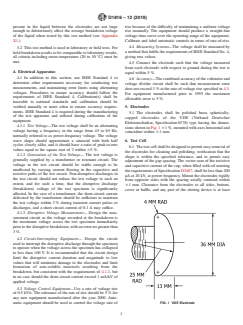
5.1 The electrodes shall be polished brass spherically-
of the test apparatus and utilized during calibration of the
capped electrodes of the VDE (Verband Deutscher
equipment.
Elektrotechniker, Specification 0370) type having the dimen-
4.1.1 Test Voltage—The test voltage shall be an alternating
sions shown in Fig. 1 61 %, mounted with axes horizontal and
voltage having a frequency in the range from 45 to 65 Hz,
coincident within 61 mm.
normally referred to as power-frequency voltage. The voltage
wave shape should approximate a sinusoid with both half 6. Test Cell
cycles closely alike, and it should have a ratio of peak-to-rms
6.1 The test cell shall be designed to permit easy removal of
values equal to the square root of 2 within 65%.
the electrodes for cleaning and polishing, verification that the
4.1.2 Generation of the Test Voltage— The test voltage is
shape is within the specified tolerance, and to permit easy
generally supplied by a transformer or resonant circuit. The
adjustment of the gap spacing. The vector sum of the resistive
voltage in the test circuit should be stable enough to be
and capacitive current of the cup, when filled with oil meeting
unaffected by varying current flowing in the capacitive and
the requirements of Specification D3487, shall be less than 200
resistive paths of the test circuit. Non-disruptive discharges in
µA at 20 kV, at power frequency. Mount the electrodes rigidly
the test circuit should not reduce the test voltage to such an
from opposite sides with the spacing axially centered within
extent, and for such a time, that the disruptive discharge
61 mm. Clearance from the electrodes to all sides, bottom,
(breakdown) voltage of the test specimen is significantly
cover or baffle, and any part of the stirring device is at least
affected. In the case of a transformer, the short-circuit current
delivered by the transformer should be sufficient to maintain
the test voltage within 3 % during transient current pulses or
discharges, and a short circuit current of 0.1 A may suffice.
4.1.3 Disruptive Voltage Measurement— Design the mea-
surement circuit so the voltage recorded at the breakdown is
the maximum voltage across the test specimen immediately
prior to the disruptive breakdown, with an error no greater than
3%.
4.2 Circuit-Interrupting Equipment— Design the circuit
used to interrupt the disruptive discharge through the specimen
to operate when the voltage across the specimen has collapsed
to less than 100 V. It is recommended that the circuit design
limit the disruptive current duration and magnitude to low
values that will minimize damage to the electrodes and limit
formation of non-soluble materials resulting from the
breakdown, but consistent with the requirements of 4.1.2, but
in no case should the short-circuit current exceed 1 mA/kV of
applied voltage.
4.3 Voltage Control Equipment—Use a rate of voltage rise
of 0.5 kV/s. The tolerance of the rate of rise should be 5 % for
any new equipment manufactured after the year 2000. Auto-
matic equipment should be used to control the voltage rate of FIG. 1 VDE Electrode
D1816 − 12 (2019)
12.7 mm ( ⁄2 in.). Provide the test cell with a motor-driven 7.3 Daily Use—At the beginning of each day’s testing, the
two-bladed impeller and drive shaft, constructed of a material electrodes shall be examined for pitting and carbon
accumulation, and the spacing checked. If the test of any
having high dielectric strength. The two-bladed impeller is 35
mm (1 ⁄8 in.) 65 % between the blade extremities, having a sample is below the breakdown value being used by the
operator as a minimum satisfactory value, drain the cell and
pitch of 40 mm (1.57 in.) 65 % (blade angle of twenty degrees
flush the cell with new insulating liquid of the type to be tested
(20°) 6 5 %), operating at a speed between 200 and 300 rpm.
thatisfilteredthrougha5-micronfilterandcontaininglessthan
The impeller, located below the lower edge of the electrodes,
25ppmmoisturebeforetestingthenextspecimen.Whennotin
rotates in such a direction that the resulting liquid flow is
use, keep the cell filled with oil that meets the requirements of
directed downward against the bottom of the test cell. Con-
Specification D3487 of the type normally tested.Alternatively,
struct the test cell of a material of high dielectric strength, that
the cell may be stored empty in a dust-free cabinet. At the
is not soluble in or attacked by any of the cleaning or test
beginning of each days testing, clean according to 7.2.
liquids used, and is nonabsorbent to moisture and the cleaning
and test liquids. So that the breakdown may be observed,
7.4 Polishing of Electrodes—When electrodes show slight
transparentmaterialsaredesirable,butnotessential.Inorderto
etching, scratching, pitting, or carbon accumulation, they
preclude stirring air with the sample, provide the cell with a
should be removed from the test cup and polished by buffing
cover or baffle that will effectively prevent air from contacting
with jeweler’s rouge using a soft cloth or soft buffing wheel.
the circulating liquid.
The residue from the buffing should be removed by repeated
wiping with lint-free tissue paper saturated with a suitable
7. Adjustment and Care of Electrodes and Test Cell solvent, followed by solvent rinsing or ultrasonic cleaning.
After careful inspection, any electrodes from which pitting
...