

ASTM E2129-18
(Practice)Standard Practice for Data Collection for Sustainability Assessment of Building Products
General Information
- Abstract
SIGNIFICANCE AND USE
5.1 This practice provides a practice for data collection for the purpose of assessing the sustainability of building products. Such data can inform decisions relative to construction, renovation, repair, and maintenance of buildings with the goal of promoting sustainability and sustainable development.
5.1.1 The users of this practice include building industry professionals who possess a broad, general understanding of sustainability issues relative to the performance of buildings. Such users may include planners, developers, architects, engineers, interior designers, contractors, owners, financial organizations related to the buildings industry, building materials and product manufacturers, government agencies including building officials, and other building professionals.
5.1.2 Users should note that, subsequent to the preliminary assessment facilitated by the comparative information collected in accordance with this practice, additional detailed and more technical information may be required in order to adequately assess specific needs for specific applications.
5.2 There are many environmental features and issues, each with local, regional, and global implications, involved in sustainability. It is becoming increasingly necessary to be able to quantify complex sustainability data relative to building industry information tools. This practice provides a format for relating the commonly accepted sustainability principles to building industry data collection methods. Users may wish to consider other building product attributes for which sustainability principles are deemed to be important or measurement methodologies may exist, or both. For example, the embodied energy of the product and greenhouse emitted over a product’s lifecycle, which can have a significant effect on the overall sustainability of a building product, may be deemed important.
5.3 The format for data collection is intended to facilitate a cost-effective and efficient assessment of su...
SCOPE
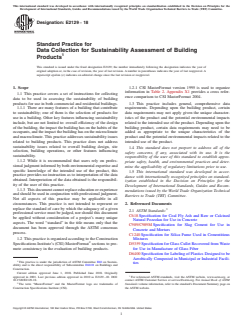
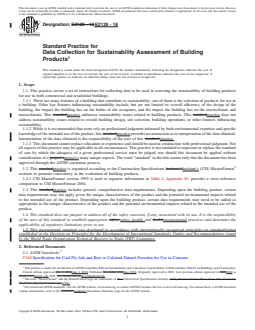
1.1 This practice covers a set of instructions for collecting data to be used in assessing the sustainability of building products for use in both commercial and residential buildings.
1.1.1 There are many features of a building that contribute to sustainability; one of them is the selection of products for use in a building. Other key features influencing sustainability include, but are not limited to: overall efficiency of the design of the building, the impact the building has on the habits of the occupants, and the impact the building has on the microclimate and macroclimate. This practice addresses sustainability issues related to building products. This practice does not address sustainability issues related to overall building design, site selection, building operations, or other features influencing sustainability.
1.1.2 While it is recommended that users rely on professional judgment informed by both environmental expertise and specific knowledge of the intended use of the product, this practice provides no instruction as to interpretation of the data obtained. Interpretation of the data obtained is the responsibility of the user of this practice.
1.1.3 This document cannot replace education or experience and should be used in conjunction with professional judgment. Not all aspects of this practice may be applicable in all circumstances. This practice is not intended to represent or replace the standard of care by which the adequacy of a given professional service must be judged, nor should this document be applied without consideration of a project’s many unique aspects. The word “standard” in the title means only that the document has been approved through the ASTM consensus process.
1.2 This practice is organized according to the Construction Specifications Institute’s (CSI) MasterFormat2 sections to promote consistency in the evaluation of building products.
1.2.1 CSI MasterFormat version 1995...
- Status
- Published
- Publication Date
- 31-May-2018
- Technical Committee
- E60 - Sustainability
- Drafting Committee
- E60.01 - Buildings and Construction
Buy Documents
ASTM E2129-18 - Standard Practice for Data Collection for Sustainability Assessment of Building Products
REDLINE ASTM E2129-18 - Standard Practice for Data Collection for Sustainability Assessment of Building Products
Overview
ASTM E2129-18, "Standard Practice for Data Collection for Sustainability Assessment of Building Products," provides a comprehensive guideline for collecting data necessary for the sustainability assessment of building products. Developed by ASTM International, this standard serves as a valuable tool for professionals in the building industry-including architects, engineers, planners, manufacturers, and building owners-who seek to make informed, sustainability-based decisions in construction, renovation, repair, and maintenance projects. By using consistent data collection practices, this standard enables clear comparison and evaluation of building products with a focus on sustainable development.
Key Topics
- Sustainability Principles in Building Products: Focuses on the environmental impacts associated with product selection, such as resource efficiency, recyclability, recycled content, embodied energy, and life-cycle impacts.
- Comprehensive Data Collection Framework: Organized according to the Construction Specifications Institute’s (CSI) MasterFormat structure to ensure uniformity and consistency in evaluation across diverse projects.
- Detailed Assessment Criteria: Includes questions on materials sourcing, manufacturing practices, operational performance, indoor environmental quality, and corporate environmental policies.
- Scope and Applicability: Applies to both commercial and residential building products, covering multiple divisions of building components, including site construction, concrete, masonry, metals, wood, plastics, finishes, mechanical systems, and electrical systems.
- User Responsibility and Flexibility: Encourages users to apply professional judgment in interpreting collected data and adapting the methodology to the unique characteristics of each project.
Applications
ASTM E2129-18 is designed for a broad range of applications within the building and construction industry, such as:
- Building Product Evaluation: Enables a standardized approach for manufacturers, suppliers, and specifiers to provide transparent information on the sustainability profile of their products.
- Green Building Certification Support: Facilitates the documentation and verification process needed for achieving green building certifications (e.g., LEED, BREEAM) by providing key data on recycled content, VOC emissions, environmental product declarations, and more.
- Sustainable Procurement: Assists government agencies, developers, and designers in specifying sustainable materials and systems based on quantifiable, comparable data.
- Life-Cycle Assessment (LCA) Preparation: Lays the groundwork for subsequent in-depth LCA or other environmental performance assessments by standardizing the data collection process.
- Reporting and Communication: Provides a structured format for communicating environmental attributes and corporate sustainability policies to stakeholders, clients, and regulatory authorities.
Related Standards
For a holistic approach to sustainable construction and building product evaluation, consider the following related standards and programs referenced in ASTM E2129-18:
- ASTM E2114: Terminology for sustainability relative to the performance of buildings
- ASTM C618 / C989 / C1240 / D5359 / D6400: Various specifications for recycled, renewable, or compostable materials in construction
- ASHRAE 90.1 & 62: Energy-efficient building design and indoor air quality
- ISO 14025, 14040, 14044, 21930: International standards for environmental product declarations (EPD) and life cycle assessment (LCA)
- EPA ENERGY STAR Program: Energy performance ratings for building products
- NFRC 100/200/300: Fenestration product energy and light transmittance performance
- ANSI A208.2: Formaldehyde emissions for medium density fiberboard
- EN 15804: Sustainability of construction works-core rules for environmental product declarations
Practical Value
By following ASTM E2129-18, industry professionals and organizations can:
- Promote Sustainable Development: Make decisions that consider environmental impact from material sourcing to product end-of-life.
- Enhance Transparency: Build trust with stakeholders through clear, organized, and verified sustainability data.
- Increase Market Access: Address growing regulatory, certification, and client demands for sustainable building materials and systems.
- Optimize Building Performance: Select products that contribute to energy efficiency, reduced emissions, improved indoor air quality, and resource conservation.
ASTM E2129-18 is an essential resource for driving sustainability in the built environment by enabling informed, data-driven decisions at every stage of the building product lifecycle.
Relations
- Effective Date
- 01-Jun-2018
- Effective Date
- 01-Feb-2024
- Effective Date
- 01-Oct-2017
- Effective Date
- 01-Oct-2017
- Refers
ASTM E2114-17 - Standard Terminology for Sustainability Relative to the Performance of Buildings - Effective Date
- 01-Feb-2017
- Effective Date
- 15-Dec-2016
- Effective Date
- 15-Jun-2015
- Effective Date
- 01-Mar-2015
- Effective Date
- 01-Nov-2014
- Effective Date
- 15-Feb-2014
- Effective Date
- 15-Dec-2012
- Effective Date
- 01-Aug-2012
- Effective Date
- 01-Jul-2012
- Effective Date
- 15-May-2012
- Effective Date
- 15-Dec-2011
Buy Documents
ASTM E2129-18 - Standard Practice for Data Collection for Sustainability Assessment of Building Products
REDLINE ASTM E2129-18 - Standard Practice for Data Collection for Sustainability Assessment of Building Products
Get Certified
Connect with accredited certification bodies for this standard

DIBt (Deutsches Institut für Bautechnik)
German Institute for Building Technology.
DIN CERTCO
DIN Group product certification.

Aboma Certification B.V.
Specialized in construction, metal, and transport sectors.
Sponsored listings
Frequently Asked Questions
ASTM E2129-18 is a standard published by ASTM International. Its full title is "Standard Practice for Data Collection for Sustainability Assessment of Building Products". This standard covers: SIGNIFICANCE AND USE 5.1 This practice provides a practice for data collection for the purpose of assessing the sustainability of building products. Such data can inform decisions relative to construction, renovation, repair, and maintenance of buildings with the goal of promoting sustainability and sustainable development. 5.1.1 The users of this practice include building industry professionals who possess a broad, general understanding of sustainability issues relative to the performance of buildings. Such users may include planners, developers, architects, engineers, interior designers, contractors, owners, financial organizations related to the buildings industry, building materials and product manufacturers, government agencies including building officials, and other building professionals. 5.1.2 Users should note that, subsequent to the preliminary assessment facilitated by the comparative information collected in accordance with this practice, additional detailed and more technical information may be required in order to adequately assess specific needs for specific applications. 5.2 There are many environmental features and issues, each with local, regional, and global implications, involved in sustainability. It is becoming increasingly necessary to be able to quantify complex sustainability data relative to building industry information tools. This practice provides a format for relating the commonly accepted sustainability principles to building industry data collection methods. Users may wish to consider other building product attributes for which sustainability principles are deemed to be important or measurement methodologies may exist, or both. For example, the embodied energy of the product and greenhouse emitted over a product’s lifecycle, which can have a significant effect on the overall sustainability of a building product, may be deemed important. 5.3 The format for data collection is intended to facilitate a cost-effective and efficient assessment of su... SCOPE 1.1 This practice covers a set of instructions for collecting data to be used in assessing the sustainability of building products for use in both commercial and residential buildings. 1.1.1 There are many features of a building that contribute to sustainability; one of them is the selection of products for use in a building. Other key features influencing sustainability include, but are not limited to: overall efficiency of the design of the building, the impact the building has on the habits of the occupants, and the impact the building has on the microclimate and macroclimate. This practice addresses sustainability issues related to building products. This practice does not address sustainability issues related to overall building design, site selection, building operations, or other features influencing sustainability. 1.1.2 While it is recommended that users rely on professional judgment informed by both environmental expertise and specific knowledge of the intended use of the product, this practice provides no instruction as to interpretation of the data obtained. Interpretation of the data obtained is the responsibility of the user of this practice. 1.1.3 This document cannot replace education or experience and should be used in conjunction with professional judgment. Not all aspects of this practice may be applicable in all circumstances. This practice is not intended to represent or replace the standard of care by which the adequacy of a given professional service must be judged, nor should this document be applied without consideration of a project’s many unique aspects. The word “standard” in the title means only that the document has been approved through the ASTM consensus process. 1.2 This practice is organized according to the Construction Specifications Institute’s (CSI) MasterFormat2 sections to promote consistency in the evaluation of building products. 1.2.1 CSI MasterFormat version 1995...
SIGNIFICANCE AND USE 5.1 This practice provides a practice for data collection for the purpose of assessing the sustainability of building products. Such data can inform decisions relative to construction, renovation, repair, and maintenance of buildings with the goal of promoting sustainability and sustainable development. 5.1.1 The users of this practice include building industry professionals who possess a broad, general understanding of sustainability issues relative to the performance of buildings. Such users may include planners, developers, architects, engineers, interior designers, contractors, owners, financial organizations related to the buildings industry, building materials and product manufacturers, government agencies including building officials, and other building professionals. 5.1.2 Users should note that, subsequent to the preliminary assessment facilitated by the comparative information collected in accordance with this practice, additional detailed and more technical information may be required in order to adequately assess specific needs for specific applications. 5.2 There are many environmental features and issues, each with local, regional, and global implications, involved in sustainability. It is becoming increasingly necessary to be able to quantify complex sustainability data relative to building industry information tools. This practice provides a format for relating the commonly accepted sustainability principles to building industry data collection methods. Users may wish to consider other building product attributes for which sustainability principles are deemed to be important or measurement methodologies may exist, or both. For example, the embodied energy of the product and greenhouse emitted over a product’s lifecycle, which can have a significant effect on the overall sustainability of a building product, may be deemed important. 5.3 The format for data collection is intended to facilitate a cost-effective and efficient assessment of su... SCOPE 1.1 This practice covers a set of instructions for collecting data to be used in assessing the sustainability of building products for use in both commercial and residential buildings. 1.1.1 There are many features of a building that contribute to sustainability; one of them is the selection of products for use in a building. Other key features influencing sustainability include, but are not limited to: overall efficiency of the design of the building, the impact the building has on the habits of the occupants, and the impact the building has on the microclimate and macroclimate. This practice addresses sustainability issues related to building products. This practice does not address sustainability issues related to overall building design, site selection, building operations, or other features influencing sustainability. 1.1.2 While it is recommended that users rely on professional judgment informed by both environmental expertise and specific knowledge of the intended use of the product, this practice provides no instruction as to interpretation of the data obtained. Interpretation of the data obtained is the responsibility of the user of this practice. 1.1.3 This document cannot replace education or experience and should be used in conjunction with professional judgment. Not all aspects of this practice may be applicable in all circumstances. This practice is not intended to represent or replace the standard of care by which the adequacy of a given professional service must be judged, nor should this document be applied without consideration of a project’s many unique aspects. The word “standard” in the title means only that the document has been approved through the ASTM consensus process. 1.2 This practice is organized according to the Construction Specifications Institute’s (CSI) MasterFormat2 sections to promote consistency in the evaluation of building products. 1.2.1 CSI MasterFormat version 1995...
ASTM E2129-18 is classified under the following ICS (International Classification for Standards) categories: 91.010.99 - Other aspects. The ICS classification helps identify the subject area and facilitates finding related standards.
ASTM E2129-18 has the following relationships with other standards: It is inter standard links to ASTM E2129-10, ASTM C989/C989M-24, ASTM C989/C989M-17, ASTM C618-17, ASTM E2114-17, ASTM C989/C989M-16e1, ASTM C1240-15, ASTM E631-15, ASTM E631-14, ASTM C1240-14, ASTM C618-12a, ASTM C1240-12, ASTM C989/C989M-12, ASTM D6400-12, ASTM C989/C989M-11. Understanding these relationships helps ensure you are using the most current and applicable version of the standard.
ASTM E2129-18 is available in PDF format for immediate download after purchase. The document can be added to your cart and obtained through the secure checkout process. Digital delivery ensures instant access to the complete standard document.
Standards Content (Sample)
This international standard was developed in accordance with internationally recognized principles on standardization established in the Decision on Principles for the
Development of International Standards, Guides and Recommendations issued by the World Trade Organization Technical Barriers to Trade (TBT) Committee.
Designation: E2129 − 18
Standard Practice for
Data Collection for Sustainability Assessment of Building
Products
This standard is issued under the fixed designation E2129; the number immediately following the designation indicates the year of
original adoption or, in the case of revision, the year of last revision. A number in parentheses indicates the year of last reapproval. A
superscript epsilon (´) indicates an editorial change since the last revision or reapproval.
1. Scope 1.2.1 CSI MasterFormat version 1995 is used to organize
information in Table 2. Appendix X1 provides a cross refer-
1.1 This practice covers a set of instructions for collecting
ence comparison to CSI MasterFormat 2004.
data to be used in assessing the sustainability of building
products for use in both commercial and residential buildings. 1.3 This practice includes general, comprehensive data
1.1.1 There are many features of a building that contribute requirements. Depending upon the building product, certain
to sustainability; one of them is the selection of products for data requirements may not apply given the unique character-
use in a building. Other key features influencing sustainability istics of the product and the potential environmental impacts
include, but are not limited to: overall efficiency of the design related to the intended use of the product. Depending upon the
of the building, the impact the building has on the habits of the building product, certain data requirements may need to be
occupants, and the impact the building has on the microclimate added as appropriate to the unique characteristics of the
and macroclimate. This practice addresses sustainability issues product and the potential environmental impacts related to the
related to building products. This practice does not address intended use of the product.
sustainability issues related to overall building design, site
1.4 This standard does not purport to address all of the
selection, building operations, or other features influencing
safety concerns, if any, associated with its use. It is the
sustainability.
responsibility of the user of this standard to establish appro-
1.1.2 While it is recommended that users rely on profes-
priate safety, health, and environmental practices and deter-
sional judgment informed by both environmental expertise and
mine the applicability of regulatory limitations prior to use.
specific knowledge of the intended use of the product, this
1.5 This international standard was developed in accor-
practice provides no instruction as to interpretation of the data
dance with internationally recognized principles on standard-
obtained. Interpretation of the data obtained is the responsibil-
ization established in the Decision on Principles for the
ity of the user of this practice.
Development of International Standards, Guides and Recom-
1.1.3 Thisdocumentcannotreplaceeducationorexperience
mendations issued by the World Trade Organization Technical
and should be used in conjunction with professional judgment.
Barriers to Trade (TBT) Committee.
Not all aspects of this practice may be applicable in all
circumstances. This practice is not intended to represent or
2. Referenced Documents
replace the standard of care by which the adequacy of a given
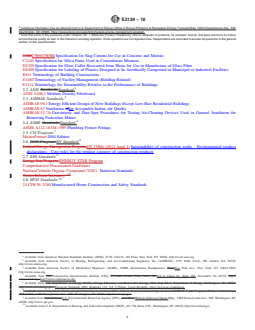
2.1 ASTM Standards:
professional service must be judged, nor should this document
C618 Specification for Coal Fly Ash and Raw or Calcined
be applied without consideration of a project’s many unique
Natural Pozzolan for Use in Concrete
aspects. The word “standard” in the title means only that the
C989/C989M Specification for Slag Cement for Use in
document has been approved through the ASTM consensus
Concrete and Mortars
process.
C1240 Specification for Silica Fume Used in Cementitious
1.2 This practice is organized according to the Construction
Mixtures
Specifications Institute’s (CSI) MasterFormat sections to pro-
D5359 Specification for Glass Cullet Recovered from Waste
mote consistency in the evaluation of building products.
for Use in Manufacture of Glass Fiber
D6400 Specification for Labeling of Plastics Designed to be
Aerobically Composted in Municipal or Industrial Facili-
This practice is under the jurisdiction of ASTM Committee E60 on Sustain-
ties
ability and is the direct responsibility of Subcommittee E60.01 on Buildings and
Construction.
Current edition approved June 1, 2018. Published June 2018. Originally
approved in 2001. Last previous edition approved in 2010 as E2129 –10. DOI: For referenced ASTM standards, visit the ASTM website, www.astm.org, or
10.1520/E2129-18. contact ASTM Customer Service at service@astm.org. For Annual Book of ASTM
The term “MasterFormat” and the MasterFormat logo are trademarks of Standards volume information, refer to the standard’s Document Summary page on
Construction Specifications Institute (CSI). the ASTM website.
Copyright © ASTM International, 100 Barr Harbor Drive, PO Box C700, West Conshohocken, PA 19428-2959. United States
E2129 − 18
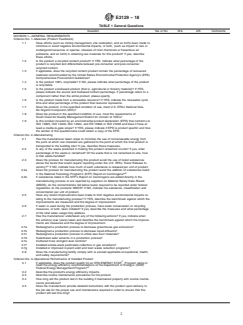
TABLE 1 General Questions
Question Yes or No N/A U/K Comments
DIVISION 1—GENERAL REQUIREMENTS
Criterion No. 1–Materials (Product Feedstock)
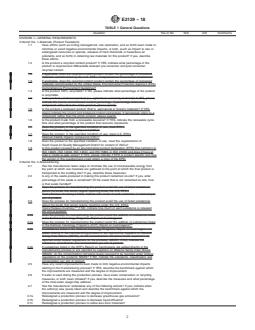
1.1 Have efforts (such as mining management, site restoration, and so forth) been made to
minimize or avoid negative environmental impacts, or both, (such as impact to rare or
endangered resources or species, releases of toxic chemicals or hazardous air
pollutants, and so forth) in obtaining raw materials for this product? If yes, describe
these efforts.
1.2 Is the product a recycled content product? If YES, indicate what percentage of the
product is recycled and differentiate between pre-consumer and post-consumer
recycled content.
1.3 If applicable, does the recycled content product contain the percentage of recovered
materials recommended by the United States Environmental Protection Agency’s (EPA)
Comprehensive Procurement Guidelines?
1.4 Is the product 100% recyclable? If NO, please indicate what percentage of the product
is recyclable.
1.5 Is the product a biobased product (that is, agricultural or forestry material)? If YES,
please indicate the source and biobased content percentage. If percentage refers to a
component rather than the entire product, please specify.
1.6 Is the product made from a renewable resource? If YES, indicate the renewable cycle
time and what percentage of the product that resource represents.
1.7 Does the product, in the specified condition of use, meet U.S. EPA’s National Vola-
tile Organic Compound (VOC)?
1.8 Does the product in the specified condition of use, meet the requirements of
South Coast Air Quality Management District for content of VOCs?
1.9 Is this product covered by an environmental product declaration (EPD) that conforms to
ISO 14025, ISO 14040, ISO 14044, and EN 15804 or ISO 21930 and does it have at
least a cradle-to-gate scope? If YES, please indicate if EPD is product specific and how
the sender of this questionnaire could obtain a copy of the EPD.
Criterion No. 2–Manufacturing
2.1 Has the manufacturer taken steps to minimize the use of nonrenewable energy from
the point at which raw materials are gathered to the point at which the final product is
transported to the building site? If yes, describe these measures.
2.2 Is any of the waste produced in making this product reclaimed on-site? If yes, what
percentage of the waste is reclaimed? Of the waste that is not reclaimed on-site, how
is that waste handled?
2.3 Does the process for manufacturing this product avoid the use of listed substances
above the levels that would require reporting under the U.S. EPA’s Toxics Release In-
A
ventory? If NO, indicate how much of each substance is released per unit of product.
2.4a Does the process for manufacturing the product avoid the addition of substances listed
B
in the National Toxicology Program’s (NTP) Report on Carcinogens?
2.4b If substances listed in the NTP’s Report on Carcinogens are added directly in the
manufacturing process or are reported by suppliers on Material Safety Data Sheets
(MSDS), do the concentrations fall below levels required to be reported under federal
regulations on the products’ MSDS? If NO, indicate the substance, classification and
concentration per unit of product.
2.5 Have any recent improvements been made to limit negative environmental impacts re-
lating to the manufacturing process? If YES, describe the benchmark against which the
improvements are measured and the degree of improvement.
2.6 If water is used during the production process, have water conservation or recycling
measures, or both, been initiated? If yes, describe the measures and what percentage
of the total water usage they address.
2.7 Has the manufacturer undertaken any of the following actions? If yes, indicate when
the action(s) was (were) taken and describe the benchmark against which the improve-
ments are measured and the degree of improvement.
2.7a Redesigned a production process to decrease greenhouse gas emissions?
2.7b Redesigned a production process to decrease liquid effluents?
2.7c Redesigned a production process to utilize less toxic materials?
2.7d Substituted safer solvents in a production process?
2.7e Instituted more stringent dust controls?
2.7f Installed smoke-stack particulate collectors or gas scrubbers?
2.7g Installed or improved in-plant solid and toxic waste reduction programs?
2.8 Does the manufacturing facility comply with or exceed applicable occupational, health,
and safety requirements?
Criterion No. 3–Operational Performance of Installed Product
C
3.1 If applicable, does the product qualify for an EPA ENERGY STAR Program rating or
meet the energy efficiency recommendations of the Department of Energy’s (DOE)
D
Federal Energy Management Program?
3.2 Describe the product’s energy efficiency impacts.
3.3 Describe routine maintenance procedures for the product.
3.4 How long will the product last in the building if maintained properly with routine mainte-
nance procedures?
3.5 Does the manufacturer provide detailed instructions with the product upon delivery to
the job site for the proper use and maintenance required in order to ensure that this
product will last this long?
E2129 − 18
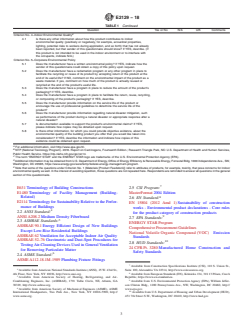
TABLE 1 Continued
Question Yes or No N/A U/K Comments
E
Criterion No. 4–Indoor Environmental Quality
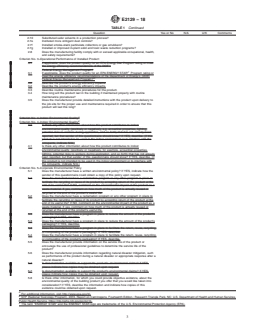
4.1 Is there any other information about how this product contributes to indoor
environmental quality (positively or negatively, for example, acoustical properties,
lighting, potential risks to workers during application, and so forth) that has not already
been reported, but that sender of this questionnaire should know? If YES, describe. (If
this product is not intended to be used in the indoor environment or to interface with
the occupants, indicate N/A.)
Criterion No. 5–Corporate Environmental Policy
5.1 Does the manufacturer have a written environmental policy? If YES, indicate how the
sender of this questionnaire could obtain a copy of this policy upon request.
5.2 Does the manufacturer have a reclamation program or any other program in place to
facilitate the recycling or reuse of its product by accepting return of the product at the
end of its useful life? If NO, comment on the environmental impact of the product as a
waste material. If yes, comment on how much of the product is actually reused or
recycled at the end of the product’s useful life.
5.3 Does the manufacturer have a program in place to reduce the amount of the product’s
packaging? If YES, describe.
5.4 Does the manufacturer have a program in place to facilitate the return, reuse, recycling,
or composting of the product’s packaging? If YES, describe.
5.5 Does the manufacturer provide information on the service life of the product or
encourage the use of professional guidelines to determine the service life of the
product?
5.6 Does the manufacturer provide information regarding natural disaster mitigation, such
as performance of the product during a natural disaster or appropriate response after a
natural disaster?
5.7 Is documentation available to support the product’s environmental claims? If YES,
please indicate how copies may be obtained upon request.
5.8 Is there other information, for which you could provide objective evidence, about the
environmental quality of the building product you offer that you would like taken into
consideration? If YES, describe the information and indicate how copies of this
evidence could be obtained upon request.
A
For additional information, visit http://www.epa.gov/tri.
B
NTP (National Toxicology Program). 2016. Report on Carcinogens, Fourteenth Edition.; Research Triangle Park, NC: U.S. Department of Health and Human Services,
Public Health Service. https://ntp.niehs.nih.gov/go/roc14.
C
The term “ENERGY STAR” and the ENERGY STAR logo are trademarks of the U.S. Environmental Protection Agency (EPA).
D
Additional information may be obtained from U.S. Department of Energy, Office of Energy Efficiency & Renewable Energy, Forrestal Bldg. 1000 Independence Ave., SW,
Washington, DC 20585, https://www.energy.gov/eere/femp/federal-energy-management-program.
E
Note that some of the questions under Criterion No. 1 (Materials [Product Feedstock]) refer to attributes of products, for example, toxicity, that pose concerns for indoor
environmental quality as well. In the interest of avoiding repetition, those questions are not repeated here. Respondents are reminded to answer all questions in the general
section of this questionnaire.
E631 Terminology of Building Constructions 2.5 CSI Program:
E1480 Terminology of Facility Management (Building- MasterFormat 2004 Edition
Related)
2.6 EN Standard:
E2114 Terminology for Sustainability Relative to the Perfor-
EN 15804 (2012 Amd 1) Sustainability of construction
mance of Buildings
works - Environmental product declarations - Core rules
2.2 ANSI Standard:
for the product category of construction products
ANSI A208.2 Medium Density Fiberboard 9
2.7 EPA Standards:
2.3 ASHRAE Standards:
ENERGY STAR Program
ASHRAE 90.1 Energy Efficient Design of New Buildings
Comprehensive Procurement Guidelines
Except Low-Rise Residential Buildings
National Volatile Organic Compound (VOC) Emission
ASHRAE 62 Ventilation for Acceptable Indoor Air Quality
Standards
ASHRAE 52–76 Gravimetric and Dust-Spot Procedures for
2.8 HUD Standards:
TestingAir-Cleaning Devices Used in General Ventilation
24 CFR Pt. 3280 Manufactured Home Construction and
for Removing Particulate Matter
Safety Standards
2.4 ASME Standard:
ASME A112.18.1M-1989 Plumbing Fixture Fittings
Available from Construction Specifications Institute (CSI), 110 S. Union St.,
Available fromAmerican National Standards Institute (ANSI), 25 W. 43rd St., Suite 100, Alexandria VA 22314, http://www.csiresources.org.
4th Floor, New York, NY 10036, http://www.ansi.org. Available from European Standards (EN), Krimicka 134, 318 13 Pilsen, Czech
Available from American Society of Heating, Refrigerating, and Air- Republic, https://www.en-standard.eu.
Conditioning Engineers, Inc. (ASHRAE), 1791 Tullie Circle, NE, Atlanta, GA Available from U.S. Environmental Protection Agency (EPA), William Jeffer-
30329, http://www.ashrae.org. son Clinton Bldg., 1200 Pennsylvania Ave., NW, Washington, DC 20460, http://
Available from American Society of Mechanical Engineers (ASME), ASME www.epa.gov.
International Headquarters, Two Park Ave., New York, NY 10016-5990, http:// Available from U.S. Department of Housing and Urban Development (HUD),
www.asme.org. 451 7th Street S.W., Washington, DC 20410, http://www.hud.gov.
E2129 − 18
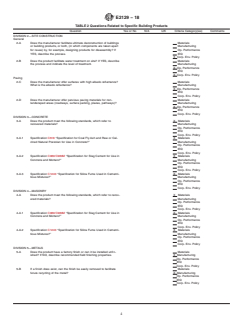
TABLE 2 Questions Related to Specific Building Products
Question Yes or No N/A U/K Criteria Category(ies) Comments
DIVISION 2—SITE CONSTRUCTION
General
2-A Does the manufacturer facilitate ultimate deconstruction of buildings Materials
or building products, or both, (in which components are taken apart Manufacturing
for reuse) by, for example, designing products for disassembly? If Op. Performance
YES, describe the process. IEQ
X Corp. Env. Policy
2-B Does the product facilitate water treatment on site? If YES, describe Materials
the process and indicate the level of treatment. Manufacturing
X Op. Performance
IEQ
X Corp. Env. Policy
Paving
2-C Does the manufacturer offer surfaces with high albedo reflectance? Materials
What is the albedo reflectance? Manufacturing
X Op. Performance
IEQ
Corp. Env. Policy
2-D Does the manufacturer offer pervious paving materials for non- Materials
landscaped areas (roadways, surface parking, plazas, pathways)? Manufacturing
X Op. Performance
IEQ
Corp. Env. Policy
DIVISION 3—CONCRETE
3-A Does the product meet the following standards, which refer to X Materials
recovered materials? Manufacturing
Op. Performance
IEQ
Corp. Env. Policy
3-A.1 Specification C618 “Specification for Coal Fly Ash and Raw or Cal- X Materials
cined Natural Pozzolan for Use in Concrete?” Manufacturing
Op. Performance
IEQ
Corp. Env. Policy
3-A.2 Specification C989/C989M “Specification for Slag Cement for Use in X Materials
Concrete and Mortars?” Manufacturing
Op. Performance
IEQ
Corp. Env. Policy
3-A.3 Specification C1240 “Specification for Silica Fume Used in Cementi- X Materials
tious Mixtures?” Manufacturing
Op. Performance
IEQ
Corp. Env. Policy
DIVISION 4—MASONRY
4-A Does the product meet the following standards, which refer to recov- X Materials
ered materials? Manufacturing
Op. Performance
IEQ
Corp. Env. Policy
4-A.1 Specification C989/C989M “Specification for Slag Cement for Use in X Materials
Concrete and Mortars?” Manufacturing
Op. Performance
IEQ
Corp. Env. Policy
4-A.2 Specification C1240 “Specification for Silica Fume Used in Cementi- X Materials
tious Mixtures?” Manufacturing
Op. Performance
IEQ
Corp. Env. Policy
DIVISION 5—METALS
5-A Does the product have a factory finish or can it be installed unfin- Materials
ished? If NO, describe recommended field finishing properties. X Manufacturing
Op. Performance
IEQ
Corp. Env. Policy
5-B If a finish does exist, can the finish be easily removed to facilitate Materials
future recycling of the metal? X Manufacturing
Op. Performance
IEQ
Corp. Env. Policy
E2129 − 18
TABLE 2 Continued
Question Yes or No N/A U/K Criteria Category(ies) Comments
DIVISION 6—WOOD AND PLASTICS
Wood
6-A Is the wood that is used in the product harvested from forests that X Materials
have been managed for sustainability according to the guidelines of Manufacturing
a recognized certification program? If YES, indicate the name of Op. Performance
regulation and describe the primary aspects of sustainability that it IEQ
promotes. Corp. Env. Policy
6-B Is the product made from a species of wood that is naturally resistant X Materials
to damage associated with the conditions to which it is exposed? If Manufacturing
YES, indicate which definition of “naturally resistant” is used to make Op. Performance
this determination and indicate the name of the species. IEQ
Corp. Env. Policy
6-C Has the wood been treated with a preservative? If YES, please Materials
indicate the preservative that was used and the standard (or X Manufacturing
standards) to which the wood was treated. Op. Performance
XIEQ
Corp. Env. Policy
6-D Is the agricultural resource from which this product is made certified X Materials
organically grown according to the standards of a recognized Manufacturing
certification program? If YES, indicate the name of the certification Op. Performance
program. IEQ
Corp. Env. Policy
6-E Is the medium density fiberboard (MDF), or products made Materials
containing MDF, third party certified to comply with the formaldehyde X Manufacturing
emissions requirements in ANSI A208.2? Op. Performance
XIEQ
Corp. Env. Policy
6-F Does the binder for plywood or particleboard, or both, meet the Materials
Manufactured Home Construction and Safety Standards promulgated X Manufacturing
by HUD 24 CFR Pt. 3280) for formaldehyde emissions? Op. Performance
XIEQ
Corp. Env. Policy
Plastics and Plastic Composites
6-G Are plastics marked to identify materials for recycling? X Materials
Manufacturing
Op. Performance
IEQ
Corp. Env. Policy
6-H Does the building product (or components of the product) meet the X Materials
requirements of Specification D6400 “Specification for Labeling of Manufacturing
Plastics Designed to be Aerobically Composted in Municipal or In- Op. Performance
dustrial Facilities?” IEQ
Corp. Env. Policy
DIVISION 7—THERMAL AND MOISTURE PROTECTION
Roofing
7-A Is the roofing material a light color/high albedo material? If YES, Materials
what is the albedo reflectance? Manufacturing
X Op. Performance
IEQ
Corp. Env. Policy
Sealants and Caulking
7-B Do caulking and sealant products come with detailed instructions for Materials
proper application in order to minimize health concerns? If YES, indi- Manufacturing
cate how the sender of this questionnaire could obtain a copy of the Op. Performance
instructions. XIEQ
Corp. Env. Policy
7-C Is the sealant or caulking compound a low-odor, all-weather, Materials
waterproof, and vapor-proof coating? Manufacturing
X Op. Performance
XIEQ
Corp. Env. Policy
Insulation
7-D Does the fiberglass insulation product meet the requirements estab- X Materials
lished in Specification D5359 “Specification for Glass Cullet Recov- Manufacturing
ered from Waste for Use in Manufacture of Glass Fiber?” Op. Performance
IEQ
Corp. Env. Policy
7-E In which R-Values is the insulation product available? Materials
Manufacturing
X Op. Performance
IEQ
Corp. Env. Policy
E2129 − 18
TABLE 2 Continued
Question Yes or No N/A U/K Criteria Category(ies) Comments
DIVISION 8—DOORS AND WINDOWS
8-A Is the energy efficiency of the windows, doors, or skylights Materials
determined in accordance with NFRC 100 (U Factor) and NFRC 200 Manufacturing
(SHGC) by an accredited independent laboratory and labeled and X Op. Performance
certified by the manufacturer? IEQ
Corp. Env.
...
This document is not an ASTM standard and is intended only to provide the user of an ASTM standard an indication of what changes have been made to the previous version. Because
it may not be technically possible to adequately depict all changes accurately, ASTM recommends that users consult prior editions as appropriate. In all cases only the current version
of the standard as published by ASTM is to be considered the official document.
Designation: E2129 − 10 E2129 − 18
Standard Practice for
Data Collection for Sustainability Assessment of Building
Products
This standard is issued under the fixed designation E2129; the number immediately following the designation indicates the year of
original adoption or, in the case of revision, the year of last revision. A number in parentheses indicates the year of last reapproval. A
superscript epsilon (´) indicates an editorial change since the last revision or reapproval.
1. Scope
1.1 This practice covers a set of instructions for collecting data to be used in assessing the sustainability of building products
for use in both commercial and residential buildings.
1.1.1 There are many features of a building that contribute to sustainability; one of them is the selection of products for use in
a building. Other key features influencing sustainability include, but are not limited to: overall efficiency of the design of the
building, the impact the building has on the habits of the occupants, and the impact the building has on the microclimate and
macroclimate. This standardpractice addresses sustainability issues related to building products. This standardpractice does not
address sustainability issues related to overall building design, site selection, building operations, or other features influencing
sustainability.
1.1.2 While it is recommended that users rely on professional judgment informed by both environmental expertise and specific
knowledge of the intended use of the product, this standardpractice provides no instruction as to interpretation of the data obtained.
Interpretation of the data obtained is the responsibility of the user of this standard.practice.
1.1.3 This document cannot replace education or experience and should be used in conjunction with professional judgment. Not
all aspects of this practice may be applicable in all circumstances. This practice is not intended to represent or replace the standard
of care by which the adequacy of a given professional service must be judged, nor should this document be applied without
consideration of a project’sproject’s many unique aspects. The word “standard” in the title means only that the document has been
approved through the ASTM consensus process.
1.2 This standardpractice is organized according to the Construction Specifications Institute’sInstitute’s (CSI) MasterFormat
sections to promote consistency in the evaluation of building products.
1.2.1 CSI MasterFormat version 1995 is used to organize information in Table 2. Appendix X1 provides a cross reference
comparison to CSI MasterFormat 2004.
1.3 This standardpractice includes general, comprehensive data requirements. Depending upon the building product, certain
data requirements may not apply given the unique characteristics of the product and the potential environmental impacts related
to the intended use of the product. Depending upon the building product, certain data requirements may need to be added as
appropriate to the unique characteristics of the product and the potential environmental impacts related to the intended use of the
product.
1.4 This standard does not purport to address all of the safety concerns, if any, associated with its use. It is the responsibility
of the user of this standard to establish appropriate safety safety, health, and healthenvironmental practices and determine the
applicability of regulatory limitations prior to use.
1.5 This international standard was developed in accordance with internationally recognized principles on standardization
established in the Decision on Principles for the Development of International Standards, Guides and Recommendations issued
by the World Trade Organization Technical Barriers to Trade (TBT) Committee.
2. Referenced Documents
2.1 ASTM Standards:
C618 Specification for Coal Fly Ash and Raw or Calcined Natural Pozzolan for Use in Concrete
This practice is under the jurisdiction of ASTM Committee E60 on Sustainability and is the direct responsibility of Subcommittee E60.01 on Buildings and Construction.
Current edition approved Oct. 1, 2010June 1, 2018. Published November 2010June 2018. Originally approved in 2001. Last previous edition approved in 20052010 as
E2129 – 05.E2129 –10. DOI: 10.1520/E2129-10.10.1520/E2129-18.
The term “MasterFormat” and the MasterFormat logo are trademarks of The Construction Specifications Institute (CSI), 99 Canal Center Plaza, Suite 300, Alexandria
VA 22314, http://www.csinet.org. (CSI).
For referenced ASTM standards, visit the ASTM website, www.astm.org, or contact ASTM Customer Service at service@astm.org. For Annual Book of ASTM Standards
volume information, refer to the standard’sstandard’s Document Summary page on the ASTM website.
Copyright © ASTM International, 100 Barr Harbor Drive, PO Box C700, West Conshohocken, PA 19428-2959. United States
E2129 − 18
TABLE 1 General Questions
Question Yes or No N/A U/K Comments
DIVISION 1—GENERAL REQUIREMENTS
Criterion No. 1–Materials (Product Feedstock)
1.1 Have efforts (such as mining management, site restoration, and so forth) been made to
minimize or avoid negative environmental impacts, or both, (such as impact to rare or
endangered resources or species, releases of toxic chemicals or hazardous air
pollutants, and so forth) in obtaining raw materials for this product? If yes, describe
these efforts.
1.2 Is the product a recycled content product? If YES, indicate what percentage of the
product is recycled and differentiate between pre-consumer and post-consumer
recycled content.
1.3 If applicable, does the recycled content product contain the percentage of recovered
materials recommended by the U.S. EPA’s Comprehensive Procurement Guidelines?
1.3 If applicable, does the recycled content product contain the percentage of recovered
materials recommended by the United States Environmental Protection Agency’s (EPA)
Comprehensive Procurement Guidelines?
1.4 Is the product 100% recyclable? If NO, please indicate what percentage of the product
is recyclable.
1.5 Is the product a biobased product (i.e. agricultural or forestry material)? If YES, please
indicate the source and biobased content percentage. If percentage refers to a
component rather than the entire product, please specify.
1.5 Is the product a biobased product (that is, agricultural or forestry material)? If YES,
please indicate the source and biobased content percentage. If percentage refers to a
component rather than the entire product, please specify.
1.6 Is the product made from a renewable resource? If YES, indicate the renewable cycle
time and what percentage of the product that resource represents.
1.7 Does the product, in the specified condition of use, meet EPA’s
National Volatile Organic Compound (VOC)?
1.7 Does the product, in the specified condition of use, meet U.S. EPA’s
National Volatile Organic Compound (VOC)?
1.8 Does the product in the specified condition of use, meet the requirements of
South Coast Air Quality Management District for content of VOCs?
1.9 Is this product covered by an environmental product declaration (EPD) that conforms to
ISO 14025, ISO 14040, ISO 14044, and EN 15804 or ISO 21930 and does it have at
least a cradle-to-gate scope? If YES, please indicate if EPD is product specific and how
the sender of this questionnaire could obtain a copy of the EPD.
Criterion No. 2–Manufacturing
2.1 Has the manufacturer taken steps to minimize the use of nonrenewable energy from
the point at which raw materials are gathered to the point at which the final product is
transported to the building site? If yes, describe these measures.
2.2 Is any of the waste produced in making this product reclaimed on-site? If yes, what
percentage of the waste is reclaimed? Of the waste that is not reclaimed on-site, how
is that waste handled?
2.3 Does the process for manufacturing this product avoid the use of listed substances
above the levels that would require reporting under the U.S. EPA’s
Toxics Release Inventory? If NO, indicate how much of each substance is released per
unit of product.
2.3 Does the process for manufacturing this product avoid the use of listed substances
above the levels that would require reporting under the U.S. EPA’s
A
Toxics Release Inventory? If NO, indicate how much of each substance is released
per unit of product.
2.4a Does the process for manufacturing the product avoid the addition of substances listed
in the National Toxicology Program’s Report on Carcinogens?
2.4a Does the process for manufacturing the product avoid the addition of substances listed
B
in the National Toxicology Program’s (NTP) Report on Carcinogens?
2.4b If substances listed in the National Toxicology Program’s Report on Carcinogens are
added directly in the manufacturing process or are reported by suppliers on Material
Safety Data Sheets (MSDS), do the concentrations fall below levels required to be
reported under federal regulations on the products’ MSDS? If NO, indicate the
substance, classification and concentration per unit of product.
2.4b If substances listed in the NTP’s Report on Carcinogens are added directly in the
manufacturing process or are reported by suppliers on Material Safety Data Sheets
(MSDS), do the concentrations fall below levels required to be reported under federal
regulations on the products’ MSDS? If NO, indicate the substance, classification and
concentration per unit of product.
2.5 Have any recent improvements been made to limit negative environmental impacts
relating to the manufacturing process? If YES, describe the benchmark against which
the improvements are measured and the degree of improvement.
2.6 If water is used during the production process, have water conservation or recycling
measures, or both, been initiated? If yes, describe the measures and what percentage
of the total water usage they address.
2.7 Has the manufacturer undertaken any of the following actions? If yes, indicate when
the action(s) was (were) taken and describe the benchmark against which the
improvements are measured and the degree of improvement.
2.7a Redesigned a production process to decrease greenhouse gas emissions?
2.7b Redesigned a production process to decrease liquid effluents?
2.7c Redesigned a production process to utilize less toxic materials?
E2129 − 18
TABLE 1 Continued
Question Yes or No N/A U/K Comments
2.7d Substituted safer solvents in a production process?
2.7e Instituted more stringent dust controls?
2.7f Installed smoke-stack particulate collectors or gas scrubbers?
2.7g Installed or improved in-plant solid and toxic waste reduction programs?
2.8 Does the manufacturing facility comply with or exceed applicable occupational, health,
and safety requirements?
Criterion No. 3–Operational Performance of Installed Product
3.1 If applicable, does the product qualify for an EPA Energy Star Program rating or meet
the energy efficiency recommendations of the DOE’s
Federal Energy Management Program?
C
3.1 If applicable, does the product qualify for an EPA ENERGY STAR Program rating or
meet the energy efficiency recommendations of the Department of Energy’s (DOE)
D
Federal Energy Management Program?
3.2 Describe the product’s energy efficiency impacts.
3.2 Describe the product’s energy efficiency impacts.
3.3 Describe routine maintenance procedures for the product.
3.4 How long will the product last in the building if maintained properly with routine
maintenance procedures?
3.5 Does the manufacturer provide detailed instructions with the product upon delivery to
the job site for the proper use and maintenance required in order to ensure that this
product will last this long?
A
Criterion No. 4–Indoor Environmental Quality
E
Criterion No. 4–Indoor Environmental Quality
4.1 Is there any other information about how this product contributes to indoor
environmental quality (positively or negatively, e.g. acoustical properties, lighting,
potential risks to workers during application, and so forth) that has not already been
reported, but that sender of this questionnaire should know? If YES, describe. (If this
product is not intended to be used in the indoor environment or to interface with the
occupants, indicate N/A.)
4.1 Is there any other information about how this product contributes to indoor
environmental quality (positively or negatively, for example, acoustical properties,
lighting, potential risks to workers during application, and so forth) that has not already
been reported, but that sender of this questionnaire should know? If YES, describe. (If
this product is not intended to be used in the indoor environment or to interface with
the occupants, indicate N/A.)
Criterion No. 5–Corporate Environmental Policy
5.1 Does the manufacturer have a written environmental policy? If YES, indicate how the
sender of this questionnaire could obtain a copy of this policy upon request.
5.2 Does the manufacturer have a reclamation program or any other program in place to
facilitate the recycling or reuse of its product by accepting return of the product at the
end of its useful life? If NO, comment on the environmental impact of the product as a
waste material. If yes, comment on how much of the product is actually reused or
recycled at the end of the product’s useful life.
5.2 Does the manufacturer have a reclamation program or any other program in place to
facilitate the recycling or reuse of its product by accepting return of the product at the
end of its useful life? If NO, comment on the environmental impact of the product as a
waste material. If yes, comment on how much of the product is actually reused or
recycled at the end of the product’s useful life.
5.3 Does the manufacturer have a program in place to reduce the amount of the product’s
packaging? If YES, describe.
5.3 Does the manufacturer have a program in place to reduce the amount of the product’s
packaging? If YES, describe.
5.4 Does the manufacturer have a program in place to facilitate the return, reuse, recycling,
or composting of the product’s packaging? If YES, describe.
5.4 Does the manufacturer have a program in place to facilitate the return, reuse, recycling,
or composting of the product’s packaging? If YES, describe.
5.5 Does the manufacturer provide information on the service life of the product or
encourage the use of professional guidelines to determine the service life of the
product?
5.6 Does the manufacturer provide information regarding natural disaster mitigation, such
as performance of the product during a natural disaster or appropriate response after a
natural disaster?
5.7 Is documentation available to support the product’s environmental claims? If YES,
please indicate how copies may be obtained upon request.
5.7 Is documentation available to support the product’s environmental claims? If YES,
please indicate how copies may be obtained upon request.
5.8 Is there other information, for which you could provide objective evidence, about the
environmental quality of the building product you offer that you would like taken into
consideration? If YES, describe the information and indicate how copies of this
evidence could be obtained upon request.
A
For additional information, visit http://www.epa.gov/tri.
B
NTP (National Toxicology Program). 2016. Report on Carcinogens, Fourteenth Edition.; Research Triangle Park, NC: U.S. Department of Health and Human Services,
Public Health Service. https://ntp.niehs.nih.gov/go/roc14.
C
The term “ENERGY STAR” and the ENERGY STAR logo are trademarks of the U.S. Environmental Protection Agency (EPA).
E2129 − 18
D
Additional information may be obtained from U.S. Department of Energy, Office of Energy Efficiency & Renewable Energy, Forrestal Bldg. 1000 Independence Ave., SW,
Washington, DC 20585, https://www.energy.gov/eere/femp/federal-energy-management-program.
E
Note that some of the questions under Criterion No. 1 (Materials [Product Feedstock]) refer to attributes of products, for example, toxicity, that pose concerns for indoor
environmental quality as well. In the interest of avoiding repetition, those questions are not repeated here. Respondents are reminded to answer all questions in the general
section of this questionnaire.
C989C989/C989M Specification for Slag Cement for Use in Concrete and Mortars
C1240 Specification for Silica Fume Used in Cementitious Mixtures
D5359 Specification for Glass Cullet Recovered from Waste for Use in Manufacture of Glass Fiber
D6400 Specification for Labeling of Plastics Designed to be Aerobically Composted in Municipal or Industrial Facilities
E631 Terminology of Building Constructions
E1480 Terminology of Facility Management (Building-Related)
E2114 Terminology for Sustainability Relative to the Performance of Buildings
2.2 ANSI Standards:Standard:
ANSI A208.2 Medium Density Fiberboard
2.3 ASHRAE Standards:
ASHRAE 90.1 Energy Efficient Design of New Buildings Except Low-Rise Residential Buildings
ASHRAE 62 Ventilation offor Acceptable Indoor Air Quality
ASHRAE 52–76 Gravimetric and Dust-Spot Procedures for Testing Air-Cleaning Devices Used in General Ventilation for
Removing Particulate Matter
2.4 ASME Standards:Standard:
ASME A112.18.1M-1989 Plumbing Fixture Fittings
2.5 CSI Program:
MasterFormat 2004 Edition
2.6 DOE Program:EN Standard:
Federal Energy Management ProgramEN 15804 (2012 Amd 1) Sustainability of construction works - Environmental product
declarations - Core rules for the product category of construction products
2.7 EPA Standards:
Energy Star Program ENERGY STAR Program
Comprehensive Procurement Guidelines
National Volatile Organic Compound (VOC) Emission Standards
Toxics Release Inventory
2.8 HUD Standards:
24 CFR Pt. 3280 Manufactured Home Construction and Safety Standards
Available from American National Standards Institute (ANSI), 25 W. 43rd St., 4th Floor, New York, NY 10036, http://www.ansi.org.
Available from American Society of Heating, Refrigerating, and Air-Conditioning Engineers, Inc. (ASHRAE), 1791 Tullie Circle, NE, Atlanta, GA 30329,
http://www.ashrae.org.
Available from American Society of Mechanical Engineers (ASME), ASME International Headquarters, ThreeTwo Park Ave., New York, NY 10016-5990,
http://www.asme.org.
Available from The Construction Specifications Institute (CSI), 99 Canal Center Plaza, Suite 300,110 S. Union St., Suite 100, Alexandria VA 22314, http://
www.csinet.org. http://www.csiresources.org.
Available from U.S. Department of Energy (DOE), Energy Efficiency and Renewable Energy, Mail Stop EE-1, Department of Energy, Washington, DC 20585,
http://www.eere.energy.gov. European Standards (EN), Krimicka 134, 318 13 Pilsen, Czech Republic, https://www.en-standard.eu.
Available from United States Environmental Protection Association (EPA), Climate Protection Partnerships Division ENERGY STAR Programs Hotline & Distribution
(MS-6202J), 1200 Pennsylvania Ave., NW, Washington, DC 20460, http://www.epa.gov.
Available from United States U.S. Environmental Protection Agency (EPA), Ariel Rios William Jefferson Clinton Bldg., 1200 Pennsylvania Ave., NW, Washington, DC
20460, http://www.epa.gov.
Available from U.S. Department of Housing and Urban Development (HUD), 451 7th Street S.W., Washington, DC 20410, http://www.hud.gov.
E2129 − 18
TABLE 2 Questions Related to Specific Building Products
Question Yes or No N/A U/K Criteria Category(ies) Comments
DIVISION 2—SITE CONSTRUCTION
General
2-A Does the manufacturer facilitate ultimate deconstruction of buildings Materials
or building products, or both, (in which components are taken apart Manufacturing
for reuse) by, for example, designing products for disassembly? If Op. Performance
YES, describe the process. IEQ
X Corp. Env. Policy
2-B Does the product facilitate water treatment on site? If YES, describe Materials
the process and indicate the level of treatment. Manufacturing
X Op. Performance
IEQ
X Corp. Env. Policy
Paving
2-C Does the manufacturer offer surfaces with high albedo reflectance? Materials
What is the albedo reflectance? Manufacturing
X Op. Performance
IEQ
Corp. Env. Policy
2-D Does the manufacturer offer pervious paving materials for non- Materials
landscaped areas (roadways, surface parking, plazas, pathways)? Manufacturing
X Op. Performance
IEQ
Corp. Env. Policy
DIVISION 3—CONCRETE
3-A Does the product meet the following standards, which refer to X Materials
recovered materials? Manufacturing
Op. Performance
IEQ
Corp. Env. Policy
3-A.1 Specification C618 “Specification for Coal Fly Ash and Raw or Cal- X Materials
cined Natural Pozzolan for Use as a Mineral Admixture in Portland Manufacturing
Cement Concrete?” Op. Performance
IEQ
Corp. Env. Policy
3-A.1 Specification C618 “Specification for Coal Fly Ash and Raw or Cal- X Materials
cined Natural Pozzolan for Use in Concrete?” Manufacturing
Op. Performance
IEQ
Corp. Env. Policy
3-A.2 Specification C989 “Specification for Ground Granulated Blast Fur- X Materials
nace Slag for use in Concrete and Mortars?” Manufacturing
Op. Performance
IEQ
Corp. Env. Policy
3-A.2 Specification C989/C989M “Specification for Slag Cement for Use in X Materials
Concrete and Mortars?” Manufacturing
Op. Performance
IEQ
Corp. Env. Policy
3-A.3 Specification C1240 “Specification for Silica Fume for Use in Hydrau- X Materials
lic Cement, Concrete, and Mortar?” Manufacturing
Op. Performance
IEQ
Corp. Env. Policy
3-A.3 Specification C1240 “Specification for Silica Fume Used in Cementi- X Materials
tious Mixtures?” Manufacturing
Op. Performance
IEQ
Corp. Env. Policy
DIVISION 4—MASONRY
4-A Does the product meet the following standards, which refer to recov- X Materials
ered materials? Manufacturing
Op. Performance
IEQ
Corp. Env. Policy
4-A.1 Specification C989 “Specification for Ground Granulated Blast Fur- X Materials
nace Slag for use in Concrete and Mortars?” Manufacturing
Op. Performance
IEQ
Corp. Env. Policy
4-A.1 Specification C989/C989M “Specification for Slag Cement for Use in X Materials
Concrete and Mortars?” Manufacturing
Op. Performance
IEQ
Corp. Env. Policy
E2129 − 18
TABLE 2 Continued
Question Yes or No N/A U/K Criteria Category(ies) Comments
4-A.2 Specification C1240 “Specification for Silica Fume for Use in Hydrau- X Materials
lic Cement, Concrete, and Mortar?” Manufacturing
Op. Performance
IEQ
Corp. Env. Policy
4-A.2 Specification C1240 “Specification for Silica Fume Used in Cementi- X Materials
tious Mixtures?” Manufacturing
Op. Performance
IEQ
Corp. Env. Policy
DIVISION 5—METALS
5-A Does the product have a factory finish or can it be installed unfin- Materials
ished? If NO, describe recommended field finishing properties. X Manufacturing
Op. Performance
IEQ
Corp. Env. Policy
5-B If a finish does exist, can the finish be easily removed to facilitate Materials
future recycling of the metal? X Manufacturing
Op. Performance
IEQ
Corp. Env. Policy
DIVISION 6—WOOD AND PLASTICS
Wood
6-A Is the wood that is used in the product harvested from forests that X Materials
have been managed for sustainability according to the guidelines of Manufacturing
a recognized certification program? If YES, indicate the name of Op. Performance
regulation and describe the primary aspects of sustainability that it IEQ
promotes. Corp. Env. Policy
6-B Is the product made from a species of wood that is naturally resistant X Materials
to damage associated with the conditions to which it is exposed? If Manufacturing
YES, indicate which definition of “naturally resistant” is used to make Op. Performance
this determination and indicate the name of the species. IEQ
Corp. Env. Policy
6-C Has the wood been treated with a preservative? If YES, please indi- Materials
cate the preservative that was used and the standard (or standards) X Manufacturing
to which the wood was treated. Op. Performance
X IEQ
Corp. Env. Policy
6-D Is the agricultural resource from which this product is made certified X Materials
organically grown according to the standards of a recognized certifi- Manufacturing
cation program? If YES, indicate the name of the certification pro- Op. Performance
gram. IEQ
Corp. Env. Policy
6-E Is the medium density fiberboard (MDF), or products made contain- Materials
ing MDF, third party certified to comply with the formaldehyde emis- X Manufacturing
sions requirements in ANSI A208.2? Op. Performance
X IEQ
Corp. Env. Policy
6-F Does the binder for plywood or particleboard, or both, meet the Materials
Manufactured Home Construction and Safety Standards promulgated X Manufacturing
by HUD 24 CFR Pt. 3280) for formaldehyde emissions? Op. Performance
X IEQ
Corp. Env. Policy
Plastics and Plastic Composites
6-G Are plastics marked to identify materials for recycling? X Materials
Manufacturing
Op. Performance
IEQ
Corp. Env. Policy
6-H Does the building product (or components of the product) meet the X Materials
requirements of Specification D6400 “Standard Specification for Manufacturing
Compostable Plastics?” Op. Performance
IEQ
Corp. Env. Policy
6-H Does the building product (or components of the product) meet the X Materials
requirements of Specification D6400 “Specification for Labeling of Manufacturing
Plastics Designed to be Aerobically Composted in Municipal or In- Op. Performance
dustrial Facilities?” IEQ
Corp. Env. Policy
DIVISION 7—THERMAL AND MOISTURE PROTECTION
Roofing
E2129 − 18
TABLE 2 Continued
Question Yes or No N/A U/K Criteria Category(ies) Comments
7-A Is the roofing material a light color/high albedo material? If YES, Materials
what is the albedo reflectance? Manufacturing
X Op. Performance
IEQ
Corp. Env. Policy
Sealants and Caulking
7-B Do caulking and sealant products come with detailed instructions for Materials
proper application in order to minimize health concerns? If YES, Manufacturing
indicate how the sender of this questionnaire could obtain a copy of Op. Performance
the instructions. X IEQ
Corp. Env. Policy
7-C Is the sealant or caulking compound a low-odor, all-weather, Materials
waterproof, and vapor-proof coating? Manufacturing
X Op. Performance
X IEQ
Corp. Env. Policy
Insulation
7-D Does the fiberglass insulation product meet the requirements X Materials
established in Specification D5359 “Specification f
...