

ASTM E2013-20
(Practice)Standard Practice for Developing Functions, Constructing FAST Diagrams, and Performing Function Analysis During Value Engineering (VE)/Value Analysis (VA) Study
General Information
- Abstract
SIGNIFICANCE AND USE
5.1 As part of the VE/VA study, perform function analysis after the collection of relevant information and prior to the identification of alternatives.
5.2 This practice provides a specific understanding of what must be accomplished and provides the basis for stimulating the creative phase of the value methodology. This is accomplished by naming and analyzing the functions and using the functions of the VE/VA study to generate ideas and alternative solutions.
5.3 This practice establishes a communication format through which all stakeholders can understand the project, product, or process.
5.4 This practice presents a method by which stakeholders’ needs and desires are compared to the cost to satisfy those needs and desires.
5.4.1 Function cost data help the user identify the alternatives and their functions that are highly valued with respect to their cost, thereby targeting opportunities for increasing value.
5.4.2 Targeting is done by identifying the low preference/high cost functions and high preference/low cost functions. These data will be used in the VE/VA study as a basis to create alternative solutions.
5.5 This practice helps stakeholders to formulate a strategy to maximize values.
5.6 Functions are also used to define criteria to compare alternatives.
SCOPE
1.1 This practice covers a logical structure for the function analysis of a project, product, or process.
1.2 This practice provides a system to identify, define, and clearly communicate the purpose of a project, product, or process and the associated elements of the project, product, or process.
1.3 This practice covers the relationship between the functions that must be satisfied and the resources for a project, product, or process to accomplish those functions.
1.4 The values stated in SI units are to be regarded as standard. The values given in parentheses after SI units are provided for information only and are not considered standard.
1.5 This standard does not purport to address all of the safety concerns, if any, associated with its use. It is the responsibility of the user of this standard to establish appropriate safety, health, and environmental practices and determine the applicability of regulatory limitations prior to use.
1.6 This international standard was developed in accordance with internationally recognized principles on standardization established in the Decision on Principles for the Development of International Standards, Guides and Recommendations issued by the World Trade Organization Technical Barriers to Trade (TBT) Committee.
- Status
- Published
- Publication Date
- 30-Nov-2020
- Technical Committee
- E06 - Performance of Buildings
- Drafting Committee
- E06.81 - Building Economics
Buy Documents
ASTM E2013-20 - Standard Practice for Developing Functions, Constructing FAST Diagrams, and Performing Function Analysis During Value Engineering (VE)/Value Analysis (VA) Study
REDLINE ASTM E2013-20 - Standard Practice for Developing Functions, Constructing FAST Diagrams, and Performing Function Analysis During Value Engineering (VE)/Value Analysis (VA) Study
Overview
ASTM E2013-20 is the recognized standard for function analysis in Value Engineering (VE) and Value Analysis (VA) studies. Developed by ASTM International, this standard sets out a logical, structured process for identifying, defining, and analyzing the functions of projects, products, or processes. The goal is to maximize value by aligning stakeholder needs with resource allocations, using tools such as FAST (Function Analysis Systems Technique) diagrams. This practice is crucial for eliminating unnecessary costs while ensuring all essential requirements are met, making it valuable across industries engaged in project management, product development, and process improvement.
Key Topics
- Function Analysis: The standard details a step-by-step methodology to identify and classify the functions that must be satisfied by a project, product, or process. This includes defining both basic (essential) and secondary (supporting) functions.
- FAST Diagrams: Function Analysis Systems Technique (FAST) is highlighted as a principal tool. FAST diagrams use "How-Why" logic to visually map the relationships among functions, facilitating communication and collaboration.
- Stakeholder Communication: ASTM E2013-20 provides a structured format to ensure that all stakeholders-such as developers, owners, users, planners, architects, engineers, and cost professionals-have a clear understanding of the purpose, objectives, and requirements of the project.
- Function Cost and Value Assessment: The standard guides the allocation of costs to functions, helping to identify high-cost/low-preference and low-cost/high-preference functions. This analysis targets opportunities to improve value and optimize resource distribution.
- Creative Phase Support: By thoroughly defining and analyzing functions before generating alternatives, the standard stimulates innovation during the creative problem-solving phase of value methodologies.
Applications
ASTM E2013-20 has broad applicability wherever cost effectiveness and value are priorities. Key practical uses include:
- Construction and Building Projects: Used to analyze and optimize building components, systems, and workflows for better performance and reduced costs.
- Product Development: Helps design teams identify required features and eliminate unnecessary expenditures, leading to cost-efficient, value-rich products.
- Process Improvement: Supports process owners in mapping functions and costs to enhance efficiency, performance, and stakeholder satisfaction.
- Stakeholder Engagement: Ensures transparent communication, allowing all parties to contribute to function definition, value analysis, and decision-making.
- Resource Optimization: Utilized during project planning to compare stakeholder needs and function costs, guiding investments to where they deliver the highest value.
Related Standards
Several ASTM standards relate closely to the methodology outlined in ASTM E2013-20, providing complimentary terminology, classification structures, and value engineering procedures:
- ASTM E1699 - Practice for Performing Value Engineering (VE)/Value Analysis (VA) of Projects, Products and Processes
- ASTM E631 - Terminology of Building Constructions
- ASTM E833 - Terminology of Building Economics
- ASTM E1557 - Classification for Building Elements and Related Sitework-UNIFORMAT II
- ASTM E2103/E2103M - Classification for Bridge Elements-UNIFORMAT II
These standards together provide a robust framework for functional analysis, value engineering, and project optimization across sectors.
By following ASTM E2013-20, organizations can systematically enhance value, improve stakeholder communication, and ensure that all investments align with well-defined requirements and objectives. Leveraging function analysis and FAST diagrams enables interdisciplinary teams to drive effective cost management and maximize project, product, or process value.
Relations
- Effective Date
- 01-Apr-2020
- Effective Date
- 01-Jul-2019
- Effective Date
- 01-Oct-2015
- Effective Date
- 01-Mar-2015
- Effective Date
- 01-Nov-2014
- Effective Date
- 01-Nov-2013
- Effective Date
- 01-Nov-2013
- Effective Date
- 15-Oct-2013
- Effective Date
- 01-Oct-2013
- Effective Date
- 01-May-2013
- Effective Date
- 01-May-2012
- Effective Date
- 01-Apr-2010
- Effective Date
- 01-Nov-2009
- Refers
ASTM E1557-09 - Standard Classification for Building Elements and Related Sitework-UNIFORMAT II - Effective Date
- 01-Jun-2009
- Effective Date
- 01-May-2009
Buy Documents
ASTM E2013-20 - Standard Practice for Developing Functions, Constructing FAST Diagrams, and Performing Function Analysis During Value Engineering (VE)/Value Analysis (VA) Study
REDLINE ASTM E2013-20 - Standard Practice for Developing Functions, Constructing FAST Diagrams, and Performing Function Analysis During Value Engineering (VE)/Value Analysis (VA) Study
Get Certified
Connect with accredited certification bodies for this standard

DIBt (Deutsches Institut für Bautechnik)
German Institute for Building Technology.
DIN CERTCO
DIN Group product certification.

Aboma Certification B.V.
Specialized in construction, metal, and transport sectors.
Sponsored listings
Frequently Asked Questions
ASTM E2013-20 is a standard published by ASTM International. Its full title is "Standard Practice for Developing Functions, Constructing FAST Diagrams, and Performing Function Analysis During Value Engineering (VE)/Value Analysis (VA) Study". This standard covers: SIGNIFICANCE AND USE 5.1 As part of the VE/VA study, perform function analysis after the collection of relevant information and prior to the identification of alternatives. 5.2 This practice provides a specific understanding of what must be accomplished and provides the basis for stimulating the creative phase of the value methodology. This is accomplished by naming and analyzing the functions and using the functions of the VE/VA study to generate ideas and alternative solutions. 5.3 This practice establishes a communication format through which all stakeholders can understand the project, product, or process. 5.4 This practice presents a method by which stakeholders’ needs and desires are compared to the cost to satisfy those needs and desires. 5.4.1 Function cost data help the user identify the alternatives and their functions that are highly valued with respect to their cost, thereby targeting opportunities for increasing value. 5.4.2 Targeting is done by identifying the low preference/high cost functions and high preference/low cost functions. These data will be used in the VE/VA study as a basis to create alternative solutions. 5.5 This practice helps stakeholders to formulate a strategy to maximize values. 5.6 Functions are also used to define criteria to compare alternatives. SCOPE 1.1 This practice covers a logical structure for the function analysis of a project, product, or process. 1.2 This practice provides a system to identify, define, and clearly communicate the purpose of a project, product, or process and the associated elements of the project, product, or process. 1.3 This practice covers the relationship between the functions that must be satisfied and the resources for a project, product, or process to accomplish those functions. 1.4 The values stated in SI units are to be regarded as standard. The values given in parentheses after SI units are provided for information only and are not considered standard. 1.5 This standard does not purport to address all of the safety concerns, if any, associated with its use. It is the responsibility of the user of this standard to establish appropriate safety, health, and environmental practices and determine the applicability of regulatory limitations prior to use. 1.6 This international standard was developed in accordance with internationally recognized principles on standardization established in the Decision on Principles for the Development of International Standards, Guides and Recommendations issued by the World Trade Organization Technical Barriers to Trade (TBT) Committee.
SIGNIFICANCE AND USE 5.1 As part of the VE/VA study, perform function analysis after the collection of relevant information and prior to the identification of alternatives. 5.2 This practice provides a specific understanding of what must be accomplished and provides the basis for stimulating the creative phase of the value methodology. This is accomplished by naming and analyzing the functions and using the functions of the VE/VA study to generate ideas and alternative solutions. 5.3 This practice establishes a communication format through which all stakeholders can understand the project, product, or process. 5.4 This practice presents a method by which stakeholders’ needs and desires are compared to the cost to satisfy those needs and desires. 5.4.1 Function cost data help the user identify the alternatives and their functions that are highly valued with respect to their cost, thereby targeting opportunities for increasing value. 5.4.2 Targeting is done by identifying the low preference/high cost functions and high preference/low cost functions. These data will be used in the VE/VA study as a basis to create alternative solutions. 5.5 This practice helps stakeholders to formulate a strategy to maximize values. 5.6 Functions are also used to define criteria to compare alternatives. SCOPE 1.1 This practice covers a logical structure for the function analysis of a project, product, or process. 1.2 This practice provides a system to identify, define, and clearly communicate the purpose of a project, product, or process and the associated elements of the project, product, or process. 1.3 This practice covers the relationship between the functions that must be satisfied and the resources for a project, product, or process to accomplish those functions. 1.4 The values stated in SI units are to be regarded as standard. The values given in parentheses after SI units are provided for information only and are not considered standard. 1.5 This standard does not purport to address all of the safety concerns, if any, associated with its use. It is the responsibility of the user of this standard to establish appropriate safety, health, and environmental practices and determine the applicability of regulatory limitations prior to use. 1.6 This international standard was developed in accordance with internationally recognized principles on standardization established in the Decision on Principles for the Development of International Standards, Guides and Recommendations issued by the World Trade Organization Technical Barriers to Trade (TBT) Committee.
ASTM E2013-20 is classified under the following ICS (International Classification for Standards) categories: 91.010.99 - Other aspects. The ICS classification helps identify the subject area and facilitates finding related standards.
ASTM E2013-20 has the following relationships with other standards: It is inter standard links to ASTM E1557-09(2020)e1, ASTM E2103/E2103M-19, ASTM E1557-09(2015), ASTM E631-15, ASTM E631-14, ASTM E1699-13, ASTM E833-13b, ASTM E833-13a, ASTM E833-13, ASTM E2103/E2103M-13, ASTM E833-12, ASTM E1699-10, ASTM E833-09a, ASTM E1557-09, ASTM E833-09. Understanding these relationships helps ensure you are using the most current and applicable version of the standard.
ASTM E2013-20 is available in PDF format for immediate download after purchase. The document can be added to your cart and obtained through the secure checkout process. Digital delivery ensures instant access to the complete standard document.
Standards Content (Sample)
This international standard was developed in accordance with internationally recognized principles on standardization established in the Decision on Principles for the
Development of International Standards, Guides and Recommendations issued by the World Trade Organization Technical Barriers to Trade (TBT) Committee.
Designation: E2013 − 20
Standard Practice for
Developing Functions, Constructing FAST Diagrams, and
Performing Function Analysis During Value Engineering
(VE)/Value Analysis (VA) Study
This standard is issued under the fixed designation E2013; the number immediately following the designation indicates the year of
original adoption or, in the case of revision, the year of last revision. A number in parentheses indicates the year of last reapproval. A
superscript epsilon (´) indicates an editorial change since the last revision or reapproval.
1. Scope Sitework—UNIFORMAT II
E1699 Practice for Performing Value Engineering (VE)/
1.1 This practice covers a logical structure for the function
Value Analysis (VA) of Projects, Products and Processes
analysis of a project, product, or process.
E2103/E2103M Classification for Bridge Elements—
1.2 This practice provides a system to identify, define, and
UNIFORMAT II
clearly communicate the purpose of a project, product, or
process and the associated elements of the project, product, or
3. Terminology
process.
3.1 Definitions—For definitions of general terms related to
1.3 This practice covers the relationship between the func-
building construction used in this practice, refer to Terminol-
tions that must be satisfied and the resources for a project,
ogy E631; and for general terms related to building economics,
product, or process to accomplish those functions.
refer to Terminology E833.
1.4 The values stated in SI units are to be regarded as
3.2 Definitions of Terms Specific to This Standard:
standard. The values given in parentheses after SI units are
3.2.1 basic function, n—a primary purpose or action of a
provided for information only and are not considered standard.
project, product, or process.
1.5 This standard does not purport to address all of the
3.2.1.1 Discussion—A basic function establishes the spe-
safety concerns, if any, associated with its use. It is the
cific purpose for which something exists and answers the
responsibility of the user of this standard to establish appro-
question “what must it do?”.
priate safety, health, and environmental practices and deter-
3.2.2 function, n—the intent or purpose that all elements of
mine the applicability of regulatory limitations prior to use.
a project, product, or process is expected to satisfy.
1.6 This international standard was developed in accor-
dance with internationally recognized principles on standard-
3.2.3 function analysis, n—the process of identifying,
ization established in the Decision on Principles for the
classifying, and prioritizing functions for value improvement.
Development of International Standards, Guides and Recom-
3.2.4 function analysis systems technique (FAST), n—a
mendations issued by the World Trade Organization Technical
structured tool used to identify, classify, and analyze functions.
Barriers to Trade (TBT) Committee.
3.2.5 function cost, n—the cost of an element or set of
2. Referenced Documents
elements to satisfy a specific function.
2.1 ASTM Standards:
3.2.6 function worth, n—the lowest utilization of resources
E631 Terminology of Building Constructions
to satisfy a specific function.
E833 Terminology of Building Economics
3.2.7 higher order function, n—it represents the specific
E1557 Classification for Building Elements and Related
goals or needs for which the basic function exists.
3.2.8 lower order function, n—this function is typically the
This practice is under the jurisdiction of ASTM Committee E06 on Perfor-
input to the project, product, or process study. It is outside the
mance of Buildings and is the direct responsibility of Subcommittee E06.81 on
scope of the study.
Building Economics.
Current edition approved Dec. 1, 2020. Published December 2020. Originally
3.2.9 secondary function, n—an action or set of actions that
approved in 1999. Last previous edition approved in 2012 as E2013 – 12. DOI:
10.1520/E2013-20. enhances the satisfaction of the stakeholders’ needs and de-
For referenced ASTM standards, visit the ASTM website, www.astm.org, or
sires.
contact ASTM Customer Service at service@astm.org. For Annual Book of ASTM
3.2.9.1 Discussion—Secondary functions define how the
Standards volume information, refer to the standard’s Document Summary page on
the ASTM website. basic functions are being accomplished.
Copyright © ASTM International, 100 Barr Harbor Drive, PO Box C700, West Conshohocken, PA 19428-2959. United States
E2013 − 20
3.2.10 sell function (aesthetic function), n—an action or set 5.5 This practice helps stakeholders to formulate a strategy
of actions that enhances a work function. to maximize values.
3.2.11 stakeholders, n—anyone who is responsible for or
5.6 Functions are also used to define criteria to compare
affected by the budget, construction, maintenance, or operation
alternatives.
of the project, product, or process.
6. Procedure
3.2.11.1 Discussion—Stakeholders include, but are not lim-
ited to, developers, owners, users, planners, contractors,
6.1 Function analysis is practiced as part of the VE/VA
designers, architects, engineers, value analysts, and cost pro-
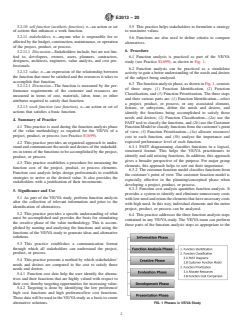
study (see Practice E1699), as shown in Fig. 1.
fessionals.
6.2 Function analysis can be practiced as a standalone
3.2.12 value, n—an expression of the relationship between
activity to gain a better understanding of the needs and desires
the function that must be satisfied and the resources it takes to
of the subject being analyzed.
accomplish that function.
6.3 The function analysis phase, as shown in Fig. 1, consists
3.2.12.1 Discussion—The function is measured by the per-
of three steps: (1) Function Identification, (2) Function
formance requirements of the customer and resources are
Classification, and (3) Function Prioritization. The three steps
measured in terms of cost, materials, labor, time, or other
and their various parts are: (1) Function Identification—select
attributes required to satisfy that function.
a project, product, or process, or any associated element,
3.2.13 work function (use function), n—an action or set of
feature, or subsystem, define the needs and desires, and
actions that satisfies a basic function.
identify the functions being accomplished to satisfy those
needs and desires; (2) Function Classification—(2a) use the
4. Summary of Practice
FAST tool to classify the functions, and (2b) use the Customer
4.1 This practice is used during the function analysis phase
FunctionModel to classify functions fromthe customer’s point
of the value methodology as required for the VE/VA of a
of view; (3) Function Prioritization—(3a) allocate resources/
project, product, or process (see Practice E1699).
cost to each function, and (3b) analyze the importance and
expected performance level of each function.
4.2 This practice provides an organized approach to under-
6.3.1 FAST diagramming classifies functions in a logical,
stand and communicate the needs and desires of the stakehold-
structured format. This helps the VE/VA practitioners to
ers in terms of the functions to be accomplished by the project,
identify and add missing functions. In addition, this approach
product, or process.
gives a broader perspective of the purpose. For major group
4.3 This practice establishes a procedure for measuring the
elements, this approach helps to sort out their importance.
function cost of the project, product, or process elements.
6.3.2 The customer function model classifies functions from
Function cost analysis helps design professionals to establish
the customer’s point of view. The customer function model is
strategies to arrive at the desired value. It also provides the
especially effective in the planning/conceptual phase when
stakeholders with a justification of their investments.
developing a project, product, or process.
6.3.3 Function cost analysis quantifies function analysis. It
5. Significance and Use
provides a system to identify and eliminate unnecessary costs
5.1 As part of the VE/VA study, perform function analysis
withlowneedandretaintheelementsthathavenecessarycosts
after the collection of relevant information and prior to the
with high need. In this way, individual elements and the entire
identification of alternatives.
project, product, or process can be analyzed.
5.2 This practice provides a specific understanding of what
6.4 This practice addresses the three function analysis steps
must be accomplished and provides the basis for stimulating
contained in any VE/VA study. The VE/VA team can perform
the creative phase of the value methodology. This is accom-
those parts of the function analysis steps as appropriate to the
plished by naming and analyzing the functions and using the
functions of the VE/VAstudy to generate ideas and alternative
solutions.
5.3 This practice establishes a communication format
through which all stakeholders can understand the project,
product, or process.
5.4 This practice presents a method by which stakeholders’
needs and desires are compared to the cost to satisfy those
needs and desires.
5.4.1 Function cost data help the user identify the alterna-
tives and their functions that are highly valued with respect to
their cost, thereby targeting opportunities for increasing value.
5.4.2 Targeting is done by identifying the low preference/
high cost functions and high preference/low cost functions.
These data will be used in the VE/VAstudy as a basis to create
alternative solutions. FIG. 1 Phases in VE/VA Study
E2013 − 20
scope of the VE/VA study. The effort to utilize some or all of tive verb and a measurable or quantifiable noun.The two-word
the parts depends upon the detail of information provided by definitions are the functions of the subject being analyzed.
the owner/client, the amount of time allocated to the study, and Some of the functions are based on the stakeholders’needs and
thenumberandlevelofexpertiseoftheVE/VAteammembers. desires.
7.5.1 Functions should not be the description of a process,
6.5 Function analysis develops functions that will facilitate
product or project element and should not be an action.
the development of alternatives specific to the purpose of the
Functions behind any action or description can be derived by
project, product, or process. This approach provides the stake-
utilizing a critical path of how-why logic.
holders with appropriate alternatives that can be implemented.
7.5.1.1 As an example, a stated function “Control Tempera-
In this practice, individual elements are analyzed.
ture” is an action. When a question is asked “Why do you
Control Temperature?”, the answer is to “Conserve Energy.”
7. Function Identification – “How-Why” Logic
7.5.1.2 The how-why logic path will expand this action to
7.1 Function analysis is critical to the VE/VA process. Its
function; Conserve Energy or Sustain Resources. This is
key activities differentiate the VE/VA process from other
possible by testing with a why question. The answer to a why
problem-solving or improvement practices. Function analysis
question of an action or description will yield a function. See
is the process of identifying what must be accomplished as
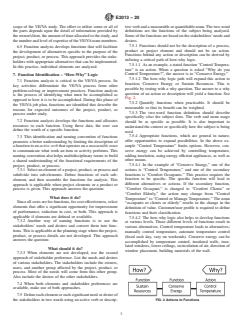
Fig. 2.
opposed to how it is to be accomplished. During this phase of
7.5.2 Quantify functions when practicable. It should be
the VE/VA job plan, functions are identified that describe the
measurable so that its benefit can be weighted.
reasons for expected outcomes of the project, product, or
7.5.3 The two-word function definition should describe
process under study.
specifically what the subject does. The verb and noun usage
7.2 Function analysis develops the functions and allocates
should be as specific as possible. It is also important to
resources to each function. Using these data, the user can
understand the context or specifically how the subject is being
define the worth of a specific function.
used.
7.5.4 Appropriate functions, which are general in nature,
7.3 This identification and naming convention of functions
offer opportunities to expand possibilities. In the above ex-
promotes a better understanding by limiting the description of
ample “Control Temperature” limits options. However, con-
afunctiontoan active verbthatoperatesona measurable noun
serve energy can be achieved by controlling temperature,
to communicate what work an item or activity performs. This
adding insulation, using energy efficient appliances, as well as
naming convention also helps multidisciplinary teams to build
other means.
a shared understanding of the functional requirements of the
7.5.4.1 In the example of “Conserve Energy,” one of the
project, product, or process.
actions is “Control Temperature,” and one of the secondary
7.3.1 Select an element of a project, product, or process and
functions is “Comfort Occupants.” This practice requires the
subdivide into sub-elements. Define functions of each sub-
function to be specific. The specific function will lead to
element, and then assemble the functions for analysis. This
different alternatives or actions. If the secondary function,
approach is applicable when project elements or a product or
“Comfort Occupant,” is changed to “Comfort Clients” or
process is given. This approach answers the question:
“Comfort Elderly,” the action may change from “Control
What does it do?
Temperature” to “Control or Manage Temperature.” The noun
Since all costs are for functions, for cost effectiveness, select
“occupants or clients or elderly” results in the change in the
elements that offer a significant opportunity for improvement
definition of value. Customer/user profile is required to define
of performance, reduction in cost, or both. This approach is
functions and their classification.
applicable if elements are defined or available.
7.5.4.2 The how-why logic also helps to develop functions
7.3.2 Another way of naming functions is to use the
at various levels. Those different levels of functions result in
stakeholders’ needs and desires and convert them into func-
various alternatives. Control temperature leads to alternatives;
tions.Thisisapplicableattheplanningstagewheretheproject,
manually control temperature, automate temperature control
product, or process details are not developed. This approach
(fixed each day, vary on weekends). Conserve energy can be
answers the question:
accomplished by temperature control, insulated walls, insu-
lated windows, lower ceilings, recirculation of air, direction of
What should it do?
window placement, building materials of the wall.
7.3.3 When elements are not developed, use the second
approach of stakeholder preference. List the needs and desires
of various stakeholders. The stakeholders include the owners,
users, and another group affected by the project, product, or
process. Most of the needs will come from this other group.
Also include the desires of the other stakeholders.
7.4 When both elements and stakeholder preferences are
available, make use of both approaches.
7.5 Defineeachelementoreachsignificantneedordesireof
the stakeholders in two words using an active verb or descrip- FIG. 2 Actions to Functions
E2013 − 20
7.6 Categorize Functions: place these constraints, needs, and desires of the project,
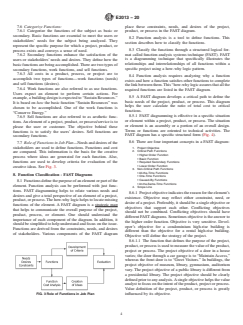
7.6.1 Categorize the functions of the subject as basic or product, or process in the FAST diagram.
secondary. Basic functions are essential to meet the users or
8.2 Function analysis is a tool to define functions. This
stakeholders’ needs for the subject being analyzed. They
section describes how to classify the functions.
represent the specific purpose for which a project, product, or
8.3 Classify the functions through a structured logical for-
process exists and conveys a sense of need.
mat called function analysis systems technique (FAST). FAST
7.6.2 Secondary functions enhance the satisfaction of the
is a diagramming technique that specifically illustrates the
users or stakeholders’ needs and desires. They define how the
relationships and interrelationships of all functions within a
basic functions are being accomplished.There are two types of
specific project using a how-why logic pattern.
secondary functions, work functions, and sell functions.
7.6.3 All costs in a product, process, or project are to
8.4 Function analysis requires analyzing why a function
accomplish two types of functions—work functions (needs)
exists and how a function satisfies other functions to complete
and sell functions (desires).
thelinkbetweenthem.This“how-whylogicassuresthatallthe
7.6.4 Work functions are also referred to as use functions.
required functions are listed in the FAST diagram.
Users expect an element to perform certain actions. For
8.5 A FAST diagram develops a critical path to define the
example, a building design is expected to “Sustain Resources.”
basic needs of the project, product, or process. This diagram
It is based on how the basic function “Sustain Resources” was
helps the user calculate the ratio of total cost to critical
chosen to be accomplished. One of the work functions is
functions.
“Conserve Energy.”
8.5.1 FAST diagramming is effective in a specific situation
7.6.5 Sell functions are also referred to as aesthetic func-
or element within a project, product, or process. The situation
tions.An element of a project, product, or process/service is to
or element is an assembly or a portion of an overall design.
please the user or customer. The objective behind these
Terms or functions are oriented to technical activities. The
functions is to satisfy the users’ desires. Sell functions are
FAST diagram has a specific structural form (Fig. 4).
secondary functions.
8.6 There are four important concepts in a FAST diagram:
7.7 Role of Functions in Job Plan—Needsanddesiresofthe
stakeholders are used to define functions. Functions and cost
1. Project Objective
2. Critical Path Functions
are compared. This information is the basis for the creative
Higher Order Function
process where ideas are generated for each function. Also,
Basic Function
functions are used to develop criteria for evaluation of the Required Secondary Functions
Lower Order Function
creative ideas. See Fig. 3.
3. Non-Critical Path Functions
All-the-Time Functions
8. Function Classification - FAST Diagrams
One-Time Functions
Caused-By Functions
8.1 Functionsdefinethepurposeofanelementorpartofthe
At-the-Same-Time Functions
element. Function analysis can be performed with just func-
4. Scope Line
tions. FAST diagramming helps to relate various needs and
8.6.1 Projectobjectiveindicatesthereasonfortheelement’s
desires and give a total perspective of an element of a project,
existence. Objective may reflect either constraint, need, or
product,orprocess.Thehow-whylogichelpstolocatemissing
desire of a project. Preferably, it should be a single objective or
functions of the element. A FAST diagram is a strategic map
objectives that support each other. Conflicting objectives
that helps to communicate the overall purpose of the project,
should not be combined. Conflicting objectives should have
product, process, or element. One should understand the
different FASTdiagrams. Sometimes objective is the answer to
importance of each component of the diagram. In addition, it
the higher order function. Objective is very sensitive. Devel-
should be simplified to help understand and focus on the issue.
oper’s objective for a condominium high-rise building is
Functions are derived from the constraints, needs, and desires
different than the objective for a rental high-rise building.
of stakeholders. Various components of the FAST diagram
Objective will define the strategy of the project.
8.6.1.1 The function that defines the purpose of the project,
product, or process is used to measure the value of the product,
project or process. The project objective of a door in a house
varies; the door through a car garage is to “Maintain Access,”
whereas the front door is to “Greet Visitors.” In buildings, the
project objective of museum, library, gymnasium, auditorium
vary. The project objective of a public library is different from
a presidential library. The project objective should be clearly
defined prior to any analysis.Asingle objective helps the value
analyst to focus on the intent of the product, project or process.
Value definition of the project, product, or process is greatly
FIG. 3 Role of Functions in Job Plan influenced by its objective.
E2013 − 20
FIG. 4 Function Analysis Systems Technique
8.6.2 Critical Path Functions—They reflect a specific way tion if it is done by form liners or an all-the-time function if it
of achieving the objective.These are derived from the needs of is done with painting or landscaping. All-the-time functions
the stakeholders. These are the absolute minimum functions may have an impact on both first costs and future costs,
needed to achieve the objective. Happen at the same time whereas a one-time function only affects first costs.
functionsarepartofthecriticalpathfunctions.Functionsinthe 8.6.5 Begin the FAST diagramming with a higher order
critical path functions are the ones that make the project or function of the project and two scope lines. All functions that
element work. It begins with the higher order function that the selected element fulfills are bounded by the two scope
satisfies the project objective. It ends wi
...
This document is not an ASTM standard and is intended only to provide the user of an ASTM standard an indication of what changes have been made to the previous version. Because
it may not be technically possible to adequately depict all changes accurately, ASTM recommends that users consult prior editions as appropriate. In all cases only the current version
of the standard as published by ASTM is to be considered the official document.
Designation: E2013 − 12 E2013 − 20
Standard Practice for
Developing Functions, Constructing FAST Diagrams, and
Performing Function Analysis During Value Engineering
(VE)/Value Analysis (VA) Study
This standard is issued under the fixed designation E2013; the number immediately following the designation indicates the year of
original adoption or, in the case of revision, the year of last revision. A number in parentheses indicates the year of last reapproval. A
superscript epsilon (´) indicates an editorial change since the last revision or reapproval.
1. Scope
1.1 This practice covers a logical structure for the function analysis of a building projectproject, product, or process.
1.2 This practice provides a system to identify unnecessary costs of a project.identify, define, and clearly communicate the purpose
of a project, product, or process and the associated elements of the project, product, or process.
1.3 This practice covers the relationship between the functions that must be satisfied and the resources for a project, product, or
process to accomplish those functions.
1.4 The values stated in SI units are to be regarded as standard. The values given in parentheses are mathematical conversions to
inch-pound units that after SI units are provided for information only and are not considered standard.
1.5 This standard does not purport to address all of the safety concerns, if any, associated with its use. It is the responsibility
of the user of this standard to establish appropriate safety safety, health, and healthenvironmental practices and determine the
applicability of regulatory limitations prior to use.
1.6 This international standard was developed in accordance with internationally recognized principles on standardization
established in the Decision on Principles for the Development of International Standards, Guides and Recommendations issued
by the World Trade Organization Technical Barriers to Trade (TBT) Committee.
2. Referenced Documents
2.1 ASTM Standards:
E631 Terminology of Building Constructions
E833 Terminology of Building Economics
E1557 Classification for Building Elements and Related Sitework—UNIFORMAT II
E1699 Practice for Performing Value Engineering (VE)/Value Analysis (VA) of Projects, Products and Processes
E2103/E2103M Classification for Bridge Elements—UNIFORMAT II
This practice is under the jurisdiction of ASTM Committee E06 on Performance of Buildings and is the direct responsibility of Subcommittee E06.81 on Building
Economics.
Current edition approved March 15, 2012Dec. 1, 2020. Published April 2012December 2020. Originally approved in 1999. Last previous edition approved in 20062012
as E2013 – 06.E2013 – 12. DOI: 10.1520/E2013-12.10.1520/E2013-20.
For referenced ASTM standards, visit the ASTM website, www.astm.org, or contact ASTM Customer Service at service@astm.org. For Annual Book of ASTM Standards
volume information, refer to the standard’sstandard’s Document Summary page on the ASTM website.
Copyright © ASTM International, 100 Barr Harbor Drive, PO Box C700, West Conshohocken, PA 19428-2959. United States
E2013 − 20
3. Terminology
3.1 Definitions: Definitions—
3.1.1 For definitions of terms used in this practice, refer to Terminologies E631 and E833.For definitions of general terms related
to building construction used in this practice, refer to Terminology E631; and for general terms related to building economics, refer
to Terminology E833.
3.2 Definitions of Terms Specific to This Standard:
3.2.1 basic function, n—a primary purpose or action of a project, product, or process.
3.2.1.1 Discussion—
A basic function establishes the specific purpose for which something exists and answers the question “what must it do?”.
3.2.2 function, n—the intent or purpose that all elements of a project, product, or process is expected to satisfy.
3.2.3 function analysis, n—the process of identifying, classifying, and prioritizing functions for value improvement.
3.2.4 function analysis systems technique (FAST), n—a structured tool used to identify, classify, and analyze functions.
3.2.5 function cost, n—the cost of an element or set of elements to satisfy a specific function.
3.2.6 function worth, n—the lowest utilization of resources to satisfy a specific function.
3.2.7 higher order function, n—it represents the specific goals or needs for which the basic function exists.
3.2.8 lower order function, n—this function is typically the input to the project, product, or process study. It is outside the scope
of the study.
3.2.9 secondary function, n—an action or set of actions that enhances the satisfaction of the stakeholders’ needs and desires.
3.2.9.1 Discussion—
Secondary functions define how the basic functions are being accomplished.
3.2.10 sell function (aesthetic function), n—an action or set of actions that enhances a work function.
3.2.11 stakeholders, n—anyone who is responsible for or affected by the budget, construction, maintenance, or operation of the
project, product, or process.
3.2.11.1 Discussion—
Stakeholders include, but are not limited to, developers, owners, users, planners, contractors, designers, architects, engineers, value
analysts, and cost professionals.
3.2.12 value, n—an expression of the relationship between the function that must be satisfied and the resources it takes to
accomplish that function.
3.2.12.1 Discussion—
The function is measured by the performance requirements of the customer and resources are measured in terms of cost, materials,
labor, time, or other attributes required to satisfy that function.
3.2.13 work function (use function), n—an action or set of actions that satisfies a basic function.
4. Summary of Practice
4.1 This practice is used during the function analysis phase of the value methodology as required for the VE/VA of a project,
product, or process (see Practice E1699).
4.2 This practice provides an organized approach for determining to understand and communicate the needs and desires of the
E2013 − 20
stakeholders during the Value Analysis (VA) of a project. These needs and desires are used in developing the functions of the
project.in terms of the functions to be accomplished by the project, product, or process.
4.2 This practice establishes a logical procedure for allocating cost to each function.
4.3 Function This practice establishes a procedure for measuring the function cost of the project, product, or process elements.
Function cost analysis helps design professionals justify the value of their concepts. to establish strategies to arrive at the desired
value. It also provides the stakeholders with a justification of their investments.
5. Significance and Use
5.1 As part of the VE/VA study, perform function analysis after the collection of relevant information and prior to the identification
of alternatives.
5.2 This practice provides a specific understanding of what must be accomplished and provides the basis for stimulating the
creative phase of the value methodology. This is accomplished by naming and analyzing the functions and using the functions of
the VE/VA study to generate ideas and alternative solutions.
5.3 This practice establishes a communication format through which all stakeholders can understand the project, product, or
process.
5.4 This practice establishes a communication format through which all stakeholders can understand, analyze, revise, and agree
on the purposes of the project. This practice presents a method by which stakeholders’stakeholders’ needs and desires are compared
to the cost to satisfy those needs and desires. This is done by identifying the low preference/high cost functions and high
preference/low cost functions. These data will be used in the value analysis study as a basis to create alternative solutions.
5.4.1 Function cost data help the user identify the alternatives and their functions that are highly valued with respect to their cost,
thereby targeting opportunities for increasing value.
5.4.2 Targeting is done by identifying the low preference/high cost functions and high preference/low cost functions. These data
will be used in the VE/VA study as a basis to create alternative solutions.
5.5 This practice helps stakeholders, which include developers, owners, users, planners, contractors, architects, engineers, value
analysts, cost professionals, and anyone who is responsible for the budget, construction, maintenance, or operation of the
project.stakeholders to formulate a strategy to maximize values.
5.6 A practice on performing value analysis of buildings and building systems and other constructed projects, Practice Functions
E1699, has been published. As part of the value analysis study, perform function analysis after the collection of relevant
information and prior to the identification of alternatives. Function Analysis Systems Technique (FAST) data helps the user identify
the alternatives that are highly valued with respect to their cost.are also used to define criteria to compare alternatives.
6. Procedure
6.1 Function analysis consists of five sequential steps: (is practiced as part of 1) select a building component, (2) define the needs
and desires (functions),the VE/VA study (see Practice E1699(),3) classify functions, ( as shown in4) Fig. 1allocate cost to each
function, and (.5) analyze the importance and expected performance level of the functions.
6.2 Selection of a Building Component—For cost-effectiveness, select building components that offer a significant opportunity for
improvement of performance, reduction in cost, or both.Function analysis can be practiced as a standalone activity to gain a better
understanding of the needs and desires of the subject being analyzed.
6.3 Definition of Needs and Desires (Functions)—Define each significant need or desire of the stakeholders in two words using
an active verb and a descriptive noun. The two-word definitions are the functions of the project.
E2013 − 20
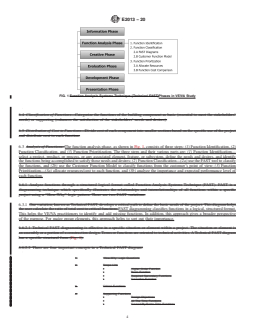
FIG. 1 Function Analysis Systems Technique (Technical FAST)Phases in VE/VA Study
6.4 Classification of Functions—Categorize the functions of the building component as basic (essential to meet the stakeholders’
needs) or supporting (enhances the satisfaction of the stakeholders’ needs and desires).
6.5 Distribution of Cost to Functions—Divide cost of each component into smaller sections based on the specific use of the project
and distribute cost to each function.
6.3 Analysis of Functions: The function analysis phase, as shown in Fig. 1, consists of three steps: (1) Function Identification, (2)
Function Classification, and (3) Function Prioritization. The three steps and their various parts are: (1) Function Identification—
select a project, product, or process, or any associated element, feature, or subsystem, define the needs and desires, and identify
the functions being accomplished to satisfy those needs and desires; (2) Function Classification—(2a) use the FAST tool to classify
the functions, and (2b) use the Customer Function Model to classify functions from the customer’s point of view; (3) Function
Prioritization—(3a) allocate resources/cost to each function, and (3b) analyze the importance and expected performance level of
each function.
6.6.1 Analyze functions through a structured logical format called Function Analysis Systems Technique (FAST). FAST is a
diagramming technique which specifically illustrates the relationships and interrelationships of all functions within a specific
project using a “How-Why” logic pattern. There are two FAST variations.
6.3.1 One variation, known as Technical FAST, develops a critical path to define the basic needs of the project. This diagram helps
the user calculate the ratio of total cost to critical functions.FAST diagramming classifies functions in a logical, structured format.
This helps the VE/VA practitioners to identify and add missing functions. In addition, this approach gives a broader perspective
of the purpose. For major group elements, this approach helps to sort out their importance.
6.6.2.1 Technical FAST diagramming is effective in a specific situation or element within a project. The situation or element is
an assembly or a portion of a construction design. Terms or functions are oriented to technical activities. A Technical FAST diagram
has a specific structural form (Fig. 1).
6.6.2.2 There are four important concepts in a Technical FAST diagram:
1. 9How-Why9 Logic Questions
2. Scope Line
• Higher Order Function
• Basic Function
• Required Secondary Functions
• Causative Function
3. Critical Functions
4. Supporting Functions
• Design Objectives
• All The Time Functions
• Caused-By/Same-Time Functions
E2013 − 20
6.6.2.3 Function analysis requires analyzing why a function exists and how a function satisfies other functions to complete the link
between them. This “How-Why” logic assures that all the required functions are listed in the FAST diagram.
6.6.2.4 Begin the Technical FAST diagramming with a higher order function of the project and two scope lines. All functions that
the selected element fulfills are bounded by the two scope lines. The basic function is on the right of the left-hand scope line, and
the higher order function is on the left. The purpose of the element or project for which a FAST diagram is developed is the higher
order function. The relationship between the higher order function and the basic function is determined by asking “Why” the basic
function candidate performs as it does. The answer should be the higher order function. The logic check must be completed by
asking “How” the higher order function performs. The logical answer must be the basic function candidate. It is still necessary to
confirm the required secondary function to the left of the right-hand scope line. When the “How” question is asked of this function,
the answer will be an outside function candidate. The outside function is called the causative function, since it really starts the
critical functions.
6.6.2.5 Determining the basic function often requires selecting functions from the list of suggestions and applying the “How” and
“Why” questions. If the “Why” question is answered by another identified function, that function is the next candidate for the basic
function. The function to the right becomes a required secondary function. Once the basic function is verified, the remaining
required secondary functions are identified. This group makes up the critical functions.
6.6.2.6 The last group of functions is supporting functions. There are three types. The first type, caused by or same time functions,
connects directly to a critical function. These functions result from the performance characteristics of particular critical functions
and act as modifiers. The second type, all-the-time functions, modifies two or more of the critical functions. The third type, design
objectives, represents specifications that are added to the design, often by the stakeholder or group that is developing or operating
the process.
6.3.2 The second variation, known as Task-oriented FAST, creates distinct functions for stakeholders’ concerns and is always
headed by four primary functions: (customer function model classifies functions from the customer’s point of view. The customer
function model is especially effective in the planning/conceptual phase when1) assure dependability, ( developing a project,2)
assure convenience, ( product, or process.3) satisfy stakeholders, and (4) attract stakeholders.
6.6.3.1 The Task-oriented FAST diagram logically displays the stakeholders’ needs and desires (see Fig. 2). Task-oriented FAST
diagramming is especially effective in the planning or conceptual phase. Use conceptual layout and building plans to develop these
FAST diagrams.
6.6.3.2 There are four parts to the Task-oriented FAST diagram:
1. Task
2. Basic Functions
• Primary
• Secondary
3. Supporting Functions
• Assure Dependability
• Assure Convenience
• Satisfy Stakeholders
• Attract Stakeholders
FIG. 2 Function Analysis System Technique (Task-Oriented FAST)Actions to Functions
FIG. X1.1 Median Slope
FIG. X1.2 Concrete Guardwall
FIG. X1.3 Alternative Guardrail
FIG. X1.4 Components and Functions
E2013 − 20
4. Classify Functions
• Primary
• Secondary
• Tertiary
6.6.3.3 The first step is to determine the task. The task satisfies the overall needs of the stakeholder. Establish a scope line just
to the right of the task. Functions that answer “why perform the task” lie outside of the scope.
6.6.3.4 The second step is to separate the identified functions into basic and supporting functions. Basic functions are those which
are essential to the performance of the task. Without the primary basic functions, the project or process will not work.
6.6.3.5 The third step is to group the remaining functions into the four primary supporting function groups. Supporting functions
play an important role in a building. Structural engineers, for instance, concentrate primarily on the basic functions, with heavy
emphasis on the primary supporting function Assure Dependability. Mechanical engineers and electrical engineers pay more
attention to the supporting function Assure Convenience, while architects’ ideas satisfy the basic and supporting functions Satisfy
Stakeholders and Attract Stakeholders.
6.6.4 Assure Dependability—Any function that assures dependability has at least one of the following attributes:
6.6.4.1 Makes the elements of the project stronger or more reliable or effective,
6.6.4.2 Makes it safer to use,
6.6.4.3 Lengthens the life of the parts or minimizes maintenance cost, or both, and
6.6.4.4 Protects the environment.
6.6.5 Assure Convenience—Any function that assures convenience has at least one of the following attributes:
6.6.5.1 Modifies the basic function to make it convenient to use,
6.6.5.2 Enhances spatial arrangements,
6.6.5.3 Facilitates maintenance and repairs, and
6.6.5.4 Furnishes instructions and directions to stakeholders.
6.6.6 Satisfy Stakeholders—Any function that satisfies stakeholders has at least one of the following attributes:
6.6.6.1 Modifies the basic function to satisfy the individual desires,
6.6.6.2 Makes the stakeholders’ life more pleasant; for example, minimizes noise, and
6.6.6.3 Makes the element appear to be better in the opinion of the stakeholder, but not necessarily in the opinion of the designer.
(Sometimes these opinions are reflected in the standards and specifications of a particular agency/owner.)
6.6.7 Attract Stakeholders—Any function that attracts stakeholders and has at least one of the following attributes:
6.6.7.1 Emphasizes the visual aspect (sight) or other senses, and
6.6.7.2 Projects a favorable image (that is, trademarks or endorsement by public figures).
6.6.8 The fourth step is to classify the functions as primary, secondary, or tertiary.
6.6.8.1 The link between the task and basic functions is the sequence of the logical question “How-Why.” The “How-Why”
concepts must work between the selected task and the primary basic functions. These primary basic functions are interdependent
and both are essential to the performance of the task.
E2013 − 20
6.6.8.2 Once the primary basic functions have been identified, the question “How” can be asked of each of the primary basic
functions. Functions that answer the question “How” will be found in the expanding branches. These are the secondary basic
functions. There must be two or more secondary basic functions to justify branching from the primary function.
6.6.8.3 In a similar manner, the secondary supporting functions branch to the right from the primary supporting functions when
the question “How” is applied. Again, there must be two or more secondary functions to justify branching.
6.6.8.4 This rule also affects further branching off to the third (tertiary) level. Usually, the tertiary level completes the branching
basic functions. The end of the branching is obtained when the hardware description or action is the noun of the function. The
branches must also satisfy the “Why” question in the opposite direction, that is, logic check.
6.6.9 Cost Estimate:
6.6.9.1 Obtain cost estimates for the proposed building components and related sitework. Classification E1557 provides a useful
format for allocating cost to functions.
6.6.10 Function Cost:
6.6.10.1 Most components of a building have more than one function to satisfy. Distribute cost of each component to each one
of these functions, proportionate to their time cost. Use the elemental format, UNIFORMAT II, for the development of cost
estimates. This expedites the completion of function costs. Allocate all life-cycle costs, including first cost, operation cost and
maintenance cost.
6.6.10.2 When cost is distributed to all functions, review the total distribution. In the Technical FAST, the ratio of total cost to the
cost of critical functions is defined as the value index. In the Task-Oriented FAST, the ratio of the total cost to the Basic and Assure
Dependability functions is defined as the value index. The value index varies from 1.5 to 6.0. As this ratio gets higher, the
opportunity to reduce cost is higher for the selected component. A value index of 1.5 means a very basic design with minimum
cost of supporting functions. If most of the total cost is spent on critical functions, the value index is approximately 1.5. The
construction of a fast food restaurant, for example, will have a value index around 1.5, whereas a luxurious restaurant may have
a value index much higher than the fast food restaurant.
6.6.10.3 In Task-Oriented FAST, the ratio of basic to supporting functions indicates how basic the project or component is
designed. Opportunity to improve value depends upon the understanding and willingness of the stakeholders to accept the findings
and change the ratios to fit the intent of the project. Cost distribution for the type of building affects the four supporting functions.
Table 1 shows the highest cost function for each of the several types of buildings. In an industrial building, major spending occurs
in order to make the building dependable. In a public building such as a train station, major spending will occur in order to make
the facility convenient to use; that is, elevators, escalators, stairs signage and corridors.
6.6.11 The team should calculate function cost as follows:
6.6.11.1 Review each building component for its functions and allocate cost accordingly,
6.6.11.2 Summarize all costs of each function, and
6.6.11.3 Compute percentage of function cost and list in the FAST diagram.
6.6.11.4 The attached appendixes consist of two case studies. The first is Appendix X1, a Technical FAST diagram case study that
shows the method of the function cost distribution in detail. The second is Appendix X2, a Task FAST diagram case study that
uses similar function cost distribution of the elements.
6.6.12 Function Preference:
6.6.12.1 Designers gather information to understand the needs, desires and constraints of the project. However, the stakeholders
may change their opinion after the project is designed and cost is distributed. Utilize questionnaires/surveys, focus groups, public
information meetings or public hearings, and measure preferences as they relate to function cost.
6.6.12.2 For each function, measure and tabulate the function preference of the project.
E2013 − 20
TABLE 1 Highest Cost Function GroupFunction Analysis Worksheet
Subject:_______________________________________________________________
Basic Function: __________________________________ (Verb, Noun)
Higher Order Function: __________________________________ (Verb, Noun)
Resource Function Resource %
A
Component Function Type
(cost, space, time, etc.) Verb Noun Allocation
High Cost % Type of Building
Assure Dependability Industrial building
Assure Convenience Public buildings (for
example, train stations,
libraries, and schools)
Satisfy Stakeholders Any building where
more decision makers
or stakeholders are
involved
Attract Stakeholders Museums, city halls,
monuments
A
Basic, Secondary (Required, Unwanted), Higher Order, Lower Order.
6.3.3 Analyze the Functions and Identify Mismatches—Compare function cost and function preference.Function cost analysis
quantifies function analysis. Table 2 shows four possible combinations of cost/preference. If the cost of a function is high and the
stakeholder thinks its importance is low, the result is a mismatch (Type A in It provides a system to identify and eliminate
unnecessary costs with low need and retain the elements that have necessary costs with Table 2). On the other hand, if the cost
of a function is low and the stakeholder rates its importance as high, a high value is achieved and the stakeholder has a match (Type
D inhigh need. In this way, individual elements and the entire project, product, or process can be Table 2). These are the two
extremes of the cost/preference measurement.analyzed.
6.6.14 Use value analysis to propose and develop redesigns to reduce or eliminate Type A combinations. Employ value analysis
E2013 − 20
TABLE 2 Illustration of Cost/Preference Combinations
Type of Function
Function Cost Function Value
Combination Preference
Type Function Function Function
of Combination Cost Preference Value
A High Low Mismatch
(Mandatory Value
Analysis) (VA)
A High Low Mismatch
Mandatory (VA)
B High High Candidate for VA
C Low Low —
C Low Low .
D Low High Match
to develop alternatives to reduce the cost of Type B combinations while maintaining high-preference functions. Maintain the Type
D combinations since it is a match. Determine if the Type C combination with low cost is worth further analysis.
6.4 This practice addresses the three function analysis steps contained in any VE/VA study. The VE/VA team can perform those
parts of the function analysis steps as appropriate to the scope of the VE/VA study. The effort to utilize some or all of the parts
depends upon the detail of information provided by the owner/client, the amount of time allocated to the study, and the number
and level of expertise of the VE/VA team members.
6.5 Function analysis develops functions that will facilitate the development of alternatives specific to the purpose of the project,
product, or process. This approach provides the stakeholders with appropriate alternatives that can be implemented. In this practice,
individual elements are analyzed.
7. Function Identification – “How-Why” Logic
7.1 Function analysis is critical to the VE/VA process. Its key activities differentiate the VE/VA process from other
problem-solving or improvement practices. Function analysis is the process of identifying what must be accomplished as opposed
to how it is to be accomplished. During this phase of the VE/VA job plan, functions are identified that describe the reasons for
expected outcomes of the project, product, or process under study.
7.2 Function analysis develops the functions and allocates resources to each function. Using these data, the user can define the
worth of a specific function.
7.3 This identification and naming convention of functions promotes a better understanding by limiting the description of a
function to an active verb that operates on a measurable noun to communicate what work an item or activity performs. This naming
convention also helps multidisciplinary teams to build a shared understanding of the functional requirements of the project,
product, or process.
7.3.1 Select an element of a project, product, or process and subdivide into sub-elements. Define functions of each sub-element,
and then assemble the functions for analysis. This approach is applicable when project elements or a product or process is given.
This approach answers the question:
What does it do?
Since all costs are for functions, for cost effectiveness, select elements that offer a significant opportunity for improvement of
performance, reduction in cost, or both. This approach is applicable if elements are defined or available.
7.3.2 Another way of naming functions is to use the stakeholders’ needs and desires and convert them into functions. This is
applicable at the planning stage where the project, product, or process details are not developed. This approach answers the
question:
E2013 − 20
What should it do?
7.3.3 When elements are not developed, use the second approach of stakeholder preference. List the needs and desires of various
stakeholders. The stakeholders include the owners, users, and another group affected by the project, product, or process. Most of
the needs will come from this other group. Also include the desires of the other stakeholders.
7.4 When both elements and stakeholder preferences are available, make use of both approaches.
7.5 Define each element or each significant need or desire of the stakeholders in two words using an active verb or descriptive
verb and a measurable or quantifiable noun. The two-word definitions are the functions of the subject being analyzed. Some of the
functions are based on the stakeholders’ needs and desires.
7.5.1 Functions should not be the description of a process, product or project element and should not be an action. Functions
behind any action or description can be derived by utilizing a critical path of how-why logic.
7.5.1.1 As an example, a stated function “Control Temperature” is an action. When a question is asked “Why do you Control
Temperature?”, the answer is to “Conserve Energy.”
7.5.1.2 The how-why logic path will expand this action to function; Conserve Energy or Sustain Resources. This is possible by
testing with a why question. The answer to a why question of an action or description will yield a function. See Fig. 2.
7.5.2 Quantify functions when practicable. It should be measurable so that its benefit can be weighted.
7.5.3 The two-word function definition should describe specifically what the subject does. The verb and noun usage should be as
specific as possible. It is also important to understand the context or specifically how the subject is being used.
7.5.4 Appropriate functions, which are general in nature, offer opportunities to expand possibilities. In the above example “Control
Temperature” limits options. However, conserve energy can be achieved by controlling temperature, adding insulation, using
energy efficient appliances, as well as other means.
7.5.4.1 In the example of “Conserve Energy,” one of the actions is “Control Temperature,” and one of the secondary functions is
“Comfort Occupants.” This practice requires the function to be specific. The specific function will lead to different alternatives or
actions. If the secondary function, “Comfort Occupant,” is changed to “Comfort Clients” or “Comfort Elderly,” the action may
change from “Control Temperature” to “Control or Manage Temperature.” The noun “occupants or clients or elderly” results in
the change in the definition of value. Customer/user profile is required to define functions and their classification.
7.5.4.2 The how-why logic also helps to develop functions at various levels. Those different levels of functions result in various
alternatives. Control temperature leads to alternatives; manually control temperature, automate temperature control (fixed each day,
vary on weekends). Conserve energy can be accomplished by temperature control, insulated walls, insulated windows, lower
ceilings, recirculation of air, direction of window placement, building materials of the wall.
E2013 − 20
7.6 Categorize Functions:
7.6.1 Categorize the functions of the subject as basic or secondary. Basic functions are essential to meet the users or stakeholders’
needs for the subject being analyzed. They represent the specific purpose for which a project, product, or process exists and
conveys a sense of need.
7.6.2 Secondary functions enhance the satisfaction of the users or stakeholders’ needs and desires. They define how the basic
functions are being accomplished. There are two types of secondary functions, work functions, and sell functions.
7.6.3 All costs in a product, process, or project are to accomplish two types of functions—work functions (needs) and sell
functions (desires).
7.6.4 Work functions are also referred to as use functions. Users expect an element to perform certain actions. For example, a
building design is expected to “Sustain Resources.” It is based on how the basic function “Sustain Resources” was chosen to be
accomplished. One of the work functions is “Conserve Energy.”
7.6.5 Sell functions are also referred to as aesthetic functions. An element of a project, product, or process/service is to please the
user or customer. The objective behind these functions is to satisfy the users’ desires. Sell functions are secondary functions.
7.7 Role of Functions in Job Plan—Needs and desires of the stakeholders are used to define functions. Functions and cost are
compared. This information is the basis for the creative process where ideas are generated for each function. Also, functions are
used to develop criteria for evaluation of the creative ideas. See Fig. 3.
8. Function Classification - FAST Diagrams
8.1 Functions define the purpose of an element or part of the element. Function analysis can be performed with just functions.
FAST diagramming helps to relate various needs and desires and give a total perspective of an element of a project, product, or
process. The how-why logic helps to locate missing functions of the element. A FAST diagram is a strategic map that helps to
communicate the overall purpose of the project, product, process, or element. One should understand the importance of each
component of the diagram. In addition, it should be simplified to help understand and focus on the issue. Functions are derived
from the constraints, needs, and desires of stakeholders. Various components of the FAST diagram place these constraints, needs,
and desires of the project, product, or process in the FAST diagram.
8.2 Function analysis is a tool to define functions. This section describes how to classify the functions.
8.3 Classify the functions through a structured logical format called function analysis systems technique (FAST). FAST is a
diagramming technique that specifically illustrates the relationships and interrelationships of all functions within a specific project
using a how-why logic pattern.
FIG. X1.53 Function Cost DistributionRole of Functions in Job Plan
FIG. X1.6 Function Analysis Systems Technique
(Technical FAST)
Guardwall as Designed
FIG. X1.7 Metal Plate Guardrail ($40 000)
FIG. X1.8 Concrete Wall Footing ($60 000)
FIG. X1.9 Revision of the Median
FIG. X1.10 Alternative Barrier Functions
E2013 − 20
8.4 Function analysis requires analyzing why a function exists and how a function satisfies other functions to complete the link
between them. This “how-why logic assures that all the required functions are listed in the FAST diagram.
8.5 A FAST diagram develops a critical path to define the basic needs of the project, product, or process. This diagram helps the
user calculate the ratio of total cost to critical functions.
8.5.1 FAST diagramming is effective in a specific situation or element within a project, product, or process. The situation or
element is an assembly or a portion of an overall design. Terms or functions are oriented to technical activities. The FAST diagram
has a specific structural form (Fig. 4).
8.6 There are four important concepts in a FAST diagram:
1. Project Objective
2. Critical Path Functions
• Higher Order Function
• Basic Function
• Required Secondary Functions
• Lower Order Function
3. Non-Critical Path Functions
• All-the-Time Functions
• One-Time Functions
• Caused-By Functions
• At-the-Same-Time Functions
4. Scope Line
8.6.1 Project objective indicates the reason for the element’s existence. Objective may reflect either constraint, need, or desire of
a project. Preferably, it should be a single objective or objectives that support each other. Conflicting objectives should not be
combined. Conflicting objectives should have different FAST diagrams. Sometimes objective is the answer to the higher order
function. Objective is very sensitive. Developer’s objective for a condominium high-rise building is different than the objective
for a rental high-rise building. Objective will define the strategy of the project.
8.6.1.1 The function that defines the purpose of the project, product, or process is used to measure the value of the product, project
or process. The project objective of a door in a house varies; the door through a car garage is to “Maintain Access,” whereas the
front door is to “Greet Visitors.” In buildings, the project objective of museum, library, gymnasium, auditorium vary. The project
FIG. X2.14 Enclosed SpaceFunction Analysis Systems Technique
E2013 − 20
objective of a public library is different from a presidential library. The project objective should be clearly defined prior to any
analysis. A single objective helps the value analyst to focus on the intent of the product, project or process. Value definition of the
project, product, or process is greatly influenced by its objective.
E2013 − 20
8.6.2 Critical Path Functions—They reflect a specific way of achieving the objective. These are derived from the needs of the
stakeholders. These are the absolute minimum functions needed to achieve the objective. Happen at the same time functions are
part of the critical path functions. Functions in the critical path functions are the ones that make the project or element work. It
begins with the higher order function that satisfies the project objective. It ends with a causative function that starts the critical path
to the higher order function.
8.6.3 There are three types of non-critical path functions:
8.6.3.1 The first type is a “caused-by” function. This function is the reaction to a specific critical path function. These are the result
of a critical path function. The cost of the caused-by functions should be kept to a minimum. In some cases, they may create
undesirable functions. In the airport, function Secure Passengers results in a caused-by function Screen Passengers. The screening
causes passenger frustration and delays. Lately this function has been modified with a Pre-TSA option. It is an example of how
improvements can be made by looking at the caused-by function.
8.6.3.2 The second type is a “same-time” function. In a highway intersection, Eliminate Conflicts and Maintain Access are at the
same-time functions.
8.6.3.3 The third type, “all-the-time functions,” modifies two or more of the critical functions. Usually they are derived from the
sell functions. “Improve Appearance” is an example of an all-the-time function of a door. These are the functions that make the
project or element sell. The owner of the project should decide whether the cost of all the time functions are worth the cost.
8.6.4 One Time Functions—These are needed at the beginning of the project. Maintain Traffic (During Construction) and Develop
Shape (Column Formwork) are examples of a one-time function. Enhance Appearance may be a one-time function if it is done
by form liners or an all-the-time function if it is done with painting or landscaping. All-the-time functions may have an impact on
both first costs and future costs, whereas a one-time function only affects first costs.
8.6.5 Begin the FAST diagramming with a higher order function of the project and two scope lines. All functions that the selected
element fulfills are bounded by the two scope lines. The basic function is on the right of the left-hand scope line, and the higher
order function is on the left. The purpose of the element or project, product, or process for which a FAST diagram is developed
is the higher order function. The relationship between the higher order function and the basic function is determined by asking
“why” the basic function candidate performs as it does. The answer should be the higher order function. The logic check must be
completed by asking “how” the higher order function performs. The logical answer must be the basic function candidate. It is still
necessary to confirm the required secondary function to the left of the right-hand scope line. When the “how” question is asked
of this function, the answer will be an outside function candidate.
8.6.6 Determining the basic function often requires selecting functions from the list of suggestions and applying the “how” and
“why” questions. If the “why” question is answered by another identified function, that function is the next candidate for the basic
function. The function to the right becomes a required secondary function. Once the basic function is verified, the remaining
required secondary functions are identified. This group makes up the critical functions.
8.6.7 The last group of functions is to place the non-critical path functions. Caused-by or same-time functions connect directly to
a critical function. These functions result from the performance characteristics of particular critical functions and act as modifiers.
These are placed below the appropriate critical path function. To differentiate the two classifications, mark the cell box with a “c”
at the upper right-hand corner for “caused-by function.” The second type, all-the-time functions, modifies two or more of the
critical functions. The third type, project objectives, represents specifications that are added to the design, often by the stakeholder
or group that is developing or operating the process. These are placed on the upper left-hand side of the diagram.
9. Function Classification – Customer Function Model
9.1 Section 7 describes a simple way of classifying and analyzing the worth of the functions. Section 8 describes a structured way
of classifying and analyzing functions. Analysis of functions is performed in two ways. Each function is individually analyzed for
its purpose within a project, product, or process, or they are analyzed as a whole with a customer function model.
9.1.1 The customer function model is another way of classifying functions. This model is based on the customer’s perspective.
9.2 Functions of a project, product, or process are listed in a random order. They can be used to analyze its worth. However it
E2013 − 20
is a recommended practice to classify them in the point of view of the customer/clients/owner/users. The following sections
describe the customer function model for classification and organization.
9.3 The customer function model classifies the functions by four primary functions: (1) Assure Dependability, (2) Assure
Convenience, (3) Satisfy Stakeholders, and (4) Attract Stakeholders. Certain agencies prefer the four primary enhancing functions
as follows: (1) Enhance Dependability, (2) Enhance Convenience, (3) Improve Acceptance and (4) Attract Stakeholders.
9.3.1 The customer function model logically displays the stakeholders’ needs and desires (see Fig. 5). It is especially effective in
the planning or conceptual phase.
9.3.2 In the conceptual or planning stage of a project, product, or process, customer function model will assist in structuring the
needs and desires of a project, product, or process. During the design phase of elements of a project, product, or process, a FAST
diagram is very effective.
9.3.3 Function classification of any of the functions of a project, product, or process can be used as the project objective of a FAST
analysis of an element. For example, functions of a door will vary based on the project objective. If the classification of the door
is “Assure Dependability,” Control Access will be the project objective. If the classification is to “Assure Convenience,” Improve
Circulation will be the project objective. If the classification is to “Attract Stakeholders,” Improve Appearance will be the project
objective.
FIG. X2.25 Co
...