

ASTM E2906/E2906M-18(2022)
(Practice)Standard Practice for Acoustic Pulse Reflectometry Examination of Tube Bundles
General Information
- Abstract
SIGNIFICANCE AND USE
5.1 APR technology is used for detection, location and identification of internal diameter (ID) flaws-indications and blockages in tube bundles.
5.2 Reliable and accurate examination of tube bundles is of great importance in different industries. On-time detection of flaws reduces a risk of catastrophic failure and minimizes unplanned shutdowns of plant equipment. Fast examination capability is of great importance due to reduction of maintenance time.
5.3 APR examinations are performed for quality control of newly manufactured tube bundles as well as for in-service inspection.
5.4 Performing an APR examination requires access to an open end of each tube to be examined.
5.5 Flaws that can be readily detected and identified include but are not limited to through-wall holes, ID pitting, erosion, blockages, bulging due to creep and plastic deformation due to bending.
5.6 APR can be applied to tube bundles made of metal, graphite, plastic or other solid materials with straight and curved sections. The APR technology has been found effective on tubes with diameters between 12.7 mm [1/2 in.] to 101.6 mm [4 in.] and lengths up to 18 metres [60 feet].
5.7 Closed cracks on ID surface, without significant geometrical alternation on ID surface, may not be detected by APR.
5.8 APR technology can be used for flaw sizing when special signal and data analysis methods are developed and applied.
5.9 In addition to detection of flaws and blockages, APR technology can be applied for assessing tube ID surface cleanliness, providing valuable information for equipment maintenance and improving its performance.
5.10 Other nondestructive test methods may be used to verify and evaluate the significance of APR indications, their exact position, depth, dimension and orientation. These include remote visual inspection, eddy current and ultrasonic testing.
5.11 Procedures for using other NDT methods are beyond the scope of this practice.
5.12 Acceptable flaw size...
SCOPE
1.1 This practice describes use of Acoustic Pulse Reflectometry (APR) technology for examination of the internal surface of typical tube bundles found in heat exchangers, boilers, tubular air heaters and reactors, during shutdown periods.
1.2 The purpose of APR examination is to detect, locate and identify flaws such as through-wall holes, ID wall loss due to pitting and/or erosion as well as full or partial tube blockages. APR may not be effective in detecting cracks with tight boundaries.
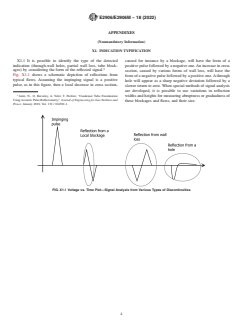
1.3 APR technology utilizes generation of sound waves through the air in the examined tube, then detecting reflections created by discontinuities and/or blockages. Analysis of the initial phase (positive or negative) and the shape of the reflected acoustic wave are used to identify the type of flaw causing the reflection.
1.4 When proper methods of signal and data analysis are developed, APR technology can be applied for sizing of flaw/blockage indications.
1.5 The values stated in either SI units or inch-pound units are to be regarded separately as standard. The values stated in each system may not be exact equivalents; therefore, each system shall be used independently of the other. Combining values from the two systems may result in non-conformance with the standards.
1.6 This standard does not purport to address all of the safety concerns, if any, associated with its use. It is the responsibility of the user of this standard to establish appropriate safety, health, and environmental practices and determine the applicability of regulatory limitations prior to use.
1.7 This international standard was developed in accordance with internationally recognized principles on standardization established in the Decision on Principles for the Development of International Standards, Guides and Recommendations issued by the World Trade Organization Technical Barriers to Trade (TBT) Committee.
- Status
- Published
- Publication Date
- 30-Nov-2022
- Technical Committee
- E07 - Nondestructive Testing
- Drafting Committee
- E07.10 - Specialized NDT Methods
Overview
ASTM E2906/E2906M-18(2022), Standard Practice for Acoustic Pulse Reflectometry Examination of Tube Bundles, provides internationally recognized guidelines for using Acoustic Pulse Reflectometry (APR) technology to examine the internal surfaces of tube bundles. Tube bundles are widely used in heat exchangers, boilers, tubular air heaters, and reactors, making reliable internal inspection critical for equipment integrity and plant safety. APR enables the detection, location, and identification of internal diameter (ID) flaws and blockages, contributing to cost-effective maintenance, risk reduction, and improved operational efficiency.
Key Topics
- Principles of APR: APR utilizes sound waves transmitted through the air inside the tube; reflected signals from discontinuities or blockages are analyzed to interpret the presence and type of flaw.
- Flaw and Blockage Detection: The standard outlines methods for identifying through-wall holes, ID pitting, erosion, blockages, bulging from material deformation, and loss due to bending.
- Equipment Setup and Calibration: Guidance is provided on setting up APR apparatus, including probes, adaptors, data acquisition units, and system calibration to ensure reliable performance.
- Inspection Applicability: APR is suitable for tubes made of various solid materials, including metal, graphite, and plastic, with diameters from 12.7 mm to 101.6 mm (1/2 in. to 4 in.) and lengths up to 18 meters (60 feet).
- Procedure Requirements: Inspection requires access to one open end of each tube. The standard covers signal analysis, flaw sizing methods, and reporting requirements for examined tube bundles.
- Limitations: APR may not detect closed cracks without significant geometric changes. Other nondestructive evaluation (NDE) methods may be needed for further assessment.
Applications
- Industrial Maintenance: APR is widely used for in-service inspection of tube bundles to detect early-stage flaws, prevent catastrophic failures, minimize unplanned plant shutdowns, and optimize maintenance schedules.
- Quality Control: Manufacturers apply APR for quality assurance on newly produced tube bundles, verifying structural integrity before deployment.
- Material Versatility: Suitable for various industries, including power generation, chemical processing, petrochemicals, and HVAC, where tube bundles are critical.
- Inspection of Complex Bundle Designs: APR can be employed for straight or curved tube bundles, enhancing flexibility in different plant layouts.
- Surface Cleanliness Assessment: Besides flaw detection, APR evaluates internal surface cleanliness, supporting maintenance planning and improving equipment efficiency.
- Complementary Use with Other NDE Methods: Results from APR can be confirmed with techniques like remote visual inspection, eddy current, and ultrasonic testing for comprehensive assessment.
Related Standards
- ASTM E543: Specification for Agencies Performing Nondestructive Testing-addresses requirements for NDT service providers.
- ASTM E1316: Terminology for Nondestructive Examinations-provides definitions pertinent to NDT practices.
- ANSI/ASNT CP-189, SNT-TC-1A: Standards for qualification and certification of NDT personnel.
- NAS-410, ISO 9712: International standards for NDT personnel qualification and certification.
Adhering to the ASTM E2906/E2906M standard ensures uniformity, reliability, and accuracy in the acoustic pulse reflectometry examination of tube bundles, supporting safer and more efficient operation across a variety of industrial applications. For thorough tube inspection, this standard forms a key part of a comprehensive nondestructive evaluation strategy.
Relations
- Effective Date
- 01-Feb-2024
- Effective Date
- 01-Dec-2019
- Effective Date
- 01-Mar-2019
- Effective Date
- 01-Jan-2018
- Effective Date
- 15-Jun-2017
- Effective Date
- 01-Feb-2017
- Effective Date
- 01-Aug-2016
- Effective Date
- 01-Feb-2016
- Effective Date
- 01-Dec-2015
- Effective Date
- 01-Sep-2015
- Effective Date
- 01-Jun-2014
- Effective Date
- 01-Jun-2014
- Effective Date
- 01-Dec-2013
- Effective Date
- 15-Jun-2013
- Effective Date
- 01-Jun-2013
Get Certified
Connect with accredited certification bodies for this standard

DNV
DNV is an independent assurance and risk management provider.

Lloyd's Register
Lloyd's Register is a global professional services organisation specialising in engineering and technology.
DNV Energy Systems
Energy and renewable energy certification.
Sponsored listings
Frequently Asked Questions
ASTM E2906/E2906M-18(2022) is a standard published by ASTM International. Its full title is "Standard Practice for Acoustic Pulse Reflectometry Examination of Tube Bundles". This standard covers: SIGNIFICANCE AND USE 5.1 APR technology is used for detection, location and identification of internal diameter (ID) flaws-indications and blockages in tube bundles. 5.2 Reliable and accurate examination of tube bundles is of great importance in different industries. On-time detection of flaws reduces a risk of catastrophic failure and minimizes unplanned shutdowns of plant equipment. Fast examination capability is of great importance due to reduction of maintenance time. 5.3 APR examinations are performed for quality control of newly manufactured tube bundles as well as for in-service inspection. 5.4 Performing an APR examination requires access to an open end of each tube to be examined. 5.5 Flaws that can be readily detected and identified include but are not limited to through-wall holes, ID pitting, erosion, blockages, bulging due to creep and plastic deformation due to bending. 5.6 APR can be applied to tube bundles made of metal, graphite, plastic or other solid materials with straight and curved sections. The APR technology has been found effective on tubes with diameters between 12.7 mm [1/2 in.] to 101.6 mm [4 in.] and lengths up to 18 metres [60 feet]. 5.7 Closed cracks on ID surface, without significant geometrical alternation on ID surface, may not be detected by APR. 5.8 APR technology can be used for flaw sizing when special signal and data analysis methods are developed and applied. 5.9 In addition to detection of flaws and blockages, APR technology can be applied for assessing tube ID surface cleanliness, providing valuable information for equipment maintenance and improving its performance. 5.10 Other nondestructive test methods may be used to verify and evaluate the significance of APR indications, their exact position, depth, dimension and orientation. These include remote visual inspection, eddy current and ultrasonic testing. 5.11 Procedures for using other NDT methods are beyond the scope of this practice. 5.12 Acceptable flaw size... SCOPE 1.1 This practice describes use of Acoustic Pulse Reflectometry (APR) technology for examination of the internal surface of typical tube bundles found in heat exchangers, boilers, tubular air heaters and reactors, during shutdown periods. 1.2 The purpose of APR examination is to detect, locate and identify flaws such as through-wall holes, ID wall loss due to pitting and/or erosion as well as full or partial tube blockages. APR may not be effective in detecting cracks with tight boundaries. 1.3 APR technology utilizes generation of sound waves through the air in the examined tube, then detecting reflections created by discontinuities and/or blockages. Analysis of the initial phase (positive or negative) and the shape of the reflected acoustic wave are used to identify the type of flaw causing the reflection. 1.4 When proper methods of signal and data analysis are developed, APR technology can be applied for sizing of flaw/blockage indications. 1.5 The values stated in either SI units or inch-pound units are to be regarded separately as standard. The values stated in each system may not be exact equivalents; therefore, each system shall be used independently of the other. Combining values from the two systems may result in non-conformance with the standards. 1.6 This standard does not purport to address all of the safety concerns, if any, associated with its use. It is the responsibility of the user of this standard to establish appropriate safety, health, and environmental practices and determine the applicability of regulatory limitations prior to use. 1.7 This international standard was developed in accordance with internationally recognized principles on standardization established in the Decision on Principles for the Development of International Standards, Guides and Recommendations issued by the World Trade Organization Technical Barriers to Trade (TBT) Committee.
SIGNIFICANCE AND USE 5.1 APR technology is used for detection, location and identification of internal diameter (ID) flaws-indications and blockages in tube bundles. 5.2 Reliable and accurate examination of tube bundles is of great importance in different industries. On-time detection of flaws reduces a risk of catastrophic failure and minimizes unplanned shutdowns of plant equipment. Fast examination capability is of great importance due to reduction of maintenance time. 5.3 APR examinations are performed for quality control of newly manufactured tube bundles as well as for in-service inspection. 5.4 Performing an APR examination requires access to an open end of each tube to be examined. 5.5 Flaws that can be readily detected and identified include but are not limited to through-wall holes, ID pitting, erosion, blockages, bulging due to creep and plastic deformation due to bending. 5.6 APR can be applied to tube bundles made of metal, graphite, plastic or other solid materials with straight and curved sections. The APR technology has been found effective on tubes with diameters between 12.7 mm [1/2 in.] to 101.6 mm [4 in.] and lengths up to 18 metres [60 feet]. 5.7 Closed cracks on ID surface, without significant geometrical alternation on ID surface, may not be detected by APR. 5.8 APR technology can be used for flaw sizing when special signal and data analysis methods are developed and applied. 5.9 In addition to detection of flaws and blockages, APR technology can be applied for assessing tube ID surface cleanliness, providing valuable information for equipment maintenance and improving its performance. 5.10 Other nondestructive test methods may be used to verify and evaluate the significance of APR indications, their exact position, depth, dimension and orientation. These include remote visual inspection, eddy current and ultrasonic testing. 5.11 Procedures for using other NDT methods are beyond the scope of this practice. 5.12 Acceptable flaw size... SCOPE 1.1 This practice describes use of Acoustic Pulse Reflectometry (APR) technology for examination of the internal surface of typical tube bundles found in heat exchangers, boilers, tubular air heaters and reactors, during shutdown periods. 1.2 The purpose of APR examination is to detect, locate and identify flaws such as through-wall holes, ID wall loss due to pitting and/or erosion as well as full or partial tube blockages. APR may not be effective in detecting cracks with tight boundaries. 1.3 APR technology utilizes generation of sound waves through the air in the examined tube, then detecting reflections created by discontinuities and/or blockages. Analysis of the initial phase (positive or negative) and the shape of the reflected acoustic wave are used to identify the type of flaw causing the reflection. 1.4 When proper methods of signal and data analysis are developed, APR technology can be applied for sizing of flaw/blockage indications. 1.5 The values stated in either SI units or inch-pound units are to be regarded separately as standard. The values stated in each system may not be exact equivalents; therefore, each system shall be used independently of the other. Combining values from the two systems may result in non-conformance with the standards. 1.6 This standard does not purport to address all of the safety concerns, if any, associated with its use. It is the responsibility of the user of this standard to establish appropriate safety, health, and environmental practices and determine the applicability of regulatory limitations prior to use. 1.7 This international standard was developed in accordance with internationally recognized principles on standardization established in the Decision on Principles for the Development of International Standards, Guides and Recommendations issued by the World Trade Organization Technical Barriers to Trade (TBT) Committee.
ASTM E2906/E2906M-18(2022) is classified under the following ICS (International Classification for Standards) categories: 27.060.30 - Boilers and heat exchangers. The ICS classification helps identify the subject area and facilitates finding related standards.
ASTM E2906/E2906M-18(2022) has the following relationships with other standards: It is inter standard links to ASTM E1316-24, ASTM E1316-19b, ASTM E1316-19, ASTM E1316-18, ASTM E1316-17a, ASTM E1316-17, ASTM E1316-16a, ASTM E1316-16, ASTM E1316-15a, ASTM E1316-15, ASTM E1316-14e1, ASTM E1316-14, ASTM E1316-13d, ASTM E1316-13c, ASTM E1316-13b. Understanding these relationships helps ensure you are using the most current and applicable version of the standard.
ASTM E2906/E2906M-18(2022) is available in PDF format for immediate download after purchase. The document can be added to your cart and obtained through the secure checkout process. Digital delivery ensures instant access to the complete standard document.
Standards Content (Sample)
This international standard was developed in accordance with internationally recognized principles on standardization established in the Decision on Principles for the
Development of International Standards, Guides and Recommendations issued by the World Trade Organization Technical Barriers to Trade (TBT) Committee.
Designation:E2906/E2906M −18 (Reapproved 2022)
Standard Practice for
Acoustic Pulse Reflectometry Examination of Tube Bundles
ThisstandardisissuedunderthefixeddesignationE2906/E2906M;thenumberimmediatelyfollowingthedesignationindicatestheyear
of original adoption or, in the case of revision, the year of last revision. A number in parentheses indicates the year of last reapproval.
A superscript epsilon (´) indicates an editorial change since the last revision or reapproval.
1. Scope mendations issued by the World Trade Organization Technical
Barriers to Trade (TBT) Committee.
1.1 This practice describes use of Acoustic Pulse Reflecto-
metry (APR) technology for examination of the internal
2. Referenced Documents
surface of typical tube bundles found in heat exchangers,
2.1 ASTM Standards:
boilers, tubular air heaters and reactors, during shutdown
E543 Specification for Agencies Performing Nondestructive
periods.
Testing
1.2 The purpose ofAPR examination is to detect, locate and
E1316 Terminology for Nondestructive Examinations
identify flaws such as through-wall holes, ID wall loss due to
2.2 Other Documents:
pitting and/or erosion as well as full or partial tube blockages.
SNT-TC-1A Recommended Practice for Nondestructive
APR may not be effective in detecting cracks with tight
Testing Personnel Qualification and Certification
boundaries.
ANSI/ASNT CP-189 ASNT Standard for Qualification and
1.3 APR technology utilizes generation of sound waves
Certification of Nondestructive Testing Personnel
through the air in the examined tube, then detecting reflections
NAS-410 Certification and Qualification of Nondestructive
created by discontinuities and/or blockages. Analysis of the
Test Personnel
initial phase (positive or negative) and the shape of the
ISO 9712 Non-Destructive Testing – Qualification and Cer-
reflected acoustic wave are used to identify the type of flaw
tification of NDT Personnel.
causing the reflection.
1.4 When proper methods of signal and data analysis are 3. Terminology
developed, APR technology can be applied for sizing of
3.1 Definitions—See Terminology E1316 for general termi-
flaw/blockage indications.
nology applicable to this practice.
1.5 The values stated in either SI units or inch-pound units
3.2 Definitions of Terms Specific to This Standard:
are to be regarded separately as standard. The values stated in
3.2.1 acoustic pulse reflectometry—a technology for
each system may not be exact equivalents; therefore, each
detecting, locating and analyzing sound reflections caused by
system shall be used independently of the other. Combining
discontinuities and abrupt changes on the internal surface of
values from the two systems may result in non-conformance
tubes and pipes as a response to an induced acoustic signal
with the standards.
within the examined structure.
1.6 This standard does not purport to address all of the
3.2.2 reference signal—a measured signal from a typical
safety concerns, if any, associated with its use. It is the
tube in the examined bundle without flaws or blockages.
responsibility of the user of this standard to establish appro-
Reflections in the reference signal indicate structural features
priate safety, health, and environmental practices and deter-
of the tube, probe or adaptor.
mine the applicability of regulatory limitations prior to use.
3.2.3 signal-to-noise ratio (SNR)—the ratio of the signal’s
1.7 This international standard was developed in accor-
Root Mean Square (RMS) to RMS of the noise signal.
dance with internationally recognized principles on standard-
3.2.4 output gain—the gain of the sound-source amplifier.
ization established in the Decision on Principles for the
Development of International Standards, Guides and Recom-
For referenced ASTM standards, visit the ASTM website, www.astm.org, or
contact ASTM Customer Service at service@astm.org. For Annual Book of ASTM
This practice is under the jurisdiction of ASTM Committee E07 on Nonde- Standards volume information, refer to the standard’s Document Summary page on
structive Testing and is the direct responsibility of Subcommittee E07.10 on the ASTM website.
Specialized NDT Methods. AvailablefromAmericanSocietyforNondestructiveTesting(ASNT),P.O.Box
Current edition approved Dec. 1, 2022. Published December 2022. Originally 28518, 1711 Arlingate Ln., Columbus, OH 43228-0518, http://www.asnt.org.
approved in 2013. Last previous edition approved in 2018 as E2906/E2906M – 18. Available fromAerospace IndustriesAssociation ofAmerica, Inc. (AIA), 1000
DOI: 10.1520/E2906_E2906M-18R22. WilsonBlvd.,Suite1700,Arlington,VA22209-3928,http://www.aia-aerospace.org.
Copyright © ASTM International, 100 Barr Harbor Drive, PO Box C700, West Conshohocken, PA 19428-2959. United States
E2906/E2906M−18 (2022)
4. Summary of Practice 6. Basis of Application
4.1 This practice describes the use of APR technology to 6.1 The following items are subject to contractual agree-
detect, locate and identify flaws and blockages in tube bundles. ment between the parties using or referencing this practice.
4.2 The practice describes typical APR apparatus and pro- 6.2 Personnel Qualification—If specified in the contractual
vides guidelines for:
agreement, personnel performing examinations to this standard
4.2.1 APR system setup and performance verification. shall be qualified in accordance with a nationally and interna-
4.2.2 APR examination and evaluation of examination re-
tionally recognized NDT personnel qualification practice or
sults including signal analysis, indication detection, location, standardsuchasANSI/ASNTCP-189,SNT-TC-1A,NAS-410,
identification and sizing.
ISO 9712, or a similar document and certified by the employer
4.2.3 Preparation of examination report. or certifying agency, as applicable. The practice or standard
used and its applicable revision shall be identified in the
5. Significance and Use
contractual agreement between the using parties.
5.1 APR technology is used for detection, location and
6.3 Qualification of Nondestructive Testing Agencies—If
identification of internal diameter (ID) flaws-indications and
specified in the contractual agreement, NDT agencies shall be
blockages in tube bundles.
qualifiedandevaluatedasdescribedinSpecificationE543.The
applicable edition of Specification E543 shall be specified in
5.2 Reliable and accurate examination of tube bundles is of
the contractual agreement.
great importance in different industries. On-time detection of
flaws reduces a risk of catastrophic failure and minimizes
6.4 Extent of Examination—The extent of examination in-
unplanned shutdowns of plant equipment. Fast examination
cludes the entire tube bundle unless otherwise specified.
capability is of great importance due to reduction of mainte-
6.5 Reexamination of Repaired/Re-cleaned Worked Tubes—
nance time.
Reexamination of repaired/re-cleaned items is not addressed in
5.3 APR examinations are performed for quality control of
this practice and if required shall be specified in the contractual
newly manufactured tube bundles as well as for in-service
agreement.
inspection.
7. Apparatus
5.4 Performing an APR examination requires access to an
open end of each tube to be examined.
7.1 Acoustic Pulse Reflectometry equipment includes:
7.1.1 An APR probe with:
5.5 Flaws that can be readily detected and identified include
7.1.1.1 A wideband sound source, usually a loudspeaker,
but are not limited to through-wall holes, ID pitting, erosion,
capable of producing frequencies typically in the range of 0 to
blockages, bulging due to creep and plastic deformation due to
8 kHz. Pulse width should be short enough to distinguish
bending.
between reflections generated by flaws located at a mutual
5.6 APR can be applied to tube bundles made of metal,
distance defined by practical requirements of the test. The
graphite, plastic or other solid materials with straight and
sound source level should be high enough to ensure that the
curved sections. TheAPR technology has been found effective
weakest reflected signal of interest is above the background
on tubes with diameters between 12.7 mm [ ⁄2 in.] to 101.6 mm
noise level.
[4 in.] and lengths up to 18 metres [60 feet].
7.1.1.2 A probe-to-tube adaptor for matching between the
5.7 Closed cracks on ID surface, without significant geo-
probe diameter and the ID of the tube under inspection.
metrical alternation on ID surface, may not be detected by
7.1.1.3 Amicrophone for measuring reflected sound waves.
APR.
7.1.2 A main unit that:
7.1.2.1 Generates and amplifies electric signals, typically
5.8 APR technology can be used for flaw sizing when
performed by a processor, Digital-to-Analog Converter (DAC)
special signal and data analysis methods are developed and
and amplifier.
applied.
7.1.2.2 Sends the generated electric signals to the probe’s
5.9 In addition to detection of flaws and blockages, APR
sound source.
technology can be applied for assessing tube ID surface
7.1.2.3 Records signals produced by reflected waves and
cleanliness, providing valuable information for equipment
captured by the microphone in a format suitable for evaluation,
maintenance and improving its performance.
typically performed by a preamplifier, Analog-to-Digital Con-
5.10 Other nondestructive tes
...