

ASTM D7876-13(2018)
(Practice)Standard Practice for Practice for Sample Decomposition Using Microwave Heating (With or Without Prior Ashing) for Atomic Spectroscopic Elemental Determination in Petroleum Products and Lubricants
General Information
- Abstract
SIGNIFICANCE AND USE
5.1 Often it is necessary to dissolve the sample, particularly if it is a solid, before atomic spectroscopic measurements. It is advantageous to use a microwave oven for dissolution of such samples since it is a far more rapid way of dissolving the samples instead of using the traditional procedures of dissolving the samples in acid solutions using a pressure decomposition vessel, or other means.
5.2 The advantage of microwave dissolution includes faster digestion that results from the high temperature and pressure attained inside the sealed containers. The use of closed vessels also makes it possible to eliminate uncontrolled trace element losses of volatile species that are present in a sample or that are formed during sample dissolution. Volatile elements arsenic, boron, chromium, mercury, antimony, selenium, and tin may be lost with some open vessel acid dissolution procedures. Another advantage of microwave aided dissolution is to have better control of potential contamination in blank as compared to open vessel procedures. This is due to less contamination from laboratory environment, unclean containers, and smaller quantity of reagents used (9).
5.3 Because of the differences among various makes and models of satisfactory devices, no detailed operating instructions can be provided. Instead, the analyst should follow the instructions provided by the manufacturer of the particular device.
5.4 Mechanism of Microwave Heating—Microwaves have the capability to heat one material much more rapidly than another since materials vary greatly in their ability to absorb microwaves depending upon their polarities. Microwave oven is acting as a source of intense energy to rapidly heat the sample. However, a chemical reaction is still necessary to complete the dissolution of the sample into acid mixtures. Microwave heating is internal as well as external as opposed to the conventional heating which is only external. Better contact between the sample particles and th...
SCOPE
1.1 This practice covers the procedure for use of microwave radiation for sample decomposition prior to elemental determination by atomic spectroscopy.
1.1.1 Although this practice is based on the use of inductively coupled plasma atomic emission spectrometry (ICP-AES) and atomic absorption spectrometry (AAS) as the primary measurement techniques, other atomic spectrometric techniques may be used if lower detection limits are required and the analytical performance criteria are achieved.
1.2 This practice is applicable to both petroleum products and lubricants such as greases, additives, lubricating oils, gasolines, and diesels.
1.3 Although not a part of Committee D02’s jurisdiction, this practice is also applicable to other fossil fuel products such as coal, fly ash, coal ash, coke, and oil shale.
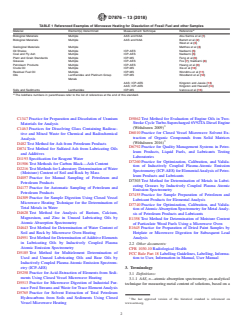
1.3.1 Some examples of actual use of microwave heating for elemental analysis of fossil fuel products and other materials are given in Table 1. (A) The boldface numbers in parentheses refer to the list of references at the end of this standard.
1.3.2 Some additional examples of ASTM methods for microwave assisted analysis in the non-fossil fuels area are included in Appendix X1.
1.4 During the sample dissolution, the samples may be decomposed with a variety of acid mixture(s). It is beyond the scope of this practice to specify appropriate acid mixtures for all possible combinations of elements present in all types of samples. But if the dissolution results in any visible insoluble material, this practice may not be applicable for the type of sample being analyzed, assuming the insoluble material contains some of the analytes of interest.
1.5 It is possible that this microwave-assisted decomposition procedure may lead to a loss of “volatile” elements such as arsenic, boron, chromium, mercury, antimony, selenium, and/or tin from the samples. Chemical species of the elements is also a concern in such dissol...
- Status
- Published
- Publication Date
- 31-Mar-2018
- Technical Committee
- D02 - Petroleum Products, Liquid Fuels, and Lubricants
- Drafting Committee
- D02.03 - Elemental Analysis
Overview
ASTM D7876-13(2018): Standard Practice for Sample Decomposition Using Microwave Heating (With or Without Prior Ashing) for Atomic Spectroscopic Elemental Determination in Petroleum Products and Lubricants provides guidance on preparing petroleum and lubricant samples for elemental analysis by atomic spectroscopy. Developed by ASTM, this international standard outlines a method that leverages microwave heating-offering fast, efficient, and controlled sample decomposition, minimizing contamination and volatile element losses compared to traditional open vessel and acid digestion techniques.
This practice is particularly relevant for laboratories performing trace elemental analysis on a wide variety of petroleum products, lubricants, greases, additives, gasolines, diesels, as well as other fossil fuel products such as coal, fly ash, coke, and oil shale.
Key Topics
- Microwave-Assisted Decomposition: This process uses microwave radiation to rapidly decompose samples, utilizing sealed vessels to achieve higher internal temperatures and pressures than conventional open vessel acid digestion.
- Elemental Determination: The practice primarily supports inductively coupled plasma atomic emission spectrometry (ICP-AES) and atomic absorption spectrometry (AAS), but can be adapted for other atomic spectrometric techniques if enhanced sensitivity is required.
- Contamination and Volatile Loss Control: Sealed microwave digestion significantly reduces the risk of losing volatile elements like arsenic, boron, chromium, mercury, antimony, selenium, and tin, and improves control over blank contamination.
- Sample and Vessel Selection: The standard offers guidelines for selecting appropriate acid mixtures, digestion vessels (PTFE, quartz, etc.), and ensures best practices for cleaning and safety to minimize cross-contamination and risk.
- Safety Considerations: Proper safety protocols for handling pressurized vessels and corrosive acids are emphasized, along with adherence to manufacturer instructions and regulatory requirements for microwave devices.
Applications
ASTM D7876-13(2018) delivers proven value in laboratories and industrial settings where precise elemental analysis of petroleum-based and fossil fuel samples is required:
- Analytical Labs in Petroleum & Lubricant Industry: Rapidly prepare gasoline, diesel, lubricating oils, and greases for spectroscopic trace metal determination.
- Environmental and Quality Control: Analyze additives and explore contamination or trace elements in stored fuels and lubricants.
- Fossil Fuel Research: Decompose coal, fly ash, coke, oil shale, and related materials for comprehensive multi-element studies.
- Regulatory Compliance: Meet national and international requirements for analytical results, ensuring method consistency and accuracy.
- Expanded Scope: Applicability also extends to non-fossil fuel matrices where microwave digestion is appropriate, including biological and geological materials when using referenced techniques in this standard.
Related Standards
For laboratories implementing this standard, familiarity with related ASTM practices and test methods enhances reliability and coverage:
- ASTM D7455: Sample preparation of petroleum and lubricant products for elemental analysis
- ASTM D482 / D874: Ash and sulfated ash determination in petroleum products and lubricants
- ASTM D4057 / D4177: Manual and automatic sampling of petroleum products
- ASTM D4951 / D5185: Multi-element determination in used and unused oils by ICP-AES
- ASTM D7303: Determination of metals in lubricating greases by ICP
- ASTM D6792: Quality management for petroleum products testing laboratories
By adopting ASTM D7876, laboratories benefit from standardized, efficient, and safe sample decomposition, supporting robust atomic spectroscopic analysis crucial to petroleum product quality, regulatory compliance, and research. For further details and purchasing the standard, visit the ASTM International website.
Relations
- Effective Date
- 01-Nov-2023
- Effective Date
- 01-Oct-2023
- Effective Date
- 01-Jul-2020
- Effective Date
- 01-May-2019
- Effective Date
- 01-May-2019
- Effective Date
- 01-May-2019
- Effective Date
- 01-Apr-2019
- Effective Date
- 01-Mar-2019
- Effective Date
- 01-Feb-2019
- Effective Date
- 01-Apr-2018
- Effective Date
- 01-Feb-2018
- Effective Date
- 01-Feb-2017
- Effective Date
- 01-Apr-2016
- Effective Date
- 01-Jan-2016
- Effective Date
- 01-Jan-2016
Get Certified
Connect with accredited certification bodies for this standard

Element Materials Technology
Materials testing and product certification.

ABS Group Brazil
ABS Group certification services in Brazil.

ABS Quality Evaluations Inc.
American Bureau of Shipping quality certification.
Sponsored listings
Frequently Asked Questions
ASTM D7876-13(2018) is a standard published by ASTM International. Its full title is "Standard Practice for Practice for Sample Decomposition Using Microwave Heating (With or Without Prior Ashing) for Atomic Spectroscopic Elemental Determination in Petroleum Products and Lubricants". This standard covers: SIGNIFICANCE AND USE 5.1 Often it is necessary to dissolve the sample, particularly if it is a solid, before atomic spectroscopic measurements. It is advantageous to use a microwave oven for dissolution of such samples since it is a far more rapid way of dissolving the samples instead of using the traditional procedures of dissolving the samples in acid solutions using a pressure decomposition vessel, or other means. 5.2 The advantage of microwave dissolution includes faster digestion that results from the high temperature and pressure attained inside the sealed containers. The use of closed vessels also makes it possible to eliminate uncontrolled trace element losses of volatile species that are present in a sample or that are formed during sample dissolution. Volatile elements arsenic, boron, chromium, mercury, antimony, selenium, and tin may be lost with some open vessel acid dissolution procedures. Another advantage of microwave aided dissolution is to have better control of potential contamination in blank as compared to open vessel procedures. This is due to less contamination from laboratory environment, unclean containers, and smaller quantity of reagents used (9). 5.3 Because of the differences among various makes and models of satisfactory devices, no detailed operating instructions can be provided. Instead, the analyst should follow the instructions provided by the manufacturer of the particular device. 5.4 Mechanism of Microwave Heating—Microwaves have the capability to heat one material much more rapidly than another since materials vary greatly in their ability to absorb microwaves depending upon their polarities. Microwave oven is acting as a source of intense energy to rapidly heat the sample. However, a chemical reaction is still necessary to complete the dissolution of the sample into acid mixtures. Microwave heating is internal as well as external as opposed to the conventional heating which is only external. Better contact between the sample particles and th... SCOPE 1.1 This practice covers the procedure for use of microwave radiation for sample decomposition prior to elemental determination by atomic spectroscopy. 1.1.1 Although this practice is based on the use of inductively coupled plasma atomic emission spectrometry (ICP-AES) and atomic absorption spectrometry (AAS) as the primary measurement techniques, other atomic spectrometric techniques may be used if lower detection limits are required and the analytical performance criteria are achieved. 1.2 This practice is applicable to both petroleum products and lubricants such as greases, additives, lubricating oils, gasolines, and diesels. 1.3 Although not a part of Committee D02’s jurisdiction, this practice is also applicable to other fossil fuel products such as coal, fly ash, coal ash, coke, and oil shale. 1.3.1 Some examples of actual use of microwave heating for elemental analysis of fossil fuel products and other materials are given in Table 1. (A) The boldface numbers in parentheses refer to the list of references at the end of this standard. 1.3.2 Some additional examples of ASTM methods for microwave assisted analysis in the non-fossil fuels area are included in Appendix X1. 1.4 During the sample dissolution, the samples may be decomposed with a variety of acid mixture(s). It is beyond the scope of this practice to specify appropriate acid mixtures for all possible combinations of elements present in all types of samples. But if the dissolution results in any visible insoluble material, this practice may not be applicable for the type of sample being analyzed, assuming the insoluble material contains some of the analytes of interest. 1.5 It is possible that this microwave-assisted decomposition procedure may lead to a loss of “volatile” elements such as arsenic, boron, chromium, mercury, antimony, selenium, and/or tin from the samples. Chemical species of the elements is also a concern in such dissol...
SIGNIFICANCE AND USE 5.1 Often it is necessary to dissolve the sample, particularly if it is a solid, before atomic spectroscopic measurements. It is advantageous to use a microwave oven for dissolution of such samples since it is a far more rapid way of dissolving the samples instead of using the traditional procedures of dissolving the samples in acid solutions using a pressure decomposition vessel, or other means. 5.2 The advantage of microwave dissolution includes faster digestion that results from the high temperature and pressure attained inside the sealed containers. The use of closed vessels also makes it possible to eliminate uncontrolled trace element losses of volatile species that are present in a sample or that are formed during sample dissolution. Volatile elements arsenic, boron, chromium, mercury, antimony, selenium, and tin may be lost with some open vessel acid dissolution procedures. Another advantage of microwave aided dissolution is to have better control of potential contamination in blank as compared to open vessel procedures. This is due to less contamination from laboratory environment, unclean containers, and smaller quantity of reagents used (9). 5.3 Because of the differences among various makes and models of satisfactory devices, no detailed operating instructions can be provided. Instead, the analyst should follow the instructions provided by the manufacturer of the particular device. 5.4 Mechanism of Microwave Heating—Microwaves have the capability to heat one material much more rapidly than another since materials vary greatly in their ability to absorb microwaves depending upon their polarities. Microwave oven is acting as a source of intense energy to rapidly heat the sample. However, a chemical reaction is still necessary to complete the dissolution of the sample into acid mixtures. Microwave heating is internal as well as external as opposed to the conventional heating which is only external. Better contact between the sample particles and th... SCOPE 1.1 This practice covers the procedure for use of microwave radiation for sample decomposition prior to elemental determination by atomic spectroscopy. 1.1.1 Although this practice is based on the use of inductively coupled plasma atomic emission spectrometry (ICP-AES) and atomic absorption spectrometry (AAS) as the primary measurement techniques, other atomic spectrometric techniques may be used if lower detection limits are required and the analytical performance criteria are achieved. 1.2 This practice is applicable to both petroleum products and lubricants such as greases, additives, lubricating oils, gasolines, and diesels. 1.3 Although not a part of Committee D02’s jurisdiction, this practice is also applicable to other fossil fuel products such as coal, fly ash, coal ash, coke, and oil shale. 1.3.1 Some examples of actual use of microwave heating for elemental analysis of fossil fuel products and other materials are given in Table 1. (A) The boldface numbers in parentheses refer to the list of references at the end of this standard. 1.3.2 Some additional examples of ASTM methods for microwave assisted analysis in the non-fossil fuels area are included in Appendix X1. 1.4 During the sample dissolution, the samples may be decomposed with a variety of acid mixture(s). It is beyond the scope of this practice to specify appropriate acid mixtures for all possible combinations of elements present in all types of samples. But if the dissolution results in any visible insoluble material, this practice may not be applicable for the type of sample being analyzed, assuming the insoluble material contains some of the analytes of interest. 1.5 It is possible that this microwave-assisted decomposition procedure may lead to a loss of “volatile” elements such as arsenic, boron, chromium, mercury, antimony, selenium, and/or tin from the samples. Chemical species of the elements is also a concern in such dissol...
ASTM D7876-13(2018) is classified under the following ICS (International Classification for Standards) categories: 75.080 - Petroleum products in general; 75.100 - Lubricants, industrial oils and related products. The ICS classification helps identify the subject area and facilitates finding related standards.
ASTM D7876-13(2018) has the following relationships with other standards: It is inter standard links to ASTM D6792-23c, ASTM D6792-23b, ASTM D7740-20, ASTM D7455-19, ASTM D7260-19, ASTM C1234-11(2019), ASTM E1358-97(2019), ASTM D2216-19, ASTM C1463-19, ASTM D5185-18, ASTM D4309-18, ASTM D4643-17, ASTM C1234-11(2016), ASTM D5765-16, ASTM E1645-01(2016)e1. Understanding these relationships helps ensure you are using the most current and applicable version of the standard.
ASTM D7876-13(2018) is available in PDF format for immediate download after purchase. The document can be added to your cart and obtained through the secure checkout process. Digital delivery ensures instant access to the complete standard document.
Standards Content (Sample)
This international standard was developed in accordance with internationally recognized principles on standardization established in the Decision on Principles for the
Development of International Standards, Guides and Recommendations issued by the World Trade Organization Technical Barriers to Trade (TBT) Committee.
Designation: D7876 − 13 (Reapproved 2018)
Standard Practice for
Practice for Sample Decomposition Using Microwave
Heating (With or Without Prior Ashing) for Atomic
Spectroscopic Elemental Determination in Petroleum
Products and Lubricants
This standard is issued under the fixed designation D7876; the number immediately following the designation indicates the year of
original adoption or, in the case of revision, the year of last revision. A number in parentheses indicates the year of last reapproval. A
superscript epsilon (´) indicates an editorial change since the last revision or reapproval.
1. Scope arsenic, boron, chromium, mercury, antimony, selenium,
and/or tin from the samples. Chemical species of the elements
1.1 This practice covers the procedure for use of microwave
is also a concern in such dissolutions since some species may
radiation for sample decomposition prior to elemental deter-
not be digested and have a different sample introduction
mination by atomic spectroscopy.
efficiency.
1.1.1 Although this practice is based on the use of induc-
tively coupled plasma atomic emission spectrometry (ICP- 1.6 A reference material or suitable NIST Standard Refer-
AES) and atomic absorption spectrometry (AAS) as the ence Material should be used to confirm the recovery of
primary measurement techniques, other atomic spectrometric analytes.Ifthesearenotavailable,thesampleshouldbespiked
techniques may be used if lower detection limits are required with a known concentration of analyte prior to microwave
and the analytical performance criteria are achieved. digestion.
1.2 This practice is applicable to both petroleum products 1.7 Additional information on sample preparation proce-
and lubricants such as greases, additives, lubricating oils, dures for elemental analysis of petroleum products and lubri-
gasolines, and diesels. cants can be found in Practice D7455.
1.3 Although not a part of Committee D02’s jurisdiction, 1.8 The values stated in SI units are to be regarded as
thispracticeisalsoapplicabletootherfossilfuelproductssuch standard. No other units of measurement are included in this
as coal, fly ash, coal ash, coke, and oil shale. standard.
1.3.1 Someexamplesofactualuseofmicrowaveheatingfor
1.9 This standard does not purport to address all of the
elemental analysis of fossil fuel products and other materials
safety concerns, if any, associated with its use. It is the
are given in Table 1.
responsibility of the user of this standard to establish appro-
1.3.2 Some additional examples of ASTM methods for
priate safety, health, and environmental practices and deter-
microwave assisted analysis in the non-fossil fuels area are
mine the applicability of regulatory limitations prior to use.
included in Appendix X1.
Specific warning statements are given in Sections 6 and 7.
1.10 This international standard was developed in accor-
1.4 During the sample dissolution, the samples may be
dance with internationally recognized principles on standard-
decomposed with a variety of acid mixture(s). It is beyond the
ization established in the Decision on Principles for the
scope of this practice to specify appropriate acid mixtures for
Development of International Standards, Guides and Recom-
all possible combinations of elements present in all types of
mendations issued by the World Trade Organization Technical
samples. But if the dissolution results in any visible insoluble
Barriers to Trade (TBT) Committee.
material, this practice may not be applicable for the type of
sample being analyzed, assuming the insoluble material con-
2. Referenced Documents
tains some of the analytes of interest.
2.1 ASTM Standards:
1.5 It is possible that this microwave-assisted decomposi-
C1234 Practice for Preparation of Oils and Oily Waste
tionproceduremayleadtoalossof“volatile”elementssuchas
Samples by High-Pressure, High-Temperature Digestion
for Trace Element Determinations
This practice is under the jurisdiction ofASTM Committee D02 on Petroleum
Products, Liquid Fuels, and Lubricants and is the direct responsibility of Subcom-
mittee D02.03 on Elemental Analysis. For referenced ASTM standards, visit the ASTM website, www.astm.org, or
Current edition approved April 1, 2018. Published June 2018. Originally contact ASTM Customer Service at service@astm.org. For Annual Book of ASTM
approved in 2013. Last previous edition approved in 2013 as D7876 – 13. DOI: Standards volume information, refer to the standard’s Document Summary page on
10.1520/D7876-13R18. the ASTM website.
Copyright © ASTM International, 100 Barr Harbor Drive, PO Box C700, West Conshohocken, PA 19428-2959. United States
D7876 − 13 (2018)
TABLE 1 Referenced Examples of Microwave Heating for Dissolution of Fossil Fuel and other Samples
A
Material Element(s) Determined Measurement Technique Reference
Biological Materials Multiple AAS and NAA Abu Samra et al (1)
Biological Materials Multiple AAS and NAA Barrett et al (2)
West et al (3)
Geological Materials Multiple Matthes et al (4)
Oil Shales Multiple ICP-AES Nadkarni (5)
Coal and Fly Ash Multiple ICP-AES Nadkarni (5)
Plant and Grain Standards Multiple ICP-MS Feng et al (6)
Greases Multiple ICP-AES Fox (7); Nadkarni (8)
Petroleum Products Multiple ICP-AES Hwang et al (9)
Crude Oil Multiple ICP-MS Xie et al (10)
Residual Fuel Oil Multiple ICP-MS Wondimu et al (11)
Oils Lanthanides and Platinum Group ICP-MS Woodland et al (12)
Metals
AAS; ICP-AES Kingston and Jassie (13)
AAS; ICP-AES Kingston and Haswell (14)
Soils and Sediments Lanthanides ICP-MS Ivanova et al (15)
A
The boldface numbers in parentheses refer to the list of references at the end of this standard.
C1347 Practice for Preparation and Dissolution of Uranium D5862 Test Method for Evaluation of Engine Oils in Two-
Materials for Analysis Stroke Cycle Turbo-Supercharged 6V92TADiesel Engine
(Withdrawn 2009)
C1463 Practices for Dissolving Glass Containing Radioac-
D6010 Practice for Closed Vessel Microwave Solvent Ex-
tive and Mixed Waste for Chemical and Radiochemical
traction of Organic Compounds from Solid Matrices
Analysis
(Withdrawn 2016)
D482 Test Method for Ash from Petroleum Products
D6792 Practice for Quality Management Systems in Petro-
D874 Test Method for Sulfated Ash from Lubricating Oils
leum Products, Liquid Fuels, and Lubricants Testing
and Additives
Laboratories
D1193 Specification for Reagent Water
D7260 Practice for Optimization, Calibration, and Valida-
D1506 Test Methods for Carbon Black—Ash Content
tion of Inductively Coupled Plasma-Atomic Emission
D2216 Test Methods for Laboratory Determination of Water
Spectrometry (ICP-AES) for ElementalAnalysis of Petro-
(Moisture) Content of Soil and Rock by Mass
leum Products and Lubricants
D4057 Practice for Manual Sampling of Petroleum and
D7303 Test Method for Determination of Metals in Lubri-
Petroleum Products
cating Greases by Inductively Coupled Plasma Atomic
D4177 Practice for Automatic Sampling of Petroleum and
Emission Spectrometry
Petroleum Products
D7455 Practice for Sample Preparation of Petroleum and
D4309 Practice for Sample Digestion Using Closed Vessel
Lubricant Products for Elemental Analysis
Microwave Heating Technique for the Determination of
D7740 Practice for Optimization, Calibration, and Valida-
Total Metals in Water
tion ofAtomicAbsorption Spectrometry for MetalAnaly-
D4628 Test Method for Analysis of Barium, Calcium,
sis of Petroleum Products and Lubricants
Magnesium, and Zinc in Unused Lubricating Oils by
E1358 Test Method for Determination of Moisture Content
Atomic Absorption Spectrometry
of Particulate Wood Fuels Using a Microwave Oven
D4643 Test Method for Determination of Water Content of E1645 Practice for Preparation of Dried Paint Samples by
Soil and Rock by Microwave Oven Heating Hotplate or Microwave Digestion for Subsequent Lead
Analysis
D4951 Test Method for Determination ofAdditive Elements
in Lubricating Oils by Inductively Coupled Plasma
2.2 Other documents:
Atomic Emission Spectrometry
CFR 1030.10 Radiological Health
D5185 Test Method for Multielement Determination of
FCC Rule Part 18 Labelling Guidelines, Labelling, Informa-
Used and Unused Lubricating Oils and Base Oils by tion to User, Information in Manual, User Manual
Inductively Coupled Plasma Atomic Emission Spectrom-
3. Terminology
etry (ICP-AES)
D5258 Practice for Acid-Extraction of Elements from Sedi-
3.1 Definitions:
ments Using Closed Vessel Microwave Heating
3.1.1 AAS, n—atomic absorption spectrometry, an analytical
D5513 Practice for Microwave Digestion of Industrial Fur-
technique for measuring metal content of solutions, based on a
nace Feed Streams and Waste for Trace ElementAnalysis
D5765 Practice for Solvent Extraction of Total Petroleum
Hydrocarbons from Soils and Sediments Using Closed 3
The last approved version of this historical standard is referenced on
Vessel Microwave Heating www.astm.org.
D7876 − 13 (2018)
combination of flame source, hollow cathode lamp, 5. Significance and Use
photomultiplier, and a readout device. D7740
5.1 Often it is necessary to dissolve the sample, particularly
3.1.2 additive, n—a material added to another, usually in if it is a solid, before atomic spectroscopic measurements. It is
small quantities, to impart or enhance desirable properties or to advantageous to use a microwave oven for dissolution of such
samples since it is a far more rapid way of dissolving the
suppress undesirable properties. D5862
samples instead of using the traditional procedures of dissolv-
3.1.3 blank, n—solutionwhichissimilarincompositionand
ing the samples in acid solutions using a pressure decomposi-
contentstothesamplesolutionbutdoesnotcontaintheanalyte
tion vessel, or other means.
being measured. D7740
5.2 The advantage of microwave dissolution includes faster
3.1.4 certified reference material, n—a reference material
digestion that results from the high temperature and pressure
one or more of whose property values are certified by a
attained inside the sealed containers. The use of closed vessels
technically valid procedure, accompanied by a traceable cer-
also makes it possible to eliminate uncontrolled trace element
tificate or other documentation which is issued by a certifying
lossesofvolatilespeciesthatarepresentinasampleorthatare
body. D6792
formed during sample dissolution. Volatile elements arsenic,
3.1.5 dilution factor, n—ratio of the sample weight of the boron, chromium, mercury, antimony, selenium, and tin may
aliquot taken to the final diluted volume of the solution. be lost with some open vessel acid dissolution procedures.
Another advantage of microwave aided dissolution is to have
3.1.5.1 Discussion—The dilution factor is used to multiply
better control of potential contamination in blank as compared
the observed reading and obtain the actual concentration of the
to open vessel procedures. This is due to less contamination
analyte in the original sample. D7740
from laboratory environment, unclean containers, and smaller
3.1.6 ICP-AES, n—inductively coupled plasma atomic
quantity of reagents used (9).
emission spectrometry, a high temperature discharge generated
5.3 Because of the differences among various makes and
by passing an ionizable gas through a magnetic field induced
models of satisfactory devices, no detailed operating instruc-
by a radio frequency coil surrounding the tubes that carry gas.
tions can be provided. Instead, the analyst should follow the
The light emitted by excited atoms by this process is measured
instructions provided by the manufacturer of the particular
at fixed wavelengths specific to elements of interest and
device.
converted to their concentrations in a sample.
5.4 Mechanism of Microwave Heating—Microwaves have
3.1.7 reference material (RM), n—a material with accepted
the capability to heat one material much more rapidly than
reference value(s), accompanied by an uncertainty at a stated
another since materials vary greatly in their ability to absorb
level of confidence for desired properties, which may be used
microwaves depending upon their polarities. Microwave oven
for calibration or quality control purposes in the laboratory.
is acting as a source of intense energy to rapidly heat the
3.1.7.1 Discussion—Sometimes these may be prepared “in-
sample. However, a chemical reaction is still necessary to
house” provided the reference values are established using
complete the dissolution of the sample into acid mixtures.
accepted standard procedures. D6792
Microwave heating is internal as well as external as opposed to
3.1.8 standard reference material (SRM), n—trademark for
the conventional heating which is only external. Better contact
reference materials certified by National Institute of Standards
between the sample particles and the acids is the key to rapid
and Technology. D7740
dissolution. Thus, heavy nonporous materials such as fuel oils
or coke are not as efficiently dissolved by microwave heating.
4. Summary of Practice
Local internal heating taking place on individual particles can
result in the rupture of the particles, thus exposing a fresh
4.1 Aweighedportionofthesampleissubjectedtoalternate
surface to the reagent contact. Heated dielectric liquids (water/
means of sample dissolution which may include (optional)
acid) in contact with the dielectric particles generate heat
sulfated ashing in a muffle furnace followed by closed or open
orders of magnitude above the surface of a particle. This can
vesselmicrowavedigestioninacid(s).Ultimately,thesediluted
create large thermal convection currents which can agitate and
acid solutions are analyzed using AAS or ICP-AES. By
sweep away the stagnant surface layers of dissolved solution
comparing absorbance or emission intensities of elements in
and thus, expose fresh surface to fresh solution. Simple
the test specimen with those measured of the calibration
microwaveheatingalone,however,willnotbreakthechemical
standards, the concentrations of elements in the test specimen
bonds, since the proton energy is less than the strength of the
can be calculated.
chemical bond (5).
4.1.1 The final elemental determinations can also be done
5.4.1 In the electromagnetic irradiation zone, the combina-
using ICP-MS; cold vapor and hydride generation AFS/AAS
tion of the acid solution and the electromagnetic radiation
can be used for mercury and hydride forming elements;
results in near complete dissolution of the inorganic constitu-
however, there is no standard ASTM procedure for such work
ents in the carbonaceous solids. Evidently, the electromagnetic
at present.
energy promotes the reaction of the acid with the inorganic
4.2 Optimal conditions for microwave digestion depend on constituents thereby facilitating the dissolution of these con-
sample weight, composition, volume of digestion acid stituents without destroying any of the carbonaceous material.
reagents, and the microwave system used. It is believed that the electromagnetic radiation serves as a
D7876 − 13 (2018)
source of intense energy which rapidly heats the acid solution systems, sensors and interlocks for temperature and pressure
and the internal as well as the external portions of the control are introduced. Since different types of sample behave
individualparticlesintheslurry.Thisrapidandintenseinternal differently in microwave field, heating control is necessary in
heating either facilitates the diffusion processes of the inor- this operation (19).
5.4.4 Microwave heating occurs because microwave reac-
ganic constituents in solution or ruptures the individual par-
ticles thereby exposing additional inorganic constituents to the tors generate an electromagnetic field that interacts with
polarizable molecules or ions in the materials.As the polarized
reactive acid. The heat generated in the aqueous liquid itself
will vary at different points around the liquid-solid interface species compete to align their dipoles with the oscillating field,
they rotate, migrate, and rub against each other, causing them
and this may create large thermal convection currents which
to heat up. This microwave effect differs from indirect heating
can agitate and sweep away the spent acid solution containing
by conduction achieved by using a hot plate (20).
dissolved inorganic constituents from the surface layers of the
carbonaceous particles thus exposing the particle surfaces to
fresh acid (16). 6. Apparatus
5.4.2 Unlike other heating mechanisms, true control of
6.1 Analytical Balance, capable of weighing to 0.001 g or
microwave heating is possible because stopping of the appli-
0.0001 g, capacity of 150 g.
cation of energy instantly halts the heating (except the exo-
6.2 Atomic Absorption Spectrometer, with appropriate hol-
therms which can be rapid when pure compounds are di-
low cathode lamps for analytes of interest, readout, and so
gested). The direction of heat flow is reversed from
forth.
conventional heating, as microwave energy is absorbed by the
6.3 Inductively Coupled Plasma Atomic Emission
contents of the container, energy is converted to heat, and the
Spectrometer—Either a sequential or simultaneous spectrom-
bulk temperature of the contents rises. Heat is transferred from
eter is suitable, if equipped with a quartz ICP torch and RF
the reagent and sample mixture to the container and dissipated
generator to form and sustain the plasma. Suggested wave-
through conduction to the surrounding atmosphere. Newer
lengths for the determinations of elements in dissolved acid
synthesized containers made up of light yet strong polymers
solutions are given in Table 2. These wavelengths are only
can withstand over 240 °C temperatures and over 800 psi
suggested and do not represent all possible choices. Wave-
pressure. During the digestion process of samples containing
lengths for boron, phosphorus, and sulfur below 190 nm
organic compounds, largely insoluble gases such as CO are
require that a vacuum or inert gas purge optical path be used in
formed.These gases combine with the vapor pressure from the
ICP-AES instrument.
reagents, at any temperature, to produce the total pressure
inside the vessel. Since the heat flow from a microwave
6.4 Microwave Oven, commercially available laboratory
digestion vessel is reversed from that of resistive devices, the microwave digestion oven of sufficient power is suitable. The
total pressures generated for microwave dissolutions are sig-
units should be capable of 1 % power adjustment and 1 s time
nificantlyloweratthesametemperaturethanothercomparably adjustment. The oven cavity should be fluorocarbon- coated or
heated devices or systems. This means larger samples can be coated with a material that has equivalent acid resistance and
digestedathighertemperaturesandlowerpressuresthanwould microwavepropertiesandbeequippedwithexhaustventilation
3 3
normally be expected from such pressurized vessels. Sample at2.8 m /min(100 ft /min)foracidvaporprotectionoftheunit
size should be controlled to prevent rapid exotherm rupture, and operator. The unit must have a rotating or alternating
turntable, capable of holding multiple digestion vessels, to
exacerbated by excess CO generation. However, the pressure
limitations of the vessel still restrict both the sample size that ensure even sample heating. Safety interlocks, to shut off
magnetron power output, must be contained in the oven door
can be used and the maximum temperature that can be
achieved due to the vapor pressure resulting from the reagents opening mechanism. The unit may contain a temperature
control device capable of controlling vessel pressure to a
(17).
minimum of 100 psig.
5.4.3 Organic and polymer samples can be especially prob-
6.4.1 The unit must comply with U. S. Health and Human
lematic because they are highly volatile and produce large
Services Standards under CFR Part 1030.10, sub parts (C) (1),
amounts of gaseous by-products such as CO and NO.Asa
2 x
(C) (2), and (C) (3), for microwave leakage. The unit should
result larger sample sizes will produce higher pressures inside
have FCC-type approval for operations under FCC Rule Part
the digestion vessel. Generally, no more than 1 g of these
18.
sample types can be digested in a closed vessel (18).
5.4.3.1 Whileinopendigestionvesselsystemstheoperating 6.5 Sample Digestion system with Closed Vessel, quartz or
temperatures are limited by the acid solutions’ boiling points, polytetrafluoroethylene (PTFE) digestion vessels capable of
temperatures in the 200 °C to 260 °C range can be typically holding 100 mL of solution. The vessel must be transparent to
achieved in sealed digestion vessels. This results in a dramatic microwave energy and capable of withstanding internal pres-
acceleration of the reaction kinetics, allowing the digestion sures of 100 psig and temperatures of 200 °C generated from
reactions to be carried out in a shorter time period. The higher the digestion of 0.2 g of sample. (Pressure achieved with a
temperatures, however, result in a pressure increase in the 100 mL vessel and 0.2 g of sample could be in excess of
vessel and thus in a potential safety hazard. Rapid heating of 100 psi).The vessel must contain a safety pressure relief valve,
the sample solution can induce exothermic reactions during the rupture disc, pressure venting system or be connected to an
digestion process. Therefore in modern microwave digestion external safety relief valve that will prevent possible vessel
D7876 − 13 (2018)
TABLE 2 Suggested Wavelengths for Some Elements Determined after Sample Digestion
Element AAS Wavelength, nm ICP-AES Wavelength, nm
Aluminum 393.1, 309.27 167.038, 308.22, 396.15, 309.27
Antimony 217.58 206.83, 217.58, 231.15
Barium 553.6 223.53, 233.527, 455.40, 493.41
Boron 249.77 249.77, 208.96
Calcium 422.67 315.88, 317.93, 364.4, 396.85, 422.67
Chromium 357.87 267.72, 357.87
Copper 324.75 324.75, 327.40
Iron 248.3, 372.0 238.20, 259.94
Lithium 670.78 670.78, 610.36, 460.29
Magnesium 285.2 279.08, 279.55, 280.278, 285.21
Manganese 279.2 257.61, 293.31
Molybdenum 313.3 135.387, 202.03, 281.62
Nickel 232.0, 341.48 231.60, 341.48
Phosphorus - - 177.51, 178.29, 213.62, 214.91, 253.40
Potassium 766.49 766.49, 404.72
Silicon 251.618 288.16, 251.618
Sodium 589.595 589.595
Vanadium 318.4 292.40, 290.88
Zinc 213.86, 398.8 202.55, 206.20, 213.86, 334.58, 481.05
rupture or ejection of the vessel cap. Microwave digestion corrosion of the equipment. Acid fumes generated inside the
systems with temperature and pressure monitoring devices are oven cavity should be air swept away from the oven cavity to
recommended for safety of personnel and accuracy of sample a hood.)
preparation.
6.9 Combustion Dishes, Vycor, quartz, or platinum evapo-
6.5.1 The closed vessel should be operated in accordance
ration dishes of 250 mL size.
with the manufacturer’s recommended operating and safety
instructions. 6.10 Volumetric Flasks, polypropylene or similar materials
of 25 mL, 50 mL, or 100 mL sizes.
NOTE 1—Follow the manufacturer’s suggested vessel cleaning instruc-
tions to avoid possible sample contamination.
6.11 Electric Muffle Furnace, capable of maintaining
6.5.2 The microwave digestion dishes are also commer- 525 °C 6 25 °C and sufficiently large to accommodate several
cially available. (Warning—Take all necessary precautions to 250 mL Vycor beakers. The capacity of an air bleed is
prevent exposure to radiofrequency (RF) radiation. See Sec- advantageous and optional. (Warning—Take all necessary
tions 6 and 9 for specifics.) precautions to prevent exposure to very hot surfaces.)
6.6 For cleaning the microwave vessels follow the manu-
6.12 Heating Lamp, commercial infrared heating lamp.
facturer’s recommended cleaning procedure. Commonly, soak
6.13 Specimen Solution Containers, of appropriate size,
thefluoropolymervesselpartsincleaningsolution(1:1mixture
glass or polyolefin vials or bottles, with screw caps without
of nitric acid and water) at 60 °C for 10 min. Other suitable
metal liners, to prevent trace element contamination.
cleaning reagents may be used if appropriate. Remove the
vesselpartsfromthecleaningsolutionandthoroughlyrinsethe
7. Reagents and Materials
parts with tap water and then with reagent water. Allow the
vessel parts to air-dry or wipe dry using a clean, soft cloth.
7.1 Purity of Reagents—At a minimum, reagent grade
chemicals shall be used in all tests. When ICP-MS analysis is
6.7 The sample digestion system requires essentially micro-
desired, the reagents should be of ultra-pure quality. Unless
wave transparent and reagent resistant suitably inert polymeric
otherwise indicated, it is intended that all reagents conform to
materials (examples are PFA or TFM) to contain acids and
the specifications of the Committee on Analytical Reagents of
samples. For higher pressure capabilities, the vessel may be
the American Chemical Society where such specifications are
contained within layers of different microwave transparent
available. Other grades may be used, provided it is first
materials for strength, durability, and safety. The vessels
ascertained that the reagent is of sufficiently high purity to
internalvolumeshouldbeatleast45 mL,capableofwithstand-
permit its use without lessening the accuracy of the determi-
ing pressures of at least 30 atm (30 bar or 435 psi), and
nation.
capable of controlled pressure relief. These specifications are
given to provide an appropriate, safe, and durable reaction
7.2 Concentrated Sulfuric, Nitric, Hydrochloric, Perchloric,
vessel of which there are many adequate designs by many
and/or Hydrofluoric Acids, as needed. (Warning—Causes
commercial suppliers.
severe burns. Corrosive.) (Warning—Hydrofluoric acid is
6.8 Rotating Turntable, to ensure homogenous distribution poisonous and must be handled with care as it causes painful
of microwave radiation within most systems. The speed of the sores on the skin usually noticed on the next day only. Avoid
turntable should be a minimum of 3 r⁄min. (Warning—It is inhaling the fumes. Liquid or vapor causes severe irritation of
not recommended to place a microwave unit in a fume hood, eyes. Skin contact causes severe burns. Wash the skin with
where it is surrounded by acid fumes, which can cause copious amounts of water. HF should not be used in the
D7876 − 13 (2018)
volume of mineral acids are added to it before sealing the vessel and
laboratory unless there is antidote material such as calcium
subjecting it to microwave radiation.
gluconate or other remedies are on hand.)
9.2.2 Wash the dissolved and clear content of the vessel into
7.3 Aqueous Standard Solutions, individual aqueous el-
a 50 mL volumetric flask and bring up to volume with water.
emental solution calibration standards in appropriate concen-
trationrangesofelementsofinterest.Thesecanbepreparedby
9.3 Closed Vessel Microwave Oven Dissolution:
dissolving pure metal compounds in water or dilute acids, or 9.3.1 Accurately weigh about 0.1 g to 1 g of the sample in a
may be purchased from commercial sources.
TFE-fluoroc
...