

ASTM D6927-22
(Test Method)Standard Test Method for Marshall Stability and Flow of Asphalt Mixtures
General Information
- Abstract
SIGNIFICANCE AND USE
4.1 Marshall stability and flow values along with density, air voids in the total mix, voids in the mineral aggregate, or voids filled with asphalt binder, or both, filled with asphalt binder are used for laboratory mix design and evaluation of asphalt mixtures. In addition, Marshall stability and flow can be used to monitor the plant process of producing asphalt mixture. Marshall stability and flow may also be used to relatively evaluate different mixes and the effects of conditioning such as with water.
4.1.1 Marshall stability and flow are asphalt mixture characteristics determined from tests of compacted specimens of a specified geometry. The Marshall Test can be conducted with two different types of equipment: (1) Method A—using a loading frame with a load ring and a dial gauge for deformation or flow meter (Traditional Method); or (2) Method B—using a load-deformation recorder in conjunction with a load cell and linear variable differential transducer (LVDT) or other automatic recording device (Automated Method).
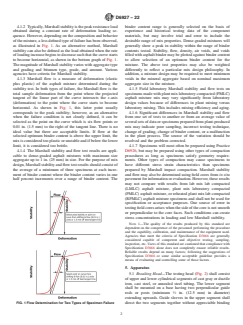
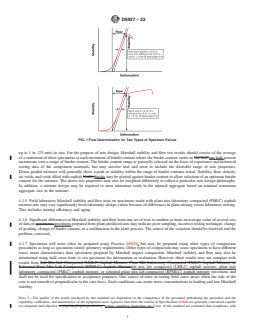
4.1.2 Typically, Marshall stability is the peak resistance load obtained during a constant rate of deformation loading sequence. However, depending on the composition and behavior of the mixture, a less defined type of failure has been observed, as illustrated in Fig. 1. As an alternative method, Marshall stability can also be defined as the load obtained when the rate of loading increase begins to decrease such that the curve starts to become horizontal, as shown in the bottom graph of Fig. 1. The magnitude of Marshall stability varies with aggregate type and grading and bitumen type, grade, and amount. Various agencies have criteria for Marshall stability.
FIG. 1 Flow Determination for Two Types of Specimen Failure
4.1.3 Marshall flow is a measure of deformation (elastic plus plastic) of the asphalt mixture determined during the stability test. In both types of failure, the Marshall flow is the total sample deformation from the point whe...
SCOPE
1.1 This test method covers measurement of resistance to plastic flow of 4 in. (102 mm) cylindrical specimens of asphalt mixture loaded in a direction perpendicular to the cylindrical axis by means of the Marshall apparatus. This test method is for use with dense-graded asphalt mixtures prepared with asphalt binder (modified and unmodified) with maximum size aggregate up to 1 in. (25 mm) in size (passing 1 in. (25 mm) sieve).
1.2 Units—The values stated in inch-pound units are to be regarded as standard. The values given in parentheses are mathematical conversions to SI units that are provided for information only and are not considered standard.
1.3 The text of this standard references notes and footnotes which provide explanatory material. These notes and footnotes (excluding those in tables and figures) shall not be considered as requirements of the standard.
1.4 This standard does not purport to address all of the safety concerns, if any, associated with its use. It is the responsibility of the user of this standard to establish appropriate safety, health, and environmental practices and determine the applicability of regulatory limitations prior to use.
1.5 This international standard was developed in accordance with internationally recognized principles on standardization established in the Decision on Principles for the Development of International Standards, Guides and Recommendations issued by the World Trade Organization Technical Barriers to Trade (TBT) Committee.
- Status
- Published
- Publication Date
- 31-Oct-2022
- Technical Committee
- D04 - Road and Paving Materials
- Drafting Committee
- D04.20 - Mechanical Tests of Asphalt Mixtures
Overview
ASTM D6927-22, Standard Test Method for Marshall Stability and Flow of Asphalt Mixtures, is an internationally recognized ASTM standard that outlines the procedure for determining the resistance to plastic flow of 4-inch cylindrical specimens of dense-graded asphalt mixtures. Using the Marshall apparatus, this test evaluates two critical properties of asphalt: Marshall stability (the load carrying capacity) and flow (deformation under load). These parameters, along with measurements such as density, air voids, and voids filled with binder, are essential for the mix design, quality control, and performance assessment of asphalt paving mixtures.
Key Topics
- Marshall Stability: Measures the peak resistance load a compacted asphalt specimen can withstand before failure when subjected to loading at a constant deformation rate. It is a primary indicator of asphalt mix strength.
- Marshall Flow: Indicates the total deformation (both elastic and plastic) that the specimen undergoes up to the point of failure. This is tracked as the Marshall flow value and reflects mixture flexibility or brittleness.
- Laboratory and Plant Mix Evaluation: The test can assess both laboratory-mixed/compacted (LMLC) and plant-mixed laboratory compacted (PMLC) specimens, as well as reheated plant mix specimens.
- Equipment and Methods: The test accommodates both traditional (manual loading frame and dial gauge) and automated methods (load cell with electronic deformation recording devices).
- Mix Design Parameters: Results for stability, flow, density, air voids, and binder content can be plotted to select optimal mix proportions for asphalt performance and durability.
Applications
- Asphalt Mix Design: Marshall stability and flow, along with density and void characteristics, guide the formulation of asphalt mixtures to achieve required performance criteria. By evaluating data from multiple binder contents, the optimum asphalt binder proportion can be selected for consistent pavement quality.
- Production and Quality Control: The standard is used for ongoing monitoring of asphalt mix production at the plant, helping identify process deviations, changes in material grading, binder content fluctuations, or equipment issues that might affect mix quality.
- Comparative Evaluation: Different asphalt mixtures and conditioning treatments (such as moisture exposure) can be compared to assess their impact on mechanical performance.
- Laboratory and Field Testing: While primarily designed for laboratory-prepared specimens, this method can also be applied to field core samples to investigate in-place pavement conditions. However, results from field cores are primarily for evaluation and not specification compliance.
- Compliance and Troubleshooting: Consistent, significant differences in stability or flow measurements can indicate sampling errors, testing inaccuracies, or plant-based problems, guiding prompt corrective actions.
Related Standards
ASTM D6927-22 references and complements several other ASTM standards and practices critical to materials testing and asphalt mix evaluation:
- ASTM D6926: Practice for Preparation of Asphalt Mixture Specimens Using Marshall Apparatus
- ASTM D8: Terminology Relating to Materials for Roads and Pavements
- ASTM D1188/D1188M: Test Method for Bulk Specific Gravity and Density of Compacted Asphalt Mixtures Using Coated Samples
- ASTM D2726/D2726M: Test Method for Bulk Specific Gravity and Density of Non-Absorptive Compacted Asphalt Mixtures
- ASTM D3549/D3549M: Test Method for Thickness or Height of Compacted Asphalt Mixture Specimens
- ASTM D6752/D6752M: Test Method for Bulk Specific Gravity and Density Using Automatic Vacuum Sealing Method
- ASTM D3666: Specification for Minimum Requirements for Agencies Testing and Inspecting Road and Paving Materials
Keywords: Marshall stability, Marshall flow, asphalt mixtures, ASTM D6927, asphalt mix design, quality control, plastic flow, pavement evaluation, dense-graded asphalt mixtures.
Relations
- Effective Date
- 01-Feb-2024
- Effective Date
- 01-Jan-2024
- Effective Date
- 01-Nov-2023
- Effective Date
- 01-Jan-2020
- Effective Date
- 01-Aug-2019
- Effective Date
- 15-Dec-2018
- Effective Date
- 15-Aug-2018
- Effective Date
- 15-Aug-2018
- Effective Date
- 01-Jul-2018
- Effective Date
- 01-Feb-2018
- Effective Date
- 01-Oct-2017
- Effective Date
- 15-Jul-2017
- Effective Date
- 15-Jun-2017
- Effective Date
- 01-Jun-2017
- Effective Date
- 01-Jun-2017
Get Certified
Connect with accredited certification bodies for this standard

Zavod za gradbeništvo Slovenije (ZAG) - Inšpekcija
ZAG inspection body for construction products, structures, and materials.
Sponsored listings
Frequently Asked Questions
ASTM D6927-22 is a standard published by ASTM International. Its full title is "Standard Test Method for Marshall Stability and Flow of Asphalt Mixtures". This standard covers: SIGNIFICANCE AND USE 4.1 Marshall stability and flow values along with density, air voids in the total mix, voids in the mineral aggregate, or voids filled with asphalt binder, or both, filled with asphalt binder are used for laboratory mix design and evaluation of asphalt mixtures. In addition, Marshall stability and flow can be used to monitor the plant process of producing asphalt mixture. Marshall stability and flow may also be used to relatively evaluate different mixes and the effects of conditioning such as with water. 4.1.1 Marshall stability and flow are asphalt mixture characteristics determined from tests of compacted specimens of a specified geometry. The Marshall Test can be conducted with two different types of equipment: (1) Method A—using a loading frame with a load ring and a dial gauge for deformation or flow meter (Traditional Method); or (2) Method B—using a load-deformation recorder in conjunction with a load cell and linear variable differential transducer (LVDT) or other automatic recording device (Automated Method). 4.1.2 Typically, Marshall stability is the peak resistance load obtained during a constant rate of deformation loading sequence. However, depending on the composition and behavior of the mixture, a less defined type of failure has been observed, as illustrated in Fig. 1. As an alternative method, Marshall stability can also be defined as the load obtained when the rate of loading increase begins to decrease such that the curve starts to become horizontal, as shown in the bottom graph of Fig. 1. The magnitude of Marshall stability varies with aggregate type and grading and bitumen type, grade, and amount. Various agencies have criteria for Marshall stability. FIG. 1 Flow Determination for Two Types of Specimen Failure 4.1.3 Marshall flow is a measure of deformation (elastic plus plastic) of the asphalt mixture determined during the stability test. In both types of failure, the Marshall flow is the total sample deformation from the point whe... SCOPE 1.1 This test method covers measurement of resistance to plastic flow of 4 in. (102 mm) cylindrical specimens of asphalt mixture loaded in a direction perpendicular to the cylindrical axis by means of the Marshall apparatus. This test method is for use with dense-graded asphalt mixtures prepared with asphalt binder (modified and unmodified) with maximum size aggregate up to 1 in. (25 mm) in size (passing 1 in. (25 mm) sieve). 1.2 Units—The values stated in inch-pound units are to be regarded as standard. The values given in parentheses are mathematical conversions to SI units that are provided for information only and are not considered standard. 1.3 The text of this standard references notes and footnotes which provide explanatory material. These notes and footnotes (excluding those in tables and figures) shall not be considered as requirements of the standard. 1.4 This standard does not purport to address all of the safety concerns, if any, associated with its use. It is the responsibility of the user of this standard to establish appropriate safety, health, and environmental practices and determine the applicability of regulatory limitations prior to use. 1.5 This international standard was developed in accordance with internationally recognized principles on standardization established in the Decision on Principles for the Development of International Standards, Guides and Recommendations issued by the World Trade Organization Technical Barriers to Trade (TBT) Committee.
SIGNIFICANCE AND USE 4.1 Marshall stability and flow values along with density, air voids in the total mix, voids in the mineral aggregate, or voids filled with asphalt binder, or both, filled with asphalt binder are used for laboratory mix design and evaluation of asphalt mixtures. In addition, Marshall stability and flow can be used to monitor the plant process of producing asphalt mixture. Marshall stability and flow may also be used to relatively evaluate different mixes and the effects of conditioning such as with water. 4.1.1 Marshall stability and flow are asphalt mixture characteristics determined from tests of compacted specimens of a specified geometry. The Marshall Test can be conducted with two different types of equipment: (1) Method A—using a loading frame with a load ring and a dial gauge for deformation or flow meter (Traditional Method); or (2) Method B—using a load-deformation recorder in conjunction with a load cell and linear variable differential transducer (LVDT) or other automatic recording device (Automated Method). 4.1.2 Typically, Marshall stability is the peak resistance load obtained during a constant rate of deformation loading sequence. However, depending on the composition and behavior of the mixture, a less defined type of failure has been observed, as illustrated in Fig. 1. As an alternative method, Marshall stability can also be defined as the load obtained when the rate of loading increase begins to decrease such that the curve starts to become horizontal, as shown in the bottom graph of Fig. 1. The magnitude of Marshall stability varies with aggregate type and grading and bitumen type, grade, and amount. Various agencies have criteria for Marshall stability. FIG. 1 Flow Determination for Two Types of Specimen Failure 4.1.3 Marshall flow is a measure of deformation (elastic plus plastic) of the asphalt mixture determined during the stability test. In both types of failure, the Marshall flow is the total sample deformation from the point whe... SCOPE 1.1 This test method covers measurement of resistance to plastic flow of 4 in. (102 mm) cylindrical specimens of asphalt mixture loaded in a direction perpendicular to the cylindrical axis by means of the Marshall apparatus. This test method is for use with dense-graded asphalt mixtures prepared with asphalt binder (modified and unmodified) with maximum size aggregate up to 1 in. (25 mm) in size (passing 1 in. (25 mm) sieve). 1.2 Units—The values stated in inch-pound units are to be regarded as standard. The values given in parentheses are mathematical conversions to SI units that are provided for information only and are not considered standard. 1.3 The text of this standard references notes and footnotes which provide explanatory material. These notes and footnotes (excluding those in tables and figures) shall not be considered as requirements of the standard. 1.4 This standard does not purport to address all of the safety concerns, if any, associated with its use. It is the responsibility of the user of this standard to establish appropriate safety, health, and environmental practices and determine the applicability of regulatory limitations prior to use. 1.5 This international standard was developed in accordance with internationally recognized principles on standardization established in the Decision on Principles for the Development of International Standards, Guides and Recommendations issued by the World Trade Organization Technical Barriers to Trade (TBT) Committee.
ASTM D6927-22 is classified under the following ICS (International Classification for Standards) categories: 93.080.20 - Road construction materials. The ICS classification helps identify the subject area and facilitates finding related standards.
ASTM D6927-22 has the following relationships with other standards: It is inter standard links to ASTM C670-24a, ASTM C670-24, ASTM D6752/D6752M-23, ASTM D6926-20, ASTM D8-19, ASTM D8-18c, ASTM D6752/D6752M-18, ASTM D8-18b, ASTM D8-18a, ASTM D8-18, ASTM D3549/D3549M-17, ASTM D8-17c, ASTM D8-17b, ASTM D6752/D6752M-17, ASTM D2726/D2726M-17. Understanding these relationships helps ensure you are using the most current and applicable version of the standard.
ASTM D6927-22 is available in PDF format for immediate download after purchase. The document can be added to your cart and obtained through the secure checkout process. Digital delivery ensures instant access to the complete standard document.
Standards Content (Sample)
This international standard was developed in accordance with internationally recognized principles on standardization established in the Decision on Principles for the
Development of International Standards, Guides and Recommendations issued by the World Trade Organization Technical Barriers to Trade (TBT) Committee.
Designation: D6927 − 22
Standard Test Method for
Marshall Stability and Flow of Asphalt Mixtures
This standard is issued under the fixed designation D6927; the number immediately following the designation indicates the year of
original adoption or, in the case of revision, the year of last revision.Anumber in parentheses indicates the year of last reapproval.A
superscript epsilon (´) indicates an editorial change since the last revision or reapproval.
1. Scope D8Terminology Relating to Materials for Roads and Pave-
ments
1.1 This test method covers measurement of resistance to
D1188/D1188MTest Method for Bulk Specific Gravity and
plastic flow of 4 in. (102 mm) cylindrical specimens of asphalt
Density of Compacted Asphalt Mixtures Using Coated
mixture loaded in a direction perpendicular to the cylindrical
Samples
axis by means of the Marshall apparatus. This test method is
D2726/D2726MTest Method for Bulk Specific Gravity and
for use with dense-graded asphalt mixtures prepared with
Density of Non-Absorptive Compacted Asphalt Mixtures
asphalt binder (modified and unmodified) with maximum size
D3549/D3549MTest Method for Thickness or Height of
aggregate up to 1 in. (25 mm) in size (passing 1 in. (25 mm)
Compacted Asphalt Mixture Specimens
sieve).
D3666Specification for Minimum Requirements for Agen-
1.2 Units—The values stated in inch-pound units are to be
cies Testing and Inspecting Road and Paving Materials
regarded as standard. The values given in parentheses are
D6752/D6752MTest Method for Bulk Specific Gravity and
mathematical conversions to SI units that are provided for
Density of CompactedAsphalt Mixtures UsingAutomatic
information only and are not considered standard.
Vacuum Sealing Method
1.3 The text of this standard references notes and footnotes
D6926Practice for Preparation of Asphalt Mixture Speci-
which provide explanatory material.These notes and footnotes
mens Using Marshall Apparatus
(excluding those in tables and figures) shall not be considered
E2251Specification for Liquid-in-Glass ASTM Thermom-
as requirements of the standard.
eters with Low-Hazard Precision Liquids
1.4 This standard does not purport to address all of the
safety concerns, if any, associated with its use. It is the
3. Terminology
responsibility of the user of this standard to establish appro-
3.1 Definitions—For definitions of terms used in this test
priate safety, health, and environmental practices and deter-
method, refer to Terminology D8.
mine the applicability of regulatory limitations prior to use.
1.5 This international standard was developed in accor-
4. Significance and Use
dance with internationally recognized principles on standard-
ization established in the Decision on Principles for the
4.1 Marshallstabilityandflowvaluesalongwithdensity,air
Development of International Standards, Guides and Recom-
voids in the total mix, voids in the mineral aggregate, or voids
mendations issued by the World Trade Organization Technical
filledwithasphaltbinder,orboth,filledwithasphaltbinderare
Barriers to Trade (TBT) Committee.
used for laboratory mix design and evaluation of asphalt
mixtures. In addition, Marshall stability and flow can be used
2. Referenced Documents
to monitor the plant process of producing asphalt mixture.
2.1 ASTM Standards:
Marshall stability and flow may also be used to relatively
C670Practice for Preparing Precision and Bias Statements
evaluatedifferentmixesandtheeffectsofconditioningsuchas
for Test Methods for Construction Materials
with water.
4.1.1 Marshall stability and flow are asphalt mixture char-
acteristics determined from tests of compacted specimens of a
This test method is under the jurisdiction of ASTM Committee D04 on Road
and Paving Materials and is the direct responsibility of Subcommittee D04.20 on
specified geometry. The Marshall Test can be conducted with
Mechanical Tests of Asphalt Mixtures.
two different types of equipment: (1) Method A—using a
Current edition approved Nov. 1, 2022. Published November 2022. Originally
loadingframewithaloadringandadialgaugefordeformation
approved in 2004. Last previous edition approved in 2015 as D6927–15. DOI:
10.1520/D6927-22.
or flow meter (Traditional Method); or (2) Method B—using a
For referenced ASTM standards, visit the ASTM website, www.astm.org, or
load-deformation recorder in conjunction with a load cell and
contact ASTM Customer Service at service@astm.org. For Annual Book of ASTM
linear variable differential transducer (LVDT) or other auto-
Standards volume information, refer to the standard’s Document Summary page on
the ASTM website. matic recording device (Automated Method).
Copyright © ASTM International, 100 Barr Harbor Drive, PO Box C700, West Conshohocken, PA 19428-2959. United States
D6927 − 22
4.1.2 Typically,Marshallstabilityisthepeakresistanceload binder content range is generally selected on the basis of
obtained during a constant rate of deformation loading se- experience and historical testing data of the component
quence. However, depending on the composition and behavior materials, but may involve trial and error to include the
ofthemixture,alessdefinedtypeoffailurehasbeenobserved, desirable range of mix properties. Dense-graded mixtures will
as illustrated in Fig. 1. As an alternative method, Marshall generally show a peak in stability within the range of binder
stability can also be defined as the load obtained when the rate contents tested. Stability, flow, density, air voids, and voids
ofloadingincreasebeginstodecreasesuchthatthecurvestarts filledwithasphaltbindermaybeplottedagainstbindercontent
to become horizontal, as shown in the bottom graph of Fig. 1. to allow selection of an optimum binder content for the
ThemagnitudeofMarshallstabilityvarieswithaggregatetype mixture. The above test properties may also be weighted
and grading and bitumen type, grade, and amount. Various differently to reflect a particular mix design philosophy. In
agencies have criteria for Marshall stability. addition, a mixture design may be required to meet minimum
4.1.3 Marshall flow is a measure of deformation (elastic voids in the mineral aggregate based on nominal maximum
plus plastic) of the asphalt mixture determined during the aggregate size in the mixture.
stability test. In both types of failure, the Marshall flow is the 4.1.5 Field laboratory Marshall stability and flow tests on
total sample deformation from the point where the projected specimensmadewithplantmixlaboratorycompacted(PMLC)
tangent of the linear part of the curve intersects the x-axis asphalt mixture mix may vary significantly from laboratory
(deformation) to the point where the curve starts to become design values because of differences in plant mixing versus
horizontal. As shown in Fig. 1, this latter point usually laboratory mixing. This includes mixing efficiency and aging.
corresponds to the peak stability; however, as an alternative 4.1.6 Significant differences in Marshall stability and flow
when the failure condition is not clearly defined, it can be from one set of tests to another or from an average value of
selected as the point on the curve which is six flow points or severalsetsofdataorspecimenspreparedfromplant-produced
0.01 in. (1.5 mm) to the right of the tangent line. There is no mix may indicate poor sampling, incorrect testing technique,
ideal value but there are acceptable limits. If flow at the change of grading, change of binder content, or a malfunction
selected optimum binder content is above the upper limit, the in the plant process. The source of the variation should be
mixisconsideredtooplasticorunstableandifbelowthelower resolved and the problem corrected.
limit, it is considered too brittle. 4.1.7 Specimens will most often be prepared using Practice
4.1.4 The Marshall stability and flow test results are appli- D6926, but may be prepared using other types of compaction
cable to dense-graded asphalt mixtures with maximum size procedures as long as specimens satisfy geometry require-
aggregate up to 1 in. (25 mm) in size. For the purpose of mix ments. Other types of compaction may cause specimens to
design,Marshallstabilityandflowtestresultsshouldconsistof have different stress strain characteristics than specimens
the average of a minimum of three specimens at each incre- prepared by Marshall impact compaction. Marshall stability
ment of binder content where the binder content varies in one and flow may also be determined using field cores from in situ
half percent increments over a range of binder content. The pavementforinformationorevaluation.However,theseresults
may not compare with results from lab mix lab compacted
(LMLC) asphalt mixture, plant mix laboratory compacted
(PMLC) asphalt mixture, or reheated plant mix lab compacted
(RPMLC) asphalt mixture specimens and shall not be used for
specification or acceptance purposes. One source of error in
testingfieldcoresariseswhenthesideofthecoreisnotsmooth
or perpendicular to the core faces. Such conditions can create
stress concentrations in loading and low Marshall stability.
NOTE 1—The quality of the results produced by this standard are
dependent on the competence of the personnel performing the procedure
and the capability, calibration, and maintenance of the equipment used.
Agencies that meet the criteria of Specification D3666 are generally
considered capable of competent and objective testing, sampling,
inspection, etc. Users of this standard are cautioned that compliance with
Specification D3666 alone does not completely ensure reliable results.
Reliable results depend on many factors; following the suggestions of
Specification D3666 or some similar acceptable guideline provides a
means of evaluating and controlling some of those factors.
5. Apparatus
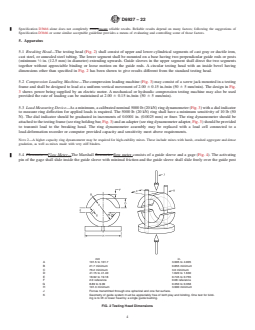
5.1 Breaking Head—The testing head (Fig. 2) shall consist
of upper and lower cylindrical segments of cast gray or ductile
iron, cast steel, or annealed steel tubing. The lower segment
shall be mounted on a base having two perpendicular guide
rods or posts (minimum ⁄2 in. (12.5 mm) in diameter)
extending upwards. Guide sleeves in the upper segment shall
FIG. 1 Flow Determination for Two Types of Specimen Failure direct the two segments together without appreciable binding
D6927 − 22
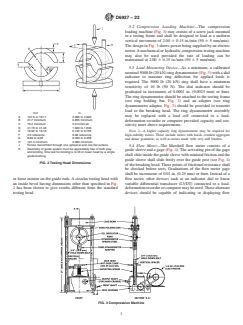
5.2 Compression Loading Machine—The compression
loading machine (Fig. 3) may consist of a screw jack mounted
in a testing frame and shall be designed to load at a uniform
vertical movement of 2.00 6 0.15 in./min (50 6 5 mm/min).
ThedesigninFig.3showspowerbeingsuppliedbyanelectric
motor.Amechanicalorhydrauliccompressiontestingmachine
may also be used provided the rate of loading can be
maintained at 2.00 6 0.15 in./min (50 6 5 mm/min).
5.3 Load Measuring Device—As a minimum, a calibrated
nominal5000lb(20kN)ringdynamometer(Fig.3)withadial
indicator to measure ring deflection for applied loads is
required. The 5000 lb (20 kN) ring shall have a minimum
sensitivity of 10 lb (50 N). The dial indicator should be
graduated in increments of 0.0001 in. (0.0025 mm) or finer.
The ring dynamometer should be attached to the testing frame
(see ring holding bar, Fig. 3) and an adapter (see ring
dynamometer adapter, Fig. 3) should be provided to transmit
load to the breaking head. The ring dynamometer assembly
mm in.
may be replaced with a load cell connected to a load-
A 101.5 to 101.7 3.995 to 4.005
B 21.7 minimum 0.855 minimum deformation recorder or computer provided capacity and sen-
C 76.2 minimum 3.0 minimum
sitivity meet above requirements.
D 41.15 to 41.40 1.620 to 1.630
NOTE 2—A higher capacity ring dynamometer may be required for
E 18.92 to 19.18 0.745 to 0.755
F 2.0 reference 0.08 reference high-stability mixes. These include mixes with harsh, crushed aggregate
G 8.89 to 9.09 0.350 to 0.358
and dense gradation, as well as mixes made with very stiff binders.
H 101.3 minimum 3.990 minimum
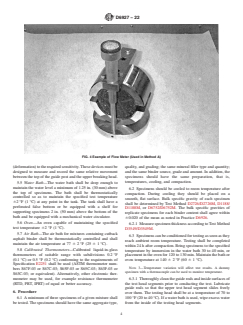
J Forces transmitted through one spherical and one flat surface. 5.4 Flow Meter—The Marshall flow meter consists of a
K Geometry of guide system must be appreciably free of both play
guidesleeveandagage(Fig.4).Theactivatingpinofthegage
and binding. One test for binding is to lift or lower head by a single
shallslideinsidetheguidesleevewithminimalfrictionandthe
guide bushing.
guide sleeve shall slide freely over the guide post (see Fig. 4)
FIG. 2 Testing Head Dimensions
of the breaking head.These points of frictional resistance shall
be checked before tests. Graduations of the flow meter gage
shall be increments of 0.01 in. (0.25 mm) or finer. Instead of a
or loose motion on the guide rods.Acircular testing head with flow meter, other devices such as an indicator dial or line
...
This document is not an ASTM standard and is intended only to provide the user of an ASTM standard an indication of what changes have been made to the previous version. Because
it may not be technically possible to adequately depict all changes accurately, ASTM recommends that users consult prior editions as appropriate. In all cases only the current version
of the standard as published by ASTM is to be considered the official document.
Designation: D6927 − 15 D6927 − 22
Standard Test Method for
Marshall Stability and Flow of Asphalt Mixtures
This standard is issued under the fixed designation D6927; the number immediately following the designation indicates the year of
original adoption or, in the case of revision, the year of last revision. A number in parentheses indicates the year of last reapproval. A
superscript epsilon (´) indicates an editorial change since the last revision or reapproval.
1. Scope
1.1 This test method covers measurement of resistance to plastic flow of 4 in. (102 mm) cylindrical specimens of asphalt paving
mixture loaded in a direction perpendicular to the cylindrical axis by means of the Marshall apparatus. This test method is for use
with dense graded dense-graded asphalt mixtures prepared with asphalt cementbinder (modified and unmodified), cutback asphalt,
tar, and tar-rubber unmodified) with maximum size aggregate up to 1 in. (25 mm) in size (passing 1 in. (25 mm) sieve).
1.2 Units—The values stated in inch-pound units are to be regarded as standard. The values given in parentheses are mathematical
conversions to SI units that are provided for information only and are not considered standard.
1.3 The text of this standard references notes and footnotes which provide explanatory material. These notes and footnotes
(excluding those in tables and figures) shall not be considered as requirements of the standard.
1.4 This standard does not purport to address all of the safety concerns, if any, associated with its use. It is the responsibility
of the user of this standard to establish appropriate safety safety, health, and healthenvironmental practices and determine the
applicability of regulatory limitations prior to use.
1.5 This international standard was developed in accordance with internationally recognized principles on standardization
established in the Decision on Principles for the Development of International Standards, Guides and Recommendations issued
by the World Trade Organization Technical Barriers to Trade (TBT) Committee.
2. Referenced Documents
2.1 ASTM Standards:
C670 Practice for Preparing Precision and Bias Statements for Test Methods for Construction Materials
D8 Terminology Relating to Materials for Roads and Pavements
D1188D1188/D1188M Test Method for Bulk Specific Gravity and Density of Compacted Asphalt Mixtures Using Coated
Samples
D2726D2726/D2726M Test Method for Bulk Specific Gravity and Density of Non-Absorptive Compacted Asphalt Mixtures
D3549D3549/D3549M Test Method for Thickness or Height of Compacted Asphalt Mixture Specimens
D3666 Specification for Minimum Requirements for Agencies Testing and Inspecting Road and Paving Materials
D6752D6752/D6752M Test Method for Bulk Specific Gravity and Density of Compacted Asphalt Mixtures Using Automatic
Vacuum Sealing Method
D6926 Practice for Preparation of Asphalt Mixture Specimens Using Marshall Apparatus
E2251 Specification for Liquid-in-Glass ASTM Thermometers with Low-Hazard Precision Liquids
This test method is under the jurisdiction of ASTM Committee D04 on Road and Paving Materials and is the direct responsibility of Subcommittee D04.20 on Mechanical
Tests of Asphalt Mixtures.
Current edition approved Feb. 1, 2015Nov. 1, 2022. Published April 2015November 2022. Originally approved in 2004. Last previous edition approved in 20062015 as
D6927 – 06.D6927 – 15. DOI: 10.1520/D6927-15.10.1520/D6927-22.
For referenced ASTM standards, visit the ASTM website, www.astm.org, or contact ASTM Customer Service at service@astm.org. For Annual Book of ASTM Standards
volume information, refer to the standard’s Document Summary page on the ASTM website.
Copyright © ASTM International, 100 Barr Harbor Drive, PO Box C700, West Conshohocken, PA 19428-2959. United States
D6927 − 22
3. Terminology
3.1 Definitions:
3.1.1 lab mix lab compacted (LMLC) asphalt mixture, n—asphalt mix samples that are prepared in the laboratory by weighing and
blending each constituent then compacting the blended mixture using a laboratory compaction apparatus.
3.1.1.1 Discussion—
LMLC typically occurs during the asphalt mixture design phase. Laboratory compaction devices such as the Superpave Gyratory
Compactor, Marshall Hammer, or other laboratory compaction devices may be used.
3.1.2 plant mix laboratory compacted (PMLC) asphalt mixture, n—asphalt mixture samples that are manufactured in a production
plant, sampled prior to compaction, then immediately compacted using a laboratory compaction apparatus.
3.1.2.1 Discussion—
PMLC specimens are often used for quality control testing. The asphalt mixture is not permitted to cool substantially and it may
be necessary to place the mixture in a laboratory oven to equilibrate the mixture to the compaction temperature before molding.
Laboratory compaction devices such as the Superpave Gyratory Compactor, Marshall Hammer, or other laboratory compaction
devices may be used.
3.1.3 reheated plant mix lab compacted (RPMLC) asphalt mixture, n—asphalt mixture samples that are manufactured in a
production plant, sampled prior to compaction, allowed to cool to room temperature, then reheated in a laboratory oven and
compacted using a laboratory compaction apparatus.
3.1.3.1 Discussion—
RPMLC are often used for quality acceptance and verification testing. The reheating time should be as short as possible to obtain
uniform temperature to avoid artificially aging the specimens. Asphalt mixture conditioning, reheat temperature, and reheat time
should be defined in the applicable specification. Laboratory compaction devices such as the Superpave Gyratory Compactor,
Marshall Hammer, or other laboratory compaction devices may be used.
3.1 Definitions—For definitions of terms used in this test method, refer to Terminology D8.
4. Significance and Use
4.1 Marshall stability and flow values along with density;density, air voids in the total mix, voids in the mineral aggregate, or voids
filled with asphalt, asphalt binder, or both, filled with asphalt binder are used for laboratory mix design and evaluation of asphalt
mixtures. In addition, Marshall stability and flow can be used to monitor the plant process of producing asphalt mixture. Marshall
stability and flow may also be used to relatively evaluate different mixes and the effects of conditioning such as with water.
4.1.1 Marshall stability and flow are asphalt mixture characteristics determined from tests of compacted specimens of a specified
geometry. The Marshall Test can be conducted with two different types of equipment: (1) Method A—using a loading frame with
a load ring and a dial gauge for deformation or flow meter (Traditional Method)Method); or (2) Method B—using a
load-deformation recorder in conjunction with a load cell and linear variable differential transducer (LVDT) or other automatic
recording device (Automated Method).
4.1.2 Typically, Marshall stability is the peak resistance load obtained during a constant rate of deformation loading sequence.
However, depending on the composition and behavior of the mixture, a less defined type of failure has been observed, as illustrated
in Fig. 1. As an alternative method, Marshall stability can also be defined as the load obtained,obtained when the rate of loading
increase begins to decrease,decrease such that the curve starts to become horizontal, as shown in the bottom graph of Fig. 1. The
magnitude of Marshall Stabilitystability varies with aggregate type and grading and bitumen type, grade, and amount. Various
agencies have criteria for Marshall stability.
4.1.3 Marshall flow is a measure of deformation (elastic plus plastic) of the asphalt mixmixture determined during the stability
test. In both types of failure, the Marshall flow is the total sample deformation from the point where the projected tangent of the
linear part of the curve intersects the x-axis (deformation) to the point where the curve starts to become horizontal. As shown in
Fig. 1, this latter point usually corresponds to the peak stability; however, as an alternative when the failure condition is not clearly
defined, it can be selected as the point on the curve which is six flow points or 0.01 in. (1.5 mm) to the right of the tangent line.
There is no ideal value but there are acceptable limits. If flow at the selected optimum binder content is above the upper limit, the
mix is considered too plastic or unstable and if below the lower limit, it is considered too brittle.
4.1.4 The Marshall stability and flow test results are applicable to dense-graded asphalt mixtures with maximum size aggregate
D6927 − 22
FIG. 1 Flow Determination for Two Types of Specimen Failure
up to 1 in. (25 mm) in size. For the purpose of mix design, Marshall stability and flow test results should consist of the average
of a minimum of three specimens at each increment of binder content where the binder content varies in one-half one half percent
increments over a range of binder content. The binder content range is generally selected on the basis of experience and historical
testing data of the component materials, but may involve trial and error to include the desirable range of mix properties.
Dense-graded mixtures will generally show a peak in stability within the range of binder contents tested. Stability, flow, density,
air voids, and voids filled with asphalt binder,binder may be plotted against binder content to allow selection of an optimum binder
content for the mixture. The above test properties may also be weighted differently to reflect a particular mix design philosophy.
In addition, a mixture design may be required to meet minimum voids in the mineral aggregate based on nominal maximum
aggregate size in the mixture.
4.1.5 Field laboratory Marshall stability and flow tests on specimens made with plant mix laboratory compacted (PMLC) asphalt
mixture mix may vary significantly from laboratory design values because of differences in plant mixing versus laboratory mixing.
This includes mixing efficiency and aging.
4.1.6 Significant differences in Marshall stability and flow from one set of tests to another or from an average value of several sets
of data or specimens,specimens prepared from plant-produced mix may indicate poor sampling, incorrect testing technique, change
of grading, change of binder content, or a malfunction in the plant process. The source of the variation should be resolved and the
problem corrected.
4.1.7 Specimens will most often be prepared using Practice D6926, but may be prepared using other types of compaction
procedures as long as specimens satisfy geometry requirements. Other types of compaction may cause specimens to have different
stress strain characteristics than specimens prepared by Marshall impact compaction. Marshall stability and flow may also be
determined using field cores from in situ pavement for information or evaluation. However, these results may not compare with
results from Lab Mix Lab Compacted (LMLC) Asphalt Mixture, Plant Mix Laboratory Compacted (PMLC) Asphalt Mixture, or
Reheated Plant Mix Lab Compacted (RPMLC) Asphalt Mixturelab mix lab compacted (LMLC) asphalt mixture, plant mix
laboratory compacted (PMLC) asphalt mixture, or reheated plant mix lab compacted (RPMLC) asphalt mixture specimens and
shall not be used for specification or acceptance purposes. One source of error in testing field cores arises when the side of the
core is not smooth or perpendicular to the core faces. Such conditions can create stress concentrations in loading and low Marshall
stability.
NOTE 1—The quality of the results produced by this standard are dependent on the competence of the personnel performing the procedure and the
capability, calibration, and maintenance of the equipment used. Agencies that meet the criteria of Specification D3666 are generally considered capable
of competent and objective testing/sampling/inspection/etc. testing, sampling, inspection, etc. Users of this standard are cautioned that compliance with
D6927 − 22
Specification D3666 alone does not completely assureensure reliable results. Reliable results depend on many factors; following the suggestions of
Specification D3666 or some similar acceptable guideline provides a means of evaluating and controlling some of those factors.
5. Apparatus
5.1 Breaking Head—The testing head (Fig. 2) shall consist of upper and lower cylindrical segments of cast gray or ductile iron,
cast steel, or annealed steel tubing. The lower segment shall be mounted on a base having two perpendicular guide rods or posts
(minimum ⁄2 in. (12.5 mm) in diameter) extending upwards. Guide sleeves in the upper segment shall direct the two segments
together without appreciable binding or loose motion on the guide rods. A circular testing head with an inside bevel having
dimensions other than specified in Fig. 2 has been shown to give results different from the standard testing head.
5.2 Compression Loading Machine—The compression loading machine (Fig. 3) may consist of a screw jack mounted in a testing
frame and shall be designed to load at a uniform vertical movement of 2.00 6 0.15 in./min (50 6 5 mm/min). The design in Fig.
3 shows power being supplied by an electric motor. A mechanical or hydraulic compression testing machine may also be used
provided the rate of loading can be maintained at 2.00 6 0.15 in./min (50 6 5 mm/min).
5.3 Load Measuring Device—As a minimum, a calibrated nominal 5000 lb (20 kN) ring dynamometer (Fig. 3) with a dial indicator
to measure ring deflection for applied loads is required. The 5000 lb (20 kN) ring shall have a minimum sensitivity of 10 lb (50
N). The dial indicator should be graduated in increments of 0.0001 in. (0.0025 mm) or finer. The ring dynamometer should be
attached to the testing frame (see ring holding bar, Fig. 3) and an adapter (see ring dynamometer adapter, Fig. 3) should be provided
to transmit load to the breaking head. The ring dynamometer assembly may be replaced with a load cell connected to a
load-deformation recorder or computer provided capacity and sensitivity meet above requirements.
NOTE 2—A higher capacity ring dynamometer may be required for high-stability mixes. These include mixes with harsh, crushed aggregate and dense
gradation, as well as mixes made with very stiff binders.
5.4 Flowmeter—Flow Meter—The Marshall flowmeter flow meter consists of a guide sleeve and a gage (Fig. 4). The activating
pin of the
...