

ASTM F2137-19
(Practice)Standard Practice for Measuring the Dynamic Characteristics of Amusement Rides and Devices
General Information
- Abstract
SIGNIFICANCE AND USE
4.1 This practice is intended for use whenever the dynamic characteristics of an amusement ride or device are to be determined. The existence of this practice is not intended to imply that there is a requirement to perform specific testing on amusement rides or devices.
4.2 The general provisions of this practice provide instrumentation specifications, data acquisition and testing procedures, and documentation requirements that when applied will improve the repeatability, reliability, and utility of the test results.
4.3 Based on the general provisions of this practice, the SARC Test specifications, when followed, will yield standardized test results regarding the patron-related, dynamic motion of amusement rides or devices. The SARC Test will facilitate both the meaningful comparison of the dynamic motion of different amusement rides or devices and the tracking of changes, if any, in the dynamic characteristics of a given ride or device.
SCOPE
1.1 This practice covers acquisition of data related to the dynamic characteristics of amusement rides and devices.
1.2 This practice also defines the specific requirements of a Standardized Amusement Ride Characterization Test (SARC Test) for use in characterizing the dynamic motion of an amusement ride or device.
1.3 The values stated in inch-pound units are to be regarded as standard. The values given in parentheses are mathematical conversions to SI units that are provided for information only and are not considered standard.
1.3.1 Exception—The values are reversed in Section 13 since EN standards primarily use SI units.
1.4 This international standard was developed in accordance with internationally recognized principles on standardization established in the Decision on Principles for the Development of International Standards, Guides and Recommendations issued by the World Trade Organization Technical Barriers to Trade (TBT) Committee.
- Status
- Published
- Publication Date
- 14-Oct-2019
- Technical Committee
- F24 - Amusement Rides and Devices
- Drafting Committee
- F24.10 - Test Methods and Component Parts
Buy Documents
ASTM F2137-19 - Standard Practice for Measuring the Dynamic Characteristics of Amusement Rides and Devices
REDLINE ASTM F2137-19 - Standard Practice for Measuring the Dynamic Characteristics of Amusement Rides and Devices
Overview
ASTM F2137-19: Standard Practice for Measuring the Dynamic Characteristics of Amusement Rides and Devices provides comprehensive guidance for acquiring and documenting data related to the dynamic motion of amusement rides and devices. Developed by ASTM International, this standard outlines procedures and specifications for instrumentation, data acquisition systems, calibration, and documentation to enable repeatable, reliable, and meaningful measurements. The standard also introduces the Standardized Amusement Ride Characterization Test (SARC Test), which serves as a framework for characterizing and comparing patron-related dynamic motion across different rides and devices.
This standard is pivotal for manufacturers, operators, and inspectors in the amusement industry seeking to ensure quality, safety, and regulatory compliance while allowing for meaningful comparison and monitoring of ride dynamics.
Key Topics
Scope of Dynamic Measurement: ASTM F2137-19 covers the acquisition of data on the dynamic performance of amusement rides and devices, which is crucial for assessing safety and functionality.
Instrumentation Specifications: The standard details requirements for transducers, data recorders (both analog and digital), and data channels. It specifies performance criteria such as resolution, frequency response, and calibration accuracy.
Data Acquisition Procedures: Clear guidance is given for mounting sensors, positioning accelerometers, selecting proper coordinate systems, and mitigating measurement errors such as zero bias.
Standardized Amusement Ride Characterization Test (SARC Test): Defines test methods for simulating and measuring the dynamic experiences of patrons, including requirements for ballast weights (to simulate patron mass), test repeatability, and documentation.
Calibration and Documentation: Annual calibration procedures, certification traceability, and comprehensive test documentation are required to ensure data integrity and traceability.
Compatibility with International Regulations: The standard aligns with principles in line with global trade and references EN 13814 for fairground and amusement park machinery safety.
Applications
ASTM F2137-19 finds practical application in several critical scenarios, including:
- Safety Assessment: Reliable measurement of ride dynamics allows engineers and inspectors to evaluate the impact of forces on patrons, aiding in the identification of potential safety hazards.
- Design Verification: Manufacturers use the standard to perform dynamic testing during development, ensuring rides meet design intent and safety standards before public operation.
- Routine Maintenance and Inspection: Operators rely on standardized dynamic data acquisition methods for condition monitoring and to detect changes in ride performance over time.
- Comparative Analysis: SARC Test results support benchmarking and comparative analysis across different types of rides, enabling evidence-based decisions for upgrades or retrofits.
- Regulatory Compliance and Reporting: Documentation as outlined ensures compliance with relevant local, national, and international regulatory requirements, and provides a record for audit and incident investigation.
Related Standards
Several other standards complement or relate to ASTM F2137-19, including:
- ASTM F747: Terminology Relating to Amusement Rides and Devices - establishes definitions used in the context of dynamic testing.
- SAE J211: Instrumentation for Impact Tests - provides additional instrumentation guidelines for impact events.
- EN 13814: Safety standards for fairground and amusement park machinery and structures - referenced for European regulatory compliance.
- ISO/IEC Guide 2: General reference for standardization, as cited in the development of ASTM F2137-19.
Practical Value
Adopting ASTM F2137-19 enhances the reliability, repeatability, and utility of dynamic ride testing. It enables manufacturers, operators, and regulators to meet current safety standards, facilitates international trade by aligning with global principles, and promotes a standardized approach to amusement ride measurement and documentation, ultimately protecting patrons and supporting industry best practices.
Keywords: ASTM F2137-19, dynamic measurement, amusement ride testing, SARC Test, ride safety, instrumentation, calibration, test documentation, ride dynamics, amusement devices, EN 13814.
Relations
- Effective Date
- 15-Oct-2019
- Effective Date
- 01-Nov-2014
- Effective Date
- 01-Feb-2006
- Effective Date
- 01-Dec-2005
- Effective Date
- 01-Jan-1997
- Effective Date
- 15-Oct-2019
- Effective Date
- 15-Oct-2019
- Effective Date
- 15-Oct-2019
- Effective Date
- 15-Oct-2019
Buy Documents
ASTM F2137-19 - Standard Practice for Measuring the Dynamic Characteristics of Amusement Rides and Devices
REDLINE ASTM F2137-19 - Standard Practice for Measuring the Dynamic Characteristics of Amusement Rides and Devices
Frequently Asked Questions
ASTM F2137-19 is a standard published by ASTM International. Its full title is "Standard Practice for Measuring the Dynamic Characteristics of Amusement Rides and Devices". This standard covers: SIGNIFICANCE AND USE 4.1 This practice is intended for use whenever the dynamic characteristics of an amusement ride or device are to be determined. The existence of this practice is not intended to imply that there is a requirement to perform specific testing on amusement rides or devices. 4.2 The general provisions of this practice provide instrumentation specifications, data acquisition and testing procedures, and documentation requirements that when applied will improve the repeatability, reliability, and utility of the test results. 4.3 Based on the general provisions of this practice, the SARC Test specifications, when followed, will yield standardized test results regarding the patron-related, dynamic motion of amusement rides or devices. The SARC Test will facilitate both the meaningful comparison of the dynamic motion of different amusement rides or devices and the tracking of changes, if any, in the dynamic characteristics of a given ride or device. SCOPE 1.1 This practice covers acquisition of data related to the dynamic characteristics of amusement rides and devices. 1.2 This practice also defines the specific requirements of a Standardized Amusement Ride Characterization Test (SARC Test) for use in characterizing the dynamic motion of an amusement ride or device. 1.3 The values stated in inch-pound units are to be regarded as standard. The values given in parentheses are mathematical conversions to SI units that are provided for information only and are not considered standard. 1.3.1 Exception—The values are reversed in Section 13 since EN standards primarily use SI units. 1.4 This international standard was developed in accordance with internationally recognized principles on standardization established in the Decision on Principles for the Development of International Standards, Guides and Recommendations issued by the World Trade Organization Technical Barriers to Trade (TBT) Committee.
SIGNIFICANCE AND USE 4.1 This practice is intended for use whenever the dynamic characteristics of an amusement ride or device are to be determined. The existence of this practice is not intended to imply that there is a requirement to perform specific testing on amusement rides or devices. 4.2 The general provisions of this practice provide instrumentation specifications, data acquisition and testing procedures, and documentation requirements that when applied will improve the repeatability, reliability, and utility of the test results. 4.3 Based on the general provisions of this practice, the SARC Test specifications, when followed, will yield standardized test results regarding the patron-related, dynamic motion of amusement rides or devices. The SARC Test will facilitate both the meaningful comparison of the dynamic motion of different amusement rides or devices and the tracking of changes, if any, in the dynamic characteristics of a given ride or device. SCOPE 1.1 This practice covers acquisition of data related to the dynamic characteristics of amusement rides and devices. 1.2 This practice also defines the specific requirements of a Standardized Amusement Ride Characterization Test (SARC Test) for use in characterizing the dynamic motion of an amusement ride or device. 1.3 The values stated in inch-pound units are to be regarded as standard. The values given in parentheses are mathematical conversions to SI units that are provided for information only and are not considered standard. 1.3.1 Exception—The values are reversed in Section 13 since EN standards primarily use SI units. 1.4 This international standard was developed in accordance with internationally recognized principles on standardization established in the Decision on Principles for the Development of International Standards, Guides and Recommendations issued by the World Trade Organization Technical Barriers to Trade (TBT) Committee.
ASTM F2137-19 is classified under the following ICS (International Classification for Standards) categories: 97.200.99 - Other equipment for entertainment. The ICS classification helps identify the subject area and facilitates finding related standards.
ASTM F2137-19 has the following relationships with other standards: It is inter standard links to ASTM F2137-18, ASTM F747-06(2014), ASTM F747-06, ASTM F747-05, ASTM F747-97, ASTM F2959-23a, ASTM F2291-23b, ASTM F2783-20, ASTM F3493-23. Understanding these relationships helps ensure you are using the most current and applicable version of the standard.
ASTM F2137-19 is available in PDF format for immediate download after purchase. The document can be added to your cart and obtained through the secure checkout process. Digital delivery ensures instant access to the complete standard document.
Standards Content (Sample)
This international standard was developed in accordance with internationally recognized principles on standardization established in the Decision on Principles for the
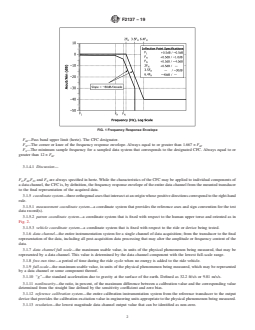
Development of International Standards, Guides and Recommendations issued by the World Trade Organization Technical Barriers to Trade (TBT) Committee.
Designation: F2137 − 19
Standard Practice for
Measuring the Dynamic Characteristics of Amusement
Rides and Devices
This standard is issued under the fixed designation F2137; the number immediately following the designation indicates the year of
original adoption or, in the case of revision, the year of last revision.Anumber in parentheses indicates the year of last reapproval.A
superscript epsilon (´) indicates an editorial change since the last revision or reapproval.
1. Scope 3.1.1 aliasing—aphenomenonassociatedwithsampleddata
systems, wherein a signal containing significant energy at
1.1 This practice covers acquisition of data related to the
frequencies greater than one half of the system sample fre-
dynamic characteristics of amusement rides and devices.
quency manifests itself in the sampled data as a lower
1.2 This practice also defines the specific requirements of a
frequency (aliased) signal. Aliasing can be avoided only by
Standardized Amusement Ride Characterization Test (SARC
limiting the frequency content of the signal prior to the
Test) for use in characterizing the dynamic motion of an
sampling process. Once a signal has been aliased, it is not
amusement ride or device.
possible to reconstruct the original signal from the sampled
1.3 The values stated in inch-pound units are to be regarded data.
as standard. The values given in parentheses are mathematical
3.1.2 calibration constant—the arithmetic mean of the sen-
conversions to SI units that are provided for information only
sitivity coefficients, evaluated at frequencies that are evenly
and are not considered standard.
spaced on a logarithmic scale between F and F .
L H
1.3.1 Exception—The values are reversed in Section 13
3.1.3 calibration value—the ratio of the reference calibra-
since EN standards primarily use SI units.
tion system output, in engineering units relevant to the
1.4 This international standard was developed in accor-
transducer, to the data channel output, in volts, as measured at
dance with internationally recognized principles on standard-
constant excitation frequency and amplitude.
ization established in the Decision on Principles for the
3.1.4 channel frequency class (CFC)—afrequencyresponse
Development of International Standards, Guides and Recom-
envelopethatconformstoFig.1andisreferredtobythevalue
mendations issued by the World Trade Organization Technical
F in hertz. The CFC frequency response envelope is defined
H
Barriers to Trade (TBT) Committee.
by the boundaries shown in Fig. 1 and the following charac-
teristic frequencies:
2. Referenced Documents
F —Pass band lower limit (hertz). Always equal to zero
L
2.1 ASTM Standards:
(0.0) hertz.
F747Terminology Relating to Amusement Rides and De-
F —Pass band upper limit (hertz). The CFC designator.
H
vices
F —Thecornerorkneeofthefrequencyresponseenvelope.
N
2.2 EN Standard:
Always equal to or greater than 1.667× F .
H
EN 13814Fairground and amusement park machinery and
F —The minimum sample frequency for a sampled data
S
structures - Safety
system that corresponds to the designated CFC. Always equal
to or greater than 12× F .
H
3. Terminology
3.1.4.1 Discussion—F , F , F ,and F arealwaysspecified
L H N S
3.1 Definitions:
in hertz. While the characteristics of the CFC may be applied
to individual components of a data channel, the CFC is, by
definition, the frequency response envelope of the entire data
ThispracticeisunderthejurisdictionofASTMCommitteeF24onAmusement
channelfromthemountedtransducertothefinalrepresentation
Rides and Devices and is the direct responsibility of Subcommittee F24.10 on Test
of the acquired data.
Methods.
Current edition approved Oct. 15, 2019. Published November 2019. Originally
3.1.5 coordinate system—three orthogonal axes that inter-
approved in 2001. Last previous edition approved in 2018 as F2137–18. DOI:
sect at an origin whose positive directions correspond to the
10.1520/F2137-19.
2 right-hand rule.
For referenced ASTM standards, visit the ASTM website, www.astm.org, or
contact ASTM Customer Service at service@astm.org. For Annual Book of ASTM
3.1.5.1 measurement coordinate system—a coordinate sys-
Standards volume information, refer to the standard’s Document Summary page on
tem that provides the reference axes and sign convention for
the ASTM website.
Available from European Committee for Standardization, http://www.cen.eu/. the test data record(s).
Copyright © ASTM International, 100 Barr Harbor Drive, PO Box C700, West Conshohocken, PA 19428-2959. United States
F2137 − 19
FIG. 1 Frequency Response Envelope
3.1.5.2 patron coordinate system—a coordinate system that 3.1.14 sensitivity coeffıcient—the slope of the straight line
is fixed with respect to the human upper torso and oriented as representing the best fit, as determined by the method of least
in Fig. 2. squares, to calibration values generated at a single frequency
and at various amplitudes within the data channel full scale
3.1.5.3 vehicle coordinate system—a coordinate system that
range. In the special case where only a single calibration value
is fixed with respect to the ride or device being tested.
is considered, the sensitivity coefficient and the calibration
3.1.6 data channel—the entire instrumentation system for a
value will be equal.
single channel of data acquisition; from the transducer to the
3.1.15 standardized amusement ride characterization test
final representation of the data, including all post-acquisition
(SARC Test)—an instrumented test of an amusement ride or
data processing that may alter the amplitude or frequency
devicethatisdoneinconformancetothegeneralspecifications
content of the data.
of this standard and the particular specifications of Section 12.
3.1.7 data channel full scale—the maximum usable value,
3.1.16 test data record—the uninterrupted time record of
in units of the physical phenomenon being measured, that may
data channel value(s) that results from a data acquisition
be represented by a data channel. This value is determined by
session.thelengthofadataacquisitionsessionisnotspecified.
the data channel component with the lowest full-scale range.
The data acquisition session is considered complete (or inter-
3.1.8 free-run time—a period of time during the ride cycle
rupted) when data is not recorded for a time interval longer
when no energy is added to the ride vehicle.
thanthesamplingperiodofthedatarecorder.Bothastripchart
3.1.9 full-scale—the maximum usable value, in units of the
paper record and a computer data file containing periodically
physical phenomenon being measured, which may be repre-
sampled data channel values are typical forms of a test data
sented by a data channel or some component thereof.
record.
3.1.10 “g”—the standard acceleration due to gravity at the
3.1.17 test documentation—the entire body of documenta-
surface of the earth. Defined as 32.2 ft/s/s or 9.81 m/s/s.
tion pertaining to a test performed in compliance with this
3.1.11 nonlinearity—the ratio, in percent, of the maximum practice, including, but not limited to, the test data record(s),
difference between a calibration value and the corresponding data channel specifications and other test specifications, and
value determined from the straight line defined by the sensi- information as provided in this practice (see Section 11 and
tivity coefficient and zero bias. 12.1.9).
3.1.12 reference calibration system—the entire calibration 3.1.18 transducer—the device at the front end of the data
instrumentation system from the reference transducer to the channel that converts a physical phenomenon, such as
output device that provides the calibration excitation value in acceleration, to a calibrated electrical signal that may be input
engineering units appropriate to the physical phenomenon to the remainder of the data channel.
being measured.
3.1.19 transverse sensitivity—the sensitivity of a rectilinear
3.1.13 resolution—the lowest magnitude data channel out- transducer to excitation along an axis that is perpendicular to
put value that can be identified as non-zero. its nominal sensitive axis.
F2137 − 19
FIG. 2 Patron Coordinate System
3.1.20 zero bias—the magnitude of the data channel output ized test results regarding the patron-related, dynamic motion
when the transducer input is zero or static. of amusement rides or devices. The SARC Test will facilitate
both the meaningful comparison of the dynamic motion of
4. Significance and Use
different amusement rides or devices and the tracking of
changes, if any, in the dynamic characteristics of a given ride
4.1 This practice is intended for use whenever the dynamic
or device.
characteristics of an amusement ride or device are to be
determined. The existence of this practice is not intended to
5. Data Channel Performance Specifications
imply that there is a requirement to perform specific testing on
5.1 CFC Definitions—The following channel frequency
amusement rides or devices.
classes are defined as standard:
4.2 The general provisions of this practice provide instru-
A B
CFC10 CFC60
mentation specifications, data acquisition and testing
F 0.0 Hz 0.0 Hz
L
procedures,anddocumentationrequirementsthatwhenapplied
F 10.0 Hz 60.0 Hz
H
will improve the repeatability, reliability, and utility of the test
F 16.7 Hz 100 Hz
N
F 120 Hz 720 Hz
results. S
4.3 Based on the general provisions of this practice, the A
CFC10 should be used when the data channel is being used for acquisition of
SARC Test specifications, when followed, will yield standard- lower frequency events.
F2137 − 19
B
CFC60 should be used when the data channel is being used for acquisition of
8. Calibration Specifications
higher frequency events.
8.1 For transducers, data recorders, or any other data chan-
5.1.1 Other channel frequency classes may be defined as
nel component that is subject to calibration changes over time,
needed or desired by the user of this practice.The proportional
the calibration constant and frequency response shall be
relationshipbetween F , F ,and F shallbemaintainedforall
H N S
determined and documented annually.
channel frequency classes.
8.2 Reference calibration instrumentation used as a second-
5.2 Minimum data channel resolution shall be 2% of the
ary standard in the calibration of a data channel or any
data channel full scale.
subsystem thereof shall have current certificates of calibration
that are traceable to accepted national standards.
5.3 Maximum nonlinearity shall be 2.5% of the data
channel full scale.
8.3 The reference calibration system and calibration meth-
odsshallnotintroduceacalibrationerrorgreaterthan1.5%of
5.4 Minimum time base resolution shall be 1/F (s).
S
the data channel full scale.
5.5 Maximum relative delay or time shift between data
8.4 To establish a data channel or data channel component
channels that are nominally acquired simultaneously shall be
frequency response and calibration constant, sensitivity coef-
1/F (s).
S
ficients shall be determined from calibration values measured
at a minimum of one signal amplitude that represents at least
6. Transducer Performance Specifications
50% of the full scale range of the data channel or component
6.1 Transducer selection shall be consistent with the in- beingcalibratedandthroughoutarangeoffrequenciesfrom F
L
tended test objectives and generally accepted instrumentation to 10× F for a given CFC.Aminimum set of five sensitivity
H
and engineering practice. coefficients establishes the frequency response of a data chan-
nel or component. The minimum set of sensitivity coefficients
6.2 The transducer frequency response curve shall conform
shall be generated at frequencies that nominally correspond to
to the CFC frequency response envelope from F through
L
the following CFC specifications:
2× F and exhibit no more than +6 dB of peaking at the
H
F , F , F ,2 3 F , and10 3 F
natural frequency of the transducer. L H N H H
8.5 To establish nonlinearity, a minimum of one sensitivity
6.3 Maximum transverse sensitivity shall be 3%.
coefficient shall be determined from calibration values gener-
ated at a minimum of three signal amplitudes that nominally
7. Recorder Performance Specifications
correspond to the following percentages of the minimum
7.1 Analog Data Recorders:
full-scale range of the data channel or data channel component
7.1.1 The analog data recorder shall provide a method by being calibrated: Less than 20% of full scale, 50% of full
whichthezerobias,ifany,canbereducedtolessthanthedata scale,and>80%offullscale.Fortheminimumrequirementof
channel minimum resolution prior to acquiring any test data. a single sensitivity coefficient, the nominal frequency shall be
halfway between F and F .
7.1.2 Minimumamplituderesolutionshallbetwo2%ofthe
L H
data channel full scale.
8.6 Ifthecalibrationequipmentcannotproducetherequired
7.1.3 Papertaperecorders(ortheirequivalent)shallprovide
input because of excessively high values of the quantity to be
a minimum paper speed, in mm/s, of 1.5× F (Hz).
H measured at the specified frequencies, calibrations shall be
performed with values reasonably close to those specified and
7.2 Digital Data Recorders:
the limits of the calibration shall be recorded in the report.
7.2.1 AlldatashallbeacquiredwithaminimumCFCoften.
7.2.2 Minimum amplitude resolution shall be 0.10% of the
9. Transducer Location and Mounting
data channel full scale.
9.1 General Instrumentation:
7.2.3 Minimum sample rate shall be F (Hz) for the chosen
S
9.1.1 Transducer location, orientation, and mounting
CFC.
methodshallbeconsistentwiththeintendedtestobjectivesand
7.2.4 Protection from aliasing errors in the sampled data
generally accepted instrumentation and engineering practice.
shall be accomplished by pre-sample filtering that conforms to
9.1.2 Transducers shall be mounted such that the angle
the specified CFC frequency response envelope for the data
between the sensitive axis (axes) of the transducer and the
channel.
corresponding axis (axes) of the selected coordinate system
7.2.4.1 Alternate protection from aliasing errors may be
shall be no greater than 5°.
accomplished by providing appropriate pre-sample, anti-alias
9.2 General Accelerometry:
filtering in conjunction with a higher-than-F sample rate and
S
digital post-acquisition filtering such that the frequency re- 9.2.1 Mounting—To avoid distortion in the data channel
sponse envelope of the data channel conforms to the desired values, accelerometers shall be mounted so as to minimize
CFC frequency response envelope.The anti-alias filter charac- relative motion between the transducers and the instrumented
teristics shall be such that the maximum possible signal surface.Whendeemedappropriate,ananalyticalorexperimen-
amplitude at one half the sampling frequency is less than the tal evaluation of transducer mounting effects on the data
data channel minimum resolution. channel should be provided (see 11.1.6).
F2137 − 19
9.2.2 When multi-axis accelerations at a point are to be 11.1.5 The results of all field calibration procedures per-
measured, the center of seismic mass of each accelerometer formed as part of the test procedure (see 10.2).
shall be within 60 mm of that point. Each accelerometer axis
11.1.6 Documentation of the transducer mounting method
shall be within one degree of orthogonal relative to the other including the results from any analytical or experimental
axes.
evaluation of transducer mounting effects on the data channel
(see 9.2.1, 12.1.6).
10. Procedure 11.1.7 Documentation of transducer mounting location(s)
and orientation(s).
10.1 The unique characteristics of a particular amusement
11.1.8 Documentation of the measurement coordinate
ride or device or other special circumstances may be such that
system, including identification of the positive direction along
it is not reasonably possible to test in strict conformance with
each of the coordinate axes.
one or more provisions of this practice.Any deviation(s) from
11.1.9 Adescriptionofeachdatachannelutilizedduringthe
theprovisionsofthispracticeshallberecordedsoastoclearly
test, including but not limited to:
provide a description of the specific deviation(s).
11.1.9.1 Datachanneltitle,engineeringunits,CFC,anddata
10.2 Field Calibration:
channel resolution.
10.2.1 Where practical, all data channels should be sub-
11.1.9.2 Documentation regarding the inclusion or exclu-
jectedtoafieldcalibrationproceduretoestablishthereliability
sionofgravityeffectsinthezerobiasfordatachannelsthatare
of the data channel calibration.
sensitive to gravity.
10.2.2 For accelerometer-based data channels, the field
11.1.10 The manufacturer, model, serial number, and most
calibration procedure, may take the form of a 2g “roll-over”
recentcalibrationdateforalldatachannelcomponentsthatare
test.The 2 g “roll-over” test requires that the accelerometer be
subject to the calibration requirements of this practice.
placed with its sensitive axis perpendicular to a plane surface
11.1.11 Documentation of the ride or device operating
thatisnominallylevelwithrespecttotheearthwhiletheoutput
parameters for each test data record including but not limited
of the data channel is recorded.The accelerometer should then
to: patron load or ballast weight and brake settings.
be oriented with its sensitive axis parallel to this surface to
record a zero-g input. Next, the accelerometer should be
12. Standardized Amusement Ride Characterization Test
inverted with respect to its original orientation and its output
(SARC Test)
recorded. This procedure will yield a three-point calibration
12.1 In addition to the general provisions of this practice, a
(+1g,0g, and -1g) with a nominal 2g range.
SARC Test shall also conform to the following specifications:
10.3 When testing the nominal dynamic characteristics of
12.1.1 Testing Ballast Weight:
amusement rides and devices that have characteristics that
12.1.1.1 Thoseamusementridesordeviceswhereadultsare
change with respect to operating temperature, the rides or
permitted to ride shall be tested with a total ballast weight
devices shall be operated for a minimum of three full cycles
equivalent to between 145 and 170 lb for each patron location.
prior to data collection. Additionally, in the case of gravity
12.1.1.2 Those amusement rides or devices that are strictly
operated amusement rides or devices, such as roller coasters,
limited to children shall be tested with a total ballast weight
the rides or devices should be operated until free-run times
equivalent to between 75 and 100 lb for each patron location.
have a variability of less than 5% prior to data collection.
12.1.2 Triaxial accelerations shall be measured (see 9.2.2).
10.4 The zero bias of each data channel shall be accounted
12.1.3 Each of the three acceleration data channels shall
for in the test data record(s).
conform to CFC10.
12.1.4 Datachannelfullscale
...
This document is not an ASTM standard and is intended only to provide the user of an ASTM standard an indication of what changes have been made to the previous version. Because
it may not be technically possible to adequately depict all changes accurately, ASTM recommends that users consult prior editions as appropriate. In all cases only the current version
of the standard as published by ASTM is to be considered the official document.
Designation: F2137 − 18 F2137 − 19
Standard Practice for
Measuring the Dynamic Characteristics of Amusement
Rides and Devices
This standard is issued under the fixed designation F2137; the number immediately following the designation indicates the year of
original adoption or, in the case of revision, the year of last revision. A number in parentheses indicates the year of last reapproval. A
superscript epsilon (´) indicates an editorial change since the last revision or reapproval.
1. Scope
1.1 This practice covers acquisition of data related to the dynamic characteristics of amusement rides and devices.
1.2 This practice also defines the specific requirements of a Standardized Amusement Ride Characterization Test (SARC Test)
for use in characterizing the dynamic motion of an amusement ride or device.
1.3 The values stated in inch-pound units are to be regarded as standard. The values given in parentheses are mathematical
conversions to SI units that are provided for information only and are not considered standard.
1.3.1 Exception—The values are reversed in Section 13 since EN standards primarily use SI units.
1.4 This international standard was developed in accordance with internationally recognized principles on standardization
established in the Decision on Principles for the Development of International Standards, Guides and Recommendations issued
by the World Trade Organization Technical Barriers to Trade (TBT) Committee.
2. Referenced Documents
2.1 ASTM Standards:
F747 Terminology Relating to Amusement Rides and Devices
2.2 SAE Standard:
SAE J211 Instrumentation for Impact Tests
2.2 EN Standard:
EN 13814 Fairground and amusement park machinery and structures - Safety
3. Terminology
3.1 Definitions:
3.1.1 aliasing—a phenomenon associated with sampled data systems, wherein a signal containing significant energy at
frequencies greater than one half of the system sample frequency manifests itself in the sampled data as a lower frequency (aliased)
signal. Aliasing can be avoided only by limiting the frequency content of the signal prior to the sampling process. Once a signal
has been aliased, it is not possible to reconstruct the original signal from the sampled data.
3.1.2 calibration constant—the arithmetic mean of the sensitivity coefficients, evaluated at frequencies that are evenly spaced
on a logarithmic scale between F and F .
L H
3.1.3 calibration value—the ratio of the reference calibration system output, in engineering units relevant to the transducer, to
the data channel output, in volts, as measured at constant excitation frequency and amplitude.
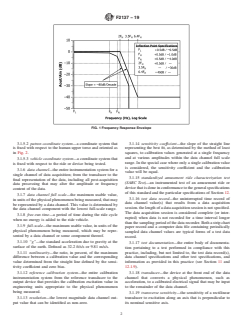
3.1.4 channel frequency class (CFC)—a frequency response envelope that conforms to Fig. 1 and is referred to by the value F
H
in hertz. The CFC frequency response envelope is defined by the boundaries shown in Fig. 1 and the following characteristic
frequencies:
F —Pass band lower limit (hertz). Always equal to zero (0.0) hertz.
L
This practice is under the jurisdiction of ASTM Committee F24 on Amusement Rides and Devices and is the direct responsibility of Subcommittee F24.10 on Test
Methods.
Current edition approved Sept. 1, 2018Oct. 15, 2019. Published November 2018November 2019. Originally approved in 2001. Last previous edition approved in 20162018
as F2137 – 16.F2137 – 18. DOI: 10.1520/F2137-18.10.1520/F2137-19.
For referenced ASTM standards, visit the ASTM website, www.astm.org, or contact ASTM Customer Service at service@astm.org. For Annual Book of ASTM Standards
volume information, refer to the standard’s Document Summary page on the ASTM website.
Available from Society of Automotive Engineers, 400 Commonwealth Drive, Warrendale, PA 15096.
Available from European Committee for Standardization, http://www.cen.eu/.
Copyright © ASTM International, 100 Barr Harbor Drive, PO Box C700, West Conshohocken, PA 19428-2959. United States
F2137 − 19
FIG. 1 Frequency Response Envelope
F —Pass band upper limit (hertz). The CFC designator.
H
F —The corner or knee of the frequency response envelope. Always equal to or greater than 1.667 × F .
N H
F —The minimum sample frequency for a sampled data system that corresponds to the designated CFC. Always equal to or
S
greater than 12 × F .
H
3.1.4.1 Discussion—
F ,F ,F , and F are always specified in hertz. While the characteristics of the CFC may be applied to individual components of
L H N S
a data channel, the CFC is, by definition, the frequency response envelope of the entire data channel from the mounted transducer
to the final representation of the acquired data.
3.1.5 coordinate system—three orthogonal axes that intersect at an origin whose positive directions correspond to the right-hand
rule.
3.1.5.1 measurement coordinate system—a coordinate system that provides the reference axes and sign convention for the test
data record(s).
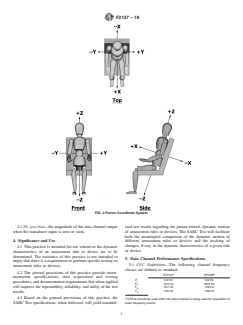
3.1.5.2 patron coordinate system—a coordinate system that is fixed with respect to the human upper torso and oriented as in
Fig. 2.
3.1.5.3 vehicle coordinate system—a coordinate system that is fixed with respect to the ride or device being tested.
3.1.6 data channel—the entire instrumentation system for a single channel of data acquisition; from the transducer to the final
representation of the data, including all post-acquisition data processing that may alter the amplitude or frequency content of the
data.
3.1.7 data channel full scale—the maximum usable value, in units of the physical phenomenon being measured, that may be
represented by a data channel. This value is determined by the data channel component with the lowest full-scale range.
3.1.8 free-run time—a period of time during the ride cycle when no energy is added to the ride vehicle.
3.1.9 full-scale—the maximum usable value, in units of the physical phenomenon being measured, which may be represented
by a data channel or some component thereof.
3.1.10 “g”—the standard acceleration due to gravity at the surface of the earth. Defined as 32.2 ft/s/s or 9.81 m/s/s.
3.1.11 nonlinearity—the ratio, in percent, of the maximum difference between a calibration value and the corresponding value
determined from the straight line defined by the sensitivity coefficient and zero bias.
3.1.12 reference calibration system—the entire calibration instrumentation system from the reference transducer to the output
device that provides the calibration excitation value in engineering units appropriate to the physical phenomenon being measured.
3.1.13 resolution—the lowest magnitude data channel output value that can be identified as non-zero.
F2137 − 19
FIG. 2 Patron Coordinate System
3.1.14 sensitivity coeffıcient—the slope of the straight line representing the best fit, as determined by the method of least squares,
to calibration values generated at a single frequency and at various amplitudes within the data channel full scale range. In the
special case where only a single calibration value is considered, the sensitivity coefficient and the calibration value will be equal.
3.1.15 standardized amusement ride characterization test (SARC Test)—an instrumented test of an amusement ride or device
that is done in conformance to the general specifications of this standard and the particular specifications of Section 12.
3.1.16 test data record—the uninterrupted time record of data channel value(s) that results from a data acquisition session. the
length of a data acquisition session is not specified. The data acquisition session is considered complete (or interrupted) when data
is not recorded for a time interval longer than the sampling period of the data recorder. Both a strip chart paper record and a
computer data file containing periodically sampled data channel values are typical forms of a test data record.
3.1.17 test documentation—the entire body of documentation pertaining to a test performed in compliance with this practice,
including, but not limited to, the test data record(s), data channel specifications and other test specifications, and information as
provided in this practice (see Section 11 and 12.1.9).
3.1.18 transducer—the device at the front end of the data channel that converts a physical phenomenon, such as acceleration,
to a calibrated electrical signal that may be input to the remainder of the data channel.
3.1.19 transverse sensitivity—the sensitivity of a rectilinear transducer to excitation along an axis that is perpendicular to its
nominal sensitive axis.
F2137 − 19
3.1.20 zero bias—the magnitude of the data channel output when the transducer input is zero or static.
4. Significance and Use
4.1 This practice is intended for use whenever the dynamic characteristics of an amusement ride or device are to be determined.
The existence of this practice is not intended to imply that there is a requirement to perform specific testing on amusement rides
or devices.
4.2 The general provisions of this practice provide instrumentation specifications, data acquisition and testing procedures, and
documentation requirements that when applied will improve the repeatability, reliability, and utility of the test results.
4.3 Based on the general provisions of this practice, the SARC Test specifications, when followed, will yield standardized test
results regarding the patron-related, dynamic motion of amusement rides or devices. The SARC Test will facilitate both the
meaningful comparison of the dynamic motion of different amusement rides or devices and the tracking of changes, if any, in the
dynamic characteristics of a given ride or device.
5. Data Channel Performance Specifications
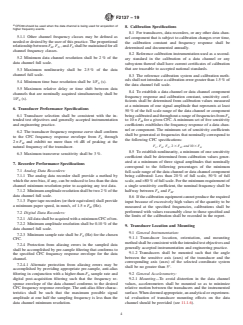
5.1 CFC Definitions—The following channel frequency classes are defined as standard:
A B
CFC10 CFC60
F 0.0 Hz 0.0 Hz
L
F 10.0 Hz 60.0 Hz
H
F 16.7 Hz 100 Hz
N
F 120 Hz 720 Hz
S
A
CFC10 should be used when the data channel is being used for acquisition of lower frequency events.
B
CFC60 should be used when the data channel is being used for acquisition of higher frequency events.
5.1.1 Other channel frequency classes may be defined as needed or desired by the user of this practice. The proportional
relationship between F ,F , and F shall be maintained for all channel frequency classes.
H N S
5.2 Minimum data channel resolution shall be 2 % of the data channel full scale.
5.3 Maximum nonlinearity shall be 2.5 % of the data channel full scale.
5.4 Minimum time base resolution shall be 1/F (s).
S
5.5 Maximum relative delay or time shift between data channels that are nominally acquired simultaneously shall be 1/F (s).
S
6. Transducer Performance Specifications
6.1 Transducer selection shall be consistent with the intended test objectives and generally accepted instrumentation and
engineering practice.
6.2 The transducer frequency response curve shall conform to the CFC frequency response envelope from F through 2 × F
L H
and exhibit no more than +6 dB of peaking at the natural frequency of the transducer.
6.3 Maximum transverse sensitivity shall be 3 %.
7. Recorder Performance Specifications
7.1 Analog Data Recorders:
7.1.1 The analog data recorder shall provide a method by which the zero bias, if any, can be reduced to less than the data channel
minimum resolution prior to acquiring any test data.
7.1.2 Minimum amplitude resolution shall be two 2 % of the data channel full scale.
7.1.3 Paper tape recorders (or their equivalent) shall provide a minimum paper speed, in mm/s, of 1.5 × F (Hz).
H
7.2 Digital Data Recorders:
7.2.1 All data shall be acquired with a minimum CFC of ten.
7.2.2 Minimum amplitude resolution shall be 0.10 % of the data channel full scale.
7.2.3 Minimum sample rate shall be F (Hz) for the chosen CFC.
S
7.2.4 Protection from aliasing errors in the sampled data shall be accomplished by pre-sample filtering that conforms to the
specified CFC frequency response envelope for the data channel.
7.2.4.1 Alternate protection from aliasing errors may be accomplished by providing appropriate pre-sample, anti-alias filtering
in conjunction with a higher-than-F sample rate and digital post-acquisition filtering such that the frequency response envelope
S
of the data channel conforms to the desired CFC frequency response envelope. The anti-alias filter characteristics shall be such
that the maximum possible signal amplitude at one half the sampling frequency is less than the data channel minimum resolution.
8. Calibration Specifications
8.1 For transducers, data recorders, or any other data channel component that is subject to calibration changes over time, the
calibration constant and frequency response shall be determined and documented annually.
F2137 − 19
8.2 Reference calibration instrumentation used as a secondary standard in the calibration of a data channel or any subsystem
thereof shall have current certificates of calibration that are traceable to accepted national standards.
8.3 The reference calibration system and calibration methods shall not introduce a calibration error greater than 1.5 % of the
data channel full scale.
8.4 To establish a data channel or data channel component frequency response and calibration constant, sensitivity coefficients
shall be determined from calibration values measured at a minimum of one signal amplitude that represents at least 50 % of the
full scale range of the data channel or component being calibrated and throughout a range of frequencies from F to 10 × F for
L H
a given CFC. A minimum set of five sensitivity coefficients establishes the frequency response of a data channel or component.
The minimum set of sensitivity coefficients shall be generated at frequencies that nominally correspond to the following CFC
specifications:
F , F , F , 23F , and 10 3F
L H N H H
8.5 To establish nonlinearity, a minimum of one sensitivity coefficient shall be determined from calibration values generated at
a minimum of three signal amplitudes that nominally correspond to the following percentages of the minimum full-scale range of
the data channel or data channel component being calibrated: Less than 20 % of full scale, 50 % of full scale, and >80 % of full
scale. For the minimum requirement of a single sensitivity coefficient, the nominal frequency shall be halfway between F and F .
L H
8.6 If the calibration equipment cannot produce the required input because of excessively high values of the quantity to be
measured at the specified frequencies, calibrations shall be performed with values reasonably close to those specified and the limits
of the calibration shall be recorded in the report.
9. Transducer Location and Mounting
9.1 General Instrumentation:
9.1.1 Transducer location, orientation, and mounting method shall be consistent with the intended test objectives and generally
accepted instrumentation and engineering practice.
9.1.2 Transducers shall be mounted such that the angle between the sensitive axis (axes) of the transducer and the corresponding
axis (axes) of the selected coordinate system shall be no greater than 5°.
9.2 General Accelerometry:
9.2.1 Mounting—To avoid distortion in the data channel values, accelerometers shall be mounted so as to minimize relative
motion between the transducers and the instrumented surface. When deemed appropriate, an analytical or experimental evaluation
of transducer mounting effects on the data channel should be provided (see 11.1.6).
9.2.2 When multi-axis accelerations at a point are to be measured, the center of seismic mass of each accelerometer shall be
within 60 mm of that point. Each accelerometer axis shall be within one degree of orthogonal relative to the other axes.
10. Procedure
10.1 The unique characteristics of a particular amusement ride or device or other special circumstances may be such that it is
not reasonably possible to test in strict conformance with one or more provisions of this practice. Any deviation(s) from the
provisions of this practice shall be recorded so as to clearly provide a description of the specific deviation(s).
10.2 Field Calibration:
10.2.1 Where practical, all data channels should be subjected to a field calibration procedure to establish the reliability of the
data channel calibration.
10.2.2 For accelerometer-based data channels, the field calibration procedure, may take the form of a 2g “roll-over” test. The
2 g “roll-over” test requires that the accelerometer be placed with its sensitive axis perpendicular to a plane surface that is
nominally level with respect to the earth while the output of the data channel is recorded. The accelerometer should then be
oriented with its sensitive axis parallel to this surface to record a zero-g input. Next, the accelerometer should be inverted with
respect to its original orientation and its output recorded. This procedure will yield a three-point calibration (+1g, 0g, and -1g) with
a nominal 2g range.
10.3 When testing the nominal dynamic characteristics of amusement rides and devices that have characteristics that change
with respect to operating temperature, the rides or devices shall be operated for a minimum of three full cycles prior to data
collection. Additionally, in the case of gravity operated amusement rides or devices, such as roller coasters, the rides or devices
should be operated until free-run times have a variability of less than 5 % prior to data collection.
10.4 The zero bias of each data channel shall be accounted for in the test data record(s).
11. Test Documentation
11.1 Include the following in the test documentation:
11.1.1 General test information, including but not limited to ride or device name, serial number, and location; test date and time;
and the names of the testing personnel.
F2137 − 19
11.1.2 A record of the nominal environmental conditions during the test, such as temperature, humidity, and wind conditions.
11.1.3 The test data record(s).
11.1.4 An indication establishing a relationship between at least one time point in each test data record and a corresponding
known physical position of the ride or device in the ride cycle. In the case where a known physical position in the ride cycle cannot
be established due to the random or non-repeatable nature of the ride, an indication establishing a relationship between at least one
time point in each test data record and a corresponding time point in the ride cycle shall be provided.
11.1.5 The results of all field calibration procedures performed as part of the test procedure (see 10.2).
11.1.6 Documentation of the transducer mounting method including the results from any analytical or experimental evaluation
of transducer mounting effects on the data channel (see 9.2.1, 12.1.6).
11.1.7 Documentation of transducer mounting location(s) and orientation(s).
11.1.8 Documentation of the measurement coordinate system, including identification of the positive direction along each of the
coordinate axes.
11.1.9 A description of each data channel utilized during the test, including but not limited to:
11.1.9.1 Data channel title, engineering units, CFC, and data channel resolution.
11.1.9.2 Documentation regarding the inclusion or exclusion of gravity effects in the zero bias for data channels that are
sensitive to gravity.
11.1.10 The manufacturer, model, serial number, and most recent calibration date fo
...