

ASTM F1193-23
(Practice)Standard Practice for Quality, Manufacture, and Construction of Amusement Rides and Devices
General Information
- Abstract
SIGNIFICANCE AND USE
3.1 The purpose of this practice is to provide the minimum manufacturing requirements for amusement rides and devices and to provide the minimum requirements for a written quality assurance program for an amusement ride or device manufacturer, or component supplier. This is not intended to include suppliers of off-the-shelf components (for example, fasteners, electrical wire).
SCOPE
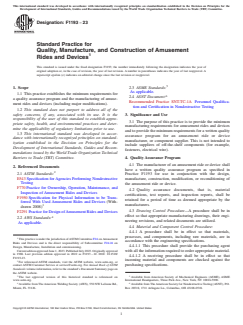
1.1 This practice establishes the minimum requirements for a quality assurance program and the manufacturing of amusement rides and devices (including major modifications).
1.2 This standard does not purport to address all of the safety concerns, if any, associated with its use. It is the responsibility of the user of this standard to establish appropriate safety, health, and environmental practices and determine the applicability of regulatory limitations prior to use.
1.3 This international standard was developed in accordance with internationally recognized principles on standardization established in the Decision on Principles for the Development of International Standards, Guides and Recommendations issued by the World Trade Organization Technical Barriers to Trade (TBT) Committee.
- Status
- Published
- Publication Date
- 31-May-2023
- Technical Committee
- F24 - Amusement Rides and Devices
- Drafting Committee
- F24.24 - Design, Manufacture, Installation and commissioning
Buy Documents
ASTM F1193-23 - Standard Practice for Quality, Manufacture, and Construction of Amusement Rides and Devices
REDLINE ASTM F1193-23 - Standard Practice for Quality, Manufacture, and Construction of Amusement Rides and Devices
Overview
ASTM F1193-23: Standard Practice for Quality, Manufacture, and Construction of Amusement Rides and Devices establishes the minimum requirements for the manufacturing and quality assurance programs for amusement rides and devices, including major modifications. Developed by ASTM International, this practice is designed to ensure that manufacturers and component suppliers maintain consistent product quality, traceability, and operational safety through documented processes and robust quality systems. It also specifies the operational, documentation, and certification requirements necessary prior to public operation.
Key Topics
Quality Assurance Programs
Manufacturers are required to maintain a written and fully implemented quality assurance (QA) program. This QA program must cover processes such as material certification, testing, inspection procedures, and record retention policies.Manufacturing Controls
Controls include procedures for drawing management, material and component verification, specification compliance, and handling of non-conforming components. Each stage of manufacturing-from procurement to assembly-must have documented inspections and approval steps.Welding Standards and Inspections
All welding activities must follow recognized ANSI/AWS, ASME, or equivalent codes, with formal qualification and documented records for welders and procedures. Ongoing inspections ensure compliance with welding standards and monitor workmanship.Installation, Testing, and Commissioning
The standard mandates developmental and installation testing to verify structural, operational, and safety parameters, including loads and performance criteria. Certification of compliance is required before rides or devices are open for public use.Operational and Maintenance Documentation
Manufacturers must include detailed operation and maintenance instructions with every ride or device. This encompasses descriptions of function, safety requirements, maintenance routines, recommended inspections, and testing guidelines.Information Plate Requirements
A durable information plate with critical information (including serial number, manufacturer, model, passenger capacity, and operational limits) must be attached to each ride or device for traceability and regulatory review.Supplemental Bulletins
Procedures for incident response, including issuing safety alerts and service bulletins, are defined to promptly communicate critical updates to ride owners, operators, and regulatory bodies.
Applications
ASTM F1193-23 is primarily used by:
Manufacturers and Component Suppliers
To establish consistent and validated manufacturing practices, quality assurance routines, and product traceability for new and modified amusement rides and devices.Ride Owners and Operators
To ensure that every amusement ride or device entering operation has been manufactured and tested according to internationally recognized standards, and to facilitate ongoing safe operation through manufacturer-supplied maintenance documentation and inspection routines.Regulatory Authorities and Inspectors
To verify compliance with manufacturing and operational standards, review certification materials, and access supplemental bulletins for ongoing oversight of amusement ride safety.
The practical value of ASTM F1193 lies in risk mitigation, enhancing public safety, supporting regulatory requirements, and promoting best practices throughout the amusement ride industry.
Related Standards
The following standards are referenced or closely related to ASTM F1193-23:
- ASTM F770 - Practice for Ownership, Operation, Maintenance, and Inspection of Amusement Rides and Devices
- ASTM F2291 - Practice for Design of Amusement Rides and Devices
- ASTM E543 - Specification for Agencies Performing Nondestructive Testing
- AWS Standards - For welding procedures and qualifications
- ASME Standards - For manufacturing and welding processes
- ASNT SNT-TC-1A - Personnel Qualification and Certification in Nondestructive Testing
These standards, together with ASTM F1193-23, form a comprehensive framework for the safe manufacture, operation, and maintenance of amusement rides and devices worldwide.
Keywords: amusement rides, devices, quality assurance, manufacturing, welding, inspection, safety, operation, ASTM F1193
Relations
- Effective Date
- 15-May-2019
- Effective Date
- 01-Jun-2018
- Effective Date
- 01-Jun-2017
- Effective Date
- 01-May-2017
- Effective Date
- 01-May-2017
- Effective Date
- 01-Dec-2016
- Effective Date
- 01-May-2015
- Effective Date
- 01-Apr-2014
- Effective Date
- 01-Sep-2013
- Effective Date
- 01-Mar-2013
- Effective Date
- 15-May-2011
- Effective Date
- 15-Jul-2009
- Effective Date
- 01-Jun-2009
- Effective Date
- 01-May-2009
- Effective Date
- 01-Jan-2009
Buy Documents
ASTM F1193-23 - Standard Practice for Quality, Manufacture, and Construction of Amusement Rides and Devices
REDLINE ASTM F1193-23 - Standard Practice for Quality, Manufacture, and Construction of Amusement Rides and Devices
Frequently Asked Questions
ASTM F1193-23 is a standard published by ASTM International. Its full title is "Standard Practice for Quality, Manufacture, and Construction of Amusement Rides and Devices". This standard covers: SIGNIFICANCE AND USE 3.1 The purpose of this practice is to provide the minimum manufacturing requirements for amusement rides and devices and to provide the minimum requirements for a written quality assurance program for an amusement ride or device manufacturer, or component supplier. This is not intended to include suppliers of off-the-shelf components (for example, fasteners, electrical wire). SCOPE 1.1 This practice establishes the minimum requirements for a quality assurance program and the manufacturing of amusement rides and devices (including major modifications). 1.2 This standard does not purport to address all of the safety concerns, if any, associated with its use. It is the responsibility of the user of this standard to establish appropriate safety, health, and environmental practices and determine the applicability of regulatory limitations prior to use. 1.3 This international standard was developed in accordance with internationally recognized principles on standardization established in the Decision on Principles for the Development of International Standards, Guides and Recommendations issued by the World Trade Organization Technical Barriers to Trade (TBT) Committee.
SIGNIFICANCE AND USE 3.1 The purpose of this practice is to provide the minimum manufacturing requirements for amusement rides and devices and to provide the minimum requirements for a written quality assurance program for an amusement ride or device manufacturer, or component supplier. This is not intended to include suppliers of off-the-shelf components (for example, fasteners, electrical wire). SCOPE 1.1 This practice establishes the minimum requirements for a quality assurance program and the manufacturing of amusement rides and devices (including major modifications). 1.2 This standard does not purport to address all of the safety concerns, if any, associated with its use. It is the responsibility of the user of this standard to establish appropriate safety, health, and environmental practices and determine the applicability of regulatory limitations prior to use. 1.3 This international standard was developed in accordance with internationally recognized principles on standardization established in the Decision on Principles for the Development of International Standards, Guides and Recommendations issued by the World Trade Organization Technical Barriers to Trade (TBT) Committee.
ASTM F1193-23 is classified under the following ICS (International Classification for Standards) categories: 97.200.99 - Other equipment for entertainment. The ICS classification helps identify the subject area and facilitates finding related standards.
ASTM F1193-23 has the following relationships with other standards: It is inter standard links to ASTM F2291-19, ASTM F770-18, ASTM F2291-17, ASTM F770-17, ASTM F770-17e1, ASTM F2291-16, ASTM F770-15, ASTM F770-14, ASTM F770-13, ASTM E543-13, ASTM F770-11, ASTM F2291-09b, ASTM E543-09, ASTM F2291-09a, ASTM F2291-09. Understanding these relationships helps ensure you are using the most current and applicable version of the standard.
ASTM F1193-23 is available in PDF format for immediate download after purchase. The document can be added to your cart and obtained through the secure checkout process. Digital delivery ensures instant access to the complete standard document.
Standards Content (Sample)
This international standard was developed in accordance with internationally recognized principles on standardization established in the Decision on Principles for the
Development of International Standards, Guides and Recommendations issued by the World Trade Organization Technical Barriers to Trade (TBT) Committee.
Designation: F1193 − 23
Standard Practice for
Quality, Manufacture, and Construction of Amusement
Rides and Devices
This standard is issued under the fixed designation F1193; the number immediately following the designation indicates the year of
original adoption or, in the case of revision, the year of last revision. A number in parentheses indicates the year of last reapproval. A
superscript epsilon (´) indicates an editorial change since the last revision or reapproval.
1. Scope 2.3 ASME Standards:
As applicable.
1.1 This practice establishes the minimum requirements for
2.4 ASNT Document:
a quality assurance program and the manufacturing of amuse-
Recommended Practice SNT-TC-1A Personnel Qualifica-
ment rides and devices (including major modifications).
tion and Certification in Nondestructive Testing
1.2 This standard does not purport to address all of the
safety concerns, if any, associated with its use. It is the
3. Significance and Use
responsibility of the user of this standard to establish appro-
3.1 The purpose of this practice is to provide the minimum
priate safety, health, and environmental practices and deter-
manufacturing requirements for amusement rides and devices
mine the applicability of regulatory limitations prior to use.
and to provide the minimum requirements for a written quality
1.3 This international standard was developed in accor-
assurance program for an amusement ride or device
dance with internationally recognized principles on standard-
manufacturer, or component supplier. This is not intended to
ization established in the Decision on Principles for the
include suppliers of off-the-shelf components (for example,
Development of International Standards, Guides and Recom-
fasteners, electrical wire).
mendations issued by the World Trade Organization Technical
Barriers to Trade (TBT) Committee.
4. Quality Assurance Program
4.1 The manufacturer of an amusement ride or device shall
2. Referenced Documents
have a written quality assurance program as specified in
2.1 ASTM Standards:
Practice F1193 for use in conjunction with the design,
E543 Specification for Agencies Performing Nondestructive
manufacture, construction, modification, or reconditioning of
Testing
the amusement ride or device.
F770 Practice for Ownership, Operation, Maintenance, and
4.2 Quality assurance documents, that is, material
Inspection of Amusement Rides and Devices
certifications, test reports, and inspection reports, shall be
F1950 Specification for Physical Information to be Trans-
retained for a period of time as deemed appropriate by the
ferred With Used Amusement Rides and Devices (With-
manufacturers.
drawn 2008)
4.3 Drawing Control Procedure—A procedure shall be in
F2291 Practice for Design of Amusement Rides and Devices
effect so that appropriate manufacturing drawings, their engi-
2.2 AWS Standards:
neering revisions, and related documents are utilized.
As applicable.
4.4 Material and Component Control Procedure:
4.4.1 A procedure shall be in effect so that materials,
processes, and components, including raw materials, are in
This practice is under the jurisdiction of ASTM Committee F24 on Amusement
accordance with the engineering specifications.
Rides and Devices and is the direct responsibility of Subcommittee F24.24 on
4.4.1.1 This procedure shall provide the purchasing agent
Design, Manufacture, Installation and commissioning.
Current edition approved June 1, 2023. Published July 2023. Originally approved
with all the information required to order appropriate material.
in 1988. Last previous edition approved in 2022 as F1193 – 22. DOI: 10.1520/
4.4.1.2 A receiving procedure shall be in effect so that
F1193-23.
incoming material and components are checked against the
For referenced ASTM standards, visit the ASTM website, www.astm.org, or
contact ASTM Customer Service at service@astm.org. For Annual Book of ASTM purchasing specifications.
Standards volume information, refer to the standard’s Document Summary page on
the ASTM website.
3 5
The last approved version of this historical standard is referenced on Available from American Society of Mechanical Engineers (ASME), ASME
www.astm.org. International Headquarters, Three Park Ave., New York, NY 10016-5990.
4 6
Available from The American Welding Society (AWS), 550 NW LeJeune Rd., Available from The American Society for Nondestructive Testing (ASNT), P.O.
Miami, FL 33126. Box 28518, 1711 Arlingate Ln., Columbus, OH 43228-0518.
Copyright © ASTM International, 100 Barr Harbor Drive, PO Box C700, West Conshohocken, PA 19428-2959. United States
F1193 − 23
4.4.2 A procedure shall be in effect so that appropriate Procedure Qualification Record (PQR), which serves as written
inspections are made on purchased components. confirmation of a successful WPS qualification.
(4) Only welders, welding operators, and tack welders who
4.4.3 A procedure shall be in effect so that material in stock
can be properly identified for future use. are qualified in accordance with the applicable standard shall
perform welding. Welders, welding operators, and tack welders
4.4.4 Documentation on any material, process, or compo-
shall be qualified by testing as indicated by the applicable
nents certified shall be filed for reference.
standard and documented on a Welding Performance Qualifi-
4.5 Manufacturing:
cation Record (WPQR).
4.5.1 Amusement ride and device components and systems
(5) The welding personnel shall follow a WPS applicable
shall be manufactured and assembled in accordance with the
to the qualification test.
designer/engineer specified criteria.
(6) The WPQR shall serve as written verification of welder
4.5.1.1 A procedure shall be in effect so that appropriate
qualification and shall list all applicable essential variables as
inspections are made on manufactured parts and
indicated by the applicable standard (see Form E-1 in ANSI/
subassemblies, for conformance with the designer/engineer
AWS D1.1/D1.1M, Annex E).
specified criteria.
(7) Welding performance standards that do not have accep-
4.5.1.2 A procedure shall be in effect so that completed
tance or workmanship criteria shall not be considered an
subassemblies, or where practical, the assembled amusement
equivalent standard.
rides or devices are inspected prior to delivery.
4.5.3 Welding Process Inspection:
4.5.1.3 Changes to the designer/engineer specified criteria
4.5.3.1 Inspectors must meet the criteria in accordance with
shall be documented and approved by the designer/engineer or
the applicable standard. An inspector can be an engineer or
a qualified engineer before components, subassemblies, or
technician who, by training or experience, or both, in metals
systems are placed into use.
fabrication, inspection, and testing, is competent to perform the
4.5.1.4 Manufacturers shall have a written procedure to
inspection of the work.
address non-conforming components. Non-conforming com-
4.5.3.2 The Inspector shall verify that all welds conform to
ponents found in 4.5.1.1, 4.5.1.2, or 4.4.2 shall be identified
the acceptance or workmanship criteria of the applicable
and evaluated. Disposition of the non-conforming components
standard, and to the drawings and documentation.
shall be one of the following:
4.5.3.3 The size and contour of welds shall be measured
(1) The non-conforming component shall not be used in the
with suitable gauges.
specific intended purpose (for example, scrapped, altered,
returned to vendor, properly identified, quarantine). 4.5.3.4 Visual inspection for cracks in welds and base metal
(2) The non-conforming component shall be reworked to
and other discontinuities shall be aided by a strong light,
bring it into compliance and re-inspected in conformance with magnifiers, or such other devices.
4.5.1.1, 4.5.1.2, or 4.4.2 of this practice.
4.5.3.5 The Inspector shall verify that only materials con-
(3) The design of the non-conforming component shall be
forming to the specifications contained within the drawings and
re-evaluated in accordance with 4.5.1.3, and the drawing or
documentation are used.
documentation shall be modified or created to allow the
4.5.3.6 The Inspector shall review all WPSs used for the
component to be used as is.
work and shall verify that the procedures conform to the
4.5.2 Welding:
criteria of the application standard.
4.5.2.1 Welding procedures shall be in accordance with
4.5.3.7 The Inspector shall inspect the work on a sampling
American National Standards Institute/American Welding So-
basis and at suitable intervals during the process to verify that
ciety (ANSI/AWS) or American Society of Mechanical Engi-
the criteria of the applicable sections of the standard are met.
neers (ASME), or equivalent standards.
4.5.3.8 The Inspector shall inspect the welding equipment
4.5.2.2 For this section on Welding, equivalent standards are
used for the work to verify that it conforms to the criteria of the
those that meet the ANSI/AWS and ASME welding process
applicable standard.
methodology. This methodology is outlined in the paragraphs
4.5.3.9 The Inspector shall verify that electrodes are used
below:
only in the positions and with the type of welding current and
(1) Welding process shall be performed in accordance with
polarity for which they are classified.
a written Weld Procedure Specification (WPS) that specifies
4.5.3.10 The Inspector shall review for accuracy and appli-
the applicable essential variables in accordance with the
cability the record of qualifications of all welders, welding
criteria of the applicable code. The specific values for these
operators, and tack welders; all WPS qualifications or other
WPS variables shall be obtained from the Procedure Qualifi-
tests that are made; and such other information as may be
cation Record (PQR) Essential variables may include: weld
appropriate.
process, joint design, base material, filler material, shielding,
preheats, position, electrical characteristics, technique, and 4.5.3.11 Records of the qualifications of all welders, weld-
travel speed. ing operators, tack welders, WPS qualifications or other tests
(2) The WPS shall state the tolerances on an essential that are made, applicable inspections, and such other informa-
variable as indicated by the applicable standard. tion as appropriate shall be maintained pursuant to the manu-
(3) A WPS shall be qualified in accordance with procedures facturer’s record retention policy and made available to those
indicated by the applicable standard and documented on the authorized to examine them.
F1193 − 23
5. Installation and Commissioning functions, including passenger restrictions to maximum expo-
sure time, shall be included.
5.1 Developmental Testing Requirements—Where
6.1.2.3 Recommended Balance of Passenger Loading or
applicable, as determined by the manufacturer/designer, the
Unloading—When passenger distribution is essential to the
following test procedures shall be developed and performed on
proper operation of the ride or device, the appropriate loading
a prototype amusement ride or device in order that the
and unloading procedure with respect to weight distribution
manufacturer/designer may determine the appropriateness for
shall be provided.
use, of not only the parts, but the entire system of a newly
6.1.2.4 Environmental Restrictions—Recommendations for
designed ride or device.
operational restrictions relating to environmental conditions
5.1.1 Procedures to Verify Maximum Safe Design Loads:
such as, but not limited to, wind, rain, salt corrosion, and
5.1.1.1 Procedures to verify such design characteristics as
extreme heat or cold.
relevant deflections, loads, and forces that are placed on both
the equipment and the passengers during operation of the ride 6.1.2.5 Recommended Passenger Restrictions—Where
or device, applicable, any recommended passenger limitations such as,
5.1.1.2 A procedure to determine operational limits and but not limited to, height passenger placement, or any other
restart criteria due to environmental conditions, appropriate restrictions.
5.1.1.3 Procedures to allow the manufacturer to determine
6.1.2.6 Electrical Power Requirements—Total electrical
such factors as component variability and certification require-
power required to properly operate the ride or device desig-
ments of components, and
nated in watts, volts, and frequency, including minimum and
5.1.1.4 Any other procedures necessary to demonstrate a
maximum voltage limits.
ride or device’s appropriateness for its intended use.
6.1.2.7 Mechanical Power Requirements—Minimum
horsepower necessary to operate ride properly.
5.2 Installation Testing Requirements:
5.2.1 This section of the standard covers those tests relevant
6.1.2.8 Water Flow—Minimum/maximum water flow
not only to installation, but also includes post-modification and
rates.
major modifications. The original manufacturer or supplier of
6.1.2.9 Static Information—The following information
an amusement ride or device shall also provide, where
shall be provided for the amusement ride or device when it is
applicable, the following standard testing guides:
in a nonoperational state with no passengers: height, width,
5.2.1.1 Materials Testing—Acceptable test procedures for
diameter, and weight.
the certification of all major structural components shall be
6.1.2.10 Dynamic Information—The following informa-
provided. Where possible, this testing should be referenced to
tion shall be provided for the amusement ride or device when
ASTM or to other commonly accepted industry standards.
it is in an operational state: height, width, diameter, and weight.
5.2.1.2 Erection/Modification Acceptance Testing—Test
6.1.2.11 Trailering Information—Each trailer necessary
procedures or criteria for the acceptance of such construction
for the transport of a portable amusement ride or device shall
operations as welding and fastening shall be provided. Again,
be provided with the following information: height, width,
where possible, reference should be made to ASTM or to other
length, and weight.
currently accepted industry standards for this purpose.
6.1.2.12 Fastener Schedule—A manufacturer-issued sched-
5.2.1.3 Performance Testing—This should consist of a se-
ule for the correct grade, torque, and placement of all fasteners
ries of specified tests that can be used to determine that the
used in the assembly, or erection, or both, of the ride or device.
newly erected ride or device conforms to the original design
6.1.2.13 Design Loads per Connection Point—Loads for
criteria.
each footing or equivalent structural connection point as
calculated for all the various load combinations as required by
6. Operation and Maintenance Documentation
Section 8, Loads and Strengths, of Practice F2291.
6.1 The manufacturer of an amusement ride or device shall
6.1.2.14 Elements and Structures—Provided the pro-
provide, with delivery of each ride or device, documented,
posed owner/operator furnishes the manufacturer with neces-
recommended operating and maintenance instructions in the
sary data concerning proposed installation and usage of the ride
English language. These instructions shall include, but not be
or device, the manufacturer shall provide to the proposed
limited to the following:
owner/operator a description of all structural interface between
6.1.1 Description of the ride or device operation, including
the ride or device and the owner/operator supports. This
the function and operation of its major components.
structural requirement definition shall include the following:
6.1.1.1 Description of the motion(s) of the ride or device
(1) Maximum static design loads of each footing or equiva-
during operation.
lent structural connection,
6.1.2 Information Requirements:
(2) Maximum dynamic design loads of each footing or
6.1.2.1 The information given in 7.1 and 6.1.2.2 – 6.1.2.14
equivalent structural connection, and
shall be included, where applicable, on the information plate as
(3) Any other structural interface design specification.
specified in 7.1, and in the documented operating and mainte-
6.1.3 Operational procedures shall include:
nance instructions to be furnished by the manufacturer or seller
at the time of sale of each amusement ride or device. 6.1.3.1 Description of the recommended passenger loading
6.1.2.2 Ride Duration—The actual time the ride is in procedures during operation, including recommended seating,
operation or a passenger is exposed to the elements of the ride where applicable.
F1193 − 23
6.1.3.2 Recommended safety procedures and instructions, 6.1.4.4 Description, including frequency, of recommended
and information about safety equipment pertaining to patrons maintenance, inspections, and testing, other than daily pre-
and ride or device operators and attendants. opening inspection.
(1) Maximum total passenger weight and maximum num- (1) The manufacturer of an amusement ride or device shall
ber of passengers by carrier unit or ride total.
provide the owner/operator with a written inspection procedure
(2) Description of the passenger restraint system, its rec-
to be delivered with the ride or device. The document shall
ommended use and operation.
outline the inspections as contained in Practices F1193 and
(3) Ride or device operator and attendant safety check:
F770.
recommended visual or other inspections to be performed by
(a) Any changes in the procedure prescribed in 6.1.4.4(1)
ride or device operators and attendants prior to and during each
deemed essential by the manufacturer due to information not
ride or device cycle.
available to the manufacturer at the time of delivery shall be
(4) Instructions to the patron: recommended information
communicated to all known owner/operators.
that should be made available to each patron of the ride or
(2) All inspections, whether recommended at the time of
device.
sale or subsequently, shall meet the following criteria:
(5) Recommendations for operational restriction relatin
...
This document is not an ASTM standard and is intended only to provide the user of an ASTM standard an indication of what changes have been made to the previous version. Because
it may not be technically possible to adequately depict all changes accurately, ASTM recommends that users consult prior editions as appropriate. In all cases only the current version
of the standard as published by ASTM is to be considered the official document.
Designation: F1193 − 22 F1193 − 23
Standard Practice for
Quality, Manufacture, and Construction of Amusement
Rides and Devices
This standard is issued under the fixed designation F1193; the number immediately following the designation indicates the year of
original adoption or, in the case of revision, the year of last revision. A number in parentheses indicates the year of last reapproval. A
superscript epsilon (´) indicates an editorial change since the last revision or reapproval.
1. Scope
1.1 This practice establishes the minimum requirements for a quality assurance program and the manufacturing of amusement
rides and devices (including major modifications).
1.2 This standard does not purport to address all of the safety concerns, if any, associated with its use. It is the responsibility
of the user of this standard to establish appropriate safety, health, and environmental practices and determine the applicability of
regulatory limitations prior to use.
1.3 This international standard was developed in accordance with internationally recognized principles on standardization
established in the Decision on Principles for the Development of International Standards, Guides and Recommendations issued
by the World Trade Organization Technical Barriers to Trade (TBT) Committee.
2. Referenced Documents
2.1 ASTM Standards:
E543 Specification for Agencies Performing Nondestructive Testing
F770 Practice for Ownership, Operation, Maintenance, and Inspection of Amusement Rides and Devices
F1950 Specification for Physical Information to be Transferred With Used Amusement Rides and Devices (Withdrawn 2008)
F2291 Practice for Design of Amusement Rides and Devices
2.2 AWS Standards:
As applicable.
2.3 ASME Standards:
As applicable.
2.4 ASNT Document:
Recommended Practice SNT-TC-1A Personnel Qualification and Certification in Nondestructive Testing
3. Significance and Use
3.1 The purpose of this practice is to provide the minimum manufacturing requirements for amusement rides and devices and to
This practice is under the jurisdiction of ASTM Committee F24 on Amusement Rides and Devices and is the direct responsibility of Subcommittee F24.24 on Design,
Manufacture, Installation and commissioning.
Current edition approved June 1, 2022June 1, 2023. Published June 2022July 2023. Originally approved in 1988. Last previous edition approved in 20182022 as
F1193 – 18a.F1193 – 22. DOI: 10.1520/F1193-22.10.1520/F1193-23.
For referenced ASTM standards, visit the ASTM website, www.astm.org, or contact ASTM Customer Service at service@astm.org. For Annual Book of ASTM Standards
volume information, refer to the standard’s Document Summary page on the ASTM website.
The last approved version of this historical standard is referenced on www.astm.org.
Available from The American Welding Society (AWS), 550 NW LeJeune Rd., Miami, FL 33126.
Available from American Society of Mechanical Engineers (ASME), ASME International Headquarters, Three Park Ave., New York, NY 10016-5990.
Available from The American Society for Nondestructive Testing (ASNT), P.O. Box 28518, 1711 Arlingate Ln., Columbus, OH 43228-0518.
Copyright © ASTM International, 100 Barr Harbor Drive, PO Box C700, West Conshohocken, PA 19428-2959. United States
F1193 − 23
provide the minimum requirements for a written quality assurance program for an amusement ride or device manufacturer, or
component supplier. This is not intended to include suppliers of off-the-shelf components (for example, fasteners, electrical wire).
4. Quality Assurance Program
4.1 The manufacturer of an amusement ride or device shall have a written quality assurance program as specified in Practice F1193
for use in conjunction with the design, manufacture, construction, modification, or reconditioning of the amusement ride or device.
4.2 Quality assurance documents, that is, material certifications, test reports, and inspection reports, shall be retained for a period
of time as deemed appropriate by the manufacturers.
4.3 Drawing Control Procedure—A procedure shall be in effect so that appropriate manufacturing drawings, their engineering
revisions, and related documents are utilized.
4.4 Material and Component Control Procedure:
4.4.1 A procedure shall be in effect so that materials, processes, and components, including raw materials, are in accordance with
the engineering specifications.
4.4.1.1 This procedure shall provide the purchasing agent with all the information required to order appropriate material.
4.4.1.2 A receiving procedure shall be in effect so that incoming material and components are checked against the purchasing
specifications.
4.4.2 A procedure shall be in effect so that appropriate inspections are made on purchased components.
4.4.3 A procedure shall be in effect so that material in stock can be properly identified for future use.
4.4.4 Documentation on any material, process, or components certified shall be filed for reference.
4.5 Manufacturing:
4.5.1 Amusement ride and device components and systems shall be manufactured and assembled in accordance with the
designer/engineer specified criteria.
4.5.1.1 A procedure shall be in effect so that appropriate inspections are made on manufactured parts and subassemblies, for
conformance with the designer/engineer specified criteria.
4.5.1.2 A procedure shall be in effect so that completed subassemblies, or where practical, the assembled amusement rides or
devices are inspected prior to delivery.
4.5.1.3 Changes to the designer/engineer specified criteria shall be documented and approved by the designer/engineer or a
qualified engineer before components, subassemblies, or systems are placed into use.
4.5.1.4 Manufacturers shall have a written procedure to address non-conforming components. Non-conforming components found
in 4.5.1.1, 4.5.1.2, or 4.4.2 shall be identified and evaluated. Disposition of the non-conforming components shall be one of the
following:
(1) The non-conforming component shall not be used in the specific intended purpose (for example, scrapped, altered, returned
to vendor, properly identified, quarantine).
(2) The non-conforming component shall be reworked to bring it into compliance and re-inspected in conformance with
4.5.1.1, 4.5.1.2, or 4.4.2 of this practice.
(3) The design of the non-conforming component shall be re-evaluated in accordance with 4.5.1.3, and the drawing or
documentation shall be modified or created to allow the component to be used as is.
4.5.2 Welding:
F1193 − 23
4.5.2.1 Welding procedures shall be in accordance with American National Standards Institute/American Welding Society
(ANSI/AWS) or American Society of Mechanical Engineers (ASME), or equivalent standards.
4.5.2.2 For this section on Welding, equivalent standards are those that meet the ANSI/AWS and ASME welding process
methodology. This methodology is outlined in the paragraphs below:
(1) Welding process shall be performed in accordance with a written Weld Procedure Specification (WPS) that specifies the
applicable essential variables in accordance with the criteria of the applicable code. The specific values for these WPS variables
shall be obtained from the Procedure Qualification Record (PQR) Essential variables may include: weld process, joint design, base
material, filler material, shielding, preheats, position, electrical characteristics, technique, and travel speed.
(2) The WPS shall state the tolerances on an essential variable as indicated by the applicable standard.
(3) A WPS shall be qualified in accordance with procedures indicated by the applicable standard and documented on the
Procedure Qualification Record (PQR), which serves as written confirmation of a successful WPS qualification.
(4) Only welders, welding operators, and tack welders who are qualified in accordance with the applicable standard shall
perform welding. Welders, welding operators, and tack welders shall be qualified by testing as indicated by the applicable standard
and documented on a Welding Performance Qualification Record (WPQR).
(5) The welding personnel shall follow a WPS applicable to the qualification test.
(6) The WPQR shall serve as written verification of welder qualification and shall list all applicable essential variables as
indicated by the applicable standard (see Form E-1 in ANSI/AWS D1.1/D1.1M, Annex E).
(7) Welding performance standards that do not have acceptance or workmanship criteria shall not be considered an equivalent
standard.
4.5.3 Welding Process Inspection:
4.5.3.1 Inspectors must meet the criteria in accordance with the applicable standard. An inspector can be an engineer or technician
who, by training or experience, or both, in metals fabrication, inspection, and testing, is competent to perform the inspection of
the work.
4.5.3.2 The Inspector shall verify that all welds conform to the acceptance or workmanship criteria of the applicable standard, and
to the drawings and documentation.
4.5.3.3 The size and contour of welds shall be measured with suitable gauges.
4.5.3.4 Visual inspection for cracks in welds and base metal and other discontinuities shall be aided by a strong light, magnifiers,
or such other devices.
4.5.3.5 The Inspector shall verify that only materials con- forming to the specifications contained within the drawings and
documentation are used.
4.5.3.6 The Inspector shall review all WPSs used for the work and shall verify that the procedures conform to the criteria of the
application standard.
4.5.3.7 The Inspector shall inspect the work on a sampling basis and at suitable intervals during the process to verify that the
criteria of the applicable sections of the standard are met.
4.5.3.8 The Inspector shall inspect the welding equipment used for the work to verify that it conforms to the criteria of the
applicable standard.
4.5.3.9 The Inspector shall verify that electrodes are used only in the positions and with the type of welding current and polarity
for which they are classified.
4.5.3.10 The Inspector shall review for accuracy and applicability the record of qualifications of all welders, welding operators,
and tack welders; all WPS qualifications or other tests that are made; and such other information as may be appropriate.
4.5.3.11 Records of the qualifications of all welders, welding operators, tack welders, WPS qualifications or other tests that are
made, applicable inspections, and such other information as appropriate shall be maintained pursuant to the manufacturer’s record
retention policy and made available to those authorized to examine them.
F1193 − 23
4.5.4 Certification—Prior to operating an amusement ride or device for the public, the manufacturer shall generate a document
certifying that the amusement ride or device is in compliance with Practice F1193. This certification shall be retained with other
quality assurance documents for the amusement ride or device. When requested by an amusement ride or device-certifying
authority, purchaser, or owner, the manufacturer shall provide a copy of this certification document.
5. Installation and Commissioning
5.1 Developmental Testing Requirements—Where applicable, as determined by the manufacturer/designer, the following test
procedures shall be developed and performed on a prototype amusement ride or device in order that the manufacturer/designer may
determine the appropriateness for use, of not only the parts, but the entire system of a newly designed ride or device.
5.1.1 Procedures to Verify Maximum Safe Design Loads:
5.1.1.1 Procedures to verify such design characteristics as relevant deflections, loads, and forces that are placed on both the
equipment and the passengers during operation of the ride or device,
5.1.1.2 A procedure to determine operational limits and restart criteria due to environmental conditions,
5.1.1.3 Procedures to allow the manufacturer to determine such factors as component variability and certification requirements of
components, and
5.1.1.4 Any other procedures necessary to demonstrate a ride or device’s appropriateness for its intended use.
5.2 Installation Testing Requirements:
5.2.1 This section of the standard covers those tests relevant not only to installation, but also includes post-modification and major
modifications. The original manufacturer or supplier of an amusement ride or device shall also provide, where applicable, the
following standard testing guides:
5.2.1.1 Materials Testing—Acceptable test procedures for the certification of all major structural components shall be provided.
Where possible, this testing should be referenced to ASTM or to other commonly accepted industry standards.
5.2.1.2 Erection/Modification Acceptance Testing—Test procedures or criteria for the acceptance of such construction operations
as welding and fastening shall be provided. Again, where possible, reference should be made to ASTM or to other currently
accepted industry standards for this purpose.
5.2.1.3 Performance Testing—This should consist of a series of specified tests that can be used to determine that the newly erected
ride or device conforms to the original design criteria.
6. Operation and Maintenance Documentation
6.1 The manufacturer of an amusement ride or device shall provide, with delivery of each ride or device, documented,
recommended operating and maintenance instructions in the English language. These instructions shall include, but not be limited
to the following:
6.1.1 Description of the ride or device operation, including the function and operation of its major components.
6.1.1.1 Description of the motion(s) of the ride or device during operation.
6.1.2 Information Requirements:
6.1.2.1 The information given in 7.1 and 6.1.2.2 – 6.1.2.14 shall be included, where applicable, on the information plate as
specified in 7.1, and in the documented operating and maintenance instructions to be furnished by the manufacturer or seller at
the time of sale of each amusement ride or device.
6.1.2.2 Ride Duration—The actual time the ride is in operation or a passenger is exposed to the elements of the ride functions,
including passenger restrictions to maximum exposure time, shall be included.
F1193 − 23
6.1.2.3 Recommended Balance of Passenger Loading or Unloading—When passenger distribution is essential to the proper
operation of the ride or device, the appropriate loading and unloading procedure with respect to weight distribution shall be
provided.
6.1.2.4 Environmental Restrictions—Recommendations for operational restrictions relating to environmental conditions such as,
but not limited to, wind, rain, salt corrosion, and extreme heat or cold.
6.1.2.5 Recommended Passenger Restrictions—Where applicable, any recommended passenger limitations such as, but not
limited to, height passenger placement, or any other appropriate restrictions.
6.1.2.6 Electrical Power Requirements—Total electrical power required to properly operate the ride or device designated in
watts, volts, and frequency, including minimum and maximum voltage limits.
6.1.2.7 Mechanical Power Requirements—Minimum horsepower necessary to operate ride properly.
6.1.2.8 Water Flow—Minimum/maximum water flow rates.
6.1.2.9 Static Information—The following information shall be provided for the amusement ride or device when it is in a
nonoperational state with no passengers: height, width, diameter, and weight.
6.1.2.10 Dynamic Information—The following information shall be provided for the amusement ride or device when it is in
an operational state: height, width, diameter, and weight.
6.1.2.11 Trailering Information—Each trailer necessary for the transport of a portable amusement ride or device shall be
provided with the following information: height, width, length, and weight.
6.1.2.12 Fastener Schedule—A manufacturer-issued schedule for the correct grade, torque, and placement of all fasteners used in
the assembly, or erection, or both, of the ride or device.
6.1.2.13 Design Loads per Connection Point—Loads for each footing or equivalent structural connection point as calculated for
all the various load combinations as required by Section 8, Loads and Strengths, of Practice F2291.
6.1.2.14 Elements and Structures—Provided the proposed owner/operator furnishes the manufacturer with necessary data
concerning proposed installation and usage of the ride or device, the manufacturer shall provide to the proposed owner/operator
a description of all structural interface between the ride or device and the owner/operator supports. This structural requirement
definition shall include the following:
(1) Maximum static design loads of each footing or equivalent structural connection,
(2) Maximum dynamic design loads of each footing or equivalent structural connection, and
(3) Any other structural interface design specification.
6.1.3 Operational procedures shall include:
6.1.3.1 Description of the recommended passenger loading procedures during operation, including recommended seating, where
applicable.
6.1.3.2 Recommended safety procedures and instructions, and information about safety equipment pertaining to patrons and ride
or device operators and attendants.
(1) Maximum total passenger weight and maximum number of passengers by carrier unit or ride total.
(2) Description of the passenger restraint system, its recommended use and operation.
(3) Ride or device operator and attendant safety check: recommended visual or other inspections to be performed by ride or
device operators and attendants prior to and during each ride or device cycle.
(4) Instructions to the patron: recommended information that should be made available to each patron of the ride or device.
(5) Recommendations for operational restriction relating to environmental conditions such as wind, rain, or temperature
fluctuation.
6.1.3.3 Manufacturer’s recommended ride or device operating procedures, including the location of ride or device operators and
attendants.
F1193 − 23
(1) Description of the recommended, daily pre-opening inspection to be performed by ride or device operator(s) and attendants
that is in a
...