

ASTM F770-23
(Practice)Standard Practice for Ownership, Operation, Maintenance, and Inspection of Amusement Rides and Devices
General Information
- Abstract
SIGNIFICANCE AND USE
4.1 The purpose of this practice is to delineate information and to establish procedures for the operation, maintenance, inspection, and training for amusement rides and devices.
SCOPE
1.1 This practice provides guidelines for operations, maintenance, and inspection procedures for amusement rides and devices to be performed by the owner/operator.
1.2 This standard does not purport to address all of the safety concerns, if any, associated with its use. It is the responsibility of the user of this standard to establish appropriate safety, health, and environmental practices and determine the applicability of regulatory limitations prior to use.
1.3 This international standard was developed in accordance with internationally recognized principles on standardization established in the Decision on Principles for the Development of International Standards, Guides and Recommendations issued by the World Trade Organization Technical Barriers to Trade (TBT) Committee.
- Status
- Published
- Publication Date
- 31-May-2023
- Technical Committee
- F24 - Amusement Rides and Devices
- Drafting Committee
- F24.40 - Operation
Buy Documents
ASTM F770-23 - Standard Practice for Ownership, Operation, Maintenance, and Inspection of Amusement Rides and Devices
REDLINE ASTM F770-23 - Standard Practice for Ownership, Operation, Maintenance, and Inspection of Amusement Rides and Devices
Overview
ASTM F770-23: Standard Practice for Ownership, Operation, Maintenance, and Inspection of Amusement Rides and Devices establishes comprehensive guidelines for the safe and effective management of amusement rides and devices. Developed by ASTM International’s Committee F24, this standard outlines the responsibilities of amusement ride owners and operators regarding the establishment of operational, maintenance, inspection, and training programs. By adopting ASTM F770-23, facility owners and operators can demonstrate commitment to rider safety and regulatory compliance, while also supporting operational consistency and incident response readiness.
Key Topics
- Operations Program: Procedures for preparing detailed Operating Documents based on manufacturer recommendations, including operational policies, safety procedures, emergency plans, and patron communication requirements.
- Maintenance Program: Guidelines for regular preventative maintenance, inspection schedules, maintaining water quality, and the use of manufacturer-approved or equivalent replacement parts. Emphasis is given to non-destructive testing and proper welding practices.
- Inspection Program: Requirements for daily pre-opening inspections, documentation protocols, pre-opening test cycles, post-incident inspections, and manufacturer notifications for incidents affecting continued operation.
- Training Program: Establishment of comprehensive, documented training for ride operators, attendants, and maintenance personnel, including hands-on demonstrations and regular updates on procedures and emergency plans.
- Documentation and Records: Requirements for maintaining detailed records of operational, maintenance, inspection, and training activities, as well as retention schedules aligned with organizational and legal mandates.
- Patron Responsibility: Clarification of the inherent risks of amusement ride participation and the duties of patrons to follow safety instructions and use provided safety equipment.
- Incident Classification and Reporting: Recommendations for recording injuries and illnesses, including formatting first-aid logs and incident reports, classifying incidents by severity and location, and notifying manufacturers in the event of a serious injury.
- Transfer of Used Rides: Guidance for documentation and communication between sellers and purchasers of used amusement rides, ensuring continuity of safe operation.
Applications
ASTM F770-23 is an essential standard for:
- Amusement parks, carnivals, and fairs seeking standardized processes for the daily operation, maintenance, and inspection of rides.
- Mobile ride operators who must ensure compliance during frequent relocation and assembly/disassembly of amusement devices.
- State and local regulators using ASTM F770-23 as a basis for inspection and enforcement of safety requirements.
- Ride manufacturers guiding their clients with industry-accepted protocols for safe operation and after-sales support.
- Training providers developing materials and sessions for ride operators and maintenance staff, conforming to recognized best practices.
Following these guidelines helps reduce operational risks, improve safety outcomes, streamline regulatory compliance, and enhance guest confidence in amusement ride attractions.
Related Standards
- ASTM F1193: Practice for Quality, Manufacture, and Construction of Amusement Rides and Devices - referenced for manufacturing, non-destructive testing, and welding requirements.
- Other ASTM standards for amusement devices and industry-specific codes, such as electrical and accessibility standards, may also apply.
- World Trade Organization TBT Committee: The standard aligns with international standardization principles as established by the WTO Technical Barriers to Trade (TBT) Committee.
By implementing ASTM F770-23, amusement ride owners and operators ensure their programs meet internationally recognized best practices, enhancing safety, reliability, and public trust in their facilities.
Relations
- Effective Date
- 15-May-2018
- Effective Date
- 15-Feb-2016
- Effective Date
- 01-Sep-2014
- Refers
ASTM F1193-06 - Practice for Quality, Manufacture, and Construction of Amusement Rides and Devices - Effective Date
- 01-Mar-2006
- Effective Date
- 01-Dec-2005
- Effective Date
- 01-Oct-2004
- Effective Date
- 01-Jun-2004
- Effective Date
- 01-Apr-2004
- Effective Date
- 10-Mar-2003
- Effective Date
- 10-Mar-2003
- Effective Date
- 01-Jan-1997
Buy Documents
ASTM F770-23 - Standard Practice for Ownership, Operation, Maintenance, and Inspection of Amusement Rides and Devices
REDLINE ASTM F770-23 - Standard Practice for Ownership, Operation, Maintenance, and Inspection of Amusement Rides and Devices
Frequently Asked Questions
ASTM F770-23 is a standard published by ASTM International. Its full title is "Standard Practice for Ownership, Operation, Maintenance, and Inspection of Amusement Rides and Devices". This standard covers: SIGNIFICANCE AND USE 4.1 The purpose of this practice is to delineate information and to establish procedures for the operation, maintenance, inspection, and training for amusement rides and devices. SCOPE 1.1 This practice provides guidelines for operations, maintenance, and inspection procedures for amusement rides and devices to be performed by the owner/operator. 1.2 This standard does not purport to address all of the safety concerns, if any, associated with its use. It is the responsibility of the user of this standard to establish appropriate safety, health, and environmental practices and determine the applicability of regulatory limitations prior to use. 1.3 This international standard was developed in accordance with internationally recognized principles on standardization established in the Decision on Principles for the Development of International Standards, Guides and Recommendations issued by the World Trade Organization Technical Barriers to Trade (TBT) Committee.
SIGNIFICANCE AND USE 4.1 The purpose of this practice is to delineate information and to establish procedures for the operation, maintenance, inspection, and training for amusement rides and devices. SCOPE 1.1 This practice provides guidelines for operations, maintenance, and inspection procedures for amusement rides and devices to be performed by the owner/operator. 1.2 This standard does not purport to address all of the safety concerns, if any, associated with its use. It is the responsibility of the user of this standard to establish appropriate safety, health, and environmental practices and determine the applicability of regulatory limitations prior to use. 1.3 This international standard was developed in accordance with internationally recognized principles on standardization established in the Decision on Principles for the Development of International Standards, Guides and Recommendations issued by the World Trade Organization Technical Barriers to Trade (TBT) Committee.
ASTM F770-23 is classified under the following ICS (International Classification for Standards) categories: 97.200.99 - Other equipment for entertainment. The ICS classification helps identify the subject area and facilitates finding related standards.
ASTM F770-23 has the following relationships with other standards: It is inter standard links to ASTM F1193-18, ASTM F1193-16, ASTM F1193-14, ASTM F1193-06, ASTM F1193-05, ASTM F1193-04b, ASTM F1193-04a, ASTM F1193-04, ASTM F1193-03, ASTM F1193-03a, ASTM F1193-97. Understanding these relationships helps ensure you are using the most current and applicable version of the standard.
ASTM F770-23 is available in PDF format for immediate download after purchase. The document can be added to your cart and obtained through the secure checkout process. Digital delivery ensures instant access to the complete standard document.
Standards Content (Sample)
This international standard was developed in accordance with internationally recognized principles on standardization established in the Decision on Principles for the
Development of International Standards, Guides and Recommendations issued by the World Trade Organization Technical Barriers to Trade (TBT) Committee.
Designation: F770 − 23
Standard Practice for
Ownership, Operation, Maintenance, and Inspection of
Amusement Rides and Devices
This standard is issued under the fixed designation F770; the number immediately following the designation indicates the year of original
adoption or, in the case of revision, the year of last revision. A number in parentheses indicates the year of last reapproval. A superscript
epsilon (´) indicates an editorial change since the last revision or reapproval.
1. Scope 4. Significance and Use
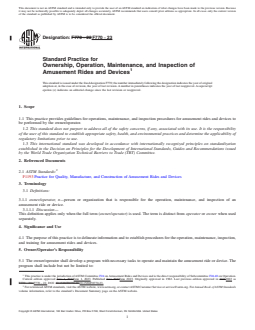
4.1 The purpose of this practice is to delineate information
1.1 This practice provides guidelines for operations,
and to establish procedures for the operation, maintenance,
maintenance, and inspection procedures for amusement rides
inspection, and training for amusement rides and devices.
and devices to be performed by the owner/operator.
1.2 This standard does not purport to address all of the
5. Owner/Operator’s Responsibility
safety concerns, if any, associated with its use. It is the
5.1 The owner/operator shall develop a program with nec-
responsibility of the user of this standard to establish appro-
essary tasks to operate and maintain the amusement ride or
priate safety, health, and environmental practices and deter-
device. The program shall include but not be limited to:
mine the applicability of regulatory limitations prior to use.
5.1.1 An operations program as outlined in Section 6;
1.3 This international standard was developed in accor-
5.1.2 A maintenance program as outlined in Section 7;
dance with internationally recognized principles on standard-
5.1.3 An inspection program as outlined in Section 8, and
ization established in the Decision on Principles for the
5.1.4 A training program as outlined in Section 9.
Development of International Standards, Guides and Recom-
mendations issued by the World Trade Organization Technical
6. Operations Program Requirements
Barriers to Trade (TBT) Committee.
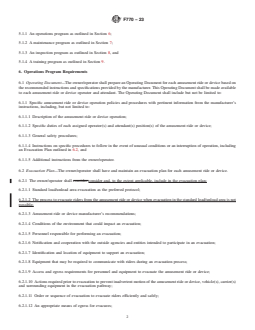
6.1 Operating Document—The owner/operator shall pre-
pare an Operating Document for each amusement ride or
2. Referenced Documents
device based on the recommended instructions and specifica-
2.1 ASTM Standards: tions provided by the manufacturer. This Operating Document
shall be made available to each amusement ride or device
F1193 Practice for Quality, Manufacture, and Construction
operator and attendant. The Operating Document shall include
of Amusement Rides and Devices
but not be limited to:
6.1.1 Specific amusement ride or device operation policies
3. Terminology
and procedures with pertinent information from the manufac-
3.1 Definitions:
turer’s instructions, including, but not limited to:
3.1.1 owner/operator, n—person or organization that is
6.1.1.1 Description of the amusement ride or device opera-
responsible for the operation, maintenance, and inspection of
tion;
an amusement ride or device.
6.1.1.2 Specific duties of each assigned operator(s) and
attendant(s) position(s) of the amusement ride or device;
3.1.1.1 Discussion—This definition applies only when the
6.1.1.3 General safety procedures;
full term (owner/operator) is used. The term is distinct from
6.1.1.4 Instructions on specific procedures to follow in the
operator or owner when used separately.
event of unusual conditions or an interruption of operation,
including an Evacuation Plan outlined in 6.2, and
6.1.1.5 Additional instructions from the owner/operator.
This practice is under the jurisdiction of ASTM Committee F24 on Amusement
Rides and Devices and is the direct responsibility of Subcommittee F24.40 on
6.2 Evacuation Plan—The owner/operator shall have and
Operation.
maintain an evacuation plan for each amusement ride or
Current edition approved June 1, 2023. Published June 2023. Originally
device.
approved in 1982. Last previous edition approved in 2022 as F770 – 22. DOI:
10.1520/F0770-23.
6.2.1 The owner/operator shall consider and, to the extent
For referenced ASTM standards, visit the ASTM website, www.astm.org, or
applicable, include in the evacuation plan:
contact ASTM Customer Service at service@astm.org. For Annual Book of ASTM
6.2.1.1 Standard load/unload area evacuation as the pre-
Standards volume information, refer to the standard’s Document Summary page on
the ASTM website. ferred protocol;
Copyright © ASTM International, 100 Barr Harbor Drive, PO Box C700, West Conshohocken, PA 19428-2959. United States
F770 − 23
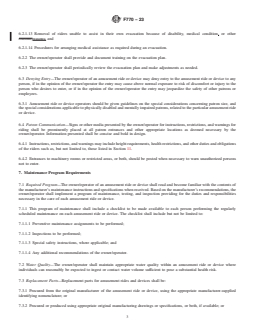
6.2.1.2 The process to evacuate riders from the amusement 7. Maintenance Program Requirements
ride or device when evacuation in the standard load/unload
7.1 Required Program—The owner/operator of an amuse-
area is not possible;
ment ride or device shall read and become familiar with the
6.2.1.3 Amusement ride or device manufacturer’s recom-
contents of the manufacturer’s maintenance instructions and
mendations;
specifications when received. Based on the manufacturer’s
6.2.1.4 Conditions of the environment that could impact an
recommendations, the owner/operator shall implement a pro-
evacuation;
gram of maintenance, testing, and inspection providing for the
6.2.1.5 Personnel responsible for performing an evacuation;
duties and responsibilities necessary in the care of each
6.2.1.6 Notification and cooperation with the outside agen-
amusement ride or device.
cies and entities intended to participate in an evacuation;
7.1.1 This program of maintenance shall include a checklist
6.2.1.7 Identification and location of equipment to support
to be made available to each person performing the regularly
an evacuation;
scheduled maintenance on each amusement ride or device. The
6.2.1.8 Equipment that may be required to communicate
checklist shall include but not be limited to:
with riders during an evacuation process;
7.1.1.1 Preventive maintenance assignments to be per-
6.2.1.9 Access and egress requirements for personnel and formed;
equipment to evacuate the amusement ride or device;
7.1.1.2 Inspections to be performed;
6.2.1.10 Actions required prior to evacuation to prevent
7.1.1.3 Special safety instructions, where applicable; and
inadvertent motion of the amusement ride or device, vehicle(s),
7.1.1.4 Any additional recommendations of the owner/
carrier(s) and surrounding equipment in the evacuation path-
operator.
way;
7.2 Water Quality—The owner/operator shall maintain ap-
6.2.1.11 Order or sequence of evacuation to evacuate riders
propriate water quality within an amusement ride or device
efficiently and safely;
where individuals can reasonably be expected to ingest or
6.2.1.12 An appropriate means of egress for evacuees;
contact water volume sufficient to pose a substantial health
6.2.1.13 Removal of riders unable to assist in their own
risk.
evacuation because of disability, medical condition, or other
7.3 Replacement Parts—Replacement parts for amusement
reasons; and
rides and devices shall be:
6.2.1.14 Procedures for arranging medical assistance as
7.3.1 Procured from the original manufacturer of the amuse-
required during an evacuation.
ment ride or device, using the appropriate manufacturer-
6.2.2 The owner/operator shall provide and document train-
supplied identifying nomenclature; or
ing on the evacuation plan.
7.3.2 Procured or produced using appropriate original
6.2.3 The owner/operator shall periodically review the
manufacturing drawings or specifications, or both, if available;
evacuation plan and make adjustments as needed.
or
6.3 Denying Entry—The owner/operator of an amusement
7.3.3 Procured or produced using specifications derived
ride or device may deny entry to the amusement ride or device
from sufficient analysis to ensure parts of equivalent functions
to any person, if in the opinion of the owner/operator the entry
and quality, to those provided by the original manufacturer and
may cause above normal exposure to risk of discomfort or
in accordance with Practice F1193.
injury to the person who desires to enter, or if in the opinion of
7.3.4 Manufactured in conformance with Practice F1193.
the owner/operator the entry may jeopardize the safety of other
7.4 Non-Destructive Testing—The owner/operator shall be
patrons or employees.
responsible for implementing a program of testing based on the
6.3.1 Amusement ride or device operators should be given
recommendations of the section on Non-Destructive Testing
guidelines on the special considerations concerning patron
Requirements of Practice F1193.
size, and the special considerations applicable to physically
disabled and mentally impaired patrons, related to the particu-
7.5 Welding—When welding on an amusement ride or
lar amusement ride or device. device is required, welding shall be performed per Practice
F1193, manufacturing section.
6.4 Patron Communication—Signs or other media pre-
sented by the owner/operator for instructions, restrictions, and
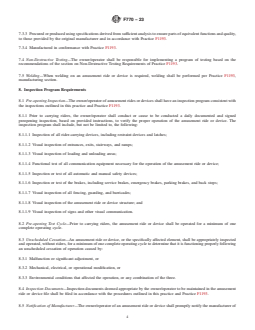
8. Inspection Program Requirements
warnings for riding shall be prominently placed at all patron
entrances and other appropriate locations as deemed necessary
8.1 Pre-opening Inspection—The owner/operator of amuse-
by the owner/operator. Information presented shall be concise
ment rides or devices shall have an inspection program
and bold in design.
consistent with the inspections outlined in this practice and
6.4.1 Instructions, restrictions, and warnings may include Practice F1193.
height requirements, health restrictions, and other duties and
8.1.1 Prior to carrying riders, the owner/operator shall
obligations of the riders such as, but not limited to, those listed conduct or cause to be conducted a daily documented and
in Section 11.
signed preopening inspection, based on provided instructions,
6.4.2 Entrances to machinery rooms or restricted areas, or to verify the proper operation of the amusement ride or device.
both, should be posted when necessary to warn unauthorized The inspection program shall include, but not be limited to, the
persons not to enter. following:
F770 − 23
8.1.1.1 Inspection of all rider-carrying devices, including 9.2.7 Additional instructions or training under the supervi-
restraint devices and latches; sion of a trainer deemed necessary by the owner/operator.
8.1.1.2 Visual inspection of entrances, exits, stairways, and
9.3 The owner/operator shall provide training under the
ramps;
supervision of a trainer for each operator, attendant and
8.1.1.3 Visual inspection of loading and unloading areas;
maintenance personnel of an amusement ride or device. The
8.1.1.4 Functional test of all communication equipment
training program shall include:
necessary for the operation of the amusement ride or device;
9.3.1 Demonstration by the trainer of the assigned duties of
8.1.1.5 Inspection or test of all automatic and manual safety
the operation or maintenance personnel
...
This document is not an ASTM standard and is intended only to provide the user of an ASTM standard an indication of what changes have been made to the previous version. Because
it may not be technically possible to adequately depict all changes accurately, ASTM recommends that users consult prior editions as appropriate. In all cases only the current version
of the standard as published by ASTM is to be considered the official document.
Designation: F770 − 22 F770 − 23
Standard Practice for
Ownership, Operation, Maintenance, and Inspection of
Amusement Rides and Devices
This standard is issued under the fixed designation F770; the number immediately following the designation indicates the year of original
adoption or, in the case of revision, the year of last revision. A number in parentheses indicates the year of last reapproval. A superscript
epsilon (´) indicates an editorial change since the last revision or reapproval.
1. Scope
1.1 This practice provides guidelines for operations, maintenance, and inspection procedures for amusement rides and devices to
be performed by the owner/operator.
1.2 This standard does not purport to address all of the safety concerns, if any, associated with its use. It is the responsibility
of the user of this standard to establish appropriate safety, health, and environmental practices and determine the applicability of
regulatory limitations prior to use.
1.3 This international standard was developed in accordance with internationally recognized principles on standardization
established in the Decision on Principles for the Development of International Standards, Guides and Recommendations issued
by the World Trade Organization Technical Barriers to Trade (TBT) Committee.
2. Referenced Documents
2.1 ASTM Standards:
F1193 Practice for Quality, Manufacture, and Construction of Amusement Rides and Devices
3. Terminology
3.1 Definitions:
3.1.1 owner/operator, n—person or organization that is responsible for the operation, maintenance, and inspection of an
amusement ride or device.
3.1.1.1 Discussion—
This definition applies only when the full term (owner/operator) is used. The term is distinct from operator or owner when used
separately.
4. Significance and Use
4.1 The purpose of this practice is to delineate information and to establish procedures for the operation, maintenance, inspection,
and training for amusement rides and devices.
5. Owner/Operator’s Responsibility
5.1 The owner/operator shall develop a program with necessary tasks to operate and maintain the amusement ride or device. The
program shall include but not be limited to:
This practice is under the jurisdiction of ASTM Committee F24 on Amusement Rides and Devices and is the direct responsibility of Subcommittee F24.40 on Operation.
Current edition approved June 1, 2022June 1, 2023. Published June 2022June 2023. Originally approved in 1982. Last previous edition approved in 20212022 as
F770 – 21a.F770 – 22. DOI: 10.1520/F0770-22.10.1520/F0770-23.
For referenced ASTM standards, visit the ASTM website, www.astm.org, or contact ASTM Customer Service at service@astm.org. For Annual Book of ASTM Standards
volume information, refer to the standard’s Document Summary page on the ASTM website.
Copyright © ASTM International, 100 Barr Harbor Drive, PO Box C700, West Conshohocken, PA 19428-2959. United States
F770 − 23
5.1.1 An operations program as outlined in Section 6;
5.1.2 A maintenance program as outlined in Section 7;
5.1.3 An inspection program as outlined in Section 8, and
5.1.4 A training program as outlined in Section 9.
6. Operations Program Requirements
6.1 Operating Document—The owner/operator shall prepare an Operating Document for each amusement ride or device based on
the recommended instructions and specifications provided by the manufacturer. This Operating Document shall be made available
to each amusement ride or device operator and attendant. The Operating Document shall include but not be limited to:
6.1.1 Specific amusement ride or device operation policies and procedures with pertinent information from the manufacturer’s
instructions, including, but not limited to:
6.1.1.1 Description of the amusement ride or device operation;
6.1.1.2 Specific duties of each assigned operator(s) and attendant(s) position(s) of the amusement ride or device;
6.1.1.3 General safety procedures;
6.1.1.4 Instructions on specific procedures to follow in the event of unusual conditions or an interruption of operation, including
an Evacuation Plan outlined in 6.2, and
6.1.1.5 Additional instructions from the owner/operator.
6.2 Evacuation Plan—The owner/operator shall have and maintain an evacuation plan for each amusement ride or device.
6.2.1 The owner/operator shall consider:consider and, to the extent applicable, include in the evacuation plan:
6.2.1.1 Standard load/unload area evacuation as the preferred protocol;
6.2.1.2 The process to evacuate riders from the amusement ride or device when evacuation in the standard load/unload area is not
possible;
6.2.1.3 Amusement ride or device manufacturer’s recommendations;
6.2.1.4 Conditions of the environment that could impact an evacuation;
6.2.1.5 Personnel responsible for performing an evacuation;
6.2.1.6 Notification and cooperation with the outside agencies and entities intended to participate in an evacuation;
6.2.1.7 Identification and location of equipment to support an evacuation;
6.2.1.8 Equipment that may be required to communicate with riders during an evacuation process;
6.2.1.9 Access and egress requirements for personnel and equipment to evacuate the amusement ride or device;
6.2.1.10 Actions required prior to evacuation to prevent inadvertent motion of the amusement ride or device, vehicle(s), carrier(s)
and surrounding equipment in the evacuation pathway;
6.2.1.11 Order or sequence of evacuation to evacuate riders efficiently and safely;
6.2.1.12 An appropriate means of egress for evacuees;
F770 − 23
6.2.1.13 Removal of riders unable to assist in their own evacuation because of disability, medical condition, or other
reasons,reasons; and
6.2.1.14 Procedures for arranging medical assistance as required during an evacuation.
6.2.2 The owner/operator shall provide and document training on the evacuation plan.
6.2.3 The owner/operator shall periodically review the evacuation plan and make adjustments as needed.
6.3 Denying Entry—The owner/operator of an amusement ride or device may deny entry to the amusement ride or device to any
person, if in the opinion of the owner/operator the entry may cause above normal exposure to risk of discomfort or injury to the
person who desires to enter, or if in the opinion of the owner/operator the entry may jeopardize the safety of other patrons or
employees.
6.3.1 Amusement ride or device operators should be given guidelines on the special considerations concerning patron size, and
the special considerations applicable to physically disabled and mentally impaired patrons, related to the particular amusement ride
or device.
6.4 Patron Communication—Signs or other media presented by the owner/operator for instructions, restrictions, and warnings for
riding shall be prominently placed at all patron entrances and other appropriate locations as deemed necessary by the
owner/operator. Information presented shall be concise and bold in design.
6.4.1 Instructions, restrictions, and warnings may include height requirements, health restrictions, and other duties and obligations
of the riders such as, but not limited to, those listed in Section 11.
6.4.2 Entrances to machinery rooms or restricted areas, or both, should be posted when necessary to warn unauthorized persons
not to enter.
7. Maintenance Program Requirements
7.1 Required Program—The owner/operator of an amusement ride or device shall read and become familiar with the contents of
the manufacturer’s maintenance instructions and specifications when received. Based on the manufacturer’s recommendations, the
owner/operator shall implement a program of maintenance, testing, and inspection providing for the duties and responsibilities
necessary in the care of each amusement ride or device.
7.1.1 This program of maintenance shall include a checklist to be made available to each person performing the regularly
scheduled maintenance on each amusement ride or device. The checklist shall include but not be limited to:
7.1.1.1 Preventive maintenance assignments to be performed;
7.1.1.2 Inspections to be performed;
7.1.1.3 Special safety instructions, where applicable; and
7.1.1.4 Any additional recommendations of the owner/operator.
7.2 Water Quality—The owner/operator shall maintain appropriate water quality within an amusement ride or device where
individuals can reasonably be expected to ingest or contact water volume sufficient to pose a substantial health risk.
7.3 Replacement Parts—Replacement parts for amusement rides and devices shall be:
7.3.1 Procured from the original manufacturer of the amusement ride or device, using the appropriate manufacturer-supplied
identifying nomenclature; or
7.3.2 Procured or produced using appropriate original manufacturing drawings or specifications, or both, if available; or
F770 − 23
7.3.3 Procured or produced using specifications derived from sufficient analysis to ensure parts of equivalent functions and quality,
to those provided by the original manufacturer and in accordance with Practice F1193.
7.3.4 Manufactured in conformance with Practice F1193.
7.4 Non-Destructive Testing—The owner/operator shall be responsible for implementing a program of testing based on the
recommendations of the section on Non-Destructive Testing Requirements of Practice F1193.
7.5 Welding—When welding on an amusement ride or device is required, welding shall be performed per Practice F1193,
manufacturing section.
8. Inspection Program Requirements
8.1 Pre-opening Inspection—The owner/operator of amusement rides or devices shall have an inspection program consistent with
the inspections outlined in this practice and Practice F1193.
8.1.1 Prior to carrying riders, the owner/operator shall conduct or cause to be conducted a daily documented and signed
preopening inspection, based on provided instructions, to verify the proper operation of the amusement ride or device. The
inspection program shall include, but not be limited to, the following:
8.1.1.1 Inspection of all rider-carrying devices, including restraint devices and latches;
8.1.1.2 Visual inspection of entrances, exits, stairways, and ramps;
8.1.1.3 Visual inspection of loading and unloading areas;
8.1.1.4 Functional test of all communication equipment necessary for the operation of the amusement ride or device;
8.1.1.5 Inspection or test of all automatic and manual safety devices;
8.1.1.6 Inspection or test of the brakes, including service brakes, emergency brakes, parking brakes, and back stops;
8.1.1.7 Visual inspection of all fencing, guarding, and barricades;
8.1.1.8 Visual inspection of the amusement ride or device structure; and
8.1.1.9 Visual inspection of signs and other visual comm
...