

ASTM F747-23
(Terminology)Standard Terminology Relating to Amusement Rides and Devices
General Information
- Abstract
SCOPE
1.1 This terminology is a repository of terms approved by Committee F24 and its subcommittees. Reproducing terms approved within all other individual F24 standards and guides, this terminology will provide a single location where terms related to amusement rides and devices are freely accessible to the public, committee members and can be maintained, updated and utilized as effective communication tools. Although published alphabetically, terms unique to a specific F24 standard or guide are indicated as such by the reference which follows the applicable term.
1.2 This international standard was developed in accordance with internationally recognized principles on standardization established in the Decision on Principles for the Development of International Standards, Guides and Recommendations issued by the World Trade Organization Technical Barriers to Trade (TBT) Committee.
- Status
- Published
- Publication Date
- 14-Jun-2023
- Technical Committee
- F24 - Amusement Rides and Devices
- Drafting Committee
- F24.20 - Specifications and Terminology
Overview
ASTM F747-23: Standard Terminology Relating to Amusement Rides and Devices is an internationally recognized repository of approved terms and definitions relevant to amusement rides and devices. Developed by ASTM Committee F24, this standard provides a comprehensive, centralized reference for terminology used across the amusement industry, including rides, devices, and safety-related components. The standard promotes clear communication, effective documentation, and consistency for professionals, manufacturers, operators, regulators, and maintenance personnel involved in the design, manufacture, installation, inspection, and operation of amusement attractions.
Key Topics
ASTM F747-23 serves as an essential resource for understanding technical and operational language connected to amusement rides and devices. The terminology included covers areas such as:
- Ride and Device Classifications: Definitions for types of amusement rides (e.g., flat-rides, high rides, circular rides, amusement railway rides, kiddie rides, and inflatables) clarify design considerations and user intent.
- Safety and Operation: Terms detailing safety features (fail-safe, restraint, patron containment, zone of operator awareness), personnel roles (operator, court attendant, lifeguard), and operational concepts (operating mode, control station, unscheduled cessation).
- Adventure Attractions: Definitions supporting adventure courses (challenge course, canopy tour, zip line, aerial trekking course) and trampoline courts.
- Measurement and Testing: Concepts such as acceleration, calibration, data channel, test documentation, sensitivity coefficient, and coordinate systems establish a common technical foundation for ride evaluation and inspection.
- Specialty Applications: Reference to specialized rides and settings (agritourism, hayride attraction, concession go-karts, trampoline courts, water slides, and netted attractions).
Each definition is carefully curated and, when unique to another F24 standard or guide, cross-referenced for further context and application.
Applications
ASTM F747-23 is widely used across the amusement industry for:
- Design and Engineering: Manufacturers, designers, and engineers employ standardized terms to create technical documentation, safety assessments, compliance reports, and operational guidelines, ensuring alignment with industry benchmarks and regulatory requirements.
- Inspection and Maintenance: Inspectors and maintenance personnel reference the terminology to interpret standards, inspection records, maintenance logs, and incident reports with clarity and precision.
- Training and Operation: Operators, attendants, and training coordinators utilize consistent terminology in manuals, hazard communication, emergency response procedures, and staff onboarding.
- Regulation and Compliance: Regulatory authorities and auditors benefit from standardized language to accurately interpret safety-related compliance, incident monitoring, and policy development for amusement rides and attractions.
- Communication and Documentation: The single-source repository enables clear, unambiguous communication within multi-disciplinary teams and across geographic boundaries.
Related Standards
ASTM F747-23 is intrinsically connected with a range of other ASTM F24 standards that govern different categories of amusement rides and devices, such as:
- ASTM F2375: Practice for design, manufacture, installation, and testing of climbing nets and netting/mesh in amusement attractions.
- ASTM F2376: Practice for classification, design, and operation of water slide systems.
- ASTM F2959: Practice for aerial adventure courses.
- ASTM F2970: Practice specific to trampoline courts.
- ASTM F3168: Practice for hayride attractions.
These references enable users to navigate the broader framework of amusement ride safety standards, reinforcing the value of consistent terminology in effective implementation and compliance.
By referencing ASTM F747-23, industry stakeholders ensure alignment with internationally accepted terminology, supporting safety, regulatory compliance, and operational excellence in the amusement rides and devices sector.
Relations
- Effective Date
- 01-Nov-2019
- Effective Date
- 01-Dec-2017
- Effective Date
- 01-May-2016
- Effective Date
- 15-Feb-2015
- Effective Date
- 01-May-2014
- Effective Date
- 01-Apr-2013
- Effective Date
- 01-Dec-2012
- Effective Date
- 01-Jan-2006
Frequently Asked Questions
ASTM F747-23 is a standard published by ASTM International. Its full title is "Standard Terminology Relating to Amusement Rides and Devices". This standard covers: SCOPE 1.1 This terminology is a repository of terms approved by Committee F24 and its subcommittees. Reproducing terms approved within all other individual F24 standards and guides, this terminology will provide a single location where terms related to amusement rides and devices are freely accessible to the public, committee members and can be maintained, updated and utilized as effective communication tools. Although published alphabetically, terms unique to a specific F24 standard or guide are indicated as such by the reference which follows the applicable term. 1.2 This international standard was developed in accordance with internationally recognized principles on standardization established in the Decision on Principles for the Development of International Standards, Guides and Recommendations issued by the World Trade Organization Technical Barriers to Trade (TBT) Committee.
SCOPE 1.1 This terminology is a repository of terms approved by Committee F24 and its subcommittees. Reproducing terms approved within all other individual F24 standards and guides, this terminology will provide a single location where terms related to amusement rides and devices are freely accessible to the public, committee members and can be maintained, updated and utilized as effective communication tools. Although published alphabetically, terms unique to a specific F24 standard or guide are indicated as such by the reference which follows the applicable term. 1.2 This international standard was developed in accordance with internationally recognized principles on standardization established in the Decision on Principles for the Development of International Standards, Guides and Recommendations issued by the World Trade Organization Technical Barriers to Trade (TBT) Committee.
ASTM F747-23 is classified under the following ICS (International Classification for Standards) categories: 01.040.97 - Domestic and commercial equipment. Entertainment. Sports (Vocabularies); 97.200.99 - Other equipment for entertainment. The ICS classification helps identify the subject area and facilitates finding related standards.
ASTM F747-23 has the following relationships with other standards: It is inter standard links to ASTM F3168-19, ASTM F2970-17, ASTM F2959-16, ASTM F2970-15, ASTM F2959-14, ASTM F2970-13, ASTM F2959-12, ASTM F2376-06. Understanding these relationships helps ensure you are using the most current and applicable version of the standard.
ASTM F747-23 is available in PDF format for immediate download after purchase. The document can be added to your cart and obtained through the secure checkout process. Digital delivery ensures instant access to the complete standard document.
Standards Content (Sample)
This international standard was developed in accordance with internationally recognized principles on standardization established in the Decision on Principles for the
Development of International Standards, Guides and Recommendations issued by the World Trade Organization Technical Barriers to Trade (TBT) Committee.
Designation: F747 − 23
Standard Terminology Relating to
Amusement Rides and Devices
This standard is issued under the fixed designation F747; the number immediately following the designation indicates the year of original
adoption or, in the case of revision, the year of last revision. A number in parentheses indicates the year of last reapproval. A superscript
epsilon (´) indicates an editorial change since the last revision or reapproval.
1. Scope acceleration, sustained—those accelerations with duration
greater than or equal to 200 ms.
1.1 This terminology is a repository of terms approved by
Committee F24 and its subcommittees. Reproducing terms
accepted engineering practice—that which conforms to ac-
approved within all other individual F24 standards and guides,
cepted principles, tests, or standards of nationally recognized
this terminology will provide a single location where terms
technical or scientific authorities.
related to amusement rides and devices are freely accessible to
aerial trekking course—self-guided aerial adventure course
the public, committee members and can be maintained, up-
containing elements intended to be obstacles. F2959
dated and utilized as effective communication tools. Although
published alphabetically, terms unique to a specific F24 stan-
agritourism—the act of conducting an activity for the enjoy-
dard or guide are indicated as such by the reference which
ment of the public that is related in some way to agriculture.
follows the applicable term.
F3168
1.2 This international standard was developed in accor-
air-supported structure—an amusement device that incorpo-
dance with internationally recognized principles on standard-
rates a structural and mechanical system and employs a
ization established in the Decision on Principles for the
high-strength fabric or film that achieves its strength, shape,
Development of International Standards, Guides and Recom-
and stability by pretensioning with internal air pressure, all
mendations issued by the World Trade Organization Technical
of which are intended to provide an enclosed area for the self
Barriers to Trade (TBT) Committee.
enjoyment of those so confined within.
2. Referenced Documents
aliasing—a phenomenon associated with sampled data
2.1 ASTM Standards: systems, wherein a signal containing significant energy at
F2375 Practice for Design, Manufacture, Installation and
frequencies greater than one half of the system sample
Testing of Climbing Nets and Netting/Mesh used in frequency manifests itself in the sampled data as a lower
Amusement Rides, Devices, Play Areas and Attractions frequency (aliased) signal. Aliasing can be avoided only by
F2376 Practice for Classification, Design, Manufacture, limiting the frequency content of the signal prior to the
Construction, and Operation of Water Slide Systems sampling process. Once a signal has been aliased, it is not
F2959 Practice for Aerial Adventure Courses
possible to reconstruct the original signal from the sampled
F2970 Practice for Design, Manufacture, Installation, data.
Operation, Maintenance, Inspection and Major Modifica-
amusement railway ride—an amusement ride that may have
tion of Trampoline Courts
multiple vehicles (for example, locomotive(s), coach(es),
F3168 Practice for Hayride Attractions
etc.) linked together, at least one of which has on board
mechanical propulsion that has an on board operator(s),
3. Terminology
utilizing flanged wheels on railroad type rails with a gauge of
acceleration, impact—those accelerations with duration of
12 in. or greater, that is insular to national regulations, which
less than 200 ms.
is designated by the Designer/Engineer as an amusement
railway ride.
This terminology is under the jurisdiction of ASTM Committee F24 on
amusement ride or amusement device—a device or combi-
Amusement Rides and Devices and is the direct responsibility of Subcommittee
nation of devices or elements that carry, convey, or direct a
F24.20 on Specifications and Terminology.
Current edition approved June 15, 2023. Published July 2023. Originally
person(s) over or through a fixed or restricted course or
approved in 1982. Last previous edition approved in 2022 as F747 – 22. DOI:
within a defined area, for the primary purpose of amusement
10.1520/F0747-23.
2 or entertainment.
For referenced ASTM standards, visit the ASTM website, www.astm.org, or
contact ASTM Customer Service at service@astm.org. For Annual Book of ASTM
assembly area—a designated area primarily used for mount-
Standards volume information, refer to the standard’s Document Summary page on
the ASTM website. ing or dismounting the trampoline court. F2970
Copyright © ASTM International, 100 Barr Harbor Drive, PO Box C700, West Conshohocken, PA 19428-2959. United States
F747 − 23
response envelope of the entire data channel from the mounted
calibration constant—the arithmetic mean of the sensitivity
transducer to the final representation of the acquired data.
coefficients, evaluated at frequencies that are evenly spaced
on a logarithmic scale between FL and FH.
children zone—a trampoline court, an area within a trampo-
line court, or an area adjacent to a trampoline court desig-
calibration value—the ratio of the reference calibration sys-
nated by the designer/engineer, manufacturer, or owner/
tem output, in engineering units relevant to the transducer, to
operator primarily for use, activity, entry, or dismount by
the data channel output, in volts, as measured at constant
young children. F2970
excitation frequency and amplitude.
concession go-kart—an amusement ride or device, which
canopy tour—aerial adventure course which provides patron
meets all of the following specifications: the device is a
access to the canopy of a forest. F2959
single vehicle, unattached to other vehicles or a common
carnival—a mobile enterprise principally devoted to offering
frame system, which is powered without connection to a
amusement or entertainment to the public in, upon, or by
common energy source, which is driver controlled with
means of portable amusement rides or devices or temporary
respect to acceleration, speed, braking, and steering, which
structures in any number or combination, whether or not
operates within the containment system of a defined track,
associated with other structures or forms of public attraction.
and which simulates competitive motor sports, which is used
by members of the general public for a fee. A concession
challenge course—guided aerial adventure course containing
go-kart has a maximum capacity of two persons and no
elements intended to be obstacles. F2959
cargo capacity.
channel frequency class (CFC)—a frequency response enve-
DISCUSSION—This definition specifically excludes similar go-kart
lope that conforms to Fig. 1 and is referred to by the value
devices that are intended for use as competitive (racing) karts or similar
FH in hertz. The CFC frequency response envelope is go-kart devices intended for ownership and use by private owners. This
definition specifically excludes devices, such as electronically or rail
defined by the boundaries shown in Fig. 1 and the following
guided amusement rides and bumper cars or other similar amusement
characteristic frequencies:
motor sports devices that operate under circumstances where there is no
F —Pass band lower limit (hertz). Always equal to zero
L
defined direction of travel.
(0.0) hertz.
F —Pass band upper limit (hertz). The CFC designator.
concession go-kart attendant—the person or persons whose
H
F —The corner or knee of the frequency response enve- duties may include but are not limited to the instruction,
N
lope. Always equal to or greater than 1.667 × FH.
dispatch, and limitation of ride duration of persons driving
F —The minimum sample frequency for a sampled data concession go-karts.
S
system that corresponds to the designated CFC. Always equal
containment system—a device installed on the concession
to or greater than 12 × FH.
go-kart track, which defines the boundaries of the track, and
DISCUSSION—FL, FH, FN, and FS are always specified in hertz.
whose primary purpose is to contain the vehicles within the
While the characteristics of the CFC may be applied to individual
components of a data channel, the CFC is, by definition, the frequency defined boundary.
FIG. 1 Frequency Response Envelope
F747 − 23
control access system—a device, barrier or mechanism that measurement coordinate system—a coordinate system that
prohibits unauthorized activation of a ride or device control provides the reference axes and sign convention for the test
system. data record(s).
patron coordinate system—a coordinate system that is fixed
control station—a location where buttons, switches or other
with respect to the human upper torso and oriented as in Fig. 2.
controls are provided for the purpose of operating ride
equipment. vehicle coordinate system—a coordinate system that is fixed
with respect to the ride or device being tested.
coordinate system—three orthogonal axes that intersect at an
origin whose positive directions correspond to the right-hand court attendant—individual trained in facility emergency
rule. procedures, familiar with fundamental trampolining and TC
FIG. 2 Patron Coordinate System
F747 − 23
foam pit operations, monitoring patrons and responding to illness—personal discomfort resulting in treatment including a
TC trampoline, and TC foam pit emergencies. F2970 personal illness, food poisoning, drug abuse, toxic
inhalation, insect sting, or other similar occurrence.
data channel—the entire instrumentation system for a single
channel of data acquisition; from the transducer to the final
inflatable amusement device—an amusement ride or device
representation of the data, including all post-acquisition data
designed for use that may include but not be limited to
processing that may alter the amplitude or frequency content
bounce, climb, slide, or interactive play. They are made of
of the data.
flexible fabric, kept inflated by continuous air flow by one or
more blowers, and rely upon air pressure to maintain their
data channel full scale—the maximum usable value, in units
shape.
of the physical phenomenon being measured, that may be
represented by a data channel. This value is determined by
injury—sustained bodily harm resulting in treatment such as
the data channel component with the lowest full-scale range.
trauma, cuts, bruises, burns, and sprains.
designer/engineer—party(s) that establishes and describes the
installation or erection—the actual act of onsite construction
configuration of the amusement ride or device, establishes
or the physical setting up and making ready for use of a ride
strength and fatigue life, designs and develops electrical/
or device.
electronic control systems, and defines inspection criteria.
institutional trampoline—a trampoline intended for use in a
dismount platform—any surface for standing, walking,
commercial or institutional facility. F2970
sitting, or climbing, or a flat surface larger than 2.0 in. (51
mm) wide by 2.0 in. (51 mm) long having less than 30°
kiddie ride—an amusement ride designed primarily for use by
angle from horizontal. F2970
children up to 12 years of age.
driver—the person who manipulates and controls the direction
landing pool—pool intended to receive riders from a water
of travel, braking, and speed of a concession go-kart.
slide. F2376
engineer—an engineer as defined by and licensed in accor-
landing zone—area in a landing pool intended for receiving
dance with the applicable provincial or territorial statute.
riders from a particular slide. F2376
fail-safe—characteristic of an amusement ride or device, or
latching—when pertaining to restraint devices, held secure
component thereof, that is designed such that the normal and
against opening except by intentional action of the patron,
expected failure mode results in a safe condition.
operator, or other means. This can include restraints (for
fence—a type of barrier consisting of, but not limited to, posts,
example, drop bars) held in place by gravity, detents or other
boards, wire, stakes, or rails that is used to inhibit patrons
means.
from coming into contact with the moving portion or
restricted portion of an amusement ride or device. lifeguard—individual specially trained in lifesaving and emer-
gency procedures, responsible for monitoring patrons and
filter corner frequency (Fn)—with reference to a low-pass
responding to aquatic and other emergencies. F2376
filter, Fn is the frequency (specified in Hz) where the
frequency response curve of the filter has magnitude of –3
locking—when pertaining to restraint devices, held securely
dB.
against opening except by intentional action of the operator
or other means not accessible by the patron.
force limiting—when pertaining to restraint devices, a char-
acteristic that, regardless of the amount of force available
major modificat
...
This document is not an ASTM standard and is intended only to provide the user of an ASTM standard an indication of what changes have been made to the previous version. Because
it may not be technically possible to adequately depict all changes accurately, ASTM recommends that users consult prior editions as appropriate. In all cases only the current version
of the standard as published by ASTM is to be considered the official document.
Designation: F747 − 22 F747 − 23
Standard Terminology Relating to
Amusement Rides and Devices
This standard is issued under the fixed designation F747; the number immediately following the designation indicates the year of original
adoption or, in the case of revision, the year of last revision. A number in parentheses indicates the year of last reapproval. A superscript
epsilon (´) indicates an editorial change since the last revision or reapproval.
1. Scope
1.1 This terminology is a repository of terms approved by Committee F24 and its subcommittees. Reproducing terms approved
within all other individual F24 standards and guides, this terminology will provide a single location where terms related to
amusement rides and devices are freely accessible to the public, committee members and can be maintained, updated and utilized
as effective communication tools. Although published alphabetically, terms unique to a specific F24 standard or guide are indicated
as such by the reference which follows the applicable term.
1.2 This international standard was developed in accordance with internationally recognized principles on standardization
established in the Decision on Principles for the Development of International Standards, Guides and Recommendations issued
by the World Trade Organization Technical Barriers to Trade (TBT) Committee.
2. Referenced Documents
2.1 ASTM Standards:
F2375 Practice for Design, Manufacture, Installation and Testing of Climbing Nets and Netting/Mesh used in Amusement Rides,
Devices, Play Areas and Attractions
F2376 Practice for Classification, Design, Manufacture, Construction, and Operation of Water Slide Systems
F2959 Practice for Aerial Adventure Courses
F2970 Practice for Design, Manufacture, Installation, Operation, Maintenance, Inspection and Major Modification of
Trampoline Courts
F3168 Practice for Hayride Attractions
3. Terminology
acceleration, impact—those accelerations with duration of less than 200 ms.
acceleration, sustained—those accelerations with duration greater than or equal to 200 ms.
accepted engineering practice—that which conforms to accepted principles, tests, or standards of nationally recognized
technical or scientific authorities.
aerial trekking course—self-guided aerial adventure course containing elements intended to be obstacles. F2959
This terminology is under the jurisdiction of ASTM Committee F24 on Amusement Rides and Devices and is the direct responsibility of Subcommittee F24.20 on
Specifications and Terminology.
Current edition approved Dec. 1, 2022June 15, 2023. Published January 2023July 2023. Originally approved in 1982. Last previous edition approved in 20212022 as
F747 – 21a.F747 – 22. DOI: 10.1520/F0747-22.10.1520/F0747-23.
For referenced ASTM standards, visit the ASTM website, www.astm.org, or contact ASTM Customer Service at service@astm.org. For Annual Book of ASTM Standards
volume information, refer to the standard’s Document Summary page on the ASTM website.
Copyright © ASTM International, 100 Barr Harbor Drive, PO Box C700, West Conshohocken, PA 19428-2959. United States
F747 − 23
agritourism—the act of conducting an activity for the enjoyment of the public that is related in some way to agriculture. F3168
air-supported structure—an amusement device that incorporates a structural and mechanical system and employs a
high-strength fabric or film that achieves its strength, shape, and stability by pretensioning with internal air pressure, all of which
are intended to provide an enclosed area for the self enjoyment of those so confined within.
aliasing—a phenomenon associated with sampled data systems, wherein a signal containing significant energy at frequencies
greater than one half of the system sample frequency manifests itself in the sampled data as a lower frequency (aliased) signal.
Aliasing can be avoided only by limiting the frequency content of the signal prior to the sampling process. Once a signal has
been aliased, it is not possible to reconstruct the original signal from the sampled data.
amusement railway ride—an amusement ride that may have multiple vehicles (for example, locomotive(s), coach(es), etc.)
linked together, at least one of which has on board mechanical propulsion that has an on board operator(s), utilizing flanged
wheels on railroad type rails with a gauge of 12 in. or greater, that is insular to national regulations, which is designated by the
Designer/Engineer as an amusement railway ride.
amusement ride or amusement device—a device or combination of devices or elements that carry, convey, or direct a person(s)
over or through a fixed or restricted course or within a defined area, for the primary purpose of amusement or entertainment.
assembly area—a designated area primarily used for mounting or dismounting the trampoline court. F2970
calibration constant—the arithmetic mean of the sensitivity coefficients, evaluated at frequencies that are evenly spaced on a
logarithmic scale between FL and FH.
calibration value—the ratio of the reference calibration system output, in engineering units relevant to the transducer, to the
data channel output, in volts, as measured at constant excitation frequency and amplitude.
canopy tour—aerial adventure course which provides patron access to the canopy of a forest. F2959
carnival—a mobile enterprise principally devoted to offering amusement or entertainment to the public in, upon, or by means
of portable amusement rides or devices or temporary structures in any number or combination, whether or not associated with
other structures or forms of public attraction.
challenge course—guided aerial adventure course containing elements intended to be obstacles. F2959
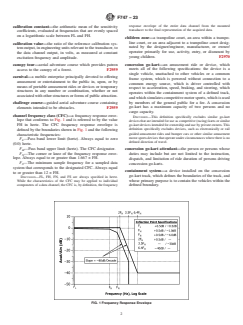
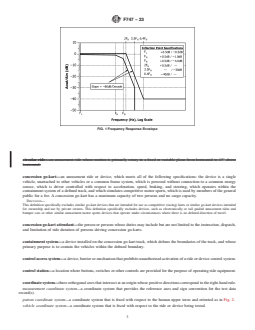
channel frequency class (CFC)—a frequency response envelope that conforms to Fig. 1 and is referred to by the value FH in
hertz. The CFC frequency response envelope is defined by the boundaries shown in Fig. 1 and the following characteristic
frequencies:
F —Pass band lower limit (hertz). Always equal to zero (0.0) hertz.
L
F —Pass band upper limit (hertz). The CFC designator.
H
F —The corner or knee of the frequency response envelope. Always equal to or greater than 1.667 × FH.
N
F —The minimum sample frequency for a sampled data system that corresponds to the designated CFC. Always equal to or
S
greater than 12 × FH.
DISCUSSION—
FL, FH, FN, and FS are always specified in hertz. While the characteristics of the CFC may be applied to individual components of a data channel,
the CFC is, by definition, the frequency response envelope of the entire data channel from the mounted transducer to the final representation of the
acquired data.
children zone—a trampoline court, an area within a trampoline court, or an area adjacent to a trampoline court designated by
the designer/engineer, manufacturer, or owner/operator primarily for use, activity, entry, or dismount by young children. F2970
F747 − 23
FIG. 1 Frequency Response Envelope
circular ride—an amusement ride whose motion is primarily rotary in a fixed or variable plane from horizontal to 45° above
horizontal.
concession go-kart—an amusement ride or device, which meets all of the following specifications: the device is a single
vehicle, unattached to other vehicles or a common frame system, which is powered without connection to a common energy
source, which is driver controlled with respect to acceleration, speed, braking, and steering, which operates within the
containment system of a defined track, and which simulates competitive motor sports, which is used by members of the general
public for a fee. A concession go-kart has a maximum capacity of two persons and no cargo capacity.
DISCUSSION—
This definition specifically excludes similar go-kart devices that are intended for use as competitive (racing) karts or similar go-kart devices intended
for ownership and use by private owners. This definition specifically excludes devices, such as electronically or rail guided amusement rides and
bumper cars or other similar amusement motor sports devices that operate under circumstances where there is no defined direction of travel.
concession go-kart attendant—the person or persons whose duties may include but are not limited to the instruction, dispatch,
and limitation of ride duration of persons driving concession go-karts.
containment system—a device installed on the concession go-kart track, which defines the boundaries of the track, and whose
primary purpose is to contain the vehicles within the defined boundary.
control access system—a device, barrier or mechanism that prohibits unauthorized activation of a ride or device control system.
control station—a location where buttons, switches or other controls are provided for the purpose of operating ride equipment.
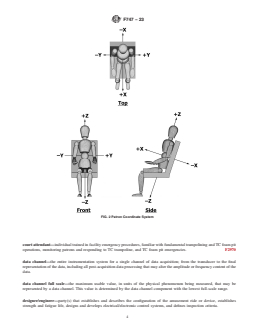
coordinate system—three orthogonal axes that intersect at an origin whose positive directions correspond to the right-hand rule.
measurement coordinate system—a coordinate system that provides the reference axes and sign convention for the test data
record(s).
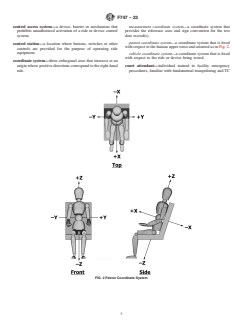
patron coordinate system—a coordinate system that is fixed with respect to the human upper torso and oriented as in Fig. 2.
vehicle coordinate system—a coordinate system that is fixed with respect to the ride or device being tested.
F747 − 23
FIG. 2 Patron Coordinate System
court attendant—individual trained in facility emergency procedures, familiar with fundamental trampolining and TC foam pit
operations, monitoring patrons and responding to TC trampoline, and TC foam pit emergencies. F2970
data channel—the entire instrumentation system for a single channel of data acquisition; from the transducer to the final
representation of the data, including all post-acquisition data processing that may alter the amplitude or frequency content of the
data.
data channel full scale—the maximum usable value, in units of the physical phenomenon being measured, that may be
represented by a data channel. This value is determined by the data channel component with the lowest full-scale range.
designer/engineer—party(s) that establishes and describes the configuration of the amusement ride or device, establishes
strength and fatigue life, designs and develops electrical/electronic control systems, and defines inspection criteria.
F747 − 23
dismount platform—any surface for standing, walking, sitting, or climbing, or a flat surface larger than 2.0 in. (51 mm) wide
by 2.0 in. (51 mm) long having less than 30° angle from horizontal. F2970
driver—the person who manipulates and controls the direction of travel, braking, and speed of a concession go-kart.
engineer—an engineer as defined by and licensed in accordance with the applicable provincial or territorial statute.
fail-safe—characteristic of an amusement ride or device, or component thereof, that is designed such that the normal and
expected failure mode results in a safe condition.
fence—a type of barrier consisting of, but not limited to, posts, boards, wire, stakes, or rails that is used to inhibit patrons from
coming into contact with the moving portion or restricted portion of an amusement ride or device.
filter corner frequency (Fn)—with reference to a low-pass filter, Fn is the frequency (specified in Hz) where the frequency
response curve of the filter has magnitude of –3 dB.
flat-ride—an amusement ride that operates on a single level whether over a controlled, fixed course or track, or confined to a
limited area of operation.
force limiting—when pertaining to restraint devices, a characteristic that, regardless of the amount of force available from the
system actuators, limits the amount of force applied to the patron(s).
free-run time—a period of time during the ride cycle when no energy is added to the ride vehicle.
full-scale—the maximum usable value, in units of the physical phenomenon being measured, which may be represented by a
data channel or some component thereof.
fun kart—a motorized vehicle with four wheels, sold commercially as consumer goods and intended for private personal
recreational use by the consumers for off-road use on suitable terrain, as recommended by the manufacturer.
“g”—the standard acceleration due to gravity at the surface of the earth. Defined as 32.2 ft/s/s or 9.81 m/s/s.
hayride attraction—an experience in which passengers board a wagon or trailer, typically a wagon filled with straw or hay, and
are taken on a set course. F3168
high ride—an amusement ride whose motion is in a fixed or variable plane from horizontal to vertical.
illness—personal discomfort resulting in treatment including a personal illness, food poisoning, drug abuse, toxic inhalation,
insect sting, or other similar occurrence.
inflatable amusement device—an amusement ride or device designed for use that may include but not be limited to bounce,
climb, slide, or interactive play. They are made of flexible fabric, kept inflated by continuous air flow by one or more blowers,
and rely upon air pressure to maintain their shape.
injury—sustained bodily harm resulting in treatment such as trauma, cuts, bruises, bu
...