

ASTM F2291-23b
(Practice)Standard Practice for Design of Amusement Rides and Devices
General Information
- Abstract
SIGNIFICANCE AND USE
4.1 The purpose of this practice is to provide designers, engineers, manufacturers, owners, and operators with criteria and references for use in designing amusement rides and devices or a major modification for amusement rides or devices.
SCOPE
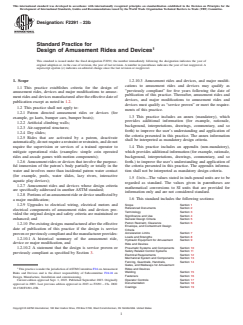
1.1 This practice establishes criteria for the design of amusement rides, devices and major modifications to amusement rides and devices manufactured after the effective date of publication except as noted in 1.2.
1.2 This practice shall not apply to:
1.2.1 Patron directed amusement rides or devices (for example, go karts, bumper cars, bumper boats);
1.2.2 Artificial climbing walls;
1.2.3 Air-supported structures;
1.2.4 Dry slides;
1.2.5 Rides that are activated by a patron, deactivate automatically, do not require a restraint or restraints, and do not require the supervision or services of a trained operator to mitigate operational risks (examples: simple coin operated rides and arcade games with motion components);
1.2.6 Amusement rides or devices that involve the purposeful immersion of the patron's body partially or totally in the water and involves more than incidental patron water contact (for example, pools, water slides, lazy rivers, interactive aquatic play devices);
1.2.7 Amusement rides and devices whose design criteria are specifically addressed in another ASTM standard;
1.2.8 Portions of an amusement ride or device unaffected by a major modification;
1.2.9 Upgrades to electrical wiring, electrical motors and electrical components of amusement rides and devices provided the original design and safety criteria are maintained or enhanced; and
1.2.10 Pre-existing designs manufactured after the effective date of publication of this practice if the design is service proven or previously compliant and the manufacturer provides:
1.2.10.1 A historical summary of the amusement ride, device or major modification, and
1.2.10.2 A statement that the design is service proven or previously compliant as specified by Section 3.
1.2.10.3 Amusement rides and devices, and major modifications to amusement rides and devices may qualify as “previously compliant” for five years following the date of publication of this practice. Thereafter, amusement rides and devices, and major modifications to amusement rides and devices must qualify as “service proven” or meet the requirements of this practice.
1.3 This practice includes an annex (mandatory), which provides additional information (for example, rationale, background, interpretations, drawings, commentary, and so forth) to improve the user's understanding and application of the criteria presented in this practice. The annex information shall be interpreted as mandatory design criteria.
1.4 This practice includes an appendix (non-mandatory), which provides additional information (for example, rationale, background, interpretations, drawings, commentary, and so forth.) to improve the user's understanding and application of the criteria presented in this practice. The appendix information shall not be interpreted as mandatory design criteria.
1.5 Units—The values stated in inch-pound units are to be regarded as standard. The values given in parentheses are mathematical conversions to SI units that are provided for information only and are not considered standard.
1.6 This standard includes the following sections:
Scope
Section 1
Referenced Documents
Section 2
Terminology
Section 3
Significance and Use
Section 4
General Design Criteria
Section 5
Patron Restraint, Clearance Envelope, and Containment Design Criteria
Section 6
Acceleration Limits
Section 7
Loads and Strengths
Section 8
Hydraulic Equipment for Amusement Ride and Devices
Section 9
Pneumatic Systems and Components
Section 10
Safety Related Control Systems
Section 11
Electrical Requirements
Section 12
Mechanical Syste...
- Status
- Published
- Publication Date
- 31-Aug-2023
- Technical Committee
- F24 - Amusement Rides and Devices
- Drafting Committee
- F24.24 - Design, Manufacture, Installation and commissioning
Overview
ASTM F2291-23b, Standard Practice for Design of Amusement Rides and Devices, establishes essential design criteria for amusement rides, devices, and major modifications manufactured after its publication date. Developed by ASTM Committee F24, this standard provides a comprehensive framework to enhance the safety and operational integrity of amusement rides and devices. It guides designers, engineers, manufacturers, owners, and operators regarding best practices for safety, design requirements, documentation, and regulatory compliance.
This standard does not cover patron-directed rides such as go-karts, bumper cars, and various other devices specifically exempted in the scope. It focuses instead on rides where operational safety depends on technical design and operator oversight.
Key Topics
ASTM F2291-23b addresses the following core areas relevant to ride design and safety:
- General Design Criteria: Outlines the engineering and documentation practices necessary for ensuring ride safety and performance.
- Hazard Analysis and Mitigation: Requires thorough ride analysis, including the identification and mitigation of hazards, and documentation of risk management strategies.
- Patron Restraint and Containment: Details requirements for restraint systems, clearance envelopes, and containment, especially focusing on the needs of children and mixed-age patrons.
- Acceleration Limits and Loads: Establishes criteria for allowable ride accelerations and the structural strength required to withstand operational stresses.
- Mechanical, Hydraulic, Pneumatic, and Electrical Systems: Specifies safety and reliability criteria for all major ride subsystems.
- Control Systems and Operator Responsibilities: Requires definition of control interfaces, safety-related control systems, operator roles, and operator awareness zones.
- Documentation and Record-Retention: Outlines required documentation, drawing standards, and mandates record-keeping for a minimum of 20 years following manufacture or major modification.
- Regulatory Review: Guides preparation of documents for regulatory or third-party review.
Applications
ASTM F2291-23b is widely utilized by amusement ride and device manufacturers, engineers, amusement park owners, ride operators, and regulatory authorities. Its application ensures:
- Enhanced Safety: By enforcing systematic hazard analysis and robust engineering criteria, the standard helps reduce risk to ride patrons and personnel.
- Consistency and Compliance: Supports regulatory compliance and harmonization of safety standards across jurisdictions by providing recognized design benchmarks.
- Design of Major Modifications: Guides safe integration of changes and upgrades to ride systems, components, and operational protocols.
- Documentation and Inspection: Facilitates clear communication of specifications for installation, operation, maintenance, and inspection-critical for ongoing safety and performance assessment.
- Patron Suitability and Accessibility: Asserts requirements for anthropometric considerations, ensuring ride accessibility and suitability for intended patron groups.
- Support for Regulatory Approval: Supplies the technical basis and documentation required for submittals to regulatory bodies during the design, commissioning, or alteration of amusement rides and devices.
Related Standards
ASTM F2291-23b references many key industry and international standards to support a holistic safety environment for amusement ride design. Relevant related standards include:
- ASTM F1193 - Quality, manufacture, and construction of amusement rides and devices
- ASTM F2137 - Measuring dynamic characteristics of amusement rides and devices
- ASTM F770 - Operation, maintenance, and inspection of amusement rides and devices
- ASTM F2374 - Design, manufacture, operation, and maintenance of inflatable amusement devices
- ASME, AISC, ANSI, ISO, and EN Standards - Addressing structural, mechanical, and electrical systems
- NFPA 79 & NFPA 70 - Electrical safety standards for industrial machinery
By conforming to ASTM F2291-23b and its referenced standards, amusement industry professionals promote a safer and more reliable leisure environment. This standard is integral to the modern design, engineering, and regulation of amusement parks and attractions worldwide.
Relations
- Effective Date
- 15-Oct-2019
- Effective Date
- 01-Jun-2018
- Effective Date
- 15-May-2018
- Effective Date
- 01-May-2017
- Effective Date
- 01-May-2017
- Effective Date
- 15-Oct-2016
- Effective Date
- 15-Feb-2016
- Effective Date
- 01-Nov-2015
- Effective Date
- 01-May-2015
- Effective Date
- 01-Feb-2015
- Effective Date
- 01-Sep-2014
- Effective Date
- 01-Apr-2014
- Effective Date
- 01-Sep-2013
- Effective Date
- 01-Aug-2013
- Effective Date
- 01-Jun-2011
Frequently Asked Questions
ASTM F2291-23b is a standard published by ASTM International. Its full title is "Standard Practice for Design of Amusement Rides and Devices". This standard covers: SIGNIFICANCE AND USE 4.1 The purpose of this practice is to provide designers, engineers, manufacturers, owners, and operators with criteria and references for use in designing amusement rides and devices or a major modification for amusement rides or devices. SCOPE 1.1 This practice establishes criteria for the design of amusement rides, devices and major modifications to amusement rides and devices manufactured after the effective date of publication except as noted in 1.2. 1.2 This practice shall not apply to: 1.2.1 Patron directed amusement rides or devices (for example, go karts, bumper cars, bumper boats); 1.2.2 Artificial climbing walls; 1.2.3 Air-supported structures; 1.2.4 Dry slides; 1.2.5 Rides that are activated by a patron, deactivate automatically, do not require a restraint or restraints, and do not require the supervision or services of a trained operator to mitigate operational risks (examples: simple coin operated rides and arcade games with motion components); 1.2.6 Amusement rides or devices that involve the purposeful immersion of the patron's body partially or totally in the water and involves more than incidental patron water contact (for example, pools, water slides, lazy rivers, interactive aquatic play devices); 1.2.7 Amusement rides and devices whose design criteria are specifically addressed in another ASTM standard; 1.2.8 Portions of an amusement ride or device unaffected by a major modification; 1.2.9 Upgrades to electrical wiring, electrical motors and electrical components of amusement rides and devices provided the original design and safety criteria are maintained or enhanced; and 1.2.10 Pre-existing designs manufactured after the effective date of publication of this practice if the design is service proven or previously compliant and the manufacturer provides: 1.2.10.1 A historical summary of the amusement ride, device or major modification, and 1.2.10.2 A statement that the design is service proven or previously compliant as specified by Section 3. 1.2.10.3 Amusement rides and devices, and major modifications to amusement rides and devices may qualify as “previously compliant” for five years following the date of publication of this practice. Thereafter, amusement rides and devices, and major modifications to amusement rides and devices must qualify as “service proven” or meet the requirements of this practice. 1.3 This practice includes an annex (mandatory), which provides additional information (for example, rationale, background, interpretations, drawings, commentary, and so forth) to improve the user's understanding and application of the criteria presented in this practice. The annex information shall be interpreted as mandatory design criteria. 1.4 This practice includes an appendix (non-mandatory), which provides additional information (for example, rationale, background, interpretations, drawings, commentary, and so forth.) to improve the user's understanding and application of the criteria presented in this practice. The appendix information shall not be interpreted as mandatory design criteria. 1.5 Units—The values stated in inch-pound units are to be regarded as standard. The values given in parentheses are mathematical conversions to SI units that are provided for information only and are not considered standard. 1.6 This standard includes the following sections: Scope Section 1 Referenced Documents Section 2 Terminology Section 3 Significance and Use Section 4 General Design Criteria Section 5 Patron Restraint, Clearance Envelope, and Containment Design Criteria Section 6 Acceleration Limits Section 7 Loads and Strengths Section 8 Hydraulic Equipment for Amusement Ride and Devices Section 9 Pneumatic Systems and Components Section 10 Safety Related Control Systems Section 11 Electrical Requirements Section 12 Mechanical Syste...
SIGNIFICANCE AND USE 4.1 The purpose of this practice is to provide designers, engineers, manufacturers, owners, and operators with criteria and references for use in designing amusement rides and devices or a major modification for amusement rides or devices. SCOPE 1.1 This practice establishes criteria for the design of amusement rides, devices and major modifications to amusement rides and devices manufactured after the effective date of publication except as noted in 1.2. 1.2 This practice shall not apply to: 1.2.1 Patron directed amusement rides or devices (for example, go karts, bumper cars, bumper boats); 1.2.2 Artificial climbing walls; 1.2.3 Air-supported structures; 1.2.4 Dry slides; 1.2.5 Rides that are activated by a patron, deactivate automatically, do not require a restraint or restraints, and do not require the supervision or services of a trained operator to mitigate operational risks (examples: simple coin operated rides and arcade games with motion components); 1.2.6 Amusement rides or devices that involve the purposeful immersion of the patron's body partially or totally in the water and involves more than incidental patron water contact (for example, pools, water slides, lazy rivers, interactive aquatic play devices); 1.2.7 Amusement rides and devices whose design criteria are specifically addressed in another ASTM standard; 1.2.8 Portions of an amusement ride or device unaffected by a major modification; 1.2.9 Upgrades to electrical wiring, electrical motors and electrical components of amusement rides and devices provided the original design and safety criteria are maintained or enhanced; and 1.2.10 Pre-existing designs manufactured after the effective date of publication of this practice if the design is service proven or previously compliant and the manufacturer provides: 1.2.10.1 A historical summary of the amusement ride, device or major modification, and 1.2.10.2 A statement that the design is service proven or previously compliant as specified by Section 3. 1.2.10.3 Amusement rides and devices, and major modifications to amusement rides and devices may qualify as “previously compliant” for five years following the date of publication of this practice. Thereafter, amusement rides and devices, and major modifications to amusement rides and devices must qualify as “service proven” or meet the requirements of this practice. 1.3 This practice includes an annex (mandatory), which provides additional information (for example, rationale, background, interpretations, drawings, commentary, and so forth) to improve the user's understanding and application of the criteria presented in this practice. The annex information shall be interpreted as mandatory design criteria. 1.4 This practice includes an appendix (non-mandatory), which provides additional information (for example, rationale, background, interpretations, drawings, commentary, and so forth.) to improve the user's understanding and application of the criteria presented in this practice. The appendix information shall not be interpreted as mandatory design criteria. 1.5 Units—The values stated in inch-pound units are to be regarded as standard. The values given in parentheses are mathematical conversions to SI units that are provided for information only and are not considered standard. 1.6 This standard includes the following sections: Scope Section 1 Referenced Documents Section 2 Terminology Section 3 Significance and Use Section 4 General Design Criteria Section 5 Patron Restraint, Clearance Envelope, and Containment Design Criteria Section 6 Acceleration Limits Section 7 Loads and Strengths Section 8 Hydraulic Equipment for Amusement Ride and Devices Section 9 Pneumatic Systems and Components Section 10 Safety Related Control Systems Section 11 Electrical Requirements Section 12 Mechanical Syste...
ASTM F2291-23b is classified under the following ICS (International Classification for Standards) categories: 97.200.50 - Toys. The ICS classification helps identify the subject area and facilitates finding related standards.
ASTM F2291-23b has the following relationships with other standards: It is inter standard links to ASTM F2137-19, ASTM F770-18, ASTM F1193-18, ASTM F770-17e1, ASTM F770-17, ASTM F2137-16, ASTM F1193-16, ASTM F2137-15a, ASTM F770-15, ASTM F2137-15, ASTM F1193-14, ASTM F770-14, ASTM F770-13, ASTM F2137-13, ASTM F2137-11. Understanding these relationships helps ensure you are using the most current and applicable version of the standard.
ASTM F2291-23b is available in PDF format for immediate download after purchase. The document can be added to your cart and obtained through the secure checkout process. Digital delivery ensures instant access to the complete standard document.
Standards Content (Sample)
This international standard was developed in accordance with internationally recognized principles on standardization established in the Decision on Principles for the
Development of International Standards, Guides and Recommendations issued by the World Trade Organization Technical Barriers to Trade (TBT) Committee.
Designation: F2291 − 23b
Standard Practice for
Design of Amusement Rides and Devices
This standard is issued under the fixed designation F2291; the number immediately following the designation indicates the year of
original adoption or, in the case of revision, the year of last revision. A number in parentheses indicates the year of last reapproval. A
superscript epsilon (´) indicates an editorial change since the last revision or reapproval.
1. Scope 1.2.10.3 Amusement rides and devices, and major modifi-
cations to amusement rides and devices may qualify as
1.1 This practice establishes criteria for the design of
“previously compliant” for five years following the date of
amusement rides, devices and major modifications to amuse-
publication of this practice. Thereafter, amusement rides and
ment rides and devices manufactured after the effective date of
devices, and major modifications to amusement rides and
publication except as noted in 1.2.
devices must qualify as “service proven” or meet the require-
1.2 This practice shall not apply to:
ments of this practice.
1.2.1 Patron directed amusement rides or devices (for
1.3 This practice includes an annex (mandatory), which
example, go karts, bumper cars, bumper boats);
provides additional information (for example, rationale,
1.2.2 Artificial climbing walls;
background, interpretations, drawings, commentary, and so
1.2.3 Air-supported structures;
forth) to improve the user’s understanding and application of
1.2.4 Dry slides;
the criteria presented in this practice. The annex information
1.2.5 Rides that are activated by a patron, deactivate
shall be interpreted as mandatory design criteria.
automatically, do not require a restraint or restraints, and do not
require the supervision or services of a trained operator to 1.4 This practice includes an appendix (non-mandatory),
mitigate operational risks (examples: simple coin operated
which provides additional information (for example, rationale,
rides and arcade games with motion components); background, interpretations, drawings, commentary, and so
1.2.6 Amusement rides or devices that involve the purpose- forth.) to improve the user’s understanding and application of
ful immersion of the patron’s body partially or totally in the the criteria presented in this practice. The appendix informa-
water and involves more than incidental patron water contact tion shall not be interpreted as mandatory design criteria.
(for example, pools, water slides, lazy rivers, interactive
1.5 Units—The values stated in inch-pound units are to be
aquatic play devices);
regarded as standard. The values given in parentheses are
1.2.7 Amusement rides and devices whose design criteria
mathematical conversions to SI units that are provided for
are specifically addressed in another ASTM standard;
information only and are not considered standard.
1.2.8 Portions of an amusement ride or device unaffected by
1.6 This standard includes the following sections:
a major modification;
1.2.9 Upgrades to electrical wiring, electrical motors and Scope Section 1
Referenced Documents Section 2
electrical components of amusement rides and devices pro-
Terminology Section 3
vided the original design and safety criteria are maintained or
Significance and Use Section 4
enhanced; and General Design Criteria Section 5
Patron Restraint, Clearance Section 6
1.2.10 Pre-existing designs manufactured after the effective
Envelope, and Containment Design
date of publication of this practice if the design is service
Criteria
Acceleration Limits Section 7
proven or previously compliant and the manufacturer provides:
Loads and Strengths Section 8
1.2.10.1 A historical summary of the amusement ride,
Hydraulic Equipment for Amusement Section 9
device or major modification, and
Ride and Devices
Pneumatic Systems and Components Section 10
1.2.10.2 A statement that the design is service proven or
Safety Related Control Systems Section 11
previously compliant as specified by Section 3.
Electrical Requirements Section 12
Mechanical System and Components Section 13
Fencing, Guardrails, Handrails, Section 14
Gates, and Walkways for Amusement
Rides and Devices
This practice is under the jurisdiction of ASTM Committee F24 on Amusement
Welding Section 15
Rides and Devices and is the direct responsibility of Subcommittee F24.24 on
Fasteners Section 16
Design, Manufacture, Installation and commissioning.
Operator Controls Section 17
Current edition approved Sept. 1, 2023. Published September 2023. Originally
Documentation Section 18
approved in 2003. Last previous edition approved in 2023 as F2291 – 23a. DOI:
Coatings Section 19
10.1520/F2291-23B.
Copyright © ASTM International, 100 Barr Harbor Drive, PO Box C700, West Conshohocken, PA 19428-2959. United States
F2291 − 23b
NDS 2005 National Design Specification for Wood Con-
Fall Protection Section 20
Sanitation/Disinfection Section 21
struction
Keywords Section 22
2.5 AISC Manuals:
Loads and Strengths Annex A1
Patron Restraint, Clearance Appendix X1
AISC 316 Manual on Steel Construction, Allowable Stress
Envelope, and Containment Design
Design (ASD)
Criteria
AISC M015 Manual on Steel Construction, Load & Resis-
Acceleration Limits Appendix X2
Degradation Due to Environmental Appendix X3
tance Factor Design (LRFD)
Conditions
2.6 ANSI Standards:
Electrical Requirements Appendix X4
Mechanical Systems and Appendix X5
ANSI/AISC 360-16 Specifications for Structural Steel
Components
Buildings
Fencing, Guardrails, and Handrails for Appendix X6
ANSI B93.114M Pneumatic Fluid Power—Systems Stan-
Amusement Rides and Devices
Supervising Companion and Appendix X7
dard for Industrial Machinery
Clearance Envelope
ANSI B77.1 Passenger Ropeways—Aerial Tramways,
Riders Under 48 in. (1.22 m) Appendix X8
Load/Unload Area Hazard Mitigation Appendix X9 Aerial Lifts, Surface Lifts, Tows and Conveyors—Safety
Strategies
Requirements
Other Acceptable Fall Protection Appendix X10
ANSI Y32.10 Graphic Symbols for Fluid Power Diagrams
Configurations (14.8)
Impact Events Appendix X11
2.7 ASCE Standard:
Loads and Strengths Appendix X12
ASCE 7 Minimum Design Loads for Buildings and Other
1.7 This standard does not purport to address all of the
Structures
safety concerns, if any, associated with its use. It is the
ASCE 16 Standard for Load and Resistance Factor Design
responsibility of the user of this standard to establish appro-
(LRFD) for Engineered Wood Construction
priate safety, health, and environmental practices and deter-
ASCE/SEI 7-22 Minimum Design Loads for Buildings and
mine the applicability of regulatory limitations prior to use.
Other Structures
1.8 This international standard was developed in accor-
2.8 ASM Documents:
dance with internationally recognized principles on standard-
ASM Atlas of Fatigue Curves
ization established in the Decision on Principles for the
2.9 ASME Standards:
Development of International Standards, Guides and Recom-
ASME Boiler and Pressure Vessel Code
mendations issued by the World Trade Organization Technical
ASME B15.1 Safety Standards for Mechanical Power Trans-
Barriers to Trade (TBT) Committee.
mission Apparatus
2. Referenced Documents
ASME A17.1 Safety Code for Elevators and Escalators
2 11
2.1 ASTM Standards: 2.10 AWS Standards:
F770 Practice for Ownership, Operation, Maintenance, and ANSI/AWS D1.1/D1.1M Structural Welding Code—Steel
Inspection of Amusement Rides and Devices
2.11 BSI Standards:
F1193 Practice for Quality, Manufacture, and Construction
BS 5400-10 Steel, Concrete and Composite Bridges—Code
of Amusement Rides and Devices
of Practice for Fatigue
F2137 Practice for Measuring the Dynamic Characteristics
2.12 Building Codes:
of Amusement Rides and Devices
International Building Code (2018) Chapter 16, “Structural
F2374 Practice for Design, Manufacture, Operation, and
Design”
Maintenance of Inflatable Amusement Devices
National Building Code of Canada (2015) Companion-
2.2 ASTM Technical Publication:
action load combinations
STP-1330 Composite Materials: Fatigue and Fracture, 7th
2.13 CDC (Center for Disease Control) Growth Charts:
Volume
4 CDC Basic Body Measurements
2.3 ACI Standards:
ACI-301 Specifications for Structural Concrete
ACI-318 Building Code Requirements for Structural Con-
Available from American Institute of Steel Construction (AISC), One E.
crete (ACI-318) and Commentary (318R)
Wacker Dr., Suite 3100, Chicago, IL 60601-2001.
2.4 AFPA, American Wood Council Standard:
Available from American National Standards Institute (ANSI), 25 W. 43rd St.,
NDS National Design Standard for ASD Design 4th Floor, New York, NY 10036.
Available from The American Society of Civil Engineers (ASCE), 1801
Alexander Bell Dr., Reston, VA 20191.
2 9
For referenced ASTM standards, visit the ASTM website, www.astm.org, or Available from American Society of Metals (ASM International), 9639 Kins-
contact ASTM Customer Service at service@astm.org. For Annual Book of ASTM man Rd., Materials Park, OH 44073-0002.
Standards volume information, refer to the standard’s Document Summary page on Available from American Society of Mechanical Engineers (ASME), ASME
the ASTM website. International Headquarters, Three Park Ave., New York, NY 10016-5990.
3 11
Available from ASTM International Headquarters, 100 Barr Harbor Drive, PO Available from The American Welding Society (AWS), 550 NW LeJeune Rd.,
Box C700, West Conshohocken, PA 19428-2959. Miami, FL 33126.
4 12
Available from American Concrete Institute (ACI), P.O. Box 9094, Farmington Available from British Standards Institute (BSI), 389 Chiswick High Rd.,
Hills, MI 48333. London W4 4AL, U.K.
5 13
Available from American Forest and Paper Association (AF&PA), 1111 19th Available from Centers for Disease Control & Prevention (CDC), 1600 Clifton
St., NW, Suite 800, Washington, DC 20036. Rd., Atlanta, GA 30333, website: http://www.cdc.gov/ [Search: anthropometrics].
F2291 − 23b
14 23
2.14 EN Standards: 2.21 National Fluid Power Association, Inc. Document:
EN 280 Mobile Elevating Work Platforms—Design NFPA/JIC T2.25.1M Pneumatic Fluid Power—Systems
Calculations, Stability Criteria, Construction, Safety, Standard for Industrial Machinery
Examinations, and Tests NFPA/T2.24.1 Hydraulic Fluid Power - Systems Standard
EN 1990 Eurocode 0: Basis of structural design for Stationary Industrial Machinery Supplement to ISO
EN 1991 Eurocode 1: Actions on structures 4413; 1998 - Hydraulic Fluid Power - General Rules
EN 1993 Eurocode 3: Design of steel structures Relating to Systems
EN 1995 Eurocode 5: Design of timber structures
2.22 SAE Standards:
2.15 Factory Mutual Standard:
SAE 100R4
FM6930 Flammability Classification of Industrial Fluids
SAE J518 Hydraulic Flanged Tube, Pipe, and Hose
Connections, Four-Bolt Split Flange Type
2.16 Federal Documents:
SAE J833 Human Physical Dimensions
FMVSS No. 213 Child Restraint Systems
SAE J1926 Connections for General Use and Fluid Power-
OSHA 29 CFR PART 1926.502 (d) Fall protection systems
Ports and Stud Ends with ASME B1.1 Threads and
criteria and practices. Personal fall arrest systems.
O-Ring Sealing Part 3: Light-Duty (L-Series) Stud Ends
USDA-72 U.S. Dept. of Agriculture, The Wood
SAE HS 4000 Fastener Standards
Handbook—Wood As An Engineering Material, Forest
Service, Forest Products Laboratory
2.23 UL Standards:
UL 508A Industrial Control Panels
2.17 ISO Standards:
ISO 4113 Road Vehicles – Calibration Fluid for Diesel
Injection Equipment Second Edition 3. Terminology
ISO 4413 Hydraulic fluid power – General rules relating to
3.1 Definitions of Terms Specific to This Standard:
systems
3.1.1 acceleration, impact—those accelerations with dura-
ISO 4414 Pneumatic Fluid Power General Rules Relating to
tion of less than 200 ms.
Systems
3.1.2 acceleration, sustained—those accelerations with du-
ISO 4406 Particle Count Chart
ration greater than or equal to 200 ms.
ISO 6149-1 Connections for hydraulic fluid power and
general use – Ports and stud ends with ISO 261 metric
3.1.3 control station—a location where buttons, switches or
threads and O-ring sealing – Part 1: Ports with truncated
other controls are provided for the purpose of operating ride
housing for O-ring seal
equipment.
ISO 7250 Basic Human Body Measurements for Techno-
3.1.4 designer/engineer—party(s) that establishes and de-
logical Design
scribes the configuration of the amusement ride or device,
ISO 13850 Safety of Machinery – Emergency Stop – Prin-
establishes strength and fatigue life, designs and develops
ciples for Design
electrical/electronic control systems, and defines inspection
2.18 Military Standards:
criteria.
MIL 17 The Composite Materials Handbook
3.1.5 fail-safe—characteristic of an amusement ride or
2.19 NEMA Standard:
device, or component thereof, that is designed such that the
NEMA 250 Enclosures for Electrical Equipment
normal and expected failure mode results in a safe condition.
2.20 NFPA Standards:
3.1.6 filter corner frequency (Fn)—with reference to a
NFPA-79 Electrical Standard for Industrial Machinery
low-pass filter, Fn is the frequency (specified in Hz) where the
NFPA-70 National Electric Code (NEC)
frequency response curve of the filter has magnitude of –3 dB.
NFPA-101 Life Safety Code
3.1.7 force limiting—when pertaining to restraints, a char-
acteristic that, regardless of the amount of force available from
the system actuators, limits the amount of force applied to the
Available from European Committee for Standardization (CEN), 36 rue de
patron(s).
Stassart, B - 1050 Brussels.
Available from FM Global at http://www.fmglobal.com/default.aspx.
3.1.8 latching—when pertaining to restraints, held secure
Available from National Highway Traffic Safety Administration (NHTSA),
against opening except by intentional action of the patron,
1200 New Jersey Ave., SE, West Building, Washington, DC 20590, http://
www.nhtsa.gov.
operator, or other means. This can include restraints (for
Available from Occupational Safety and Health Administration (OSHA), 200
example, drop bars) held in place by gravity, detents or other
Constitution Ave., NW, Washington, DC 20210, http://www.osha.gov.
means.
Available from U.S. Government Printing Office Superintendent of
Documents, 732 N. Capitol St., NW, Mail Stop: SDE, Washington, DC 20401.
Available from International Organization for Standardization (ISO), 1 rue de
Varembé, Case postale 56, CH-1211, Geneva 20, Switzerland.
20 23
Available from Standardization Documents Order Desk, DODSSP, Bldg. 4, Available from National Fluid Power Association, Inc., 3333 N. Mayfair Rd.,
Section D, 700 Robbins Ave., Philadelphia, PA 19111-5098 Milwaukee, WI 53222–3219.
21 24
Available from National Electrical Manufacturers Association (NEMA), 1300 Available from Society of Automotive Engineers (SAE), 400 Commonwealth
N. 17th St., Suite 1847, Rosslyn, VA 22209. Dr., Warrendale, PA 15096-0001.
22 25
Available from National Fire Protection Association (NFPA), 1 Batterymarch Available from Underwriters Laboratories (UL), Corporate Progress, 333
Park, Quincy, MA 02269-9101. Pfingsten Rd., Northbrook, IL 60062.
F2291 − 23b
3.1.9 locking—when pertaining to restraints, held securely 3.1.22 supervising companion—a person on a ride or device
against opening except by intentional action of the operator or who is qualified by a reasonable age or other means to
other means not accessible by the patron. understand rider instructions, assist a patron or child under 48
in. (1.22 m) in height in complying with rider instructions, and
3.1.10 manual release—when pertaining to restraints, a
who meets all other criteria for riding.
hand or foot operated mechanism that allows for opening the
patron restraint. 3.1.23 use case—a purpose for which equipment is used by
persons or external systems. Examples of common use cases
3.1.11 manufacturer—party producing the amusement ride
include but are not limited to entertaining patrons, supporting
or device, performing major modifications and can include the
routine maintenance, and programming for creative intent. Use
designer/engineer.
cases and operating modes may or may not have a one-to-one
3.1.12 operating mode—a defined behavior of an amuse-
correspondence.
ment ride or device with a corresponding set of rules or
3.1.24 zone of operator awareness—area defined by the
interlocks that are implemented in control systems as required.
sights, sounds, and other stimuli an operator can reasonably be
3.1.13 patron clearance envelope—patron reach envelope
expected to monitor from their specified location(s) relative to
plus a margin of 3 in. (76 mm).
the amusement ride or device that they are operating. The zone
3.1.14 patron containment—features in an amusement ride
of operator awareness could include multiple, noncontiguous
or device that accommodate the patron for the purpose of portions of a ride-vehicle path. Information provided by remote
riding the ride or device. This may include but is not limited to
audio or video monitoring devices may be part of the zone of
the seats, side walls, walls, or bulkheads ahead of the patron(s), operator awareness.
floors, objects within the vicinity of the patron(s), restraint
systems, and cages.
4. Significance and Use
3.1.15 patron reach envelope—space a patron could reach
4.1 The purpose of this practice is to provide designers,
during a ride cycle while properly positioned, as defined by the
engineers, manufacturers, owners, and operators with criteria
ride analysis, in the amusement ride or device and limited only
and references for use in designing amusement rides and
by the vehicle, seat geometry, and restraint system.
devices or a major modification for amusement rides or
devices.
3.1.16 previously compliant—amusement ride or device, or
major modification to an amusement ride or device, of which
5. General Design Criteria
the design meets the ASTM Standard in place at the time of its
design.
5.1 Ride Analysis:
3.1.17 primary circulation area—areas leading directly to 5.1.1 The designer/engineer shall perform and document a
the entrance and exit of a ride that are normally traveled by
ride analysis that illustrates how hazards to persons have been
patrons. These areas would not include emergency exit routes, managed. The documentation shall include but not be limited
maintenance areas, or other areas not normally on the route of
to the following:
the patron.
5.1.1.1 An identification of the scope of the analysis. The
scope shall describe the equipment considered by the analysis.
3.1.18 restraint—system, device, or characteristic that is
The scope shall identify the use cases of the amusement ride or
intended to inhibit or restrict the movement of the patron(s)
device. The scope may be clarified by identifying excluded
while on the amusement ride or device.
equipment or scenarios.
3.1.19 safety-related control system (SRCS)—an assembly
5.1.1.2 An identification of hazards that includes potential
of components that monitor and control the amusement ride or
sources and consequences of harm.
device such that it: (1) mitigates hazards to persons; or (2) has
5.1.1.3 An identification of hazardous scenarios.
the capability to block or otherwise alter the performance of
(1) Hazardous scenarios shall consider physical areas
systems that implement safety features. Components may
where persons are expected to access.
include without limitation electronic, electric, electro-
(2) Hazardous scenarios shall consider exposure to hazards
mechanical, hydraulic, pneumatic or mechanical devices, or
under all identified use cases.
combinations thereof.
(3) Hazardous scenarios related to maintenance personnel
3.1.20 service proven—an amusement ride, device, or major
actions shall be restricted to routine, repetitive and essential
modification to an amusement ride or device of which (1)
procedures.
unit(s) have been in service to the public for a minimum of five
5.1.1.4 An assessment of hazards that includes a description
years, and (2) unit(s) that have been in service have done so
of how identified hazards are mitigated to an acceptable level.
without any significant design related failures or significant
Hazards are mitigated by reducing the severity of the hazard,
design related safety issues that have not been mitigated.
reducing the probability of occurrence of related hazardous
3.1.21 service proven practice—a policy or procedure used scenarios, or both. Not all hazards require mitigation. The
in association with an amusement ride or device, which (1) has assessment of hazards shall consider hazards that are created or
been in service to the public for a minimum of five years, and aggravated by the means of mitigation and the potential for
(2) has done so without any significant safety related issues that failure of the means of mitigation. This assessment shall
have not been mitigated. include but not be limited to the following:
F2291 − 23b
(1) Patron Suitability Assessment—A patron suitability 5.2.4 Hazard mitigations that involve operator procedures,
assessment shall describe the suitability of the design of the or involve routine, repetitive, and essential maintenance pro-
amusement ride or device for the intended patrons, including cedures shall:
anthropometric factors that relate age and physical size. 5.2.4.1 Identify the frequency of the procedures, and
(2) Patron Restraint and Containment Analysis—A patron
5.2.4.2 Define the elements that must be included in the
restraint and containment analysis shall be performed in documented procedures in order to make those procedures
accordance with Section 6.
effective with respect to associated hazards.
(3) Patron Clearance Envelope Analysis—A patron clear-
5.2.5 The design shall identify appropriate devices that
ance envelope analysis shall be performed in accordance with
allow the operator(s) to enable, intercept, or affect amusement
Section 6.
ride or device operation considering the operator’s specified
(4) Load/Unload Areas Activities Analysis—A load/unload
responsibilities, specified location, and identified zone of
areas analysis shall describe how the attraction’s design ad- operator awareness.
dresses risk associated with activities that are performed in the
5.3 Design and Calculations:
primary load/unload areas of the amusement ride or device.
5.3.1 The designer/engineer shall perform calculations
(See Appendix X9 for examples of strategies.)
showing compliance with the design criteria of this practice.
(5) Failure Analysis—A failure analysis shall be performed
Calculations and assessments of the following types are
on the safety related systems of the amusement ride or device.
required.
The failure analysis shall include either a Fault Tree Analysis,
5.3.1.1 Calculations verifying the adequacy of structural,
a Failure Mode and Effects Analysis (FMEA), or other ac-
mechanical, and electrical components.
cepted engineering practices.
5.3.1.2 Calculations of significant and predictable accelera-
(6) Environmental Conditions—The environmental condi-
tion that is generated by the ride or device when operated as
tions to which the amusement ride or device is designed to be
reflected in the manufacturer’s provided operating and main-
subjected shall be included in the hazard assessment.
tenance manuals or written instructions.
(7) Evacuation Analysis—A patron evacuation analysis for
5.3.1.3 Performance and functional characteristics of con-
the amusement ride or device shall be performed. The Evacu-
trol systems.
ation Analysis shall include information specific to the amuse-
5.3.1.4 Calculations shall be performed using coordinate
ment ride or device to support the Owner/Operator in devel-
axis and load paths as defined by Practice F2137 or the EN
oping an Evacuation Plan per Practice F770-21a Section 6.2
equivalent.
Evacuations.
5.4 Other Design Considerations—Where water is a design
5.2 Hazard Mitigations:
element of the ride or of related ride effects and is intended to
5.2.1 Hazard mitigations shall consider:
contact the equipment of the ride, the designer/engineer should
5.2.1.1 The anticipated lifetime of safety related systems
consider water quality maintenance and treatment when deter-
and components as identified in the Ride Analysis, based on
mining materials for use in manufacture.
their expected use;
5.5 Units:
5.2.1.2 The potential deterioration of safety-related
5.5.1 Units of measurement shall be clearly specified in all
components, as identified in the Ride Analysis, due to the
documentation.
environmental conditions identified in the hazard assessment;
5.5.2 The coordinate system shown in Fig. 1 shall be used as
and
the standard reference for acceleration directions, including the
5.2.1.3 The means and methods for detecting component
application of the different means of restraint in accordance
failures. Detection methods include but are not limited to
with the criteria of the restraint diagram shown in Fig. 2.
automatic detection by a control system, periodic operational
5.6 Drawings and Records:
testing, and periodic inspection of components including non-
5.6.1 The designer/engineer or manufacturer shall produce
destructive testing.
and retain as-built drawings, calculations, and control software
5.2.2 Hazard mitigations that involve safety-related control
that depict the amusement ride, device, or major modification
functions shall consider and identify:
details. These drawings and calculations shall be retained for a
5.2.2.1 System response/reaction time,
minimum of 20 years from the date of last manufacture. In the
5.2.2.2 Tolerance limits for parameters (for example, speed,
case of a major modification, only the records associated with
distance, force), and
that major modification, and not the entire ride or device, must
5.2.2.3 Reliability, redundancy, and performance character-
be retained for a minimum of 20 years.
istics.
5.6.2 Documents deemed proprietary and confidential by
5.2.3 Hazard mitigations that involve operator responsibili-
the manufacturer shall include a statement of such on each
ties to perform actions shall:
document. Use of the manufacturer’s documentation and
5.2.3.1 Identify operator responsibilities and actions related
records should be limited, where possible, to the installation,
to hazard mitigation and system responses to those actions.
maintenance, inspection, and operation of the ride or device.
5.2.3.2 Consider the specified operator responsibilities re- All other dissemination should be limited.
lated to hazard mitigations in combination with other reason- 5.6.3 Documentation supplied to the buyer, owner, or op-
ably anticipated operator responsibilities. erator shall be complete and adequate for proper installation,
F2291 − 23b
FIG. 1 Patron Coordinate System
maintenance, inspection, and operation of the amusement ride, tightening specifications, descriptions of any other materials or
device, or major modification. lubricants used, and other important information.
5.6.4 Drawings and documents shall illustrate and define all
5.6.4.3 Detailed drawings of all components specifically
important dimensions and tolerances. Dimensions, tolerances,
manufactured for use in the amusement ride, device, or major
and other important characteristics shall be clearly depicted in
modification.
appropriate views and cross sections. The following shall be
5.7 Regulatory Body Review Documents:
included:
5.7.1 When the approval of the amusement ride, device, or
5.6.4.1 General drawings or diagrams in plan, elevation, and
major modification design is required by a regulatory authority,
section views showing the general arrangement of components,
the following documents are typically made available for
including patron clearance envelope as described in Section 6
review:
of this practice.
5.7.1.1 General assembly drawings,
5.6.4.2 Assembly and subassembly drawings providing ad-
5.7.1.2 Facility interface drawings and related load
ditional views of areas not clearly discernible from the general
calculations,
drawings and providing clear identification and specification of
all included components, their locations, and other information 5.7.1.3 Operations, maintenance, and assembly instructions,
as applicable, for example, proper adjustment(s), fastener and
F2291 − 23b
FIG. 2 Restraint Determination Diagram—Accelerations in Design Stage
5.7.1.4 Information otherwise called for in accordance with 6.1.4.1 When amusement ride or device patron vehicles are
the guidelines in Practice F1193. provided with doors, measures shall be taken to ensure that the
5.7.2 Use of the manufacturer’s documentation and records
doors do not open during operation, failure, or in case of
should be limited to the regulatory approval process and
emergency, unless otherwise determined by the ride analysis.
dissemination shall be limited to minimize disclosure of
6.1.4.2 Powered doors shall be designed to minimize pinch
proprietary and confidential documents.
points and entrapment areas. The doors’ (opening and closing)
movement shall be controlled, and the maximum exerted force,
6. Patron Restraint, Clearance Envelope, and
measured on the edge of the door at the furthermost point from
Containment Design Criteria
the hinge or pivot, shall not exceed 30 lb (133 N).
6.1 Patron Containment:
6.2 Security of Patron Containment System:
6.1.1 The amusement ride or device shall be designed to
support and contain the patron(s) during operation. This 6.2.1 Any system or systems used to support and contain the
support and containment, that is, the patron containment, shall
patron(s) shall be securely fixed to the structure of the ride or
be consistent with the intended action of the ride or device. device and shall have adequate strength for the intended forces
6.1.2 Parts of amusement rides and devices that patrons may
produced by the ride or device and the reasonably foreseeable
reasonably be expected to contact shall be smooth; free from
actions of the patron(s).
unprotected protruding studs, bolts, screws, sharp edges and
6.3 Patron Restraints:
corners, and rough or splintered surfaces; and considered for
6.3.1 Patron restraints shall be provided as determined by
padding as appropriate.
the designer/engineer. This determination shall be based on the
6.1.3 For devices lacking a ride vehicle or patron carrier,
patron restraint and containment analysis performed in accor-
consideration shall be given to measures that prevent or
dance with criteria defined in this practice and shall take into
mitigate injuries potentially caused by collisions as determined
by the ride analysis and patron restraint and containment consideration the nature of the amusement ride or device and
the intended adult or child patron physical characteristics,
analysis.
6.1.4 Ride or Device Vehicle Doors: based on recognized and published anthropometric data such as
F2291 − 23b
Dreyfuss Human Scale 4/5/6 (1), 7/8/9 (2), SAE J833, ISO 6.4.1 Restraints Required in Kiddie Rides:
7250, or Center for Disease Control Growth Charts. The
6.4.1.1 Where kiddie rides or devices do not provide a fully
specific anthropometric data utilized shall be documented in
enclosed compartment (that is, so as to reject a 4 in. (102 mm)
the ride analysis. When evaluating anthropometric data to be
diameter sphere at all openings), a latching restraint shall be
used in design, the designer/engineer shall consider that the
provided, unless the patron restraint and containment analysis
patron height requirement will be enforced as stated in Practice
indicate a locking restraint is needed or a restraint is not
F770.
appropriate (for example, a kiddie canoe ride).
6.3.2 The patron restraint and containment analysis may
6.4.1.2 Where kiddie rides or devices provide either latch-
identify the need for a restraint system for reasons other than
ing or locking restraints, the final latching or locking position
acceleration or seat inclination. The analysis shall also evaluate
of the restraint must be adjustable in relation to the patron(s).
the need for locking or latching functions when restraints are
6.4.1.3 When a latching restraint is used and a supervising
required.
companion is not required, the latching device must be difficult
6.3.3 The manufacturer shall take into consideration the
for a child Patron to open by virtue of its design or location, for
evacuation of patrons from any reasonably foreseeable position
example, beyond the child Patrons reach envelope or a “push to
or situation on the ride or device, including emergency stops
open” buckle with a release force of 9 lbf (40 N) or greater. A
and stops in unplanned locations. The patron restraint and
recognized test such as found in FMVSS No. 213 (October 1,
containment analysis shall address whether individual or group
2004 edition, paragraph S6.2.1) may be used to determine
restraints releases are appropriate.
release force.
6.3.4 The manufacturer shall specify the state, locked or
6.4.2 Restraints Required in or Supervision Required for
unlocked, of the restraint system in the event of unintended
Rides That Accommodate Both Children Under 48 in. (1.22 m)
stop, for example, emergency stop or loss of power. This
in Height and Adults:
specification shall be based on the results of the ride analysis
performed in 5.1. 6.4.2.1 Amusement rides or devices intended to accommo-
6.3.5 Restraints shall be designed such that the opportunity date both children under 48 in. (1.22 m) in height and adults
shall meet the requirements of 6.4.1 or employ other safe-
for pinching or unintentional trapping of fingers, hands, feet,
and other parts of the patron’s body is minimized. guards such as a supervising companion or other means
determined by the ride analysis.
6.3.6 The maximum exerted force produced by any pow-
ered patron restraint while opening or closing shall not be more
6.4.2.2 When a supervising companion is employed to
than 18 lb (0.08 kN), measured on the active surfaces contact-
accompany children under 48 in. (1.22 m) in height on rides
ing the patron. Force limiting systems, if used to achieve this,
that accommodate both children under 48 in. (1.22 m) in height
shall be configured so that the failure of any one element of that
and adults, the supervising companion must either:
system will still result in force being limited to 18 lb (0.08 kN).
(1) Comply with a service proven practice of the operating
6.3.7 The manufacturer shall take into account the patron-
facility which relates to qualifying supervising companions, or
induced loads, for example, bracing, etc., in addition to the
(2) Meet all the criteria for riding alone and be approxi-
loads and criteria specified in the Loads and Strengths section
mately 14 years of age or older. (See X7.2). A ride analysis
of this practice.
may lead to alternate requirements.
6.3.8 A manual restraint release shall be provided for
6.4.3 Restraints Required Due to Acceleration and Seat
authorized personnel use.
Inclination:
6.3.8.1 The manual release should be conveniently located
6.4.3.1 Restraints shall be provided in cases where it is
and easily accessed by authorized personnel without crawling
reasonably foreseeable that patrons could be lifted or ejected
over or under or otherwise coming in direct contact with the
from their seats or riding positions by the acceleration of the
patrons.
amusement ride or device, or by seat inclination, during the
6.3.8.2 External or unmonitored internal nonmechanical
ride or device cycle and other reasonably foreseeable
stored energy, for example, battery, accumulator, hydraulic, or
situations, for example, the application of emergency brakes or
pneumatic, shall not be used for a manual release unless
vehicles stopped in inverted positions. Refer to X1.5 for further
otherwise determined by the ride analysis.
guidance on design considerations.
6.3.8.3 Special tools shall not be required to operate the
6.4.3.2 The restraint diagram shown in Fig. 2 shall be used
manual release, unless otherwise determined by the ride
as part the patron restraint and containment analysis for
analysis.
determining if a restraint is required, and if required, what type.
6.3.9 When a latching or locking restraint is provided, the
The restraint diagram identifies and graphically illustrates five
Patron Restraint and Containment Analysis shall evaluate the
distinctive areas of theoretical acceleration. Each of the five
need for features such as contours, dividers, bolsters or other
distinctive areas may require a different class of restraint as
forms and shapes that aid in preventing patrons from sliding
indicated in 6.5 of this practice. The restraint diagram applies
longitudinally or laterally outside of the restraint area.
for “sustained acceleration” levels only. It is not to be applied
6.4 Restraint Configuration:
for “impact acceleration.”
6.4.3.3 Restraint Criteria—Referring to areas on the re-
straint determination diagram shown in Fig. 2, as a minimum,
The boldface numbers in parentheses refer to the list of references at the end
of this standard. the following restraint classes shall be used (in all areas, a
F2291 − 23b
higher class restraint or individual requirements of a higher 6.4.3.7 Area-4—A Class-4 restraint is required. A Class-4
class restraint is permitted). restraint is generally defined as a locking restraint for each
individual patron. A Class-4 restraint shall have at least the
6.4.3.4 Area-1—A Class-1 restraint is defined as unre-
following:
strained or no restraint at all.
(1) Number of Patrons per Restraint—A restraint shall be
(1) Based solely on Area-1 dynamic forces, no restraint is
provided for each individual patron.
required; however, other criteria in this practice (that is, the
(2) Final Latching Position Relative to the Patron—The
ride analysis) may require a higher class restraint.
final latching position of the restraint must be variable in
6.4.3.5 Area-2—A Class-2 restraint is required unless pa-
relation to the patrons, for example, a bar or a rail with multiple
trons are provided sufficient support and the means to react to
latching positions.
the forces, for example, handrails, footrest, or other devices. A
(3) Type of Locking—The restraint shall be automatically
Class-2 restraint is generally defined as a latching restraint for
locked.
each individual patron or a latching collective restraint for
(4) Type of Unlocking—Only the operator shall manually
more than one patron. A Class-2 restraint shall have at least the
or automatically unlock the restraint.
following:
(5) Restraint Position Monitoring—The design shall allow
(1) Number of Patrons Per Restraint—Individual patron or
the operator to perform a visual or manual check of the
more than one patron.
restraint position each ride cycle.
(2) Final Latching Position Relative to the Patron—The
(6) Means of Activation—The restraint may be manually or
final latching position may be fixed or variable in relation to the
automatically (for example, motorized) opened or closed.
patron.
(7) Redundancy of Locking Device—Redundancy shall be
(3) Type of Latching—The patron or operator may latch the
provided for the locking device function.
restraint.
(8) Monitoring of Locking Device—The locking device
(4) Type of Unlatching—The patron or operator may un-
shall be periodically tested prior to being put into operation
latch the restraint.
with patrons. The frequency and procedure of such a periodic
(5) Restraint Position Monitoring—No external indication
test shall be determined by the designer/engineer.
is required.
6.4.3.8 Area-5—A Class-5 restraint is required. A Class-5
(6) Means of Activation—The restraint may be manually or
restraint is generally defined as a redundant locking restraint
automatically (for example, motorized) opened and closed.
for each individual patron. A Class-5 restraint shall have at
(7) Redundancy of Latching Device—Redundancy is not
least the following:
required.
(1) Number of Patrons per Restraint—A restraint shall be
6.4.3.6 Area-3—A Class-3 restraint is required. A Class-3
provided for each individual patron.
restraint is generally defined as a latching restraint for each
(2) Final Latching Position Relative to the Patron—The
individual patron or a latching collective restraint for more than
final latching position of the restraint must be variable in
one patron. A Class-3 restraint shall have at least the following:
relation to the patrons, for example, a bar or a rail with multiple
(1) Number of Patrons per Restraint—Individual patron or
latching positions.
more than one patron.
(3) Type of Locking—The restraint shall be automatically
(2) Final Latching Position Relative to the Patron(s)—The
locked.
final latching position must be variable in relation to the
(4) Type of Unlocking—Only the operator shall manually
patron(s), for example, a bar or a rail with multiple latching
or automatically unlock the restraint.
positions.
(5) Restraint Position Monitoring—An external indication
(3) Type of Latching—The patron or operator may manu-
is required. Detecting the failure of any monitored device shall
ally latch the restraint or it may be automatically latched. The
either bring the ride to a cycle stop or inhibit cycle start. The
manufacturer shall provide instructions that the operator shall
design shall allow the operator to perform a visual or manual
verify the restraint is latched.
check of the restraint position each ride cycle.
(4) Type of Unlatching—The patron may manually unlatch
(6) Means of Activation—The restraint may be manually or
the restraint or the operator may manually or automatically
automatically (for example, motorized) opened or closed.
unlatch the restraint.
(7) Redundancy of Locking Device—Redundancy shall be
(5) Restraint Position Monitoring—No external indication
provided for the locking device function.
is required. The design shall allow the operator to perform a
(8) Monitoring of Locking Device—The locking device
visual or manual check of the restraint position each ride cycle.
shall be periodically tested prior to being put into operation
(6) Means of Activation—The restraint may be manually or
with patrons. The frequency and procedure of such a periodic
automatically (for example, motorized) opened and closed.
test shall be determined by the designer/engineer.
(7) Redundancy of Latching Device—Redundancy is not
(9) Restraint Configuration—Two restraints, for example,
required.
upper torso and lap bar or one fail-safe restraint is required.
(8) Monitoring of Latching Device—The latching device
shall be periodically tested prior to being put into operation 6.4.3.9 Secondary Restraints for Class 5—A Class-5 re-
with patron. The frequency and procedure of such a periodic straint configuration may be achieved by the use of two
test shall be determined by the designer/engineer. independent restraints or one fail-safe restraint. When two
F2291 − 23b
independent restraints are used, the secondary restraint shall features or edges, protruding items, pinch points, or entrapment
have the following minimum characteristics: areas. This requirement is especially important in a ride or
(1) Number of Patrons per Restraint—Individual patron or
device load/unload area where patron control and assistance
more than one patron.
devices are provided. The ride analysis shall specifically
(2) Final Latching Position Relative to the Patron—The
address these issues.
final latching position may be fixed or variable in relation to the
6.6.2.1 When the design of an amusement ride and device
patron.
allows patron-to-patron contact (for example, while seated in
(3) Type of Locking—Only the operator may manually or
separate vehicles), the designer/engineer shall take reasonably
automatically lock the restraint.
appropriate steps to ensure that the potential contact is appro-
(4) Type of Unlocking—Only the operator shall manually
priate for the amusement ride or device’s intended use and the
or automatically unlock the restraint.
intended patron experience.
(5) Restraint Position Monitoring—No external indication
6.6.3 The designer/engineer shall determine the shape and
is required other than a visual check of the restraint position
size of the required patron clearance envelope based on the
itsel
...
This document is not an ASTM standard and is intended only to provide the user of an ASTM standard an indication of what changes have been made to the previous version. Because
it may not be technically possible to adequately depict all changes accurately, ASTM recommends that users consult prior editions as appropriate. In all cases only the current version
of the standard as published by ASTM is to be considered the official document.
Designation: F2291 − 23a F2291 − 23b
Standard Practice for
Design of Amusement Rides and Devices
This standard is issued under the fixed designation F2291; the number immediately following the designation indicates the year of
original adoption or, in the case of revision, the year of last revision. A number in parentheses indicates the year of last reapproval. A
superscript epsilon (´) indicates an editorial change since the last revision or reapproval.
1. Scope
1.1 This practice establishes criteria for the design of amusement rides, devices and major modifications to amusement rides and
devices manufactured after the effective date of publication except as noted in 1.2.
1.2 This practice shall not apply to:
1.2.1 Patron directed amusement rides or devices (for example, go karts, bumper cars, bumper boats);
1.2.2 Artificial climbing walls;
1.2.3 Air-supported structures;
1.2.4 Dry slides;
1.2.5 Rides that are activated by a patron, deactivate automatically, do not require a restraint or restraints, and do not require the
supervision or services of a trained operator to mitigate operational risks (examples: simple coin operated rides and arcade games
with motion components);
1.2.6 Amusement rides or devices that involve the purposeful immersion of the patron’s body partially or totally in the water and
involves more than incidental patron water contact (for example, pools, water slides, lazy rivers, interactive aquatic play devices);
1.2.7 Amusement rides and devices whose design criteria are specifically addressed in another ASTM standard;
1.2.8 Portions of an amusement ride or device unaffected by a major modification;
1.2.9 Upgrades to electrical wiring, electrical motors and electrical components of amusement rides and devices provided the
original design and safety criteria are maintained or enhanced; and
1.2.10 Pre-existing designs manufactured after the effective date of publication of this practice if the design is service proven or
previously compliant and the manufacturer provides:
1.2.10.1 A historical summary of the amusement ride, device or major modification, and
1.2.10.2 A statement that the design is service proven or previously compliant as specified by Section 3.
This practice is under the jurisdiction of ASTM Committee F24 on Amusement Rides and Devices and is the direct responsibility of Subcommittee F24.24 on Design,
Manufacture, Installation and commissioning.
Current edition approved Aug. 1, 2023Sept. 1, 2023. Published September 2023. Originally approved in 2003. Last previous edition approved in 2023 as
F2291 – 23.F2291 – 23a. DOI: 10.1520/F2291-23A.10.1520/F2291-23B.
Copyright © ASTM International, 100 Barr Harbor Drive, PO Box C700, West Conshohocken, PA 19428-2959. United States
F2291 − 23b
1.2.10.3 Amusement rides and devices, and major modifications to amusement rides and devices may qualify as “previously
compliant” for five years following the date of publication of this practice. Thereafter, amusement rides and devices, and major
modifications to amusement rides and devices must qualify as “service proven” or meet the requirements of this practice.
1.3 This practice includes an annex (mandatory), which provides additional information (for example, rationale, background,
interpretations, drawings, commentary, and so forth) to improve the user’s understanding and application of the criteria presented
in this practice. The annex information shall be interpreted as mandatory design criteria.
1.4 This practice includes an appendix (non-mandatory), which provides additional information (for example, rationale,
background, interpretations, drawings, commentary, and so forth.) to improve the user’s understanding and application of the
criteria presented in this practice. The appendix information shall not be interpreted as mandatory design criteria.
1.5 Units—The values stated in inch-pound units are to be regarded as standard. The values given in parentheses are mathematical
conversions to SI units that are provided for information only and are not considered standard.
1.6 This standard includes the following sections:
Scope Section 1
Referenced Documents Section 2
Terminology Section 3
Significance and Use Section 4
General Design Criteria Section 5
Patron Restraint, Clearance Envelope, and Containment Design Criteria Section 6
Acceleration Limits Section 7
Loads and Strengths Section 8
Hydraulic Equipment for Amusement Ride and Devices Section 9
Pneumatic Systems and Components Section 10
Safety Related Control Systems Section 11
Electrical Requirements Section 12
Mechanical System and Components Section 13
Fencing, Guardrails, Handrails, Gates, and Walkways for Amusement Rides and Section 14
Devices
Welding Section 15
Fasteners Section 16
Operator Controls Section 17
Documentation Section 18
Coatings Section 19
Fall Protection Section 20
Sanitation/Disinfection Section 21
Keywords Section 22
Loads and Strengths Annex A1
Patron Restraint, Clearance Envelope, and Containment Design Criteria Appendix X1
Acceleration Limits Appendix X2
Degradation Due to Environmental Conditions Appendix X3
Electrical Requirements Appendix X4
Mechanical Systems and Components Appendix X5
Fencing, Guardrails, and Handrails for Amusement Rides and Devices Appendix X6
Supervising Companion and Clearance Envelope Appendix X7
Riders Under 48 in. (1.22 m) Appendix X8
Load/Unload Area Hazard Mitigation Strategies Appendix X9
Other Acceptable Fall Protection Configurations (14.8) Appendix X10
Impact Events Appendix X11
Loads and Strengths Appendix X12
1.7 This standard does not purport to address all of the safety concerns, if any, associated with its use. It is the responsibility
of the user of this standard to establish appropriate safety, health, and environmental practices and determine the applicability of
regulatory limitations prior to use.
1.8 This international standard was developed in accordance with internationally recognized principles on standardization
established in the Decision on Principles for the Development of International Standards, Guides and Recommendations issued
by the World Trade Organization Technical Barriers to Trade (TBT) Committee.
F2291 − 23b
2. Referenced Documents
2.1 ASTM Standards:
F770 Practice for Ownership, Operation, Maintenance, and Inspection of Amusement Rides and Devices
F1193 Practice for Quality, Manufacture, and Construction of Amusement Rides and Devices
F2137 Practice for Measuring the Dynamic Characteristics of Amusement Rides and Devices
F2374 Practice for Design, Manufacture, Operation, and Maintenance of Inflatable Amusement Devices
2.2 ASTM Technical Publication:
STP-1330 Composite Materials: Fatigue and Fracture, 7th Volume
2.3 ACI Standards:
ACI-301 Specifications for Structural Concrete
ACI-318 Building Code Requirements for Structural Concrete (ACI-318) and Commentary (318R)
2.4 AFPA, American Wood Council Standard:
NDS National Design Standard for ASD Design
NDS 2005 National Design Specification for Wood Construction
2.5 AISC Manuals:
AISC 316 Manual on Steel Construction, Allowable Stress Design (ASD)
AISC M015 Manual on Steel Construction, Load & Resistance Factor Design (LRFD)
2.6 ANSI Standards:
ANSI/AISC 360-16 Specifications for Structural Steel Buildings
ANSI B93.114M Pneumatic Fluid Power—Systems Standard for Industrial Machinery
ANSI B77.1 Passenger Ropeways—Aerial Tramways, Aerial Lifts, Surface Lifts, Tows and Conveyors—Safety Requirements
ANSI Y32.10 Graphic Symbols for Fluid Power Diagrams
2.7 ASCE Standard:
ASCE 7 Minimum Design Loads for Buildings and Other Structures
ASCE 16 Standard for Load and Resistance Factor Design (LRFD) for Engineered Wood Construction
ASCE/SEI 7-22 Minimum Design Loads for Buildings and Other Structures
2.8 ASM Documents:
ASM Atlas of Fatigue Curves
2.9 ASME Standards:
ASME Boiler and Pressure Vessel Code
ASME B15.1 Safety Standards for Mechanical Power Transmission Apparatus
ASME A17.1 Safety Code for Elevators and Escalators
2.10 AWS Standards:
ANSI/AWS D1.1/D1.1M Structural Welding Code—Steel
2.11 BSI Standards:
BS 5400-10 Steel, Concrete and Composite Bridges—Code of Practice for Fatigue
2.12 Building Codes:
International Building Code (2018) Chapter 16, “Structural Design”
National Building Code of Canada (2015) Companion-action load combinations
2.13 CDC (Center for Disease Control) Growth Charts:
CDC Basic Body Measurements
2.14 EN Standards:
EN 280 Mobile Elevating Work Platforms—Design Calculations, Stability Criteria, Construction, Safety, Examinations, and
Tests
For referenced ASTM standards, visit the ASTM website, www.astm.org, or contact ASTM Customer Service at service@astm.org. For Annual Book of ASTM Standards
volume information, refer to the standard’s Document Summary page on the ASTM website.
Available from ASTM International Headquarters, 100 Barr Harbor Drive, PO Box C700, West Conshohocken, PA 19428-2959.
Available from American Concrete Institute (ACI), P.O. Box 9094, Farmington Hills, MI 48333.
Available from American Forest and Paper Association (AF&PA), 1111 19th St., NW, Suite 800, Washington, DC 20036.
Available from American Institute of Steel Construction (AISC), One E. Wacker Dr., Suite 3100, Chicago, IL 60601-2001.
Available from American National Standards Institute (ANSI), 25 W. 43rd St., 4th Floor, New York, NY 10036.
Available from The American Society of Civil Engineers (ASCE), 1801 Alexander Bell Dr., Reston, VA 20191.
Available from American Society of Metals (ASM International), 9639 Kinsman Rd., Materials Park, OH 44073-0002.
Available from American Society of Mechanical Engineers (ASME), ASME International Headquarters, Three Park Ave., New York, NY 10016-5990.
Available from The American Welding Society (AWS), 550 NW LeJeune Rd., Miami, FL 33126.
Available from British Standards Institute (BSI), 389 Chiswick High Rd., London W4 4AL, U.K.
Available from Centers for Disease Control & Prevention (CDC), 1600 Clifton Rd., Atlanta, GA 30333, website: http://www.cdc.gov/ [Search: anthropometrics].
Available from European Committee for Standardization (CEN), 36 rue de Stassart, B - 1050 Brussels.
F2291 − 23b
EN 1990 Eurocode 0: Basis of structural design
EN 1991 Eurocode 1: Actions on structures
EN 1993 Eurocode 3: Design of steel structures
EN 1995 Eurocode 5: Design of timber structures
2.15 Factory Mutual Standard:
FM6930 Flammability Classification of Industrial Fluids
2.16 Federal Documents:
FMVSS No. 213 Child Restraint Systems
OSHA 29 CFR PART 1926.502 (d) Fall protection systems criteria and practices. Personal fall arrest systems.
USDA-72 U.S. Dept. of Agriculture, The Wood Handbook—Wood As An Engineering Material, Forest Service, Forest Products
Laboratory
2.17 ISO Standards:
ISO 4113 Road Vehicles – Calibration Fluid for Diesel Injection Equipment Second Edition
ISO 4413 Hydraulic fluid power – General rules relating to systems
ISO 4414 Pneumatic Fluid Power General Rules Relating to Systems
ISO 4406 Particle Count Chart
ISO 6149-1 Connections for hydraulic fluid power and general use – Ports and stud ends with ISO 261 metric threads and O-ring
sealing – Part 1: Ports with truncated housing for O-ring seal
ISO 7250 Basic Human Body Measurements for Technological Design
ISO 13850 Safety of Machinery – Emergency Stop – Principles for Design
2.18 Military Standards:
MIL 17 The Composite Materials Handbook
2.19 NEMA Standard:
NEMA 250 Enclosures for Electrical Equipment
2.20 NFPA Standards:
NFPA-79 Electrical Standard for Industrial Machinery
NFPA-70 National Electric Code (NEC)
NFPA-101 Life Safety Code
2.21 National Fluid Power Association, Inc. Document:
NFPA/JIC T2.25.1M Pneumatic Fluid Power—Systems Standard for Industrial Machinery
NFPA/T2.24.1 Hydraulic Fluid Power - Systems Standard for Stationary Industrial Machinery Supplement to ISO 4413; 1998
- Hydraulic Fluid Power - General Rules Relating to Systems
2.22 SAE Standards:
SAE 100R4
SAE J518 Hydraulic Flanged Tube, Pipe, and Hose Connections, Four-Bolt Split Flange Type
SAE J833 Human Physical Dimensions
SAE J1926 Connections for General Use and Fluid PowerPorts and Stud Ends with ASME B1.1 Threads and O-Ring Sealing
Part 3: Light-Duty (L-Series) Stud Ends
SAE HS 4000 Fastener Standards
2.23 UL Standards:
UL 508A Industrial Control Panels
3. Terminology
3.1 Definitions of Terms Specific to This Standard:
3.1.1 acceleration, impact—those accelerations with duration of less than 200 ms.
3.1.2 acceleration, sustained—those accelerations with duration greater than or equal to 200 ms.
Available from FM Global at http://www.fmglobal.com/default.aspx.
Available from National Highway Traffic Safety Administration (NHTSA), 1200 New Jersey Ave., SE, West Building, Washington, DC 20590, http://www.nhtsa.gov.
Available from Occupational Safety and Health Administration (OSHA), 200 Constitution Ave., NW, Washington, DC 20210, http://www.osha.gov.
Available from U.S. Government Printing Office Superintendent of Documents, 732 N. Capitol St., NW, Mail Stop: SDE, Washington, DC 20401.
Available from International Organization for Standardization (ISO), 1 rue de Varembé, Case postale 56, CH-1211, Geneva 20, Switzerland.
Available from Standardization Documents Order Desk, DODSSP, Bldg. 4, Section D, 700 Robbins Ave., Philadelphia, PA 19111-5098
Available from National Electrical Manufacturers Association (NEMA), 1300 N. 17th St., Suite 1847, Rosslyn, VA 22209.
Available from National Fire Protection Association (NFPA), 1 Batterymarch Park, Quincy, MA 02269-9101.
Available from National Fluid Power Association, Inc., 3333 N. Mayfair Rd., Milwaukee, WI 53222–3219.
Available from Society of Automotive Engineers (SAE), 400 Commonwealth Dr., Warrendale, PA 15096-0001.
Available from Underwriters Laboratories (UL), Corporate Progress, 333 Pfingsten Rd., Northbrook, IL 60062.
F2291 − 23b
3.1.3 control station—a location where buttons, switches or other controls are provided for the purpose of operating ride
equipment.
3.1.4 designer/engineer—party(s) that establishes and describes the configuration of the amusement ride or device, establishes
strength and fatigue life, designs and develops electrical/electronic control systems, and defines inspection criteria.
3.1.5 fail-safe—characteristic of an amusement ride or device, or component thereof, that is designed such that the normal and
expected failure mode results in a safe condition.
3.1.6 filter corner frequency (Fn)—with reference to a low-pass filter, Fn is the frequency (specified in Hz) where the frequency
response curve of the filter has magnitude of –3 dB.
3.1.7 force limiting—when pertaining to restraints, a characteristic that, regardless of the amount of force available from the
system actuators, limits the amount of force applied to the patron(s).
3.1.8 latching—when pertaining to restraints, held secure against opening except by intentional action of the patron, operator, or
other means. This can include restraints (for example, drop bars) held in place by gravity, detents or other means.
3.1.9 locking—when pertaining to restraints, held securely against opening except by intentional action of the operator or other
means not accessible by the patron.
3.1.10 manual release—when pertaining to restraints, a hand or foot operated mechanism that allows for opening the patron
restraint.
3.1.11 manufacturer—party producing the amusement ride or device, performing major modifications and can include the
designer/engineer.
3.1.12 operating mode—a defined behavior of an amusement ride or device with a corresponding set of rules or interlocks that
are implemented in control systems as required.
3.1.13 patron clearance envelope—patron reach envelope plus a margin of 3 in. (76 mm).
3.1.14 patron containment—features in an amusement ride or device that accommodate the patron for the purpose of riding the
ride or device. This may include but is not limited to the seats, side walls, walls, or bulkheads ahead of the patron(s), floors, objects
within the vicinity of the patron(s), restraint systems, and cages.
3.1.15 patron reach envelope—space a patron could reach during a ride cycle while properly positioned, as defined by the ride
analysis, in the amusement ride or device and limited only by the vehicle, seat geometry, and restraint system.
3.1.16 previously compliant—amusement ride or device, or major modification to an amusement ride or device, of which the
design meets the ASTM Standard in place at the time of its design.
3.1.17 primary circulation area—areas leading directly to the entrance and exit of a ride that are normally traveled by patrons.
These areas would not include emergency exit routes, maintenance areas, or other areas not normally on the route of the patron.
3.1.18 restraint—system, device, or characteristic that is intended to inhibit or restrict the movement of the patron(s) while on the
amusement ride or device.
3.1.19 safety-related control system (SRCS)—an assembly of components that monitor and control the amusement ride or device
such that it: (1) mitigates hazards to persons; or (2) has the capability to block or otherwise alter the performance of systems that
implement safety features. Components may include without limitation electronic, electric, electro-mechanical, hydraulic,
pneumatic or mechanical devices, or combinations thereof.
F2291 − 23b
3.1.20 service proven—an amusement ride, device, or major modification to an amusement ride or device of which (1) unit(s) have
been in service to the public for a minimum of five years, and (2) unit(s) that have been in service have done so without any
significant design related failures or significant design related safety issues that have not been mitigated.
3.1.21 service proven practice—a policy or procedure used in association with an amusement ride or device, which (1) has been
in service to the public for a minimum of five years, and (2) has done so without any significant safety related issues that have
not been mitigated.
3.1.22 supervising companion—a person on a ride or device who is qualified by a reasonable age or other means to understand
rider instructions, assist a patron or child under 48 in. (1.22 m) in height in complying with rider instructions, and who meets all
other criteria for riding.
3.1.23 use case—a purpose for which equipment is used by persons or external systems. Examples of common use cases include
but are not limited to entertaining patrons, supporting routine maintenance, and programming for creative intent. Use cases and
operating modes may or may not have a one-to-one correspondence.
3.1.24 zone of operator awareness—area defined by the sights, sounds, and other stimuli an operator can reasonably be expected
to monitor from their specified location(s) relative to the amusement ride or device that they are operating. The zone of operator
awareness could include multiple, noncontiguous portions of a ride-vehicle path. Information provided by remote audio or video
monitoring devices may be part of the zone of operator awareness.
4. Significance and Use
4.1 The purpose of this practice is to provide designers, engineers, manufacturers, owners, and operators with criteria and
references for use in designing amusement rides and devices or a major modification for amusement rides or devices.
5. General Design Criteria
5.1 Ride Analysis:
5.1.1 The designer/engineer shall perform and document a ride analysis that illustrates how hazards to persons have been
managed. The documentation shall include but not be limited to the following:
5.1.1.1 An identification of the scope of the analysis. The scope shall describe the equipment considered by the analysis. The scope
shall identify the use cases of the amusement ride or device. The scope may be clarified by identifying excluded equipment or
scenarios.
5.1.1.2 An identification of hazards that includes potential sources and consequences of harm.
5.1.1.3 An identification of hazardous scenarios.
(1) Hazardous scenarios shall consider physical areas where persons are expected to access.
(2) Hazardous scenarios shall consider exposure to hazards under all identified use cases.
(3) Hazardous scenarios related to maintenance personnel actions shall be restricted to routine, repetitive and essential
procedures.
5.1.1.4 An assessment of hazards that includes a description of how identified hazards are mitigated to an acceptable level.
Hazards are mitigated by reducing the severity of the hazard, reducing the probability of occurrence of related hazardous scenarios,
or both. Not all hazards require mitigation. The assessment of hazards shall consider hazards that are created or aggravated by the
means of mitigation and the potential for failure of the means of mitigation. This assessment shall include but not be limited to
the following:
(1) Patron Suitability Assessment—A patron suitability assessment shall describe the suitability of the design of the amusement
ride or device for the intended patrons, including anthropometric factors that relate age and physical size.
(2) Patron Restraint and Containment Analysis—A patron restraint and containment analysis shall be performed in accordance
with Section 6.
(3) Patron Clearance Envelope Analysis—A patron clearance envelope analysis shall be performed in accordance with Section
6.
F2291 − 23b
(4) Load/Unload Areas Activities Analysis—A load/unload areas analysis shall describe how the attraction’s design addresses
risk associated with activities that are performed in the primary load/unload areas of the amusement ride or device. (See Appendix
X9 for examples of strategies.)
(5) Failure Analysis—A failure analysis shall be performed on the safety related systems of the amusement ride or device. The
failure analysis shall include either a Fault Tree Analysis, a Failure Mode and Effects Analysis (FMEA), or other accepted
engineering practices.
(6) Environmental Conditions—The environmental conditions to which the amusement ride or device is designed to be
subjected shall be included in the hazard assessment.
(7) Evacuation Analysis—A patron evacuation analysis for the amusement ride or device shall be performed. The Evacuation
Analysis shall include information specific to the amusement ride or device to support the Owner/Operator in developing an
Evacuation Plan per Practice F770-21a Section 6.2 Evacuations.
5.2 Hazard Mitigations:
5.2.1 Hazard mitigations shall consider:
5.2.1.1 The anticipated lifetime of safety related systems and components as identified in the Ride Analysis, based on their
expected use;
5.2.1.2 The potential deterioration of safety-related components, as identified in the Ride Analysis, due to the environmental
conditions identified in the hazard assessment; and
5.2.1.3 The means and methods for detecting component failures. Detection methods include but are not limited to automatic
detection by a control system, periodic operational testing, and periodic inspection of components including non-destructive
testing.
5.2.2 Hazard mitigations that involve safety-related control functions shall consider and identify:
5.2.2.1 System response/reaction time,
5.2.2.2 Tolerance limits for parameters (for example, speed, distance, force), and
5.2.2.3 Reliability, redundancy, and performance characteristics.
5.2.3 Hazard mitigations that involve operator responsibilities to perform actions shall:
5.2.3.1 Identify operator responsibilities and actions related to hazard mitigation and system responses to those actions.
5.2.3.2 Consider the specified operator responsibilities related to hazard mitigations in combination with other reasonably
anticipated operator responsibilities.
5.2.4 Hazard mitigations that involve operator procedures, or involve routine, repetitive, and essential maintenance procedures
shall:
5.2.4.1 Identify the frequency of the procedures, and
5.2.4.2 Define the elements that must be included in the documented procedures in order to make those procedures effective with
respect to associated hazards.
5.2.5 The design shall identify appropriate devices that allow the operator(s) to enable, intercept, or affect amusement ride or
device operation considering the operator’s specified responsibilities, specified location, and identified zone of operator awareness.
5.3 Design and Calculations:
5.3.1 The designer/engineer shall perform calculations showing compliance with the design criteria of this practice. Calculations
and assessments of the following types are required.
5.3.1.1 Calculations verifying the adequacy of structural, mechanical, and electrical components.
F2291 − 23b
5.3.1.2 Calculations of significant and predictable acceleration that is generated by the ride or device when operated as reflected
in the manufacturer’s provided operating and maintenance manuals or written instructions.
5.3.1.3 Performance and functional characteristics of control systems.
5.3.1.4 Calculations shall be performed using coordinate axis and load paths as defined by Practice F2137 or the EN equivalent.
5.4 Other Design Considerations—Where water is a design element of the ride or of related ride effects and is intended to contact
the equipment of the ride, the designer/engineer should consider water quality maintenance and treatment when determining
materials for use in manufacture.
5.5 Units:
5.5.1 Units of measurement shall be clearly specified in all documentation.
5.5.2 The coordinate system shown in Fig. 1 shall be used as the standard reference for acceleration directions, including the
application of the different means of restraint in accordance with the criteria of the restraint diagram shown in Fig. 2.
5.6 Drawings and Records:
5.6.1 The designer/engineer or manufacturer shall produce and retain as-built drawings, calculations, and control software that
depict the amusement ride, device, or major modification details. These drawings and calculations shall be retained for a minimum
of 20 years from the date of last manufacture. In the case of a major modification, only the records associated with that major
modification, and not the entire ride or device, must be retained for a minimum of 20 years.
5.6.2 Documents deemed proprietary and confidential by the manufacturer shall include a statement of such on each document.
Use of the manufacturer’s documentation and records should be limited, where possible, to the installation, maintenance,
inspection, and operation of the ride or device. All other dissemination should be limited.
5.6.3 Documentation supplied to the buyer, owner, or operator shall be complete and adequate for proper installation, maintenance,
inspection, and operation of the amusement ride, device, or major modification.
5.6.4 Drawings and documents shall illustrate and define all important dimensions and tolerances. Dimensions, tolerances, and
other important characteristics shall be clearly depicted in appropriate views and cross sections. The following shall be included:
5.6.4.1 General drawings or diagrams in plan, elevation, and section views showing the general arrangement of components,
including patron clearance envelope as described in Section 6 of this practice.
5.6.4.2 Assembly and subassembly drawings providing additional views of areas not clearly discernible from the general drawings
and providing clear identification and specification of all included components, their locations, and other information as applicable,
for example, proper adjustment(s), fastener tightening specifications, descriptions of any other materials or lubricants used, and
other important information.
5.6.4.3 Detailed drawings of all components specifically manufactured for use in the amusement ride, device, or major
modification.
5.7 Regulatory Body Review Documents:
5.7.1 When the approval of the amusement ride, device, or major modification design is required by a regulatory authority, the
following documents are typically made available for review:
5.7.1.1 General assembly drawings,
5.7.1.2 Facility interface drawings and related load calculations,
5.7.1.3 Operations, maintenance, and assembly instructions, and
F2291 − 23b
FIG. 1 Patron Coordinate System
5.7.1.4 Information otherwise called for in accordance with the guidelines in Practice F1193.
5.7.2 Use of the manufacturer’s documentation and records should be limited to the regulatory approval process and dissemination
shall be limited to minimize disclosure of proprietary and confidential documents.
6. Patron Restraint, Clearance Envelope, and Containment Design Criteria
6.1 Patron Containment:
6.1.1 The amusement ride or device shall be designed to support and contain the patron(s) during operation. This support and
containment, that is, the patron containment, shall be consistent with the intended action of the ride or device.
6.1.2 Parts of amusement rides and devices that patrons may reasonably be expected to contact shall be smooth; free from
unprotected protruding studs, bolts, screws, sharp edges and corners, and rough or splintered surfaces; and considered for padding
as appropriate.
F2291 − 23b
FIG. 2 Restraint Determination Diagram—Accelerations in Design Stage
6.1.3 For devices lacking a ride vehicle or patron carrier, consideration shall be given to measures that prevent or mitigate injuries
potentially caused by collisions as determined by the ride analysis and patron restraint and containment analysis.
6.1.4 Ride or Device Vehicle Doors:
6.1.4.1 When amusement ride or device patron vehicles are provided with doors, measures shall be taken to ensure that the doors
do not open during operation, failure, or in case of emergency, unless otherwise determined by the ride analysis.
6.1.4.2 Powered doors shall be designed to minimize pinch points and entrapment areas. The doors’ (opening and closing)
movement shall be controlled, and the maximum exerted force, measured on the edge of the door at the furthermost point from
the hinge or pivot, shall not exceed 30 lb (133 N).
6.2 Security of Patron Containment System:
6.2.1 Any system or systems used to support and contain the patron(s) shall be securely fixed to the structure of the ride or device
and shall have adequate strength for the intended forces produced by the ride or device and the reasonably foreseeable actions of
the patron(s).
6.3 Patron Restraints:
6.3.1 Patron restraints shall be provided as determined by the designer/engineer. This determination shall be based on the patron
restraint and containment analysis performed in accordance with criteria defined in this practice and shall take into consideration
the nature of the amusement ride or device and the intended adult or child patron physical characteristics, based on recognized and
F2291 − 23b
published anthropometric data such as Dreyfuss Human Scale 4/5/6 (1), 7/8/9 (2), SAE J833, ISO 7250, or Center for Disease
Control Growth Charts. The specific anthropometric data utilized shall be documented in the ride analysis. When evaluating
anthropometric data to be used in design, the designer/engineer shall consider that the patron height requirement will be enforced
as stated in Practice F770.
6.3.2 The patron restraint and containment analysis may identify the need for a restraint system for reasons other than acceleration
or seat inclination. The analysis shall also evaluate the need for locking or latching functions when restraints are required.
6.3.3 The manufacturer shall take into consideration the evacuation of patrons from any reasonably foreseeable position or
situation on the ride or device, including emergency stops and stops in unplanned locations. The patron restraint and containment
analysis shall address whether individual or group restraints releases are appropriate.
6.3.4 The manufacturer shall specify the state, locked or unlocked, of the restraint system in the event of unintended stop, for
example, emergency stop or loss of power. This specification shall be based on the results of the ride analysis performed in 5.1.
6.3.5 Restraints shall be designed such that the opportunity for pinching or unintentional trapping of fingers, hands, feet, and other
parts of the patron’s body is minimized.
6.3.6 The maximum exerted force produced by any powered patron restraint while opening or closing shall not be more than 18
lb (0.08 kN), measured on the active surfaces contacting the patron. Force limiting systems, if used to achieve this, shall be
configured so that the failure of any one element of that system will still result in force being limited to 18 lb (0.08 kN).
6.3.7 The manufacturer shall take into account the patron-induced loads, for example, bracing, etc., in addition to the loads and
criteria specified in the Loads and Strengths section of this practice.
6.3.8 A manual restraint release shall be provided for authorized personnel use.
6.3.8.1 The manual release should be conveniently located and easily accessed by authorized personnel without crawling over or
under or otherwise coming in direct contact with the patrons.
6.3.8.2 External or unmonitored internal nonmechanical stored energy, for example, battery, accumulator, hydraulic, or pneumatic,
shall not be used for a manual release unless otherwise determined by the ride analysis.
6.3.8.3 Special tools shall not be required to operate the manual release, unless otherwise determined by the ride analysis.
6.3.9 When a latching or locking restraint is provided, the Patron Restraint and Containment Analysis shall evaluate the need for
features such as contours, dividers, bolsters or other forms and shapes that aid in preventing patrons from sliding longitudinally
or laterally outside of the restraint area.
6.4 Restraint Configuration:
6.4.1 Restraints Required in Kiddie Rides:
6.4.1.1 Where kiddie rides or devices do not provide a fully enclosed compartment (that is, so as to reject a 4 in. (102 mm)
diameter sphere at all openings), a latching restraint shall be provided, unless the patron restraint and containment analysis indicate
a locking restraint is needed or a restraint is not appropriate (for example, a kiddie canoe ride).
6.4.1.2 Where kiddie rides or devices provide either latching or locking restraints, the final latching or locking position of the
restraint must be adjustable in relation to the patron(s).
6.4.1.3 When a latching restraint is used and a supervising companion is not required, the latching device must be difficult for a
child Patron to open by virtue of its design or location, for example, beyond the child Patrons reach envelope or a “push to open”
buckle with a release force of 9 lbf (40 N) or greater. A recognized test such as found in FMVSS No. 213 (October 1, 2004 edition,
paragraph S6.2.1) may be used to determine release force.
The boldface numbers in parentheses refer to the list of references at the end of this standard.
F2291 − 23b
6.4.2 Restraints Required in or Supervision Required for Rides That Accommodate Both Children Under 48 in. (1.22 m) in Height
and Adults:
6.4.2.1 Amusement rides or devices intended to accommodate both children under 48 in. (1.22 m) in height and adults shall meet
the requirements of 6.4.1 or employ other safeguards such as a supervising companion or other means determined by the ride
analysis.
6.4.2.2 When a supervising companion is employed to accompany children under 48 in. (1.22 m) in height on rides that
accommodate both children under 48 in. (1.22 m) in height and adults, the supervising companion must either:
(1) Comply with a service proven practice of the operating facility which relates to qualifying supervising companions, or
(2) Meet all the criteria for riding alone and be approximately 14 years of age or older. (See X7.2). A ride analysis may lead
to alternate requirements.
6.4.3 Restraints Required Due to Acceleration and Seat Inclination:
6.4.3.1 Restraints shall be provided in cases where it is reasonably foreseeable that patrons could be lifted or ejected from their
seats or riding positions by the acceleration of the amusement ride or device, or by seat inclination, during the ride or device cycle
and other reasonably foreseeable situations, for example, the application of emergency brakes or vehicles stopped in inverted
positions. Refer to X1.5 for further guidance on design considerations.
6.4.3.2 The restraint diagram shown in Fig. 2 shall be used as part the patron restraint and containment analysis for determining
if a restraint is required, and if required, what type. The restraint diagram identifies and graphically illustrates five distinctive areas
of theoretical acceleration. Each of the five distinctive areas may require a different class of restraint as indicated in 6.5 of this
practice. The restraint diagram applies for “sustained acceleration” levels only. It is not to be applied for “impact acceleration.”
6.4.3.3 Restraint Criteria—Referring to areas on the restraint determination diagram shown in Fig. 2, as a minimum, the following
restraint classes shall be used (in all areas, a higher class restraint or individual requirements of a higher class restraint is
permitted).
6.4.3.4 Area-1—A Class-1 restraint is defined as unrestrained or no restraint at all.
(1) Based solely on Area-1 dynamic forces, no restraint is required; however, other criteria in this practice (that is, the ride
analysis) may require a higher class restraint.
6.4.3.5 Area-2—A Class-2 restraint is required unless patrons are provided sufficient support and the means to react to the forces,
for example, handrails, footrest, or other devices. A Class-2 restraint is generally defined as a latching restraint for each individual
patron or a latching collective restraint for more than one patron. A Class-2 restraint shall have at least the following:
(1) Number of Patrons Per Restraint—Individual patron or more than one patron.
(2) Final Latching Position Relative to the Patron—The final latching position may be fixed or variable in relation to the
patron.
(3) Type of Latching—The patron or operator may latch the restraint.
(4) Type of Unlatching—The patron or operator may unlatch the restraint.
(5) Restraint Position Monitoring—No external indication is required.
(6) Means of Activation—The restraint may be manually or automatically (for example, motorized) opened and closed.
(7) Redundancy of Latching Device—Redundancy is not required.
6.4.3.6 Area-3—A Class-3 restraint is required. A Class-3 restraint is generally defined as a latching restraint for each individual
patron or a latching collective restraint for more than one patron. A Class-3 restraint shall have at least the following:
(1) Number of Patrons per Restraint—Individual patron or more than one patron.
(2) Final Latching Position Relative to the Patron(s)—The final latching position must be variable in relation to the patron(s),
for example, a bar or a rail with multiple latching positions.
(3) Type of Latching—The patron or operator may manually latch the restraint or it may be automatically latched. The
manufacturer shall provide instructions that the operator shall verify the restraint is latched.
(4) Type of Unlatching—The patron may manually unlatch the restraint or the operator may manually or automatically unlatch
the restraint.
(5) Restraint Position Monitoring—No external indication is required. The design shall allow the operator to perform a visual
or manual check of the restraint position each ride cycle.
(6) Means of Activation—The restraint may be manually or automatically (for example, motorized) opened and closed.
F2291 − 23b
(7) Redundancy of Latching Device—Redundancy is not required.
(8) Monitoring of Latching Device—The latching device shall be periodically tested prior to being put into operation with
patron. The frequency and procedure of such a periodic test shall be determined by the designer/engineer.
6.4.3.7 Area-4—A Class-4 restraint is required. A Class-4 restraint is generally defined as a locking restraint for each individual
patron. A Class-4 restraint shall have at least the following:
(1) Number of Patrons per Restraint—A restraint shall be provided for each individual patron.
(2) Final Latching Position Relative to the Patron—The final latching position of the restraint must be variable in relation to
the patrons, for example, a bar or a rail with multiple latching positions.
(3) Type of Locking—The restraint shall be automatically locked.
(4) Type of Unlocking—Only the operator shall manually or automatically unlock the restraint.
(5) Restraint Position Monitoring—The design shall allow the operator to perform a visual or manual check of the restraint
position each ride cycle.
(6) Means of Activation—The restraint may be manually or automatically (for example, motorized) opened or closed.
(7) Redundancy of Locking Device—Redundancy shall be provided for the locking device function.
(8) Monitoring of Locking Device—The locking device shall be periodically tested prior to being put into operation with
patrons. The frequency and procedure of such a periodic test shall be determined by the designer/engineer.
6.4.3.8 Area-5—A Class-5 restraint is required. A Class-5 restraint is generally defined as a redundant locking restraint for each
individual patron. A Class-5 restraint shall have at least the following:
(1) Number of Patrons per Restraint—A restraint shall be provided for each individual patron.
(2) Final Latching Position Relative to the Patron—The final latching position of the restraint must be variable in relation to
the patrons, for example, a bar or a rail with multiple latching positions.
(3) Type of Locking—The restraint shall be automatically locked.
(4) Type of Unlocking—Only the operator shall manually or automatically unlock the restraint.
(5) Restraint Position Monitoring—An external indication is required. Detecting the failure of any monitored device shall
either bring the ride to a cycle stop or inhibit cycle start. The design shall allow the operator to perform a visual or manual check
of the restraint position each ride cycle.
(6) Means of Activation—The restraint may be manually or automatically (for example, motorized) opened or closed.
(7) Redundancy of Locking Device—Redundancy shall be provided for the locking device function.
(8) Monitoring of Locking Device—The locking device shall be periodically tested prior to being put into operation with
patrons. The frequency and procedure of such a periodic test shall be determined by the designer/engineer.
(9) Restraint Configuration—Two restraints, for example, upper torso and lap bar or one fail-safe restraint is required.
6.4.3.9 Secondary Restraints for Class 5—A Class-5 restraint configuration may be achieved by the use of two independent
restraints or one fail-safe restraint. When two independent restraints are used, the secondary restraint shall have the following
minimum characteristics:
(1) Number of Patrons per Restraint—Individual patron or more than one patron.
(2) Final Latching Position Relative to the Patron—The final latching position may be fixed or variable in relation to the
patron.
(3) Type of Locking—Only the operator may manually or automatically lock the restraint.
(4) Type of Unlocking—Only the operator shall manually or automatically unlock the restraint.
(5) Restraint Position Monitoring—No external indication is required other than a visual check of the restraint position itself.
(6) Means of Activation—The restraint may be manually or automatically (for example, motorized) opened or closed.
(7) Redundancy of Locking Device—The locking and unlocking of the secondary restraint shall be independent of the primary
restraint.
6.4.4 Other Restraint Considerations:
6.4.4.1 The application of the restraint diagram is intended as a design guide. The ride analysis or other factors or requirements
of this practice may in
...