

ASTM F2729-18
(Specification)Standard Consumer Safety Specification for Constant Air Inflatable Play Devices for Home Use
General Information
- Abstract
ABSTRACT
This consumer safety specification establishes performance requirements, test methods, and labeling requirements to promote the safe use of constant air inflatable play devices for private home use intended for children aged from 2 to 12 years. It aims to reduce the risk of death and minimize serious injury to children resulting from use of constant air inflatable play devices for home use. The marking and labelling section of this specification covers constant air inflatable play devices for home use that incorporate water play features and are intended to hold water for wading or water recreational purposes.
SCOPE
1.1 This consumer safety specification establishes performance requirements, test methods, and labeling requirements to promote the safe use of constant air inflatable play devices for private home use. Constant air inflatable play devices for home use that incorporate water play features and do not retain water are not considered as portable pools. Constant air inflatable play devices for home use that incorporate water play features and are intended to hold water for wading or water recreational purposes are applicable to the marking and labeling section of this specification. This specification does not apply to stored air inflatable swimming pools or sealed inflatable devices whether or not they retain water.
1.2 This consumer safety specification provides safety requirements for various types of constant air inflatable play devices for home use intended for children aged from two (2) years through twelve (12) years.
1.3 This consumer safety specification is intended to reduce the risk of death and minimize serious injury to children resulting from use of constant air inflatable play devices for home use.
1.4 No constant air inflatable play devices for home use produced after the approval date of this consumer safety specification shall, either by label or other means, indicate compliance with this specification unless it conforms to all requirements contained herein. The following statement is suggested for use in identifying a product that conforms to all requirements in this specification:
1.4.1 “This product conforms to ASTM F2729, Standard Consumer Safety Specification for Constant Air Inflatable Play Device for Home Use.”
1.5 The test values and dimensions stated in SI units are to be regarded as standard. The inch-pound values in parenthesis, when given, are for information only.
1.6 General Measures, Tolerances, and Conversions:
1.6.1 The general tolerances for this specification (unless otherwise specified) are as follows:
Dimension Tolerance
X ± 12.7 mm (X ± 0.5 in.)
X.X ± 1.27 mm (X.X ± 0.05 in.)
X.XX ± 0.127 mm (X.XX ± 0.005 in.)
These tolerances still apply to a dimension even when terms like greater than, less than, minimum, or maximum are used.
1.6.2 The values stated in SI units are to be regarded as standard. The values given in parentheses are mathematical conversions to inch-pound units that are provided for information only.
1.6.3 The conversion factor from SI to inch-pound units is 25.4 mm = 1 in., and 0.45359 kg = 1 lb.
1.7 The following precautionary caveat pertains only to the test methods portion of this consumer safety specification: This standard does not purport to address all of the safety concerns, if any, associated with its use. It is the responsibility of the user of this standard to establish appropriate safety, health, and environmental practices and determine the applicability of regulatory limitations prior to use.
1.8 This international standard was developed in accordance with internationally recognized principles on standardization established in the Decision on Principles for the Development of International Standards, Guides and Recommendations issued by the World Trade Organization Technical Barriers to Trade (TBT) Committee.
- Status
- Published
- Publication Date
- 14-Aug-2018
- Technical Committee
- F15 - Consumer Products
- Drafting Committee
- F15.61 - Constant Air Inflatable Play Devices for Home Use
Buy Documents
ASTM F2729-18 - Standard Consumer Safety Specification for Constant Air Inflatable Play Devices for Home Use
REDLINE ASTM F2729-18 - Standard Consumer Safety Specification for Constant Air Inflatable Play Devices for Home Use
Overview
ASTM F2729-18, Standard Consumer Safety Specification for Constant Air Inflatable Play Devices for Home Use, establishes clear performance, testing, and labeling requirements to ensure the safe use of constant air inflatable play devices intended for children aged 2 to 12 years in private home environments. These inflatable structures rely on a continuous supply of air from a powered blower and are designed for recreational purposes, including some models that incorporate water features for wading or water recreation.
The goal of this ASTM safety standard is to reduce the risk of fatal and serious injuries to children during use of these devices by stipulating design, material, structural, and labeling criteria. Compliance is mandatory for products manufactured after the approval date, which must not be represented as meeting ASTM F2729-18 unless all requirements are satisfied.
Key Topics
1. Safety Performance Requirements
- Prohibits hazardous sharp points or edges and the use of small parts that pose choking hazards (per CFR 16 Part 1500 for children under 3 years).
- Limits use of toxic surface coatings and enforces lead content restrictions according to federal regulations.
- Requires sufficient tear, tensile, and seam strength in materials, especially in load-bearing areas, according to referenced ASTM test methods.
- Mandates impact attenuation, anchoring, and stability to prevent accidents caused by tipping or wind.
2. Structural and Material Testing
- Devices must endure use and abuse, maintaining shape and safety under expected loads and during deflation.
- Flammability of fabrics tested to minimize the risk from fire and flaming debris.
- Provisions for visibility and supervision, ensuring parts of the device are visible to caregivers at two perimeter locations.
3. Design and Usability Features
- Hand supports, steps, and climbing aids must meet ergonomic requirements for different ages.
- Entrapment hazards are minimized through dimensional and force-based tests for all possible user-accessible openings.
- Requirements for anchoring: devices must withstand wind speeds up to Beaufort Scale 6 (approx. 11.1 m/s), and anchor points are calculated for each side.
- Electrical components (e.g., blowers) must comply with applicable safety standards and include integrated ground-fault protection.
4. Marking and Labeling
- Detailed labeling is required for products, especially those intended to hold water, including cautionary statements and proper instructions.
- Compliance must be clearly identified with the statement: “This product conforms to ASTM F2729, Standard Consumer Safety Specification for Constant Air Inflatable Play Device for Home Use.”
Applications
ASTM F2729-18 applies to:
- Manufacturers and distributors of constant air inflatable play devices for home use, including slides, bouncers, obstacle courses, and water-featured inflatables designed for children.
- Quality assessment and conformity testing by third-party evaluators and regulatory agencies.
- Consumers and caregivers, by providing assurance of product safety when purchasing inflatables marked as compliant.
- Product development teams seeking to improve safety, reduce liability, and meet consumer protection laws for children’s outdoor play equipment.
Not Covered:
The standard does not apply to sealed inflatable devices, stored air swimming pools, or those not designed to hold water.
Related Standards
- ASTM F963: Standard Consumer Safety Specification for Toy Safety
- ASTM D1683, D2240, D5034: Textile and material property testing methods
- 16 CFR 1303 & 16 CFR 1500: U.S. regulations covering lead in products and hazardous substances in children’s products
- ANSI Z535.4: Product safety signs and labels
- UL 1450: Standard for motor-operated air compressors and related equipment
- CPAI 84: Flame-resistant materials used in tentage
Compliance with ASTM F2729-18 enhances safety and aligns products with recognized standards for safe design and use of inflatable play structures for children.
Relations
- Effective Date
- 15-Aug-2018
- Effective Date
- 01-Aug-2023
- Effective Date
- 01-Aug-2016
- Effective Date
- 01-Dec-2011
- Effective Date
- 01-Dec-2008
- Effective Date
- 01-Jun-2008
- Effective Date
- 01-Jul-2007
- Effective Date
- 15-Mar-2007
- Effective Date
- 01-Mar-2004
- Effective Date
- 01-Oct-2003
- Effective Date
- 10-Nov-1996
- Effective Date
- 10-Nov-1996
- Effective Date
- 10-Nov-1996
- Effective Date
- 15-May-1995
- Effective Date
- 15-May-1995
Buy Documents
ASTM F2729-18 - Standard Consumer Safety Specification for Constant Air Inflatable Play Devices for Home Use
REDLINE ASTM F2729-18 - Standard Consumer Safety Specification for Constant Air Inflatable Play Devices for Home Use
Frequently Asked Questions
ASTM F2729-18 is a technical specification published by ASTM International. Its full title is "Standard Consumer Safety Specification for Constant Air Inflatable Play Devices for Home Use". This standard covers: ABSTRACT This consumer safety specification establishes performance requirements, test methods, and labeling requirements to promote the safe use of constant air inflatable play devices for private home use intended for children aged from 2 to 12 years. It aims to reduce the risk of death and minimize serious injury to children resulting from use of constant air inflatable play devices for home use. The marking and labelling section of this specification covers constant air inflatable play devices for home use that incorporate water play features and are intended to hold water for wading or water recreational purposes. SCOPE 1.1 This consumer safety specification establishes performance requirements, test methods, and labeling requirements to promote the safe use of constant air inflatable play devices for private home use. Constant air inflatable play devices for home use that incorporate water play features and do not retain water are not considered as portable pools. Constant air inflatable play devices for home use that incorporate water play features and are intended to hold water for wading or water recreational purposes are applicable to the marking and labeling section of this specification. This specification does not apply to stored air inflatable swimming pools or sealed inflatable devices whether or not they retain water. 1.2 This consumer safety specification provides safety requirements for various types of constant air inflatable play devices for home use intended for children aged from two (2) years through twelve (12) years. 1.3 This consumer safety specification is intended to reduce the risk of death and minimize serious injury to children resulting from use of constant air inflatable play devices for home use. 1.4 No constant air inflatable play devices for home use produced after the approval date of this consumer safety specification shall, either by label or other means, indicate compliance with this specification unless it conforms to all requirements contained herein. The following statement is suggested for use in identifying a product that conforms to all requirements in this specification: 1.4.1 “This product conforms to ASTM F2729, Standard Consumer Safety Specification for Constant Air Inflatable Play Device for Home Use.” 1.5 The test values and dimensions stated in SI units are to be regarded as standard. The inch-pound values in parenthesis, when given, are for information only. 1.6 General Measures, Tolerances, and Conversions: 1.6.1 The general tolerances for this specification (unless otherwise specified) are as follows: Dimension Tolerance X ± 12.7 mm (X ± 0.5 in.) X.X ± 1.27 mm (X.X ± 0.05 in.) X.XX ± 0.127 mm (X.XX ± 0.005 in.) These tolerances still apply to a dimension even when terms like greater than, less than, minimum, or maximum are used. 1.6.2 The values stated in SI units are to be regarded as standard. The values given in parentheses are mathematical conversions to inch-pound units that are provided for information only. 1.6.3 The conversion factor from SI to inch-pound units is 25.4 mm = 1 in., and 0.45359 kg = 1 lb. 1.7 The following precautionary caveat pertains only to the test methods portion of this consumer safety specification: This standard does not purport to address all of the safety concerns, if any, associated with its use. It is the responsibility of the user of this standard to establish appropriate safety, health, and environmental practices and determine the applicability of regulatory limitations prior to use. 1.8 This international standard was developed in accordance with internationally recognized principles on standardization established in the Decision on Principles for the Development of International Standards, Guides and Recommendations issued by the World Trade Organization Technical Barriers to Trade (TBT) Committee.
ABSTRACT This consumer safety specification establishes performance requirements, test methods, and labeling requirements to promote the safe use of constant air inflatable play devices for private home use intended for children aged from 2 to 12 years. It aims to reduce the risk of death and minimize serious injury to children resulting from use of constant air inflatable play devices for home use. The marking and labelling section of this specification covers constant air inflatable play devices for home use that incorporate water play features and are intended to hold water for wading or water recreational purposes. SCOPE 1.1 This consumer safety specification establishes performance requirements, test methods, and labeling requirements to promote the safe use of constant air inflatable play devices for private home use. Constant air inflatable play devices for home use that incorporate water play features and do not retain water are not considered as portable pools. Constant air inflatable play devices for home use that incorporate water play features and are intended to hold water for wading or water recreational purposes are applicable to the marking and labeling section of this specification. This specification does not apply to stored air inflatable swimming pools or sealed inflatable devices whether or not they retain water. 1.2 This consumer safety specification provides safety requirements for various types of constant air inflatable play devices for home use intended for children aged from two (2) years through twelve (12) years. 1.3 This consumer safety specification is intended to reduce the risk of death and minimize serious injury to children resulting from use of constant air inflatable play devices for home use. 1.4 No constant air inflatable play devices for home use produced after the approval date of this consumer safety specification shall, either by label or other means, indicate compliance with this specification unless it conforms to all requirements contained herein. The following statement is suggested for use in identifying a product that conforms to all requirements in this specification: 1.4.1 “This product conforms to ASTM F2729, Standard Consumer Safety Specification for Constant Air Inflatable Play Device for Home Use.” 1.5 The test values and dimensions stated in SI units are to be regarded as standard. The inch-pound values in parenthesis, when given, are for information only. 1.6 General Measures, Tolerances, and Conversions: 1.6.1 The general tolerances for this specification (unless otherwise specified) are as follows: Dimension Tolerance X ± 12.7 mm (X ± 0.5 in.) X.X ± 1.27 mm (X.X ± 0.05 in.) X.XX ± 0.127 mm (X.XX ± 0.005 in.) These tolerances still apply to a dimension even when terms like greater than, less than, minimum, or maximum are used. 1.6.2 The values stated in SI units are to be regarded as standard. The values given in parentheses are mathematical conversions to inch-pound units that are provided for information only. 1.6.3 The conversion factor from SI to inch-pound units is 25.4 mm = 1 in., and 0.45359 kg = 1 lb. 1.7 The following precautionary caveat pertains only to the test methods portion of this consumer safety specification: This standard does not purport to address all of the safety concerns, if any, associated with its use. It is the responsibility of the user of this standard to establish appropriate safety, health, and environmental practices and determine the applicability of regulatory limitations prior to use. 1.8 This international standard was developed in accordance with internationally recognized principles on standardization established in the Decision on Principles for the Development of International Standards, Guides and Recommendations issued by the World Trade Organization Technical Barriers to Trade (TBT) Committee.
ASTM F2729-18 is classified under the following ICS (International Classification for Standards) categories: 97.200.50 - Toys. The ICS classification helps identify the subject area and facilitates finding related standards.
ASTM F2729-18 has the following relationships with other standards: It is inter standard links to ASTM F2729-12, ASTM F963-23, ASTM F963-16, ASTM F963-11, ASTM F963-08, ASTM D5034-08, ASTM D1683-07, ASTM F963-07e1, ASTM D1683-04, ASTM F963-03, ASTM F963-96ae1, ASTM F963-96a, ASTM F963-96ae2, ASTM D5034-95, ASTM D5034-95(2001). Understanding these relationships helps ensure you are using the most current and applicable version of the standard.
ASTM F2729-18 is available in PDF format for immediate download after purchase. The document can be added to your cart and obtained through the secure checkout process. Digital delivery ensures instant access to the complete standard document.
Standards Content (Sample)
This international standard was developed in accordance with internationally recognized principles on standardization established in the Decision on Principles for the
Development of International Standards, Guides and Recommendations issued by the World Trade Organization Technical Barriers to Trade (TBT) Committee.
Designation:F2729 −18
Standard Consumer Safety Specification for
Constant Air Inflatable Play Devices for Home Use
This standard is issued under the fixed designation F2729; the number immediately following the designation indicates the year of
original adoption or, in the case of revision, the year of last revision. A number in parentheses indicates the year of last reapproval. A
superscript epsilon (´) indicates an editorial change since the last revision or reapproval.
1. Scope 1.6.1 The general tolerances for this specification (unless
otherwise specified) are as follows:
1.1 This consumer safety specification establishes perfor-
Dimension Tolerance
mance requirements, test methods, and labeling requirements
X 6 12.7 mm (X 6 0.5 in.)
to promote the safe use of constant air inflatable play devices
X.X 6 1.27 mm (X.X 6 0.05 in.)
for private home use. Constant air inflatable play devices for
home use that incorporate water play features and do not retain
X.XX 6 0.127 mm (X.XX 6 0.005 in.)
water are not considered as portable pools. Constant air
These tolerances still apply to a dimension even when terms
inflatableplaydevicesforhomeusethatincorporatewaterplay
like greater than, less than, minimum, or maximum are used.
features and are intended to hold water for wading or water
1.6.2 The values stated in SI units are to be regarded as
recreational purposes are applicable to the marking and label-
standard. The values given in parentheses are mathematical
ing section of this specification. This specification does not
conversions to inch-pound units that are provided for informa-
apply to stored air inflatable swimming pools or sealed
tion only.
inflatable devices whether or not they retain water.
1.6.3 The conversion factor from SI to inch-pound units is
1.2 This consumer safety specification provides safety re- 25.4 mm = 1 in., and 0.45359 kg=1lb.
quirements for various types of constant air inflatable play
1.7 The following precautionary caveat pertains only to the
devices for home use intended for children aged from two (2)
test methods portion of this consumer safety specification: This
years through twelve (12) years.
standard does not purport to address all of the safety concerns,
1.3 This consumer safety specification is intended to reduce if any, associated with its use. It is the responsibility of the user
of this standard to establish appropriate safety, health, and
the risk of death and minimize serious injury to children
resulting from use of constant air inflatable play devices for environmental practices and determine the applicability of
regulatory limitations prior to use.
home use.
1.8 This international standard was developed in accor-
1.4 No constant air inflatable play devices for home use
dance with internationally recognized principles on standard-
produced after the approval date of this consumer safety
ization established in the Decision on Principles for the
specification shall, either by label or other means, indicate
Development of International Standards, Guides and Recom-
compliance with this specification unless it conforms to all
mendations issued by the World Trade Organization Technical
requirements contained herein. The following statement is
Barriers to Trade (TBT) Committee.
suggested for use in identifying a product that conforms to all
requirements in this specification:
2. Referenced Documents
1.4.1 “This product conforms to ASTM F2729, Standard
Consumer Safety Specification for ConstantAir Inflatable Play
2.1 ASTM Standards:
Device for Home Use.”
D1683 Test Method for Failure in Sewn Seams of Woven
Fabrics
1.5 The test values and dimensions stated in SI units are to
D2240 Test Method for Rubber Property—Durometer Hard-
be regarded as standard. The inch-pound values in parenthesis,
ness
when given, are for information only.
D5034 TestMethodforBreakingStrengthandElongationof
1.6 General Measures, Tolerances, and Conversions:
Textile Fabrics (Grab Test)
F963 Consumer Safety Specification for Toy Safety
This specification is under the jurisdiction of ASTM Committee F15 on
Consumer Products and is the direct responsibility of Subcommittee F15.61 on
Constant Air Inflatable Play Devices for Home Use. For referenced ASTM standards, visit the ASTM website, www.astm.org, or
Current edition approved Aug. 15, 2018. Published September 2018. Originally contact ASTM Customer Service at service@astm.org. For Annual Book of ASTM
approved in 2012. Last previous edition approved in 2012 as F2729 – 12. DOI: Standards volume information, refer to the standard’s Document Summary page on
10.1520/F2729-18. the ASTM website.
Copyright © ASTM International, 100 Barr Harbor Drive, PO Box C700, West Conshohocken, PA 19428-2959. United States
F2729−18
2.2 Federal Regulations: 3.1.3 constant air inflatable play device, n—a structure
16 CFR 1303 Ban of Lead-Containing Paint and Certain relying on a continuous supply of air pressure to maintain its
Consumer Products Bearing Lead Containing Paint shape, on or in which users play.
16 CFR 1500 Federal Hazardous Substances Act
3.1.3.1 Discussion—This term constant air inflatable play
regulations, including sections:
device refers to the simplified term “inflatable device” through
1500.44 Method for Determining Extremely Flammable and
out the remainder of the document.
Flammable Solids
3.1.4 critical fall height, n—the upper limit of all free
1500.48 Technical Requirements for Determining a Sharp
heights of fall, for which the surface provides adequate levels
Point in Toys and Other Articles Intended for Use by
of impact attenuation.
Children Under 8 Years of Age
1500.49 Technical requirements for Determining a Sharp 3.1.5 flaming debris, n—material that becomes detached
from the sample during the test procedure and continues to
Metal or Glass Edge in Toys or in OtherArticles Intended
for Use by Children Under 8 Years of Age flame as it falls.
1500.50 TestMethodsforSimulatingUseandAbuseofToys
3.1.6 free height of fall, n—the greatest distance from the
and Other Articles Intended for Use by Children
clearly intended body support to the fall zone below.
1500.52 TestMethodsforSimulatingUseandAbuseofToys
3.1.7 grounding, n—contact with the underlying surface on
andOtherArticlesIntendedforUseOver18ButNotOver
which the inflatable device sits.
36 Months of Age
1500.53 TestMethodsforSimulatingUseandAbuseofToys
3.1.8 load bearing components, n—those components in-
and OtherArticles Intended for Over 36 But Not Over 96
tended to bear the mass of the users. Examples of these include
Months of Age
but are not limited to: surfaces intended to be bounced on,
1500.87 Children’s Products Containing Lead: Inaccessible
slides, steps, ladders, footholds, gripping and grasping devices,
Component Parts
climbing devices, transition platforms, containment walls that
1500.88 ExemptionsfromLeadLimitsUnderSection101of
enclose a surface intended to be bounced on, ramps, tunnels,
the Consumer Product Safety Improvement Act for Cer-
pools, and anchoring devices.
tain Electronic Devices
3.1.9 molten drips, n—falling droplets of molten material.
1500.91 DeterminationsRegardingLeadContentforCertain
Materials or Products Under Section 101 of the Consumer
3.1.10 non-climbable net or mesh, n—a fabric or synthetic
Product Safety Improvement Act material that is not intended to be climbed.
16 CFR 1501 Method for Identifying Toys and Other Ar-
3.1.11 non-load bearing components, n—those components
ticles Intended for Use by Children Under 3 Years ofAge
not intended to bear the mass of the users. Examples of these
Which Present Choking,Aspiration, or Ingestion Hazards
include but are not limited to: decorative items such as flags,
Because of Small Parts
areas under bouncing surfaces, air baffles, blower tubes, roof,
16 CFR 1505 Requirements for Electrically Operated Toys
and un-inflated areas.
or Other Electrically Operated Articles Intended for Use
3.1.12 non-rigid, n—any material having hardness below 70
By Children
ShoreAscale durometer, as measured by the latest revision of
2.3 Other:
Test Method D2240.
ANSI Z535.4 Product safety signs and labels
Beaufort Wind Force Scale
3.1.13 open side, n—any external side of an inflatable
CPAI 84A Specification for Flame-Resistant Materials used
device with no containment wall.
in Camping Tentage
3.1.14 platform, n—any surface on which users stand, sit or
UL 1450 Standard for Motor-Operated Air Compressors,
5 traverse.
Vacuum Pumps, and Painting Equipment
3.1.15 playing area, n—any part or area of the inflatable
3. Terminology
device that is intended solely for the purpose of taking part in
the activity for which the inflatable device is designed.
3.1 Definitions of Terms Specific to This Standard:
3.1.1 blower, n—a powered fan used to inflate the inflatable
3.1.16 ramp, n—an inclined section aiding the access and
device.
egress of users into and out of the playing area.
3.1.2 blower tube, n—the part of the inflatable device to
3.1.17 rigid, n—any material having hardness above or
which the blower is connected to the inflatable device for the
equal to 70 ShoreAscale durometer, as measured by the latest
purpose of inflation.
revision of Test Method D2240.
3.1.18 run-out section, n—intended deceleration zone at the
AvailablefromU.S.GovernmentPrintingOfficeSuperintendentofDocuments,
bottom of a slide.
732 N. Capitol St., NW, Mail Stop: SDE, Washington, DC 20401, http://
www.access.gpo.gov.
3.1.19 sealed inflatable device, n—a structure or device on
Available fromAmerican National Standards Institute (ANSI), 25 W. 43rd St.,
or in which users play that is inflated by means of air and,
4th Floor, New York, NY 10036, http://www.ansi.org.
having achieved the design pressure, is sealed and does not
Available from Underwriters Laboratories (UL), 333 Pfingsten Rd.,
Northbrook, IL 60062-2096, http://www.ul.com. require additional continuous inflation.
F2729−18
3.1.20 toy accessory, n—an article that provides certain play 5.2 There shall be no small parts as defined in 16 CFR 1501
value separate from, but attached to or sold with, the inflatable before testing or liberated as a result of testing to this
device intended for playtime use by a child.
specification for inflatable devices intended for children under
36 months.
3.1.21 use zone, n—an area beneath and immediately adja-
cent to the inflatable device that is designed for unrestricted
5.3 All surface coatings on the inflatable device shall
circulation around the inflatable device.
comply with the requirements of 16 CFR 1303 and the Heavy
Metals requirements of Consumer Safety Specification F963.
4. Calibration and Standardization
5.4 Accessible component parts (before and after Use-and-
4.1 Unless otherwise noted, the inflatable device shall be
Abuse testing described at 16 CFR 1500.50–53 and 16 CFR
completely assembled in accordance with the manufacturer’s
1500.87(h)) shall not contain lead or lead compounds in which
instructions.
the lead content (calculated as lead metal [Pb]) is in excess of
4.2 The inflatable device to be tested shall be inflated at an
100 ppm.
ambient temperature of 23 6 5°C (73 6 9°F) for at least one
hour prior to testing. Testing shall be conducted within this
5.5 The constant air inflatable shall be designed to allow
temperature range.
natural air circulation and lines of visibility between users and
persons supervising when evaluated according to 5.5.1.
4.3 All structural testing required by this specification shall
be conducted on the same unit.
5.5.1 The constant air inflatable shall be designed to allow a
3 3
portion of a cube with the size of 0.057 m (2 ft ) to be viewed
5. General Requirements
from at least 2 points on a perimeter line placed at a distance
of 2.75 m (9 ft) from the perimeter of the constant air inflatable
5.1 There shall be no hazardous sharp points or edges as
defined in 16 CFR 1500.48 and 16 CFR 1500.49, before or and spaced at a distance of at least 2.75 m (9 ft) from each
other, and viewed from a height of 1.5 m (5 ft) above the
after the inflatable device has been tested to this consumer
safety specification. perimeter line. (See Fig. 1.)
FIG. 1Lines of Visibility
F2729−18
5.6 Fabric Strength—Fabrics shall be of adequate tear and 5.9 Non-Climbable Netting or Mesh—Where used for con-
tensile strength for the weight of the intended users and have tainment or retention, the netting or mesh shall meet the
sufficient air retention abilities to enable the inflatable device, strength requirements described in 5.6. The mesh size shall be
when pressurized utilizing the manufacturer’s blower, to re- small enough to prevent the 12 mm (0.5 in.) rod from passing
sume its intended shape after distortion under load. Fabrics through when tested as follows:
usedinthoseareasoftheinflatabledevicethatareload-bearing 5.9.1 Test Procedure for Non-Climbable Net or Mesh—
shall have the following as a minimum: Align the probe (see Fig. 2) perpendicular to the net or mesh.
5.6.1 When tested in accordance with Test Method D5034, Push the probe, with a 4.45 N (1.0 lbf), round end first, into the
fabricsshallhaveaminimumtensilestrengthof480N(108lb) net or mesh.Anet or mesh is non-climbable if the probe enters
and a minimum tensile strength of 50 % of its original tensile equal to or less than 12 mm (0.5 in.) deep.
strength after being subjected to 100 hours of conditioning set
5.10 Rope Climber Nets—Rope climber nets shall be se-
forth in CPAI 84, Section 4.2.2.3.
curely attached at both ends to the inflatable device to prevent
5.6.2 Minimum seam strength of 380 N (85 lb) when tested
lifting by users. The rope shall be a minimum of 12 mm (0.5
in accordance with Test Method D1683.
in.) in diameter and securely knotted at intersections so that the
5.6.3 Non-load bearing components are exempt from these
knots do not slip when subjected to a 140 kg (308 lb) load or
requirements.
three times the manufacturer’s maximum intended weight of
5.7 Flamability—Flexible fabric-like materials used in the the user, whichever is greater.
inflatabledeviceshallbetestedaccordingtoamodifiedversion
5.11 Climber nets shall comply with head and neck entrap-
of the flammability of solids test method in 16 CFR 1500.44,
ment requirements in section 6.4.
as follows:
5.12 Climbing Ropes—Climbing ropes shall be anchored at
5.7.1 Cut test samples with dimensions of at least 610 by
both ends and not be capable of being looped back on itself,
100 mm (24 by 4 in.) from each accessible material available
creating an inside loop perimeter greater than 125 mm (5 in.).
on the inflatable device. Each test sample shall be made of one
material. Where possible, ensure that the sample does not
5.13 Zippers—Zippers shall withstand the air pressure gen-
include seamed edges. As seams modify the rate of spread of erated within the inflatable device. If zippers are used, they
flame, they shall be placed in the upper part of the sample
shall be easy to use from both sides. Zippers used for deflation
holder. If there is insufficient material to make a full sample as purposes shall have the zipper pull covered from view (for
described above, it is acceptable to use two equal pieces of the
example, by a flap or pocket).
same material with dimensions of 305 by 100 mm (12 by 4 in.)
6. Performance Requirements
so that when they overlap, a full sample of at least 610 by 100
mm (24 by 4 in.) is obtained. In order to ensure that there is no
6.1 Anchoring:
gap at the overlap, it is acceptable to use staples to secure the
6.1.1 Sufficient anchor points shall be provided and located
joint.
under the load and wind velocities described below to enable
5.7.2 As the rate of flame spread can be different with the
stability and restraint to be maintained under the manufactur-
direction of the fabric-like material, where there is enough
er’s recommended maximum loading condition and wind
material, cut the test sample with the length corresponding to
velocity.Anchoring for inflatable devices for outdoor use shall
the vertical direction of the inflatable when in use.
be designed to withstand a minimum Beaufort scale 6 wind
5.7.3 Place the sample in an appropriate sample holder,
speed (11.1 m/s).
slightly tensioned to avoid creases, waving or curling. Both
6.1.2 The number of anchor points required shall be
surfaces of the same material shall be tested separately.
calculated, independently for each side, using the following
5.7.4 Position the sample holder at a 45° (0.785 rad) angle.
formula and values below. There shall be a minimum of two
5.7.5 Apply the test candle flame to the bottom edge of the
anchor points per side when the result of the calculation for
test sample.
anchor points is less than 2. First calculate the force on each
5.7.6 The rate of flame spread shall not exceed 25.4 mm/s
side using:
(1.0 in./s) or shall self-extinguish. There shall be no flaming
ρ
debris or molten drips.
F 5 C V A (1)
W
NOTE 1—Debris that builds up on the edges of test bracket and drips is
where:
not classified as molten drips.
F = force on the side,
5.8 Solids Flammability—Solid materials used in the inflat-
C = wind coefficient,
W
able device shall be tested according to the flammability of
ρ = density of air,
solids test method in 16 CFR 1500.44.
FIG. 2Non-Climbable Net or Mesh Probe
F2729−18
6.1.5 Each anchor assembly system (anchor, rope, or strap
V = maximum wind speed, and
and associated fittings) shall have a minimum breaking load of
A = area of exposed surface in meters.
1.6 kN (360 lbf) at the juncture of the strap and the inflatable
Using the following values:
device.
C = 1.5
W 6.1.6 Anchor points shall not be placed at the exit of a slide
ρ = 1.24 kg/m
or access and egress where a child may come in contact with
V = calculation wind velocity in m/s (Beaufort scale 6 =
the stake.
11.1 m/s)
6.2 Structural Integrity:
A = area of exposed surface in meters (to be determined by
measurement and calculation)
6.2.1 Air Pressure:
6.2.1.1 The minimum air pressure inside the inflatable
The number of anchor points required on this side shall be
device delivered by the blower shall in all cases be sufficient to
calculated by dividing the force, F, by the force each anchor
system shall be engineered to withstand, 1600 N (360 lbf), and give a firm and reliable footing and adequately support the
structure. The maximum individual weight specified by the
multiplying by a safety factor of 1.5. The value shall be
rounded integer to the nearest whole number. The calculation manufacturer shall be placed on each structural unit without
shall be repeated for each side. grounding.
The number of anchor-points required on each side is:
6.2.1.2 Horizontal surfaces shall support the load specified
F
in Table 1, without grounding.When tested in accordance with
N5 31.5 rounded up where 1.5 is a safety factor.
1600N
the structural integrity test method 6.2.1.3 and 6.2.1.4, the
This calculation shall be repeated for each side.
appropriateloadshallremainsupportedbytheinflatabledevice
at each test point.
NOTE 2—Corner anchors count as one half of an anchor on each side
towards the total.
6.2.1.3 Structural Integrity Test Method—For platforms
2 2
with an area greater than 0.93 m (10 ft ), the load, as defined
6.1.3 Stakes that are used as an anchor system shall be
in Table 1, shall be applied vertically, without shock, and the
designed and installed so that top of the stake is below the
total load shall remain for 5 minutes. For the purpose of
ground level, if accessible to a user falling onto the stake.
applying the load, the platform shall be divided into four equal
6.1.4 All external corners along the perimeter of the inflat-
able device’s footprint shall have anchor points. Each external area quadrants. The total load shall be located in equal
portions, in the center of each quadrant and at the center point
corner anchor counts as one half an anchor towards the total
amount of anchors per side. Based on the design configuration of the platform, for a total of 5 points. For platforms with an
2 2
of the inflatable device, additional anchor points shall be area less than 0.93 m (10 ft ), apply the load over a 305 mm
required for the following configurations: (See Fig. 3) External (1 ft) diameter area.
2 2
corners (1) of extending geometry are required to be anchored. (1) Platforms with an area less than 0.93 m (10 ft )
Internal corners (2) of extending geometry are not required to intended for access and egress that rest on the ground with a
be anchored, unless based on the calculation of the formula. height of 305 mm (12 in.) or less are exempt from this
Semi-circular or circular sides (3) should be treated as a flat requirement.
2 2
sideandusetheformulatocalculatethenumberrequiredalong (2) Platforms with an area less than 0.93 m (10 ft )
that surface. intended for lounging are exempt from this requirement.
FIG. 3Anchor Locations
F2729−18
TABLE 1 Area and Load on Platform
6.3.5 Theheightofentryandexitregionsofalltunnelsshall
2 2
Area m (ft ) Load kg (lb) retain at least half of their initial inflated height at the 30
<0.92 (<10) 85 (190) second mark.
0.92-1.85 (10–20) 127 (280)
6.3.6 Deflation Test Method:
1.85-2.80 (20–30) 170 (375)
2.80-3.70 (30–40) 204 (450) 6.3.6.1 Ensure the inflatable device is inflated to its speci-
>3.70 (>40) 250 (550)
fied minimum air pressure or to the pressure of the supplied
blower.
6.3.6.2 Apply the appropriate test load based on the height
of the highest platform as specified in Table 2.
(3) The exit area of a slide, for the last 460 mm (18 in.),
with a height of 305 mm (12 in.) or less, is exempt from this 6.3.6.3 The size of the test load shall be a 40.0 cm (16 in.)
requirement. diameter sand bag.
6.2.1.4 Structural Integrity Test Procedure—The loading
6.3.6.4 Place the load on the geometric center of the highest
procedure shall be as follows:
platform or playing surface.
(1) Ensure the inflatable device is inflated to its specified
6.3.6.5 Timing begins when the blower motor is stopped.
minimumairpressureortothepressureofthesuppliedblower.
6.3.6.6 Timing is stopped when the test load contacts the
(2) Select the appropriate load to be applied from Table 1.
ground.
(3) Place the individual loads indicated in Table 1 onto
eachindividualtestpositionselectedinaccordancewithFig.4, 6.4 Head and Neck Entrapment:
exampleoftestpositiongrid,untiltheloadsoccupyallfivetest
6.4.1 Inflatable devices shall be designed and constructed or
positions.
assembled so that any openings that are accessible to users
shall meet the following performance requirements to reduce
6.3 Deflation:
the risk of accidental head or neck entrapment by either a
6.3.1 The design of an inflatable device shall ensure that,
head-first or feet-first entry into the opening.
upon loss of air pressure, the inflatable device remains sup-
6.4.2 Accessible Openings—A completely bounded rigid
portedwithsufficientclearancesfortheoldest(tallest)userand
opening is accessible when a torso test probe (see Fig. 5) can
adequate time for the youngest user to evacuate.
be inserted into the opening to a depth of 102 mm (4.0 in.) or
6.3.2 It is acceptable to use an independent support system.
more.
6.3.3 Inflatable devices shall be designed to ensure adults
are able to gain access in order to assist users during evacua- 6.4.2.1 TestProcedureforCompletelyBoundedRigidOpen-
tion. ings:
6.3.4 The inflatable device cannot tip over and create a (1) An opening fails the test if the opening admits the torso
hazardous situation while deflating. probe, but does not admit the head probe.
FIG. 4Example of Test Position Grid
F2729−18
TABLE 2 Deflation Load and Time
6.5.2 An exception to this recommendation can be made if
Height of Highest Total Load, Minimum Deflation an in-filled shield is attached to the vertex between adjacent
Platform, mm (ft) kg (lb) Time
components and the shield is of sufficient size to prevent a 229
<610 mm (2) 20 (44) 10 s
mm (9 in.) diameter circular template from simultaneously
610–1525 mm (2–5) 20 (44) 20 s
touching components on either side of the vertex, see Fig. 8,
>1525–2134 mm (5–7) 34 (75) 30 s
>2134 mm (7) 34 (75) 40 s in-fill shield for angles.
6.6 Entrapment of Body:
6.6.1 Adjacent inflated surfaces shall be more than 120 mm
(4.75in.)apartiftheapertureformedismorethan200mm(7.9
in.) deep. See Fig. 9 for body entrapment examples.
(2) Place the torso probe in the opening with the plane of
6.6.2 Inflatabledevicetunnelsshallcomplywiththefollow-
the base of the probe parallel to the plane of the opening; rotate
ing requirements:
the probe to its most adverse orientation (that is, major axis of
6.6.2.1 Tunnels of 750 mm (29.5 in.) or less in length shall:
the base of the probe parallel to the major axis of opening).
(1) Have an initial opening diameter of at least 400 mm
6.4.2.2 If the torso probe can be inserted into the opening to
(15.75 in.);
a depth of 102 mm (4.0 in.) or more, place the head probe (see
(2) Comply with head and neck entrapment requirements
Fig. 6) in the opening with the plane of the base of the probe
for non-rigid completely bounded openings; and
parallel to the plane of the opening.
(3) Be capable of expansion to at least 400 mm (15.75 in.)
6.4.2.3 An opening passes this test if (1) the opening does
diameter for the entire length of the inner panel under a force
not admit the torso probe when it is rotated to any orientation
of no more than 222 N (50 lb).
about its own axis, or (2) the opening admits the torso probe
6.6.2.2 Tunnels over 750 mm (29.5 in.) and up to 2 m (6.6
and also admits the head probe.
ft) in length shall be of at least 500 mm (19.7 in.) internal
6.4.3 Non-Rigid Completely Bounded Openings—A non-
diameter.
rigid opening such as, but not limited to flexible nets, water
6.6.2.3 Tunnelsofover2m(6.6ft)inlengthshallbeatleast
tubing, tarps, and plastic enclosures is considered accessible if
750 mm (29.5 in.) internal diameter and have access gaps or
a torso probe will penetrate the opening to a depth of 102 mm
open branches at least every 2 m (6.6 ft).
(4.0 in.) or more when tested in accordance with the test
procedure outlined in 6.4.3.2.
6.7 Protrusions:
6.4.3.1 If the non-rigid opening consists of a material that
6.7.1 When tested, no protrusion shall extend beyond the
can be manipulated to create a larger opening under a force of
face of the appropriate test gage as shown in Figs. 10 and 11.
no greater than 22.2 N (5 lb) in any orientation or plane,
6.7.2 Protrusions that are non-rigid and moveable are ex-
conduct the test with the opening in its worst-case orientation
empt from the requirements of 6.7.
under the applied force.
6.7.3 Perform protrusion tests by successively placing each
6.4.3.2 Test Procedure for Completely Bounded Non-Rigid
test gauge shown in Fig. 10 to determine if the protrusion
Openings:
extends beyond the face of the smallest gauge that can be
(1) Place the torso probe in the opening, tapered-end first,
successfully placed over the protrusion (for example of test
with the plane of its base parallel to the plane of the opening;
gauge use, see Fig. 12).
rotate the probe to its most adverse orientation (that is, the
6.7.4 Upright Protrusions—Protrusions that fit within any
major axis of the base of the probe parallel to the major axis of
of the gauges and that project upwards from a horizontal plane
the opening); apply a force of 222 N (50 lb) to the probe to
shall have no projection extending more than 3 mm (0.125 in.)
attempt to pass it through the opening.
perpendicular to the plane of the initial surface (see Fig. 13).
(2) If the base of the probe passes through the opening,
6.7.5 Forced Motion—Protrusions shall not extend beyond
place the large head probe in the opening, tapered end first,
the face of the test gage shown in Fig. 11. Place the gauge
with the plane of its base parallel to the plane of the opening.
shown in Fig. 11 over any protrusions such that the axis of the
Attempt to pass it through the opening freely.
hole is parallel to both the intended path of the travel and a
(3) A non-rigid opening passes the test if: (a) the opening
horizontal plane.
does not allow the torso probe to be inserted so deep that the
6.7.6 Slides—Slides, including protective barriers and their
opening admits the base of the probe when it is rotated to any
method of attachment and transition areas, pose a greater risk
orientation about its own axis, or (b) the opening allows full
of entanglement than other areas, therefore, the following
passage of the to
...
This document is not an ASTM standard and is intended only to provide the user of an ASTM standard an indication of what changes have been made to the previous version. Because
it may not be technically possible to adequately depict all changes accurately, ASTM recommends that users consult prior editions as appropriate. In all cases only the current version
of the standard as published by ASTM is to be considered the official document.
Designation: F2729 − 12 F2729 − 18
Standard Consumer Safety Specification for
Constant Air Inflatable Play Devices for Home Use
This standard is issued under the fixed designation F2729; the number immediately following the designation indicates the year of
original adoption or, in the case of revision, the year of last revision. A number in parentheses indicates the year of last reapproval. A
superscript epsilon (´) indicates an editorial change since the last revision or reapproval.
1. Scope
1.1 This consumer safety specification establishes performance requirements, test methods, and labeling requirements to
promote the safe use of constant air inflatable play devices for private home use. Constant air inflatable play devices for home use
that incorporate water play features and do not retain water are not considered as portable pools. Constant air inflatable play devices
for home use that incorporate water play features and are intended to hold water for wading or water recreational purposes are
applicable to the marking and labeling section of this specification. This specification does not apply to stored air inflatable
swimming pools or sealed inflatable devices whether or not they retain water.
1.2 This consumer safety specification provides safety requirements for various types of constant air inflatable play devices for
home use intended for children aged from two (2) years through twelve (12) years.
1.3 This consumer safety specification is intended to reduce the risk of death and minimize serious injury to children resulting
from use of constant air inflatable play devices for home use.
1.4 No constant air inflatable play devices for home use produced after the approval date of this consumer safety specification
shall, either by label or other means, indicate compliance with this specification unless it conforms to all requirements contained
herein. The following statement is suggested for use in identifying a product that conforms to all requirements in this specification:
1.4.1 “This product conforms to ASTM F2729, Standard Consumer Safety Specification for Constant Air Inflatable Play Device
for Home Use.”
1.5 The test values and dimensions stated in SI units are to be regarded as standard. The inch-pound values in parenthesis, when
given, are for information only.
1.6 General Measures, Tolerances, and Conversions:
1.6.1 The general tolerances for this specification (unless otherwise specified) are as follows:
Dimension Tolerance
X 6 12.7 mm (X 6 0.5 in.)
X.X 6 1.27 mm (X.X 6 0.05 in.)
X.XX 6 0.127 mm (X.XX 6 0.005 in.)
These tolerances still apply to a dimension even when terms like greater than, less than, minimum, or maximum are used.
1.6.2 The values stated in SI units are to be regarded as standard. The values given in parentheses are mathematical conversions
to inch-pound units that are provided for information only.
1.6.3 The conversion factor from SI to inch-pound units is 25.4 mm = 1 in., and 0.45359 kg = 1 lb.
1.7 The following precautionary caveat pertains only to the test methods portion of this consumer safety specification: This
standard does not purport to address all of the safety concerns, if any, associated with its use. It is the responsibility of the user
of this standard to establish appropriate safety safety, health, and healthenvironmental practices and determine the applicability
of regulatory limitations prior to use.
1.8 This international standard was developed in accordance with internationally recognized principles on standardization
established in the Decision on Principles for the Development of International Standards, Guides and Recommendations issued
by the World Trade Organization Technical Barriers to Trade (TBT) Committee.
This specification is under the jurisdiction of ASTM Committee F15 on Consumer Products and is the direct responsibility of Subcommittee F15.61 on Constant Air
Inflatable Play Devices for Home Use.
Current edition approved Sept. 1, 2012Aug. 15, 2018. Published November 2012September 2018. Originally approved in 2012. Last previous edition approved in 2012
as F2729 – 12. DOI: 10.1520/F2729-12.10.1520/F2729-18.
Copyright © ASTM International, 100 Barr Harbor Drive, PO Box C700, West Conshohocken, PA 19428-2959. United States
F2729 − 18
2. Referenced Documents
2.1 ASTM Standards:
D1683 Test Method for Failure in Sewn Seams of Woven Fabrics
D2240 Test Method for Rubber Property—Durometer Hardness
D5034 Test Method for Breaking Strength and Elongation of Textile Fabrics (Grab Test)
F963 Consumer Safety Specification for Toy Safety
2.2 Federal Regulations:
16 CFR 1303 Ban of Lead-Containing Paint and Certain Consumer Products Bearing Lead Containing Paint
16 CFR 1500 Federal Hazardous Substances Act regulations, including sections:
1500.44 Method for Determining Extremely Flammable and Flammable Solids
1500.48 Technical Requirements for Determining a Sharp Point in Toys and Other Articles Intended for Use by Children Under
8 Years of Age
1500.49 Technical requirements for Determining a Sharp Metal or Glass Edge in Toys or in Other Articles Intended for Use by
Children Under 8 Years of Age
1500.50 Test Methods for Simulating Use and Abuse of Toys and Other Articles Intended for Use by Children
1500.52 Test Methods for Simulating Use and Abuse of Toys and Other Articles Intended for Use Over 18 But Not Over 36
Months of Age
1500.53 Test Methods for Simulating Use and Abuse of Toys and Other Articles Intended for Over 36 But Not Over 96 Months
of Age
1500.87 Children’s Products Containing Lead: Inaccessible Component Parts
1500.88 Exemptions from Lead Limits Under Section 101 of the Consumer Product Safety Improvement Act for Certain
Electronic Devices
1500.91 Determinations Regarding Lead Content for Certain Materials or Products Under Section 101 of the Consumer Product
Safety Improvement Act
16 CFR 1501 Method for Identifying Toys and Other Articles Intended for Use by Children Under 3 Years of Age Which Present
Choking, Aspiration, or Ingestion Hazards Because of Small Parts
16 CFR 1505 Requirements for Electrically Operated Toys or Other Electrically Operated Articles Intended for Use By Children
2.3 Other:
ANSI Z535.4 Product safety signs and labels
Beaufort Wind Force Scale
CPAI 84 A Specification for Flame-Resistant Materials used in Camping Tentage
UL 5071450 UL Standard for Safety Electric FansStandard for Motor-Operated Air Compressors, Vacuum Pumps, and Painting
Equipment
3. Terminology
3.1 Definitions of Terms Specific to This Standard:
3.1.1 blower, n—a powered fan used to inflate the inflatable device.
3.1.2 blower tube, n—the part of the inflatable device to which the blower is connected to the inflatable device for the purpose
of inflation.
3.1.3 constant air inflatable play device, n—a structure relying on a continuous supply of air pressure to maintain its shape, on
or in which users play.
3.1.3.1 Discussion—
This term constant air inflatable play device refers to the simplified term “inflatable device” through out the remainder of the
document.
3.1.4 critical fall height, n—the upper limit of all free heights of fall, for which the surface provides adequate levels of impact
attenuation.
3.1.5 flaming debris, n—material that becomes detached from the sample during the test procedure and continues to flame as
it falls.
For referenced ASTM standards, visit the ASTM website, www.astm.org, or contact ASTM Customer Service at service@astm.org. For Annual Book of ASTM Standards
volume information, refer to the standard’s Document Summary page on the ASTM website.
Available from U.S. Government Printing Office Superintendent of Documents, 732 N. Capitol St., NW, Mail Stop: SDE, Washington, DC 20401, http://
www.access.gpo.gov.
Available from American National Standards Institute (ANSI), 25 W. 43rd St., 4th Floor, New York, NY 10036, http://www.ansi.org.
Available from Underwriters Laboratories (UL), 333 Pfingsten Rd., Northbrook, IL 60062-2096, http://www.ul.com.
F2729 − 18
3.1.6 free height of fall, n—the greatest distance from the clearly intended body support to the fall zone below.
3.1.7 grounding, n—contact with the underlying surface on which the inflatable device sits.
3.1.8 load bearing components, n—those components intended to bear the mass of the users. Examples of these include but are
not limited to: surfaces intended to be bounced on, slides, steps, ladders, footholds, gripping and grasping devices, climbing
devices, transition platforms, containment walls that enclose a surface intended to be bounced on, ramps, tunnels, pools, and
anchoring devices.
3.1.9 molten drips, n—falling droplets of molten material.
3.1.10 non-climbable net or mesh, n—a fabric or synthetic material that is not intended to be climbed.
3.1.11 non-load bearing components, n—those components not intended to bear the mass of the users. Examples of these
include but are not limited to: decorative items such as flags, areas under bouncing surfaces, air baffles, blower tubes, roof, and
un-inflated areas.
3.1.12 non-rigid, n—any material having hardness below 70 Shore A scale durometer, as measured by the latest revision of Test
Method D2240.
3.1.13 open side, n—any external side of an inflatable device with no containment wall.
3.1.14 platform, n—any surface on which users stand, sit or traverse.
3.1.15 playing area, n—any part or area of the inflatable device that is intended solely for the purpose of taking part in the
activity for which the inflatable device is designed.
3.1.16 ramp, n—an inclined section aiding the access and egress of users into and out of the playing area.
3.1.17 rigid, n—any material having hardness above or equal to 70 Shore A scale durometer, as measured by the latest revision
of Test Method D2240.
3.1.18 run-out section, n—intended deceleration zone at the bottom of a slide.
3.1.19 sealed inflatable device, n—a structure or device on or in which users play that is inflated by means of air and, having
achieved the design pressure, is sealed and does not require additional continuous inflation.
3.1.20 toy accessory, n—an article that provides certain play value separate from, but attached to or sold with, the inflatable
device intended for playtime use by a child.
3.1.21 use zone, n—an area beneath and immediately adjacent to the inflatable device that is designed for unrestricted circulation
around the inflatable device.
4. Calibration and Standardization
4.1 Unless otherwise noted, the inflatable device shall be completely assembled in accordance with the manufacturer’s
instructions.
4.2 The inflatable device to be tested shall be inflated at an ambient temperature of 23 6 5°C (73 6 9°F) for at least one hour
prior to testing. Testing shall be conducted within this temperature range.
4.3 All structural testing required by this specification shall be conducted on the same unit.
5. General Requirements
5.1 There shall be no hazardous sharp points or edges as defined in 16 CFR 1500.48 and 16 CFR 1500.49, before or after the
inflatable device has been tested to this consumer safety specification.
5.2 There shall be no small parts as defined in 16 CFR 1501 before testing or liberated as a result of testing to this specification
for inflatable devices intended for children under 36 months.
5.3 All surface coatings on the inflatable device shall comply with the requirements of 16 CFR 1303 and the Heavy Metals
requirements of Consumer Safety Specification F963.
5.4 Accessible component parts (before and after Use-and-Abuse testing described at 16 CFR 1500.50–53 and 16 CFR
1500.87(h)) shall not contain lead or lead compounds in which the lead content (calculated as lead metal [Pb]) is in excess of 100
ppm.
5.5 The constant air inflatable device shall be designed to allow natural air circulation and lines of visibility between users and
persons supervising when evaluated according to 5.5.1.
3 3
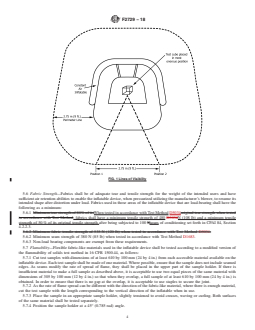
5.5.1 Each The constant air inflatable shall be designed to allow a portion of a cube with the size of 0.057 m (2 ft ) section
of the playing area must be visible from the outer perimeter, in a minimum of two locations that are spaced at to be viewed from
at least 2 points on a perimeter line placed at a distance of 2.75 m (9 ft) from the perimeter of the constant air inflatable and spaced
at a distance of at least 2.75 m (9 ft) apart measured at from each other, and viewed from a height of 1.5 m (5 ft) above the ground
level.perimeter line. (See Fig. 1.)
F2729 − 18
FIG. 1 Lines of Visibility
5.6 Fabric Strength—Fabrics shall be of adequate tear and tensile strength for the weight of the intended users and have
sufficient air retention abilities to enable the inflatable device, when pressurized utilizing the manufacturer’s blower, to resume its
intended shape after distortion under load. Fabrics used in those areas of the inflatable device that are load-bearing shall have the
following as a minimum:
5.6.1 Minimum tear strength of 80% of itsWhen tested in accordance with Test Method D5034original tear strength when tested
in accordance with Test Method, fabrics shall have a minimum tensile strength of 480 D5034N (108 lb) and a minimum tensile
strength of 50 % of its original tensile strength after being subjected to 100 hhours of conditioning set forth in CPAI 84, Section
4.2.2.3.
5.6.2 Minimum fabric tensile strength of 535 N (120 lb) when tested in accordance with Test Method D5034.
5.6.2 Minimum seam strength of 380 N (85 lb) when tested in accordance with Test Method D1683.
5.6.3 Non-load bearing components are exempt from these requirements.
5.7 Flamability—Flexible fabric-like materials used in the inflatable device shall be tested according to a modified version of
the flammability of solids test method in 16 CFR 1500.44, as follows:
5.7.1 Cut test samples with dimensions of at least 610 by 100 mm (24 by 4 in.) from each accessible material available on the
inflatable device. Each test sample shall be made of one material. Where possible, ensure that the sample does not include seamed
edges. As seams modify the rate of spread of flame, they shall be placed in the upper part of the sample holder. If there is
insufficient material to make a full sample as described above, it is acceptable to use two equal pieces of the same material with
dimensions of 305 by 100 mm (12 by 4 in.) so that when they overlap, a full sample of at least 610 by 100 mm (24 by 4 in.) is
obtained. In order to ensure that there is no gap at the overlap, it is acceptable to use staples to secure the joint.
5.7.2 As the rate of flame spread can be different with the direction of the fabric-like material, where there is enough material,
cut the test sample with the length corresponding to the vertical direction of the inflatable when in use.
5.7.3 Place the sample in an appropriate sample holder, slightly tensioned to avoid creases, waving or curling. Both surfaces
of the same material shall be tested separately.
5.7.4 Position the sample holder at a 45° (0.785 rad) angle.
F2729 − 18
5.7.5 Apply the test candle flame to the bottom edge of the test sample.
5.7.6 The rate of flame spread shall not exceed 25.4 mm/s (1.0 in./s) or shall self-extinguish. There shall be no flaming debris
or molten drips.
NOTE 1—Debris that builds up on the edges of test bracket and drips is not classified as molten drips.
5.8 Solids Flammability—Solid materials used in the inflatable device shall be tested according to the flammability of solids test
method in 16 CFR 1500.44.
5.9 Non-Climbable Netting or Mesh—Where used for containment or retention, the netting or mesh shall meet the strength
requirements described in 5.6. The mesh size shall be small enough to prevent the 12 mm (0.5 in.) rod from passing through when
tested as follows:
5.9.1 Test Procedure for Non-Climbable Net or Mesh—Align the probe (see Fig. 12) perpendicular to the net or mesh. Push the
probe, with a 4.45 N (1.0 lbf), round end first, into the net or mesh. A net or mesh is non-climbable if the probe enters equal to
or less than 12 mm (0.5 in.) deep.
5.10 Rope Climber Nets—Rope climber nets shall be securely attached at both ends to the inflatable device to prevent lifting
by users. The rope shall be a minimum of 12 mm (0.5 in.) in diameter and securely knotted at intersections so that the knots do
not slip when subjected to a 140 kg (308 lb) load or three times the manufacturer’s maximum intended weight of the user,
whichever is greater.
5.11 Climber nets shall comply with head and neck entrapment requirements in section 6.4.
5.12 Climbing Ropes—Climbing ropes shall be anchored at both ends and not be capable of being looped back on itself, creating
an inside loop perimeter greater than 125 mm (5 in.).
5.13 Zippers—Zippers shall withstand the air pressure generated within the inflatable device. If zippers are used, they shall be
easy to use from both sides. Zippers used for deflation purposes shall have the zipper pull covered from view (for example, by a
flap or pocket).
6. Performance Requirements
6.1 Anchoring:
6.1.1 Sufficient anchor points shall be provided and located under the load and wind velocities described below to enable
stability and restraint to be maintained under the manufacturer’s recommended maximum loading condition and wind velocity.
Anchoring for inflatable devices for outdoor use shall be designed to withstand a minimum Beaufort scale 6 wind speed (11.1 m/s).
6.1.2 The number of anchor points required shall be calculated, independently for each side, using the following formula and
values below. In all cases, there There shall be a minimum of two anchor points per side. side when the result of the calculation
for anchor points is less than 2. First calculate the force on each side using:
ρ
F 5 C V A (1)
W
where:
F = force on the side,
C = wind coefficient,
W
ρ = density of air,
V = maximum wind speed, and
A = area of exposed surface.
A = area of exposed surface in meters.
Using the following values:
C = 1.5
W
ρ = 1.24 kg/m
V = calculation wind velocity in m/s (Beaufort scale 6 = 11.1 m/s)
A = area of exposed surface in meters (to be determined by measurement and calculation)
The number of anchor points required on this side shall be calculated by dividing the force, F, by the force each anchor system
shall be engineered to withstand, 1600 N (360 lbf), and multiplying by a safety factor of 1.5. The value shall be rounded upinteger
to the next integer. nearest whole number. The calculation shall be repeated for each side.
FIG. 12 Non-Climbable Net or Mesh Probe
F2729 − 18
The number of anchor-points required on each side is:
F
N5 31.5 rounded up where 1.5 is a safety factor.
1600N
This calculation shall be repeated for each side.
NOTE 2—Corner anchors count as one half of an anchor on each side towards the total.
6.1.3 Stakes that are used as an anchor system shall be designed and installed so that top of the stake is flush to or below the
ground, ground level, if accessible to a user falling onto the stake.
6.1.4 Where the inflatable device is not secured with ground anchor stakes (such as a ballast bag, sandbox, or other means), the
total anchor system shall be designed and detailed All external corners along the perimeter of the inflatable device’s footprint shall
have anchor points. Each external corner anchor counts as one half an anchor towards the total amount of anchors per side. Based
on the design configuration of the inflatable device, additional anchor points shall be required for the following configurations: (See
Fig. 3to withstand the same forces as though it was secured with ground anchor stakes.) External corners (1) of extending geometry
are required to be anchored. Internal corners (2) of extending geometry are not required to be anchored, unless based on the
calculation of the formula. Semi-circular or circular sides (3) should be treated as a flat side and use the formula to calculate the
number required along that surface.
6.1.5 Each anchor rope assembly system (anchor, rope, or strap and associated fittingsfittings) shall have a minimum breaking
load of 81.6 kN (1800(360 lbf) at the juncture of the strap and the inflatable device.
6.1.6 The anchor system shall be designed so that the anchor ropes or straps are secured in a manner that prevents the inflatable
device lifting completely off the ground.Anchor points shall not be placed at the exit of a slide or access and egress where a child
may come in contact with the stake.
6.1.7 Anchor systems shall be consistent throughout.
6.2 Structural Integrity:
6.2.1 Air Pressure:
6.2.1.1 The minimum air pressure inside the inflatable device delivered by the blower shall in all cases be sufficient to give a
firm and reliable footing and adequately support the structure. The maximum individual weight specified by the manufacturer shall
be placed on each structural unit without grounding.
6.2.1.2 Horizontal surfaces shall support the load specified in Table 1, without grounding. When tested in accordance with the
structural integrity test method 6.2.1.3 and 6.2.1.4, the appropriate load shall remain supported by the inflatable device at each test
point.
2 2
6.2.1.3 Structural Integrity Test Method—For platforms with an area greater than 0.93 m (10 ft ), the load, as defined in Table
1, shall be applied vertically, without shock, and the total load shall remain for 5 minutes. For the purpose of applying the load,
the platform shall be divided into four equal area quadrants. The total load shall be located in equal portions, in the center of each
2 2
quadrant and at the center point of the platform, for a total of 5 points. For platforms with an area less than 0.93 m (10 ft ), apply
the load over a 305 mm (1 ft) diameter area.
2 2
(1) Platforms with an area less than 0.93 m (10 ft ) intended for access and egress that rest on the ground with a height of
305 mm (12 in.) or less are exempt from this requirement.
FIG. 3 Anchor Locations
F2729 − 18
TABLE 1 Area and Load on Platform
2 2
Area m (ft ) Load kg (lb)
<0.92 (<10) 85 (190)
0.92-1.85 (10–20) 127 (280)
1.85-2.80 (20–30) 170 (375)
2.80-3.70 (30–40) 204 (450)
>3.70 (>40) 250 (550)
2 2
(2) Platforms with an area less than 0.93 m (10 ft ) intended for lounging are exempt from this requirement.
(3) The exit area of a slide, for the last 460 mm (18 in.), with a height of 305 mm (12 in.) or less, is exempt from this
requirement.
6.2.1.4 Structural Integrity Test Procedure—The loading procedure shall be as follows:
(1) Ensure the inflatable device is inflated to its specified minimum air pressure or to the pressure of the supplied blower.
(2) Select the appropriate load to be applied from Table 1.
(3) Place the individual loads indicated in Table 1 onto each individual test position selected in accordance with Fig. 24,
example of test position grid, until the loads occupy all five test positions.
6.3 Deflation:
6.3.1 The design of an inflatable device shall ensure that, upon loss of air pressure, the inflatable device remains supported with
sufficient clearances for the oldest (tallest) user and adequate time for the youngest user to evacuate.
6.3.2 It is acceptable to use an independent support system.
6.3.3 Inflatable devices shall be designed to ensure adults are able to gain access in order to assist users during evacuation.
6.3.4 The inflatable device cannot tip over and create a hazardous situation while deflating.
6.3.5 If a tunnel is under the highest platform, the opening of the tunnel cannot decrease by half the initial height beforeThe
height of entry and exit regions of all tunnels shall retain at least half of their initial inflated height at the 30 second mark.
6.3.6 Deflation Test Method:
6.3.6.1 Ensure the inflatable device is inflated to its specified minimum air pressure or to the pressure of the supplied blower.
6.3.6.2 Apply the appropriate test load based on the height of the highest platform as specified in Table 2.
6.3.6.3 The size of the test load shall be a 40.0 cm (16 in.) diameter sand bag.
6.3.6.4 Place the load on the geometric center of the highest platform or playing surface.
6.3.6.5 Timing begins when the blower motor is stopped.
6.3.6.6 Timing is stopped when the test load contacts the ground.
FIG. 24 Example of Test Position Grid
F2729 − 18
TABLE 2 Deflation Load and Time
Height of Highest Total Load, Minimum Deflation
Platform, mm (ft) kg (lb) Time
<610 mm (2) 20 (44) 10 s
610–1525 mm (2–5) 20 (44) 20 s
>1525–2134 mm (5–7) 34 (75) 30 s
>2134 mm (7) 34 (75) 40 s
6.4 Head and Neck Entrapment:
6.4.1 Inflatable devices shall be designed and constructed or assembled so that any openings that are accessible to users shall
meet the following performance requirements to reduce the risk of accidental head or neck entrapment by either a head-first or
feet-first entry into the opening.
6.4.2 Accessible Openings—A completely bounded rigid opening is accessible when a torso test probe (see Fig. 35) can be
inserted into the opening to a depth of 102 mm (4.0 in.) or more.
6.4.2.1 Test Procedure for Completely Bounded Rigid Openings:
(1) An opening fails the test if the opening admits the torso probe, but does not admit the head probe.
(2) Place the torso probe in the opening with the plane of the base of the probe parallel to the plane of the opening; rotate the
probe to its most adverse orientation (that is, major axis of the base of the probe parallel to the major axis of opening).
6.4.2.2 If the torso probe can be inserted into the opening to a depth of 102 mm (4.0 in.) or more, place the head probe (see
Fig. 46) in the opening with the plane of the base of the probe parallel to the plane of the opening.
6.4.2.3 An opening passes this test if (1) the opening does not admit the torso probe when it is rotated to any orientation about
its own axis, or (2) the opening admits the torso probe and also admits the head probe.
6.4.3 Non-Rigid Completely Bounded Openings—A non-rigid opening such as, but not limited to flexible nets, water tubing,
tarps, and plastic enclosures is considered accessible if a torso probe will penetrate the opening to a depth of 102 mm (4.0 in.) or
more when tested in accordance with the test procedure outlined in 6.4.3.2.
FIG. 35 Torso Probe
F2729 − 18
FIG. 46 Head Probe
6.4.3.1 If the non-rigid opening consists of a material that can be manipulated to create a larger opening under a force of no
greater than 22.2 N (5 lb) in any orientation or plane, conduct the test with the opening in its worst-case orientation under the
applied force.
6.4.3.2 Test Procedure for Completely Bounded Non-Rigid Openings:
(1) Place the torso probe in the opening, tapered-end first, with the plane of its base parallel to the plane of the opening; rotate
the probe to its most adverse orientation (that is, the major axis of the base of the probe parallel to the major axis of the opening);
apply a force of 222 N (50 lb) to the probe to attempt to pass it through the opening.
(2) If the base of the probe passes through the opening, place the large head probe in the opening, tapered end first, with the
plane of its base parallel to the plane of the opening. Attempt to pass it through the opening freely.
(3) A non-rigid opening passes the test if: (a) the opening does not allow the torso probe to be inserted so deep that the opening
admits the base of the probe when it is rotated to any orientation about its own axis, or (b) the opening allows full passage of the
torso probe and also allows the large head probe to pass completely through.
(4) A non-rigid opening fails the test if the opening allows full passage of the torso probe but does not admit the large head
probe.
6.5 Angles:
6.5.1 The angle of any vertex formed by adjacent components shall be greater than 55° (0.96 rad), unless the lower leg is
horizontal or projects downwards, refer to Fig. 57, recommended angle measurements.
6.5.2 An exception to this recommendation can be made if an in-filled shield is attached to the vertex between adjacent
components and the shield is of sufficient size to prevent a 229 mm (9 in.) diameter circular template from simultaneously touching
components on either side of the vertex, see Fig. 68, in-fill shield for angles.
6.6 Entrapment of Body:
F2729 − 18
FIG. 57 Recommended Angle Measurements
FIG. 68 In-Fill Shield for Angles Less than 55°
6.6.1 Adjacent inflated surfaces shall be more than 120 mm (4.75 in.) apart if the aperture formed is more than 200 mm (7.9
in.) deep. See Fig. 79 for body entrapment examples.
6.6.2 Inflatable device tunnels shall comply with the following requirements:
6.6.2.1 Tunnels of 750 mm (29.5 in.) or less in length shall:
(1) Have an initial opening diameter of at least 400 mm (15.75 in.);
(2) Comply with head and neck entrapment requirements for non-rigid completely bounded openings; and
(3) Be capable of expansion to at least 400 mm (15.75 in.) diameter for the entire length of the inner panel under a force of
no more than 222 N (50 lb).
F2729 − 18
FIG. 79 Body Entrapment Points
6.6.2.2 Tunnels over 750 mm (29.5 in.) and up to 2 m (6.6 ft) in length shall be of at least 500 mm (19.7 in.) internal diameter.
6.6.2.3 Tunnels of over 2 m (6.6 ft) in length shall be at least 750 mm (29.5 in.) internal diameter and have access gaps or open
branches at least every 2 m (6.6 ft).
6.7 Protrusions:
6.7.1 When tested, no protrusion shall extend beyond the face of the appropriate test gage as shown in Figs. 810 and 911.
6.7.2 Protrusions that are non-rigid and moveable are exempt from the requirements of 6.7.
F2729 − 18
FIG. 810 Protrusion Gauges
FIG. 911 Additional Protrusion Gauge
6.7.3 Perform protrusion tests by successively placing each test gauge shown in Fig. 810 to determine if the protrusion extends
beyond the face of the smallest gauge that can be successfully placed over the protrusion (for example of test gauge use, see Fig.
1012).
6.7.4 Upright Protrusions—Protrusions that fit within any of the gauges and that project upwards from a horizontal plane shall
have no projection extending more than 3 mm (0.125 in.) perpendicular to the plane of the initial surface (see Fig. 1113).
6.7.5 Forced Motion—Protrusions shall not extend beyond the face of the test gage shown in Fig. 911. Place the gauge shown
in Fig. 911 over any protrusions such that the axis of the hole is parallel to both the intended path of the travel and a horizontal
plane.
6.7.6 Slides—Slides, including protective barriers and their method of attachment and transition areas, pose a greater risk of
entanglement than other areas, therefor
...