

ASTM E2925-19a
(Specification)Standard Specification for Manufactured Polymeric Drainage and Ventilation Materials Used to Provide a Rainscreen Function
General Information
- Abstract
ABSTRACT
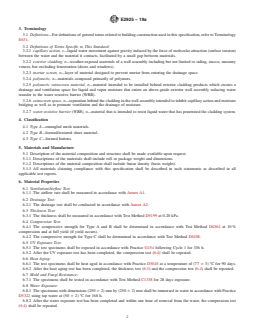
This specification covers the requirements and corresponding test methods for manufactured polymeric materials used to provide a rainscreen function, a means for the drainage of liquid moisture and the ventilation of vapor moisture that enters an above-grade exterior wall assembly. Rainscreen materials that conform to this specification are intended to be used behind exterior cladding products and to cover the entire wall area that is designed to provide a rainscreen function to resist water infiltration. Three types of rainscreen materials are addressed: Type A (entangled mesh materials), Type B (formed/textured sheet material), and Type C (formed battens). This specification also covers descriptions of the materials and material composition; material properties and material performance requirements; specimen preparation; reporting requirements; marking and labeling; and packaging and package marking. A table presents the requirements for ventilation/airflow, drainage, thickness, compression, strength, UV exposure, heat aging, mold/fungal growth, and water exposure.
SCOPE
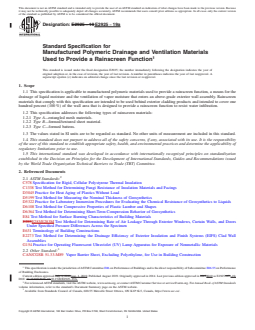
1.1 This specification is applicable to manufactured polymeric materials used to provide a rainscreen function, a means for the drainage of liquid moisture and the ventilation of vapor moisture that enters an above-grade exterior wall assembly. Rainscreen materials that comply with this specification are intended to be used behind exterior cladding products and intended to cover one hundred percent (100 %) of the wall area that is designed to provide a rainscreen function to resist water infiltration.
1.2 This specification addresses the following types of rainscreen materials:
1.2.1 Type A—entangled mesh materials.
1.2.2 Type B—formed/textured sheet material.
1.2.3 Type C—formed battens.
1.3 The values stated in SI units are to be regarded as standard. No other units of measurement are included in this standard.
1.4 This standard does not purport to address all of the safety concerns, if any, associated with its use. It is the responsibility of the user of this standard to establish appropriate safety, health, and environmental practices and determine the applicability of regulatory limitations prior to use.
1.5 This international standard was developed in accordance with internationally recognized principles on standardization established in the Decision on Principles for the Development of International Standards, Guides and Recommendations issued by the World Trade Organization Technical Barriers to Trade (TBT) Committee.
- Status
- Published
- Publication Date
- 31-Jul-2019
- Technical Committee
- E06 - Performance of Buildings
- Drafting Committee
- E06.55 - Performance of Building Enclosures
Buy Documents
ASTM E2925-19a - Standard Specification for Manufactured Polymeric Drainage and Ventilation Materials Used to Provide a Rainscreen Function
REDLINE ASTM E2925-19a - Standard Specification for Manufactured Polymeric Drainage and Ventilation Materials Used to Provide a Rainscreen Function
Overview
ASTM E2925-19a is the Standard Specification for Manufactured Polymeric Drainage and Ventilation Materials Used to Provide a Rainscreen Function. Developed by ASTM International, this specification defines requirements and test methods for engineered polymeric materials designed to provide a rainscreen function as part of above-grade exterior wall assemblies. Rainscreen materials are crucial in modern building envelope design, enabling drainage of liquid moisture and ventilation of vapor that may enter wall cavities behind exterior claddings such as siding, masonry veneer, and stucco.
The standard ensures that rainscreen materials used behind claddings meet minimum performance requirements in key areas such as moisture drainage, airflow, compression strength, durability, and resistance to mold and environmental factors. Compliance with ASTM E2925-19a helps builders, architects, and manufacturers ensure that wall systems resist water infiltration and support a durable, energy-efficient building envelope.
Key Topics
ASTM E2925-19a covers the following points:
- Material Types: The specification identifies three types of polymeric rainscreen materials:
- Type A: Entangled mesh materials
- Type B: Formed or textured sheet materials
- Type C: Formed battens
- Drainage and Ventilation Performance: Specifies test methods to determine the capability of a material to drain water and allow airflow (ventilation) within the wall assembly.
- Material Properties: Establishes minimum requirements for:
- Ventilation/airflow
- Drainage efficiency
- Thickness (minimum 5 mm)
- Compression strength (minimum 20 kPa)
- UV exposure durability
- Heat aging resistance
- Mold and fungi resistance
- Water exposure durability
- (Optional) Flame spread and freeze-thaw resistance
- Specimen Preparation and Reporting: Details requirements for sampling, specimen conditioning, and comprehensive reporting, including conformity declarations and property data.
- Marking and Packaging: Outlines requirements for product labeling, packaging, and installation instructions, ensuring traceability and correct field application.
Applications
Manufactured polymeric rainscreen drainage and ventilation materials are intended for use:
- Behind exterior cladding systems on above-grade walls, such as:
- Residential and commercial siding
- Stone, brick, or masonry veneer
- Stucco and other applied finishes
- In building envelope assemblies where control of liquid and vapor moisture is essential to durability and energy performance
- In all climate zones where rainscreen systems are recommended or required by building codes or best practices
Adhering to ASTM E2925-19a ensures that the rainscreen materials used:
- Enhance the drying potential of exterior walls by allowing ventilation
- Reduce risk of water damage, rot, and mold growth by providing effective drainage paths
- Support compliance with building codes requiring rain control layers behind claddings
- Facilitate long-term durability and occupant health by protecting the water-resistive barrier (WRB) and insulation layers
Related Standards
To fully implement ASTM E2925-19a, reference to related standards is often required, including:
- ASTM C578: Specification for Rigid, Cellular Polystyrene Thermal Insulation
- ASTM C1338: Test Method for Determining Fungi Resistance of Insulation Materials and Facings
- ASTM D3045: Practice for Heat Aging of Plastics Without Load
- ASTM D5199: Test Method for Measuring the Nominal Thickness of Geosynthetics
- ASTM D5322: Practice for Laboratory Immersion Procedures for Geosynthetics
- ASTM D6108: Test Method for Compressive Properties of Plastic Lumber and Shapes
- ASTM D6364: Test Method for Short-Term Compression Behavior of Geosynthetics
- ASTM E84: Test Method for Surface Burning Characteristics of Building Materials
- ASTM E2273: Test Method for Drainage Efficiency of EIFS-Clad Wall Assemblies
- CAN/CGSB 51.33-M89: Vapor Barrier Sheet for Use in Building Construction
Keywords: drainage plane, rainscreen, water-resistive barrier, weather-resistive barrier, building envelope, exterior wall, ventilation, ASTM E2925-19a
Relations
- Effective Date
- 01-Aug-2019
- Effective Date
- 01-Feb-2024
- Effective Date
- 01-Dec-2023
- Effective Date
- 01-Sep-2023
- Effective Date
- 01-Sep-2023
- Effective Date
- 01-Sep-2023
- Effective Date
- 01-Jul-2019
- Refers
ASTM D5199-12(2019) - Standard Test Method for Measuring the Nominal Thickness of Geosynthetics - Effective Date
- 15-Jun-2019
- Effective Date
- 01-May-2019
- Effective Date
- 15-Apr-2019
- Effective Date
- 01-Mar-2019
- Effective Date
- 01-Oct-2018
- Effective Date
- 01-Sep-2018
- Effective Date
- 01-Aug-2018
- Effective Date
- 01-Jul-2018
Buy Documents
ASTM E2925-19a - Standard Specification for Manufactured Polymeric Drainage and Ventilation Materials Used to Provide a Rainscreen Function
REDLINE ASTM E2925-19a - Standard Specification for Manufactured Polymeric Drainage and Ventilation Materials Used to Provide a Rainscreen Function
Get Certified
Connect with accredited certification bodies for this standard

DIBt (Deutsches Institut für Bautechnik)
German Institute for Building Technology.
DIN CERTCO
DIN Group product certification.

Aboma Certification B.V.
Specialized in construction, metal, and transport sectors.
Sponsored listings
Frequently Asked Questions
ASTM E2925-19a is a technical specification published by ASTM International. Its full title is "Standard Specification for Manufactured Polymeric Drainage and Ventilation Materials Used to Provide a Rainscreen Function". This standard covers: ABSTRACT This specification covers the requirements and corresponding test methods for manufactured polymeric materials used to provide a rainscreen function, a means for the drainage of liquid moisture and the ventilation of vapor moisture that enters an above-grade exterior wall assembly. Rainscreen materials that conform to this specification are intended to be used behind exterior cladding products and to cover the entire wall area that is designed to provide a rainscreen function to resist water infiltration. Three types of rainscreen materials are addressed: Type A (entangled mesh materials), Type B (formed/textured sheet material), and Type C (formed battens). This specification also covers descriptions of the materials and material composition; material properties and material performance requirements; specimen preparation; reporting requirements; marking and labeling; and packaging and package marking. A table presents the requirements for ventilation/airflow, drainage, thickness, compression, strength, UV exposure, heat aging, mold/fungal growth, and water exposure. SCOPE 1.1 This specification is applicable to manufactured polymeric materials used to provide a rainscreen function, a means for the drainage of liquid moisture and the ventilation of vapor moisture that enters an above-grade exterior wall assembly. Rainscreen materials that comply with this specification are intended to be used behind exterior cladding products and intended to cover one hundred percent (100 %) of the wall area that is designed to provide a rainscreen function to resist water infiltration. 1.2 This specification addresses the following types of rainscreen materials: 1.2.1 Type A—entangled mesh materials. 1.2.2 Type B—formed/textured sheet material. 1.2.3 Type C—formed battens. 1.3 The values stated in SI units are to be regarded as standard. No other units of measurement are included in this standard. 1.4 This standard does not purport to address all of the safety concerns, if any, associated with its use. It is the responsibility of the user of this standard to establish appropriate safety, health, and environmental practices and determine the applicability of regulatory limitations prior to use. 1.5 This international standard was developed in accordance with internationally recognized principles on standardization established in the Decision on Principles for the Development of International Standards, Guides and Recommendations issued by the World Trade Organization Technical Barriers to Trade (TBT) Committee.
ABSTRACT This specification covers the requirements and corresponding test methods for manufactured polymeric materials used to provide a rainscreen function, a means for the drainage of liquid moisture and the ventilation of vapor moisture that enters an above-grade exterior wall assembly. Rainscreen materials that conform to this specification are intended to be used behind exterior cladding products and to cover the entire wall area that is designed to provide a rainscreen function to resist water infiltration. Three types of rainscreen materials are addressed: Type A (entangled mesh materials), Type B (formed/textured sheet material), and Type C (formed battens). This specification also covers descriptions of the materials and material composition; material properties and material performance requirements; specimen preparation; reporting requirements; marking and labeling; and packaging and package marking. A table presents the requirements for ventilation/airflow, drainage, thickness, compression, strength, UV exposure, heat aging, mold/fungal growth, and water exposure. SCOPE 1.1 This specification is applicable to manufactured polymeric materials used to provide a rainscreen function, a means for the drainage of liquid moisture and the ventilation of vapor moisture that enters an above-grade exterior wall assembly. Rainscreen materials that comply with this specification are intended to be used behind exterior cladding products and intended to cover one hundred percent (100 %) of the wall area that is designed to provide a rainscreen function to resist water infiltration. 1.2 This specification addresses the following types of rainscreen materials: 1.2.1 Type A—entangled mesh materials. 1.2.2 Type B—formed/textured sheet material. 1.2.3 Type C—formed battens. 1.3 The values stated in SI units are to be regarded as standard. No other units of measurement are included in this standard. 1.4 This standard does not purport to address all of the safety concerns, if any, associated with its use. It is the responsibility of the user of this standard to establish appropriate safety, health, and environmental practices and determine the applicability of regulatory limitations prior to use. 1.5 This international standard was developed in accordance with internationally recognized principles on standardization established in the Decision on Principles for the Development of International Standards, Guides and Recommendations issued by the World Trade Organization Technical Barriers to Trade (TBT) Committee.
ASTM E2925-19a is classified under the following ICS (International Classification for Standards) categories: 91.060.10 - Walls. Partitions. Facades. The ICS classification helps identify the subject area and facilitates finding related standards.
ASTM E2925-19a has the following relationships with other standards: It is inter standard links to ASTM E2925-19, ASTM D6108-24, ASTM E84-23d, ASTM C578-23, ASTM E84-23c, ASTM D5322-23, ASTM E84-19b, ASTM D5199-12(2019), ASTM D6108-19, ASTM E84-19a, ASTM E84-19, ASTM E84-18b, ASTM E2273-18, ASTM D3045-18, ASTM E84-18a. Understanding these relationships helps ensure you are using the most current and applicable version of the standard.
ASTM E2925-19a is available in PDF format for immediate download after purchase. The document can be added to your cart and obtained through the secure checkout process. Digital delivery ensures instant access to the complete standard document.
Standards Content (Sample)
This international standard was developed in accordance with internationally recognized principles on standardization established in the Decision on Principles for the
Development of International Standards, Guides and Recommendations issued by the World Trade Organization Technical Barriers to Trade (TBT) Committee.
Designation:E2925 −19a
Standard Specification for
Manufactured Polymeric Drainage and Ventilation Materials
Used to Provide a Rainscreen Function
This standard is issued under the fixed designation E2925; the number immediately following the designation indicates the year of
original adoption or, in the case of revision, the year of last revision. A number in parentheses indicates the year of last reapproval. A
superscript epsilon (´) indicates an editorial change since the last revision or reapproval.
1. Scope C578 Specification for Rigid, Cellular Polystyrene Thermal
Insulation
1.1 This specification is applicable to manufactured poly-
C1338 Test Method for Determining Fungi Resistance of
meric materials used to provide a rainscreen function, a means
Insulation Materials and Facings
for the drainage of liquid moisture and the ventilation of vapor
D3045 Practice for Heat Aging of Plastics Without Load
moisture that enters an above-grade exterior wall assembly.
D5199 Test Method for Measuring the Nominal Thickness
Rainscreen materials that comply with this specification are
of Geosynthetics
intended to be used behind exterior cladding products and
D5322 Practice for Laboratory Immersion Procedures for
intended to cover onehundredpercent(100 %)ofthewallarea
Evaluating the Chemical Resistance of Geosynthetics to
that is designed to provide a rainscreen function to resist water
Liquids
infiltration.
D6108 Test Method for Compressive Properties of Plastic
1.2 This specification addresses the following types of
Lumber and Shapes
rainscreen materials:
D6364 Test Method for Determining Short-Term Compres-
1.2.1 Type A—entangled mesh materials.
sion Behavior of Geosynthetics
1.2.2 Type B—formed/textured sheet material.
E84 Test Method for Surface Burning Characteristics of
1.2.3 Type C—formed battens.
Building Materials
1.3 The values stated in SI units are to be regarded as E283/E283M Test Method for Determining Rate of Air
Leakage Through Exterior Windows, Curtain Walls, and
standard. No other units of measurement are included in this
standard. Doors Under Specified Pressure Differences Across the
Specimen
1.4 This standard does not purport to address all of the
E631 Terminology of Building Constructions
safety concerns, if any, associated with its use. It is the
E2273 Test Method for Determining the Drainage Efficiency
responsibility of the user of this standard to establish appro-
of Exterior Insulation and Finish Systems (EIFS) Clad
priate safety, health, and environmental practices and deter-
Wall Assemblies
mine the applicability of regulatory limitations prior to use.
G154 Practice for Operating Fluorescent Ultraviolet (UV)
1.5 This international standard was developed in accor-
Lamp Apparatus for Exposure of Nonmetallic Materials
dance with internationally recognized principles on standard-
2.2 Other Standard:
ization established in the Decision on Principles for the
CAN/CGSB 51.33-M89 Vapor Barrier Sheet, Excluding
Development of International Standards, Guides and Recom-
Polyethylene, for Use in Building Construction
mendations issued by the World Trade Organization Technical
Barriers to Trade (TBT) Committee.
3. Terminology
2. Referenced Documents
3.1 Definitions—For definitions of general terms related to
building construction used in this specification, refer to Termi-
2.1 ASTM Standards:
nology E631.
3.2 Definitions of Terms Specific to This Standard:
This specification is under the jurisdiction of ASTM Committee E06 on
3.2.1 capillary action, v—liquid water movement against
Performance of Buildings and is the direct responsibility of Subcommittee E06.55
on Performance of Building Enclosures.
gravity induced by the force of molecular attraction (surface
Current edition approved Aug. 1, 2019. Published August 2019. Originally
tension) between the water and the material it contacts,
approved in 2014. Last previous edition approved in 2019 as E2925–19. DOI:
facilitated by a small gap between materials.
10.1520/E2925–19A.
For referenced ASTM standards, visit the ASTM website, www.astm.org, or
contact ASTM Customer Service at service@astm.org. For Annual Book of ASTM
Standards volume information, refer to the standard’s Document Summary page on Available from Standards Council of Canada, 600-55 Metcalfe Street Ottawa,
the ASTM website. ON K1P 6L5, Canada, https://www.scc.ca/.
Copyright © ASTM International, 100 Barr Harbor Drive, PO Box C700, West Conshohocken, PA 19428-2959. United States
E2925−19a
3.2.2 exterior cladding, n—weather-exposed materials of a 6.5.1 The test specimens shall be exposed in accordance
wall assembly including but not limited to siding, stucco, with Practice G154 following Cycle 1 for 336 h.
masonry veneer, but excluding fenestration (doors and win-
6.5.2 After the UV exposure test has been completed, the
dows). compression test (6.4) shall be repeated.
3.2.3 mortar screen, n—layer of material designed to pre-
6.6 Heat Aging:
vent mortar from entering the drainage space.
6.6.1 The test specimens shall be heat aged in accordance
3.2.4 polymeric, n—materials composed primarily of poly- with Practice D3045 at a temperature of (77 6 3) °C for 90
days.
mers.
6.6.2 After the heat aging test has been completed, the
3.2.5 polymeric rainscreen material, n—material intended
thickness test (6.3) and the compression test (6.4) shall be
to be installed behind exterior cladding products which creates
repeated.
a drainage and ventilation space for liquid and vapor moisture
that enters an above-grade exterior wall assembly reducing
6.7 Mold and Fungi Resistance:
water transfer to the water resistive barrier (WRB).
6.7.1 The specimens shall be tested in accordance with Test
Method C1338 for 28 days exposure.
3.2.6 rainscreen space, n—separationbehindthecladdingin
the wall assembly intended to inhibit capillary action and
6.8 Water Exposure:
moisture bridging as well as to promote ventilation and the
6.8.1 The specimens with dimensions (250 6 2) mm by
drainage of moisture.
(250 6 2) mm shall be immersed in water in accordance with
3.2.7 water-resistive barrier (WRB), n—material that is Practice D5322 using tap water at (50 6 2) °C for 168 h.
intended to resist liquid water that has penetrated the cladding
6.8.2 After the water exposure test has been completed and
system.
within one hour of removal from the water, the compression
test (6.4) shall be repeated.
4. Classification
6.9 Flame Spread Test (Optional):
4.1 Type A—entangled mesh materials.
6.9.1 When desired, the material shall be tested in accor-
dance with Test Method E84 for flame spread.
4.2 Type B—formed/textured sheet material.
6.10 Freeze-Thaw (Optional):
4.3 Type C—formed battens.
6.10.1 The freeze-thaw exposure shall be conducted in
accordance with the aging procedure of Section 8.3.2.1 of
5. Materials and Manufacture
CAN/CGSB 51.33-M89.
5.1 Description of the material composition and structure
6.10.2 After the freeze thaw exposure test has been com-
shall be made available upon request.
pleted and within one hour of the completion of the test, the
5.1.1 Descriptions of the materials shall include roll or
compression test (6.4) shall be repeated.
package weight and dimensions.
5.1.2 Descriptions of the material composition shall include
7. Material Performance Requirements
linear density (basis weight).
7.1 All materials shall provide the minimum performance
5.1.3 All materials claiming compliance with this specifica-
requirements listed in Table 1.
tion shall be described in such statements as described in all
applicable test reports.
8. Sampling
6. Material Properties
8.1 The material to be tested for conformance to this
specification shall be taken directly from a randomly selected
6.1 Ventilation/Airflow Test:
roll or package which is representative of the commercial
6.1.1 The airflow rate shall be measured in accordance with
product.
Annex A1.
6.2 Drainage Test:
9. Specimen Preparation
6.2.1 The drainage test shall be conducted in accordance
with Annex A2. 9.1 The specimens from roll materials shall be cut from the
interior of the sample roll so that no specimen edge is nearer
6.3 Thickness Test:
than 75 mm to the original roll edge.
6.3.1 The thickness shall be measured in accordance with
Test Method D5199 at 0.20 kPa. 9.2 Unlessotherwisestatedinthetestmethod,allspecimens
shall be conditioned for a minimum period of 40 h at (23 6
6.4 Compression Test:
2) °C and (50 6 10) % relative humidity (RH).
6.4.1 The compressive strength for Type A and B shall be
determined in accordance with Test Method D6364 at 10 % 9.3 The specimen size shall be determined by the test
compression and at full yield (if yield occurs). method.
6.4.2 The compressive strength for Type C shall be deter-
9.4 If not otherwise specified in the referenced test method,
mined in accordance with Test Method D6108.
a minimum of five specimens shall be tested and each
6.5 UV Exposure Test: specimen shall meet the minimum performance requirements.
E2925−19a
TABLE 1 Material Performance Requirements
Test Method Units Min/Max Performance Requirements
Ventilation/Airflow at 10 Pa 3.1 L/s Min 0.10
Pressure Difference
Drainage 3.2 % Min 90
Thickness 3.3 mm Min 5
Compression Strength 3.4 kPa Min 20
UV Exposure 3.5 kPa Min The compression strength after UV exposure shall not be less than 80 %
Heat Aging 3.6 kPa Min The compression strength after heat aging shall not be less than 80 %
Mold/Fungal Growth 3.7 visual Max No visual mold or fungal growth on the test specimens
Water Exposure 3.8 kPa Min The compression strength after water exposure shall not be less than 80 %
Flame Spread 3.9 . Max 25
Smoke-Developed 3.9 . Max 450
Freeze/Thaw 3.10 kPa Min The compression strength after freeze-thaw shall not be less than 80 %
10. Reporting Requirements assembly (with and without insect screen), and the percentage
and weight of the water retained in the test wall assembly;
10.1 Report required and declared test data in the form of a
10.2.15 the compression test results shall provide the com-
table(s) with property, result and pass/fail status including
plete compression curve;
results for all properties tested.
10.2.16 the compression test values shall be reported at
10.2 In addition to the information specified in the indi-
10 % compression and at yield for each sample, and the
vidual test methods, all reports describing the testing of the
average values shall be calculated;
material in accordance with the specification shall include the
10.2.17 the flame spread test results shall include the flame
following information:
spread rating and smoke developed index;
10.2.1 date test conducted;
10.2.2 manufacturer’s name, address, production facility
11. Marking and Labeling
address and product designation;
11.1 The material shall be marked or labeled with manufac-
10.2.3 type and name of the material and other material
turer name and product name.
description;
10.2.4 description of the material composition and struc-
12. Packaging and Package Marking
ture;
10.2.5 lot number and manufactured date;
12.1 The information on the material or packaging shall
10.2.6 expiration date; if applicable;
include the manufacturer’s name, product name, and reference
10.2.7 material sampling procedure used;
to this specification.
10.2.8 description of test apparatus, calibration standards
12.2 Installation instructions shall be provided as part of the
used and their source;
packaging and shall include as a minimum.
10.2.9 name and location of laboratory performing the tests
12.2.1 maximum weather exposure time allowed before
and the accreditation agency for the laboratory;
cladding shall be installed;
10.2.10 description of the specimen preparation;
12.2.2 type of mechanical fastener;
10.2.11 size of specimens used for each test (length, width
12.2.3 minimum fastener spacing to attach the material to
(or diameter) and thickness);
the underlying structure; and
10.2.12 declaration of conformity with this specification;
12.2.4 minimum over lapping requirements.
10.2.13 if the standard requirements were modified, a state-
ment in the test report and a complete description of the
13. Keywords
modifications;
10.2.14 re
...
This document is not an ASTM standard and is intended only to provide the user of an ASTM standard an indication of what changes have been made to the previous version. Because
it may not be technically possible to adequately depict all changes accurately, ASTM recommends that users consult prior editions as appropriate. In all cases only the current version
of the standard as published by ASTM is to be considered the official document.
Designation: E2925 − 19 E2925 − 19a
Standard Specification for
Manufactured Polymeric Drainage and Ventilation Materials
Used to Provide a Rainscreen Function
This standard is issued under the fixed designation E2925; the number immediately following the designation indicates the year of
original adoption or, in the case of revision, the year of last revision. A number in parentheses indicates the year of last reapproval. A
superscript epsilon (´) indicates an editorial change since the last revision or reapproval.
1. Scope
1.1 This specification is applicable to manufactured polymeric materials used to provide a rainscreen function, a means for the
drainage of liquid moisture and the ventilation of vapor moisture that enters an above-grade exterior wall assembly. Rainscreen
materials that comply with this specification are intended to be used behind exterior cladding products and intended to cover one
hundred percent (100 %) of the wall area that is designed to provide a rainscreen function to resist water infiltration.
1.2 This specification addresses the following types of rainscreen materials:
1.2.1 Type A—entangled mesh materials.
1.2.2 Type B—formed/textured sheet material.
1.2.3 Type C—formed battens.
1.3 The values stated in SI units are to be regarded as standard. No other units of measurement are included in this standard.
1.4 This standard does not purport to address all of the safety concerns, if any, associated with its use. It is the responsibility
of the user of this standard to establish appropriate safety, health, and environmental practices and determine the applicability of
regulatory limitations prior to use.
1.5 This international standard was developed in accordance with internationally recognized principles on standardization
established in the Decision on Principles for the Development of International Standards, Guides and Recommendations issued
by the World Trade Organization Technical Barriers to Trade (TBT) Committee.
2. Referenced Documents
2.1 ASTM Standards:
C578 Specification for Rigid, Cellular Polystyrene Thermal Insulation
C1338 Test Method for Determining Fungi Resistance of Insulation Materials and Facings
D3045 Practice for Heat Aging of Plastics Without Load
D5199 Test Method for Measuring the Nominal Thickness of Geosynthetics
D5322 Practice for Laboratory Immersion Procedures for Evaluating the Chemical Resistance of Geosynthetics to Liquids
D6108 Test Method for Compressive Properties of Plastic Lumber and Shapes
D6364 Test Method for Determining Short-Term Compression Behavior of Geosynthetics
E84 Test Method for Surface Burning Characteristics of Building Materials
E283E283/E283M Test Method for Determining Rate of Air Leakage Through Exterior Windows, Curtain Walls, and Doors
Under Specified Pressure Differences Across the Specimen
E631 Terminology of Building Constructions
E2273 Test Method for Determining the Drainage Efficiency of Exterior Insulation and Finish Systems (EIFS) Clad Wall
Assemblies
G154 Practice for Operating Fluorescent Ultraviolet (UV) Lamp Apparatus for Exposure of Nonmetallic Materials
2.2 Other Standard:
CAN/CGSB 51.33-M89 Vapor Barrier Sheet, Excluding Polyethylene, for Use in Building Construction
This specification is under the jurisdiction of ASTM Committee E06 on Performance of Buildings and is the direct responsibility of Subcommittee E06.55 on Performance
of Building Enclosures.
Current edition approved July 1, 2019Aug. 1, 2019. Published August 2019. Originally approved in 2014. Last previous edition approved in 20172019 as E2925–17.–19.
DOI: 10.1520/E2925–19.10.1520/E2925–19A.
For referenced ASTM standards, visit the ASTM website, www.astm.org, or contact ASTM Customer Service at service@astm.org. For Annual Book of ASTM Standards
volume information, refer to the standard’s Document Summary page on the ASTM website.
Available from Standards Council of Canada, 600-55 Metcalfe Street Ottawa, ON K1P 6L5, Canada, https://www.scc.ca/.
Copyright © ASTM International, 100 Barr Harbor Drive, PO Box C700, West Conshohocken, PA 19428-2959. United States
E2925 − 19a
3. Terminology
3.1 Definitions—For definitions of general terms related to building construction used in this specification, refer to Terminology
E631.
3.2 Definitions of Terms Specific to This Standard:
3.2.1 capillary action, v—liquid water movement against gravity induced by the force of molecular attraction (surface tension)
between the water and the material it contacts, facilitated by a small gap between materials.
3.2.2 exterior cladding, n—weather-exposed materials of a wall assembly including but not limited to siding, stucco, masonry
veneer, but excluding fenestration (doors and windows).
3.2.3 mortar screen, n—layer of material designed to prevent mortar from entering the drainage space.
3.2.4 polymeric, n—materials composed primarily of polymers.
3.2.5 polymeric rainscreen material, n—material intended to be installed behind exterior cladding products which creates a
drainage and ventilation space for liquid and vapor moisture that enters an above-grade exterior wall assembly reducing water
transfer to the water resistive barrier (WRB).
3.2.6 rainscreen space, n—separation behind the cladding in the wall assembly intended to inhibit capillary action and moisture
bridging as well as to promote ventilation and the drainage of moisture.
3.2.7 water-resistive barrier (WRB), n—material that is intended to resist liquid water that has penetrated the cladding system.
4. Classification
4.1 Type A—entangled mesh materials.
4.2 Type B—formed/textured sheet material.
4.3 Type C—formed battens.
5. Materials and Manufacture
5.1 Description of the material composition and structure shall be made available upon request.
5.1.1 Descriptions of the materials shall include roll or package weight and dimensions.
5.1.2 Descriptions of the material composition shall include linear density (basis weight).
5.1.3 All materials claiming compliance with this specification shall be described in such statements as described in all
applicable test reports.
6. Material Properties
6.1 Ventilation/Airflow Test:
6.1.1 The airflow rate shall be measured in accordance with Annex A1.
6.2 Drainage Test:
6.2.1 The drainage test shall be conducted in accordance with Annex A2.
6.3 Thickness Test:
6.3.1 The thickness shall be measured in accordance with Test Method D5199 at 0.20 kPa.
6.4 Compression Test:
6.4.1 The compressive strength for Type A and B shall be determined in accordance with Test Method D6364 at 10 %
compression and at full yield (if yield occurs).
6.4.2 The compressive strength for Type C shall be determined in accordance with Test Method D6108.
6.5 UV Exposure Test:
6.5.1 The test specimens shall be exposed in accordance with Practice G154 following Cycle 1 for 336 h.
6.5.2 After the UV exposure test has been completed, the compression test (6.4) shall be repeated.
6.6 Heat Aging:
6.6.1 The test specimens shall be heat aged in accordance with Practice D3045 at a temperature of (77 6 3) °C for 90 days.
6.6.2 After the heat aging test has been completed, the thickness test (6.3) and the compression test (6.4) shall be repeated.
6.7 Mold and Fungi Resistance:
6.7.1 The specimens shall be tested in accordance with Test Method C1338 for 28 days exposure.
6.8 Water Exposure:
6.8.1 The specimens with dimensions (250 6 2) mm by (250 6 2) mm shall be immersed in water in accordance with Practice
D5322 using tap water at (50 6 2) °C for 168 h.
6.8.2 After the water exposure test has been completed and within one hour of removal from the water, the compression test
(6.4) shall be repeated.
E2925 − 19a
6.9 Flame Spread Test (Optional):
6.9.1 When desired, the material shall be tested in accordance with Test Method E84 for flame spread.
6.10 Freeze-Thaw (Optional):
6.10.1 The freeze-thaw exposure shall be conducted in accordance with the aging procedure of Section 8.3.2.1 of CAN/CGSB
51.33-M89.
6.10.2 After the freeze thaw exposure test has been completed and within one hour of the completion of the test, the
compression test (6.4) shall be repeated.
7. Material Performance Requirements
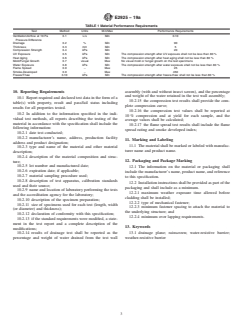
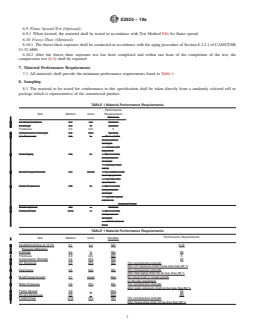
7.1 All materials shall provide the minimum performance requirements listed in Table 1.
8. Sampling
8.1 The material to be tested for conformance to this specification shall be taken directly from a randomly selected roll or
package which is representative of the commercial product.
TABLE 1 Material Performance Requirements
Performance
Test Method Units Requirements
Minimum
Ventilation/Airflow 3.1 L/s Declare
Drainage 3.2 % Declare
Thickness 3.3 mm 5
Compression Strength 3.4 kPa Declare
UV Exposure 3.5 % 80 % of the
compression
strength
before UV
exposure
Heat Aging 3.6 % 80 % of the
compression
strength
before heat
aging
Mold/Fungal Growth 3.7 visual no visible mold
or fungi growth
on the test
specimens
Water Exposure 3.8 % 80 % of the
compression
strength
before water
exposure
Optional Tests
Flame Spread 3.9 . Declare
Freeze/Thaw 3.10 . 80 % of the
compression
strength
before freeze
thaw
TABLE 1 Material Performance Requirements
Performance Requirements
Test Method Units Min/Max
Ventilation/Airflow at 10 Pa 3.1 L/s Min 0.10
Pressure Difference
Drainage 3.2 % Min 90
Thickness 3.3 mm Min 5
Compression Strength 3.4 kPa Min 20
UV Exposure 3.5 kPa Min The compression strength
after UV exposure shall not be less than 80 %
Heat Aging 3.6 kPa Min The compression strength
after heat aging shall not be less than 80 %
Mold/Fungal Growth 3.7 visual Max No visual mold or fungal growth
on the test specimens
Water Exposure 3.8 kPa Min The compression strength
after water exposure shall not be less than 80 %
Flame Spread 3.9 . Max 25
Smoke-Developed 3.9 . Max 450
Freeze/Thaw 3.10 kPa Min The compression strength
after freeze-thaw shall not be less than 80 %
E2925 − 19a
9. Specimen Preparation
9.1 The specimens from roll materials shall be cut from the interior of the sample roll so that no specimen edge is nearer than
75 mm to the original roll edge.
9.2 Unless otherwise stated in the test method, all specimens shall be conditioned for a minimum period of 40 h at (23 6 2) °C
and (50 6 10) % relative humidity (RH).
9.3 The specimen size shall be determined by the test method.
9.4 If not otherwise specified in the referenced test method, a minimum of five specimens shall be tested and each specimen
shall meet the minimum performance requirements.
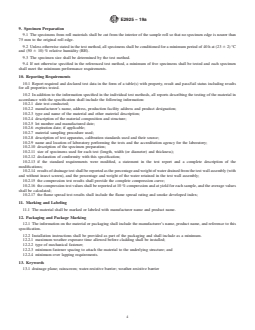
10. Reporting Requirements
10.1 Report required and declared test data in the form of a table(s) with property, result and pass/fail status including results
for all properties tested.
10.2 In addition to the information specified in the individual test methods, all reports describing the testing of the material in
accordance with the specification shall include the following information:
10.2.1 date test conducted;
10.2.2 manufacturer’s name, address, production facility address and product designation;
10.2.3 type and name of the material and other material description;
10.2.4 description of the material composition and structure;
10.2.5 lot number and manufactured date;
10.2.6 expiration date; if applicable;
10.2.7 material sampling procedure used;
10.2.8 description of test apparatus, calibration standards used and their source;
10.2.9 name and location of laboratory performing the tests and the accreditation agency for the laboratory;
10.2.10 description of the specimen preparation;
10.2.11 size of specimens used for each test (length, width (or diameter) and thickness);
10.2.12 declaration of conformity with this specification;
10.2.13 if the standard requirements were modified, a statement in the test report and a complete description of the
modifications;
10.2.14 results of drainage test shall be reported as the percentage and weight of water drained from the test wall assembly (with
and without insect screen), and the percentage and weight of the water retained in the test wall assembly;
10.2.15 the compression test results shall provide the complete compression curve;
10.2.16 the compression test values shall be reported at 10 % compression and at yield for each sample, and the average values
shall be calculated;
10.2.17 the flame spread test results shall include the flame spread rating and smoke developed index;
11. Marking and Labeling
11.1 The material shall be marked or labeled with manufacturer name and product name.
12. Packaging and Package Marking
12.1 The information on the material or packaging shall incl
...