

ASTM E1825-21
(Guide)Standard Guide for Evaluation of Building Exterior Enclosure Materials, Products, and Systems
General Information
- Abstract
SIGNIFICANCE AND USE
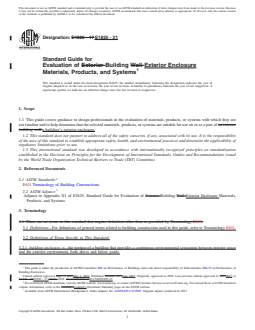
4.1 This guide may be used by design professionals and others in the building construction industry to provide factual support for professional judgment of materials, products, or systems during the design development of new and remedial building exterior enclosure construction.
4.2 This guide is intended to provide guidance to the user of this standard in the evaluation and qualification of materials, products, or systems with which they do not have substantial, long-term experience or that are intended to be employed in a new or different manner. The standard may be used to investigate and assess the probable performance of such materials, products, or systems in relation to the proposed use on or as part of a building exterior enclosure.
4.3 The procedures outlined in Section 5 will help guide the user in making informed selections based on the materials, products, or systems performance history on constructed projects and provide information on limitations of use, the manufacturer’s performance history, and current status. The use of this guide will reduce, but not eliminate, the risk of in-service performance problems with materials, products, or systems.
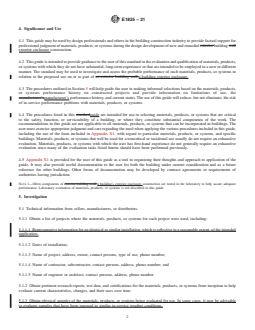
4.4 The procedures listed in this guide are intended for use in selecting materials, products, or systems that are critical to the safety, function, or serviceability of a building, or where they constitute substantial components of the work. The recommendations in this guide are not applicable to all materials, products, or systems that can be incorporated in buildings. The user must exercise appropriate judgment and care regarding the need when applying the various procedures included in this guide, including the use of the form included in Appendix X1, with regard to particular materials, products, or systems, and specific buildings. Materials, products, or systems that will be used for a noncritical or incidental use usually do not require an exhaustive evaluation. Materials, products, or systems ...
SCOPE
1.1 This guide covers guidance to design professionals in the evaluation of materials, products, or systems with which they are not familiar and to help determine that the selected materials, products, or systems are suitable for use on or as a part of a building’s exterior enclosure.
1.2 This standard does not purport to address all of the safety concerns, if any, associated with its use. It is the responsibility of the user of this standard to establish appropriate safety, health, and environmental practices and determine the applicability of regulatory limitations prior to use.
1.3 This international standard was developed in accordance with internationally recognized principles on standardization established in the Decision on Principles for the Development of International Standards, Guides and Recommendations issued by the World Trade Organization Technical Barriers to Trade (TBT) Committee.
- Status
- Published
- Publication Date
- 30-Apr-2021
- Technical Committee
- E06 - Performance of Buildings
- Drafting Committee
- E06.55 - Performance of Building Enclosures
Buy Documents
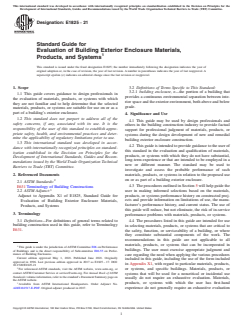
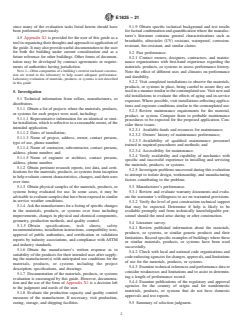
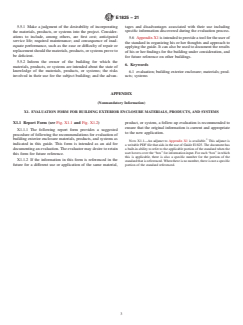
ASTM E1825-21 - Standard Guide for Evaluation of Building Exterior Enclosure Materials, Products, and Systems
REDLINE ASTM E1825-21 - Standard Guide for Evaluation of Building Exterior Enclosure Materials, Products, and Systems
Overview
ASTM E1825-21 - Standard Guide for Evaluation of Building Exterior Enclosure Materials, Products, and Systems - provides comprehensive guidance to design professionals and stakeholders in the building construction industry. Developed by ASTM International, this standard assists in the evaluation and selection of unfamiliar or innovative materials, products, and systems intended for use in building exterior enclosures. It supports informed decision-making during the design and development of both new construction and remediation projects, aiming to improve safety, function, and serviceability.
The standard offers systematic procedures to assess probable performance, gather supporting technical documentation, and review past installation and manufacturer histories. While this guide supports professional judgment and reduces the risk of performance issues, it is not exhaustive and should be applied with careful consideration of project-specific needs, regulatory requirements, and safety practices.
Key Topics
- Evaluation Process: Outlines a structured methodology for gathering data on unfamiliar building enclosure materials or systems, including manufacturer information, technical reports, and performance histories.
- Performance Assessment: Provides recommendations for reviewing installation history, maintenance requirements, and in-service durability by contacting owners, design professionals, and contractors.
- Manufacturer and Installer Review: Encourages verification of manufacturer performance, responsiveness to warranties, technical support, and the availability of qualified installers and maintenance providers.
- Literature and Compliance Survey: Advises reviewing published technical information, code compliance, and regulatory approvals relevant to the materials or systems under consideration.
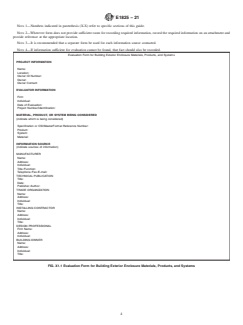
- Documentation Tools: Includes a suggested evaluation form (Appendix X1) to document findings systematically, supporting future references and project records.
Applications
The practical value of ASTM E1825-21 is evident in its broad applicability across multiple project types and stages:
- New Construction: Assists architects, engineers, and construction professionals in evaluating innovative materials or systems not previously used within their projects, ensuring suitability for exterior wall assemblies and building enclosures.
- Remediation and Retrofits: Provides a framework for evaluating replacement or repair materials in remedial construction, increasing confidence in continued building performance.
- Product Substitution: Supports decision-making when substituting new or improved products, detailing the steps to assess their relevance and compatibility with existing enclosures.
- Risk Mitigation: Reduces the likelihood of in-service performance failures by recommending the collection of evidence-based information, historic data, and technical validation.
- Project Documentation: Facilitates consistent recordkeeping and thorough documentation which are essential for compliance, quality assurance, and future maintenance planning.
Related Standards
ASTM E1825-21 incorporates and references several other ASTM standards and industry best practices:
- ASTM E631: Terminology of Building Constructions - For definitions and clarification of terms used in building enclosure contexts.
- Industry Guidelines: Recommendations in E1825-21 complement other ASTM standards on building envelope and wall systems performance.
- Regulatory Compliance: The guide addresses the need to check local, national, and international building codes and regulatory agency approvals.
- Documentation Adjunct: A writable PDF adjunct to Appendix X1 is available from ASTM, providing a standardized tool for the evaluation process.
Summary
ASTM E1825-21 serves as a crucial standard for evaluating and qualifying building exterior enclosure materials, products, and systems. Whether for new construction or remedial projects, its robust procedures help ensure that selected materials contribute to a building’s long-term safety, performance, and reliability. By using this guide, professionals in architecture, engineering, and construction can make well-supported, responsible choices and maintain thorough documentation for project quality and compliance.
Keywords: building exterior enclosure, evaluation guide, ASTM E1825, building materials, façade systems, construction standards, building envelope, product qualification, building performance.
Relations
- Effective Date
- 01-Mar-2015
- Effective Date
- 01-Nov-2014
- Effective Date
- 01-Jun-2006
- Effective Date
- 28-Jul-2000
Buy Documents
ASTM E1825-21 - Standard Guide for Evaluation of Building Exterior Enclosure Materials, Products, and Systems
REDLINE ASTM E1825-21 - Standard Guide for Evaluation of Building Exterior Enclosure Materials, Products, and Systems
Get Certified
Connect with accredited certification bodies for this standard

DIBt (Deutsches Institut für Bautechnik)
German Institute for Building Technology.
DIN CERTCO
DIN Group product certification.

Aboma Certification B.V.
Specialized in construction, metal, and transport sectors.
Sponsored listings
Frequently Asked Questions
ASTM E1825-21 is a guide published by ASTM International. Its full title is "Standard Guide for Evaluation of Building Exterior Enclosure Materials, Products, and Systems". This standard covers: SIGNIFICANCE AND USE 4.1 This guide may be used by design professionals and others in the building construction industry to provide factual support for professional judgment of materials, products, or systems during the design development of new and remedial building exterior enclosure construction. 4.2 This guide is intended to provide guidance to the user of this standard in the evaluation and qualification of materials, products, or systems with which they do not have substantial, long-term experience or that are intended to be employed in a new or different manner. The standard may be used to investigate and assess the probable performance of such materials, products, or systems in relation to the proposed use on or as part of a building exterior enclosure. 4.3 The procedures outlined in Section 5 will help guide the user in making informed selections based on the materials, products, or systems performance history on constructed projects and provide information on limitations of use, the manufacturer’s performance history, and current status. The use of this guide will reduce, but not eliminate, the risk of in-service performance problems with materials, products, or systems. 4.4 The procedures listed in this guide are intended for use in selecting materials, products, or systems that are critical to the safety, function, or serviceability of a building, or where they constitute substantial components of the work. The recommendations in this guide are not applicable to all materials, products, or systems that can be incorporated in buildings. The user must exercise appropriate judgment and care regarding the need when applying the various procedures included in this guide, including the use of the form included in Appendix X1, with regard to particular materials, products, or systems, and specific buildings. Materials, products, or systems that will be used for a noncritical or incidental use usually do not require an exhaustive evaluation. Materials, products, or systems ... SCOPE 1.1 This guide covers guidance to design professionals in the evaluation of materials, products, or systems with which they are not familiar and to help determine that the selected materials, products, or systems are suitable for use on or as a part of a building’s exterior enclosure. 1.2 This standard does not purport to address all of the safety concerns, if any, associated with its use. It is the responsibility of the user of this standard to establish appropriate safety, health, and environmental practices and determine the applicability of regulatory limitations prior to use. 1.3 This international standard was developed in accordance with internationally recognized principles on standardization established in the Decision on Principles for the Development of International Standards, Guides and Recommendations issued by the World Trade Organization Technical Barriers to Trade (TBT) Committee.
SIGNIFICANCE AND USE 4.1 This guide may be used by design professionals and others in the building construction industry to provide factual support for professional judgment of materials, products, or systems during the design development of new and remedial building exterior enclosure construction. 4.2 This guide is intended to provide guidance to the user of this standard in the evaluation and qualification of materials, products, or systems with which they do not have substantial, long-term experience or that are intended to be employed in a new or different manner. The standard may be used to investigate and assess the probable performance of such materials, products, or systems in relation to the proposed use on or as part of a building exterior enclosure. 4.3 The procedures outlined in Section 5 will help guide the user in making informed selections based on the materials, products, or systems performance history on constructed projects and provide information on limitations of use, the manufacturer’s performance history, and current status. The use of this guide will reduce, but not eliminate, the risk of in-service performance problems with materials, products, or systems. 4.4 The procedures listed in this guide are intended for use in selecting materials, products, or systems that are critical to the safety, function, or serviceability of a building, or where they constitute substantial components of the work. The recommendations in this guide are not applicable to all materials, products, or systems that can be incorporated in buildings. The user must exercise appropriate judgment and care regarding the need when applying the various procedures included in this guide, including the use of the form included in Appendix X1, with regard to particular materials, products, or systems, and specific buildings. Materials, products, or systems that will be used for a noncritical or incidental use usually do not require an exhaustive evaluation. Materials, products, or systems ... SCOPE 1.1 This guide covers guidance to design professionals in the evaluation of materials, products, or systems with which they are not familiar and to help determine that the selected materials, products, or systems are suitable for use on or as a part of a building’s exterior enclosure. 1.2 This standard does not purport to address all of the safety concerns, if any, associated with its use. It is the responsibility of the user of this standard to establish appropriate safety, health, and environmental practices and determine the applicability of regulatory limitations prior to use. 1.3 This international standard was developed in accordance with internationally recognized principles on standardization established in the Decision on Principles for the Development of International Standards, Guides and Recommendations issued by the World Trade Organization Technical Barriers to Trade (TBT) Committee.
ASTM E1825-21 is classified under the following ICS (International Classification for Standards) categories: 91.060.10 - Walls. Partitions. Facades. The ICS classification helps identify the subject area and facilitates finding related standards.
ASTM E1825-21 has the following relationships with other standards: It is inter standard links to ASTM E631-15, ASTM E631-14, ASTM E631-06, ASTM E631-93a(1998)e1. Understanding these relationships helps ensure you are using the most current and applicable version of the standard.
ASTM E1825-21 is available in PDF format for immediate download after purchase. The document can be added to your cart and obtained through the secure checkout process. Digital delivery ensures instant access to the complete standard document.
Standards Content (Sample)
This international standard was developed in accordance with internationally recognized principles on standardization established in the Decision on Principles for the
Development of International Standards, Guides and Recommendations issued by the World Trade Organization Technical Barriers to Trade (TBT) Committee.
Designation: E1825 − 21
Standard Guide for
Evaluation of Building Exterior Enclosure Materials,
Products, and Systems
This standard is issued under the fixed designation E1825; the number immediately following the designation indicates the year of
original adoption or, in the case of revision, the year of last revision. A number in parentheses indicates the year of last reapproval. A
superscript epsilon (´) indicates an editorial change since the last revision or reapproval.
1. Scope 3.2 Definitions of Terms Specific to This Standard:
3.2.1 building enclosure, n—the portion of a building that
1.1 This guide covers guidance to design professionals in
provides a continuous environmental separation between inte-
the evaluation of materials, products, or systems with which
rior space and the exterior environment, both above and below
they are not familiar and to help determine that the selected
grade.
materials, products, or systems are suitable for use on or as a
part of a building’s exterior enclosure.
4. Significance and Use
1.2 This standard does not purport to address all of the
4.1 This guide may be used by design professionals and
safety concerns, if any, associated with its use. It is the
others in the building construction industry to provide factual
responsibility of the user of this standard to establish appro-
support for professional judgment of materials, products, or
priate safety, health, and environmental practices and deter-
systems during the design development of new and remedial
mine the applicability of regulatory limitations prior to use.
building exterior enclosure construction.
1.3 This international standard was developed in accor-
4.2 This guide is intended to provide guidance to the user of
dance with internationally recognized principles on standard-
this standard in the evaluation and qualification of materials,
ization established in the Decision on Principles for the
products, or systems with which they do not have substantial,
Development of International Standards, Guides and Recom-
long-term experience or that are intended to be employed in a
mendations issued by the World Trade Organization Technical
new or different manner. The standard may be used to
Barriers to Trade (TBT) Committee.
investigate and assess the probable performance of such
materials, products, or systems in relation to the proposed use
2. Referenced Documents
on or as part of a building exterior enclosure.
2.1 ASTM Standards:
4.3 The procedures outlined in Section 5 will help guide the
E631 Terminology of Building Constructions
user in making informed selections based on the materials,
2.2 ASTM Adjunct:
products, or systems performance history on constructed proj-
Adjunct to Appendix X1 of E1825, Standard Guide for
ects and provide information on limitations of use, the manu-
Evaluation of Building Exterior Enclosure Materials,
facturer’s performance history, and current status. The use of
Products, and Systems
this guide will reduce, but not eliminate, the risk of in-service
3. Terminology
performance problems with materials, products, or systems.
3.1 Definitions—For definitions of general terms related to
4.4 The procedures listed in this guide are intended for use
building construction used in this guide, refer to Terminology
in selecting materials, products, or systems that are critical to
E631.
the safety, function, or serviceability of a building, or where
they constitute substantial components of the work. The
recommendations in this guide are not applicable to all
materials, products, or systems that can be incorporated in
This guide is under the jurisdiction of ASTM Committee E06 on Performance
buildings. The user must exercise appropriate judgment and
of Buildings and is the direct responsibility of Subcommittee E06.55 on Perfor-
mance of Building Enclosures.
care regarding the need when applying the various procedures
Current edition approved May 1, 2021. Published June 2021. Originally
included in this guide, including the use of the form included
approved in 1996. Last previous edition approved in 2017 as E1825 – 17. DOI:
in Appendix X1, with regard to particular materials, products,
10.1520/E1825-21
or systems, and specific buildings. Materials, products, or
For referenced ASTM standards, visit the ASTM website, www.astm.org, or
contact ASTM Customer Service at service@astm.org. For Annual Book of ASTM
systems that will be used for a noncritical or incidental use
Standards volume information, refer to the standard’s Document Summary page on
usually do not require an exhaustive evaluation. Materials,
theASTM website.
products, or systems with which the user has first-hand
Available from ASTM International Headquarters. Order Adjunct No.
ADJE182517-E-PDF. Original adjunct produced in 2017. experience do not generally require an exhaustive evaluation
Copyright © ASTM International, 100 Barr Harbor Drive, PO Box C700, West Conshohocken, PA 19428-2959. United States
E1825 − 21
since many of the evaluation tasks listed herein should have 5.1.9 Obtain specific technical background and test results
been performed previously. for factual confirmation and quantification where the manufac-
turer’s literature contains general characterizations such as
4.5 Appendix X1 is provided for the user of this guide as a
breathable, ultraviolet (UV) resistant, waterproof, corrosion-
tool in organizing their thoughts and approach to application of
resistant, fire-resistant, and similar claims.
the guide. It may also provide useful documentation to the user
for both the building under current consideration and as a 5.2 Past performance.
future reference for other buildings. Other forms of documen-
5.2.1 Contact owners, designers, contractors, and mainte-
tation may be developed by contract agreements or require-
nance organizations with first-hand experience regarding the
ments of authorities having jurisdiction.
materials, products, or systems to assess performance history.
NOTE 1—Often components of a building’s exterior enclosure construc-
Note the effect of different uses and climates on performance
tion are tested in the laboratory to help assure adequate performance.
and durability.
Laboratory evaluation of materials, products, or systems is not described
5.2.2 Visit completed installations to observe the materials,
in this guide.
products, or systems in place, being careful to assure they are
usedinamannersimilartothecontemplateduse.Visitnewand
5. Investigation
old installations to evaluate the effects of aging and in-service
5.1 Technical information from sellers, manufacturers, or
exposure. Where possible, visit installations reflecting applica-
distributors.
tions and exposure conditions similar to the contemplated use.
5.1.1 Obtain a list of projects where the materials, products,
5.2.3 Review maintenance requirements for the material,
or systems for each project were used, including:
product, or system. Compare them to probable maintenance
5.1.1.1 Representative information for an identical or simi-
procedures to be expected for the proposed application. Con-
lar installation, which is reflective to a reasonable extent, of the
sider these issues:
intended application.
5.2.3.1 Available funds and resources for maintenance;
5.1.1.2 Dates of installation;
5.2.3.2 Owners’ history of maintenance performance;
5.1.1.3 Name of project, address, owner, contact persons,
5.2.3.3 Availability of qualified maintenance personnel
type of use, phone number;
trained in required procedures and methods; and
5.1.1.4 Name of contractor, subcontractor, contact persons,
5.2.3.4 Accessibility for maintenance.
address, phone number; and
5.2.4 Verify availability and capability of mechanics with
5.1.1.5 Name of engineer or architect, contact persons,
specific and successful experience in installing and servicing
address, phone number.
the materials, products, or systems.
5.1.2 Obtain pertinent research reports, test data, and certi-
5.2.5 Investigate problems uncovered during this evaluation
fications for the materials, products, or systems from inception
to attempt to isolate design, workmanship, and manufacturing
to help evaluate current characteristics, changes, and their uses
factors contributing to the problem.
over time.
5.3 Manufacturer’s performance.
5.1.3 Obtain physical samples of the materials, products, or
systems being evaluated for use. In some cases, it may be 5.3.1 Review and evaluate warranty documents and evalu-
advisabletoevaluatesamplesthathavebeenexposedtosimilar ate the warrantor’s willingness to act on warranted provisions.
in-service weather conditions.
5.3.2 Verify the level of post construction technical support
5.1.4 Ask the manufacturers for a listing of specific changes
that may be expected. Determine if help is likely to be
in the materials, products, or systems over time including available promptly and from techn
...
This document is not an ASTM standard and is intended only to provide the user of an ASTM standard an indication of what changes have been made to the previous version. Because
it may not be technically possible to adequately depict all changes accurately, ASTM recommends that users consult prior editions as appropriate. In all cases only the current version
of the standard as published by ASTM is to be considered the official document.
Designation: E1825 − 17 E1825 − 21
Standard Guide for
Evaluation of Exterior Building Wall Exterior Enclosure
Materials, Products, and Systems
This standard is issued under the fixed designation E1825; the number immediately following the designation indicates the year of
original adoption or, in the case of revision, the year of last revision. A number in parentheses indicates the year of last reapproval. A
superscript epsilon (´) indicates an editorial change since the last revision or reapproval.
1. Scope
1.1 This guide covers guidance to design professionals in the evaluation of materials, products, or systems with which they are
not familiar and to help determine that the selected materials, products, or systems are suitable for use on or as a part of an exterior
building wall.a building’s exterior enclosure.
1.2 This standard does not purport to address all of the safety concerns, if any, associated with its use. It is the responsibility
of the user of this standard to establish appropriate safety, health, and environmental practices and determine the applicability of
regulatory limitations prior to use.
1.3 This international standard was developed in accordance with internationally recognized principles on standardization
established in the Decision on Principles for the Development of International Standards, Guides and Recommendations issued
by the World Trade Organization Technical Barriers to Trade (TBT) Committee.
2. Referenced Documents
2.1 ASTM Standards:
E631 Terminology of Building Constructions
2.2 ASTM Adjunct:
Adjunct to Appendix X1 of E1825, Standard Guide for Evaluation of Exterior Building Wall Exterior Enclosure Materials,
Products, and Systems
3. Terminology
3.1 There are no terms in this standard that require definition other than as provided by Terminology E631.
3.1 Definitions—For definitions of general terms related to building construction used in this guide, refer to Terminology E631.
3.2 Definitions of Terms Specific to This Standard:
3.2.1 building enclosure, n—the portion of a building that provides a continuous environmental separation between interior space
and the exterior environment, both above and below grade.
This guide is under the jurisdiction of ASTM Committee E06 on Performance of Buildings and is the direct responsibility of Subcommittee E06.55 on Performance of
Building Enclosures.
Current edition approved Sept. 1, 2017May 1, 2021. Published October 2017June 2021. Originally approved in 1996. Last previous edition approved in 20122017 as
E1825 – 06E1825 – 17.(2012). DOI: 10.1520/E1825-1710.1520/E1825-21
For referenced ASTM standards, visit the ASTM website, www.astm.org, or contact ASTM Customer Service at service@astm.org. For Annual Book of ASTM Standards
volume information, refer to the standard’sstandard’s Document Summary page on the ASTM website.
Available from ASTM International Headquarters. Order Adjunct No. ADJE182517-E-PDF. Original adjunct produced in 2017.
Copyright © ASTM International, 100 Barr Harbor Drive, PO Box C700, West Conshohocken, PA 19428-2959. United States
E1825 − 21
4. Significance and Use
4.1 This guide may be used by design professionals and others in the building construction industry to provide factual support for
professional judgment of materials, products, or systems during the design development of new and remedial exterior building wall
exterior enclosure construction.
4.2 This guide is intended to provide guidance to the user of this standard in the evaluation and qualification of materials, products,
or systems with which they do not have substantial, long-term experience or that are intended to be employed in a new or different
manner. The standard may be used to investigate and assess the probable performance of such materials, products, or systems in
relation to the proposed use on or as part of an exterior building wall.a building exterior enclosure.
4.3 The procedures outlined in Section 5 will help guide the user in making informed selections based on the materials, products,
or systems performance history on constructed projects and provide information on limitations of use, the
manufacturer’smanufacturer’s performance history, and current status. The use of this guide will reduce, but not eliminate, the risk
of in-service performance problems with materials, products, or systems.
4.4 The procedures listed in this standardguide are intended for use in selecting materials, products, or systems that are critical
to the safety, function, or serviceability of a building, or where they constitute substantial components of the work. The
recommendations in this guide are not applicable to all materials, products, or systems that can be incorporated in buildings. The
user must exercise appropriate judgment and care regarding the need when applying the various procedures included in this guide,
including the use of the form included in Appendix X1, with regard to particular materials, products, or systems, and specific
buildings. Materials, products, or systems that will be used for a noncritical or incidental use usually do not require an exhaustive
evaluation. Materials, products, or systems with which the user has first-hand experience do not generally require an exhaustive
evaluation since many of the evaluation tasks listed herein should have been performed previously.
4.5 Appendix X1 is provided for the user of this guide as a tool in organizing their thoughts and approach to application of the
guide. It may also provide useful documentation to the user for both the building under current consideration and as a future
reference for other buildings. Other forms of documentation may be developed by contract agreements or requirements of
authorities having jurisdiction.
NOTE 1—Often components of exterior building wall a building’s exterior enclosure construction are tested in the laboratory to help assure adequate
performance. Laboratory evaluation of materials, products, or systems is not described in this guide.
5. Investigation
5.1 Technical information from sellers, manufacturers, or distributors.
5.1.1 Obtain a list of projects where the materials, products, or systems for each project were used, including:
5.1.1.1 Representative information for an identical or similar installation, which is reflective to a reasonable extent, of the intended
application.
5.1.1.2 Dates of installation;
5.1.1.3 Name of project, address, owner, contact persons, type of use, phone number;
5.1.1.4 Name of contractor, subcontractor, contact persons, address, phone number; and
5.1.1.5 Name of engineer or architect, contact persons, address, phone number.
5.1.2 Obtain pertinent research reports, test data, and certifications for the materials, products, or systems from inception to help
evaluate current characteristics, changes, and their uses over time.
5.1.3 Obtain physical samples of the materials, products, or systems being evaluated for use. In some cases, it may be advisable
to evaluate samples that have been exposed to similar in-service weather conditions.
E1825 − 21
5.1.4 Ask the manufacturers for a listing of specific changes in the materials, products, or systems over time including
improvements, changes in physical and chemical components, geometry, production methods, and quality control.
5.1.5 Obtain specifications, tech sheets, safety recommendations, installation standards,instructions, compatibility tests, approval
of public authorities and authorities, and certification or validation reports by industry associations, and compliance with ASTM
and industry standards.
5.1.6 Obtain the manufacturer’s written response as to suitability of the products for their intended uses after supplying the
manufacturer(s) with anticipated use conditions for the materials, products, or systems including the project description,
specifications, and drawings.
5.1.7 Documentation of the materials, products, or systems evaluation is encouraged by this guide. However, documentation and
the use of the form of Appendix X1 is a decision left to the judgment and needs of the user.
5.1.8 Evaluate the production capacity and quality control measures of the manufacturer. If necessary, visit production, curing,
storage, and shipping facilities.
5.1.9 Obtain specific technical background and test results for factual confirmation and quantification where the manufacturer’s
literature contains general characterizations such as breathable, ultraviolet (UV) resistant, waterproof, corrosion-resistant,
fire-resistant, and similar claims.
5.2 Past performance.
5.2.1 Contact owners, designers, contractors, and maintenance organizations with first-hand experience regarding the materials,
products, or systems to assess performance history. Note the effect of different uses and climates on performance and durability.
5.2.2 Visit completed installations to observe the materials, products, or systems in place, being careful to assure they are used
in a manner similar to the contemplated use. Visit new and old installations to evaluate the effects of aging and in-service exposure.
Where possible, visi
...