

ASTM E330/E330M-14(2021)
(Test Method)Standard Test Method for Structural Performance of Exterior Windows, Doors, Skylights and Curtain Walls by Uniform Static Air Pressure Difference
General Information
- Abstract
SIGNIFICANCE AND USE
5.1 This test method is a standard procedure for determining structural performance under uniform static air pressure difference. This typically is intended to represent the effects of a wind load on exterior building surface elements. The actual loading on building surfaces is quite complex, varying with wind direction, time, height above ground, building shape, terrain, surrounding structures, and other factors. The resistance of many windows, curtain walls, and door assemblies to wind loading is also complex and depends on the complete history of load, magnitude, duration, and repetition. These factors are discussed in ASCE/SEI 7 and in the literature (1-8).5
5.2 Design wind velocities are selected for particular geographic locations and probabilities of occurrence based on data from wind velocity maps such as are provided in ASCE/SEI 7. These wind velocities are translated into uniform static air pressure differences and durations acting inward and outward. Complexities of wind pressures, as related to building design, wind intensity versus duration, frequency of occurrence, and other factors must be considered. Superimposed on sustained winds are gusting winds which, for short periods of time from a fraction of a second to a few seconds, are capable of moving at considerably higher velocities than the sustained winds. The analytical procedures in ASCE/SEI 7, wind tunnel studies, computer simulations, and model analyses are helpful in determining the appropriate design wind loads on exterior surface elements of buildings. Generally, wind load durations obtained from ASCE/SEI 7 are 2 s to 10 s and are dependent upon the specific time reference employed in determining the pressure coefficients.
5.3 Some materials have strength or deflection characteristics that are time dependent. Therefore, the duration of the applied test load may have a significant impact on the performance of materials used in the test specimen. The most common examples of materials with...
SCOPE
1.1 This test method describes the determination of the structural performance of exterior windows, doors, skylights, and curtain walls under uniform static air pressure differences, using a test chamber. This test method is applicable to curtain wall assemblies including, but not limited to, metal, glass, masonry, and stone components.2
1.2 This test method is intended only for evaluating the structural performance associated with the specified test specimen and not the structural performance of adjacent construction.
1.3 The proper use of this test method requires a knowledge of the principles of pressure and deflection measurement.
1.4 This test method describes the apparatus and the procedure to be used for applying uniformly distributed test loads to a specimen.
1.4.1 Procedure A (see 11.2) shall be used when a load-deflection curve is not required.
1.4.2 Procedure B (see 11.3) shall be used when a load-deflection curve is required.
1.5 The text of this standard references notes and footnotes which provide explanatory materials. These notes and footnotes (excluding those in tables and figures) shall not be considered as requirements of the standard.
1.6 The values stated in either SI units or inch-pound units are to be regarded separately as standard. The values stated in each system are not necessarily exact equivalents; therefore, to ensure conformance with the standard, each system shall be used independently of the other, and values from the two systems shall not be combined.
1.7 This standard does not purport to address all of the safety concerns, if any, associated with its use. It is the responsibility of the user of this standard to establish appropriate safety, health, and environmental practices and determine the applicability of regulatory limitations prior to use. For specific hazard statements, see Section 7.
1.8 This international standard was developed in accordance with int...
- Status
- Published
- Publication Date
- 14-Oct-2021
- Technical Committee
- E06 - Performance of Buildings
- Drafting Committee
- E06.51 - Performance of Windows, Doors, Skylights and Curtain Walls
Overview
ASTM E330/E330M-14(2021) is the internationally recognized standard test method for determining the structural performance of exterior windows, doors, skylights, and curtain walls when subjected to a uniform static air pressure difference. Developed by ASTM International, this standard is critical for evaluating how these building elements withstand the effects of wind loads, ensuring safety, reliability, and durability in exterior construction. The method uses a test chamber to apply specified pressures that simulate real-world wind conditions, providing objective criteria to assess structural integrity and resistance to deflection, deformation, and distress.
Key Topics
- Structural performance evaluation: Assessment under uniform static air pressure, representing wind loads.
- Component applicability: Covers metal, glass, masonry, and stone curtain wall assemblies, along with windows, doors, and skylights.
- Test apparatus and procedures: Specifies necessary equipment and test methods for both load-only and load-deflection curve requirements.
- Pressure and deflection measurement: Accurate measurement of air pressure differences and observed specimen movements.
- Material time-dependence: Considers how material properties like strength and deflection may change with the duration of applied loads.
- Safety and best practices: Emphasizes the importance of safety measures for test personnel due to high-pressure testing environments.
- Dual unit systems: Provides test criteria in both SI (metric) and inch-pound values, but requires the use of only one system in any specific test.
- Limitations: Does not account for cyclic loads or windborne debris impact, which are addressed by other ASTM standards.
Applications
ASTM E330/E330M is essential in a variety of practical applications related to the structural performance of building envelope components:
- Product certification and quality assurance: Used by manufacturers to demonstrate compliance with specified wind load resistance requirements for exterior windows, doors, curtain walls, and skylights.
- Building code compliance: Supports designers, architects, engineers, and builders in meeting local, national, and international code provisions concerning wind load structural performance.
- Design verification: Assists in validating calculations and simulations used in the structural design phase, ensuring that installed components can withstand site-specific wind pressures.
- Performance comparison: Provides objective, repeatable test results for comparing different products, designs, or installation methods.
- Project submittals: Often required for submittals on projects involving high-rise buildings, complex facades, or structures exposed to severe wind climates.
- Litigation and failure analysis: Contributes to forensic investigations when assessing the causes of building envelope failures due to wind-induced forces.
Related Standards
Several other ASTM and industry standards complement or relate to ASTM E330/E330M in the context of structural performance and fenestration testing:
- ASTM E1233/E1233M – Structural performance by cyclic air pressure differential, addressing repeated or fluctuating loads.
- ASTM E997 / E998 – Methods for structural performance of glass and glass breakage under uniform static loads.
- ASTM E1300 – Determining load resistance of glass in buildings.
- ASTM E1886 & E1996 – Performance of exterior components subjected to impact by missile (debris) and subsequent cyclic wind pressure.
- ASCE/SEI 7 – Minimum design loads for buildings and other structures, providing fundamental wind load criteria referenced in this test method.
By adhering to ASTM E330/E330M, stakeholders in building design, construction, and manufacturing can ensure that exterior envelope elements are fit for purpose, deliver safety under wind loading, and satisfy stringent regulatory and market expectations for structural performance.
Relations
- Effective Date
- 01-Mar-2024
- Effective Date
- 01-Oct-2019
- Effective Date
- 01-Oct-2019
- Effective Date
- 01-Mar-2015
- Effective Date
- 01-Nov-2014
- Effective Date
- 01-Oct-2014
- Effective Date
- 01-Jun-2014
- Effective Date
- 01-Jun-2014
- Effective Date
- 01-Oct-2013
- Effective Date
- 01-Sep-2013
- Effective Date
- 01-Nov-2012
- Effective Date
- 01-May-2012
- Effective Date
- 01-May-2012
- Effective Date
- 15-Apr-2012
- Effective Date
- 15-Apr-2012
Get Certified
Connect with accredited certification bodies for this standard

DIBt (Deutsches Institut für Bautechnik)
German Institute for Building Technology.
DIN CERTCO
DIN Group product certification.

Aboma Certification B.V.
Specialized in construction, metal, and transport sectors.
Sponsored listings
Frequently Asked Questions
ASTM E330/E330M-14(2021) is a standard published by ASTM International. Its full title is "Standard Test Method for Structural Performance of Exterior Windows, Doors, Skylights and Curtain Walls by Uniform Static Air Pressure Difference". This standard covers: SIGNIFICANCE AND USE 5.1 This test method is a standard procedure for determining structural performance under uniform static air pressure difference. This typically is intended to represent the effects of a wind load on exterior building surface elements. The actual loading on building surfaces is quite complex, varying with wind direction, time, height above ground, building shape, terrain, surrounding structures, and other factors. The resistance of many windows, curtain walls, and door assemblies to wind loading is also complex and depends on the complete history of load, magnitude, duration, and repetition. These factors are discussed in ASCE/SEI 7 and in the literature (1-8).5 5.2 Design wind velocities are selected for particular geographic locations and probabilities of occurrence based on data from wind velocity maps such as are provided in ASCE/SEI 7. These wind velocities are translated into uniform static air pressure differences and durations acting inward and outward. Complexities of wind pressures, as related to building design, wind intensity versus duration, frequency of occurrence, and other factors must be considered. Superimposed on sustained winds are gusting winds which, for short periods of time from a fraction of a second to a few seconds, are capable of moving at considerably higher velocities than the sustained winds. The analytical procedures in ASCE/SEI 7, wind tunnel studies, computer simulations, and model analyses are helpful in determining the appropriate design wind loads on exterior surface elements of buildings. Generally, wind load durations obtained from ASCE/SEI 7 are 2 s to 10 s and are dependent upon the specific time reference employed in determining the pressure coefficients. 5.3 Some materials have strength or deflection characteristics that are time dependent. Therefore, the duration of the applied test load may have a significant impact on the performance of materials used in the test specimen. The most common examples of materials with... SCOPE 1.1 This test method describes the determination of the structural performance of exterior windows, doors, skylights, and curtain walls under uniform static air pressure differences, using a test chamber. This test method is applicable to curtain wall assemblies including, but not limited to, metal, glass, masonry, and stone components.2 1.2 This test method is intended only for evaluating the structural performance associated with the specified test specimen and not the structural performance of adjacent construction. 1.3 The proper use of this test method requires a knowledge of the principles of pressure and deflection measurement. 1.4 This test method describes the apparatus and the procedure to be used for applying uniformly distributed test loads to a specimen. 1.4.1 Procedure A (see 11.2) shall be used when a load-deflection curve is not required. 1.4.2 Procedure B (see 11.3) shall be used when a load-deflection curve is required. 1.5 The text of this standard references notes and footnotes which provide explanatory materials. These notes and footnotes (excluding those in tables and figures) shall not be considered as requirements of the standard. 1.6 The values stated in either SI units or inch-pound units are to be regarded separately as standard. The values stated in each system are not necessarily exact equivalents; therefore, to ensure conformance with the standard, each system shall be used independently of the other, and values from the two systems shall not be combined. 1.7 This standard does not purport to address all of the safety concerns, if any, associated with its use. It is the responsibility of the user of this standard to establish appropriate safety, health, and environmental practices and determine the applicability of regulatory limitations prior to use. For specific hazard statements, see Section 7. 1.8 This international standard was developed in accordance with int...
SIGNIFICANCE AND USE 5.1 This test method is a standard procedure for determining structural performance under uniform static air pressure difference. This typically is intended to represent the effects of a wind load on exterior building surface elements. The actual loading on building surfaces is quite complex, varying with wind direction, time, height above ground, building shape, terrain, surrounding structures, and other factors. The resistance of many windows, curtain walls, and door assemblies to wind loading is also complex and depends on the complete history of load, magnitude, duration, and repetition. These factors are discussed in ASCE/SEI 7 and in the literature (1-8).5 5.2 Design wind velocities are selected for particular geographic locations and probabilities of occurrence based on data from wind velocity maps such as are provided in ASCE/SEI 7. These wind velocities are translated into uniform static air pressure differences and durations acting inward and outward. Complexities of wind pressures, as related to building design, wind intensity versus duration, frequency of occurrence, and other factors must be considered. Superimposed on sustained winds are gusting winds which, for short periods of time from a fraction of a second to a few seconds, are capable of moving at considerably higher velocities than the sustained winds. The analytical procedures in ASCE/SEI 7, wind tunnel studies, computer simulations, and model analyses are helpful in determining the appropriate design wind loads on exterior surface elements of buildings. Generally, wind load durations obtained from ASCE/SEI 7 are 2 s to 10 s and are dependent upon the specific time reference employed in determining the pressure coefficients. 5.3 Some materials have strength or deflection characteristics that are time dependent. Therefore, the duration of the applied test load may have a significant impact on the performance of materials used in the test specimen. The most common examples of materials with... SCOPE 1.1 This test method describes the determination of the structural performance of exterior windows, doors, skylights, and curtain walls under uniform static air pressure differences, using a test chamber. This test method is applicable to curtain wall assemblies including, but not limited to, metal, glass, masonry, and stone components.2 1.2 This test method is intended only for evaluating the structural performance associated with the specified test specimen and not the structural performance of adjacent construction. 1.3 The proper use of this test method requires a knowledge of the principles of pressure and deflection measurement. 1.4 This test method describes the apparatus and the procedure to be used for applying uniformly distributed test loads to a specimen. 1.4.1 Procedure A (see 11.2) shall be used when a load-deflection curve is not required. 1.4.2 Procedure B (see 11.3) shall be used when a load-deflection curve is required. 1.5 The text of this standard references notes and footnotes which provide explanatory materials. These notes and footnotes (excluding those in tables and figures) shall not be considered as requirements of the standard. 1.6 The values stated in either SI units or inch-pound units are to be regarded separately as standard. The values stated in each system are not necessarily exact equivalents; therefore, to ensure conformance with the standard, each system shall be used independently of the other, and values from the two systems shall not be combined. 1.7 This standard does not purport to address all of the safety concerns, if any, associated with its use. It is the responsibility of the user of this standard to establish appropriate safety, health, and environmental practices and determine the applicability of regulatory limitations prior to use. For specific hazard statements, see Section 7. 1.8 This international standard was developed in accordance with int...
ASTM E330/E330M-14(2021) is classified under the following ICS (International Classification for Standards) categories: 91.060.10 - Walls. Partitions. Facades; 91.060.50 - Doors and windows. The ICS classification helps identify the subject area and facilitates finding related standards.
ASTM E330/E330M-14(2021) has the following relationships with other standards: It is inter standard links to ASTM E1300-24, ASTM E998-19, ASTM E1886-19, ASTM E631-15, ASTM E631-14, ASTM E1996-14a, ASTM E997-14, ASTM E1996-14, ASTM E1886-13a, ASTM E1886-13, ASTM E1996-12a, ASTM E1300-12ae1, ASTM E1300-12a, ASTM E1300-12, ASTM E997-12. Understanding these relationships helps ensure you are using the most current and applicable version of the standard.
ASTM E330/E330M-14(2021) is available in PDF format for immediate download after purchase. The document can be added to your cart and obtained through the secure checkout process. Digital delivery ensures instant access to the complete standard document.
Standards Content (Sample)
This international standard was developed in accordance with internationally recognized principles on standardization established in the Decision on Principles for the
Development of International Standards, Guides and Recommendations issued by the World Trade Organization Technical Barriers to Trade (TBT) Committee.
Designation: E330/E330M − 14 (Reapproved 2021)
Standard Test Method for
Structural Performance of Exterior Windows, Doors,
Skylights and Curtain Walls by Uniform Static Air Pressure
Difference
This standard is issued under the fixed designation E330/E330M; the number immediately following the designation indicates the year
of original adoption or, in the case of revision, the year of last revision. A number in parentheses indicates the year of last reapproval.
A superscript epsilon (´) indicates an editorial change since the last revision or reapproval.
This standard has been approved for use by agencies of the U.S. Department of Defense.
1. Scope used independently of the other, and values from the two
systems shall not be combined.
1.1 This test method describes the determination of the
1.7 This standard does not purport to address all of the
structural performance of exterior windows, doors, skylights,
safety concerns, if any, associated with its use. It is the
and curtain walls under uniform static air pressure differences,
responsibility of the user of this standard to establish appro-
using a test chamber. This test method is applicable to curtain
priate safety, health, and environmental practices and deter-
wall assemblies including, but not limited to, metal, glass,
mine the applicability of regulatory limitations prior to use.
masonry, and stone components.
For specific hazard statements, see Section 7.
1.2 This test method is intended only for evaluating the
1.8 This international standard was developed in accor-
structural performance associated with the specified test speci-
dance with internationally recognized principles on standard-
men and not the structural performance of adjacent construc-
ization established in the Decision on Principles for the
tion.
Development of International Standards, Guides and Recom-
1.3 The proper use of this test method requires a knowledge
mendations issued by the World Trade Organization Technical
of the principles of pressure and deflection measurement. Barriers to Trade (TBT) Committee.
1.4 This test method describes the apparatus and the proce-
2. Referenced Documents
dure to be used for applying uniformly distributed test loads to
2.1 ASTM Standards:
a specimen.
E631 Terminology of Building Constructions
1.4.1 Procedure A (see 11.2) shall be used when a load-
E997 Test Method for Evaluating Glass Breakage Probabil-
deflection curve is not required.
ity Under the Influence of Uniform Static Loads by Proof
1.4.2 Procedure B (see 11.3) shall be used when a load-
Load Testing
deflection curve is required.
E998 Test Method for Structural Performance of Architec-
1.5 The text of this standard references notes and footnotes
tural Glass Products Under the Influence of Uniform
which provide explanatory materials. These notes and foot-
Static Loads
notes (excluding those in tables and figures) shall not be
E1233/E1233M Test Method for Structural Performance of
considered as requirements of the standard.
ExteriorWindows,Doors,Skylights,andCurtainWallsby
Cyclic Air Pressure Differential
1.6 The values stated in either SI units or inch-pound units
E1300 Practice for Determining Load Resistance of Glass in
are to be regarded separately as standard. The values stated in
Buildings
each system are not necessarily exact equivalents; therefore, to
E1886 Test Method for Performance of Exterior Windows,
ensure conformance with the standard, each system shall be
Curtain Walls, Doors, and Impact Protective Systems
Impacted by Missile(s) and Exposed to Cyclic Pressure
Differentials
This test method is under the jurisdiction of ASTM Committee E06 on
E1996 Specification for Performance of Exterior Windows,
Performance of Buildings and is the direct responsibility of Subcommittee E06.51
Curtain Walls, Doors, and Impact Protective Systems
on Performance of Windows, Doors, Skylights and Curtain Walls.
Current edition approved Oct. 15, 2021. Published October 2021. Originally
approved in 1967. Last previous edition approved in 2014 as E330/E330M – 14.
DOI: 10.1520/E0330_E0330M–14R21. For referenced ASTM standards, visit the ASTM website, www.astm.org, or
Additional information on curtain wall assemblies can be obtained from the contact ASTM Customer Service at service@astm.org. For Annual Book of ASTM
Fenestration & Glazing Industry Alliance (FGIA), 1900 E Golf Rd, Suite 1250 Standards volume information, refer to the standard’s Document Summary page on
Schaumburg, IL 60173, https://www.fgiaonline.org/. the ASTM website.
Copyright © ASTM International, 100 Barr Harbor Drive, PO Box C700, West Conshohocken, PA 19428-2959. United States
E330/E330M − 14 (2021)
Impacted by Windborne Debris in Hurricanes wind load on exterior building surface elements. The actual
loading on building surfaces is quite complex, varying with
2.2 ASCE/SEI Standard:
wind direction, time, height above ground, building shape,
ASCE/SEI 7 Minimum Design Loads for Buildings and
terrain, surrounding structures, and other factors. The resis-
Other Structures
tance of many windows, curtain walls, and door assemblies to
3. Terminology
wind loading is also complex and depends on the complete
history of load, magnitude, duration, and repetition. These
3.1 Definitions—Definitions are in accordance with Termi-
factors are discussed in ASCE/SEI 7 and in the literature
nology E631, unless otherwise indicated.
(1-8).
3.2 Definitions of Terms Specific to This Standard:
3.2.1 design wind load—the uniform static air pressure
5.2 Design wind velocities are selected for particular geo-
differences, inward and outward, for which the specimen
graphic locations and probabilities of occurrence based on data
would be designed under service load conditions using con-
from wind velocity maps such as are provided inASCE/SEI 7.
ventional wind engineering specifications and concepts, ex-
These wind velocities are translated into uniform static air
pressed in pascals [or pounds-force per square foot]. This
pressure differences and durations acting inward and outward.
pressure is determined by either analytical or wind-tunnel
Complexities of wind pressures, as related to building design,
procedures (such as are specified in ASCE/SEI 7).
wind intensity versus duration, frequency of occurrence, and
other factors must be considered. Superimposed on sustained
3.2.2 permanent deformation, n—the displacement or
winds are gusting winds which, for short periods of time from
change in dimension of the specimen after the applied load has
a fraction of a second to a few seconds, are capable of moving
been removed and the specimen has relaxed for the specified
at considerably higher velocities than the sustained winds. The
period of time.
analytical procedures in ASCE/SEI 7, wind tunnel studies,
3.2.3 proof load—atestloadmultipliedbyafactorofsafety.
computer simulations, and model analyses are helpful in
3.2.4 stick system, n—a curtain wall assembly composed of
determining the appropriate design wind loads on exterior
individually framed continuous members, vertical mullions,
surface elements of buildings. Generally, wind load durations
and horizontal rails that are installed in a sequential, piece-by-
obtained from ASCE/SEI 7 are 2 s to 10 s and are dependent
piece process. The completed system is assembled entirely in
upon the specific time reference employed in determining the
the field.
pressure coefficients.
3.2.5 structural distress—achangeinconditionofthespeci-
5.3 Some materials have strength or deflection characteris-
men indicative of deterioration or incipient failure, such as
tics that are time dependent. Therefore, the duration of the
cracking, local yielding, fastener loosening, or loss of adhesive
applied test load may have a significant impact on the
bond.
performance of materials used in the test specimen. The most
3.2.6 test load—thespecifieddifferenceinstaticairpressure
common examples of materials with time-dependent response
(positive or negative) for which the specimen is to be tested,
characteristics that are used are glass, plastics, and composites
expressed in pascals [or pounds-force per square foot].
that employ plastics. For this reason, the strength of an
assembly is tested for the actual time duration to which it
3.2.7 test specimen, n—the entire assembled unit submitted
would be exposed to a sustained or a gust load, or both, as
for test (as described in Section 8).
discussed above. Generally, U.S. practice for wind load testing
3.2.8 unit/panel system, n—a curtain wall assembly com-
has been to require a minimum test period of 10 s for test loads
posedofpre-assembledgroupsofindividualframingmembers.
equal to the design wind load and proof loads equal to 1.5
The completed system is designed to be modular,
timesthedesignwindload.Thusasafetyfactorisincorporated
transportable, and installed as a finished assembly.
inthetesting.Ifthedesignwindloadisdeterminedthroughthe
analytical procedures of ASCE/SEI 7, the test load shall be
4. Summary of Test Method
basedonthenominalloadsderivedfromtheloadcombinations
4.1 This test method consists of sealing the test specimen
used in allowable stress design.With test loads for wind higher
into or against one face of a test chamber, supplying air to or
than those determined by ASCE/SEI 7 or of longer time
exhausting air from the chamber according to a specific test
duration than 10 s, the designer must consider what safety
loading program, at the rate required to maintain the test
factors are appropriate. For test loads that represent design
pressure difference across the specimen, and observing,
loads other than wind, such as snow load, consideration shall
measuring, and recording the deflection, deformations, and
be given to establish an appropriate test period for both design
nature of any distress or failures of the specimen.
and proof load testing.
5. Significance and Use 5.4 This standard is not intended to account for the effect of
windborne debris or cyclic loads. Consideration of cyclic air
5.1 Thistestmethodisastandardprocedurefordetermining
pressure differentials is addressed in Test Method E1233/
structural performance under uniform static air pressure differ-
E1233M. Consideration of windborne debris in combination
ence. This typically is intended to represent the effects of a
4 5
Available from American Society of Civil Engineers (ASCE), 1801 Alexander The boldface numbers in parentheses refer to a list of references at the end of
Bell Dr., Reston, VA 20191, http://www.asce.org. this standard.
E330/E330M − 14 (2021)
NOTE 2—It is convenient to use a reversible blower or a separate
with cyclic air pressure differential representing extreme wind
pressure and exhaust system to provide the required air-pressure differ-
events is addressed in Test Method E1886 and Specification
ence so that the test specimen can be tested for the effect of wind blowing
E1996.
against the wall (positive pressure) or for the effect of suction on the lee
side of the building (negative pressure) without removing, reversing, and
5.5 Thistestmethodisnotintendedforuseinevaluatingthe
reinstalling the test specimen. If an adequate air supply is available, a
structural adequacy of glass for a particular application. When
completely airtight seal need not be provided around the perimeter of the
the structural performance of glass is to be evaluated, the
test specimen and the mounting panel, although it is preferable. However,
procedure described in Test Method E997 or E998 shall be
substantial air leakage will require an air supply of much greater capacity
used. to maintain the required pressure differences.
NOTE 1—In applying the results of tests by this test method, note that
6.2.3 Pressure-Measuring Apparatus, to measure the test
the performance of a wall or its components, or both, may be a function
pressure difference within a tolerance of 62% or 62.5 Pa
of fabrication, installation, and adjustment. The specimen may or may not
[60.01 in.] of water column, whichever is greater.
truly represent every aspect of the actual structure. In service, the
performance will also depend on the rigidity of supporting construction,
6.2.4 Deflection-Measuring System, to measure deflections
temperature, and on the resistance of components to deterioration by
within a tolerance of 60.25 mm [60.01 in.].
various other causes, including vibration, thermal expansion and
6.2.4.1 For Procedure A, any locations at which deflections
contraction, etc.
are to be measured shall be stated by the specifier.
6. Apparatus
6.2.4.2 ForProcedureB,maximumandenddeflectionsofat
least one of each type of principal member not directly and
6.1 Thedescriptionoftheapparatusisgeneralinnature;any
continuously supported by surrounding construction shall be
equipment capable of performing the test procedure within the
measured.Additional locations for deflection measurements, if
allowable tolerances is permitted.
required, shall be stated by the specifier.
6.2 Major Components (see Fig. 1):
6.2.4.3 When deflections are to be measured, the deflection
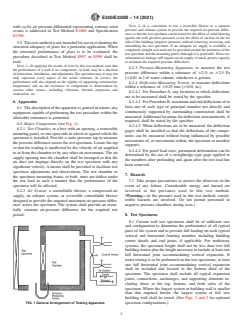
6.2.1 Test Chamber, or a box with an opening, a removable
gages shall be installed so that the deflections of the compo-
mountingpanel,oroneopensideinwhichoragainstwhichthe
nents can be measured without being influenced by possible
specimen is installed. Provide a static pressure tap to measure
movements of, or movements within, the specimen or member
the pressure difference across the test specimen. Locate the tap
supports.
so that the reading is unaffected by the velocity of air supplied
6.2.4.4 For proof load tests, permanent deformation can be
to or from the chamber or by any other air movements. The air
determined by the use of a straightedge-type gage applied to
supply opening into the chamber shall be arranged so that the
the members after preloading and again after the test load has
air does not impinge directly on the test specimen with any
been removed.
significant velocity.Ameans shall be provided to facilitate test
specimen adjustments and observations. The test chamber or
7. Hazards
the specimen mounting frame, or both, must not deflect under
the test load in such a manner that the performance of the 7.1 Take proper precautions to protect the observers in the
specimen will be affected. event of any failure. Considerable energy and hazard are
6.2.2 Air System, a controllable blower, a compressed-air involved at the pressures used in this test method.
(Warning—At the pressure used in this test method, consid-
supply, an exhaust system, or reversible controllable blower
designed to provide the required maximum air-pressure differ- erable hazards are involved. Do not permit personnel in
negative pressure chambers during tests.)
ence across the specimen. The system shall provide an essen-
tially constant air-pressure difference for the required test
period. 8. Test Specimens
8.1 Curtain wall test specimens shall be of sufficient size
and configuration to determine the performance of all typical
parts of the system and to provide full loading on each typical
vertical and horizontal framing member, including building
corner details and end joints, if applicable. For multistory
systems, the specimen height shall not be less than two full
buildingstoriesplustheheightnecessarytoincludeatleastone
full horizontal joint accommodating vertical expansion. If
water testing is to be performed on the test specimens, at least
one full horizontal joint accommodating vertical expansion
shall be included and located in the bottom third of the
specimen. The specimen shall include all typical expansion
joints, connections, anchorages, and supporting elements in-
cluding those at the top, bottom, and both sides of the
specimen. Where the largest system or building wall is smaller
than that required herein, the largest system or full size
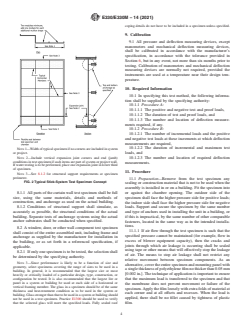
building wall shall be tested. (See Figs. 2 and 3 for optional
FIG. 1 General Arrangement of Testing Apparatus specimen configurations.)
...