

ASTM D5571-22
(Test Method)Standard Test Method for Environmental Stress Crack Resistance (ESCR) of Plastic Tight-head Drums Not Exceeding 60 Gal (227 L) in Rated Capacity
General Information
- Abstract
SIGNIFICANCE AND USE
5.1 These procedures provide an indication of the environmental stress-crack resistance of plastic tight-head drums. This test method may be used for determining the applicability of various plastic resins, mold designs, processing techniques, and parameters for plastic tight-head drums.
5.2 Environmental stress cracking is indicative of what results when a container is exposed to chemical agents such as soaps, organics, bleaches, or any surface-active solutions while under conditions of stress.
5.3 Environmental stress cracking is a mechanism of chemical attack that is highly dependent upon the test reagent, resin, container manufacturing or processing history, exposure temperature, applied stress, and other factors. The combination of these factors may result in eventual stress crack failure.
5.4 Both procedures minimize the potential for test variability by providing the user with rigidly defined test conditions. This test method may be used as design qualification and auditing tools for plastic tight-head drums.
5.5 This test method is not meant to provide a quantitative value of measurement (that is, number of days to failure). It is intended only as a pass/fail procedure in accordance with user’s specifications, or as agreed upon between the user and supplier. It is not intended as a predictor or indicator of field performance regarding time to failure.
SCOPE
1.1 This test method provides an indication of the environmental stress crack resistance of plastic tight-head drums as a summation of the effects of container design, resin, manufacturing conditions, field performance, and other factors.
1.2 This test method may be used to evaluate a plastic drum's resistance to failure by cracking when in the presence of chemical and physical stresses.
1.3 Two procedures are provided as follows:
1.3.1 Procedure A—Internal pressure stress crack resistance method to nonyl phenoxypoly (ethyleneoxy) ethanol solution, a stress cracking reagent. The internal pressure is controlled at a constant elevated pressure and temperature.
1.3.2 Procedure B—Top-load stress crack resistance method to nonyl phenoxypoly ethanol, a stress cracking reagent. The compressive top-load is controlled at a constant weight while maintaining an elevated temperature.
1.4 Although these procedures are not designed to test the ability of the closure or closure gasket material to retain the test reagent, the inclusion of closure failure as a container failure mode is optional. However, leakage through a closure may affect the internal pressure that could affect the test results.
1.5 This test method does not attempt to address all factors that could lead to stress cracking of plastic drums. The user of this standard may use other test parameters, such as top-loads, chemical reagents, etc., as agreed upon between the user and supplier in the event of a drum qualification or purchase agreement.
1.6 The values stated in inch-pound units are to be regarded as the standard. The SI units given in parentheses are for information only.
1.7 This standard does not purport to address all of the safety concerns, if any, associated with its use. It is the responsibility of the user of this standard to establish appropriate safety, health, and environmental practices and determine the applicability of regulatory limitations prior to use. Specific warning statements are given in 6.2.
1.8 This international standard was developed in accordance with internationally recognized principles on standardization established in the Decision on Principles for the Development of International Standards, Guides and Recommendations issued by the World Trade Organization Technical Barriers to Trade (TBT) Committee.
- Status
- Published
- Publication Date
- 30-Sep-2022
- Technical Committee
- D10 - Packaging
Buy Documents
ASTM D5571-22 - Standard Test Method for Environmental Stress Crack Resistance (ESCR) of Plastic Tight-head Drums Not Exceeding 60 Gal (227 L) in Rated Capacity
REDLINE ASTM D5571-22 - Standard Test Method for Environmental Stress Crack Resistance (ESCR) of Plastic Tight-head Drums Not Exceeding 60 Gal (227 L) in Rated Capacity
Overview
ASTM D5571-22 specifies the standard test method for assessing the Environmental Stress Crack Resistance (ESCR) of plastic tight-head drums with a rated capacity not exceeding 60 gallons (227 liters). This crucial ASTM standard provides guidance on evaluating a plastic drum’s ability to withstand stress cracking when exposed to chemical agents under defined environmental conditions. The methodology helps manufacturers, users, and auditors ensure that plastic tight-head drums meet application and regulatory requirements by testing design, resin selection, processing, and quality control measures.
Environmental stress cracking is a critical mechanism of failure in plastic containers, often resulting from exposure to aggressive substances like detergents, soaps, organics, and surface-active solutions, combined with physical stresses. ASTM D5571-22 serves as a pass/fail qualification tool for manufacturers and suppliers, aiding in product development, procurement, and compliance.
Key Topics
- Environmental Stress Crack Resistance (ESCR):
- Evaluates the susceptibility of plastic tight-head drums to crack formation under chemical and physical stress.
- Test Procedures:
- Procedure A: Internal pressure method using nonyl phenoxypoly (ethyleneoxy) ethanol solution, with elevated pressure and temperature.
- Procedure B: Top-load method applying a controlled compressive load at an elevated temperature, using the same stress cracking reagent.
- Design and Process Evaluation:
- Assesses impacts of resin type, container design, manufacturing conditions, and processing parameters.
- Test Conditions:
- Defined, repeatable environments to minimize test variability-ensuring reliability in pass/fail assessments.
- Limitations:
- Results are not intended to quantify time to failure or directly predict field performance, but to confirm compliance to specified requirements.
Applications
ASTM D5571-22 plays an essential role across multiple industries that rely on the safe storage and transport of liquid chemicals and materials. Typical applications include:
- Container Qualification: Used by drum manufacturers during product development and batch qualification to validate resistance to stress cracking.
- Procurement and Supply Chain: Enables buyers and suppliers to agree on performance specifications for plastic tight-head drums, ensuring only compliant products are procured.
- Quality Auditing: Provides a standardized method for ongoing quality checks and audits throughout production or when reviewing new sources of supply.
- Design Optimization: Supports improvements in drum design or material selection by providing feedback on performance under stress conditions.
- Safety and Compliance: Facilitates compliance with packaging regulations and guidelines for hazardous or sensitive chemicals.
Related Standards
ASTM D5571-22 references several key ASTM standards that provide supplementary definitions, test methods, and sampling practices:
- ASTM D996: Terminology of Packaging and Distribution Environments
- ASTM D4577: Test Method for Compression Resistance of a Container Under Constant Load
- ASTM E122: Practice for Calculating Sample Size to Estimate, With Specified Precision, the Average for a Characteristic of a Lot or Process
These related standards offer additional guidance on terminology, test methods, and statistical reliability, supporting consistent application and interpretation of ASTM D5571-22 test results.
Keywords: ASTM D5571-22, Environmental Stress Crack Resistance, ESCR, plastic tight-head drums, stress cracking, packaging standards, drum qualification, chemical resistance, top-load test, internal pressure test, ASTM standards.
Relations
- Effective Date
- 01-Oct-2023
- Refers
ASTM D4577-19 - Standard Test Method for Compression Resistance of a Container Under Constant Load - Effective Date
- 01-Apr-2019
- Effective Date
- 01-Oct-2018
- Effective Date
- 01-Aug-2011
- Effective Date
- 01-Dec-2010
- Effective Date
- 01-Aug-2010
- Effective Date
- 01-Aug-2009
- Effective Date
- 01-Oct-2007
- Refers
ASTM D4577-05 - Standard Test Method for Compression Resistance of a Container Under Constant Load - Effective Date
- 01-Oct-2005
- Effective Date
- 01-Apr-2004
- Effective Date
- 10-Apr-2002
- Effective Date
- 10-Apr-2002
- Effective Date
- 10-Oct-2000
- Effective Date
- 10-Oct-2000
- Refers
ASTM D4577-00 - Standard Test Method for Compression Resistance of a Container Under Constant Load - Effective Date
- 10-Apr-2000
Buy Documents
ASTM D5571-22 - Standard Test Method for Environmental Stress Crack Resistance (ESCR) of Plastic Tight-head Drums Not Exceeding 60 Gal (227 L) in Rated Capacity
REDLINE ASTM D5571-22 - Standard Test Method for Environmental Stress Crack Resistance (ESCR) of Plastic Tight-head Drums Not Exceeding 60 Gal (227 L) in Rated Capacity
Get Certified
Connect with accredited certification bodies for this standard

BRCGS (Brand Reputation Compliance Global Standards)
Global food safety and quality standards owner.
Sponsored listings
Frequently Asked Questions
ASTM D5571-22 is a standard published by ASTM International. Its full title is "Standard Test Method for Environmental Stress Crack Resistance (ESCR) of Plastic Tight-head Drums Not Exceeding 60 Gal (227 L) in Rated Capacity". This standard covers: SIGNIFICANCE AND USE 5.1 These procedures provide an indication of the environmental stress-crack resistance of plastic tight-head drums. This test method may be used for determining the applicability of various plastic resins, mold designs, processing techniques, and parameters for plastic tight-head drums. 5.2 Environmental stress cracking is indicative of what results when a container is exposed to chemical agents such as soaps, organics, bleaches, or any surface-active solutions while under conditions of stress. 5.3 Environmental stress cracking is a mechanism of chemical attack that is highly dependent upon the test reagent, resin, container manufacturing or processing history, exposure temperature, applied stress, and other factors. The combination of these factors may result in eventual stress crack failure. 5.4 Both procedures minimize the potential for test variability by providing the user with rigidly defined test conditions. This test method may be used as design qualification and auditing tools for plastic tight-head drums. 5.5 This test method is not meant to provide a quantitative value of measurement (that is, number of days to failure). It is intended only as a pass/fail procedure in accordance with user’s specifications, or as agreed upon between the user and supplier. It is not intended as a predictor or indicator of field performance regarding time to failure. SCOPE 1.1 This test method provides an indication of the environmental stress crack resistance of plastic tight-head drums as a summation of the effects of container design, resin, manufacturing conditions, field performance, and other factors. 1.2 This test method may be used to evaluate a plastic drum's resistance to failure by cracking when in the presence of chemical and physical stresses. 1.3 Two procedures are provided as follows: 1.3.1 Procedure A—Internal pressure stress crack resistance method to nonyl phenoxypoly (ethyleneoxy) ethanol solution, a stress cracking reagent. The internal pressure is controlled at a constant elevated pressure and temperature. 1.3.2 Procedure B—Top-load stress crack resistance method to nonyl phenoxypoly ethanol, a stress cracking reagent. The compressive top-load is controlled at a constant weight while maintaining an elevated temperature. 1.4 Although these procedures are not designed to test the ability of the closure or closure gasket material to retain the test reagent, the inclusion of closure failure as a container failure mode is optional. However, leakage through a closure may affect the internal pressure that could affect the test results. 1.5 This test method does not attempt to address all factors that could lead to stress cracking of plastic drums. The user of this standard may use other test parameters, such as top-loads, chemical reagents, etc., as agreed upon between the user and supplier in the event of a drum qualification or purchase agreement. 1.6 The values stated in inch-pound units are to be regarded as the standard. The SI units given in parentheses are for information only. 1.7 This standard does not purport to address all of the safety concerns, if any, associated with its use. It is the responsibility of the user of this standard to establish appropriate safety, health, and environmental practices and determine the applicability of regulatory limitations prior to use. Specific warning statements are given in 6.2. 1.8 This international standard was developed in accordance with internationally recognized principles on standardization established in the Decision on Principles for the Development of International Standards, Guides and Recommendations issued by the World Trade Organization Technical Barriers to Trade (TBT) Committee.
SIGNIFICANCE AND USE 5.1 These procedures provide an indication of the environmental stress-crack resistance of plastic tight-head drums. This test method may be used for determining the applicability of various plastic resins, mold designs, processing techniques, and parameters for plastic tight-head drums. 5.2 Environmental stress cracking is indicative of what results when a container is exposed to chemical agents such as soaps, organics, bleaches, or any surface-active solutions while under conditions of stress. 5.3 Environmental stress cracking is a mechanism of chemical attack that is highly dependent upon the test reagent, resin, container manufacturing or processing history, exposure temperature, applied stress, and other factors. The combination of these factors may result in eventual stress crack failure. 5.4 Both procedures minimize the potential for test variability by providing the user with rigidly defined test conditions. This test method may be used as design qualification and auditing tools for plastic tight-head drums. 5.5 This test method is not meant to provide a quantitative value of measurement (that is, number of days to failure). It is intended only as a pass/fail procedure in accordance with user’s specifications, or as agreed upon between the user and supplier. It is not intended as a predictor or indicator of field performance regarding time to failure. SCOPE 1.1 This test method provides an indication of the environmental stress crack resistance of plastic tight-head drums as a summation of the effects of container design, resin, manufacturing conditions, field performance, and other factors. 1.2 This test method may be used to evaluate a plastic drum's resistance to failure by cracking when in the presence of chemical and physical stresses. 1.3 Two procedures are provided as follows: 1.3.1 Procedure A—Internal pressure stress crack resistance method to nonyl phenoxypoly (ethyleneoxy) ethanol solution, a stress cracking reagent. The internal pressure is controlled at a constant elevated pressure and temperature. 1.3.2 Procedure B—Top-load stress crack resistance method to nonyl phenoxypoly ethanol, a stress cracking reagent. The compressive top-load is controlled at a constant weight while maintaining an elevated temperature. 1.4 Although these procedures are not designed to test the ability of the closure or closure gasket material to retain the test reagent, the inclusion of closure failure as a container failure mode is optional. However, leakage through a closure may affect the internal pressure that could affect the test results. 1.5 This test method does not attempt to address all factors that could lead to stress cracking of plastic drums. The user of this standard may use other test parameters, such as top-loads, chemical reagents, etc., as agreed upon between the user and supplier in the event of a drum qualification or purchase agreement. 1.6 The values stated in inch-pound units are to be regarded as the standard. The SI units given in parentheses are for information only. 1.7 This standard does not purport to address all of the safety concerns, if any, associated with its use. It is the responsibility of the user of this standard to establish appropriate safety, health, and environmental practices and determine the applicability of regulatory limitations prior to use. Specific warning statements are given in 6.2. 1.8 This international standard was developed in accordance with internationally recognized principles on standardization established in the Decision on Principles for the Development of International Standards, Guides and Recommendations issued by the World Trade Organization Technical Barriers to Trade (TBT) Committee.
ASTM D5571-22 is classified under the following ICS (International Classification for Standards) categories: 55.140 - Barrels. Drums. Canisters. The ICS classification helps identify the subject area and facilitates finding related standards.
ASTM D5571-22 has the following relationships with other standards: It is inter standard links to ASTM D4577-19(2023), ASTM D4577-19, ASTM D4577-05(2018), ASTM E122-09e1, ASTM D996-10a, ASTM D4577-05(2010), ASTM E122-09, ASTM E122-07, ASTM D4577-05, ASTM D996-04, ASTM D996-99, ASTM D996-02, ASTM E122-99, ASTM E122-00, ASTM D4577-00. Understanding these relationships helps ensure you are using the most current and applicable version of the standard.
ASTM D5571-22 is available in PDF format for immediate download after purchase. The document can be added to your cart and obtained through the secure checkout process. Digital delivery ensures instant access to the complete standard document.
Standards Content (Sample)
This international standard was developed in accordance with internationally recognized principles on standardization established in the Decision on Principles for the
Development of International Standards, Guides and Recommendations issued by the World Trade Organization Technical Barriers to Trade (TBT) Committee.
Designation: D5571 − 22
Standard Test Method for
Environmental Stress Crack Resistance (ESCR) of Plastic
Tight-head Drums Not Exceeding 60 Gal (227 L) in Rated
Capacity
This standard is issued under the fixed designation D5571; the number immediately following the designation indicates the year of
original adoption or, in the case of revision, the year of last revision. A number in parentheses indicates the year of last reapproval. A
superscript epsilon (´) indicates an editorial change since the last revision or reapproval.
1. Scope* responsibility of the user of this standard to establish appro-
priate safety, health, and environmental practices and deter-
1.1 This test method provides an indication of the environ-
mine the applicability of regulatory limitations prior to
mental stress crack resistance of plastic tight-head drums as a
use. Specific warning statements are given in 6.2.
summation of the effects of container design, resin, manufac-
1.8 This international standard was developed in accor-
turing conditions, field performance, and other factors.
dance with internationally recognized principles on standard-
1.2 This test method may be used to evaluate a plastic
ization established in the Decision on Principles for the
drum’s resistance to failure by cracking when in the presence
Development of International Standards, Guides and Recom-
of chemical and physical stresses.
mendations issued by the World Trade Organization Technical
Barriers to Trade (TBT) Committee.
1.3 Two procedures are provided as follows:
1.3.1 Procedure A—Internal pressure stress crack resistance
2. Referenced Documents
method to nonyl phenoxypoly (ethyleneoxy) ethanol solution,
a stress cracking reagent. The internal pressure is controlled at 2.1 ASTM Standards:
D996 Terminology of Packaging and Distribution Environ-
a constant elevated pressure and temperature.
1.3.2 Procedure B—Top-load stress crack resistance method ments
D4577 Test Method for Compression Resistance of a Con-
to nonyl phenoxypoly ethanol, a stress cracking reagent. The
compressive top-load is controlled at a constant weight while tainer Under Constant Load
E122 Practice for Calculating Sample Size to Estimate,With
maintaining an elevated temperature.
Specified Precision, the Average for a Characteristic of a
1.4 Although these procedures are not designed to test the
Lot or Process
abilityoftheclosureorclosuregasketmaterialtoretainthetest
reagent, the inclusion of closure failure as a container failure
3. Terminology
mode is optional. However, leakage through a closure may
3.1 Definitions—Reference Terminology D996 for defini-
affect the internal pressure that could affect the test results.
tions of terms applicable to this test method.
1.5 This test method does not attempt to address all factors
3.2 Definitions of Terms Specific to This Standard:
that could lead to stress cracking of plastic drums. The user of
3.2.1 environmental stress crack—a crack that develops
this standard may use other test parameters, such as top-loads,
when a plastic drum is exposed to chemical and physical
chemical reagents, etc., as agreed upon between the user and
stresses.
supplier in the event of a drum qualification or purchase
3.2.2 plastic tight-head drum—Anon-removable head plas-
agreement.
tic drum, maximum capacity not exceeding 60 gal (227 L),
1.6 The values stated in inch-pound units are to be regarded
with openings for filling and emptying not exceeding 2.76 in.
as the standard. The SI units given in parentheses are for
(70 mm) in diameter.
information only.
3.2.3 stress crack failure—any environmental stress crack
1.7 This standard does not purport to address all of the
that penetrates through the thickness of the drum resulting in a
safety concerns, if any, associated with its use. It is the
loss or leakage of the test reagent shall be interpreted as a
failure.
This test method is under the jurisdiction of ASTM Committee D10 on
Packaging and is the direct responsibility of Subcommittee D10.21 on Shipping
Containers and Systems - Application of Performance Test Methods. For referenced ASTM standards, visit the ASTM website, www.astm.org, or
Current edition approved Oct. 1, 2022. Published November 2022. Originally contact ASTM Customer Service at service@astm.org. For Annual Book of ASTM
approved in 1994. Last previous edition approved in 2016 as D5571 – 16. DOI: Standards volume information, refer to the standard’s Document Summary page on
10.1520/D5571-22. the ASTM website.
*A Summary of Changes section appears at the end of this standard
Copyright © ASTM International, 100 Barr Harbor Drive, PO Box C700, West Conshohocken, PA 19428-2959. United States
D5571 − 22
4. Summary of Test Method 6. Apparatus
4.1 Procedure A—Exposes a minimum of three partly filled 6.1 Environmental Chamber—The environmental chamber
plastic drums to the action of a stress cracking reagent, within
should be capable of maintaining a temperature control of
the container, at an elevated internal pressure and elevated 62.5 °F (61.4 °C) of set point. For best circulation and a
temperature. The test duration shall be 14 days, or as specified
constant temperature throughout, a forced air system is recom-
by the user. mended.
4.2 Procedure B—Exposes a minimum of three plastic
6.2 Top-load (for Procedure B only)—Requires free weights
drums to a mechanical top- load at elevated temperatures. The
(dead load) be placed on top of the specimens in amounts
drums are filled to rated capacity with a stress cracking reagent
necessary to equal the specified top-load. The deadload base
and sealed prior to the load being applied. The test duration
should be of sufficient dimensions to completely cover the top
shall be 14 days, or as specified by the user.
perimeter of the drum. A calibrated pneumatic or hydraulic
cylinder may be substituted for the free weights. (Warning—
5. Significance and Use
The potential exists for catastrophic stress-crack failure caus-
5.1 These procedures provide an indication of the environ- ing an instability of the applied top-load. Precautionary steps
should be taken (that is, allow drum failure but restrain the
mental stress-crack resistance of plastic tight-head drums. This
test method may be used for determining the applicability of top-load) to reduce the chance of injury to the operator or
damage to the chamber and surrounding test drums.)
various plastic resins, mold designs, processing techniques,
and parameters for plastic tight-head drums.
6.3 For Procedure A Only:
5.2 Environmental stress cracking is indicative of what
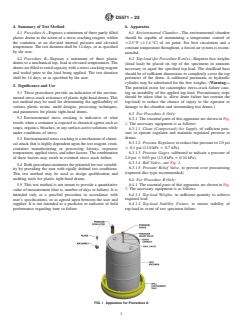
6.3.1 The essential parts of this apparatus are shown in Fig.
results when a container is exposed to chemical agents such as
1. The necessary equipment is as follows:
soaps, organics, bleaches, or any surface-active solutions while
6.3.1.1 Clean (Compressed) Air Supply, of sufficient pres-
under conditions of stress.
sure to operate regulator and maintain regulated pressure to
drums.
5.3 Environmentalstresscrackingisamechanismofchemi-
6.3.1.2 Pressure Regulator, to reduce line pressure to 2.0 psi
cal attack that is highly dependent upon the test reagent, resin,
6 0.1 psi (13.8 kPa 6 0.7 kPa).
container manufacturing or processing history, exposure
6.3.1.3 Pressure Gages, calibrated to indicate a pressure of
temperature, applied stress, and other factors.The combination
of these factors may result in eventual stress crack failure. 2.0 psi 6 0.05 psi (13.8 kPa 6 0.34 kPa).
6.3.1.4 Ball Valve—see Fig. 2.
5.4 Both procedures minimize the potential for test variabil-
6.3.1.5 Pressure Relief Valve, to prevent over pressurizing
ity by providing the user with rigidly defined test conditions.
(ruptured disc-type recommended).
This test method may be used as design qualification and
auditing tools for plastic tight-head drums.
6.4 For Procedure B Only:
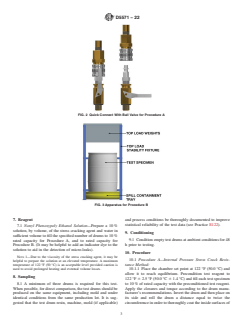
6.4.1 The essential parts of this apparatus are shown in Fig.
5.5 This test method is not meant to provide a quantitative
3. The necessary equipment is as follows:
value of measurement (that is, number of days to failure). It
...
This document is not an ASTM standard and is intended only to provide the user of an ASTM standard an indication of what changes have been made to the previous version. Because
it may not be technically possible to adequately depict all changes accurately, ASTM recommends that users consult prior editions as appropriate. In all cases only the current version
of the standard as published by ASTM is to be considered the official document.
Designation: D5571 − 16 D5571 − 22
Standard Test Method for
Environmental Stress Crack Resistance (ESCR) of Plastic
TightheadTight-head Drums Not Exceeding 60 Gal (227 L) in
Rated Capacity
This standard is issued under the fixed designation D5571; the number immediately following the designation indicates the year of
original adoption or, in the case of revision, the year of last revision. A number in parentheses indicates the year of last reapproval. A
superscript epsilon (´) indicates an editorial change since the last revision or reapproval.
1. Scope Scope*
1.1 This test method provides an indication of the environmental stress crack resistance of plastic tightheadtight-head drums as
a summation of the effects of container design, resin, manufacturing conditions, field performance, and other factors.
1.2 This test method may be used to evaluate a plastic drum’s resistance to failure by cracking when in the presence of chemical
and physical stresses.
1.3 Two procedures are provided as follows:
1.3.1 Procedure A—Internal pressure stress crack resistance method to nonyl phenoxypoly (ethyleneoxy) ethanol solution, a stress
cracking reagent. The internal pressure is controlled at a constant elevated pressure and temperature.
1.3.2 Procedure B—Top-load stress crack resistance method to nonyl phenoxypoly ethanol, a stress cracking reagent. The
compressive top load top-load is controlled at a constant weight while maintaining an elevated temperature.
1.4 Although these procedures are not designed to test the ability of the closure or closure gasket material to retain the test reagent,
the inclusion of closure failure as a container failure mode is optional. However, leakage through a closure may affect the internal
pressure that could affect the test results.
1.5 This test method does not attempt to address all factors that could lead to stress cracking of plastic drums. The user of this
standard may use other test parameters, such as top loads, top-loads, chemical reagents, etc., as agreed upon between the user and
supplier in the event of a drum qualification or purchase agreement.
1.6 The values stated in inch-pound units are to be regarded as the standard. The SI units given in parentheses are for information
only.
1.7 This standard does not purport to address all of the safety concerns, if any, associated with its use. It is the responsibility
of the user of this standard to establish appropriate safety safety, health, and healthenvironmental practices and determine the
applicability of regulatory limitations prior to use. use. Specific warning statements are given in 6.2.
This test method is under the jurisdiction of ASTM Committee D10 on Packaging and is the direct responsibility of Subcommittee D10.21 on Shipping Containers and
Systems - Application of Performance Test Methods.
Current edition approved June 1, 2016Oct. 1, 2022. Published July 2016November 2022. Originally approved in 1994. Last previous edition approved in 20102016 as
D5571D5571 – 16.–94 (2010). DOI: 10.1520/D5571-16.10.1520/D5571-22.
*A Summary of Changes section appears at the end of this standard
Copyright © ASTM International, 100 Barr Harbor Drive, PO Box C700, West Conshohocken, PA 19428-2959. United States
D5571 − 22
1.8 This international standard was developed in accordance with internationally recognized principles on standardization
established in the Decision on Principles for the Development of International Standards, Guides and Recommendations issued
by the World Trade Organization Technical Barriers to Trade (TBT) Committee.
2. Referenced Documents
2.1 ASTM Standards:
D996 Terminology of Packaging and Distribution Environments
D4577 Test Method for Compression Resistance of a Container Under Constant Load
E122 Practice for Calculating Sample Size to Estimate, With Specified Precision, the Average for a Characteristic of a Lot or
Process
3. Terminology
3.1 Definitions—Reference Terminology D996 for definitions of terms applicable to this test method.
3.2 Definitions of Terms Specific to This Standard:
3.2.1 environmental stress crack—a crack that develops when a plastic drum is exposed to chemical and physical stresses.
3.2.2 plastic tightheadtight-head drum—A non-removable head plastic drum, maximum capacity not exceeding 60 gal (227 L),
with openings for filling and emptying not exceeding 2.76 in. (70 mm) in diameter.
3.2.3 stress crack failure—any environmental stress crack that penetrates through the thickness of the drum resulting in a loss or
leakage of the test reagent shall be interpreted as a failure.
4. Summary of Test Method
4.1 Procedure A—Exposes a minimum of three partly filled plastic drums to the action of a stress cracking reagent, within the
container, at an elevated internal pressure and elevated temperature. The test duration shall be 14 days, or as specified by the user.
4.2 Procedure B—Exposes a minimum of three plastic drums to a mechanical toptop- load at elevated temperatures. The drums
are filled to rated capacity with a stress cracking reagent and sealed prior to the load being applied. The test duration shall be 14
days, or as specified by the user.
5. Significance and Use
5.1 These procedures provide an indication of the environmental stress-crack resistance of plastic tightheadtight-head drums. This
test method may be used for determining the applicability of various plastic resins, mold designs, processing techniques, and
parameters for plastic tightheadtight-head drums.
5.2 Environmental stress cracking is indicative of what results when a container is exposed to chemical agents such as soaps,
organics, bleaches, or any surface active surface-active solutions while under conditions of stress.
5.3 Environmental stress cracking is a mechanism of chemical attack that is highly dependent upon the test reagent, resin,
container manufacturing or processing history, exposure temperature, applied stress, and other factors. The combination of these
factors may result in eventual stress crack failure.
5.4 Both procedures minimize the potential for test variability by providing the user with rigidly defined test conditions. This test
method may be used as design qualification and auditing tools for plastic tightheadtight-head drums.
5.5 This test method is not meant to provide a quantitative value of measurement (that is, number of days to failure). It is intended
For referenced ASTM standards, visit the ASTM website, www.astm.org, or contact ASTM Customer Service at service@astm.org. For Annual Book of ASTM Standards
volume information, refer to the standard’s Document Summary page on the ASTM website.
D5571 − 22
only as a pass/fail procedure in accordance with user’suser’s specifications, or as agreed upon between the user and supplier. It
is not intended as a predictor or indicator of field performance regarding time to failure.
6. Apparatus
6.1 Environmental Chamber—The environmental chamber should be capable of maintaining a temperature control of 62.5°F
(61.4°C)62.5 °F (61.4 °C) of set point. For best circulation and a constant temperature throughout, a forced air system is
recommended.
6.2 Top Load Top-load (for Procedure B only)—Requires free weights (dead load) be placed on top of the specimens in amounts
necessary to equal the specified top load. top-load. The deadload base should be of sufficient dimensions to completely cover the
top perimeter of the drum. A calibrated pneumatic or hydraulic cylinder may be substituted for the free weights. (Warning—
WarningThe—The potential exists for catastrophic stress-crack failure causing an instability of the applied topload.top-load.
Precautionary steps should be taken (that is, allow drum failure but restrain the top load) top-load) to reduce the chance of injury
to the operator or damage to the chamber and surrounding test drums.)
6.3 For Procedure A Only:
6.3.1 The essential parts of this apparatus are shown in Fig. 1. The necessary equipment is as follows:
6.3.1.1 Clean (Compressed) Air Supply, of sufficient pressure to operate regulator and maintain regulated pressure to drums.
6.3.1.2 Pressure Regulator, to reduce line pressure to 2.02.0 psi 6 0.1 psi (13.8(13.8 kPa 6 0.7 kPa).
6.3.1.3 Pressure Gages, calibrated to indicate a pressure of 2.02.0 psi 6 0.05 psi (13.8(13.8 kPa 6 0.34 kP
...