

ASTM F3326-21
(Specification)Standard Specification for Flame Mitigation Devices on Portable Fuel Containers
General Information
- Abstract
SCOPE
1.1 This specification establishes performance requirements for flame mitigation devices (FMDs) in portable fuel containers (PFCs) for gasoline, kerosene, and diesel fuels intended for reuse by the consumer.
1.2 A flame mitigation device in gasoline (red), diesel (yellow), and kerosene (blue) PFCs protects the container openings from possible propagation of a flame into a flammable fuel-air mixture within the container. Formation of a flammable fuel-air mixture in the container can occur in special circumstances associated with cold ambient conditions and low liquid levels in the container. Delineations of those circumstances and conditions have been described in published reports, for example, Gardiner et al, 2010 (1),2 and papers, for example, Elias et al, 2013 (2), including research sponsored and overseen by the ASTM F15.10 Technical Committee.
1.3 This specification does not address the hazard of injury or death caused by ignition of vapors external to the PFC when the fuel in the PFC is poured onto or near to a fire or other ignition source causing these external vapors to ignite or explode. An FMD does not prevent hazards associated with misuse of the PFC resulting in external vapor ignition.
1.4 The flame mitigation device is chemically conditioned by exposure to representative fuel surrogates CE25a and CE85a fuel and other expected conditions prior to the tests.
1.5 The flame mitigation device is mechanically conditioned by repeated insertions and removal of a fuel refueling spout prior to the tests.
1.6 The first test method establishes that the flame mitigation device can effectively prevent flame propagation into a flammable butane-air mixture inside the portable fuel container. The butane-air mixture is a controlled and repeatable proxy for the more variable fuel vapor-air mixture in the container.
1.7 The second test method establishes that the flame mitigation device is permitting adequate flow rates of fuel.
1.8 This specification states values in SI units which are to be regarded as the standard. The values given in parentheses are for information only.
1.9 This standard does not purport to address all of the safety concerns, if any, associated with its use. It is the responsibility of the user of this standard to establish appropriate safety, health, and environmental practices and determine the applicability of regulatory limitations prior to use.
1.10 This international standard was developed in accordance with internationally recognized principles on standardization established in the Decision on Principles for the Development of International Standards, Guides and Recommendations issued by the World Trade Organization Technical Barriers to Trade (TBT) Committee.
- Status
- Published
- Publication Date
- 31-Aug-2021
- Technical Committee
- F15 - Consumer Products
- Drafting Committee
- F15.10 - Standards for Flammable Liquid Containers
Buy Documents
ASTM F3326-21 - Standard Specification for Flame Mitigation Devices on Portable Fuel Containers
REDLINE ASTM F3326-21 - Standard Specification for Flame Mitigation Devices on Portable Fuel Containers
Overview
ASTM F3326-21 is the international standard that details the performance requirements for flame mitigation devices (FMDs) on portable fuel containers (PFCs) designed for reuse by consumers. These containers are intended for gasoline, kerosene, and diesel fuels. The primary purpose of this specification is to enhance fire safety by preventing flame propagation into the container, reducing the risk of internal explosions caused by ignition of flammable fuel-air mixtures within PFCs.
This ASTM standard was developed by ASTM Committee F15 on Consumer Products, reflecting both current industry knowledge and research findings. The specification focuses on portable fuel containers commonly used for storing and transporting small quantities of flammable fuels in consumer settings.
Key Topics
Flame Mitigation Device (FMD) Requirements
- FMDs must be permanently installed in each opening of a portable fuel container.
- Devices are tested for chemical and mechanical durability, ensuring they withstand exposure to fuels and repeated use.
Performance Testing
- Test methods establish the ability of FMDs to prevent flame propagation using controlled butane-air mixtures as representative surrogates.
- Flow resistance tests verify that FMDs allow adequate fuel flow rates for practical consumer use.
- Durability tests simulate long-term exposure to fuels and physical wear from repeated spout insertions.
Scope Limitations
- The standard does not address hazards from ignited vapors outside the PFC, including misuse such as pouring fuel onto an active fire.
Color Coding and Marking
- Containers are color-coded by fuel type: red for gasoline, yellow for diesel, blue for kerosene, aiding safe identification and use.
Container Capacity
- The largest model in a family of PFCs, up to 5 gallons or 20 liters, can represent all similar designs for compliance with this standard.
Applications
ASTM F3326-21 is critical for:
- Manufacturers of Portable Fuel Containers: Ensures products meet advanced safety requirements before market entry.
- Product Certification: Provides a baseline for compliance with consumer safety regulations and product liability defenses.
- Fuel Storage and Transport: Offers safer solutions for consumers storing gasoline, diesel, or kerosene for use in vehicles, equipment, or small engines.
- Consumer Safety Initiatives: Supports public safety efforts by reducing the risk of flame flashback incidents commonly associated with portable fuel containers.
- Inspection and Quality Assurance: Enables testing labs and certifying bodies to assess FMD effectiveness and flow resistance, contributing to consistent product quality.
Related Standards
The following standards provide essential context or complementary requirements for manufacturers and stakeholders:
- ASTM F852: Specification for Portable Gasoline, Kerosene, and Diesel Containers for Consumer Use
- NFPA 497: Recommended Practice for the Classification of Flammable Liquids, Gases, or Vapors of Hazardous Locations
- IEC 60079-20-1: Explosive Atmospheres – Material Characteristics for Gas and Vapour Classification
- CSA B376: Portable Containers for Gasoline and Other Petroleum Fuels
These documents collectively help ensure comprehensive safety and performance for portable fuel containers and their flame mitigation devices.
Keywords: ASTM F3326-21, flame mitigation devices, portable fuel containers, gasoline container safety, kerosene, diesel, FMD, fuel storage, fire prevention, consumer safety, flow resistance, fuel container testing, ASTM standards.
Relations
- Effective Date
- 01-Jul-2008
- Effective Date
- 01-Jul-2006
Buy Documents
ASTM F3326-21 - Standard Specification for Flame Mitigation Devices on Portable Fuel Containers
REDLINE ASTM F3326-21 - Standard Specification for Flame Mitigation Devices on Portable Fuel Containers
Get Certified
Connect with accredited certification bodies for this standard

BRCGS (Brand Reputation Compliance Global Standards)
Global food safety and quality standards owner.
Sponsored listings
Frequently Asked Questions
ASTM F3326-21 is a technical specification published by ASTM International. Its full title is "Standard Specification for Flame Mitigation Devices on Portable Fuel Containers". This standard covers: SCOPE 1.1 This specification establishes performance requirements for flame mitigation devices (FMDs) in portable fuel containers (PFCs) for gasoline, kerosene, and diesel fuels intended for reuse by the consumer. 1.2 A flame mitigation device in gasoline (red), diesel (yellow), and kerosene (blue) PFCs protects the container openings from possible propagation of a flame into a flammable fuel-air mixture within the container. Formation of a flammable fuel-air mixture in the container can occur in special circumstances associated with cold ambient conditions and low liquid levels in the container. Delineations of those circumstances and conditions have been described in published reports, for example, Gardiner et al, 2010 (1),2 and papers, for example, Elias et al, 2013 (2), including research sponsored and overseen by the ASTM F15.10 Technical Committee. 1.3 This specification does not address the hazard of injury or death caused by ignition of vapors external to the PFC when the fuel in the PFC is poured onto or near to a fire or other ignition source causing these external vapors to ignite or explode. An FMD does not prevent hazards associated with misuse of the PFC resulting in external vapor ignition. 1.4 The flame mitigation device is chemically conditioned by exposure to representative fuel surrogates CE25a and CE85a fuel and other expected conditions prior to the tests. 1.5 The flame mitigation device is mechanically conditioned by repeated insertions and removal of a fuel refueling spout prior to the tests. 1.6 The first test method establishes that the flame mitigation device can effectively prevent flame propagation into a flammable butane-air mixture inside the portable fuel container. The butane-air mixture is a controlled and repeatable proxy for the more variable fuel vapor-air mixture in the container. 1.7 The second test method establishes that the flame mitigation device is permitting adequate flow rates of fuel. 1.8 This specification states values in SI units which are to be regarded as the standard. The values given in parentheses are for information only. 1.9 This standard does not purport to address all of the safety concerns, if any, associated with its use. It is the responsibility of the user of this standard to establish appropriate safety, health, and environmental practices and determine the applicability of regulatory limitations prior to use. 1.10 This international standard was developed in accordance with internationally recognized principles on standardization established in the Decision on Principles for the Development of International Standards, Guides and Recommendations issued by the World Trade Organization Technical Barriers to Trade (TBT) Committee.
SCOPE 1.1 This specification establishes performance requirements for flame mitigation devices (FMDs) in portable fuel containers (PFCs) for gasoline, kerosene, and diesel fuels intended for reuse by the consumer. 1.2 A flame mitigation device in gasoline (red), diesel (yellow), and kerosene (blue) PFCs protects the container openings from possible propagation of a flame into a flammable fuel-air mixture within the container. Formation of a flammable fuel-air mixture in the container can occur in special circumstances associated with cold ambient conditions and low liquid levels in the container. Delineations of those circumstances and conditions have been described in published reports, for example, Gardiner et al, 2010 (1),2 and papers, for example, Elias et al, 2013 (2), including research sponsored and overseen by the ASTM F15.10 Technical Committee. 1.3 This specification does not address the hazard of injury or death caused by ignition of vapors external to the PFC when the fuel in the PFC is poured onto or near to a fire or other ignition source causing these external vapors to ignite or explode. An FMD does not prevent hazards associated with misuse of the PFC resulting in external vapor ignition. 1.4 The flame mitigation device is chemically conditioned by exposure to representative fuel surrogates CE25a and CE85a fuel and other expected conditions prior to the tests. 1.5 The flame mitigation device is mechanically conditioned by repeated insertions and removal of a fuel refueling spout prior to the tests. 1.6 The first test method establishes that the flame mitigation device can effectively prevent flame propagation into a flammable butane-air mixture inside the portable fuel container. The butane-air mixture is a controlled and repeatable proxy for the more variable fuel vapor-air mixture in the container. 1.7 The second test method establishes that the flame mitigation device is permitting adequate flow rates of fuel. 1.8 This specification states values in SI units which are to be regarded as the standard. The values given in parentheses are for information only. 1.9 This standard does not purport to address all of the safety concerns, if any, associated with its use. It is the responsibility of the user of this standard to establish appropriate safety, health, and environmental practices and determine the applicability of regulatory limitations prior to use. 1.10 This international standard was developed in accordance with internationally recognized principles on standardization established in the Decision on Principles for the Development of International Standards, Guides and Recommendations issued by the World Trade Organization Technical Barriers to Trade (TBT) Committee.
ASTM F3326-21 is classified under the following ICS (International Classification for Standards) categories: 55.140 - Barrels. Drums. Canisters. The ICS classification helps identify the subject area and facilitates finding related standards.
ASTM F3326-21 has the following relationships with other standards: It is inter standard links to ASTM F852-08, ASTM F852-99(2006). Understanding these relationships helps ensure you are using the most current and applicable version of the standard.
ASTM F3326-21 is available in PDF format for immediate download after purchase. The document can be added to your cart and obtained through the secure checkout process. Digital delivery ensures instant access to the complete standard document.
Standards Content (Sample)
This international standard was developed in accordance with internationally recognized principles on standardization established in the Decision on Principles for the
Development of International Standards, Guides and Recommendations issued by the World Trade Organization Technical Barriers to Trade (TBT) Committee.
Designation:F3326 −21
Standard Specification for
Flame Mitigation Devices on Portable Fuel Containers
This standard is issued under the fixed designation F3326; the number immediately following the designation indicates the year of
original adoption or, in the case of revision, the year of last revision. A number in parentheses indicates the year of last reapproval. A
superscript epsilon (´) indicates an editorial change since the last revision or reapproval.
1. Scope 1.7 The second test method establishes that the flame
mitigation device is permitting adequate flow rates of fuel.
1.1 This specification establishes performance requirements
forflamemitigationdevices(FMDs)inportablefuelcontainers 1.8 This specification states values in SI units which are to
(PFCs) for gasoline, kerosene, and diesel fuels intended for be regarded as the standard. The values given in parentheses
reuse by the consumer. are for information only.
1.9 This standard does not purport to address all of the
1.2 A flame mitigation device in gasoline (red), diesel
safety concerns, if any, associated with its use. It is the
(yellow), and kerosene (blue) PFCs protects the container
responsibility of the user of this standard to establish appro-
openings from possible propagation of a flame into a flam-
priate safety, health, and environmental practices and deter-
mable fuel-air mixture within the container. Formation of a
mine the applicability of regulatory limitations prior to use.
flammablefuel-airmixtureinthecontainercanoccurinspecial
1.10 This international standard was developed in accor-
circumstancesassociatedwithcoldambientconditionsandlow
dance with internationally recognized principles on standard-
liquid levels in the container. Delineations of those circum-
ization established in the Decision on Principles for the
stances and conditions have been described in published
Development of International Standards, Guides and Recom-
reports, for example, Gardiner et al, 2010 (1), and papers, for
mendations issued by the World Trade Organization Technical
example, Elias et al, 2013 (2), including research sponsored
Barriers to Trade (TBT) Committee.
and overseen by the ASTM F15.10 Technical Committee.
1.3 This specification does not address the hazard of injury
2. Referenced Documents
or death caused by ignition of vapors external to the PFC when
2.1 ASTM Standards:
the fuel in the PFC is poured onto or near to a fire or other
F852 Specification for Portable Gasoline, Kerosene, and
ignition source causing these external vapors to ignite or
Diesel Containers for Consumer Use
explode. An FMD does not prevent hazards associated with
2.2 Other Standards:
misuse of the PFC resulting in external vapor ignition.
NFPA 497 Recommended Practice for the Classification of
1.4 The flame mitigation device is chemically conditioned
Flammable Liquids, Gases, orVapors of Hazardous (Clas-
by exposure to representative fuel surrogates CE25a and
sified) Locations for Electrical Installations in Chemical
CE85a fuel and other expected conditions prior to the tests.
Process Areas
1.5 The flame mitigation device is mechanically condi-
IEC 60079-20-1 Explosive atmospheres – Part 20-1: Mate-
tioned by repeated insertions and removal of a fuel refueling
rial characteristics for gas and vapour classification – Test
spout prior to the tests.
methods and data
1.6 The first test method establishes that the flame mitiga-
3. Terminology
tion device can effectively prevent flame propagation into a
flammable butane-air mixture inside the portable fuel con-
3.1 Specification F852 is the reference for all portable fuel
tainer. The butane-air mixture is a controlled and repeatable
container specific terminology in this specification. Definitions
proxy for the more variable fuel vapor-air mixture in the
may be presented in this section for convenience.
container.
For referenced ASTM standards, visit the ASTM website, www.astm.org, or
This specification is under the jurisdiction of ASTM Committee F15 on contact ASTM Customer Service at service@astm.org. For Annual Book of ASTM
Consumer Products and is the direct responsibility of Subcommittee F15.10 on Standards volume information, refer to the standard’s Document Summary page on
Standards for Flammable Liquid Containers. the ASTM website.
Current edition approved Sept. 1, 2021. Published October 2021. Originally Available from National Fire Protection Association (NFPA), 1 Batterymarch
approved in 2019. Last previous edition approved in 2019 as F3326 – 19a. DOI: Park, Quincy, MA 02169-7471, http://www.nfpa.org.
10.1520/F3326-21. Available from International Electrotechnical Commission (IEC), 3, rue de
The boldface numbers in parentheses refer to a list of references at the end of Varembé, 1st Floor, P.O. Box 131, CH-1211, Geneva 20, Switzerland, http://
this standard. www.iec.ch.
Copyright © ASTM International, 100 Barr Harbor Drive, PO Box C700, West Conshohocken, PA 19428-2959. United States
F3326−21
3.2 Definitions: 4.2.2 When tested in accordance with 6.1, a PFC which has
undergone test method 8.4 of Specification F852, Hydrostatic
3.2.1 flame mitigation device (FMD), n—a device perma-
Pressure Test:
nently installed in a PFC to prevent the propagation of an
external ignition into the PFC. 4.2.2.1 Shall not allow a flame to propagate into and ignite
the headspace within the PFC with the pouring spout installed
3.2.2 flame speed, n—the average frame to frame measured
according to the manufacturer’s instructions.
speed of the flame in the first ⁄4 of the tube length.
4.2.2.2 If the pouring spout is removable, shall not allow a
3.2.3 fuel, n—a volatile mixture of liquid petroleum hydro-
flame to propagate into and ignite the headspace within the
carbons distillates, and small amounts of additives, sometimes
PFC with the pouring spout removed.
blended with ethanol or similar oxygenates, suitable for use as
4.2.2.3 Ifthereareseparateopeningsforfillingandpouring,
a fuel in spark-ignition, internal combustion gasoline engines),
shall not allow a flame to propagate into and ignite the
or bio diesel (for compression ignition in diesel engines).
headspace within the PFC through the filling opening.
3.2.4 Maximum Experimental Safe Gap (MESG), n—the
4.2.3 When tested in accordance with 6.1, a new, unused
maximum clearance between two parallel metal surfaces that
PFC chemically conditioned in accordance to 5.1 using Stan-
has been found, under specified test conditions, to prevent a
dardFuelCE25a,thenmechanicallyconditionedinaccordance
deflagration in a test chamber from being propagated to a
to 5.2 and tested within 48 h of the chemical conditioning:
secondary chamber containing the same gas or vapor at the
4.2.3.1 Shall not allow a flame to propagate into and ignite
same concentration (see IEC 60079-20-1).
the headspace within the PFC over the course of five (5)
3.2.5 portable fuel container (PFC), n—a single- or multi-
successive tests within 8 h with the pouring spout installed
compartment vessel intended for use by consumers to transport
according to the manufacturer’s instructions.
gasoline, gas/oil mixtures (or separate compartments of gas
4.2.3.2 If the pouring spout is removable, shall not allow a
andoil),diesel,orkerosenefromtheirdistributionpointstothe
flame to propagate into and ignite the headspace within the
consumer’s storage and use points, including all of the com-
PFC over the course of five (5) successive tests within 8 h with
ponents intended for use on or with the container including
the pouring spout removed.
those supplied by manufacturers other than the PFC manufac-
4.2.3.3 Ifthereareseparateopeningsforfillingandpouring,
turer.
shall not allow a flame to propagate into and ignite the
headspace within the PFC through the filling opening over the
4. FMD Requirements
course of five (5) successive tests within 8 h.
4.1 General Requirements:
NOTE 3—It is permissible to use the same conditioned PFC as used in
4.1.1 A flame mitigation device shall be provided in each
4.3.1.
PFC opening to protect the container opening(s) from possible
4.2.4 When tested in accordance with 6.1, a new, unused
propagationofaflameintoaflammablefuel-airmixturewithin
PFC chemically conditioned in accordance to 5.1 using Stan-
the container.
dardFuelCE85a,thenmechanicallyconditionedinaccordance
4.1.2 Due to the increased risk of static discharge with more
to 5.2 and tested within 48 h of the chemical conditioning:
conductive materials, a plastic PFC shall only contain FMDs
4.2.4.1 Shall not allow a flame to propagate into and ignite
composed of nonmetallic materials.
the headspace within the PFC over the course of five (5)
4.1.3 The PFC with the highest rated capacity up to 5 gal or
successive tests within 8 h with the pouring spout installed
20 L of a family of similar design and construction shall be
according to the manufacturer’s instructions.
representativeofallofthePFCswithinthatfamilywithrespect
4.2.4.2 If the pouring spout is removable, shall not allow a
to this specification.
flame to propagate into and ignite the headspace within the
NOTE 1—The PFC with the highest rated capacity in the family may be
PFC over the course of five (5) successive tests within 8 h with
used to certify all of the PFCs in the family.
the pouring spout removed.
NOTE 2—This FMD standard may be referenced for other container
capacities and applications. 4.2.4.3 Ifthereareseparateopeningsforfillingandpouring,
shall not allow a flame to propagate into and ignite the
4.2 FMD Effectiveness:
headspace within the PFC through the filling opening over the
4.2.1 When tested in accordance with 6.1, a PFC which has
course of five (5) successive tests within 8 h.
undergone test method 8.3 of Specification F852, Drop
Strength Test using water only:
NOTE 4—It is permissible to use the same conditioned PFC as used in
4.3.2.
4.2.1.1 Shall not allow a flame to propagate into and ignite
the headspace within the PFC with the pouring spout installed
4.3 FMD Flow Resistance:
according to the manufacturer’s instructions.
4.3.1 A new, unused PFC chemically conditioned in accor-
4.2.1.2 If the pouring spout is removable, shall not allow a
dance to 5.1 using Standard Fuel CE25a, then mechanically
flame to propagate into and ignite the headspace within the
conditioned in accordance to 5.2:
PFC with the pouring spout removed.
4.3.1.1 When tested in accordance with 6.2.3 shall have a
4.2.1.3 Ifthereareseparateopeningsforfillingandpouring,
pour-in rate not less than 34 L/min (9 gal/min).
shall not allow a flame to propagate into and ignite the
headspace within the PFC through the filling opening. NOTE 5—It is permissible to use this conditioned PFC for 4.2.3.
F3326−21
4.3.2 A new, unused PFC chemically conditioned in accor- surface inclined at an angle of 45° to the horizontal so that it
dance to 5.1 using Standard Fuel CE85a, then mechanically can slide into the filling opening of an FMD equipped PFC,
conditioned in accordance to 5.2: which is also mounted on an inclined surface oriented perpen-
4.3.2.1 When tested in accordance with 6.2.3 shall have a dicular to the nozzle spout slide. Use a fixture equivalent to a
pour-in rate not less than 34 L/min (9 gal/min). standard nozzle of 29 mm (1 ⁄8 in.) in diameter, weighing 1320
g (2.91 lb) and approximately 18 cm (7 in.) in length.
NOTE 6—It is permissible to use this conditioned PFC for 4.2.4.
Appendix X2, Fig. X2.1 is an illustrative example of the
4.4 Flow Out Test [Reserved]:
apparatus setup for this conditioning.
5.2.3 Mechanical Durability Conditioning Procedure—
NOTE 7—If applicable, a requirement regarding the pouring out rate,
intended to ensure that the pouring out flow characteristic of an FMD
Allow the nozzle to slide via gravity into filling opening of the
equipped PFC does not adversely affect consumer acceptance, may be
fuel container, and then retrieved and repositioned on the
incorporated in a later version of this specification.
inclined surface. This conditioning procedure simulates the
4.5 FMD Removal:
mechanical wear due to friction between nozzle and the PFC
4.5.1 When tested in accordance with 6.3, the FMD shall
openingcontainingtheFMD.Repeattheinsertionandretrieval
not be removed from the PFC.
process 49 times.
4.6 Retest Statement:
NOTE 9—It is permissible to make intermediate examinations of the
4.6.1 Testing Requirements—No qualification testing is re-
FMD to determine if obvious physical damage has clearly rendered it
quired as a result of this revision.
ineffective.
5. Sample Preparation/Conditioning
6. Test Methods
5.1 PFC FMD Test Sample Chemical Durability Condition-
6.1 FMD Effectiveness Test:
ing:
NOTE 10—FMD effectiveness tests are carried out within 48 h of
5.1.1 Chemical Conditioning Purpose—The FMD equipped
chemical conditioning.
PFC is conditioned with Standard Fuel CE25a and CE85a to
6.1.1 The bottom of an FMD equipped PFC is cut off and
verify that the FMD structure and effectiveness is not compro-
the PFC is mounted to a base plate containing a gas sampling
mised by prolonged exposure to the specified fuel formula-
port and an aluminum foil blow out panel. Fill the modified
tions.
PFC, with the pouring spout locked open where applicable,
5.1.2 Chemical Durability Conditioning Apparatus:
with a flammable butane-air mixture (simulating the fuel-air
5.1.2.1 A PFC and fuel.
mixture)whichalsofillsanignitertubeattachedtotheopening
5.1.2.2 A PFC temperature controlled enclosure capable of
being tested. The orientation of the test setup positions the
maintaining and monitoring a constant temperature of 40 °C 6
ignitor tube approximately horizontally. Expose the FMD
2 °C(104 °F 64 °F)nearthePFClocationisusedforthePFC
under test to flame as described in 6.1.4. The configurations
thermal environment.
with and without spout are illustrated in Fig. 1.
5.1.3 Chemical Conditioning Procedure:
5.1.3.1 Fill the PFC with fuel such that approximately 50 % 6.1.2 Hazards—Ignition of a flammable vapor-air mixture,
of the length of the FMD in the filling opening is immersed in as is required in the FMD effectiveness test, inevitably entails
test fuel. fire and explosion hazards. Laboratory personnel responsible
5.1.3.2 Secure closures with the torque values specified in for these tests need to have training and experience in
Specification F852, Table 1. conducting tests with flammable vapors.
5.1.3.3 Place PFC into the enclosure with a controlled
6.1.3 Test Apparatus and Setup:
temperature of 40 °C 6 2 °C (104 °F 6 4 °F), as measured
6.1.3.1 Fig. 1 shows the test apparatus set up.
near the PFC.
6.1.3.2 CutoffthebottomoftheFMDequippedPFCsothat
5.1.3.4 Store in enclosure for a minimum of 60 days. Once
the FMD being tested clears the mounting plate by 2 cm to
each weekday during storage, remove PFC from enclosure,
5 cm. Mount the PFC on a rigid base plate containing an
shake PFC so that the liquid will contact the FMD situated in
opening for the exhaust gas vent tube connection and an
the filling opening, and return to enclosure.
approximately 100 mm diameter blowout panel comprised of
5.1.3.5 Remove PFC after at least 60 days.
standard household aluminum foil with a thickness of approxi-
5.1.3.6 Examine and photograph applicable FMDs within 4
mately 0.016 mm.
h, noting any deterioration or changes in dimensions or shape.
NOTE 11—It is recommended that exhaust gas tube connection is
NOTE 8—It is permissible to make intermediate examinations of the
located in the lower elevation of the mounting plate.
FMD to determine if obvious physical damage has clearly rendered it
ineffective. 6.1.3.3 A source of dry air, flowed through a controller
capable of constant flow, to mix with fuel vapor.
5.2 PFC FMD Mechanical Durability Conditioning:
6.1.3.4 A source of n-butane, flowed through a controller
5.2.1 This mechanical durability conditioning is carried out
capable of constant flow, to mix with air.
on the FMD in the filling opening after the 5.1 chemical
6.1.3.5 A source of air or nitrogen to purge PFC.
conditioning.
5.2.2 Mechanical Durability Conditioning Apparatus—A 6.1.3.6 A transpa
...
This document is not an ASTM standard and is intended only to provide the user of an ASTM standard an indication of what changes have been made to the previous version. Because
it may not be technically possible to adequately depict all changes accurately, ASTM recommends that users consult prior editions as appropriate. In all cases only the current version
of the standard as published by ASTM is to be considered the official document.
Designation: F3326 − 19a F3326 − 21
Standard Specification for
Flame Mitigation Devices on Portable Fuel Containers
This standard is issued under the fixed designation F3326; the number immediately following the designation indicates the year of
original adoption or, in the case of revision, the year of last revision. A number in parentheses indicates the year of last reapproval. A
superscript epsilon (´) indicates an editorial change since the last revision or reapproval.
1. Scope
1.1 This specification establishes performance requirements for Flame Mitigation Devicesflame mitigation devices (FMDs) in
portable fuel containers (PFCs) for gasoline, kerosene, and diesel fuels intended for reuse by the consumer.
1.2 A flame mitigation device in gasoline (red), diesel (yellow), and kerosene (blue) PFCs protects the container openings from
possible propagation of a flame into a flammable fuel-air mixture within the container. Formation of a flammable fuel-air mixture
in the container can occur in special circumstances associated with cold ambient conditions and low liquid levels in the container.
Delineations of those circumstances and conditions have been described in published reports (forreports, for example, Gardiner et
al, 2010 ((1),), and papers, for example, Elias et al, 2013 ((2),), including research sponsored and overseen by the ASTM F15.10
Technical Committee.
1.3 This specification does not address the hazard of injury or death caused by ignition of vapors external to the PFC when the
fuel in the PFC is poured onto or near to a fire or other ignition source causing these external vapors to ignite or explode. An FMD
does not prevent hazards associated with misuse of the PFC resulting in external vapor ignition.
1.4 The flame mitigation device is chemically conditioned by exposure to representative fuel surrogates CE25a and CE85a fuel
and other expected conditions prior to the tests.
1.5 The flame mitigation device is mechanically conditioned by repeated insertions and removal of a fuel refueling spout prior to
the tests.
1.6 The first test method establishes that the flame mitigation device can effectively prevent flame propagation into a flammable
butane-air mixture inside the portable fuel container. The butane-air mixture is a controlled and repeatable proxy for the more
variable fuel vapor-air mixture in the container.
1.7 The second test method establishes that the flame mitigation device is permitting adequate flow rates of fuel.
1.8 This specification states values in SI units which are to be regarded as the standard. The values given in parentheses are for
information only.
This specification is under the jurisdiction of ASTM Committee F15 on Consumer Products and is the direct responsibility of Subcommittee F15.10 on Standards for
Flammable Liquid Containers.
Current edition approved May 15, 2019Sept. 1, 2021. Published June 2019October 2021. Originally approved in 2019. Last previous edition approved in 2019 as
F3326 – 19.F3326 – 19a. DOI: 10.1520/F3326-19A.10.1520/F3326-21.
The boldface numbers in parentheses refer to a list of references at the end of this standard.
Copyright © ASTM International, 100 Barr Harbor Drive, PO Box C700, West Conshohocken, PA 19428-2959. United States
F3326 − 21
1.9 This standard does not purport to address all of the safety concerns, if any, associated with its use. It is the responsibility
of the user of this standard to establish appropriate safety, health, and environmental practices and determine the applicability of
regulatory limitations prior to use.
1.10 This international standard was developed in accordance with internationally recognized principles on standardization
established in the Decision on Principles for the Development of International Standards, Guides and Recommendations issued
by the World Trade Organization Technical Barriers to Trade (TBT) Committee.
2. Referenced Documents
2.1 ASTM Standards:
F852 Specification for Portable Gasoline, Kerosene, and Diesel Containers for Consumer Use
2.2 Other Standards:
NFPA 497 Recommended Practice for the Classification of Flammable Liquids, Gases, or Vapors of Hazardous (Classified)
Locations for Electrical Installations in Chemical Process Areas
IEC 60079-20-1 Explosive atmospheres – Part 20-1: Material characteristics for gas and vapour classification – Test methods
and data
CSA B376 Portable Containers for Gasoline and Other Petroleum
3. Terminology
3.1 Specification F852 is the reference for all portable fuel container specific terminology in this specification. Definitions may
be presented in this section for convenience.
3.2 Definitions:
3.2.1 flame mitigation device (FMD), n—a device permanently installed in a PFC to prevent the propagation of an external ignition
into the PFC.
3.2.2 flame speed, n—the average frame to frame measured speed of the flame in the first ⁄4 of the tube length.
3.2.3 fuel, n—a volatile mixture of liquid petroleum hydrocarbons distillates, and small amounts of additives, sometimes blended
with ethanol or similar oxygenates, suitable for use as a fuel in spark-ignition, internal combustion gasoline engines), or bio diesel
(for compression ignition in diesel engines).
3.2.4 Maximum Experimental Safe Gap (MESG), n—the maximum clearance between two parallel metal surfaces that has been
found, under specified test conditions, to prevent a deflagration in a test chamber from being propagated to a secondary chamber
containing the same gas or vapor at the same concentration (see IEC 60079-20-1).
3.2.5 portable fuel container (PFC), n—a single- or multi-compartment vessel intended for use by consumers to transport
gasoline, gas/oil mixtures (or separate compartments of gas and oil), diesel, or kerosene from their distribution points to the
consumer’s storage and use points, including all of the components intended for use on or with the container including those
supplied by manufacturers other than the PFC manufacturer.
4. FMD Requirements
4.1 General Requirements:
4.1.1 A flame mitigation device shall be provided in each PFC opening to protect the container opening(s) from possible
propagation of a flame into a flammable fuel-air mixture within the container.
4.1.2 Due to the increased risk of static discharge with more conductive materials, the FMD shall be a plastic PFC shall only
contain FMDs composed of nonmetallic materials.
For referenced ASTM standards, visit the ASTM website, www.astm.org, or contact ASTM Customer Service at service@astm.org. For Annual Book of ASTM Standards
volume information, refer to the standard’s Document Summary page on the ASTM website.
Available from National Fire Protection Association (NFPA), 1 Batterymarch Park, Quincy, MA 02169-7471, http://www.nfpa.org.
Available from International Electrotechnical Commission (IEC), 3, rue de Varembé, 1st Floor, P.O. Box 131, CH-1211, Geneva 20, Switzerland, http://www.iec.ch.
F3326 − 21
4.1.3 The PFC with the highest rated capacity up to 5 gal or 20 L of a family of similar design and construction shall be
representative of all of the PFCs within that family with respect to this specification.
NOTE 1—The PFC with the highest rated capacity in the family may be used to certify all of the PFCs in the family.
NOTE 2—This FMD standard may be referenced for other container capacities and applications.
4.2 FMD Effectiveness:
4.2.1 When tested in accordance with 6.1, a PFC which has undergone test method 8.3 of Specification F852, Drop Strength Test
using water only:
4.2.1.1 Shall not allow a flame to propagate into and ignite the headspace within the PFC with the pouring spout installed
according to the manufacturer’s instructions.
4.2.1.2 If the pouring spout is removable, shall not allow a flame to propagate into and ignite the headspace within the PFC with
the pouring spout removed.
4.2.1.3 If there are separate openings for filling and pouring, shall not allow a flame to propagate into and ignite the headspace
within the PFC through the filling opening.
4.2.2 When tested in accordance with 6.1, a PFC which has undergone test method 8.4 of Specification F852, Hydrostatic Pressure
Test:
4.2.2.1 Shall not allow a flame to propagate into and ignite the headspace within the PFC with the pouring spout installed
according to the manufacturer’s instructions.
4.2.2.2 If the pouring spout is removable, shall not allow a flame to propagate into and ignite the headspace within the PFC with
the pouring spout removed.
4.2.2.3 If there are separate openings for filling and pouring, shall not allow a flame to propagate into and ignite the headspace
within the PFC through the filling opening.
4.2.3 When tested in accordance with 6.1, a new, unused PFC chemically conditioned in accordance to 5.1 using Standard Fuel
CE25a, then mechanically conditioned in accordance to 5.2 and tested within 48 h of the chemical conditioning:
4.2.3.1 Shall not allow a flame to propagate into and ignite the headspace within the PFC over the course of five (5) successive
tests within 8 h with the pouring spout installed according to the manufacturer’s instructions.
4.2.3.2 If the pouring spout is removable, shall not allow a flame to propagate into and ignite the headspace within the PFC over
the course of five (5) successive tests within 8 h with the pouring spout removed.
4.2.3.3 If there are separate openings for filling and pouring, shall not allow a flame to propagate into and ignite the headspace
within the PFC through the filling opening over the course of five (5) successive tests within 8 h.
NOTE 3—It is permissible to use the same conditioned PFC as used in 4.3.1.
4.2.4 When tested in accordance with 6.1, a new, unused PFC chemically conditioned in accordance to 5.1 using Standard Fuel
CE85a, then mechanically conditioned in accordance to 5.2 and tested within 48 h of the chemical conditioning:
4.2.4.1 Shall not allow a flame to propagate into and ignite the headspace within the PFC over the course of five (5) successive
tests within 8 h with the pouring spout installed according to the manufacturer’s instructions.
4.2.4.2 If the pouring spout is removable, shall not allow a flame to propagate into and ignite the headspace within the PFC over
the course of five (5) successive tests within 8 h with the pouring spout removed.
F3326 − 21
4.2.4.3 If there are separate openings for filling and pouring, shall not allow a flame to propagate into and ignite the headspace
within the PFC through the filling opening over the course of five (5) successive tests within 8 h.
NOTE 4—It is permissible to use the same conditioned PFC as used in 4.3.2.
4.3 FMD Flow Resistance:
4.3.1 A new, unused PFC chemically conditioned in accordance to 5.1 using Standard Fuel CE25a, then mechanically conditioned
in accordance to 5.2:
4.3.1.1 When tested in accordance with 6.2.3 shall have a pour-in rate not less than 34 L/min (9 gal/min).
NOTE 5—It is permissible to use this conditioned PFC for 4.2.3.
4.3.2 A new, unused PFC chemically conditioned in accordance to 5.1 using Standard Fuel CE85a, then mechanically conditioned
in accordance to 5.2:
4.3.2.1 When tested in accordance with 6.2.3 shall have a pour-in rate not less than 34 L/min (9 gal/min).
NOTE 6—It is permissible to use this conditioned PFC for 4.2.4.
4.4 Flow Out Test [Reserved]:
NOTE 7—If applicable, a requirement regarding the pouring out rate, intended to ensure that the pouring out flow characteristic of an FMD equipped PFC
does not adversely affect consumer acceptance, may be incorporated in a later version of this specification.
4.5 FMD Removal:
4.5.1 When tested in accordance with 6.3, the FMD shall not be removed from the PFC.
4.6 Retest Statement:
4.6.1 Testing Requirements—No qualification testing is required as a result of this revision.
5. Sample Preparation/Conditioning
5.1 PFC FMD Test Sample Chemical Durability Conditioning:
5.1.1 Chemical Conditioning Purpose—The FMD equipped PFC is conditioned with Standard Fuel CE25a and CE85a to verify
that the FMD structure and effectiveness is not compromised by prolonged exposure to the specified fuel formulations.
5.1.2 Chemical Durability Conditioning Apparatus:
5.1.2.1 A PFC and fuel.
5.1.2.2 A PFC temperature controlled enclosure capable of maintaining and monitoring a constant temperature of 4040 °C 6 2°C
(1042 °C (104 °F 6 4°F)4 °F) near the PFC location is used for the PFC thermal environment.
5.1.3 Chemical Conditioning Procedure:
5.1.3.1 Fill the PFC with fuel such that approximately 50 % of the length of the FMD in the filling opening is immersed in test
fuel.
5.1.3.2 Secure closures with the torque values specified in Specification F852, Table 1.
F3326 − 21
5.1.3.3 Place PFC into the enclosure with a controlled temperature of 4040 °C 6 2°C (1042 °C (104 °F 6 4°F),4 °F), as measured
near the PFC.
5.1.3.4 Store in enclosure for a minimum of 60 days. Once each weekday during storage, remove PFC from enclosure, shake PFC
so that the liquid will contact the FMD situated in the filling opening, and return to enclosure.
5.1.3.5 Remove PFC after at least 60 days.
5.1.3.6 Examine and photograph applicable FMDs within 4 h, noting any deterioration or changes in dimensions or shape.
NOTE 8—It is permissible to make intermediate examinations of the FMD to determine if obvious physical damage has clearly rendered it ineffective.
5.2 PFC FMD Mechanical Durability Conditioning:
5.2.1 This mechanical durability conditioning is carried out on the FMD in the filling opening after the 5.1 chemical conditioning.
5.2.2 Mechanical Durability Conditioning Apparatus—A commercial type fuel dispensing nozzle is mounted on a surface inclined
at an angle of 45° to the horizontal so that it can slide into the filling opening of an FMD equipped PFC, which is also mounted
on an inclined surface oriented perpendicular to the nozzle spout slide. Use a fixture equivalent to a standard nozzle of 29 mm (1 ⁄8
in.) in diameter, weighing 1320 g (2.91 lb) and approximately 18 cm (7 in.) in length. Appendix X2, Fig. X2.1 is an illustrative
example of the apparatus setup for this conditioning.
5.2.3 Mechanical Durability Conditioning Procedure—Allow the nozzle to slide via gravity into filling opening of the fuel
container, and then retrieved and repositioned on the inclined surface. This conditioning procedure simulates the mechanical wear
due to friction between nozzle and the PFC opening containing the FMD. Repeat the insertion and retrieval process 49 times.
NOTE 9—It is permissible to make intermediate examinations of the FMD to determine if obvious physical damage has clearly rendered it ineffective.
6. Test Methods
6.1 FMD Effectiveness Test:
NOTE 10—FMD effectiveness tests are carried out within 48 h of chemical conditioning.
6.1.1 The bottom of an FMD equipped PFC is cut off and the PFC is mounted to a base plate containing a gas sampling port and
an aluminum foil blow out panel. Fill the modified PFC, with the pouring spout locked open where applicable, with a flammable
butane-air mixture (simulating the fuel-air mixture) which also fills an igniter tube attached to the opening being tested. The
orientation of the test setup positions the ignitor tube approximately horizontally. Expose the FMD under test to flame as described
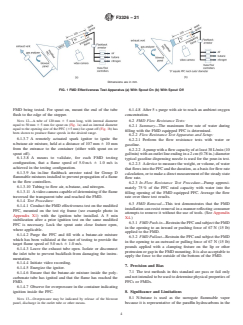
in 6.1.4. The configurations with and without spout are illustrated in Fig. 1.
Dimensions are in mm.
FIG. 1 FMD Effectiveness Test Apparatus (a) With Spout On (b) With Spout Off
F3326 − 21
6.1.2 Hazards—Ignition of a flammable vapor-air mixture, as is required in the FMD effectiveness test, inevitably entails fire and
explosion hazards. Laboratory personnel responsible for these tests need to have training and experience in conducting tests with
flammable vapors.
6.1.3 Test Apparatus and Setup:
6.1.3.1 Fig. 1 shows the test apparatus set up.
6.1.3.2 Cut off the bottom of the FMD equipped PFC so that the FMD being tested clears the mounting plate by 22 cm to 5 cm.
5 cm. Mount the PFC on a rigid base plate containing an opening for the exhaust gas vent tube connection and an approximately
100 mm diameter blowout panel comprised of standard household aluminum foil with a thickness of approximately 0.016 mm.
NOTE 11—It is recommended that exhaust gas tube connection is located in the lower elevation of the mounting plate.
6.1.3.3 A source of dry air, flowed through a controller capable of constant flow
...