

ASTM E1865-97(2021)
(Guide)Standard Guide for Open-Path Fourier Transform Infrared (OP/FT-IR) Monitoring of Gases and Vapors in Air
General Information
- Abstract
SIGNIFICANCE AND USE
4.1 This guide is intended for users of OP/FT-IR monitors. Applications of OP/FT-IR systems include monitoring for hazardous air pollutants in ambient air, along the perimeter of an industrial facility, at hazardous waste sites and landfills, in response to accidental chemical spills or releases, and in workplace environments.
SCOPE
1.1 This guide covers active open-path Fourier transform infrared (OP/FT-IR) monitors and provides guidelines for using active OP/FT-IR monitors to obtain concentrations of gases and vapors in air.
1.2 The values stated in SI units are to be regarded as standard. No other units of measurement are included in this standard.
1.3 This standard does not purport to address all of the safety concerns, if any, associated with its use. It is the responsibility of the user of this standard to establish appropriate safety, health, and environmental practices and determine the applicability of regulatory limitations prior to use.
1.4 This international standard was developed in accordance with internationally recognized principles on standardization established in the Decision on Principles for the Development of International Standards, Guides and Recommendations issued by the World Trade Organization Technical Barriers to Trade (TBT) Committee.
- Status
- Published
- Publication Date
- 31-Mar-2021
- Technical Committee
- E13 - Molecular Spectroscopy and Separation Science
- Drafting Committee
- E13.03 - Infrared and Near Infrared Spectroscopy
Overview
ASTM E1865-97(2021): Standard Guide for Open-Path Fourier Transform Infrared (OP/FT-IR) Monitoring of Gases and Vapors in Air is an internationally recognized guide developed by ASTM International. This standard provides comprehensive guidance for the application and operation of active open-path Fourier Transform Infrared (OP/FT-IR) monitoring systems to quantify concentrations of gases and vapors in ambient air. OP/FT-IR technology is essential for environmental monitoring, workplace safety, emergency response, and perimeter surveillance, enabling real-time, in situ detection of hazardous air pollutants (HAPs) without the need for sample collection.
Key Topics
Principles of OP/FT-IR Monitoring: The guide explains the operational concepts of OP/FT-IR systems, which use infrared spectroscopy to detect and quantify atmospheric gases and vapors over open air paths.
System Configurations: Two main geometric configurations are described:
- Bistatic Systems: IR source and detector are at opposite ends of the monitoring path.
- Monostatic Systems: IR source and detector are at the same end; the beam is returned by a retroreflector.
Instrumental Parameters: Guidance is provided for:
- Measurement time and its impact on signal-to-noise ratio (S/N).
- Optimal selection of spectral resolution, zero-filling, and apodization functions for quality spectral data.
- Avoiding detector saturation and managing stray light or ambient radiation.
Safety and Regulatory Compliance: Users are reminded that safety, health, and environmental practices, as well as compliance with local regulations, are the user’s responsibility.
Applications
Monitoring with open-path FT-IR systems delivers valuable data for:
- Hazardous Air Pollutant Detection: Real-time monitoring for volatile organic compounds (VOCs) and other regulated pollutants in ambient air.
- Industrial Perimeter Surveillance: Continuous assessment of air quality along facility boundaries to ensure compliance and environmental protection.
- Hazardous Waste Sites and Landfill Monitoring: Detection of fugitive emissions, leak detection, and assessment of remediation efforts.
- Workplace Exposure Monitoring: Safeguarding worker health by identifying and quantifying potential airborne hazards.
- Emergency Response: Rapid assessment and mapping of chemical releases due to accidental spills or industrial incidents, aiding emergency response teams in decision-making.
Related Standards
ASTM E1865-97(2021) references and complements several key ASTM standards relevant to infrared spectroscopy and quantitative analysis:
- ASTM E131: Terminology Relating to Molecular Spectroscopy
- ASTM E168: Practices for General Techniques of Infrared Quantitative Analysis
- ASTM E1421: Practice for Measuring Performance of FT-MIR Spectrometers
- ASTM E1655: Practices for Infrared Multivariate Quantitative Analysis
By adhering to ASTM E1865-97(2021), organizations benefit from standardized methodologies, improved data reliability, and enhanced safety in environmental and industrial air monitoring. The standard aligns with international principles for standard development, supporting global adoption and regulatory acceptance of OP/FT-IR monitoring practices.
Relations
- Effective Date
- 01-Mar-2010
- Effective Date
- 01-Mar-2009
- Effective Date
- 01-Mar-2006
- Effective Date
- 01-Sep-2005
- Effective Date
- 01-Dec-2004
- Refers
ASTM E168-99(2004) - Standard Practices for General Techniques of Infrared Quantitative Analysis - Effective Date
- 01-Feb-2004
- Effective Date
- 01-Feb-2004
- Effective Date
- 10-Sep-2002
- Effective Date
- 10-Sep-2000
- Effective Date
- 10-Sep-2000
- Effective Date
- 10-Oct-1999
- Effective Date
- 10-Oct-1999
Get Certified
Connect with accredited certification bodies for this standard

ECOCERT
Organic and sustainability certification.

BSMI (Bureau of Standards, Metrology and Inspection)
Taiwan's standards and inspection authority.

Eurofins Food Testing Global
Global leader in food, environment, and pharmaceutical product testing.
Sponsored listings
Frequently Asked Questions
ASTM E1865-97(2021) is a guide published by ASTM International. Its full title is "Standard Guide for Open-Path Fourier Transform Infrared (OP/FT-IR) Monitoring of Gases and Vapors in Air". This standard covers: SIGNIFICANCE AND USE 4.1 This guide is intended for users of OP/FT-IR monitors. Applications of OP/FT-IR systems include monitoring for hazardous air pollutants in ambient air, along the perimeter of an industrial facility, at hazardous waste sites and landfills, in response to accidental chemical spills or releases, and in workplace environments. SCOPE 1.1 This guide covers active open-path Fourier transform infrared (OP/FT-IR) monitors and provides guidelines for using active OP/FT-IR monitors to obtain concentrations of gases and vapors in air. 1.2 The values stated in SI units are to be regarded as standard. No other units of measurement are included in this standard. 1.3 This standard does not purport to address all of the safety concerns, if any, associated with its use. It is the responsibility of the user of this standard to establish appropriate safety, health, and environmental practices and determine the applicability of regulatory limitations prior to use. 1.4 This international standard was developed in accordance with internationally recognized principles on standardization established in the Decision on Principles for the Development of International Standards, Guides and Recommendations issued by the World Trade Organization Technical Barriers to Trade (TBT) Committee.
SIGNIFICANCE AND USE 4.1 This guide is intended for users of OP/FT-IR monitors. Applications of OP/FT-IR systems include monitoring for hazardous air pollutants in ambient air, along the perimeter of an industrial facility, at hazardous waste sites and landfills, in response to accidental chemical spills or releases, and in workplace environments. SCOPE 1.1 This guide covers active open-path Fourier transform infrared (OP/FT-IR) monitors and provides guidelines for using active OP/FT-IR monitors to obtain concentrations of gases and vapors in air. 1.2 The values stated in SI units are to be regarded as standard. No other units of measurement are included in this standard. 1.3 This standard does not purport to address all of the safety concerns, if any, associated with its use. It is the responsibility of the user of this standard to establish appropriate safety, health, and environmental practices and determine the applicability of regulatory limitations prior to use. 1.4 This international standard was developed in accordance with internationally recognized principles on standardization established in the Decision on Principles for the Development of International Standards, Guides and Recommendations issued by the World Trade Organization Technical Barriers to Trade (TBT) Committee.
ASTM E1865-97(2021) is classified under the following ICS (International Classification for Standards) categories: 17.060 - Measurement of volume, mass, density, viscosity; 71.040.50 - Physicochemical methods of analysis. The ICS classification helps identify the subject area and facilitates finding related standards.
ASTM E1865-97(2021) has the following relationships with other standards: It is inter standard links to ASTM E131-10, ASTM E1421-99(2009), ASTM E168-06, ASTM E131-05, ASTM E1655-04, ASTM E168-99(2004), ASTM E1421-99(2004), ASTM E131-02, ASTM E131-00a, ASTM E1655-00, ASTM E168-99, ASTM E1421-99. Understanding these relationships helps ensure you are using the most current and applicable version of the standard.
ASTM E1865-97(2021) is available in PDF format for immediate download after purchase. The document can be added to your cart and obtained through the secure checkout process. Digital delivery ensures instant access to the complete standard document.
Standards Content (Sample)
This international standard was developed in accordance with internationally recognized principles on standardization established in the Decision on Principles for the
Development of International Standards, Guides and Recommendations issued by the World Trade Organization Technical Barriers to Trade (TBT) Committee.
Designation: E1865 − 97 (Reapproved 2021)
Standard Guide for
Open-Path Fourier Transform Infrared (OP/FT-IR) Monitoring
of Gases and Vapors in Air
This standard is issued under the fixed designation E1865; the number immediately following the designation indicates the year of
original adoption or, in the case of revision, the year of last revision.Anumber in parentheses indicates the year of last reapproval.A
superscript epsilon (´) indicates an editorial change since the last revision or reapproval.
1. Scope 3. Terminology
3.1 For definitions of terms relating to general molecular
1.1 This guide covers active open-path Fourier transform
spectroscopy used in this guide refer to Terminology E131.A
infrared (OP/FT-IR) monitors and provides guidelines for
completeglossaryoftermsrelatingtoopticalremotesensingis
using active OP/FT-IR monitors to obtain concentrations of
given in Ref (1).
gases and vapors in air.
3.2 Definitions:
1.2 The values stated in SI units are to be regarded as
3.2.1 background spectrum, n—asingle-beamspectrumthat
standard. No other units of measurement are included in this
does not contain the spectral features of the analyte(s) of
standard.
interest.
1.3 This standard does not purport to address all of the
3.2.2 bistatic system, n—a system in which the IR source is
safety concerns, if any, associated with its use. It is the
some distance from the detector. For OP/FT-IR monitoring,
responsibility of the user of this standard to establish appro-
this implies that the IR source and the detector are at opposite
priate safety, health, and environmental practices and deter-
ends of the monitoring path.
mine the applicability of regulatory limitations prior to use.
3.2.3 monitoring path, n—the location in space over which
1.4 This international standard was developed in accor-
concentrationsofgasesandvaporsaremeasuredandaveraged.
dance with internationally recognized principles on standard-
3.2.4 monitoring pathlength, n—the distance the optical
ization established in the Decision on Principles for the
beam traverses through the monitoring path.
Development of International Standards, Guides and Recom-
3.2.5 monostatic or unistatic system, n—a system with the
mendations issued by the World Trade Organization Technical
IR source and the detector at the same end of the monitoring
Barriers to Trade (TBT) Committee.
path.ForOP/FT-IRsystems,thebeamisgenerallyreturnedby
a retroreflector.
2. Referenced Documents
3.2.6 open-path monitoring, n—monitoring over a path that
2.1 ASTM Standards:
is completely open to the atmosphere.
E131Terminology Relating to Molecular Spectroscopy
3.2.7 parts per million meters, n—the units associated with
E168Practices for General Techniques of Infrared Quanti-
the quantity path-integrated concentration and a possible unit
tative Analysis
of choice for reporting data from OP/FT-IR monitors because
E1421Practice for Describing and Measuring Performance
it is independent of the monitoring pathlength.
of Fourier Transform Mid-Infrared (FT-MIR) Spectrom-
eters: Level Zero and Level One Tests
3.2.8 path-averagedconcentration,n—theresultofdividing
E1655 Practices for Infrared Multivariate Quantitative the path-integrated concentration by the pathlength.
Analysis 3.2.8.1 Discussion—Path-averaged concentration gives the
averagevalueoftheconcentrationalongthepath,andtypically
is expressed in units of parts per million (ppm), parts per
−3
billion (ppb), or micrograms per cubic meter (µgm ).
This guide is under the jurisdiction of ASTM Committee E13 on Molecular
Spectroscopy and Separation Science and is the direct responsibility of Subcom-
3.2.9 path-integrated concentration, n—the quantity mea-
mittee E13.03 on Infrared and Near Infrared Spectroscopy.
suredbyanOP/FT-IRmonitoroverthemonitoringpath.Ithas
Current edition approved April 1, 2021. Published April 2021. Originally
units of concentration times length, for example, ppm·m.
approved in 1997. Last previous edition approved in 2013 as E1865–97(2013).
DOI: 10.1520/E1865-97R21.
For referenced ASTM standards, visit the ASTM website, www.astm.org, or
contact ASTM Customer Service at service@astm.org. For Annual Book of ASTM
Standards volume information, refer to the standard’s Document Summary page on The boldface numbers in parentheses refer to a list of references at the end of
the ASTM website. this standard.
Copyright © ASTM International, 100 Barr Harbor Drive, PO Box C700, West Conshohocken, PA 19428-2959. United States
E1865 − 97 (2021)
NOTE 1—The OP/FT-IR monitor can be configured to operate in two
3.2.10 plume, n—the gaseous and aerosol effluents emitted
modes: active or passive. In the active mode, a collimated beam of
from a stack or other pollutant source and the volume of space
radiation from an IR source that is a component of the system is
they occupy.
transmittedalongtheopen-airpath.Inthepassivemode,radiationemitted
from objects in the field of view of the instrument is used as the source of
3.2.11 retroreflector, n—an optical device that returns radia-
IR energy. Passive FT-IR monitors have been used for environmental
tion in directions close to the direction from which it came.
applications, such as characterizing the plumes of smoke stacks. More
3.2.11.1 Discussion—Retroreflectors come in a variety of
recently these systems have been developed to detect chemical warfare
forms. The retroreflector commonly used in OP/FT-IR moni-
agentsinmilitaryapplications.However,todate,theactivemodehasbeen
toring uses reflection from three mutually perpendicular sur-
used for most environmental applications of OP/FT-IR monitoring. In
addition to open-air measurements, extractive measurements can be made
faces.Thiskindofretroreflectorisusuallycalledacube-corner
by interfacing a closed cell to an FT-IR system. This type of system can
retroreflector.
beusedasapointmonitorortomeasuretheeffluentinstacksorpipelines.
3.2.12 single-beam spectrum, n—the radiant power mea-
6. Description of OP/FT-IR Systems
sured by the instrument detector as a function of frequency.
3.2.12.1 Discussion—In FT-IR absorption spectrometry the
6.1 Therearetwoprimarygeometricalconfigurationsavail-
single-beamspectrumisobtainedafterafastFouriertransform
able for transmitting the IR beam along the path in active
of the interferogram.
OP/FT-IR systems. One configuration is referred to as bistatic,
3.2.13 synthetic background spectrum, n—a background
while the other is referred to as monostatic, or unistatic.
spectrum made by choosing points along the envelope of a
6.1.1 Bistatic Configuration—In this configuration, the de-
single-beamspectrumandfittingaseriesofshort,straightlines
tector and the IR source are at opposite ends of the monitoring
or a polynomial function to the chosen data points to simulate
path. In this case, the optical pathlength is equal to the
the instrument response in the absence of absorbing gases or
monitoring pathlength. Two configurations can be used for
vapors.
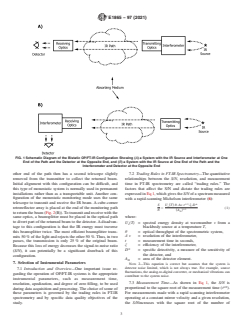
bistatic systems. One configuration places the IR source,
interferometer, and transmitting optics at one end of the path
4. Significance and Use
and the receiving optics and detector at the other end (Fig.
4.1 This guide is intended for users of OP/FT-IR monitors. 1(A)). Typically a Cassegrain or Newtonian telescope is used
Applications of OP/FT-IR systems include monitoring for to transmit and collect the IR beam. The advantage of the
hazardous air pollutants in ambient air, along the perimeter of configuration depicted in Fig. 1(A) is that the IR beam is
an industrial facility, at hazardous waste sites and landfills, in modulated along the path, which enables the unmodulated
response to accidental chemical spills or releases, and in ambient radiation to be rejected by the system’s electronics.
workplace environments. Themaximumdistancethattheinterferometerandthedetector
can be separated in this configuration is limited because
5. Principles of OP/FT-IR Monitoring
communication between these two components is required for
5.1 Long-path IR spectrometry has been used since the timing purposes. For example, a bistatic system with this
mid-1950s to characterize hazardous air pollutants (2). For the configuration developed for monitoring workplace environ-
most part, this earlier work involved the use of multiple-pass, mentshadamaximummonitoringpathlengthof40m (5).The
long-pathIRcellstocollectandanalyzeairsamples.Inthelate other bistatic configuration places the IR source and transmit-
1970s a mobile FT-IR system capable of detecting pollutants ting optics at one end of the path and the receiving optics,
along an open path was developed (3). The 1990 amendments interferometer, and detector at the other end of the path (Fig.
to the Clean Air Act, which may require that as many as 189 1(B)). This is the most common configuration of bistatic
compounds be monitored in the atmosphere, have led to a systems in current use. In this configuration the beam from the
renewed interest in OP/FT-IR monitoring (4). The OP/FT-IR IRsourceiscollimatedbyamirrorshapedasaparaboloid.The
monitor is a spectrometric instrument that uses the mid-IR configuration shown in Fig. 1(B) allows the maximum moni-
toring path, in principle, to be doubled compared to that of the
spectral region to identify and quantify atmospheric gases.
These instruments can be either transportable or permanently monostatic configuration. The main drawback to this bistatic
configuration is that the IR radiation is not modulated before it
installed. An open-path monitor contains many of the same
componentsasthoseinalaboratoryFT-IRsystem,forexample is transmitted along the path. Therefore, radiation from the
the same types of interferometers and detectors are used, active IR source and the ambient background cannot be
exceptthatthesamplevolumeconsistsoftheopenatmosphere. distinguished by electronic processing.
In contrast to more conventional point monitors, the OP/FT-IR 6.1.2 Monostatic Configuration—In monostatic
monitor provides path-integrated concentration data. Unlike configurations, the IR source and the detector are at the same
many other air monitoring methods, such as those that use end of the monitoring path. A retroreflector of some sort is
canistersorsorbentcartridges,theOP/FT-IRmonitormeasures required at the midpoint of the optical path to return the beam
pollutants in situ. Therefore, no samples need be collected, to the detector. Thus, the optical pathlength is twice the
extracted, or returned to the laboratory for analysis. Detection distance between the source and the retroreflector. Two tech-
limits in OP/FT-IR depend on several factors, such as the niques are currently in use for returning the beam along the
monitoring pathlength, the absorptivity of the analyte, and the optical path in the monostatic configuration. One technique
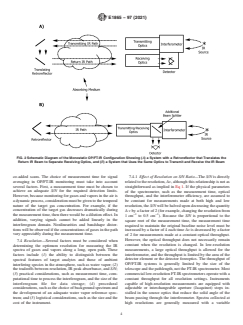
presence of interfering species. For most analytes of interest, uses an arrangement of mirrors, such as a single cube-corner
detection limits typically range between path-integrated con- retroreflector, at one end of the path that translates the beam
centrations of 1.5 and 50 ppm·m. slightly so that it does not fold back on itself (Fig. 2(A)). The
E1865 − 97 (2021)
FIG. 1 Schematic Diagram of the Bistatic OP/FT-IR Configuration Showing (A) a System with the IR Source and Interferometer at One
End of the Path and the Detector at the Opposite End, and (B) a System with the IR Source at One End of the Path and the
Interferometer and Detector at the Opposite End
other end of the path then has a second telescope slightly 7.2 Trading Rules in FT-IR Spectrometry—The quantitative
removed from the transmitter to collect the returned beam. relationships between the S/N, resolution, and measurement
Initial alignment with this configuration can be difficult, and
time in FT-IR spectrometry are called “trading rules.” The
this type of monostatic system is normally used in permanent
factors that affect the S/N and dictate the trading rules are
installations rather than as a transportable unit. Another con-
expressedinEq1,whichgivesthe S/Nofaspectrummeasured
figuration of the monostatic monitoring mode uses the same
with a rapid-scanning Michelson interferometer (6):
telescope to transmit and receive the IR beam. A cube-corner
1/2
S U T ·θ·∆v·t ·ξ·D*
~ !
v
retroreflector array is placed at the end of the monitoring path 5 (1)
1/2
N ~A !
D
toreturnthebeam(Fig.2(B)).Totransmitandreceivewiththe
where:
same optics, a beamsplitter must be placed in the optical path
to divert part of the returned beam to the detector.Adisadvan-
U (T) = spectral energy density at wavenumber v from a
v
tage to this configuration is that the IR energy must traverse
blackbody source at a temperature T,
this beamsplitter twice. The most efficient beamsplitter trans-
θ = optical throughput of the spectrometric system,
∆ v = resolution of the interferometer,
mits 50% of the light and rejects the other 50%.Thus, in two
t = measurement time in seconds,
passes, the transmission is only 25% of the original beam.
ξ = efficiency of the interferometer,
Because this loss of energy decreases the signal-to-noise ratio
D* = specific detectivity, a measure of the sensitivity of
(S/N), it can potentially be a significant drawback of this
the detector, and
configuration.
A = area of the detector element.
D
7. Selection of Instrumental Parameters
NOTE 2—This equation is correct but assumes that the system is
detector noise limited, which is not always true. For example, source
7.1 Introduction and Overview—One important issue re-
fluctuations, the analog-to-digital converter, or mechanical vibrations can
garding the operation of OP/FT-IR systems is the appropriate
contribute to the system noise.
instrumental parameters, such as measurement time,
7.3 Measurement Time—As shown in Eq 1, the S/N is
resolution, apodization, and degree of zero filling, to be used
1/2
proportional to the square root of the measurement time (t ).
during data acquisition and processing. The choice of some of
these parameters is governed by the trading rules in FT-IR For measurements made with a rapid scanning interferometer
operating at a constant mirror velocity and a given resolution,
spectrometry and by specific data quality objectives of the
study. the S/Nincreases with the square root of the number of
E1865 − 97 (2021)
FIG. 2 Schematic Diagram of the Monostatic OP/FT-IR Configuration Showing (A) a System with a Retroreflector that Translates the
Return IR Beam to Separate Receiving Optics, and (B) a System that Uses the Same Optics to Transmit and Receive the IR Beam
co-added scans. The choice of measurement time for signal 7.4.1 Effect of Resolution on S/N Ratio—The S/N is directly
averaging in OP/FT-IR monitoring must take into account relatedtotheresolution,∆v,althoughthisrelationshipisnotas
several factors. First, a measurement time must be chosen to straightforward as implied in Eq 1. If the physical parameters
achieve an adequate S/N for the required detection limits.
of the spectrometer, such as the measurement time, optical
However,becausemonitoringforgasesandvaporsintheairis throughput, and the interferometer efficiency, are assumed to
adynamicprocess,considerationmustbegiventothetemporal
be constant for measurements made at both high and low
nature of the target gas concentration. For example, if the
resolution,the S/Nwillbehalvedupondecreasingthequantity
concentration of the target gas decreases dramatically during
∆ vbyafactorof2(forexample,changingtheresolutionfrom
−1 −1
themeasurementtime,thentherewouldbeadilutioneffect.In
1cm to 0.5 cm ). Because the S/N is proportional to the
addition, varying signals cannot be added linearly in the
square root of the measurement time, the measurement time
interferogram domain. Nonlinearities and bandshape distor-
required to maintain the original baseline noise level must be
tionswillbeobservediftheconcentrationsofgasesinthepath
increasedbyafactorof4eachtime∆visdecreasedbyafactor
vary appreciably during the measurement time.
of 2 for measurements made at a constant optical throughput.
However, the optical throughput does not necessarily remain
7.4 Resolution—Several factors must be considered when
constant when the resolution is changed. In low-resolution
determining the optimum resolution for measuring the IR
measurements, a large optical throughput is allowed for the
spectra of gases and vapors along a long, open path. These
interferometer, and the throughput is limited by the area of the
factors include (1) the ability to distinguish between the
detector element or the detector foreoptics. The throughput of
spectral features of target analytes and those of ambient
OP/FT-IR systems is generally limited by the size of the
interfering species in the atmosphere, such as water vapor; (2)
telescopeandthepathlength,nottheFT-IRspectrometer.Most
thetradeoffsbetweenresolution,IRpeakabsorbance,and S/N;
(3) practical considerations, such as measurement time, com- commerciallow-resolutionFT-IRspectrometersoperatewitha
constant throughput for all resolution settings. Instruments
putationaltimetoprocesstheinterferogram,andthesizeofthe
interferogram file for data storage; (4) procedural capable of high-resolution measurements are equipped with
adjustable or interchangeable aperture (Jacquinot) stops in-
considerations,suchasthechoiceofbackgroundspectrumand
the development of an adequate water vapor reference spec- stalled in the source optics that reduce the solid angle of the
beam passing through the interferometer. Spectra collected at
trum;and(5)logisticalconsiderations,suchasthesizeandthe
cost of the instrument. high resolutions are generally measured with a variable
E1865 − 97 (2021)
−1
rithm.Also, only the 0.5cm resolution measurements exhibited a linear
throughput, which decreases as the spectral resolution im-
relationship for all concentrations of diborane studied. Strang and Levine
proves. In high-resolution measurements made under variable
(9)alsoobservedlittledifferenceinthedetectionlimitsestimatedforthese
throughput conditions, the throughput is halved as ∆v is
−1 −1 −1 −1
compounds at resolutions of 0.5cm ,2cm ,4cm ,and8cm .
−1
decreased by a factor of 2. This results in an additional
However, diborane and phosphine were difficult to quantify at 8cm
decrease in the S/N by one-half, which requires increasing the
resolution because of an insufficient number of data points to define the
absorptionbandusedforquantification.Inalaboratorystudyusinga5cm
measurement time by another factor of 4 to obtain the original
cell, Marshall et al (10) found that, for selected volatile organic com-
S/N. Thus, for high-resolution FT-IR spectrometers operating
pounds (VOCs), the specificity and the accuracy of the CLS results
under variable throughput conditions, the total measurement
deteriorated as the resolution was degraded. Childers and Thompson (11)
time is increased by a factor of 16 when ∆ v is decreased by a
usedCLStoanalyzeasetofdigitallycreatedmixturesofspectraacquired
factor of 2. The preceding discussions apply only to the effect on a bench-top FT-IR system equipped with a 0.5cm gas cell. In this
study, the CLS algorithm accurately quantified target analytes that
of resolution on the baseline noise level. Resolution may also
exhibited spectra with overlapping sharp features, even when the bands
affect the peak absorbance of the bands being measured. For a
used for analysis were not fully resolved. Because the spectral mixtures
weak and narrow spectral feature whose full width at half
were created digitally, Beer’s law was always upheld. However, a failure
height (FWHH) is much less than the instrumental resolution,
to identify all of the overlapping components in a mixture resulted in a
bias and an increase in the error in the CLS analysis. The accuracy of the
the peak absorbance will approximately double on decreasing
CLS analysis was also not affected by resolution for spectra with
∆v by a factor of 2. Assuming this band was measured under
overlapping broad features. However, the magnitude of the errors in the
constant-throughput conditions, its S/N would be the same for
CLSanalysiswasrelatedtothenumberofdatapointsperwavenumberin
measurementstakenatthehigherandlowerresolutionsettings,
the spectra. Therefore, the errors in the CLS analysis increased as the
provided the measurement times are equal. For weak, broad
resolution degraded, if the degree of zero filling was the same at each
resolution.ThemagnitudeoftheerrorsintheCLSanalysesalsoincreased
spectral features whose peak absorbance does not change as a
proportionally with baseline noise. Other multivariate techniques, such as
functionofresolution,acquiringdataatahigherresolutionwill
partial least squares (PLS), may be superior to CLS in dealing with
only increase the baseline noise.
nonlinearity due to low resolution and severe spectral overlap. Griffiths et
7.4.2 Effect of Resolution on Quantitative Analyses—The al (12) have suggested that because many VOCs of interest have band
−1
contours roughly 20 cm wide, a low spectral resolution should be
determination of target gas concentrations by OP/FT-IR spec-
adequate for OP/FT-IR measurements. The authors found that the PLS
trometry depends on the linear relationship between IR absor-
standard error of calibration and standard error of prediction were at a
bance and concentration as given by Beer’s law. This linear
−1
minimumformeasurementsofVOCmixturesmadeat16cm resolution.
relationshipisobservedonlywhenthespectrumismeasuredat
A low-resolution OP/FT-IR monitor based on this premise is currently
a resolution that is equal to or higher than the FWHH of the being developed and evaluated.
band. The measured spectrum is the convolution of the
7.5 Zero-Filling—The fast Fourier transform of a normal
instrument line shape function and the true band shape. As a
interferogram generates spectral points of regular intervals.
result, if the FWHH of the band is narrower than the instru-
When the interferogram contains frequencies that do not
mental function, the measured spectrum will vary only ap-
coincide with the frequency sample points, the spectrum
proximatelylinearlywithconcentration.Forexample,Spellicy
resembles a “picket fence.” Extending the interferogram syn-
etal (4)haveshownthattheabsorbanceforasingleLorentzian
thetically with zeros added to the end will increase the density
−1
band with a FWHH of 0.1 cm is linear with concentration
of points in the spectrum and reduce the picket fence effect.
only when measured at a high resolution, for example, 0.01
Zero filling improves only the digital resolution, and not the
−1
cm . Deviation from linearity would most likely be observed
spectral resolution. Normally, some multiple (for example, 2,
in small molecules such as HCl, CO, CO , and H O, which
2 2
4, etc.) of the original number of data points is added to the
−1
have sharp spectral features (FWHH ≈ 0.1 cm ). For larger
interferogram.Oneorderofzerofilling,whichistwotimesthe
molecules,suchasheavyhydrocarbonsthatexhibitbroaderIR
original number of data points, is usually appropriate. The
−1
bands with contours of approximately 20 cm , the linear
picket fence effect is less extreme if the spectral components
relationship between absorbance and concentration is more
arebroadenoughtobespreadoverseveralsamplingpositions.
likely to be followed at lower resolution.
It should be noted that zero filling does increase the file size
and, therefore, the time required for data processing.
NOTE 3—The effect of resolution on quantitative OP/FT-IR measure-
ments has been addressed by several groups, although a consensus on
7.6 Apodization—Thefinitemovementoftheinterferometer
what resolution is generally applicable has not yet been reached. The
mirror truncates, or cuts off, the true interferogram. This, in
optimum resolution to use is influenced by the choice of quantitative
effect, multiplies the interferogram by a boxcar truncation
analysis method. For example, if the scaled subtraction method is used,
function.Thisfunctionmaycausetheappearanceofsidelobes
high-resolution spectra can be used to advantage. Bittner et al (7) used
scaled subtraction to detect 5 ppb of benzene over a 100m path. Spectra
on both sides of a narrow absorption band. The corrective
−1
recordedat0.125cm resolutionallowedthenarrowbenzenebandat674
procedure for eliminating these side lobes is called apodiza-
−1
cm to be separated from the strong CO absorption bands. If a
tion.Apodization is done by multiplying the interferogram by
multivariateanalysismethodisused,theabsorptionbandsofthetargetgas
amathematicalfunction.Typicalapodizationfunctionsinclude
and interfering species do not need to be completely resolved. However,
the degree of spectral overlap does seem to affect the accuracy of some triangular, Happ-Genzel, and Norton-Beer functions.Apodiza-
multivariate techniques, such as classical least squares (CLS). For
tion affects the spectral resolution, the peak absorbance, and
example, Strang et al (8) used a closed-path FT-IR system equipped with
the noise of the spectrum. The absorbance of narrow or strong
a 20.25m multipass cell to monitor organic vapors and metal hydrides in
bands will be most affected by the choice of apodization
simulatedworkplaceenvironments.Becauseofspectraloverlapwithother
−1
function.Ingeneral,thebandsinaspectrumcomputedwithno
target analytes, CO , and water vapor, a resolution of 0.5 cm was
required to quantify arsine, diborane, and phosphine with a CLS algo- apodizationwillbemoreintensethanbandscomputedfromthe
E1865 − 97 (2021)
−1
same interferogram after applying an apodization function. completely resolved only at a resolution of 0.125 cm or
Apodization also degrades resolution slightly. In general, to better. Because these compounds are in every long-path spec-
obtain the optimum S/N for spectra of small molecules with
trum and often overlap with the target analyte, access to
resolvablefinestructure,theuseofnoapodizationispreferable
high-resolution data may be required to visualize the spectral
if side lobes from neighboring intense bands do not present an
features of the target gas and to identify interfering species.
interference. If side lobes are present and interfere with either
This information can then be used to develop the analysis
qualitative or quantitative analyses, apodization becomes nec-
method.
essary.Forbroadabsorptionbands,themeasuredabsorbanceis
7.7.2.2 Determine if interfering species are present. If the
about the same in apodized and unapodized spectra. Overall,
comparison or scaled subtraction method is used for quantita-
the greatest noise suppression will be obtained with the
tive analysis (see 12.4), the resolution should be sufficient to
strongest apodization function, but the spectral resolution and
separate spectral features of the target gases from those of
band intensities will be greatest for weaker apodization func-
interfering species.
tions (6). The choice of apodization function also may affect
7.7.2.3 Acquire reference spectra of the target gases. If the
the quality of fit in multivariate analysis techniques. The same
specific target gases are known before beginning the monitor-
apodization function should be used for the sample spectra as
ing study, reference spectra of the compounds of interest
was used for the reference spectra.Also, the same apodization
should be obtained at various resolutions. By comparing the
function should be used for spectral data that are to be
exchanged from one instrument to another for comparative spectra recorded at different resolutions, the operator can
purposes. determinethelowestresolutionmeasurementthatstillresolves
the spectral features of interest. This resolution setting should
7.7 Guidance for Selecting Instrumental Parameters—
be used as a starting point for future measurements. If it is not
Although a stepwise protocol that specifies instrumental pa-
possible to record the reference spectra, the operator should
rameters is not yet available for OP/FT-IR monitoring, the
consult reference libraries to determine the resolution required
operator should have an appreciation for the effect that the
to characterize the target analyte.
instrumental parameters have on spectral measurements. Gras-
7.7.2.4 Develop calibration curves of the target gases. If an
selli et al (13) have published criteria for presenting spectra
inadequate resolution is used, the relationship between absor-
fromcomputerizedIRinstruments,withanemphasisonFT-IR
measurements. The authors established recommendations and bance and concentration will not be linear. This relationship is
guidelines for reporting experimental conditions, instrumental also affected by the apodization function. Calibration curves
parameters, and other pertinent information describing the
coveringtheconcentrationrangeofthetargetgasesexpectedin
acquisition of FT-IR spectra. These guidelines should be
the ambient measurements should be developed at different
followed when reporting OP/FT-IR data.The following guide-
resolutions and with the use of different apodization functions
linesshouldbetakenintoaccountwhenchoosingtheoptimum
to determine the optimum settings. If the compound of interest
instrumental parameters for OP/FT-IR measurements. The
does not respond linearly with respect to concentration, a
parameters may need to be optimized for the specific experi-
correction curve will need to be applied to the data during
ments planned, taking into consideration the goals of the
quantitative analysis.
monitoring study.
7.7.2.5 Determine the effect of resolution on the other
7.7.1 Measurement Time—First, determine the measure-
procedures involved with generating OP/FT-IR data, such as
ment time required to achieve the desired S/N at the selected
creation of a synthetic background and water-vapor-reference
resolution. Then determine if this is an appropriate measure-
spectrum. These procedures rely on a series of subjective
ment time to capture the event being studied. If the measure-
judgements based on the visual inspection of the field spectra.
ment time is longer than the event being studied there will be
Choices made in these procedures can be facilitated by using a
a dilution effect. Nonlinearities and band distortions might be
higher resolution.
observed due to adding a changing signal in the interferogram
7.7.3 Zero Filling and Apodization—In general, a zero
domain.
filling factor of 2 should be used when processing the original
7.7.2 Resolution—Although there is currently no consensus
interferograms.Triangular and Happ-Genzel apodization func-
among workers in the discipline of OP/FT-IR monitoring as to
tions are commonly used in OP/FT-IR monitoring, although
the optimum resolution to be used to collect field data, the
Griffiths et al (12) have indicated that a Norton-Beer medium
following steps can be taken to choose the best resolution for
function actually gives a better representation of the true
a particular application.
absorbance. In all cases, however, the same parameters should
7.7.2.1 Consider the bandwidths of the absorption features
be used to collect the field spectra that were used to record the
usedtoanalyzeforspecifictargetgases.Iftheabsorptionbands
reference spectra. The choice of apodization function may be
of the target gases are broad, there may be no need to acquire
limited by this requirement. If spectra from a commercial or
high-resolution spectra. When this is the case, no additional
user-generated library are to be the reference spectra for
information will be gained, and the measurements will have
quantitative analysis, then the parameters that were used to
poorer S/N and will require longer data collection, longer
generate those reference spectra should be used to collect the
computationaltimes,andlargerdatastoragespace.Theanalyst
field spectra. Otherwise, errors in the concentration measure-
must be aware, however, that the spectral features of atmo-
spheric constituents such as CO,H O, and CH can be ment will occur.
2 2 4
E1865 − 97 (2021)
8. Initial Instrument Operation although it is not opaque. The absorption features of methane
−1
arealsointhisregion.Theatmospherefrom3500cm to3900
8.1 The assumption made for the following discussion is
−1
cm is opaque, again because of water vapor. At sufficiently
that the manufacturer has set up the OP/FT-IR system and it is
long monitoring paths (approximately 50 m) spectral features
performing according to specifications. The tests outlined in
−1 −1 −1
ofCO(2040cm to2230cm )andN O(2150cm to2265
this section should be performed before actual field data are
−1
cm ) should be observed in the single-beam spectrum. As in
recorded. Many of the tests involving the initial instrument
tests described in Practice E1421, the intensity of the single-
setup are similar to those proposed for use in the quality
beam spectrum should be recorded for different regions, for
assurance/quality control (QA/QC) procedures presented in
−1 −1 −1
example, near 990cm , 2500cm , and 4400 cm , to form a
Section 13 of this guide.
basicsetofdataabouttheinstrument’soperation.Regionsthat
8.2 The Single-Beam Spectrum—The operator should be-
are not impacted significantly by water vapor should be
come familiar with the features that are expected to be present
chosen.Alongwiththisinformation,theoperatorshouldrecord
in a typical single-beam spectrum. A single-beam spectrum
the pathlength and water-vapor concentration.
−1
acquired along a 414m optical path at a nominal 1cm
8.3 Distance to Detector Saturation—Oneofthefirstpieces
resolution is shown in Fig. 3. There are several features in the
of information to obtain with an OP/FT-IR monitor is the
spectrum that should be noted. First, the IR energy in the
−1 −1 pathlength at which the detector becomes saturated. For
regions from approximately 1415cm to 1815 cm and
−1 −1 permanent installations in which the pathlength is fixed or
3550cm to3900cm istotallyabsorbedbywatervapor.For
predetermined this should be a parameter specified to the
a given pathlength, the width of the region for complete
manufacturer. The distance at which the detector becomes
absorption varies as the amount of water vapor in the atmo-
saturated is particularly important for mercury-cadmium-
sphere changes. The strong absorption in the region from
−1 −1 telluride (MCT) detectors that are currently used in OP/FT-IR
approximately 2235cm to 2390 cm is due to carbon
systems. Detector saturation is not as severe of a problem for
dioxide.Theatmosphereisalwaysopaqueinthiswavenumber
thermal detectors, such as deuterated triglycine sulfate
region,evenovershortpaths.Theopaqueregionsrepresentthe
detectors, which may be used in OP/FT-IR systems in the
baseline of the single-beam spectrum and they should always
future. The operator should pay particular attention to the
be flat and register zero. Any deviation from zero in these
spectrum in the wavenumber region below the detector cutoff.
regions indicates that something is wrong with the instrument
For the MCT detector used to generate Fig. 3, the detector
operation. For example, the opaque regions are slightly el-
−1 −1
cutoff occurs between 600cm and 700 cm . The spectrum
evated in Fig. 3. This is due to internal stray light. This point
below the detector cutoff frequency should be flat and at the
is discussed in more detail in 8.5.When the monitoring path is
baseline. If the spectrum has an elevated baseline in this
sufficiently long (for example, 200m) or the water vapor
wavenumber region, the detector may be operating in a
partialpressureishighenough,forexample,1333Pa(10torr),
−1 nonlinear manner. If this is the case, nonphysical energy will
an absorption band should be noticeable at 2720 cm . This
appearwellbelowthedetectorcutoffastheretroreflectororIR
band is the Q-branch of deuterated water (HDO) and it is also
−1 −1 source is brought closer to the receiving optics.An example of
possible to observe the P(2700cm to 2550 cm ) and the R
−1 −1 this is given in Fig. 4 for a single-beam spectrum recorded at
(2750cm to 2850 cm ) branches. The spectral region
−1 a 20m pathlength. The minimum of this artifact is not to be
around 3000 cm is also strongly impacted by water vapor,
FIG. 4 Single-Beam OP/FT-IR Spectrum Recorded at a 20 m Total
FIG. 3 Single-Beam OP/FT-IR Spectrum Along a 414 m Path with Pathlength. The Nonphysical Energy Annotated in the Encircled
Regions of Typical Atmospheric Absorption Features Annotated Area Indicates Detector Saturation
E1865 − 97 (2021)
−1
confused with an absorption band due to CO near 668 cm . surfaces within the instrument housing and sensed by the
The distance at which the nonphysical energy appears repre- detector without traversing the monitoring path. Ambient
sents the minimum pathlength over which it is possible to
radiation mostly affects bistatic systems in which the active IR
operate without making changes to the instrument. A test for source is separated from the interferometer and detector (see
determining the ratio of the nonphysical energy to the maxi-
Fig. 1(B)). In principle, all radiation collected by the receiving
mum energy in the single-beam spectrum is given in Practice
telescopeismodulatedbytheinterferometerandsensedbythe
E1421. If significant nonphysical energy is observed at the
detector. Because the IR radiation from the active IR source is
desiredmonitoringpathlength,itispossibletoattenuatetheIR
not modulated as it propagates along the monitoring path in
beam, for example, by using a fine wire mesh screen to cover
thistypeofsystem,thereisnowaytodistinguishitfromother
the aperture. As a last resort, it is possible to rotate the
IR sources in the field of view of the telescope. Therefore, the
retroreflector or the IR source to lower the signal strength and
detector response in this type of bistatic system represents a
minimize the nonphysical energy. Also, it is not useful to
composite of radiation from various IR sources. The presence
simplychangethegainofthedetectorpreamplifiertolowerthe
of stray light or ambient radiation causes errors in the photo-
apparentbeamintensity,becausethedetectornonlinearitydoes
metric accuracy and ultimately errors in the concentration
not depend on gain.
measurements. Errors due to stray light or ambient radiation
can be larger than those caused by other instrumental sources
8.4 SignalStrengthasaFunctionofDistance—InOP/FT-IR
of error, such as source flicker. In general, if uncorrected for,
systems, the IR beam is collimated before it is transmitted
the presence of stray light or ambient radiation always causes
along the path. However, the beam will diverge as it traverses
the concentration to be underestimated. For example, if stray
the path. The size of the IR source determines the divergence
light represents 10% of the total return signal, the resulting
of the beam. Once the diameter of the beam is larger than the
calculated concentration will be approximately 10% lower
retroreflector (monostatic system) or the receiving telescope
than the actual concentration. The relative effect of stray light
(bistaticsystem),thesignalstrengthwilldiminishasthesquare
or ambient radiation increases as the return signal decreases
ofthedistance.Theneedtodeterminetherelationshipbetween
signal strength and distance is twofold. First, at some distance and is amplified at low values of transmittance (high values of
absorbance). However, the effect of stray light and ambient
thesystemnoisewillbecomeanappreciablepartofthesignal.
Secondly,extraneousradiationcanproducemeasurablesignals radiation is not uniform across the range of absorbance values
in OP/FT-IR systems. For example, monostatic systems with typically encountered in OP/FT-IR measurements. Therefore,
the configuration depicted in Fig. 2(B) that use an additional even if the field spectra are corrected for either stray light or
beamsplitterhavesomesignalcontributionduetointernalstray ambient radiation, the accuracy of the concentration measure-
light. In bistatic systems that use an unmodulated, external IR ments may still be affected. Thus, the relative contributions of
source (Fig. 1(B)), ambient radiation contributes to the total
stray light or ambient radiation to the total signal should be
signal. In both systems, the strength of the signal should be minimized. In bistatic systems, efforts to make the ambient
maintainedabovethesignalduetoeitherstraylightorambient
background as consistent as possible should be made. Hot
radiation. To determine the signal strength as a function of objects, objects that may undergo temperature differences
distance, start with the retroreflector or the IR source at the
during the monitoring period, and the sky should not be in the
minimum working distance as determined in 8.3, then move
field of view of the instrument during data acquisition. In
the retroreflector or IR source back by some distance and
monostaticsystems,anexcessiveamountofinternalstraylight
record the magnitude of the signal. For this test, the signal
indicates either a design or an alignment problem in the
strength can be determined by measuring either the peak-to-
transfer optics. Correction of excessive stray light problems
peak voltage of the interferogram or the intensity of the
may require action by the manufacturer of the instrument.
single-beam spectrum at a specific frequency. If the single-
8.5.1 Measurement of the Internal Stray Light—As men-
beam intensity is monitored for this test, a wavenumber region
tioned previously, the problem of modulated, internal stray
that does not contain water-vapor-absorption bands should be
light is most apparent in monostatic systems that use a single
used.
telescope to transmit and receive the IR beam and require an
additional beamsplitter in the path (see Fig. 2(B)). The stray
8.5 Determination of the Signal Due to Internal Stray Light
light in the instrument can be measured without regard to the
and Ambient Radiation—Asshownin8.2,single-beamspectra
distance to the retroreflector. To measure the stray light in this
recorded with an OP/FT-IR monitor may exhibit non-zero
type of monostatic system, point the telescope away from the
signal intensities in wavenumber regions in which the atmo-
retroreflectorormovetheretroreflectoroutofthefieldofview
sphere is totally opaque. This non-zero response can be
attributed to either internal stray light or ambient radiation of the telescope and collect a spectrum. A record of the stray
light spectrum should be made and compared to the single-
depending on the configuration of the OP/FT-IR monitor.
Internalstraylightismostlikelytobeaprobleminmonostatic beam spectrum recorded at the selected working distance. An
example of the relative contribution of stray light to the total
systems that use a single telescope to transmit and receive the
IR beam (see Fig. 2(B)). As discussed in 6.1.2, this configu- signal in this type of monostatic system is given in Fig. 5.In
thiscase,themagnitudeofthestraylightisapproximately6%
rationrequiresanadditionalbeamsplittertodirectthereturnIR
beamtothedetector.Thisbeamsplitteralsodivertsabout50% ofthetotalreturnsignal.Typicallythestraylightspectrumwill
of the IR energy before it is transmitted along the monitoring overlap with the minima of the field single-beam spectrum in
path. A portion of this diverted IR energy can be reflected by wavenumber regions in which the atmosphere is totally
E1865 − 97 (2021)
FIG. 6 Single-Beam OP/FT-IR Spectra Measured with a Bistatic
FIG. 5 Single-Beam OP/FT-IR Spectra Recorded with a Monostatic
System over a 207 m Path with (A) the IR Source On and (B) with
System over a 414 m Path with (A) the Telescope Slewed Away
the IR Source Off. Spectrum Represents the Total IR Signal
from the Retroreflector. Spectrum A Represents the Total Return
Whereas Spectrum Represents the Signal Due to Ambient
Signal Whereas Spectrum B Represents the Signal Due to Stray
Radiation
Light
−1
but is less significant above 2000 cm . Because the spectrum
opaque. The fine structure in the stray light spectrum from
−1 −1 −1 −1 due to ambient radiation is temperature-dependent, its relative
4200cm to 2900 cm and 2200cm to 1100 cm is
contribution to the total signal will be variable. This variation
absorption
...