

ASTM D6783-05a(2022)
(Specification)Standard Specification for Polymer Concrete Pipe
General Information
- Abstract
ABSTRACT
This specification covers the testing and requirements fof polymer concrete pipes of specified lengths, intended for use in gravity-flow systems for conveying sanitary sewage, storm water, and industrial wastes. Although this specification is suited primarily for pipes to be installed by direct burial and pipe jacking, it may be used to the extent applicable for other installations such as slip-lining and rehabilitation of existing pipelines. Materials shall be appropriately sampled for purposes of testing their conformance to such requirements as: workmanship; dimension (diameter, length, thickness, straightness, roundness, and squareness of ends); three-edge bearing; hydrostatic pressure; compressive strength; chemical resistance; and joint tightness.
SCOPE
1.1 This specification covers polymer concrete pipe, 6 in. (150 mm) through 144 in. (3 660 mm), intended for use in gravity-flow systems for conveying sanitary sewage, storm water, and industrial wastes.
1.2 Although this specification is suited primarily for pipe to be installed by direct burial and pipe jacking, it may be used to the extent applicable for other installations such as sliplining and rehabilitation of existing pipelines.
Note 1: Unlike reinforced thermosetting resin pipes, polymer concrete pipe is designed and installed using rigid pipe design theory and practices.
1.3 The values stated in inch-pound units are to be regarded as the standard. The values given in parentheses are for information only.
1.4 The following safety hazards caveat pertains only to the test methods portion, Section 8, of this specification. This standard does not purport to address all of the safety concerns, if any, associated with its use. It is the responsibility of the user of this standard to establish appropriate safety, health, and environmental practices and determine the applicability of regulatory limitations prior to use.
Note 2: There is no known ISO equivalent to this standard.
1.5 This international standard was developed in accordance with internationally recognized principles on standardization established in the Decision on Principles for the Development of International Standards, Guides and Recommendations issued by the World Trade Organization Technical Barriers to Trade (TBT) Committee.
- Status
- Published
- Publication Date
- 14-Jul-2022
- Technical Committee
- D20 - Plastics
Overview
ASTM D6783-05a(2022), Standard Specification for Polymer Concrete Pipe, defines the requirements and test methods for polymer concrete pipes used primarily in gravity-flow systems for conveying sanitary sewage, stormwater, and industrial wastes. Developed by ASTM International, this standard provides guidance on pipe dimensions, materials, strength classes, and performance criteria. The specification applies mainly to pipes installed by direct burial or pipe jacking but extends to other installation methods such as slip-lining and pipeline rehabilitation.
Polymer concrete pipe, as specified in ASTM D6783, offers a rigid, corrosion-resistant solution suitable for demanding environments where traditional materials may not suffice. This standard ensures consistent quality and reliable performance, supporting safe and effective pipeline infrastructure.
Key Topics
Scope and Applicability
- Covers polymer concrete pipe sizes from 6 in. (150 mm) to 144 in. (3,660 mm) for gravity-flow applications
- Addresses use in sanitary sewers, storm drains, and industrial waste systems
- Applicable to direct burial, pipe jacking, sliplining, and rehabilitation
Material Requirements
- Specifies use of thermosetting resin and aggregate composition for pipe walls
- Details gasket-sealed joining systems using elastomeric seals, as per ASTM F477
- Outlines manufacturing criteria to ensure consistent quality and pipe performance
Dimensional and Physical Properties
- Sets tolerances for diameter, length, wall thickness, straightness, roundness, and end squareness
- Defines strength classes (I-V) with different load-bearing capacities
- Requires pipes to be free from defects that could affect strength and performance
Performance Testing
- Three-edge bearing strength test for structural integrity
- Hydrostatic pressure test confirming leak resistance
- Compressive strength test requirement
- Chemical resistance testing over short and long terms
- Joint tightness verification for both direct bury and jacking pipe installations
Quality Control and Sampling
- Production testing requirements for each lot manufactured
- Qualification tests upon changes to materials or processes
- Annual control tests for chemical resistance unless otherwise agreed
Applications
Polymer concrete pipe produced in accordance with ASTM D6783-05a(2022) finds essential usage in a variety of infrastructure and civil engineering projects due to its high strength, chemical resistance, and rigid structural characteristics.
Gravity-Flow Conveyance Systems
- Sanitary sewer systems transporting domestic and municipal wastewater
- Stormwater drainage for roadways, airports, and urban areas
- Conveyance of industrial waste where aggressive chemical environments demand durable materials
Installation Methods
- Suitable for direct burial in new construction pipelines
- Pipe jacking for trenchless installations beneath roadways or waterways
- Slip-lining and pipeline rehabilitation, reducing the need for large excavations when upgrading existing facilities
Industrial and Municipal Projects
- Waste treatment facilities, factories, power plants, and municipal infrastructure benefit from the extended service life and lower maintenance needs offered by polymer concrete pipe
Related Standards
ASTM D6783-05a(2022) references a range of ASTM standards to specify test methods, terminology, and material requirements, ensuring unified quality throughout the manufacturing and installation processes. Key related standards include:
- ASTM F477: Specification for Elastomeric Seals (Gaskets) for Joining Plastic Pipe
- ASTM D4161: Specification for Glass-Fiber-Reinforced Thermosetting-Resin Pipe Joints Using Flexible Elastomeric Seals
- ASTM C579: Test Methods for Compressive Strength of Polymer Concretes
- ASTM C125: Terminology Relating to Concrete and Concrete Aggregates
- ASTM C136/C136M: Test Method for Sieve Analysis of Fine and Coarse Aggregates
- ASTM D648: Test Method for Deflection Temperature of Plastics
Note: There is currently no ISO equivalent for ASTM D6783-05a(2022).
By adhering to ASTM D6783-05a(2022), engineers, manufacturers, and contractors ensure that polymer concrete piping systems meet rigorous and internationally recognized standards for structural integrity and long-term performance in challenging environments.
Relations
- Effective Date
- 01-Feb-2024
- Effective Date
- 01-Feb-2024
- Effective Date
- 01-Jan-2024
- Effective Date
- 15-Nov-2023
- Effective Date
- 01-Nov-2023
- Effective Date
- 01-Apr-2020
- Effective Date
- 01-Jan-2020
- Effective Date
- 15-Dec-2019
- Effective Date
- 01-Aug-2019
- Effective Date
- 15-Apr-2019
- Effective Date
- 01-Apr-2019
- Effective Date
- 01-Feb-2019
- Effective Date
- 01-Jan-2019
- Effective Date
- 01-Jan-2019
- Effective Date
- 01-Dec-2018
Get Certified
Connect with accredited certification bodies for this standard

Zavod za gradbeništvo Slovenije (ZAG) - Inšpekcija
ZAG inspection body for construction products, structures, and materials.
Sponsored listings
Frequently Asked Questions
ASTM D6783-05a(2022) is a technical specification published by ASTM International. Its full title is "Standard Specification for Polymer Concrete Pipe". This standard covers: ABSTRACT This specification covers the testing and requirements fof polymer concrete pipes of specified lengths, intended for use in gravity-flow systems for conveying sanitary sewage, storm water, and industrial wastes. Although this specification is suited primarily for pipes to be installed by direct burial and pipe jacking, it may be used to the extent applicable for other installations such as slip-lining and rehabilitation of existing pipelines. Materials shall be appropriately sampled for purposes of testing their conformance to such requirements as: workmanship; dimension (diameter, length, thickness, straightness, roundness, and squareness of ends); three-edge bearing; hydrostatic pressure; compressive strength; chemical resistance; and joint tightness. SCOPE 1.1 This specification covers polymer concrete pipe, 6 in. (150 mm) through 144 in. (3 660 mm), intended for use in gravity-flow systems for conveying sanitary sewage, storm water, and industrial wastes. 1.2 Although this specification is suited primarily for pipe to be installed by direct burial and pipe jacking, it may be used to the extent applicable for other installations such as sliplining and rehabilitation of existing pipelines. Note 1: Unlike reinforced thermosetting resin pipes, polymer concrete pipe is designed and installed using rigid pipe design theory and practices. 1.3 The values stated in inch-pound units are to be regarded as the standard. The values given in parentheses are for information only. 1.4 The following safety hazards caveat pertains only to the test methods portion, Section 8, of this specification. This standard does not purport to address all of the safety concerns, if any, associated with its use. It is the responsibility of the user of this standard to establish appropriate safety, health, and environmental practices and determine the applicability of regulatory limitations prior to use. Note 2: There is no known ISO equivalent to this standard. 1.5 This international standard was developed in accordance with internationally recognized principles on standardization established in the Decision on Principles for the Development of International Standards, Guides and Recommendations issued by the World Trade Organization Technical Barriers to Trade (TBT) Committee.
ABSTRACT This specification covers the testing and requirements fof polymer concrete pipes of specified lengths, intended for use in gravity-flow systems for conveying sanitary sewage, storm water, and industrial wastes. Although this specification is suited primarily for pipes to be installed by direct burial and pipe jacking, it may be used to the extent applicable for other installations such as slip-lining and rehabilitation of existing pipelines. Materials shall be appropriately sampled for purposes of testing their conformance to such requirements as: workmanship; dimension (diameter, length, thickness, straightness, roundness, and squareness of ends); three-edge bearing; hydrostatic pressure; compressive strength; chemical resistance; and joint tightness. SCOPE 1.1 This specification covers polymer concrete pipe, 6 in. (150 mm) through 144 in. (3 660 mm), intended for use in gravity-flow systems for conveying sanitary sewage, storm water, and industrial wastes. 1.2 Although this specification is suited primarily for pipe to be installed by direct burial and pipe jacking, it may be used to the extent applicable for other installations such as sliplining and rehabilitation of existing pipelines. Note 1: Unlike reinforced thermosetting resin pipes, polymer concrete pipe is designed and installed using rigid pipe design theory and practices. 1.3 The values stated in inch-pound units are to be regarded as the standard. The values given in parentheses are for information only. 1.4 The following safety hazards caveat pertains only to the test methods portion, Section 8, of this specification. This standard does not purport to address all of the safety concerns, if any, associated with its use. It is the responsibility of the user of this standard to establish appropriate safety, health, and environmental practices and determine the applicability of regulatory limitations prior to use. Note 2: There is no known ISO equivalent to this standard. 1.5 This international standard was developed in accordance with internationally recognized principles on standardization established in the Decision on Principles for the Development of International Standards, Guides and Recommendations issued by the World Trade Organization Technical Barriers to Trade (TBT) Committee.
ASTM D6783-05a(2022) is classified under the following ICS (International Classification for Standards) categories: 93.030 - External sewage systems. The ICS classification helps identify the subject area and facilitates finding related standards.
ASTM D6783-05a(2022) has the following relationships with other standards: It is inter standard links to ASTM A276/A276M-24a, ASTM D883-24, ASTM A276/A276M-24, ASTM C117-23, ASTM D883-23, ASTM F412-20, ASTM D883-20, ASTM C125-19a, ASTM D883-19c, ASTM D883-19a, ASTM D4161-14(2019), ASTM D883-19, ASTM F412-19, ASTM C125-19, ASTM D883-18a. Understanding these relationships helps ensure you are using the most current and applicable version of the standard.
ASTM D6783-05a(2022) is available in PDF format for immediate download after purchase. The document can be added to your cart and obtained through the secure checkout process. Digital delivery ensures instant access to the complete standard document.
Standards Content (Sample)
This international standard was developed in accordance with internationally recognized principles on standardization established in the Decision on Principles for the
Development of International Standards, Guides and Recommendations issued by the World Trade Organization Technical Barriers to Trade (TBT) Committee.
Designation: D6783 −05a (Reapproved 2022)
Standard Specification for
Polymer Concrete Pipe
This standard is issued under the fixed designation D6783; the number immediately following the designation indicates the year of
original adoption or, in the case of revision, the year of last revision. A number in parentheses indicates the year of last reapproval. A
superscript epsilon (´) indicates an editorial change since the last revision or reapproval.
1. Scope A276/A276M Specification for Stainless Steel Bars and
Shapes
1.1 This specification covers polymer concrete pipe, 6 in.
C33/C33M Specification for Concrete Aggregates
(150 mm) through 144 in. (3 660 mm), intended for use in
C117 Test Method for Materials Finer than 75-µm (No. 200)
gravity-flow systems for conveying sanitary sewage, storm
Sieve in Mineral Aggregates by Washing
water, and industrial wastes.
C125 Terminology Relating to Concrete and Concrete Ag-
1.2 Althoughthisspecificationissuitedprimarilyforpipeto
gregates
be installed by direct burial and pipe jacking, it may be used to
C136/C136M Test Method for Sieve Analysis of Fine and
the extent applicable for other installations such as sliplining
Coarse Aggregates
and rehabilitation of existing pipelines.
C579 Test Methods for Compressive Strength of Chemical-
NOTE1—Unlikereinforcedthermosettingresinpipes,polymerconcrete
Resistant Mortars, Grouts, Monolithic Surfacings, and
pipe is designed and installed using rigid pipe design theory and practices.
Polymer Concretes
1.3 The values stated in inch-pound units are to be regarded
D648 Test Method for Deflection Temperature of Plastics
as the standard. The values given in parentheses are for
Under Flexural Load in the Edgewise Position
information only.
D883 Terminology Relating to Plastics
1.4 The following safety hazards caveat pertains only to the D1600 Terminology forAbbreviatedTerms Relating to Plas-
test methods portion, Section 8, of this specification. This
tics
standard does not purport to address all of the safety concerns, D2584 Test Method for Ignition Loss of Cured Reinforced
if any, associated with its use. It is the responsibility of the user
Resins
of this standard to establish appropriate safety, health, and D3567 Practice for Determining Dimensions of “Fiberglass”
environmental practices and determine the applicability of (Glass-Fiber-Reinforced Thermosetting Resin) Pipe and
regulatory limitations prior to use.
Fittings
D3681 Test Method for Chemical Resistance of “Fiberglass”
NOTE 2—There is no known ISO equivalent to this standard.
(Glass–Fiber–Reinforced Thermosetting-Resin) Pipe in a
1.5 This international standard was developed in accor-
Deflected Condition
dance with internationally recognized principles on standard-
D3892 Practice for Packaging/Packing of Plastics
ization established in the Decision on Principles for the
D4161 Specification for “Fiberglass” (Glass-Fiber-
Development of International Standards, Guides and Recom-
Reinforced Thermosetting-Resin) Pipe Joints Using Flex-
mendations issued by the World Trade Organization Technical
ible Elastomeric Seals
Barriers to Trade (TBT) Committee.
F412 Terminology Relating to Plastic Piping Systems
F477 Specification for Elastomeric Seals (Gaskets) for Join-
2. Referenced Documents
ing Plastic Pipe
2.1 ASTM Standards:
3. Terminology
3.1 Definitions—Unless otherwise indicated, definitions are
This specification is under the jurisdiction of ASTM Committee D20 on
in accordance with Terminologies C125, D883, and F412, and
Plastics and is the direct responsibility of Subcommittee D20.23 on Reinforced
Thermosetting Resin Piping Systems and Chemical Equipment.
abbreviations are in accordance with Terminology D1600.
Current edition approved July 15, 2022. Published July 2022. Originally
3.2 Definitions of Terms Specific to This Standard:
approved in 2002. Last previous edition approved in 2017 as D6783 - 05a(2017).
DOI: 10.1520/D6783-05AR22.
3.2.1 aggregate, n—a granular material, such as sand,
For referenced ASTM standards, visit the ASTM website, www.astm.org, or
gravel, or crushed stone, in accordance with to the require-
contact ASTM Customer Service at service@astm.org. For Annual Book of ASTM
ments of Specification C33/C33M except that the requirements
Standards volume information, refer to the standard’s Document Summary page on
the ASTM website. for gradation shall not apply.
Copyright © ASTM International, 100 Barr Harbor Drive, PO Box C700, West Conshohocken, PA 19428-2959. United States
D6783 − 05a (2022)
3.2.2 pipe jacking, n—a system of directly installing pipes
behind a shield machine by hydraulic jacking from a drive
shaft, such that the pipes form a continuous string in the
ground.
3.2.3 polymer concrete, n—a composite material that con-
sists essentially of a thermosetting resin within which are
embedded particles or fragments of aggregate.
3.2.4 polymer concrete pipe, n—tubular product containing
aggregate, embedded in or surrounded by cured thermosetting
resin, which may also contain granular or platelet fillers,
thixotropic agents, pigments, or dyes.
3.2.5 qualification test, n—one or more tests used to prove
the design of a product and which are not routine quality
control tests.
4. Classification
FIG. 1 Typical Coupling Joint Detail
4.1 Polymer concrete pipe furnished under this specification
is manufactured in strength classes I, II, III, IV, or V as given
in Table 1. (See also Note 5.)
NOTE 3—The D-Load is the three-edge bearing strength per unit length
divided by the inside diameter.
NOTE 4—Other strength categories shall be permitted by agreement
between the purchaser and the manufacturer.
5. Materials and Manufacture
5.1 Wall Composition—The wall composition shall consist
of a thermosetting resin and aggregate.
FIG. 2 Typical Jacking Pipe Joint
5.1.1 Thermosetting Resin—The resin shall have a mini-
mum deflection temperature of 158°F (70°C) when tested at
264 psi (1.820 mPa) following Test Method D648. The resin
upon between the purchaser and the supplier as being resistant
content shall not be less than 7 % of the weight of the sample
to the intended chemical environments.
as determined by Test Method D2584.
5.1.2 Aggregate—Aggregate, and mineral fillers tested in
6. Requirements
accordance with all requirements of Test Methods C117 and
C136/C136M, except requirements for gradation shall not
6.1 Workmanship—Each pipe shall be free from all defects,
apply.
including indentations, cracks, foreign inclusions, and resin-
starved areas that, due to their nature, degree, or extent,
5.2 Joints—The pipe shall have a gasket sealed joining
detrimentally affect the strength and serviceability of the pipe.
system that shall prevent leakage of fluid in the intended
The pipe shall be as uniform as commercially practicable in
service condition.
color, opacity, density, and other physical properties.
5.2.1 Couplings—Stainless Steel 316, in accordance with,
6.1.1 The inside surface of each pipe shall be free of bulges,
Specification A276/A276M, or a glass-fiber- reinforced-
dents, ridges, and other defects that result in a variation of
thermosetting-resin coupling which uses an elastomeric seal.
insidediameterofmorethan ⁄8in.(3.2mm)fromthatobtained
Alternate materials may be permitted by agreement between
on adjacent unaffected portions of the surface.
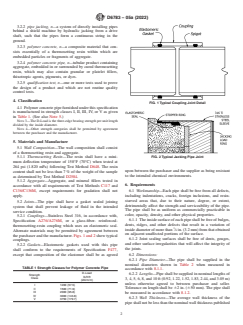
the purchaser and the manufacturer. Figs. 1 and 2 show typical
6.1.2 Joint sealing surfaces shall be free of dents, gouges,
couplings.
and other surface irregularities that will affect the integrity of
5.2.2 Gaskets—Elastomeric gaskets used with this pipe
the joints.
shall conform to the requirements of Specification F477,
except that composition of the elastomer shall be as agreed
6.2 Dimensions:
6.2.1 Pipe Diameter—The pipe shall be supplied in the
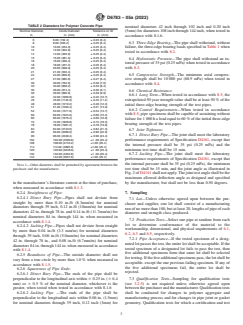
nominal diameters shown in Table 2 when measured in
TABLE 1 Strength Classes for Polymer Concrete Pipe
accordance with 8.1.1.
D-Load
6.2.2 Lengths—Pipe shall be supplied in nominal lengths of
Strength
lb/ft/ft
Class
3, 4, 5, 6, 8, and 10 ft (0.92, 1.22, 1.52, 1.83, 2.44, and 3.05 m)
(kN/m/m)
unless otherwise agreed to between purchaser and seller.
I 1200 (57.5)
II 1500 (71.9) Tolerance on length shall be 62 in. (650 mm). The pipe shall
III 2000 (95.8)
be measured in accordance with 8.1.2.
IV 3000 (143.8)
6.2.3 Wall Thickness—The average wall thickness of the
V 3750 (179.7)
pipeshallnotbelessthanthenominalwallthicknesspublished
D6783 − 05a (2022)
TABLE 2 Diameters for Polymer Concrete Pipe
nominal diameters 42 inch through 102 inch and 0.20 inch
Nominal Diameter, Inside Diameter Tolerance on ID (5mm)fordiameters108inchthrough144inch,whentestedin
in. in. (mm) in. (mm)
accordance with 8.1.6.
6 6.00 (152.4) ± 0.25 (6.4)
6.3 Three-Edge Bearing—The pipe shall withstand, without
8 8.00 (203.2) ± 0.25 (6.4)
10 10.00 (254.0) ± 0.25 (6.4)
failure, the three-edge bearing loads specified in Table 1 when
12 12.00 (304.8) ± 0.25 (6.4)
tested in accordance with 8.2.
14 14.00 (355.6) ± 0.25 (6.4)
15 15.00 (381.0) ± 0.25 (6.4)
6.4 Hydrostatic Pressure—The pipe shall withstand an in-
16 16.00 (406.4) ± 0.25 (6.4)
ternal pressure of 35 psi (0.25 mPa) when tested in accordance
18 18.00 (457.2) ± 0.25 (6.4)
20 20.00 (508.0) ± 0.25 (6.4) with 8.3.
21 21.00 (533.4) ± 0.25 (6.4)
6.5 Compressive Strength—The minimum axial compres-
24 24.00 (609.6) ± 0.25 (6.4)
27 27.00 (685.8) ± 0.27 (6.4)
sive strength shall be 10 000 psi (68.9 mPa) when tested in
30 30.00 (762.0) ± 0.30 (7.6)
accordance with 8.4.
33 33.00 (838.2) ± 0.33 (8.4)
36 36.00 (914.4) ± 0.36 (9.1)
6.6 Chemical Resistance:
39 39.00 (990.6) ± 0.39 (9.9)
6.6.1 Long Term—When tested in accordance with 8.5, the
42 42.00 (1066.8) ± 0.42 (10.7)
45 45.00 (1143.0) ± 0.45 (11.4) extrapolated 50 year strength value shall be at least 50 % of the
48 48.00 (1219.2) ± 0.48 (12.2)
initial three-edge bearing strength of the test pipes.
51 51.00 (1295.4) ± 0.51 (13.0)
6.6.2 Control Requirements—When tested in accordance
54 54.00 (1371.6) ± 0.54 (13.7)
with 8.5, pipe specimens shall be capable of sustaining without
60 60.00 (1524.0) ± 0.60 (15.2)
66 66.00 (1676.4) ± 0.66 (16.8)
failure for 1 000 h a load equal to 60 % of the initial three-edge
72 72.00 (1828.8) ± 0.72 (18.3)
bearing strength of the test pipes.
78 78.00 (1981.2) ± 0.78 (19.8)
84 84.00 (2133.6) ± 0.84 (21.3)
6.7 Joint Tightness:
90 90.00 (2286.0) ± 0.90 (22.9)
6.7.1 Direct Bury Pipe—The joint shall meet the laboratory
96 96.00 (2438.4) ± 0.96 (24.4)
102 102.00 (2590.8) ±1 .00 (25.4)
performance requirements of Specification D4161, except that
108 108.00 (2743.2) ±1.00 (25.4)
the internal pressure shall be 35 psi (0.25 mPa) and the
114 114.00 (2895.6) ±1.00 (25.4)
minimum test time shall be 15 min.
120 120.00 (3048.0) ±1 .00 (25.4)
132 132.00 (3352.8) ±1 .00 (25.4)
6.7.2 Jacking Pipe—The joint shall meet the laboratory
144 144.00 (3657.6) ±1.00 (25.4)
performance requirements of Specification D4161, except that
the internal pressure shall be 35 psi (0.25 mPa), the minimum
NOTE 1—Other diameters shall be permitted by agreement between the
test time shall be 15 min, and the joint angle as illustrated in
purchaser and the manufacturer.
Fig.2ofD4161shallnotapply.Thejointtestangleshallbethe
maximum allowed deflection angle as designed and specified
by the manufacturer, but shall not be less than 0.50 degrees.
in the manufacturer’s literature current at the time of purchase,
when measured in accordance with 8.1.3.
7. Sampling
6.2.4 Straightness of Pipe:
6.2.4.1 Direct Bury Pipe—Pipes shall not deviate from
7.1 Lot—Unless otherwise agreed upon between the pur-
straight by more than 0.10 in./ft (8.3mm/m) for nominal
chaser and supplier, one lot shall consist of a manufacturing
diameters through 39 inch, 0.12 in./ft (10mm/m) for nominal
run of no more than 100, but at least 20, lengths of pipe of each
diameters 42 in. through 78 in. and 0.14 in./ft (11.7mm/m) for
diameter and strength class produced.
nominal diameters 84 in. through 144 in. when measured in
7.2 Production Tests—Select one pipe at random from each
accordance with 8.1.4.
lot to determine conformance of the material to the
6.2.4.2 Jacking Pipe—Pipes shall not deviate from straight
workmanship, dimensional, and physical requirements of 6.1,
by more than 0.04 in./ft (3.3 mm/m) for nominal diameters
6.2, 6.3 and 6.5, respectively.
through 39 inch, 0.06 in./ft (5.0mm/m) for nominal diameters
7.2.1 Pipe Acceptance—If the tested specimen of a desig-
42 in. through 78 in., and 0.08 in./ft (6.7mm/m) for nominal
natedlotpassesthetest,theentirelotshallbeacceptable.Ifthe
diameters 84 in. through 144 in. when measured in accordance
tested specimen of a designated lot fails to pass the test, then
with 8.1.4.
five additional specimens from that same lot shall be selected
6.2.5 Roundness of Pipe—The outside diameter shall not
fortesting.Ifthefiveadditionalspecimenspass,thelotshallbe
vary from a true circle by more than 1.0 % when measured in
acceptable. except the one previous failing specimen. If any of
accordance with 8.1.5.
the five additional specimens fail, the entire
...