

ASTM D5926-15(2020)
(Specification)Standard Specification for Poly (Vinyl Chloride) (PVC) Gaskets for Drain, Waste, and Vent (DWV), Sewer, Sanitary, and Storm Plumbing Systems
General Information
- Abstract
ABSTRACT
This specification describes material and physical requirements for virgin nonrigid poly(vinyl chloride) (PVC) preformed molded and spliced gaskets used in mechanical couplings for gravity flow drain, waste, and vent (DWV), sewer, sanitary, and storm plumbing systems. They include couplings that join similar and dissimilar piping sizes and piping materials. Recycled materials may also be used in this product. Properly sampled specimens shall undergo tests, and shall conform accordingly to the following property requirements: durometer hardness; tensile strength; volatile loss; brittleness temperature; hardness increase, loss in tensile strength, and loss in elongation after heat aging; water absorption and weight increase; cracks and ozone resistance; volume increase and decrease after oil immersion; stress relaxation; and force retention.
SCOPE
1.1 This specification describes material and physical requirements for nonrigid poly (vinyl chloride) (PVC) preformed molded and spliced gaskets used in mechanical couplings. These couplings are used in gravity flow drain, waste, and vent (DWV), sewer, sanitary, and storm plumbing systems. They include couplings to join similar and dissimilar piping sizes and piping material.
1.2 It is acceptable to use recycled materials in this product in accordance with the requirements in Section 4.
1.3 The values stated in inch-pound units are to be regarded as standard. The values given in parentheses are mathematical conversions to SI units that are provided for information only and are not considered standard.
Note 1: There is no known ISO equivalent to this standard.
1.4 The following safety hazards caveat pertains only to the test method portion, Section 7, of this specification: This standard does not purport to address all of the safety concerns, if any, associated with its use. It is the responsibility of the user of this standard to establish appropriate safety, health, and environmental practices and determine the applicability of regulatory limitations prior to use.
1.5 This international standard was developed in accordance with internationally recognized principles on standardization established in the Decision on Principles for the Development of International Standards, Guides and Recommendations issued by the World Trade Organization Technical Barriers to Trade (TBT) Committee.
- Status
- Published
- Publication Date
- 30-Nov-2020
- Technical Committee
- D20 - Plastics
- Drafting Committee
- D20.24 - Plastic Building Products

Overview
ASTM D5926-15(2020) is the ASTM International standard that specifies requirements for poly (vinyl chloride) (PVC) preformed molded and spliced gaskets used in drain, waste, and vent (DWV), sewer, sanitary, and storm plumbing systems. This standard is critical for manufacturers, engineers, and specifiers seeking reliable gasket solutions for gravity-flow piping systems that demand both performance and compliance with recognized quality criteria. The specification covers material properties, manufacturing, testing, and marking requirements to ensure compatibility and durability in diverse piping applications.
Keywords: ASTM D5926, PVC gaskets, plumbing gasket standard, DWV systems, sewer system gaskets, PVC pipe seals
Key Topics
Core Areas Covered in ASTM D5926-15(2020):
Materials: Defines requirements for virgin and recycled nonrigid PVC compounds for use in gaskets, with acceptance of recycled content if conforming to the standard.
Physical Properties: Details various mandatory material properties and performance metrics, including:
- Durometer hardness
- Tensile strength and elongation
- Tear strength
- Volatile loss and water absorption
- Brittleness temperature
- Ozone and oil resistance
- Stress relaxation and force retention
Dimensions and Tolerances: Requires gaskets to conform to agreed-upon sizes and tolerances suitable for the piping systems they are intended to join.
Manufacturing Quality: Emphasizes freedom from surface defects such as cracks, blisters, or pitting, and sets limits on flash thickness and extension.
Testing and Sampling Procedures: Specifies methods and frequencies for qualification and production sampling, including statistical sampling and 100% inspection of spliced gaskets.
Applications
Where ASTM D5926 Standard is Used:
- DWV Systems: Ensures optimal sealing performance in gravity-flow drain, waste, and vent systems, helping prevent leaks and system failures.
- Sewer and Sanitary Piping: Provides reliable joint integrity for underground and above-ground sewer and sanitation piping networks.
- Storm Plumbing Systems: Enables resilient, leak-resistant joints in stormwater drainage infrastructure.
- Multi-material Couplings: Supports mechanical couplings that join similar or dissimilar piping sizes and materials, increasing system design flexibility.
- Product Marking and Certification: Gaskets produced to ASTM D5926 are clearly marked for compliance, simplifying inspection and regulatory acceptance.
The broad application spectrum ensures that plumbing professionals can specify and use compliant gaskets in a range of residential, commercial, municipal, and industrial water management systems.
Related Standards
Standards Referenced and Commonly Used with ASTM D5926:
- ASTM D2287: Specification for nonrigid vinyl chloride polymer and copolymer molding and extrusion compounds
- ASTM D2240: Test method for durometer hardness of rubber and plastics
- ASTM D412: Test methods for tension properties of vulcanized rubber and thermoplastic elastomers
- ASTM D624: Test method for tear strength of conventional vulcanized rubber and thermoplastic elastomers
- ASTM D471: Test method for rubber property - effect of liquids
- ASTM D746: Test method for brittleness temperature of plastics and elastomers by impact
- ASTM D1149: Test methods for rubber deterioration - cracking in an ozone controlled environment
- ASTM C717 / D883 / D1600: Terminology standards for building seals, plastics, and abbreviated plastic terms
Implementing ASTM D5926-15(2020) in gasket selection and procurement supports long-term system performance, regulatory compliance, and compatibility with related standards for plumbing components and materials.
Relations
- Effective Date
- 01-Feb-2024
- Effective Date
- 01-Nov-2023
- Refers
ASTM D1203-23 - Standard Test Methods for Volatile Loss from Plastics Using Activated Carbon Methods - Effective Date
- 01-Nov-2023
- Effective Date
- 01-Jan-2020
- Effective Date
- 01-Nov-2019
- Effective Date
- 01-Aug-2019
- Refers
ASTM D4968-19a - Standard Practice for Annual Review of Test Methods and Specifications for Plastics - Effective Date
- 01-Aug-2019
- Refers
ASTM D4968-19 - Standard Practice for Annual Review of Test Methods and Specifications for Plastics - Effective Date
- 01-May-2019
- Effective Date
- 15-Apr-2019
- Effective Date
- 01-Mar-2019
- Effective Date
- 01-Feb-2019
- Effective Date
- 01-Dec-2018
- Effective Date
- 01-Nov-2018
- Effective Date
- 01-Mar-2018
- Refers
ASTM D1600-18 - Standard Terminology for Abbreviated Terms Relating to Plastics (Withdrawn 2024) - Effective Date
- 01-Jan-2018
Get Certified
Connect with accredited certification bodies for this standard

Zavod za gradbeništvo Slovenije (ZAG) - Inšpekcija
ZAG inspection body for construction products, structures, and materials.
Sponsored listings
Frequently Asked Questions
ASTM D5926-15(2020) is a technical specification published by ASTM International. Its full title is "Standard Specification for Poly (Vinyl Chloride) (PVC) Gaskets for Drain, Waste, and Vent (DWV), Sewer, Sanitary, and Storm Plumbing Systems". This standard covers: ABSTRACT This specification describes material and physical requirements for virgin nonrigid poly(vinyl chloride) (PVC) preformed molded and spliced gaskets used in mechanical couplings for gravity flow drain, waste, and vent (DWV), sewer, sanitary, and storm plumbing systems. They include couplings that join similar and dissimilar piping sizes and piping materials. Recycled materials may also be used in this product. Properly sampled specimens shall undergo tests, and shall conform accordingly to the following property requirements: durometer hardness; tensile strength; volatile loss; brittleness temperature; hardness increase, loss in tensile strength, and loss in elongation after heat aging; water absorption and weight increase; cracks and ozone resistance; volume increase and decrease after oil immersion; stress relaxation; and force retention. SCOPE 1.1 This specification describes material and physical requirements for nonrigid poly (vinyl chloride) (PVC) preformed molded and spliced gaskets used in mechanical couplings. These couplings are used in gravity flow drain, waste, and vent (DWV), sewer, sanitary, and storm plumbing systems. They include couplings to join similar and dissimilar piping sizes and piping material. 1.2 It is acceptable to use recycled materials in this product in accordance with the requirements in Section 4. 1.3 The values stated in inch-pound units are to be regarded as standard. The values given in parentheses are mathematical conversions to SI units that are provided for information only and are not considered standard. Note 1: There is no known ISO equivalent to this standard. 1.4 The following safety hazards caveat pertains only to the test method portion, Section 7, of this specification: This standard does not purport to address all of the safety concerns, if any, associated with its use. It is the responsibility of the user of this standard to establish appropriate safety, health, and environmental practices and determine the applicability of regulatory limitations prior to use. 1.5 This international standard was developed in accordance with internationally recognized principles on standardization established in the Decision on Principles for the Development of International Standards, Guides and Recommendations issued by the World Trade Organization Technical Barriers to Trade (TBT) Committee.
ABSTRACT This specification describes material and physical requirements for virgin nonrigid poly(vinyl chloride) (PVC) preformed molded and spliced gaskets used in mechanical couplings for gravity flow drain, waste, and vent (DWV), sewer, sanitary, and storm plumbing systems. They include couplings that join similar and dissimilar piping sizes and piping materials. Recycled materials may also be used in this product. Properly sampled specimens shall undergo tests, and shall conform accordingly to the following property requirements: durometer hardness; tensile strength; volatile loss; brittleness temperature; hardness increase, loss in tensile strength, and loss in elongation after heat aging; water absorption and weight increase; cracks and ozone resistance; volume increase and decrease after oil immersion; stress relaxation; and force retention. SCOPE 1.1 This specification describes material and physical requirements for nonrigid poly (vinyl chloride) (PVC) preformed molded and spliced gaskets used in mechanical couplings. These couplings are used in gravity flow drain, waste, and vent (DWV), sewer, sanitary, and storm plumbing systems. They include couplings to join similar and dissimilar piping sizes and piping material. 1.2 It is acceptable to use recycled materials in this product in accordance with the requirements in Section 4. 1.3 The values stated in inch-pound units are to be regarded as standard. The values given in parentheses are mathematical conversions to SI units that are provided for information only and are not considered standard. Note 1: There is no known ISO equivalent to this standard. 1.4 The following safety hazards caveat pertains only to the test method portion, Section 7, of this specification: This standard does not purport to address all of the safety concerns, if any, associated with its use. It is the responsibility of the user of this standard to establish appropriate safety, health, and environmental practices and determine the applicability of regulatory limitations prior to use. 1.5 This international standard was developed in accordance with internationally recognized principles on standardization established in the Decision on Principles for the Development of International Standards, Guides and Recommendations issued by the World Trade Organization Technical Barriers to Trade (TBT) Committee.
ASTM D5926-15(2020) is classified under the following ICS (International Classification for Standards) categories: 93.030 - External sewage systems. The ICS classification helps identify the subject area and facilitates finding related standards.
ASTM D5926-15(2020) has the following relationships with other standards: It is inter standard links to ASTM D883-24, ASTM D883-23, ASTM D1203-23, ASTM D883-20, ASTM D2287-19, ASTM D883-19c, ASTM D4968-19a, ASTM D4968-19, ASTM D883-19a, ASTM C717-19, ASTM D883-19, ASTM D883-18a, ASTM D883-18, ASTM C717-18, ASTM D1600-18. Understanding these relationships helps ensure you are using the most current and applicable version of the standard.
ASTM D5926-15(2020) is available in PDF format for immediate download after purchase. The document can be added to your cart and obtained through the secure checkout process. Digital delivery ensures instant access to the complete standard document.
Standards Content (Sample)
This international standard was developed in accordance with internationally recognized principles on standardization established in the Decision on Principles for the
Development of International Standards, Guides and Recommendations issued by the World Trade Organization Technical Barriers to Trade (TBT) Committee.
Designation:D5926 −15 (Reapproved 2020) An American National Standard
Standard Specification for
Poly (Vinyl Chloride) (PVC) Gaskets for Drain, Waste, and
Vent (DWV), Sewer, Sanitary, and Storm Plumbing Systems
This standard is issued under the fixed designation D5926; the number immediately following the designation indicates the year of
original adoption or, in the case of revision, the year of last revision. A number in parentheses indicates the year of last reapproval. A
superscript epsilon (´) indicates an editorial change since the last revision or reapproval.
1. Scope* D412 Test Methods forVulcanized Rubber andThermoplas-
tic Elastomers—Tension
1.1 This specification describes material and physical re-
D471 Test Method for Rubber Property—Effect of Liquids
quirementsfornonrigidpoly(vinylchloride)(PVC)preformed
D573 Test Method for Rubber—Deterioration in an Air
molded and spliced gaskets used in mechanical couplings.
Oven
These couplings are used in gravity flow drain, waste, and vent
D618 Practice for Conditioning Plastics for Testing
(DWV), sewer, sanitary, and storm plumbing systems. They
D624 Test Method for Tear Strength of Conventional Vul-
include couplings to join similar and dissimilar piping sizes
canized Rubber and Thermoplastic Elastomers
and piping material.
D746 Test Method for Brittleness Temperature of Plastics
1.2 It is acceptable to use recycled materials in this product
and Elastomers by Impact
in accordance with the requirements in Section 4.
D883 Terminology Relating to Plastics
D1149 Test Methods for Rubber Deterioration—Cracking in
1.3 The values stated in inch-pound units are to be regarded
as standard. The values given in parentheses are mathematical an Ozone Controlled Environment
D1203 Test Methods for Volatile Loss From Plastics Using
conversions to SI units that are provided for information only
and are not considered standard. Activated Carbon Methods
D1600 Terminology forAbbreviatedTerms Relating to Plas-
NOTE 1—There is no known ISO equivalent to this standard.
tics
1.4 The following safety hazards caveat pertains only to the
D2240 Test Method for Rubber Property—Durometer Hard-
test method portion, Section 7, of this specification: This
ness
standard does not purport to address all of the safety concerns,
D2287 Classification System and Basis for Specification for
if any, associated with its use. It is the responsibility of the user
Nonrigid Vinyl Chloride Polymer and Copolymer Mold-
of this standard to establish appropriate safety, health, and
ing and Extrusion Compounds
environmental practices and determine the applicability of
D3892 Practice for Packaging/Packing of Plastics
regulatory limitations prior to use.
D4968 Practice for Annual Review of Test Methods and
1.5 This international standard was developed in accor-
Specifications for Plastics
dance with internationally recognized principles on standard-
D6147 TestMethodforVulcanizedRubberandThermoplas-
ization established in the Decision on Principles for the
tic Elastomer—Determination of Force Decay (Stress
Development of International Standards, Guides and Recom-
Relaxation) in Compression
mendations issued by the World Trade Organization Technical
D7209 Guide for Waste Reduction, Resource Recovery, and
Barriers to Trade (TBT) Committee.
Use of Recycled Polymeric Materials and Products (With-
drawn 2015)
2. Referenced Documents
2.1 ASTM Standards:
3. Terminology
C717 Terminology of Building Seals and Sealants
3.1 General—DefinitionsareinaccordancewithTerminolo-
gies C717, D883, and D1600, unless otherwise indicated.
This specification is under the jurisdiction of ASTM Committee D20 on
Plastics and is the direct responsibility of Subcommittee D20.24 on Plastic Building
3.2 Definitions of Terms Specific to This Standard:
Products.
3.2.1 flash—the excess material protruding from the surface
Current edition approved Dec. 1, 2020. Published December 2020. Originally
of a molded article at the mold junction.
approved in 1996. Last previous edition approved in 2015 as D5926-15. DOI:
10.1520/D5926-15R20.
For referenced ASTM standards, visit the ASTM website, www.astm.org, or
contact ASTM Customer Service at service@astm.org. For Annual Book of ASTM
Standards volume information, refer to the standard’s Document Summary page on The last approved version of this historical standard is referenced on
the ASTM website. www.astm.org.
*A Summary of Changes section appears at the end of this standard
Copyright © ASTM International, 100 Barr Harbor Drive, PO Box C700, West Conshohocken, PA 19428-2959. United States
D5926−15 (2020)
4. Materials and Manufacture 4.6 The compound manufacturer shall certify in writing to
the gasket manufacturer that the compound supplied meets all
4.1 This specification covers preformed gaskets made prin-
the requirements of this specification.
cipallyfromvirginnonrigidPVCmoldingcompoundconform-
ing to the requirements of Specification D2287 for general
5. Requirements
purpose, electrical requirements excluded class PVC 30267,
5.1 Dimensions—Gaskets shall conform to the dimensions
40366 or 50465. Refer to Table 1 in Specification D2287.
and dimensional tolerances as agreed upon between the sup-
4.1.1 This class compound has the following material prop-
plier and the purchaser. All dimensions shall be compatible
erty requirements:
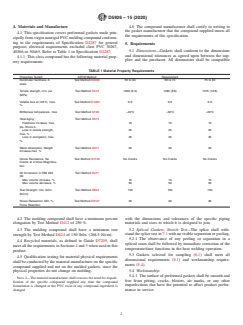
TABLE 1 Material Property Requirements
Properties Tested ASTM Method Requirement
Durometer hardness, A Test Method D2240 55 to 64 65 to 74 75 to 84
scale
Tensile strength, min, psi Test Method D412 1000 (6.9) 1285 (8.8) 1575 (10.8)
(MPa)
Volatile loss at 105°C, max. Test Method D1203 6.0 6.0 6.0
%
Brittleness temperature, max Test Method D746 −40°C −30°C −20°C
Heat Aging : Test Method D573
Hardness increase, max, 10 10 10
pts. Shore A
Loss in tensile strength, 25 25 25
max, %
Loss in elongation, max, 35 35 35
%
Water Absorption, Weight Test Method D471 20 20 20
increase,max, %
Ozone Resistance, No Test Method D1149 No Cracks No Cracks No Cracks
Cracks at 2 times Magnifica-
tion
Oil Immersion in IRM 903 Test Method D471
Oil:
Max volume increase, % 10 10 10
Max volume decrease, % 50 50 50
Tear Strength, min, lbf/in. Test Method D624 150 150 150
(N/cm)
Stress Relaxation, Min. % Test Method D6147 30 30 30
Force Retention
4.2 The molding compound shall have a minimum percent with the dimensions and tolerances of the specific piping
elongation by Test Method D412 of 250 %. materials and sizes to w
...