

ASTM D4161-14(2019)
(Specification)Standard Specification for “Fiberglass” (Glass-Fiber-Reinforced Thermosetting-Resin) Pipe Joints Using Flexible Elastomeric Seals
General Information
- Abstract
ABSTRACT
This specification covers axially unrestrained bell-and-spigot gasket joints including couplings required for machine-made "fiberglass" (glass-fiber-reinforced thermosetting-resin) pipe systems, 8 in. (200 mm) through 144 in. (3700 mm), using flexible elastomeric seals to obtain soundness. The pipe systems may be pressure or nonpressure systems for water or for chemicals or gases that are not deleterious to the materials specified in this specification. The gasket shall be a continuous elastomeric ring of circular or other geometric cross section and shall meet the prescribed specifications. The gasket shall be subject to vacuum or external pressure test and shear loading test.
SCOPE
1.1 This specification covers axially unrestrained bell-and-spigot gasket joints including couplings required for machine-made “fiberglass” (glass-fiber-reinforced thermosetting-resin) pipe systems, 8 in. (200 mm) through 156 in. (4000 mm), using flexible elastomeric seals to obtain soundness. The pipe systems may be pressure (typically up to 250 psi) or nonpressure systems for water or for chemicals or gases that are not deleterious to the materials specified in this specification. This specification covers materials, dimensions, test requirements, and methods of test.
1.2 The values stated in inch-pound units are to be regarded as the standard. The values given in parentheses are provided for information purposes only.
Note 1: There is a similar but technically different ISO Standard (ISO 8639).
1.3 This standard does not purport to address all of the safety concerns, if any, associated with its use. It is the responsibility of the user of this standard to establish appropriate safety, health, and environmental practices and determine the applicability of regulatory limitations prior to use.
1.4 This international standard was developed in accordance with internationally recognized principles on standardization established in the Decision on Principles for the Development of International Standards, Guides and Recommendations issued by the World Trade Organization Technical Barriers to Trade (TBT) Committee.
- Status
- Published
- Publication Date
- 31-Mar-2019
- Technical Committee
- D20 - Plastics

Overview
ASTM D4161-14(2019) sets forth requirements for axially unrestrained bell-and-spigot gasket joints, including couplings, in machine-made "fiberglass" (glass-fiber-reinforced thermosetting-resin) pipe systems. The standard focuses on joints using flexible elastomeric seals to achieve leakproof performance. Covering nominal pipe sizes from 8 inches (200 mm) to 156 inches (4000 mm), this specification is applicable to both pressure (typically up to 250 psi) and nonpressure pipe systems intended for the conveyance of water, chemicals, or gases that are compatible with the materials described.
This ASTM standard details material requirements, dimensional tolerances, joint geometry, laboratory testing, and performance criteria, aiming to ensure reliability and durability in glass-fiber-reinforced piping applications.
Key Topics
- Scope and Pipe Sizes: Specifies joint requirements for pipes ranging from 8 in. to 156 in. in diameter.
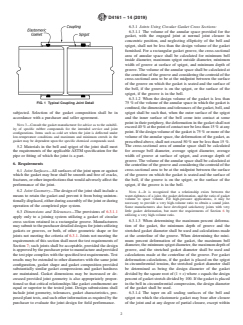
- Joint Types: Describes axially unrestrained bell-and-spigot gasket joints and couplings using flexible elastomeric seals. Two main joint designs are included: one with the gasket compressed in the bell and one with the gasket stretched on the spigot.
- Material Specifications: Elastomeric gaskets must meet ASTM F477 requirements and be chemically compatible with intended service media. The bell and spigot materials must comply with applicable ASTM specifications for glass-fiber-reinforced thermosetting-resin piping.
- Joint Geometry: The gasket and joint design must ensure effective sealing, proper deformation ratios, and acceptable tolerances to maintain soundness and prevent leakage under operational conditions.
- Performance Testing: Includes internal hydrostatic pressure tests, angular deflection testing, shear loading tests, and vacuum or external pressure tests. The tests verify the integrity of the joints under realistic service conditions.
- Dimensional Tolerances: Covers requirements for joint and gasket dimensions for reliable field assembly and performance.
- Retesting Protocols: Offers procedures for retesting in case of initial failure, upon agreement between purchaser and manufacturer.
- International Standardization: Prepared in line with WTO TBT Committee principles, facilitating broader acceptance in international markets.
Applications
ASTM D4161-14(2019) is widely utilized in sectors that require reliable, corrosion-resistant piping systems. Key applications include:
- Water Transmission: Municipal and industrial water supply systems benefit from leak-tight, durable glass-fiber-reinforced thermosetting-resin pipe joints.
- Chemical Processing: Used in transporting chemicals and process fluids that are not harmful to the specified gasket and pipe materials.
- Wastewater Systems: Provides standards for joints in nonpressure and low-pressure sewage and wastewater pipelines.
- Gas Conveyance: Suitable for gas transport systems where compatibility with materials can be ensured.
- Infrastructure Projects: Large-diameter pipe systems in infrastructure work, such as stormwater management and irrigation, often rely on this standard to meet project specifications and regulatory demands.
Related Standards
For optimal results and seamless integration, the following ASTM and international standards are referenced or relevant to the use of ASTM D4161-14(2019):
- ASTM F477: Specification for Elastomeric Seals (Gaskets) for Joining Plastic Pipe
- ASTM D883: Terminology Relating to Plastics
- ASTM D1600: Terminology for Abbreviated Terms Relating to Plastics
- ASTM F412: Terminology Relating to Plastic Piping Systems
- ISO 8639: Similar, but technically different, international standard for glass-fiber-reinforced thermosetting-resin pipe joints using flexible seals
By adhering to ASTM D4161-14(2019), engineers and specifiers can ensure long-lasting, leak-resistant joints in fiberglass-reinforced piping networks, supporting safe and efficient operation in municipal, industrial, and commercial systems.
Relations
- Effective Date
- 01-Apr-2019
- Effective Date
- 01-Feb-2024
- Effective Date
- 01-Nov-2023
- Effective Date
- 01-Apr-2020
- Effective Date
- 01-Jan-2020
- Effective Date
- 01-Aug-2019
- Effective Date
- 15-Apr-2019
- Effective Date
- 01-Feb-2019
- Effective Date
- 01-Jan-2019
- Effective Date
- 01-Dec-2018
- Effective Date
- 01-Nov-2018
- Refers
ASTM D1600-18 - Standard Terminology for Abbreviated Terms Relating to Plastics (Withdrawn 2024) - Effective Date
- 01-Jan-2018
- Effective Date
- 15-Aug-2017
- Effective Date
- 01-Aug-2017
- Effective Date
- 01-Feb-2017
Get Certified
Connect with accredited certification bodies for this standard

Institut za varilstvo d.o.o. (Welding Institute)
Slovenia's leading welding institute since 1952. ISO 3834, EN 1090, pressure equipment certification, NDT personnel, welder qualification. Only IIW Au
Sponsored listings
Frequently Asked Questions
ASTM D4161-14(2019) is a technical specification published by ASTM International. Its full title is "Standard Specification for “Fiberglass” (Glass-Fiber-Reinforced Thermosetting-Resin) Pipe Joints Using Flexible Elastomeric Seals". This standard covers: ABSTRACT This specification covers axially unrestrained bell-and-spigot gasket joints including couplings required for machine-made "fiberglass" (glass-fiber-reinforced thermosetting-resin) pipe systems, 8 in. (200 mm) through 144 in. (3700 mm), using flexible elastomeric seals to obtain soundness. The pipe systems may be pressure or nonpressure systems for water or for chemicals or gases that are not deleterious to the materials specified in this specification. The gasket shall be a continuous elastomeric ring of circular or other geometric cross section and shall meet the prescribed specifications. The gasket shall be subject to vacuum or external pressure test and shear loading test. SCOPE 1.1 This specification covers axially unrestrained bell-and-spigot gasket joints including couplings required for machine-made “fiberglass” (glass-fiber-reinforced thermosetting-resin) pipe systems, 8 in. (200 mm) through 156 in. (4000 mm), using flexible elastomeric seals to obtain soundness. The pipe systems may be pressure (typically up to 250 psi) or nonpressure systems for water or for chemicals or gases that are not deleterious to the materials specified in this specification. This specification covers materials, dimensions, test requirements, and methods of test. 1.2 The values stated in inch-pound units are to be regarded as the standard. The values given in parentheses are provided for information purposes only. Note 1: There is a similar but technically different ISO Standard (ISO 8639). 1.3 This standard does not purport to address all of the safety concerns, if any, associated with its use. It is the responsibility of the user of this standard to establish appropriate safety, health, and environmental practices and determine the applicability of regulatory limitations prior to use. 1.4 This international standard was developed in accordance with internationally recognized principles on standardization established in the Decision on Principles for the Development of International Standards, Guides and Recommendations issued by the World Trade Organization Technical Barriers to Trade (TBT) Committee.
ABSTRACT This specification covers axially unrestrained bell-and-spigot gasket joints including couplings required for machine-made "fiberglass" (glass-fiber-reinforced thermosetting-resin) pipe systems, 8 in. (200 mm) through 144 in. (3700 mm), using flexible elastomeric seals to obtain soundness. The pipe systems may be pressure or nonpressure systems for water or for chemicals or gases that are not deleterious to the materials specified in this specification. The gasket shall be a continuous elastomeric ring of circular or other geometric cross section and shall meet the prescribed specifications. The gasket shall be subject to vacuum or external pressure test and shear loading test. SCOPE 1.1 This specification covers axially unrestrained bell-and-spigot gasket joints including couplings required for machine-made “fiberglass” (glass-fiber-reinforced thermosetting-resin) pipe systems, 8 in. (200 mm) through 156 in. (4000 mm), using flexible elastomeric seals to obtain soundness. The pipe systems may be pressure (typically up to 250 psi) or nonpressure systems for water or for chemicals or gases that are not deleterious to the materials specified in this specification. This specification covers materials, dimensions, test requirements, and methods of test. 1.2 The values stated in inch-pound units are to be regarded as the standard. The values given in parentheses are provided for information purposes only. Note 1: There is a similar but technically different ISO Standard (ISO 8639). 1.3 This standard does not purport to address all of the safety concerns, if any, associated with its use. It is the responsibility of the user of this standard to establish appropriate safety, health, and environmental practices and determine the applicability of regulatory limitations prior to use. 1.4 This international standard was developed in accordance with internationally recognized principles on standardization established in the Decision on Principles for the Development of International Standards, Guides and Recommendations issued by the World Trade Organization Technical Barriers to Trade (TBT) Committee.
ASTM D4161-14(2019) is classified under the following ICS (International Classification for Standards) categories: 23.040.60 - Flanges, couplings and joints. The ICS classification helps identify the subject area and facilitates finding related standards.
ASTM D4161-14(2019) has the following relationships with other standards: It is inter standard links to ASTM D4161-14, ASTM D883-24, ASTM D883-23, ASTM F412-20, ASTM D883-20, ASTM D883-19c, ASTM D883-19a, ASTM D883-19, ASTM F412-19, ASTM D883-18a, ASTM D883-18, ASTM D1600-18, ASTM D883-17, ASTM F412-17a, ASTM F412-17. Understanding these relationships helps ensure you are using the most current and applicable version of the standard.
ASTM D4161-14(2019) is available in PDF format for immediate download after purchase. The document can be added to your cart and obtained through the secure checkout process. Digital delivery ensures instant access to the complete standard document.
Standards Content (Sample)
This international standard was developed in accordance with internationally recognized principles on standardization established in the Decision on Principles for the
Development of International Standards, Guides and Recommendations issued by the World Trade Organization Technical Barriers to Trade (TBT) Committee.
Designation: D4161 −14 (Reapproved 2019)
Standard Specification for
“Fiberglass” (Glass-Fiber-Reinforced Thermosetting-Resin)
Pipe Joints Using Flexible Elastomeric Seals
This standard is issued under the fixed designation D4161; the number immediately following the designation indicates the year of
original adoption or, in the case of revision, the year of last revision.Anumber in parentheses indicates the year of last reapproval.A
superscript epsilon (´) indicates an editorial change since the last revision or reapproval.
1. Scope* D1600TerminologyforAbbreviatedTermsRelatingtoPlas-
tics
1.1 This specification covers axially unrestrained bell-and-
F412Terminology Relating to Plastic Piping Systems
spigot gasket joints including couplings required for machine-
F477Specification for Elastomeric Seals (Gaskets) for Join-
made “fiberglass” (glass-fiber-reinforced thermosetting-resin)
ing Plastic Pipe
pipesystems,8in.(200mm)through156in.(4000mm),using
flexible elastomeric seals to obtain soundness. The pipe sys-
3. Terminology
tems may be pressure (typically up to 250 psi) or nonpressure
3.1 Definitions:
systems for water or for chemicals or gases that are not
3.1.1 General—Definitions and abbreviations are in accor-
deleterious to the materials specified in this specification. This
dance with Terminology D883 or Terminology F412, and
specification covers materials, dimensions, test requirements,
Terminology D1600 unless otherwise indicated.
and methods of test.
1.2 The values stated in inch-pound units are to be regarded
4. Types of Joints
as the standard. The values given in parentheses are provided
4.1 This specification covers two types of axially unre-
for information purposes only.
strained joints based on effecting soundness of the joint
through compression of an elastomeric seal or ring:
NOTE 1—There is a similar but technically different ISO Standard (ISO
8639).
4.1.1 Bell-and-spigot or coupling joint with the gasket
placed in the bell in circumferential compression. An elasto-
1.3 This standard does not purport to address all of the
meric gasket joint design featuring a continuous elastomeric
safety concerns, if any, associated with its use. It is the
ring gasket placed in an annular space provided in the bell or
responsibility of the user of this standard to establish appro-
socketofthepipeorfitting.Thespigotendofthepipeorfitting
priate safety, health, and environmental practices and deter-
mine the applicability of regulatory limitations prior to use. is forced into the bell, thereby compressing the gasket radially
to form a positive seal.
1.4 This international standard was developed in accor-
dance with internationally recognized principles on standard- 4.1.2 Bell-and-spigot or coupling joint with the gasket
placedonthespigotincircumferentialtension:Apushonjoint
ization established in the Decision on Principles for the
Development of International Standards, Guides and Recom- designfeaturingacontinuouselastomericringgasketplacedin
an annular space provided on the spigot end of the pipe or
mendations issued by the World Trade Organization Technical
Barriers to Trade (TBT) Committee. fitting. The spigot is forced into the bell of the pipe or fitting,
therebycompressingthegasketradiallytoformapositiveseal.
2. Referenced Documents
NOTE 2—A coupling joint of these types is a loose double-bell sleeve
used to connect pipes which have spigots at both ends (see Fig. 1). All
2.1 ASTM Standards:
references to bells in this specification are applicable to the sleeve
D883Terminology Relating to Plastics
coupling as well as to the integral bell of a bell-and-spigot gasket joint.
5. Materials and Manufacture
This specification is under the jurisdiction of ASTM Committee D20 on
5.1 The gasket shall be a continuous elastomeric ring of
Plastics and is the direct responsibility of Subcommittee D20.23 on Reinforced
circular or other geometric cross section and shall meet the
Plastic Piping Systems and Chemical Equipment.
requirements of Specification F477, unless otherwise specified
Current edition approved April 1, 2019. Published May 2019. Originally
in this specification. When a splice is used in the manufacture
approved in 1982. Last previous edition approved in 2014 as D4161–14. DOI:
10.1520/D4161-14R19.
of the gasket, no more than two splices shall be made in any
For referenced ASTM standards, visit the ASTM website, www.astm.org, or
one gasket.
contact ASTM Customer Service at service@astm.org. For Annual Book of ASTM
5.1.1 The chemical composition of the gasket shall be
Standards volume information, refer to the standard’s Document Summary page on
the ASTM website. compatible with the type of environment to which it will be
*A Summary of Changes section appears at the end of this standard
Copyright © ASTM International, 100 Barr Harbor Drive, PO Box C700, West Conshohocken, PA 19428-2959. United States
D4161 − 14 (2019)
6.3.1 Joints Using Circular Gasket Cross Sections:
6.3.1.1 The volume of the annular space provided for the
gasket, with the engaged joint at normal joint closure in
concentric position, and neglecting ellipticity of the bell and
spigot, shall not be less than the design volume of the gasket
furnished. For a rectangular gasket groove, the cross-sectional
area of annular space shall be calculated for minimum bell
inside diameter, maximum spigot outside diameter, minimum
width of groove at surface of spigot, and minimum depth of
groove. The volume of the annular space shall be calculated at
thecenterlineofthegrooveandconsideringthecentroidofthe
cross-sectional area to be at the midpoint between the surface
of the groove on which the gasket is seated and the surface of
the bell, if the groove is on the spigot, or the surface of the
spigot, if the groove is in the bell.
6.3.1.2 When the design volume of the gasket is less than
FIG. 1 Typical Coupling Joint Detail
75% of the volume of the annular space in which the gasket is
confined,thedimensionsandtolerancesofthegasket,bell,and
subjected. Selection of the gasket composition shall be in spigot shall be such that, when the outer surface of the spigot
and the inner surface of the bell come into contact at some
accordance with a purchaser and seller agreement.
point in their periphery, the deformation in the gasket shall not
NOTE 3—Consult the gasket manufacturer for advice as to the suitabil-
exceed40%atthepointofcontactnorbelessthan15%atany
ity of specific rubber compounds for the intended service and joint
point.Ifthedesignvolumeofthegasketis75%ormoreofthe
configurations. Items such as cold set when the joint is deflected under
low-temperature conditions and maximum and minimum stretch in the
volume of the annular space, the deformation of the gasket, as
gasket may be dependent upon the specific chemical compounds used.
prescribedabove,shallnotexceed50%norbelessthan15%.
5.2 Materials in the bell and spigot of the joint shall meet The cross-sectional area of annular space shall be calculated
for average bell diameter, average spigot diameter, average
the requirements of the applicableASTM specification for the
pipe or fitting of which the joint is a part. width of groove at surface of spigot, and average depth of
groove. The volume of the annular space shall be calculated at
6. Requirements
thecenterlineofthegrooveandconsideringthecentroidofthe
cross-sectional area to be at the midpoint between the surface
6.1 Joint Surfaces—All surfaces of the joint upon or against
of the groove on which the gasket is seated and the surface of
which the gasket may bear shall be smooth and free of cracks,
the bell, if the groove is on the spigot, or the surface of the
fractures,orotherimperfectionsthatwouldadverselyaffectthe
spigot, if the groove is in the bell.
performance of the joint.
6.2 Joint Geometry—The design of the joint shall include a
NOTE 4—It is recognized that a relationship exists between the
water-tightness of a joint, the gasket deformation, and the ratio of gasket
means to retain the gasket and prevent it from being uninten-
volume to space volume. For high-pressure applications, it may be
tionallydisplaced,eitherduringassemblyofthejointorduring
necessary to provide a very high-volume ratio to obtain a sound joint.
operation of the completed pipe system.
Some manufacturers also have developed satisfactory joints with very
little gasket deformation, but meet the requirements of Section 6 by
6.3 Dimensions and Tolerances—The provisions of 6.3.1.1
utilizing a very high-volume ratio.
apply only to a joining system utilizing a gasket of circular
6.3.1.3 When determining the maximum percent deforma-
cross section retained in a rectangular groove. Manufacturers
maysubmittothepurchaserdetaileddesignsforjointsutilizing tion of the gasket, the minimum depth of groove and the
stretched gasket diameter shall be used and calculations made
gaskets or grooves, or both, of other geometric shape or for
joints not meeting the criteria of 6.3.1. Joints not meeting the at the centerline of the groove. When determining the mini-
mum percent deformation of the gasket, the maximum bell
requirements of this section shall meet the test requirements of
Section 7; such joints shall be acceptable, provided the design diameter,theminimumspigotdiameter,themaximumdepthof
groove, and the stretched gasket diameter shall be used and
isapprovedbythepurchaserpriortomanufactureandprovided
thetestpipecomplieswiththespecifiedtestrequirements.Test calculation
...