

ASTM D5421-23
(Specification)Standard Specification for Contact Molded “Fiberglass” (Glass-Fiber-Reinforced Thermosetting Resin) Flanges
General Information
- Abstract
ABSTRACT
This specification covers the requirements for materials, workmanship, performance, and dimensions of circular contact-molded "fiberglass" (glass fiber reinforced thermosetting resin) flanges for use in pipe systems and tank nozzles. This specification does not address flange design or gasket selection. Flanges may be produced as integral flanges (Type A) or flange-on-pipe (Type B). They may be made of either epoxy resin (Grade 1), polyester resin (Grade 2), phenolic resin (Grade 3), vinylester resin (Grade 4), or furan resin (Grade 5). Flanges are also grouped into classes according to pressure and thrust capability as Class I (hoop and axial pressure) and Class II (hoop pressure only). Specimens shall undergo tests for which performance requirements must be met for sealing, short-term rupture strength, and maximum bolt torque.
SCOPE
1.1 This specification covers circular contact-molded fiberglass reinforced-thermosetting-resin flanges for use in pipe systems and tank nozzles. Included are requirements for materials, workmanship, performance, and dimensions.
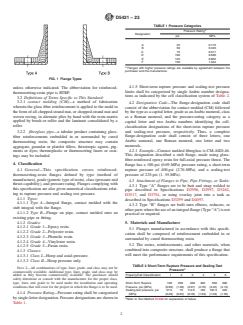
1.2 Flanges (see Fig. 1) may be produced as integral flanges, Type A, or flange-on-pipe, Type B.
FIG. 1 Flange Types
1.3 This specification is based on flange performance and does not cover design.
1.4 These flanges are designed for use with pipe and tanks that are manufactured to Specifications D2996, D2997, D3262, D3299, D3517, D3754, and D4097.
1.5 Selection of gaskets is not covered in this specification, refer to the manufacturer's recommendation.
1.6 The values stated in inch-pound units are to be regarded as the standard. The SI units given in parentheses are for information only.
1.7 The following precautionary caveat pertains only to the test methods portion, Section 9, of this specification: This standard does not purport to address all of the safety concerns, if any, associated with its use. It is the responsibility of the user of this standard to establish appropriate safety, health, and environmental practices and determine the applicability of regulatory limitations prior to use.
Note 1: There is no known ISO equivalent to this standard.
1.8 This international standard was developed in accordance with internationally recognized principles on standardization established in the Decision on Principles for the Development of International Standards, Guides and Recommendations issued by the World Trade Organization Technical Barriers to Trade (TBT) Committee.
- Status
- Published
- Publication Date
- 30-Apr-2023
- Technical Committee
- D20 - Plastics
Buy Documents
ASTM D5421-23 - Standard Specification for Contact Molded “Fiberglass” (Glass-Fiber-Reinforced Thermosetting Resin) Flanges
REDLINE ASTM D5421-23 - Standard Specification for Contact Molded “Fiberglass” (Glass-Fiber-Reinforced Thermosetting Resin) Flanges
Overview
ASTM D5421-23: Standard Specification for Contact Molded “Fiberglass” (Glass-Fiber-Reinforced Thermosetting Resin) Flanges defines requirements for circular contact-molded fiberglass flanges used in pipe systems and tank nozzles. Developed by ASTM International, this standard specifies the materials, manufacturing processes, dimensional tolerances, and performance criteria for these flanges, which play a critical role in industrial piping and fluid containment systems.
Fiberglass (glass-fiber-reinforced thermosetting resin) flanges are used for their corrosion resistance, lightweight properties, and versatility. ASTM D5421-23 addresses both Type A (integral) and Type B (flange-on-pipe) options, covering a wide range of applications in various grades and classes according to pressure and thrust requirements.
Key Topics
Material Requirements: Flanges are manufactured from cured thermosetting resins embedded with glass fiber reinforcements. Acceptable resin types include:
- Epoxy (Grade 1)
- Polyester (Grade 2)
- Phenolic (Grade 3)
- Vinylester (Grade 4)
- Furan (Grade 5)
Flange Types and Classes:
- Type A: Integral flange, molded with the pipe or nozzle
- Type B: Contact-molded onto an existing pipe or fitting
- Class I: Rated for hoop and axial pressure
- Class II: Rated for hoop pressure only
Performance Criteria:
- Sealing: Must resist leakage at 1.5 times the rated pressure
- Short-Term Rupture Strength: Withstands at least four times rated pressure
- Bolt Torque: Endures at least 1.5 times recommended bolt torque without visible damage
Dimensional Standards:
- Flange and bolt dimensions align with ASME B16.5 and B16.1 for various sizes
- Strict tolerances ensure compatibility and reliable sealing
Workmanship and Finish: Finished flanges must be free of significant defects such as bubbles, delaminations, or resin-starved areas, adhering to visual quality criteria.
Product Marking: Flanges must be marked with the ASTM D5421 designation, identification code, nominal size, manufacturer, and traceability information.
Applications
ASTM D5421-23 flanges are essential in the construction and maintenance of fiberglass-reinforced thermosetting resin piping systems. Important application areas include:
- Industrial Piping Systems: Used in chemical processing, wastewater treatment, and industrial fluid handling where corrosion resistance is crucial.
- Tank Nozzles: Applied in composite storage tanks for attaching piping or fittings.
- Offshore and Marine Installations: Suitable for environments that demand lightweight, high-strength, and corrosion-resistant components.
- Municipal Water and Sewage Infrastructure: Successfully deployed in systems requiring low maintenance and long service life.
These flanges are specifically designed for use with pipes and tanks manufactured to related ASTM standards such as D2996, D2997, D3262, D3299, D3517, D3754, and D4097.
Related Standards
- ASTM D2996: Filament-Wound “Fiberglass” Pipe
- ASTM D2997: Centrifugally Cast “Fiberglass” Pipe
- ASTM D3299: Filament-Wound Glass-Fiber-Reinforced Tanks
- ASTM D3517: Pressure Pipe Standards
- ASTM D3754/D3262/D4097: Additional pipe and tank specifications
- ASME B16.1 & ASME B16.5: Pipe flange and fitting dimensions
For proper integration and compliance, always reference the latest editions of these standards along with ASTM D5421-23.
Keywords: ASTM D5421-23, fiberglass flanges, glass fiber reinforced, contact molded, thermosetting resin, pipe systems, tank nozzles, industrial piping standards, corrosion resistance, ASME flange dimensions.
Relations
- Effective Date
- 01-Feb-2024
- Effective Date
- 01-Nov-2023
- Effective Date
- 01-Oct-2023
- Effective Date
- 01-Mar-2020
- Effective Date
- 01-Jan-2020
- Effective Date
- 01-Nov-2019
- Effective Date
- 01-Aug-2019
- Effective Date
- 01-Aug-2019
- Effective Date
- 01-Aug-2019
- Effective Date
- 15-Apr-2019
- Effective Date
- 01-Feb-2019
- Effective Date
- 01-Dec-2018
- Effective Date
- 01-Nov-2018
- Effective Date
- 01-Sep-2018
- Effective Date
- 01-Aug-2018
Buy Documents
ASTM D5421-23 - Standard Specification for Contact Molded “Fiberglass” (Glass-Fiber-Reinforced Thermosetting Resin) Flanges
REDLINE ASTM D5421-23 - Standard Specification for Contact Molded “Fiberglass” (Glass-Fiber-Reinforced Thermosetting Resin) Flanges
Get Certified
Connect with accredited certification bodies for this standard

Institut za varilstvo d.o.o. (Welding Institute)
Slovenia's leading welding institute since 1952. ISO 3834, EN 1090, pressure equipment certification, NDT personnel, welder qualification. Only IIW Au
Sponsored listings
Frequently Asked Questions
ASTM D5421-23 is a technical specification published by ASTM International. Its full title is "Standard Specification for Contact Molded “Fiberglass” (Glass-Fiber-Reinforced Thermosetting Resin) Flanges". This standard covers: ABSTRACT This specification covers the requirements for materials, workmanship, performance, and dimensions of circular contact-molded "fiberglass" (glass fiber reinforced thermosetting resin) flanges for use in pipe systems and tank nozzles. This specification does not address flange design or gasket selection. Flanges may be produced as integral flanges (Type A) or flange-on-pipe (Type B). They may be made of either epoxy resin (Grade 1), polyester resin (Grade 2), phenolic resin (Grade 3), vinylester resin (Grade 4), or furan resin (Grade 5). Flanges are also grouped into classes according to pressure and thrust capability as Class I (hoop and axial pressure) and Class II (hoop pressure only). Specimens shall undergo tests for which performance requirements must be met for sealing, short-term rupture strength, and maximum bolt torque. SCOPE 1.1 This specification covers circular contact-molded fiberglass reinforced-thermosetting-resin flanges for use in pipe systems and tank nozzles. Included are requirements for materials, workmanship, performance, and dimensions. 1.2 Flanges (see Fig. 1) may be produced as integral flanges, Type A, or flange-on-pipe, Type B. FIG. 1 Flange Types 1.3 This specification is based on flange performance and does not cover design. 1.4 These flanges are designed for use with pipe and tanks that are manufactured to Specifications D2996, D2997, D3262, D3299, D3517, D3754, and D4097. 1.5 Selection of gaskets is not covered in this specification, refer to the manufacturer's recommendation. 1.6 The values stated in inch-pound units are to be regarded as the standard. The SI units given in parentheses are for information only. 1.7 The following precautionary caveat pertains only to the test methods portion, Section 9, of this specification: This standard does not purport to address all of the safety concerns, if any, associated with its use. It is the responsibility of the user of this standard to establish appropriate safety, health, and environmental practices and determine the applicability of regulatory limitations prior to use. Note 1: There is no known ISO equivalent to this standard. 1.8 This international standard was developed in accordance with internationally recognized principles on standardization established in the Decision on Principles for the Development of International Standards, Guides and Recommendations issued by the World Trade Organization Technical Barriers to Trade (TBT) Committee.
ABSTRACT This specification covers the requirements for materials, workmanship, performance, and dimensions of circular contact-molded "fiberglass" (glass fiber reinforced thermosetting resin) flanges for use in pipe systems and tank nozzles. This specification does not address flange design or gasket selection. Flanges may be produced as integral flanges (Type A) or flange-on-pipe (Type B). They may be made of either epoxy resin (Grade 1), polyester resin (Grade 2), phenolic resin (Grade 3), vinylester resin (Grade 4), or furan resin (Grade 5). Flanges are also grouped into classes according to pressure and thrust capability as Class I (hoop and axial pressure) and Class II (hoop pressure only). Specimens shall undergo tests for which performance requirements must be met for sealing, short-term rupture strength, and maximum bolt torque. SCOPE 1.1 This specification covers circular contact-molded fiberglass reinforced-thermosetting-resin flanges for use in pipe systems and tank nozzles. Included are requirements for materials, workmanship, performance, and dimensions. 1.2 Flanges (see Fig. 1) may be produced as integral flanges, Type A, or flange-on-pipe, Type B. FIG. 1 Flange Types 1.3 This specification is based on flange performance and does not cover design. 1.4 These flanges are designed for use with pipe and tanks that are manufactured to Specifications D2996, D2997, D3262, D3299, D3517, D3754, and D4097. 1.5 Selection of gaskets is not covered in this specification, refer to the manufacturer's recommendation. 1.6 The values stated in inch-pound units are to be regarded as the standard. The SI units given in parentheses are for information only. 1.7 The following precautionary caveat pertains only to the test methods portion, Section 9, of this specification: This standard does not purport to address all of the safety concerns, if any, associated with its use. It is the responsibility of the user of this standard to establish appropriate safety, health, and environmental practices and determine the applicability of regulatory limitations prior to use. Note 1: There is no known ISO equivalent to this standard. 1.8 This international standard was developed in accordance with internationally recognized principles on standardization established in the Decision on Principles for the Development of International Standards, Guides and Recommendations issued by the World Trade Organization Technical Barriers to Trade (TBT) Committee.
ASTM D5421-23 is classified under the following ICS (International Classification for Standards) categories: 23.040.60 - Flanges, couplings and joints. The ICS classification helps identify the subject area and facilitates finding related standards.
ASTM D5421-23 has the following relationships with other standards: It is inter standard links to ASTM D883-24, ASTM D883-23, ASTM D2996-23, ASTM D3262-20, ASTM D883-20, ASTM D3754-19, ASTM D883-19c, ASTM D4097-19, ASTM D3517-19, ASTM D883-19a, ASTM D883-19, ASTM D883-18a, ASTM D883-18, ASTM D1599-18, ASTM D4097-18. Understanding these relationships helps ensure you are using the most current and applicable version of the standard.
ASTM D5421-23 is available in PDF format for immediate download after purchase. The document can be added to your cart and obtained through the secure checkout process. Digital delivery ensures instant access to the complete standard document.
Standards Content (Sample)
This international standard was developed in accordance with internationally recognized principles on standardization established in the Decision on Principles for the
Development of International Standards, Guides and Recommendations issued by the World Trade Organization Technical Barriers to Trade (TBT) Committee.
Designation: D5421 − 23
Standard Specification for
Contact Molded “Fiberglass” (Glass-Fiber-Reinforced
Thermosetting Resin) Flanges
This standard is issued under the fixed designation D5421; the number immediately following the designation indicates the year of
original adoption or, in the case of revision, the year of last revision. A number in parentheses indicates the year of last reapproval. A
superscript epsilon (´) indicates an editorial change since the last revision or reapproval.
1. Scope* 2. Referenced Documents
2.1 ASTM Standards:
1.1 This specification covers circular contact-molded fiber-
C582 Specification for Contact-Molded Reinforced Thermo-
glass reinforced-thermosetting-resin flanges for use in pipe
setting Plastic (RTP) Laminates for Corrosion-Resistant
systems and tank nozzles. Included are requirements for
Equipment
materials, workmanship, performance, and dimensions.
D883 Terminology Relating to Plastics
1.2 Flanges (see Fig. 1) may be produced as integral flanges,
D1599 Test Method for Resistance to Short-Time Hydraulic
Type A, or flange-on-pipe, Type B.
Pressure of Plastic Pipe, Tubing, and Fittings
D1600 Terminology for Abbreviated Terms Relating to Plas-
1.3 This specification is based on flange performance and
tics
does not cover design.
D2996 Specification for Filament-Wound “Fiberglass”
1.4 These flanges are designed for use with pipe and tanks
(Glass-Fiber-Reinforced Thermosetting-Resin) Pipe
that are manufactured to Specifications D2996, D2997, D3262,
D2997 Specification for Centrifugally Cast “Fiberglass”
D3299, D3517, D3754, and D4097.
(Glass-Fiber-Reinforced Thermosetting-Resin) Pipe
D3262 Specification for “Fiberglass” (Glass-Fiber-
1.5 Selection of gaskets is not covered in this specification,
Reinforced Thermosetting-Resin) Sewer Pipe
refer to the manufacturer’s recommendation.
D3299 Specification for Filament-Wound Glass-Fiber-
1.6 The values stated in inch-pound units are to be regarded
Reinforced Thermoset Resin Corrosion-Resistant Tanks
as the standard. The SI units given in parentheses are for
D3517 Specification for “Fiberglass” (Glass-Fiber-
information only.
Reinforced Thermosetting-Resin) Pressure Pipe
D3754 Specification for “Fiberglass” (Glass-Fiber-
1.7 The following precautionary caveat pertains only to the
Reinforced Thermosetting-Resin) Sewer and Industrial
test methods portion, Section 9, of this specification: This
Pressure Pipe
standard does not purport to address all of the safety concerns,
D4097 Specification for Contact-Molded Glass-Fiber-
if any, associated with its use. It is the responsibility of the user
Reinforced Thermoset Resin Corrosion-Resistant Tanks
of this standard to establish appropriate safety, health, and
2.2 ASME Standards:
environmental practices and determine the applicability of
regulatory limitations prior to use. B 16.1 Cast Iron Pipe Flanges and Flanged Fittings
B 16.5 Pipe Flanges and Flanged Fittings
NOTE 1—There is no known ISO equivalent to this standard.
B 18.21.1 Type “A” Narrow Washers
1.8 This international standard was developed in accor-
3. Terminology
dance with internationally recognized principles on standard-
ization established in the Decision on Principles for the
3.1 Definitions:
Development of International Standards, Guides and Recom-
3.1.1 Definitions are in accordance with Terminology D883.
mendations issued by the World Trade Organization Technical
Abbreviations are in accordance with Terminology D1600,
Barriers to Trade (TBT) Committee.
For referenced ASTM standards, visit the ASTM website, www.astm.org, or
This specification is under the jurisdiction of ASTM Committee D20 on contact ASTM Customer Service at service@astm.org. For Annual Book of ASTM
Plastics and is the direct responsibility of Subcommittee D20.23 on Reinforced Standards volume information, refer to the standard’s Document Summary page on
Thermosetting Resin Piping Systems and Chemical Equipment. the ASTM website.
Current edition approved May 1, 2023. Published May 2023. Originally Available from American Society of Mechanical Engineers (ASME), ASME
approved in 1993. Last previous edition approve in 2015 as D5421 – 15. DOI: International Headquarters, Two Park Ave., New York, NY 10016-5990, http://
10.1520/D5421-23. www.asme.org.
*A Summary of Changes section appears at the end of this standard
Copyright © ASTM International, 100 Barr Harbor Drive, PO Box C700, West Conshohocken, PA 19428-2959. United States
D5421 − 23
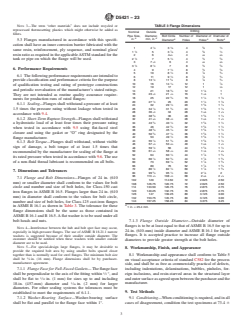
TABLE 1 Pressure Categories
A
Pressure Rating
Designation
psi MPa
A 25 0.173
B 50 0.345
C 75 0.517
D 100 0.690
E 125 0.862
F 150 1.034
A
Flanges with higher pressure ratings are available by agreement between the
purchaser and the manufacturer.
FIG. 1 Flange Types
4.1.5 Short-term rupture pressure and sealing-test pressure
unless otherwise indicated. The abbreviation for reinforced-
limits shall be categorized by single Arabic number designa-
thermosetting-resin pipe is RTRP.
tions as indicated by the cell classification system of Table 2.
3.2 Definitions of Terms Specific to This Standard:
3.2.1 contact molding (CM)—a method of fabrication
4.2 Designation Code—The flange-designation code shall
wherein the glass fiber reinforcement is applied to the mold in
consist of the abbreviation for contact molded (CM) followed
the form of all chopped-strand mat, or chopped-strand mat and
by the type as a capital letter, grade as an Arabic numeral, class
woven roving, in alternate plies by hand with the resin matrix
as a Roman numeral, and the pressure-rating category as a
applied by brush or roller and the laminate consolidated by a
capital letter and two Arabic numbers identifying the cell-
roller.
classification designations of the short-term rupture pressure
and sealing-test pressure, respectively. Thus, a complete
3.2.2 fiberglass pipe—a tubular product containing glass-
flange-designation code shall consist of three letters, one
fiber reinforcements embedded in or surrounded by cured
Arabic numeral, one Roman numeral, one letter and two
thermosetting resin; the composite structure may contain
numerals.
aggregate, granular or platelet fillers, thixotropic agents, pig-
4.2.1 Example—Contact molded fiberglass is CM-AlID-46.
ments or dyes; thermoplastic or thermosetting liners or coat-
This designation described a stub flange, made using glass-
ings may be included.
fiber-reinforced epoxy resin for full-axial pressure thrust. The
4. Classification
flange has a 100-psi (0.69-MPa) pressure rating, a short-term
rupture pressure of 400-psi (2.76-MPa), and a sealing-test
4.1 General—This specification covers reinforced-
thermosetting-resin flanges defined by type (method of pressure of 225-psi (1. 55-MPa).
manufacture), grade (generic type of resin), class (pressure end
4.3 Attachment of Flanges to Pipe, Pipe Fittings, or Tanks:
thrust capability), and pressure rating. Flanges complying with
4.3.1 Type “A” flanges are to be butt and strap welded to
this specification are also given numerical classifications relat-
pipe described in Specifications D2996, D2997, D3262,
ing to rupture pressure and sealing test pressure.
D3517, and D3754, or using overlay joint into a tank as
4.1.1 Types:
described in Specifications D3299 and D4097.
4.1.1.1 Type A—Integral flange, contact molded with the
4.3.2 Type “B” flanges are built onto elbows, reducers, or
stub integral with the flange.
other parts where the use of an integral flange (Type “A”) is not
4.1.1.2 Type B—Flange on pipe, contact molded onto an
practical or required.
existing pipe or fitting.
4.1.2 Grades:
5. Materials and Manufacture
4.1.2.1 Grade 1—Epoxy resin.
5.1 Flanges manufactured in accordance with this specifi-
4.1.2.2 Grade 2—Polyester resin.
cation shall be composed of reinforcement embedded in or
4.1.2.3 Grade 3—Phenolic resin.
surrounded by cured thermosetting resin.
4.1.2.4 Grade 4—Vinylester resin.
5.2 The resins, reinforcements, and other materials, when
4.1.2.5 Grade 5—Furan resin.
combined into composite structure, shall produce a flange that
4.1.3 Classes:
will meet the performance requirements of this specification.
4.1.3.1 Class I—Hoop and axial-pressure.
4.1.3.2 Class II—Hoop pressure only.
TABLE 2 Short-Term Rupture Pressure and Sealing-Test
NOTE 2—All combinations of type, liner, grade, and class may not be
A
Pressure
commercially available. Additional type, liner, grade, and class may be
Property/Cell Classification 1 2 3 4 5 6
added as they become commercially available. The purchaser should
solely determine or consult with the manufacturer for the proper class,
type, liner, and grade to be used under the installation and operating Short-Term Rupture 100 200 300 400 500 600
Pressure, psi (MPa) (0.69) (1.38) (2.07) (2.76) (3.45) (4.14)
conditions that will exist for the project in which the flange is to be used.
Sealing-test pressure, psi 37.5 75 112.5 150 187.5 225
4.1.4 Pressure Rating—Pressure rating shall be categorized
(MPa) (0.26) (0.52) (0.78) (1.03) (1.29) (1.55)
by single-letter designation. Pressure designations are shown in A
Refer to Test Method D1599 for explanation of failure.
Table 1.
D5421 − 23
NOTE 3—The term “other materials” does not include recycled or TABLE 3 Flange Dimensions
reprocessed thermosetting plastics which might otherwise be added as
Drilling
Nominal Outside
fillers.
Pipe Size, Diameter,
Bolt Circle Number of Diameter of Diameter of
A A
A A A
in. min, in.
Diameter Holes Holes Bolts
5.3 Flanges manufactured in accordance with this specifi-
cation shall have an inner corrosion barrier fabricated with the
1 1 5 1
1 4 ⁄4 3 ⁄8 4 ⁄8 ⁄2
same resin, reinforcement, ply sequence, and nominal glass/
1 7 5 1
1 ⁄2 5 3 ⁄8 4 ⁄8 ⁄2
resin ratio as required in the applicable ASTM standard for the 3 3 5
2 6 4 ⁄4 4 ⁄4 ⁄8
1 1 3 5
2 ⁄2 7 5 ⁄2 4 ⁄4 ⁄8
tank or pipe on which the flange will be used.
1 3 5
3 7 ⁄2 6 4 ⁄4 ⁄8
1 1 3 5
3 ⁄2 8 ⁄2 7 8 ⁄4 ⁄8
1 3 5
6. Performance Requirements
4 9 7 ⁄2 8 ⁄4 ⁄8
1 7 3
5 10 8 ⁄2 8 ⁄8 ⁄4
6.1 The following performance requirements are intended to
1 7 3
6 11 9 ⁄2 8 ⁄8 ⁄4
1 3 7 3
provide classification and performance criteria for the purpose 8 13 ⁄2 11 ⁄4 8 ⁄8 ⁄4
1 7
10 16 14 ⁄4 12 1 ⁄8
of qualification testing and rating of prototype constructions
12 19 17 12 1 ⁄8
and periodic reevaluation of the manufacturer’s stated ratings.
3 1
14 21 18 ⁄4 12 1 ⁄8 1
1 1 1
16 23 ⁄2 21 ⁄4 16 1 ⁄8 1
They are not intended as routine quality assurance require-
3 1 1
18 25 22 ⁄4 16 1 ⁄4 1 ⁄8
ments for production runs of rated flanges:
1 1 1
20 27 ⁄2 25 20 1 ⁄4 1 ⁄8
6.1.1 Sealing—Flanges shall withstand a pressure of at least 1 3 1
24 32 29 ⁄2 20 1 ⁄8 1 ⁄4
1 3 3 1
26 34 ⁄4 31 ⁄4 24 1 ⁄8 1 ⁄4
1.5 times the pressure rating without leakage when tested in
1 3 1
28 36 ⁄2 34 28 1 ⁄8 1 ⁄4
accordance with 9.4.
3 3 1
30 38 ⁄4 36 28 1 ⁄8 1 ⁄4
6.1.2 Short-Term Rupture Strength—Flanges shall withsta
...
This document is not an ASTM standard and is intended only to provide the user of an ASTM standard an indication of what changes have been made to the previous version. Because
it may not be technically possible to adequately depict all changes accurately, ASTM recommends that users consult prior editions as appropriate. In all cases only the current version
of the standard as published by ASTM is to be considered the official document.
Designation: D5421 − 15 D5421 − 23
Standard Specification for
Contact Molded “Fiberglass” (Glass-Fiber-Reinforced
Thermosetting Resin) Flanges
This standard is issued under the fixed designation D5421; the number immediately following the designation indicates the year of
original adoption or, in the case of revision, the year of last revision. A number in parentheses indicates the year of last reapproval. A
superscript epsilon (´) indicates an editorial change since the last revision or reapproval.
1. Scope*
1.1 This specification covers circular contact-molded fiberglass reinforced-thermosetting-resin flanges for use in pipe systems and
tank nozzles. Included are requirements for materials, workmanship, performance, and dimensions.
1.2 Flanges (see Fig. 1) may be produced as integral flanges, Type A, or flange-on-pipe, Type B.
1.3 This specification is based on flange performance and does not cover design.
1.4 These flanges are designed for use with pipe and tanks that are manufactured to Specifications D2996, D2997, D3262, D3299,
D3517, D3754, and D4097.
1.5 Selection of gaskets is not covered in this specification, refer to the manufacturer’s recommendation.
1.6 The values stated in inch-pound units are to be regarded as the standard. The SI units given in parentheses are for information
only.
1.7 The following precautionary caveat pertains only to the test methods portion, Section 9, of this specification: This standard
does not purport to address all of the safety concerns, if any, associated with its use. It is the responsibility of the user of this
standard to establish appropriate safety, health, and environmental practices and determine the applicability of regulatory
limitations prior to use.
NOTE 1—There is no known ISO equivalent to this standard.
1.8 This international standard was developed in accordance with internationally recognized principles on standardization
established in the Decision on Principles for the Development of International Standards, Guides and Recommendations issued
by the World Trade Organization Technical Barriers to Trade (TBT) Committee.
2. Referenced Documents
2.1 ASTM Standards:
C582 Specification for Contact-Molded Reinforced Thermosetting Plastic (RTP) Laminates for Corrosion-Resistant Equipment
This specification is under the jurisdiction of ASTM Committee D20 on Plastics and is the direct responsibility of Subcommittee D20.23 on Reinforced Plastic
Thermosetting Resin Piping Systems and Chemical Equipment.
Current edition approved May 1, 2015May 1, 2023. Published June 2015May 2023. Originally approved in 1993. Last previous edition approve in 20102015 as
D5421 – 05D5421 – 15.(2010). DOI: 10.1520/D5421-15.10.1520/D5421-23.
For referenced ASTM standards, visit the ASTM website, www.astm.org, or contact ASTM Customer Service at service@astm.org. For Annual Book of ASTM Standards
volume information, refer to the standard’s Document Summary page on the ASTM website.
*A Summary of Changes section appears at the end of this standard
Copyright © ASTM International, 100 Barr Harbor Drive, PO Box C700, West Conshohocken, PA 19428-2959. United States
D5421 − 23
FIG. 1 Flange Types
D883 Terminology Relating to Plastics
D1599 Test Method for Resistance to Short-Time Hydraulic Pressure of Plastic Pipe, Tubing, and Fittings
D1600 Terminology for Abbreviated Terms Relating to Plastics
D2996 Specification for Filament-Wound “Fiberglass” (Glass-Fiber-Reinforced Thermosetting-Resin) Pipe
D2997 Specification for Centrifugally Cast “Fiberglass” (Glass-Fiber-Reinforced Thermosetting-Resin) Pipe
D3262 Specification for “Fiberglass” (Glass-Fiber-Reinforced Thermosetting-Resin) Sewer Pipe
D3299 Specification for Filament-Wound Glass-Fiber-Reinforced Thermoset Resin Corrosion-Resistant Tanks
D3517 Specification for “Fiberglass” (Glass-Fiber-Reinforced Thermosetting-Resin) Pressure Pipe
D3754 Specification for “Fiberglass” (Glass-Fiber-Reinforced Thermosetting-Resin) Sewer and Industrial Pressure Pipe
D4097 Specification for Contact-Molded Glass-Fiber-Reinforced Thermoset Resin Corrosion-Resistant Tanks
2.2 ASME Standards:
B 16.1 Cast Iron Pipe Flanges and Flanged Fittings
B 16.5 Pipe Flanges and Flanged Fittings
B 18.21.1 Type “A” Narrow Washers
3. Terminology
3.1 Definitions:
3.1.1 Definitions are in accordance with Terminology D883. Abbreviations are in accordance with Terminology D1600, unless
otherwise indicated. The abbreviation for reinforced-thermosetting-resin pipe is RTRP.
3.2 Definitions of Terms Specific to This Standard:
3.2.1 contact molding (CM)—a method of fabrication wherein the glass fiber reinforcement is applied to the mold in the form of
all chopped-strand mat, or chopped-strand mat and woven roving, in alternate plies by hand with the resin matrix applied by brush
or roller and the laminate consolidated by a roller.
3.2.2 fiberglass pipe—a tubular product containing glass-fiber reinforcements embedded in or surrounded by cured thermosetting
resin; the composite structure may contain aggregate, granular or platelet fillers, thixotropic agents, pigments or dyes;
thermoplastic or thermosetting liners or coatings may be included.
4. Classification
4.1 General—This specification covers reinforced-thermosetting-resin flanges defined by type (method of manufacture), grade
(generic type of resin), class (pressure end thrust capability), and pressure rating. Flanges complying with this specification are also
given numerical classifications relating to rupture pressure and sealing test pressure.
4.1.1 Types:
4.1.1.1 Type A—Integral flange, contact molded with the stub integral with the flange.
4.1.1.2 Type B—Flange on pipe, contact molded onto an existing pipe or fitting.
Available from American Society of Mechanical Engineers (ASME), ASME International Headquarters, Two Park Ave., New York, NY 10016-5990, http://
www.asme.org.
D5421 − 23
4.1.2 Grades:
4.1.2.1 Grade 1—Epoxy resin.
4.1.2.2 Grade 2—Polyester resin.
4.1.2.3 Grade 3—Phenolic resin.
4.1.2.4 Grade 4—Vinylester resin.
4.1.2.5 Grade 5—Furan resin.
4.1.3 Classes:
4.1.3.1 Class I—Hoop and axial-pressure.
4.1.3.2 Class II—Hoop pressure only.
NOTE 2—All combinations of type, liner, grade, and class may not be commercially available. Additional type, liner, grade, and class may be added as
they become commercially available. The purchaser should solely determine or consult with the manufacturer for the proper class, type, liner, and grade
to be used under the installation and operating conditions that will exist for the project in which the flange is to be used.
4.1.4 Pressure Rating—Pressure rating shall be categorized by single-letter designation. Pressure designations are shown in Table
1.
4.1.5 Short-term rupture pressure and sealing-test pressure limits shall be categorized by single arabicArabic number designations
as indicated by the cell classification system of Table 2.
4.2 Designation Code—The flange-designation code shall consist of the abbreviation for contact molded (CM) followed by the
type as a capital letter, grade as an Arabic numeral, class as a Roman numeral, and the pressure-rating category as a capital letter
and two Arabic numbers identifying the cell-classification designations of the short-term rupture pressure and sealing-test pressure,
respectively. Thus, a complete flange-designation code shall consist of three letters, one Arabic numeral, one Roman numeral, one
letter and two numerals.
4.2.1 Example—Contact molded fiberglass is CM-AlID-46. This designation described a stub flange, made using glass-fiber-
reinforced epoxy resin for full-axial pressure thrust. The flange has a 100-psi (0.69-MPa) pressure rating, a short-term rupture
pressure of 400-psi (2.76-MPa), and a sealing-test pressure of 225-psi (1. 55-MPa).
4.3 Attachment of Flanges to Pipe, Pipe Fittings, or Tanks:
4.3.1 Type “A” flanges are to be butt and strap welded to pipe described in Specifications D2996, D2997, D3262, D3517, and
D3754, or using overlay joint into a tank as described in Specifications D3299 and D4097.
4.3.2 Type “B” flanges are built onto elbows, reducers, or other parts where the use of an integral flange (Type “A”) is not practical
or required.
TABLE 1 Pressure Categories
A
Pressure Rating
Designation
psi MPa
A 25 0.173
B 50 0.345
C 75 0.517
D 100 0.690
E 125 0.862
F 150 1.034
A
Flanges with higher pressure ratings are available by agreement between the
purchaser and the manufacturer.
D5421 − 23
TABLE 2 Short-Term Rupture Pressure and Sealing-Test
A
Pressure
Property/Cell Classification 1 2 3 4 5 6
Short-Term Rupture 100 200 300 400 500 600
Pressure, psi (MPa) (0.69) (1.38) (2.07) (2.76) (3.45) (4.14)
Sealing-test pressure, psi 37.5 75 112.5 150 187.5 225
(MPa) (0.26) (0.52) (0.78) (1.03) (1.29) (1.55)
A
Refer to Test Method D1599 for explanation of failure.
5. Materials and Manufacture
5.1 Flanges manufactured in accordance with this specification shall be composed of reinforcement embedded in or surrounded
by cured thermosetting resin.
5.2 The resins, reinforcements, and other materials, when combined into composite structure, shall produce a flange that will meet
the performance requirements of this specification.
NOTE 3—The term “other materials” does not include recycled or reprocessed thermosetting plastics which might otherwise be added as fillers.
5.3 Flanges manufactured in accordance with this specification shall have an inner corrosion barrier fabricated with the same resin,
reinforcement, ply sequence, and nominal glass/resin ratio as required in the applicable ASTM standard for the tank or pipe on
which the flange will be used.
6. Performance Requirements
6.1 The following performance requirements are intended to provide classification and performance criteria for the purpose of
qualification testing and rating of prototype constructions and periodic reevaluation of the manufacturer’s stated ratings. They are
not intended as routine quality assurance requirements for production runs of rated flanges:
6.1.1 Sealing—Flanges shall withstand a pressure of at least 1.5 times the pressure rating without leakage when tested in
accordance with 9.4.
6.1.2 Short-Term Rupture Strength—Flanges shall withstand a hydrostatic load of at least four times their pressure rating when
tested in accordance with 9.5 using flat-faced steel closure and using the gasket or “O” ring designated by the flange manufacturer.
6.1.3 Bolt Torque—Flanges shall withstand, without visible sign of damage, a bolt torque of two at least 1.5 times that
recommended by the manufacturer. manufacturer for sealing of the flange at its rated pressure when tested in accordance with 9.6.
The use of a non-fluid thread lubricant is recommended on all bolts.
7. Dimensions and Tolerances
7.1 Flange and Bolt Dimensions—Flanges of 24 in. (610 mm) or smaller diameter shall conform to the values for bolt circle and
number and size of bolt holes, for Class-150 cast iron flanges in ASME B 16.5. Flanges larger than 24 in. (610 mm) in diameter
shall conform to the values for bolt circle, nu
...