

ASTM D3754-19
(Specification)Standard Specification for “Fiberglass” (Glass-Fiber-Reinforced Thermosetting-Resin) Sewer and Industrial Pressure Pipe
General Information
- Abstract
ABSTRACT
This specification covers machine-made fiberglass pipe for use in pressure systems for conveying sanitary sewage, storm water, and many industrial wastes, and corrosive fluids. Both glass-fiberreinforced thermosetting-resin pipe (RTRP) and glass-fiberreinforced polymer mortar pipe (RPMP) are fiberglass pipes. This standard is suited primarily for pipes to be installed in buried applications, although it may be used to the extent applicable for other installations such as, but not limited to, jacking, tunnel lining and slip-lining and rehabilitation of existing pipelines. The pipe is intended to operate at certain internal gage pressures. The fiberglass sewer and industrial pressure pipe are defined by raw materials in the structural wall (type) and liner, surface layer material (grade), operating pressure (class), and pipe stiffness. Different tests shall be performed in order to determine the following properties of pipe: inside diameter, outside diameter, length, wall thickness, squareness of pipe ends, chemical resistance, soundness, stiffness, hoop-tensile strength, beam strength, longitudinal tensile strength, and longitudinal compressive strength.
SCOPE
1.1 This specification covers machine-made fiberglass pipe, 8 in. (200 mm) through 156 in. (4000 mm), for use in pressure systems for conveying sanitary sewage, storm water, and many industrial wastes, and corrosive fluids. Both glass-fiber-reinforced thermosetting-resin pipe (RTRP) and glass-fiber-reinforced polymer mortar pipe (RPMP) are fiberglass pipes. This standard is suited primarily for pipes to be installed in buried applications, although it may be used to the extent applicable for other installations such as, but not limited to, jacking, tunnel lining and slip-lining and rehabilitation of existing pipelines. Pipe covered by this specification is intended to operate at internal gage pressures of 450 psi (3103 kPa) or less.
Note 1: For the purposes of this standard, polymer does not include natural polymers.
1.2 The values given in inch-pound units are to be regarded as the standard. The values given in parentheses are provided for information purposes only.
3
Grade
1
Polyester resin surface layer—
reinforcedB
2
polyesterB resin surface layer—
nonreinforcedB
3
polyesterB resin and sand surface layer nonreinforced
4
epoxy resin surface layer—
reinforced
5
epoxy resin surface layer—
nonreinforced
6
No surface layer
4
ClassC
C50
C100
C150
C200
C250
C300
C350
C400
C450
5
Pipe Stiffness
psi (kPa)
A
9 (62)
B
18 (124)
C
36 (248)
D
72 (496)ABC
1.3 The following precautionary caveat pertains only to the test method portion, Section 8, of this specification: This standard does not purport to address all of the safety concerns, if any, associated with its use. It is the responsibility of the user of this standard to establish appropriate safety, health, and environmental practices and determine the applicability of regulatory limitations prior to use.
Note 2: There is no known ISO equivalent to this standard.
1.4 This international standard was developed in accordance with internationally recognized principles on standardization established in the Decision on Principles for the Development of International Standards, Guides and Recommendations issued by the World Trade Organization Technical Barriers to Trade (TBT) Committee.
- Status
- Published
- Publication Date
- 31-Oct-2019
- Technical Committee
- D20 - Plastics
Buy Documents
ASTM D3754-19 - Standard Specification for “Fiberglass” (Glass-Fiber-Reinforced Thermosetting-Resin) Sewer and Industrial Pressure Pipe
REDLINE ASTM D3754-19 - Standard Specification for “Fiberglass” (Glass-Fiber-Reinforced Thermosetting-Resin) Sewer and Industrial Pressure Pipe
Overview
ASTM D3754-19 is the recognized standard specification for machine-made fiberglass (glass-fiber-reinforced thermosetting-resin) pressure pipe used for sewer and industrial applications. Developed by ASTM International, this standard details requirements for both glass-fiber-reinforced thermosetting-resin pipe (RTRP) and glass-fiber-reinforced polymer mortar pipe (RPMP). The specification applies primarily to pressure pipes designed for conveying sanitary sewage, storm water, various industrial wastes, and corrosive fluids, particularly in buried installations. It is also utilized for pipe jacking, tunnel lining, slip-lining, and the rehabilitation of existing pipelines, providing critical guidance to ensure long-term performance in demanding environments.
Key Topics
Classification and Pipe Properties
- Pipe Types: Covers both RTRP (without aggregate) and RPMP (with aggregate) pipes.
- Liner Options: Includes various liners – reinforced thermoset, non-reinforced thermoset, thermoplastic, or no liner – for different service and chemical resistance needs.
- Grades: Specifies resin type and reinforcement, including polyester and epoxy resins, and surface layers tailored for performance in corrosive or abrasive settings.
- Pressure Classes: Ranges from C50 to C450, setting maximum operating pressures up to 450 psi (3103 kPa).
- Pipe Stiffness: Multiple stiffness grades (A, B, C, D) ensure adaptability to loading and deflection requirements in installation environments.
Performance Requirements
- Mechanical and Chemical Testing: Pipes must meet rigorous criteria for inside/outside diameter, wall thickness, squareness, chemical resistance, soundness, stiffness, hoop-tensile strength, beam strength, longitudinal strength, and compression strength.
- Joint Tightness: Specifies joint designs and performance, including unrestrained and restrained options such as bell-and-spigot, mechanical couplings, and others, ensuring watertight connections under pressure.
- Quality Assurance: Mandates sampling and control tests to confirm compliance with workmanship, dimensional tolerances, pressure integrity, and chemical service suitability.
Industry Compliance
- ASTM D3754-19 aligns with international principles for standardization and references related ASTM, ISO, and AWWA standards to support global project requirements.
Applications
Buried Sewer and Pressure Pipes
- Widely used in municipal infrastructure for conveying sanitary sewage and storm water under pressure, where reliability and corrosion resistance are vital.
Industrial Waste and Process Fluids
- Shown to be robust in transporting various industrial effluents, process solutions, and corrosive fluids, benefiting from fiberglass’s resistance to many chemicals.
Pipeline Rehabilitation and Advanced Installations
- Integral for jacking, slip-lining, and tunnel lining in both new installations and rehabilitation projects, due to lightweight construction, strength, and flexibility.
- Suitable for environments requiring high-pressure containment and long-term durability, such as large-diameter industrial utility corridors.
Custom-Engineered Solutions
- The standard's classification system allows pipe properties (type, liner, grade, class, stiffness) to be matched precisely to service conditions and installation requirements, facilitating engineered piping systems for specialized applications.
Related Standards
- ASTM C33: Specification for Concrete Aggregates – relevant for aggregate used in RPMP.
- ASTM C581: Determining Chemical Resistance of Thermosetting Resins – used for evaluating pipe liner performance.
- ASTM D638, D695, D790: Various methods for tensile, compressive, and flexural properties of plastics.
- ASTM D2290: Apparent Hoop Tensile Strength of Plastic or Reinforced Plastic Pipe.
- ASTM D2412: External Loading Characteristics of Plastic Pipe.
- ASTM D2992: Hydrostatic Design Basis for Fiberglass Pipes.
- ASTM D4161: Specification for Pipe Joints Using Flexible Elastomeric Seals.
- AWWA C950: Glass-Fiber Reinforced Thermosetting Resin Pressure Pipe – often specified for municipal water/wastewater projects.
- ISO 1172: Determination of Loss on Ignition for Textile Glass Reinforced Plastics.
By following ASTM D3754-19, engineers, manufacturers, and contractors can ensure the performance, safety, and durability of fiberglass pressure pipes in critical wastewater and industrial fluid handling applications.
Relations
- Effective Date
- 01-Nov-2019
- Effective Date
- 01-Feb-2024
- Effective Date
- 01-Nov-2023
- Effective Date
- 01-Apr-2020
- Effective Date
- 15-Feb-2020
- Effective Date
- 01-Jan-2020
- Effective Date
- 01-Aug-2019
- Effective Date
- 01-Aug-2019
- Effective Date
- 15-Apr-2019
- Effective Date
- 01-Apr-2019
- Effective Date
- 01-Feb-2019
- Effective Date
- 01-Jan-2019
- Effective Date
- 01-Jan-2019
- Effective Date
- 01-Dec-2018
- Effective Date
- 01-Nov-2018
Buy Documents
ASTM D3754-19 - Standard Specification for “Fiberglass” (Glass-Fiber-Reinforced Thermosetting-Resin) Sewer and Industrial Pressure Pipe
REDLINE ASTM D3754-19 - Standard Specification for “Fiberglass” (Glass-Fiber-Reinforced Thermosetting-Resin) Sewer and Industrial Pressure Pipe
Get Certified
Connect with accredited certification bodies for this standard

Institut za varilstvo d.o.o. (Welding Institute)
Slovenia's leading welding institute since 1952. ISO 3834, EN 1090, pressure equipment certification, NDT personnel, welder qualification. Only IIW Au
Sponsored listings
Frequently Asked Questions
ASTM D3754-19 is a technical specification published by ASTM International. Its full title is "Standard Specification for “Fiberglass” (Glass-Fiber-Reinforced Thermosetting-Resin) Sewer and Industrial Pressure Pipe". This standard covers: ABSTRACT This specification covers machine-made fiberglass pipe for use in pressure systems for conveying sanitary sewage, storm water, and many industrial wastes, and corrosive fluids. Both glass-fiberreinforced thermosetting-resin pipe (RTRP) and glass-fiberreinforced polymer mortar pipe (RPMP) are fiberglass pipes. This standard is suited primarily for pipes to be installed in buried applications, although it may be used to the extent applicable for other installations such as, but not limited to, jacking, tunnel lining and slip-lining and rehabilitation of existing pipelines. The pipe is intended to operate at certain internal gage pressures. The fiberglass sewer and industrial pressure pipe are defined by raw materials in the structural wall (type) and liner, surface layer material (grade), operating pressure (class), and pipe stiffness. Different tests shall be performed in order to determine the following properties of pipe: inside diameter, outside diameter, length, wall thickness, squareness of pipe ends, chemical resistance, soundness, stiffness, hoop-tensile strength, beam strength, longitudinal tensile strength, and longitudinal compressive strength. SCOPE 1.1 This specification covers machine-made fiberglass pipe, 8 in. (200 mm) through 156 in. (4000 mm), for use in pressure systems for conveying sanitary sewage, storm water, and many industrial wastes, and corrosive fluids. Both glass-fiber-reinforced thermosetting-resin pipe (RTRP) and glass-fiber-reinforced polymer mortar pipe (RPMP) are fiberglass pipes. This standard is suited primarily for pipes to be installed in buried applications, although it may be used to the extent applicable for other installations such as, but not limited to, jacking, tunnel lining and slip-lining and rehabilitation of existing pipelines. Pipe covered by this specification is intended to operate at internal gage pressures of 450 psi (3103 kPa) or less. Note 1: For the purposes of this standard, polymer does not include natural polymers. 1.2 The values given in inch-pound units are to be regarded as the standard. The values given in parentheses are provided for information purposes only. 3 Grade 1 Polyester resin surface layer— reinforcedB 2 polyesterB resin surface layer— nonreinforcedB 3 polyesterB resin and sand surface layer nonreinforced 4 epoxy resin surface layer— reinforced 5 epoxy resin surface layer— nonreinforced 6 No surface layer 4 ClassC C50 C100 C150 C200 C250 C300 C350 C400 C450 5 Pipe Stiffness psi (kPa) A 9 (62) B 18 (124) C 36 (248) D 72 (496)ABC 1.3 The following precautionary caveat pertains only to the test method portion, Section 8, of this specification: This standard does not purport to address all of the safety concerns, if any, associated with its use. It is the responsibility of the user of this standard to establish appropriate safety, health, and environmental practices and determine the applicability of regulatory limitations prior to use. Note 2: There is no known ISO equivalent to this standard. 1.4 This international standard was developed in accordance with internationally recognized principles on standardization established in the Decision on Principles for the Development of International Standards, Guides and Recommendations issued by the World Trade Organization Technical Barriers to Trade (TBT) Committee.
ABSTRACT This specification covers machine-made fiberglass pipe for use in pressure systems for conveying sanitary sewage, storm water, and many industrial wastes, and corrosive fluids. Both glass-fiberreinforced thermosetting-resin pipe (RTRP) and glass-fiberreinforced polymer mortar pipe (RPMP) are fiberglass pipes. This standard is suited primarily for pipes to be installed in buried applications, although it may be used to the extent applicable for other installations such as, but not limited to, jacking, tunnel lining and slip-lining and rehabilitation of existing pipelines. The pipe is intended to operate at certain internal gage pressures. The fiberglass sewer and industrial pressure pipe are defined by raw materials in the structural wall (type) and liner, surface layer material (grade), operating pressure (class), and pipe stiffness. Different tests shall be performed in order to determine the following properties of pipe: inside diameter, outside diameter, length, wall thickness, squareness of pipe ends, chemical resistance, soundness, stiffness, hoop-tensile strength, beam strength, longitudinal tensile strength, and longitudinal compressive strength. SCOPE 1.1 This specification covers machine-made fiberglass pipe, 8 in. (200 mm) through 156 in. (4000 mm), for use in pressure systems for conveying sanitary sewage, storm water, and many industrial wastes, and corrosive fluids. Both glass-fiber-reinforced thermosetting-resin pipe (RTRP) and glass-fiber-reinforced polymer mortar pipe (RPMP) are fiberglass pipes. This standard is suited primarily for pipes to be installed in buried applications, although it may be used to the extent applicable for other installations such as, but not limited to, jacking, tunnel lining and slip-lining and rehabilitation of existing pipelines. Pipe covered by this specification is intended to operate at internal gage pressures of 450 psi (3103 kPa) or less. Note 1: For the purposes of this standard, polymer does not include natural polymers. 1.2 The values given in inch-pound units are to be regarded as the standard. The values given in parentheses are provided for information purposes only. 3 Grade 1 Polyester resin surface layer— reinforcedB 2 polyesterB resin surface layer— nonreinforcedB 3 polyesterB resin and sand surface layer nonreinforced 4 epoxy resin surface layer— reinforced 5 epoxy resin surface layer— nonreinforced 6 No surface layer 4 ClassC C50 C100 C150 C200 C250 C300 C350 C400 C450 5 Pipe Stiffness psi (kPa) A 9 (62) B 18 (124) C 36 (248) D 72 (496)ABC 1.3 The following precautionary caveat pertains only to the test method portion, Section 8, of this specification: This standard does not purport to address all of the safety concerns, if any, associated with its use. It is the responsibility of the user of this standard to establish appropriate safety, health, and environmental practices and determine the applicability of regulatory limitations prior to use. Note 2: There is no known ISO equivalent to this standard. 1.4 This international standard was developed in accordance with internationally recognized principles on standardization established in the Decision on Principles for the Development of International Standards, Guides and Recommendations issued by the World Trade Organization Technical Barriers to Trade (TBT) Committee.
ASTM D3754-19 is classified under the following ICS (International Classification for Standards) categories: 23.040.20 - Plastics pipes. The ICS classification helps identify the subject area and facilitates finding related standards.
ASTM D3754-19 has the following relationships with other standards: It is inter standard links to ASTM D3754-14, ASTM D883-24, ASTM D883-23, ASTM F412-20, ASTM C581-20, ASTM D883-20, ASTM D2290-19a, ASTM D883-19c, ASTM D883-19a, ASTM D4161-14(2019), ASTM D883-19, ASTM F412-19, ASTM D2290-19, ASTM D883-18a, ASTM D883-18. Understanding these relationships helps ensure you are using the most current and applicable version of the standard.
ASTM D3754-19 is available in PDF format for immediate download after purchase. The document can be added to your cart and obtained through the secure checkout process. Digital delivery ensures instant access to the complete standard document.
Standards Content (Sample)
This international standard was developed in accordance with internationally recognized principles on standardization established in the Decision on Principles for the
Development of International Standards, Guides and Recommendations issued by the World Trade Organization Technical Barriers to Trade (TBT) Committee.
Designation:D3754 −19
Standard Specification for
“Fiberglass” (Glass-Fiber-Reinforced Thermosetting-Resin)
Sewer and Industrial Pressure Pipe
This standard is issued under the fixed designation D3754; the number immediately following the designation indicates the year of
original adoption or, in the case of revision, the year of last revision. A number in parentheses indicates the year of last reapproval. A
superscript epsilon (´) indicates an editorial change since the last revision or reapproval.
1. Scope 2. Referenced Documents
2.1 ASTM Standards:
1.1 This specification covers machine-made fiberglass pipe,
C33 Specification for Concrete Aggregates
8 in. (200 mm) through 156 in. (4000 mm), for use in pressure
C581 Practice for Determining Chemical Resistance of
systems for conveying sanitary sewage, storm water, and many
Thermosetting Resins Used in Glass-Fiber-Reinforced
industrial wastes, and corrosive fluids. Both glass-fiber-
Structures Intended for Liquid Service
reinforced thermosetting-resin pipe (RTRP) and glass-fiber-
D638 Test Method for Tensile Properties of Plastics
reinforced polymer mortar pipe (RPMP) are fiberglass pipes.
D695 Test Method for Compressive Properties of Rigid
This standard is suited primarily for pipes to be installed in
Plastics
buried applications, although it may be used to the extent
D790 Test Methods for Flexural Properties of Unreinforced
applicable for other installations such as, but not limited to,
and Reinforced Plastics and Electrical Insulating Materi-
jacking, tunnel lining and slip-lining and rehabilitation of
als
existing pipelines. Pipe covered by this specification is in-
D883 Terminology Relating to Plastics
tended to operate at internal gage pressures of 450 psi (3103
D1600 Terminology forAbbreviatedTerms Relating to Plas-
kPa) or less.
tics
NOTE 1—For the purposes of this standard, polymer does not include
D2290 Test Method for Apparent Hoop Tensile Strength of
natural polymers.
Plastic or Reinforced Plastic Pipe
1.2 The values given in inch-pound units are to be regarded
D2412 Test Method for Determination of External Loading
as the standard. The values given in parentheses are provided
Characteristics of Plastic Pipe by Parallel-Plate Loading
for information purposes only.
D2584 Test Method for Ignition Loss of Cured Reinforced
Resins
1.3 The following precautionary caveat pertains only to the
D2992 Practice for Obtaining Hydrostatic or Pressure De-
test method portion, Section 8, of this specification: This
sign Basis for “Fiberglass” (Glass-Fiber-Reinforced
standard does not purport to address all of the safety concerns,
Thermosetting-Resin) Pipe and Fittings
if any, associated with its use. It is the responsibility of the user
D3567 Practice for Determining Dimensions of “Fiberglass”
of this standard to establish appropriate safety, health, and
(Glass-Fiber-Reinforced Thermosetting Resin) Pipe and
environmental practices and determine the applicability of
Fittings
regulatory limitations prior to use.
D3681 TestMethodforChemicalResistanceof“Fiberglass”
NOTE 2—There is no known ISO equivalent to this standard.
(Glass–Fiber–Reinforced Thermosetting-Resin) Pipe in a
Deflected Condition
1.4 This international standard was developed in accor-
D3892 Practice for Packaging/Packing of Plastics
dance with internationally recognized principles on standard-
D4161 Specification for “Fiberglass” (Glass-Fiber-
ization established in the Decision on Principles for the
Reinforced Thermosetting-Resin) Pipe Joints Using Flex-
Development of International Standards, Guides and Recom-
ible Elastomeric Seals
mendations issued by the World Trade Organization Technical
F412 Terminology Relating to Plastic Piping Systems
Barriers to Trade (TBT) Committee.
F477 Specification for Elastomeric Seals (Gaskets) for Join-
ing Plastic Pipe
This specification is under the jurisdiction of ASTM Committee D20 on
Plastics and is the direct responsibility of Subcommittee D20.23 on Reinforced
Plastic Piping Systems and Chemical Equipment. For referenced ASTM standards, visit the ASTM website, www.astm.org, or
Current edition approved Nov. 1, 2019. Published December 2019. Originally contact ASTM Customer Service at service@astm.org. For Annual Book of ASTM
approved in 1979. Last previous edition approved 2014 as D3754 – 14. DOI: Standards volume information, refer to the standard’s Document Summary page on
10.1520/D3754-19. the ASTM website.
Copyright © ASTM International, 100 Barr Harbor Drive, PO Box C700, West Conshohocken, PA 19428-2959. United States
D3754−19
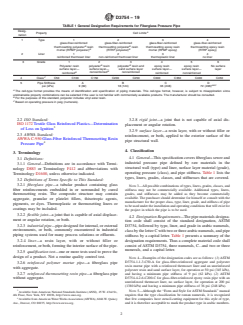
TABLE 1 General Designation Requirements for Fiberglass Pressure Pipe
Desig-
A
Property Cell Limits
nation
1 Type 1 2 3 4
glass-fiber-reinforced glass-fiber-reinforced glass-fiber-reinforced glass-fiber-reinforced
B B
thermosetting polyester resin thermosetting polyester resin thermosetting epoxy resin thermosetting epoxy resin
B B
mortar (RPMP polyester) (RTRP polyester)
mortar (RPMP epoxy) (RTRP epoxy)
2 Liner 1 2 3 4
reinforced thermoset liner non-reinforced thermoset liner thermoplastic liner no liner
3 Grade 1 2 3 4 5 6
B B
Polyester resin polyester resin polyester resin and epoxy resin epoxy resin No surface
surface layer— sand surface layer
surface layer— surface layer— surface layer— layer
B
B nonreinforced nonreinforced
reinforced reinforced nonreinforced
C
4 Class C50 C100 C150 C200 C250 C300 C350 C400 C450
5 Pipe Stiffness A B C D
ABC
psi (kPa) 9 (62) 18 (124) 36 (248) 72 (496)
A
The cell-type format provides the means of identification and specification of piping materials. This cell-type format, however, is subject to misapplication since
unobtainable property combinations can be selected if the user is not familiar with commercially available products. The manufacturer should be consulted.
B
For the purposes of this standard, polyester includes vinyl ester resin.
C
Based on operating pressure in psig (numerals).
2.2 ISO Standard: 3.2.8 rigid joint—a joint that is not capable of axial dis-
ISO 1172 Textile Glass Reinforced Plastics—Determination placement or angular rotation.
of Loss on Ignition
3.2.9 surface layer—a resin layer, with or without filler or
2.3 AWWA Standard:
reinforcement, or both, applied to the exterior surface of the
AWWA C-950 Glass-Fiber Reinforced Thermosetting Resin
pipe structural wall.
Pressure Pipe
4. Classification
3. Terminology
4.1 General—This specification covers fiberglass sewer and
3.1 Definitions:
industrial pressure pipe defined by raw materials in the
3.1.1 General—Definitions are in accordance with Termi-
structural wall (type) and liner, surface layer material (grade),
nology D883 or Terminology F412 and abbreviations with
operating pressure (class), and pipe stiffness. Table 1 lists the
Terminology D1600, unless otherwise indicated.
types, liners, grades, classes, and stiffnesses that are covered.
3.2 Definitions of Terms Specific to This Standard:
3.2.1 fiberglass pipe—a tubular product containing glass
NOTE3—Allpossiblecombinationsoftypes,liners,grades,classes,and
fiber reinforcements embedded in or surrounded by cured stiffness may not be commercially available. Additional types, liners,
grades, and stiffnesses may be added as they become commercially
thermosetting resin. The composite structure may contain
available. The purchaser should determine for himself or consult with the
aggregate, granular or platelet fillers, thixotropic agents,
manufacturer for the proper class, type, liner, grade, and stiffness of pipe
pigments, or dyes. Thermoplastic or thermosetting liners or
tobeusedundertheinstallationandoperatingconditionsthatwillexistfor
coatings may be included.
the project in which the pipe is to be used.
3.2.2 flexible joint—a joint that is capable of axial displace-
4.2 Designation Requirements—Thepipematerialsdesigna-
ment or angular rotation, or both.
tion code shall consist of the standard designation, ASTM
3.2.3 industrial pipe—pipe designed for internal, or external
D3754, followed by type, liner, and grade in arabic numerals,
environments, or both, commonly encountered in industrial
classbytheletterCwithtwoorthreearabicnumerals,andpipe
piping systems used for many process solutions or effluents.
stiffness by a capital letter. Table 1 presents a summary of the
designation requirements. Thus a complete material code shall
3.2.4 liner—a resin layer, with or without filler or
reinforcement, or both, forming the interior surface of the pipe. consist of ASTM D3754, three numerals, C.and two or three
numerals, and a capital letter.
3.2.5 qualification test—one or more tests used to prove the
design of a product. Not a routine quality control test.
NOTE 4—Examples of the designation codes are as follows: (1)ASTM
D3754-1-1-3-C50-A for glass-fiber-reinforced aggregate and polyester
3.2.6 reinforced polymer mortar pipe—a fiberglass pipe
resin mortar pipe with a reinforced thermoset liner and an unreinforced
with aggregate.
polyester resin and sand surface layer, for operation at 50 psi (345 kPa),
3.2.7 reinforced thermosetting resin pipe—a fiberglass pipe
and having a minimum pipe stiffness of 9 psi (62 kPa). (2) ASTM
without aggregate. D3754-4-2-6-C200-C for glass-fiber-reinforced epoxy resin pipe with an
unreinforced thermoset liner, no surface layer, for operation at 200 psi
(1380 kPa) and having a minimum pipe stiffness of 36 psi (248 kPa).
NOTE 5—Although the “Form and Style for ASTM Standards” manual
Available fromAmerican National Standards Institute (ANSI), 25 W. 43rd St.,
requires that the type classification be roman numerals, it is recognized
4th Floor, New York, NY 10036, http://www.ansi.org.
Available fromAmerican Water WorksAssociation (AWWA), 6666 W. Quincy that few companies have stencil-cutting equipment for this style of type,
Ave., Denver, CO 80235, http://www.awwa.org. and it is therefore acceptable to mark the product type in arabic numbers.
D3754−19
5. Materials and Manufacture 5.4.2.7 Mechanical Coupling, an elastomeric sealed cou-
pling with supplemental restraining elements.
5.1 General—The thermosetting resins, glass fiber
reinforcements, fillers, and other materials, when combined as
NOTE 6—Other types of joints may be added as they become commer-
a composite structure, shall produce piping products that meet cially available.
the performance requirements of this specification. NOTE 7—Restrained joints typically increase service loads on the pipe
to greater than those experienced with unrestrained joints. The purchaser
5.2 Wall Composition—The basic structural wall composi-
is cautioned to take into consideration all conditions that may be
tion shall consist of a thermosetting resin, glass-fiber
encountered in the anticipated service and to consult the manufacturer
regarding the suitability of a particular type and class of pipe for service
reinforcement, and, if used, an aggregate filler.
with restrained joint systems.
5.2.1 Resin—Athermosetting polyester or epoxy resin, with
or without filler.
5.5 Gaskets—Elastomeric gaskets, when used with this
5.2.2 Aggregate—A siliceous sand conforming to the re-
pipe, shall conform to the requirements of Specification F477,
quirements of Specification C33, except that the requirements
except that composition of the elastomer shall be as agreed
for gradation shall not apply.
upon between the purchaser and the supplier for the particular
5.2.3 Reinforcement—A commercial grade of glass fibers
exposure to oily or aggressive-chemical environments.
compatible with the resin used.
6. Requirements
5.3 Liner and Surface Layers—A liner or surface layer, or
both, when incorporated into or onto the pipe shall meet the
6.1 Workmanship:
chemical and structural requirements of this specification.
6.1.1 Each pipe shall be free from all defects including
5.4 Joints—The pipe shall have a joining system that shall indentations, delaminations, bubbles, pinholes, cracks, pits,
provide for fluid tightness for the intended service condition.A blisters, foreign inclusions, and resin-starved areas that due to
particular type of joint may be restrained or unrestrained and their nature, degree, or extent, detrimentally affect the strength
flexible or rigid depending on the specific configuration and and serviceability of the pipe. The pipe shall be as uniform as
design conditions. commercially practicable in color, opacity, density, and other
5.4.1 Unrestrained—Pipe joints capable of withstanding physical properties.
internal pressure but not longitudinal forces.
6.1.2 The inside surface of each pipe shall be free of bulges,
5.4.1.1 Coupling or Bell-and-Spigot Gasket Joints, with a
dents, ridges, or other defects that result in a variation of inside
groove either on the spigot or in the bell to retain an
diameter of more than ⁄8 in. (3.2 mm) from that obtained on
elastomeric gasket that shall be the sole element of the joint to
adjacent unaffected portions of the surface. No glass-fiber
provide watertightness. For typical joint details see Fig. 1.
reinforcement shall penetrate the interior surface of the pipe
5.4.1.2 Mechanical Coupling Joint, with elsastomeric seals.
wall.
5.4.1.3 Butt Joint, with laminated overlay
6.1.3 Joint sealing surfaces shall be free of dents, gouges, or
5.4.1.4 Flanged Joint, both integral and loose ring.
other surface irregularities that will affect the integrity of the
5.4.2 Restrained—Pipe joints capable of withstanding inter-
joints.
nal pressure and longitudinal tensile loads.
6.2 Dimensions:
5.4.2.1 Joints similar to those in 5.4.1.1 with supplemental
6.2.1 Pipe Diameters—The pipe shall be supplied in the
restraining elements.
nominal diameters shown in Table 2 or Table 3. The pipe
5.4.2.2 Butt Joint, with laminated overlay.
diameter tolerances shall be as shown in Table 2 or Table 3,
5.4.2.3 Bell-and-Spigot, with laminated overlay.
when measured in accordance with 8.1.1.
5.4.2.4 Bell-and-Spigot, adhesive-bonded-joint: Three types
6.2.2 Lengths—The pipe shall be supplied in nominal
of adhesive-bonded joints are premitted by this standard as
lengths of 10, 20, 30, 40, and 60 ft (3.05, 6.10, 9.15, 12.19, and
follows:
18.29 m). The actual laying length shall be the nominal length
(1) Tapered bell-and-spigot,anadhesivejointthatismanu-
62in.(651mm),whenmeasuredinaccordancewith8.1.2.At
factured with a tapered socket for use in conjunction with a
least 90 % of the total footage of any one size and class,
tapered spigot and a suitable adhesive.
excluding special-order lengths, shall be furnished in the
(2) Straight bell-and-spigot,anadhesivejointthatismanu-
nominal lengths specified by the purchaser. Random lengths, if
factured with an untapered socket for use in conjunction with
furnished, shall not vary from the nominal lengths by more
an untapered spigot and a suitable adhesive.
than 5 ft (1.53 m), or 25 %, whichever is less.
(3) Tapered bell and straight spigot, an adhesive joint that
is manufactured with a tapered socket for use with an unta- 6.2.3 Wall Thickness—The average wall thickness of the
pered spigot and a suitable adhesive. pipeshallnotbelessthanthenominalwallthicknesspublished
5.4.2.5 Flanged Joint, both integral and loose ring. in the manufacturer’s literature current at the time of purchase,
5.4.2.6 Threaded Joints. and the minimum wall thickness at any point shall not be less
FIG. 1 Typical Joints
D3754−19
TABLE 2 Nominal Inside Diameters (ID) and Tolerances Inside Diameter Control Pipe
B B
ID Range, mm Tolerance on
Nominal Nominal Metric
Tolerances, in. Declared ID,
A B
Diameter, in. Diameter, mm Minimum Maximum
mm
8 ±0.25 200 196 204 ±1.5
10 ±0.25 250 246 255 ±1.5
12 ±0.25 300 296 306 ±1.8
14 ±0.25 400 396 408 ±2.4
15 ±0.25 500 496 510 ±3.0
16 ±0.25 600 595 612 ±3.6
18 ±0.25 700 695 714 ±4.2
20 ±0.25 800 795 816 ±4.2
21 ±0.25 900 895 918 ±4.2
24 ±0.25 1000 995 1020 ±5.0
27 ±0.27 1200 1195 1220 ±5.0
30 ±0.30 1400 1395 1420 ±5.0
33 ±0.33 1600 1595 1620 ±5.0
36 ±0.36 1800 1795 1820 ±5.0
39 ±0.39 2000 1995 2020 ±5.0
42 ±0.42 (2200) 2195 2220 ±6.0
45 ±0.45 2400 2395 2420 ±6.0
48 ±0.48 (2600) 2595 2620 ±6.0
51 ±0.51 2800 2795 2820 ±6.0
54 ±0.54 (3000) 2995 3020 ±6.0
60 ±0.60 3200 3195 3220 ±7.0
66 ±0.66 (3400) 3395 3420 ±7.0
72 ±0.72 3600 3595 3620 ±7.0
78 ±0.78 (3800) 3795 3820 ±7.0
84 ±0.84 4000 3995 4020 ±7.0
90 ±0.90 . . . .
96 ±0.96 . . . .
102 ±1.00 . . . .
108 ±1.00 . . . .
114 ±1.00 . . . .
120 ±1.00 . . . .
132 ±1.00 . . . .
144 ±1.00 . . . .
156 ±1.00 . . . .
A
Inside diameters other than those shown shall be permitted by agreement between purchaser and supplier.
B
Values are taken from International Standards Organization documents. Parentheses indicate non-preferred diameters.
than 87.5 % of the nominal wall thickness when measured in strain level must fall at or above the lower 95 % confidence
accordance with 8.1.3.
limit of the originally determined regression line, b) no
6.2.4 Squareness of Pipe Ends—All points around each end
specimen-failure times may be sooner than the lower 95 %
of a pipe unit shall fall within 6 ⁄4 in. (6.4 mm) or 60.5 % of
prediction limit of the originally determined regression line,
the nominal diameter of the pipe, whichever is greater, to a
and c) one-third or more of the specimen failure times must be
plane perpendicular to the longitudinal axis of the pipe, when
on or above the originally determined regression line.
measured in accordance with 8.1.4.
NOTE 10—Determine the lower 95 % confidence limit and the lower
6.3 Chemical Requirements:
95 % prediction limit in accordance with to Annex A2.
6.3.1 Sanitary Sewer Service:
6.3.1.4 When the alternative method of 8.2.1.5 is used,
6.3.1.1 Long-Term—Pipe specimens, when tested in accor-
dance with 8.2.1 shall be capable of being deflected, without failure shall not occur in any specimen.
failure, at the 50 year strain level given in Table 4 when
6.3.2 Industrial Service—The resin component of the liner
exposed to 1.0 N sulfuric acid.
or of the surface layer, or both, shall be a commercial-grade
corrosion-resistant thermoset that has either been evaluated in
NOTE 8—See Appendix X1 for derivation of the minimum sanitary
sewer pipe chemical requirements given in Table 4.
a laminate by test, in accordance with 8.2.2, or that has been
NOTE 9—The calculations in Table 4 and Appendix X1 assume that the
determined by previous documented service to be acceptable
neutral axis is at the pipe wall midpoint. For pipe wall constructions that
for the service conditions. Where service conditions have not
produce an altered neutral axis position, it is necessary to evaluate results
been evaluated, a suitable resin may also be selected by
and establish requirements substituting 2y for t.(y is the maximum
distance from the neutral axis to the pipe surface.)
agreement between the manufacturer and purchaser.
6.3.1.2 Control Requirements—Test pipe specimens peri-
NOTE 11—The results obtained by this test shall serve as a guide only
odically in accordance with 8.2.1.3, following the procedure of
in the selection of a pipe material for a specific service application. The
8.2.1.4, or alternatively, the procedure of 8.2.1.5.
purchaser is cautioned to evaluate all of the various factors that may enter
6.3.1.3 When the procedure of 8.2.1.4 is used, the following
into the serviceability of a pipe material when subjected to chemical
three criteria must be met: a) the average failure time at each environment, including chemical resistance in the strained condition.
D3754−19
TABLE 3 Nominal Outside Diameters (OD) and Tolerances
NOTE 1—The external diameter of the pipe at the spigots shall be within the tolerances given in the table, and the manufacturer shall declare his
allowable maximum and minimum spigot diameters. Some pipes are manufactured such that the entire pipe meets the OD tolerances while other pipes
meet the tolerances at the spigots, in which case, if such pipes are cut (shortened) the ends may need to be calibrated to meet the tolerances.
Metric Ductile Iron Pipe Tolerance Upper, Tolerance Lower, International O.D., Tolerance Upper, Tolerance Lower,
Pipe Size, mm Equivalent, mm mm mm mm mm mm
200 220.0 +1.0 0.0 . . . . . . . . .
250 271.8 +1.0 -0.2 . . . . . . . . .
300 323.8 +1.0 -0.3 310 +1.0 -1.0
350 375.7 +1.0 -0.3 361 +1.0 -1.2
400 426.6 +1.0 -0.3 412 +1.0 -1.4
450 477.6 +1.0 -0.4 463 +1.0 -1.6
500 529.5 +1.0 -0.4 514 +1.0 -1.8
600 632.5 +1.0 -0.5 616 +1.0 -2.0
700 718 +1.0 -2.2
800 820 +1.0 -2.4
900 924 +1.0 -2.6
1000 1026 +2.0 -2.6
1200 1229 +2.0 -2.6
1400 1434 +2.0 -2.8
1600 1638 +2.0 -2.8
1800 1842 +2.0 -3.0
2000 2046 +2.0 -3.0
2200 2250 +2.0 -3.2
2400 2453 +2.0 -3.4
2600 2658 +2.0 -3.6
2800 2861 +2.0 -3.8
3000 3066 +2.0 -4.0
3200 3270 +2.0 -4.2
3400 3474 +2.0 -4.4
3600 3678 +2.0 -4.6
3800 3882 +2.0 -4.8
4000 4086 +2.0 -5.0
TABLE 4 Minimum Sanitary Sewer Pipe Chemical Requirements
ε
scv
Minimum Strain
Pipe Stiffness,
psi (kPa)
6 min 10 h 100 h 1 000 10 000 50 years
9 (62) 0.97 (t/de) 0.84 (t/d) 0.78 (t/d) 0.73 (t/d) 0.68 (t/d) 0.60 (t/d)
18 (124) 0.85 (t/d) 0.72 (t/d) 0.66 (t/d) 0.61 (t/d) 0.56 (t/d) 0.49 (t/d)
36 (248) 0.71 (t/d) 0.60 (t/d) 0.55 (t/d) 0.51 (t/d) 0.47 (t/d) 0.41 (t/d)
72 (496) 0.56 (t/d) 0.48 (t/d) 0.44 (t/d) 0.41 (t/d) 0.38 (t/d) 0.34 (t/d)
Where: t and d are the nominal total wall thickness and the mean diameter (inside diameter plus t) as determined in accordance with 8.1.
D3754−19
TABLE 6 Long-Term Hydrostatic Pressure Categories
6.4 Soundness—Unlessotherwiseagreeduponbetweenpur-
chaser and supplier, test each length of pipe up to 96 in. (2400 Minimum Calculated Values of
Class Long-Term Hydrostatic
mm) diameter hydrostatically without leakage or cracking, at
Pressure gage, psi (kPa)
the internal hydrostatic proof pressures specified for the
C50 90 (621)
applicable class in Table 5 when tested in accordance with 8.3.
C100 180 (1241)
C150 270 (1862)
For sizes over 96 in. (2400 mm), the frequency of hydrostatic
C200 360 (2482)
leak tests shall be as agreed upon by purchaser and supplier.
C250 450 (3103)
C300 540 (3722)
6.5 Hydrostatic Design Basis:
C350 630 (4343)
6.5.1 Long-Term Hydrostatic Pressure—The pressure
C400 720 (4963)
C450 810 (5584)
classes shall be based on long-term hydrostatic pressure data
obtained in accordance with 8.4 and categorized in accordance
with Table 6. Pressure classes are based on extrapolated
TABLE 7 Minimum Stiffness at 5% Deflection
strengths at 50 years. For pipe subjected to longitudinal loads
Nominal Pipe Stiffness, psi (kPa)
orcircumferentialbending,theeffectoftheseconditionsonthe
Diameter,
Designation
hydrostatic design pressure classification of the pipe must be
in.
AB C D
considered.
6.5.2 Control Requirements—Test pipe specimens periodi-
8 . . . . . . 36 (248) 72 (496)
10 . . . 18 (124) 36 (248) 72 (496)
cally in accordance with the reconfirmation procedures de-
12 and greater 9 (62) 18 (124) 36 (248) 72 (496)
scribed in Practice D2992.
NOTE 12—Hydrostatic design basis (HDB—extrapolated value at 50
years)determinedinaccordancewithProcedureAofPracticeD2992,may TABLE 8 Ring Deflection Without Damage or Structural Failure
be substituted for the Procedure B evaluation required by 8.4.Itis
Nominal Pipe Stiffness, psi
generallyacceptedthattheProcedureAvaluemultipliedby3isequivalent
9 183672
to the Procedure B value.
6.6 Stiffness—Each length of pipe shall have sufficient
Level A 18 % 15 % 12 % 9%
Level B 30 % 25 % 20 % 15 %
strength to exhibit the minimum pipe stiffness (F/∆y) specified
in Table 7 when tested in accordance with 8.5. At deflection
levelAper Table 8, there shall be no visible damage in the test
6.6.1 For other pipe stiffness levels, appropriate values for
specimen evidenced by surface cracks. At deflection level B
LevelAand Level B deflections (Table 8) may be computed as
perTable8,thereshallbenoindicationofstructuraldamageas
follows:
evidenced by interlaminar separation, separation of the liner or
0.33
surface layer (if incorporated) from the structural wall, tensile
Level A at new PS 5 ~9! (1)
S D
failure of the glass-fiber reinforcement, fracture, or buckling of
new PS
the pipe wall.
Level B at new PS 5 new Level A÷0.6
NOTE 13—This is a visual observation (made with the unaided eye) for
6.6.2 Since products may have use limits of other than 5 %
quality control purposes only, and should not be considered a simulated
long-termdeflection,LevelAandLevelBdeflections(Table8)
service test. Table 8 values are based on an in-use long-term deflection
may be proportionally adjusted to maintain equivalent in-use
limit of 5 % and provide an appropriate uniform safety margin for all pipe
stiffnesses. Since the pipe-stiffness values (F/∆y) shown in Table 7 vary,
safety margins. For example, a 4 % long-term limiting deflec-
the percent deflection of the pipe under a given set of installation
tion would result in a 20 % reduction of Level A and Level B
conditions will not be constant for all pipes. To avoid possible
deflections, while a 6 % limiting deflection would result in a
misapplication, take care to analyze all conditions that might affect
20 % increase in Level A and Level B deflection values.
performance of the installed pipe.
However,minimumvaluesforLevelAandLevelBdeflections
shall be equivalent to strains of 0.6 and 1.0 % respectively (as
computed by Eq X1.1 in Appendix X1).
6.6.3 For high stiffness pipes, 5% deflection will likely be
TABLE 5 Hydrostatic Pressure Test
above the use limit and the adjusted levelAtest deflection. For
Pressure Hydrostatic Proof Pressure
very high stiffness pipes, 5% deflection may also be greater
Class Pipe Diameters Pipe Diameters
up to and >54 in. up to and
than the adjusted level B test deflection. In such cases, the
including 54 in. including 96 in.
pipes may be damaged or fail prior to determining the pipe
(psi) psi (kPa) psi (kPa)
stiffness at 5% deflection. Therefore, it is permitted to set the
C50 100 (689) 75 (517)
C100 200 (1379) 150 (1034)
pipe stiffness test deflection equal to the adjusted level A
C150 300 (2068) 225 (1551)
deflection, but not greater than 5%. See Note 14 for additional
C200 400 (2757) 300 (2068)
information and further clarification.
C250 500 (3447) 375 (2585)
C300 600 (4136) 450 (3102)
NOTE 14—Depending upon the product modulus and allowable ring
C350 700 (4826) 525 (3619)
bending strain, this will likely begin affecting pipes with stiffness between
C400 800 (5515) 600 (4136)
C450 900 (6205) 675 (4654) 200 and 400 psi. For example, a pipe with pipe stiffness of PS360 may
have a use limit of 4.3 %, an adjusted level A deflection of 4.5 % and an
D3754−19
adjusted level B deflection of 7.5 %. Therefore, the new pipe stiffness test
6.9.1 Beam Strength—For pipe sizes up to 27 in. (686 mm),
deflection would be 4.5 %.Another possible product with pipe stiffness of
the pipe shall withstand, without failure, the beam loads
PS900 may have a use limit of 2.8 %, an adjusted level A deflection of
specifiedinTable11,whentestedinaccordancewith8.7.1.For
2.7% and an adjusted level B deflection of 4.5 %. Therefore, the new pipe
pipe sizes larger than 27 in., and alternatively for smaller sizes,
stiffness test deflection would be 2.7 %.
adequate beam strength is demonstrated by tensile and com-
6.7 Hoop-Tensile Strength—All pipe manufactured under
pression tests conducted in accordance with 8.7.2 and 8.7.3
thisspecificationshallmeetorexceedthehoop-tensilestrength
respectively, for pipe wall specimens oriented in the longitu-
shown for each size and class in Table 9 and Table 10, when
dinal direction, using the minimum tensile and compression
tested in accordance with 8.6.
strengths specified in Table 11.
6.7.1 Alternative Requirements—When agreed upon by the
6.9.2 Longitudinal Tensile Strength—All pipe manufactured
purchaser and the supplier, the minimum hoop tensile strength
under this specification shall have a minimum axial tensile
shall be as determined in accordance with 8.6.1.
elongation at failure of 0.25% and meet or exceed the longi-
6.8 Joint Tightness—All joints shall meet the laboratory
tudinal tensile strength shown for each size and class in Table
performance requirements of Specification D4161. Unre-
12 and Table 13, when tested in accordance with 8.7.2.
strainedjointsshallbetestedwithafixedendclosurecondition
NOTE 15—The values listed in Table 12 are the minimum criteria for
and restrained joints shall be tested with a free end closure
products made to this standard. The values may not be indicative of the
condition. Rigid joints shall be exempt from angular deflection
axial strength of some products, or of the axial strength required by some
requirements of D4161. Rigid joints typically include butt
installation conditions and joint configurations.
joints with laminated overlay, bell-and-spigot joints with lami-
6.9.3 Conformance to the requirements of 6.9.1 shall satisfy
nated overlay, flanged, bell-and-spigot adhesive bonded and
therequirementsof6.9.2forthosepipesizesandclasseswhere
threaded.
the minimum longitudinal tensile strength values of Table 11
6.9 Longitudinal Strength: are equal to the values of Table 12. Conformance to the
TABLE 9 Minimum Hoop Tensile Strength of Pipe Wall
...
This document is not an ASTM standard and is intended only to provide the user of an ASTM standard an indication of what changes have been made to the previous version. Because
it may not be technically possible to adequately depict all changes accurately, ASTM recommends that users consult prior editions as appropriate. In all cases only the current version
of the standard as published by ASTM is to be considered the official document.
Designation: D3754 − 14 D3754 − 19 An American National Standard
Standard Specification for
“Fiberglass” (Glass-Fiber-Reinforced Thermosetting-Resin)
Sewer and Industrial Pressure Pipe
This standard is issued under the fixed designation D3754; the number immediately following the designation indicates the year of
original adoption or, in the case of revision, the year of last revision. A number in parentheses indicates the year of last reapproval. A
superscript epsilon (´) indicates an editorial change since the last revision or reapproval.
1. Scope*Scope
1.1 This specification covers machine-made fiberglass pipe, 8 in. (200 mm) through 156 in. (4000 mm), for use in pressure
systems for conveying sanitary sewage, storm water, and many industrial wastes, and corrosive fluids. Both glass-fiber-reinforced
thermosetting-resin pipe (RTRP) and glass-fiber-reinforced polymer mortar pipe (RPMP) are fiberglass pipes. This standard is
suited primarily for pipes to be installed in buried applications, although it may be used to the extent applicable for other
installations such as, but not limited to, jacking, tunnel lining and slip-lining and rehabilitation of existing pipelines. Pipe covered
by this specification is intended to operate at internal gage pressures of 450 psi (3103 kPa) or less.
NOTE 1—For the purposes of this standard, polymer does not include natural polymers.
1.2 The values given in inch-pound units are to be regarded as the standard. The values given in parentheses are provided for
information purposes only.
1.3 The following precautionary caveat pertains only to the test method portion, Section 8, of this specification: This standard
does not purport to address all of the safety concerns, if any, associated with its use. It is the responsibility of the user of this
standard to establish appropriate safety safety, health, and healthenvironmental practices and determine the applicability of
regulatory limitations prior to use.
NOTE 2—There is no known ISO equivalent to this standard.
1.4 This international standard was developed in accordance with internationally recognized principles on standardization
established in the Decision on Principles for the Development of International Standards, Guides and Recommendations issued
by the World Trade Organization Technical Barriers to Trade (TBT) Committee.
2. Referenced Documents
2.1 ASTM Standards:
C33 Specification for Concrete Aggregates
C581 Practice for Determining Chemical Resistance of Thermosetting Resins Used in Glass-Fiber-Reinforced Structures
Intended for Liquid Service
D638 Test Method for Tensile Properties of Plastics
D695 Test Method for Compressive Properties of Rigid Plastics
D790 Test Methods for Flexural Properties of Unreinforced and Reinforced Plastics and Electrical Insulating Materials
D883 Terminology Relating to Plastics
D1600 Terminology for Abbreviated Terms Relating to Plastics
D2290 Test Method for Apparent Hoop Tensile Strength of Plastic or Reinforced Plastic Pipe
D2412 Test Method for Determination of External Loading Characteristics of Plastic Pipe by Parallel-Plate Loading
D2584 Test Method for Ignition Loss of Cured Reinforced Resins
D2992 Practice for Obtaining Hydrostatic or Pressure Design Basis for “Fiberglass” (Glass-Fiber-Reinforced Thermosetting-
Resin) Pipe and Fittings
D3567 Practice for Determining Dimensions of “Fiberglass” (Glass-Fiber-Reinforced Thermosetting Resin) Pipe and Fittings
This specification is under the jurisdiction of ASTM Committee D20 on Plastics and is the direct responsibility of Subcommittee D20.23 on Reinforced Plastic Piping
Systems and Chemical Equipment.
Current edition approved March 1, 2014Nov. 1, 2019. Published March 2014December 2019. Originally approved in 1979. Last previous edition approved 20112014 as
D3754 – 11.D3754 – 14. DOI: 10.1520/D3754-14.10.1520/D3754-19.
For referenced ASTM standards, visit the ASTM website, www.astm.org, or contact ASTM Customer Service at service@astm.org. For Annual Book of ASTM Standards
volume information, refer to the standard’s Document Summary page on the ASTM website.
*A Summary of Changes section appears at the end of this standard
Copyright © ASTM International, 100 Barr Harbor Drive, PO Box C700, West Conshohocken, PA 19428-2959. United States
D3754 − 19
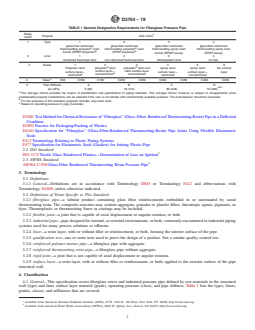
TABLE 1 General Designation Requirements for Fiberglass Pressure Pipe
Desig-
A
Property Cell Limits
nation
1 Type 1 2 3 4
glass-fiber-reinforced glass-fiber-reinforced glass-fiber-reinforced glass-fiber-reinforced
B B
thermosetting polyester resin thermosetting polyester resin thermosetting epoxy resin thermosetting epoxy resin
B B
mortar (RPMP polyester) (RTRP polyester)
mortar (RPMP epoxy) (RTRP epoxy)
2 Liner 1 2 3 4
reinforced thermoset liner non-reinforced thermoset liner thermoplastic liner no liner
3 Grade 1 2 3 4 5 6
B B
Polyester resin polyester resin polyester resin and epoxy resin epoxy resin No surface
surface layer— sand surface layer
surface layer— surface layer— surface layer— layer
B
B nonreinforced nonreinforced
reinforced reinforced nonreinforced
C
4 Class C50 C100 C150 C200 C250 C300 C350 C400 C450
5 Pipe Stiffness A B C D
ABC
psi (kPa) 9 (62) 18 (124) 36 (248) 72 (496)
A
The cell-type format provides the means of identification and specification of piping materials. This cell-type format, however, is subject to misapplication since
unobtainable property combinations can be selected if the user is not familiar with commercially available products. The manufacturer should be consulted.
B
For the purposes of this standard, polyester includes vinyl ester resin.
C
Based on operating pressure in psig (numerals).
D3681 Test Method for Chemical Resistance of “Fiberglass” (Glass–Fiber–Reinforced Thermosetting-Resin) Pipe in a Deflected
Condition
D3892 Practice for Packaging/Packing of Plastics
D4161 Specification for “Fiberglass” (Glass-Fiber-Reinforced Thermosetting-Resin) Pipe Joints Using Flexible Elastomeric
Seals
F412 Terminology Relating to Plastic Piping Systems
F477 Specification for Elastomeric Seals (Gaskets) for Joining Plastic Pipe
2.2 ISO Standard:
ISO 1172 Textile Glass Reinforced Plastics—Determination of Loss on Ignition
2.3 AWWA Standard:
AWWA C-950 Glass-Fiber Reinforced Thermosetting Resin Pressure Pipe
3. Terminology
3.1 Definitions:
3.1.1 General—Definitions are in accordance with Terminology D883 or Terminology F412 and abbreviations with
Terminology D1600, unless otherwise indicated.
3.2 Definitions of Terms Specific to This Standard:
3.2.1 fiberglass pipe—a tubular product containing glass fiber reinforcements embedded in or surrounded by cured
thermosetting resin. The composite structure may contain aggregate, granular or platelet fillers, thixotropic agents, pigments, or
dyes. Thermoplastic or thermosetting liners or coatings may be included.
3.2.2 flexible joint—a joint that is capable of axial displacement or angular rotation, or both.
3.2.3 industrial pipe—pipe designed for internal, or external environments, or both, commonly encountered in industrial piping
systems used for many process solutions or effluents.
3.2.4 liner—a resin layer, with or without filler or reinforcement, or both, forming the interior surface of the pipe.
3.2.5 qualification test—one or more tests used to prove the design of a product. Not a routine quality control test.
3.2.6 reinforced polymer mortar pipe—a fiberglass pipe with aggregate.
3.2.7 reinforced thermosetting resin pipe—a fiberglass pipe without aggregate.
3.2.8 rigid joint—a joint that is not capable of axial displacement or angular rotation.
3.2.9 surface layer—a resin layer, with or without filler or reinforcement, or both, applied to the exterior surface of the pipe
structural wall.
4. Classification
4.1 General—This specification covers fiberglass sewer and industrial pressure pipe defined by raw materials in the structural
wall (type) and liner, surface layer material (grade), operating pressure (class), and pipe stiffness. Table 1 lists the types, liners,
grades, classes, and stiffnesses that are covered.
Available from American National Standards Institute (ANSI), 25 W. 43rd St., 4th Floor, New York, NY 10036, http://www.ansi.org.
Available from American Water Works Association (AWWA), 6666 W. Quincy Ave., Denver, CO 80235, http://www.awwa.org.
D3754 − 19
NOTE 3—All possible combinations of types, liners, grades, classes, and stiffness may not be commercially available. Additional types, liners, grades,
and stiffnesses may be added as they become commercially available. The purchaser should determine for himself or consult with the manufacturer for
the proper class, type, liner, grade, and stiffness of pipe to be used under the installation and operating conditions that will exist for the project in which
the pipe is to be used.
4.2 Designation Requirements—The pipe materials designation code shall consist of the standard designation, ASTM D3754,
followed by type, liner, and grade in arabic numerals, class by the letter C with two or three arabic numerals, and pipe stiffness
by a capital letter. Table 1 presents a summary of the designation requirements. Thus a complete material code shall consist of
ASTM D3754, three numerals, C.and two or three numerals, and a capital letter.
NOTE 4—Examples of the designation codes are as follows: (1) ASTM D3754-1-1-3-C50-A for glass-fiber-reinforced aggregate and polyester resin
mortar pipe with a reinforced thermoset liner and an unreinforced polyester resin and sand surface layer, for operation at 50 psi (345 kPa), and having
a minimum pipe stiffness of 9 psi (62 kPa). (2) ASTM D3754-4-2-6-C200-C for glass-fiber-reinforced epoxy resin pipe with an unreinforced thermoset
liner, no surface layer, for operation at 200 psi (1380 kPa) and having a minimum pipe stiffness of 36 psi (248 kPa).
NOTE 5—Although the “Form and Style for ASTM Standards” manual requires that the type classification be roman numerals, it is recognized that few
companies have stencil-cutting equipment for this style of type, and it is therefore acceptable to mark the product type in arabic numbers.
5. Materials and Manufacture
5.1 General—The thermosetting resins, glass fiber reinforcements, fillers, and other materials, when combined as a composite
structure, shall produce piping products that meet the performance requirements of this specification.
5.2 Wall Composition—The basic structural wall composition shall consist of a thermosetting resin, glass-fiber reinforcement,
and, if used, an aggregate filler.
5.2.1 Resin—A thermosetting polyester or epoxy resin, with or without filler.
5.2.2 Aggregate—A siliceous sand conforming to the requirements of Specification C33, except that the requirements for
gradation shall not apply.
5.2.3 Reinforcement—A commercial grade of glass fibers compatible with the resin used.
5.3 Liner and Surface Layers—A liner or surface layer, or both, when incorporated into or onto the pipe shall meet the chemical
and structural requirements of this specification.
5.4 Joints—The pipe shall have a joining system that shall provide for fluid tightness for the intended service condition. A
particular type of joint may be restrained or unrestrained and flexible or rigid depending on the specific configuration and design
conditions.
5.4.1 Unrestrained—Pipe joints capable of withstanding internal pressure but not longitudinal forces.
5.4.1.1 Coupling or Bell-and-Spigot Gasket Joints, with a groove either on the spigot or in the bell to retain an elastomeric
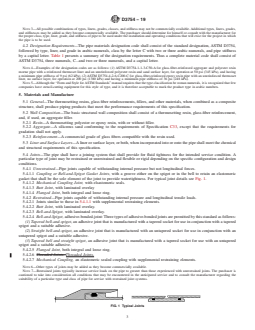
gasket that shall be the sole element of the joint to provide watertightness. For typical joint details see Fig. 1.
5.4.1.2 Mechanical Coupling Joint, with elsastomeric seals.
5.4.1.3 Butt Joint, with laminated overlay
5.4.1.4 Flanged Joint, both integral and loose ring.
5.4.2 Restrained—Pipe joints capable of withstanding internal pressure and longitudinal tensile loads.
5.4.2.1 Joints similar to those in 5.4.1.1 with supplemental restraining elements.
5.4.2.2 Butt Joint, with laminated overlay.
5.4.2.3 Bell-and-Spigot, with laminated overlay.
5.4.2.4 Bell-and-Spigot, adhesive-bonded-joint: Three types of adhesive-bonded joints are premitted by this standard as follows:
(1) Tapered bell-and-spigot, an adhesive joint that is manufactured with a tapered socket for use in conjunction with a tapered
spigot and a suitable adhesive.
(2) Straight bell-and-spigot, an adhesive joint that is manufactured with an untapered socket for use in conjunction with an
untapered spigot and a suitable adhesive.
(3) Tapered bell and straight spigot, an adhesive joint that is manufactured with a tapered socket for use with an untapered
spigot and a suitable adhesive.
5.4.2.5 Flanged Joint, both integral and loose ring.
5.4.2.6 Threaded Joints. Threaded Joints.
5.4.2.7 Mechanical Coupling, an elastomeric sealed coupling with supplemental restraining elements.
NOTE 6—Other types of joints may be added as they become commercially available.
NOTE 7—Restrained joints typically increase service loads on the pipe to greater than those experienced with unrestrained joints. The purchaser is
cautioned to take into consideration all conditions that may be encountered in the anticipated service and to consult the manufacturer regarding the
suitability of a particular type and class of pipe for service with restrained joint systems.
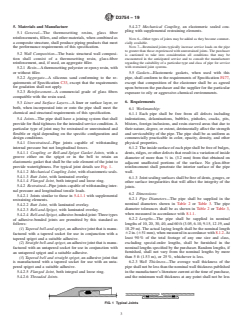
FIG. 1 Typical Joints
D3754 − 19
5.5 Gaskets—Elastomeric gaskets, when used with this pipe, shall conform to the requirements of Specification F477, except
that composition of the elastomer shall be as agreed upon between the purchaser and the supplier for the particular exposure to
oily or aggressive-chemical environments.
6. Requirements
6.1 Workmanship:
6.1.1 Each pipe shall be free from all defects including indentations, delaminations, bubbles, pinholes, cracks, pits, blisters,
foreign inclusions, and resin-starved areas that due to their nature, degree, or extent, detrimentally affect the strength and
serviceability of the pipe. The pipe shall be as uniform as commercially practicable in color, opacity, density, and other physical
properties.
6.1.2 The inside surface of each pipe shall be free of bulges, dents, ridges, or other defects that result in a variation of inside
diameter of more than ⁄8 in. (3.2 mm) from that obtained on adjacent unaffected portions of the surface. No glass-fiber
reinforcement shall penetrate the interior surface of the pipe wall.
6.1.3 Joint sealing surfaces shall be free of dents, gouges, or other surface irregularities that will affect the integrity of the joints.
6.2 Dimensions:
6.2.1 Pipe Diameters—The pipe shall be supplied in the nominal diameters shown in Table 2 or Table 3. The pipe diameter
tolerances shall be as shown in Table 2 or Table 3, when measured in accordance with 8.1.1.
6.2.2 Lengths—The pipe shall be supplied in nominal lengths of 10, 20, 30, 40, and 60 ft (3.05, 6.10, 9.15, 12.19, and 18.29
m). The actual laying length shall be the nominal length 62 in. (651 mm), when measured in accordance with 8.1.2. At least 90 %
of the total footage of any one size and class, excluding special-order lengths, shall be furnished in the nominal lengths specified
by the purchaser. Random lengths, if furnished, shall not vary from the nominal lengths by more than 5 ft (1.53 m), or 25 %,
whichever is less.
6.2.3 Wall Thickness—The average wall thickness of the pipe shall not be less than the nominal wall thickness published in the
manufacturer’s literature current at the time of purchase, and the minimum wall thickness at any point shall not be less than 87.5 %
of the nominal wall thickness when measured in accordance with 8.1.3.
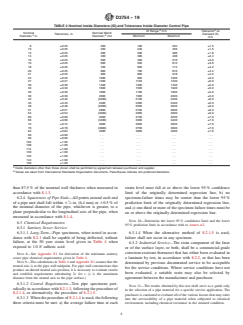
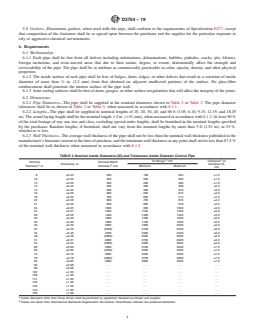
TABLE 2 Nominal Inside Diameters (ID) and Tolerances Inside Diameter Control Pipe
B B
ID Range, mm Tolerance on
Nominal Nominal Metric
Tolerances, in. Declared ID,
A B
Diameter, in. Diameter, mm
Minimum Maximum
mm
8 ±0.25 200 196 204 ±1.5
10 ±0.25 250 246 255 ±1.5
12 ±0.25 300 296 306 ±1.8
14 ±0.25 400 396 408 ±2.4
15 ±0.25 500 496 510 ±3.0
16 ±0.25 600 595 612 ±3.6
18 ±0.25 700 695 714 ±4.2
20 ±0.25 800 795 816 ±4.2
21 ±0.25 900 895 918 ±4.2
24 ±0.25 1000 995 1020 ±5.0
27 ±0.27 1200 1195 1220 ±5.0
30 ±0.30 1400 1395 1420 ±5.0
33 ±0.33 1600 1595 1620 ±5.0
36 ±0.36 1800 1795 1820 ±5.0
39 ±0.39 2000 1995 2020 ±5.0
42 ±0.42 (2200) 2195 2220 ±6.0
45 ±0.45 2400 2395 2420 ±6.0
48 ±0.48 (2600) 2595 2620 ±6.0
51 ±0.51 2800 2795 2820 ±6.0
54 ±0.54 (3000) 2995 3020 ±6.0
60 ±0.60 3200 3195 3220 ±7.0
66 ±0.66 (3400) 3395 3420 ±7.0
72 ±0.72 3600 3595 3620 ±7.0
78 ±0.78 (3800) 3795 3820 ±7.0
84 ±0.84 4000 3995 4020 ±7.0
90 ±0.90 . . . . . . . . . . . .
96 ±0.96 . . . . . . . . . . . .
102 ±1.00 . . . . . . . . . . . .
108 ±1.00 . . . . . . . . . . . .
114 ±1.00 . . . . . . . . . . . .
120 ±1.00 . . . . . . . . . . . .
132 ±1.00 . . . . . . . . . . . .
144 ±1.00 . . . . . . . . . . . .
156 ±1.00 . . . . . . . . . . . .
A
Inside diameters other than those shown shall be permitted by agreement between purchaser and supplier.
B
Values are taken from International Standards Organization documents. Parentheses indicate non-preferred diameters.
D3754 − 19
TABLE 3 Nominal Outside Diameters (OD) and Tolerances
NOTE 1—The external diameter of the pipe at the spigots shall be within the tolerances given in the table, and the manufacturer shall declare his
allowable maximum and minimum spigot diameters. Some pipes are manufactured such that the entire pipe meets the OD tolerances while other pipes
meet the tolerances at the spigots, in which case, if such pipes are cut (shortened) the ends may need to be calibrated to meet the tolerances.
Metric Ductile Iron Pipe Tolerance Upper, Tolerance Lower, International O.D., Tolerance Upper, Tolerance Lower,
Pipe Size, mm Equivalent, mm mm mm mm mm mm
200 220.0 +1.0 0.0 . . . . . . . . .
250 271.8 +1.0 -0.2 . . . . . . . . .
300 323.8 +1.0 -0.3 310 +1.0 -1.0
350 375.7 +1.0 -0.3 361 +1.0 -1.2
400 426.6 +1.0 -0.3 412 +1.0 -1.4
450 477.6 +1.0 -0.4 463 +1.0 -1.6
500 529.5 +1.0 -0.4 514 +1.0 -1.8
600 632.5 +1.0 -0.5 616 +1.0 -2.0
700 718 +1.0 -2.2
800 820 +1.0 -2.4
900 924 +1.0 -2.6
1000 1026 +2.0 -2.6
1200 1229 +2.0 -2.6
1400 1434 +2.0 -2.8
1600 1638 +2.0 -2.8
1800 1842 +2.0 -3.0
2000 2046 +2.0 -3.0
2200 2250 +2.0 -3.2
2400 2453 +2.0 -3.4
2600 2658 +2.0 -3.6
2800 2861 +2.0 -3.8
3000 3066 +2.0 -4.0
3200 3270 +2.0 -4.2
3400 3474 +2.0 -4.4
3600 3678 +2.0 -4.6
3800 3882 +2.0 -4.8
4000 4086 +2.0 -5.0
6.2.4 Squareness of Pipe Ends—All points around each end of a pipe unit shall fall within 6 ⁄4 in. (6.4 mm) or 60.5 % of the
nominal diameter of the pipe, whichever is greater, to a plane perpendicular to the longitudinal axis of the pipe, when measured
in accordance with 8.1.4.
6.3 Chemical Requirements:
6.3.1 Sanitary Sewer Service:
6.3.1.1 Long-Term—Pipe specimens, when tested in accordance with 8.2.1 shall be capable of being deflected, without failure,
at the 50 year strain level given in Table 4 when exposed to 1.0 N sulfuric acid.
NOTE 8—See Appendix X1 for derivation of the minimum sanitary sewer pipe chemical requirements given in Table 4.
NOTE 9—The calculations in Table 4 and Appendix X1 assume that the neutral axis is at the pipe wall midpoint. For pipe wall constructions that
D3754 − 19
TABLE 4 Minimum Sanitary Sewer Pipe Chemical Requirements
ε
scv
Minimum Strain
Pipe Stiffness,
psi (kPa)
6 min 10 h 100 h 1 000 10 000 50 years
9 (62) 0.97 (t/de) 0.84 (t/d) 0.78 (t/d) 0.73 (t/d) 0.68 (t/d) 0.60 (t/d)
18 (124) 0.85 (t/d) 0.72 (t/d) 0.66 (t/d) 0.61 (t/d) 0.56 (t/d) 0.49 (t/d)
36 (248) 0.71 (t/d) 0.60 (t/d) 0.55 (t/d) 0.51 (t/d) 0.47 (t/d) 0.41 (t/d)
72 (496) 0.56 (t/d) 0.48 (t/d) 0.44 (t/d) 0.41 (t/d) 0.38 (t/d) 0.34 (t/d)
Where: t and d are the nominal total wall thickness and the mean diameter (inside diameter plus t) as determined in accordance with 8.1.
produce an altered neutral axis position, it is necessary to evaluate results and establish requirements substituting 2y for t. (y is the maximum distance
from the neutral axis to the pipe surface.)
6.3.1.2 Control Requirements—Test pipe specimens periodically in accordance with 8.2.1.3, following the procedure of 8.2.1.4,
or alternatively, the procedure of 8.2.1.5.
6.3.1.3 When the procedure of 8.2.1.4 is used, the following three criteria must be met: a) the average failure time at each strain
level must fall at or above the lower 95 % confidence limit of the originally determined regression line, b) no specimen-failure
times may be sooner than the lower 95 % prediction limit of the originally determined regression line, and c) one-third or more
of the specimen failure times must be on or above the originally determined regression line.
NOTE 10—Determine the lower 95 % confidence limit and the lower 95 % prediction limit in accordance with to Annex A2.
6.3.1.4 When the alternative method of 8.2.1.5 is used, failure shall not occur in any specimen.
6.3.2 Industrial Service—The resin component of the liner or of the surface layer, or both, shall be a commercial-grade
corrosion-resistant thermoset that has either been evaluated in a laminate by test, in accordance with 8.2.2, or that has been
determined by previous documented service to be acceptable for the service conditions. Where service conditions have not been
evaluated, a suitable resin may also be selected by agreement between the manufacturer and purchaser.
NOTE 11—The results obtained by this test shall serve as a guide only in the selection of a pipe material for a specific service application. The purchaser
is cautioned to evaluate all of the various factors that may enter into the serviceability of a pipe material when subjected to chemical environment,
including chemical resistance in the strained condition.
6.4 Soundness—Unless otherwise agreed upon between purchaser and supplier, test each length of pipe up to 96 in. (2400 mm)
diameter hydrostatically without leakage or cracking, at the internal hydrostatic proof pressures specified for the applicable class
in Table 5 when tested in accordance with 8.3. For sizes over 96 in. (2400 mm), the frequency of hydrostatic leak tests shall be
as agreed upon by purchaser and supplier.
6.5 Hydrostatic Design Basis:
6.5.1 Long-Term Hydrostatic Pressure—The pressure classes shall be based on long-term hydrostatic pressure data obtained in
accordance with 8.4 and categorized in accordance with Table 6. Pressure classes are based on extrapolated strengths at 50 years.
For pipe subjected to longitudinal loads or circumferential bending, the effect of these conditions on the hydrostatic design pressure
classification of the pipe must be considered.
6.5.2 Control Requirements—Test pipe specimens periodically in accordance with the reconfirmation procedures described in
Practice D2992.
NOTE 12—Hydrostatic design basis (HDB—extrapolated value at 50 years) determined in accordance with Procedure A of Practice D2992, may be
substituted for the Procedure B evaluation required by 8.4. It is generally accepted that the Procedure A value multiplied by 3 is equivalent to the
Procedure B value.
TABLE 5 Hydrostatic Pressure Test
Pressure Hydrostatic Proof Pressure
Class Pipe Diameters Pipe Diameters
up to and >54 in. up to and
including 54 in. including 96 in.
(psi) psi (kPa) psi (kPa)
C50 100 (689) 75 (517)
C100 200 (1379) 150 (1034)
C150 300 (2068) 225 (1551)
C200 400 (2757) 300 (2068)
C250 500 (3447) 375 (2585)
C300 600 (4136) 450 (3102)
C350 700 (4826) 525 (3619)
C400 800 (5515) 600 (4136)
C450 900 (6205) 675 (4654)
D3754 − 19
TABLE 6 Long-Term Hydrostatic Pressure Categories
Minimum Calculated Values of
Class Long-Term Hydrostatic
Pressure gage, psi (kPa)
C50 90 (621)
C100 180 (1241)
C150 270 (1862)
C200 360 (2482)
C250 450 (3103)
C300 540 (3722)
C350 630 (4343)
C400 720 (4963)
C450 810 (5584)
6.6 Stiffness—Each length of pipe shall have sufficient strength to exhibit the minimum pipe stiffness (F/Δy) specified in Table
7 when tested in accordance with 8.5. At deflection level A per Table 8, there shall be no visible damage in the test specimen
evidenced by surface cracks. At deflection level B per Table 8, there shall be no indication of structural damage as evidenced by
interlaminar separation, separation of the liner or surface layer (if incorporated) from the structural wall, tensile failure of the
glass-fiber reinforcement, fracture, or buckling of the pipe wall.
NOTE 13—This is a visual observation (made with the unaided eye) for quality control purposes only, and should not be considered a simulated service
test. Table 8 values are based on an in-use long-term deflection limit of 5 % and provide an appropriate uniform safety margin for all pipe stiffnesses.
Since the pipe-stiffness values (F/Δy) shown in Table 7 vary, the percent deflection of the pipe under a given set of installation conditions will not be
constant for all pipes. To avoid possible misapplication, take care to analyze all conditions that might affect performance of the installed pipe.
6.6.1 For other pipe stiffness levels, appropriate values for Level A and Level B deflections (Table 8) may be computed as
follows:
0.33
Level A at new PS 5 ~9! (1)
S D
new PS
Level B at new PS 5 new Level A÷0.6
6.6.2 Since products may have use limits of other than 5 % long-term deflection, Level A and Level B deflections (Table 8) may
be proportionally adjusted to maintain equivalent in-use safety margins. For example, a 4 % long-term limiting deflection would
result in a 20 % reduction of Level A and Level B deflections, while a 6 % limiting deflection would result in a 20 % increase in
Level A and Level B deflection values. However, minimum values for Level A and Level B deflections shall be equivalent to strains
of 0.6 and 1.0 % respectively (as computed by Eq X1.1 in Appendix X1).
6.6.3 For high stiffness pipes, 5% deflection will likely be above the use limit and the adjusted level A test deflection. For very
high stiffness pipes, 5% deflection may also be greater than the adjusted level B test deflection. In such cases, the pipes may be
damaged or fail prior to determining the pipe stiffness at 5% deflection. Therefore, it is permitted to set the pipe stiffness test
deflection equal to the adjusted level A deflection, but not greater than 5%. See Note 14 for additional information and further
clarification.
NOTE 14—Depending upon the product modulus and allowable ring bending strain, this will likely begin affecting pipes with stiffness between 200
and 400 psi. For example, a pipe with pipe stiffness of PS360 may have a use limit of 4.3 %, an adjusted level A deflection of 4.5 % and an adjusted
level B deflection of 7.5 %. Therefore, the new pipe stiffness test deflection would be 4.5 %. Another possible product with pipe stiffness of PS900 may
have a use limit of 2.8 %, an adjusted level A deflection of 2.7% and an adjusted level B deflection of 4.5 %. Therefore, the new pipe stiffness test
deflection would be 2.7 %.
6.7 Hoop-Tensile Strength—All pipe manufactured under this specification shall meet or exceed the hoop-tensile strength shown
for each size and class in Table 9 and Table 10, when tested in accordance with 8.6.
6.7.1 Alternative Requirements—When agreed upon by the purchaser and the supplier, the minimum hoop tensile strength shall
be as determined in accordance with 8.6.1.
TABLE 7 Minimum Stiffness at 5 % Deflection
Nominal Pipe Stiffness, psi (kPa)
Diameter,
Designation
in.
A B C D
8 . . . . . . 36 (248) 72 (496)
10 . . . 18 (124) 36 (248) 72 (496)
12 and greater 9 (62) 18 (124) 36 (248) 72 (496)
D3754 − 19
TABLE 8 Ring Deflection Without Damage or Structural Failure
Nominal Pipe Stiffness, psi
9 18 36 72
Level A 18 % 15 % 12 % 9 %
Level B 30 % 25 % 20 % 15 %
6.8 Joint Tightness—All joints shall meet the laboratory performance requirements of Specification D4161. Unrestrained joints
shall be tested with a fixed end closure condition and restrained joints shall be tested with a free end closure condition. Rigid joints
shall be exempt from angular deflection requirements of D4161. Rigid joints typically include butt joints with laminated overlay,
bell-and-spigot joints with laminated overlay, flanged, bell-and-spigot adhesive bonded and threaded.
6.9 Longitudinal Strength:
6.9.1 Beam Strength—For pipe sizes up to 27 in. (686 mm), the pipe shall withstand, without failure, the beam loads specified
in Table 11, when tested in accordance with 8.7.1. For pipe sizes larger than 27 in., and alternatively for smaller sizes, adequate
beam strength is demonstrated by tensile and compression tests conducted in accordance with 8.7.2 and 8.7.3 respectively, for pipe
wall specimens oriented in the longitudinal direction, using the minimum tensile and compression strengths specified in Table 11.
6.9.2 Longitudinal Tensile Strength—All pipe manufactured under this specification shall have a minimum axial tensile
elongation at failure of 0.25% and meet or exceed the longitudinal tensile strength shown for each size and class in Table 12 and
Table 13, when tested in accordance with 8.7.2.
NOTE 15—The values listed in Table 12 are the minimum criteria for products made to this standard. The values may not be indicative of the axial
strength of some products, or of the axial strength required by some installation conditions and joint configurations.
6.9.3 Conformance to the requirements of 6.9.1 shall satisfy the requirements of 6.9.2 for those pipe sizes and classes where
the minimum longitudinal tensile strength values of Table 11 are equal to the values of Table 12. Conformance to the requirements
of 6.9.2 shall satisfy the longitudinal tensile strength requirements of 6.9.1.
7. Sampling
7.1 Lot—Unless otherwise agreed upon by the purchaser and the supplier, one lot shall consist of 100 l
...