

ASTM D2996-23
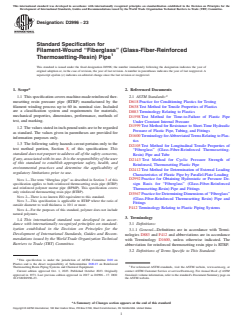
(Specification)Standard Specification for Filament-Wound “Fiberglass” (Glass-Fiber-Reinforced Thermosetting-Resin) Pipe
General Information
- Abstract
ABSTRACT
This specification covers machine-made reinforced thermosetting resin pressure pipe (RTRP) manufactured by the filament winding process. This specification does not include reinforced polymer mortar pipe (RPMP), which is another type of fiberglass pipe. The pipes are generally classified by type, grade, class, and hydrostatic design. In addition, a secondary cell classification system defines the basic mechanical properties of the pipe. The resins, reinforcements, colorants, fillers, and other materials, when combined as a composite structure, shall produce a pipe that shall meet the performance requirements of this specification. Materials shall be tested and the individual grades shall conform to the specified values of dimensions and tolerances, long-term static hydrostatic strength, long-term cyclic hydrostatic strength, short-term hydrostatic failure strength, longitudinal tensile properties, and stiffness factor.
SCOPE
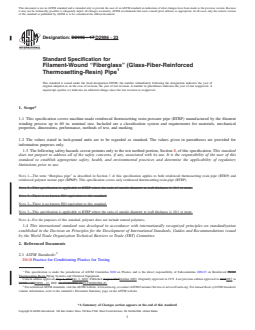
1.1 This specification covers machine-made reinforced thermosetting resin pressure pipe (RTRP) manufactured by the filament winding process up to 60 in. nominal size. Included are a classification system and requirements for materials, mechanical properties, dimensions, performance, methods of test, and marking.
1.2 The values stated in inch-pound units are to be regarded as standard. The values given in parentheses are provided for information purposes only.
1.3 The following safety hazards caveat pertains only to the test method portion, Section 8, of this specification: This standard does not purport to address all of the safety concerns, if any, associated with its use. It is the responsibility of the user of this standard to establish appropriate safety, health, and environmental practices and determine the applicability of regulatory limitations prior to use.
Note 1: The term “fiberglass pipe” as described in Section 3 of this specification applies to both reinforced thermosetting resin pipe (RTRP) and reinforced polymer mortar pipe (RPMP). This specification covers only reinforced thermosetting resin pipe (RTRP).
Note 2: There is no known ISO equivalent to this standard.
Note 3: This specification is applicable to RTRP where the ratio of outside diameter to wall thickness is 10:1 or more.
Note 4: For the purposes of this standard, polymer does not include natural polymers.
1.4 This international standard was developed in accordance with internationally recognized principles on standardization established in the Decision on Principles for the Development of International Standards, Guides and Recommendations issued by the World Trade Organization Technical Barriers to Trade (TBT) Committee.
- Status
- Published
- Publication Date
- 30-Sep-2023
- Technical Committee
- D20 - Plastics
Buy Documents
ASTM D2996-23 - Standard Specification for Filament-Wound “Fiberglass” (Glass-Fiber-Reinforced Thermosetting-Resin) Pipe
REDLINE ASTM D2996-23 - Standard Specification for Filament-Wound “Fiberglass” (Glass-Fiber-Reinforced Thermosetting-Resin) Pipe
Overview
ASTM D2996-23: Standard Specification for Filament-Wound “Fiberglass” (Glass-Fiber-Reinforced Thermosetting-Resin) Pipe provides comprehensive guidelines for machine-made reinforced thermosetting resin pressure pipe (RTRP). These pipes are produced using the filament winding process and are not to be confused with reinforced polymer mortar pipe (RPMP). The standard establishes requirements for materials, mechanical properties, dimensional tolerances, performance, test methods, and product marking for fiberglass-reinforced pipes used in various industries.
This specification supports a classification system that takes into account type, grade, class, and hydrostatic design, ensuring that each pipe meets specific performance benchmarks. The outlined criteria are designed to ensure product reliability, structural integrity, and safety in demanding applications.
Key Topics
Scope and Applicability
- Covers RTRP manufactured up to 60-inch nominal size.
- Classification by type, grade, class, and hydrostatic design basis.
- Not applicable to RPMP or fiberglass pipes with low diameter-to-thickness ratios.
Materials and Manufacture
- Requirements for resins, glass fiber reinforcements, fillers, and colorants.
- Composite structure must consistently meet performance criteria.
Mechanical and Physical Properties
- Criteria for short-term rupture strength, longitudinal tensile strength, tensile modulus, and pipe stiffness.
- Dimensional tolerances specified for both inside and outside diameters and wall thickness.
Testing Methods
- Includes procedures for hydrostatic strength (static and cyclic), tensile properties, and stiffness.
- Reference to ASTM test methods such as D638, D1598, D1599, D2105, and D2412.
Product Marking and Traceability
- Pipes must be marked with size, designation code, standard reference (ASTM D2996), manufacturer, and traceability data.
Safety and Compliance
- Emphasis on user responsibility for safety, health, and environmental practices.
- Developed in accordance with WTO standardization principles.
Applications
Filament-wound fiberglass-reinforced thermosetting resin pipe specified by ASTM D2996-23 is widely used in industries requiring lightweight, corrosion-resistant, and structurally robust piping solutions. Typical applications include:
- Chemical processing: Transport of corrosive liquids and harsh chemicals.
- Water and wastewater treatment: Durable for both potable and industrial water systems.
- Oil and gas: Piping for process water, effluent, and corrosive liquids.
- Industrial facilities: Systems handling process fluids under pressure or severe environmental conditions.
- Marine and power generation: Infrastructure resistant to saltwater and temperature variations.
These pipes are particularly valued where metallic piping may be unsuitable due to corrosion, weight, or maintenance considerations.
Related Standards
- ASTM D618: Practice for Conditioning Plastics for Testing.
- ASTM D638: Test Method for Tensile Properties of Plastics.
- ASTM D1598: Test Method for Time-to-Failure of Plastic Pipe Under Constant Internal Pressure.
- ASTM D1599: Test Method for Resistance to Short-Time Hydraulic Pressure.
- ASTM D2105: Test Method for Longitudinal Tensile Properties of Fiberglass Pipe.
- ASTM D2143: Test Method for Cyclic Pressure Strength.
- ASTM D2412: Test Method for Determination of External Loading Characteristics.
- ASTM D2992: Practice for Obtaining Hydrostatic or Pressure Design Basis for Fiberglass Pipe.
- ASTM D3567: Practice for Determining Dimensions of Fiberglass Pipe.
- ASTM F412: Terminology Relating to Plastic Piping Systems.
Note: There is currently no ISO equivalent to ASTM D2996-23 for filament-wound fiberglass pressure pipe.
Keywords: ASTM D2996, fiberglass pipe, filament-wound, glass-fiber-reinforced, thermosetting resin, RTRP, pressure pipe, mechanical properties, hydrostatic strength, industrial piping standards.
Relations
- Effective Date
- 01-Oct-2023
- Effective Date
- 01-Feb-2024
- Effective Date
- 01-Nov-2023
- Effective Date
- 01-Nov-2022
- Refers
ASTM D1600-18 - Standard Terminology for Abbreviated Terms Relating to Plastics (Withdrawn 2024) - Effective Date
- 01-Jan-2018
- Referred By
ASTM F1155-10(2019) - Standard Practice for Selection and Application of Piping System Materials - Effective Date
- 01-Oct-2023
- Effective Date
- 01-Oct-2023
- Effective Date
- 01-Oct-2023
- Effective Date
- 01-Oct-2023
- Effective Date
- 01-Oct-2023
- Effective Date
- 01-Oct-2023
- Effective Date
- 01-Oct-2023
Buy Documents
ASTM D2996-23 - Standard Specification for Filament-Wound “Fiberglass” (Glass-Fiber-Reinforced Thermosetting-Resin) Pipe
REDLINE ASTM D2996-23 - Standard Specification for Filament-Wound “Fiberglass” (Glass-Fiber-Reinforced Thermosetting-Resin) Pipe
Get Certified
Connect with accredited certification bodies for this standard

Institut za varilstvo d.o.o. (Welding Institute)
Slovenia's leading welding institute since 1952. ISO 3834, EN 1090, pressure equipment certification, NDT personnel, welder qualification. Only IIW Au
Sponsored listings
Frequently Asked Questions
ASTM D2996-23 is a technical specification published by ASTM International. Its full title is "Standard Specification for Filament-Wound “Fiberglass” (Glass-Fiber-Reinforced Thermosetting-Resin) Pipe". This standard covers: ABSTRACT This specification covers machine-made reinforced thermosetting resin pressure pipe (RTRP) manufactured by the filament winding process. This specification does not include reinforced polymer mortar pipe (RPMP), which is another type of fiberglass pipe. The pipes are generally classified by type, grade, class, and hydrostatic design. In addition, a secondary cell classification system defines the basic mechanical properties of the pipe. The resins, reinforcements, colorants, fillers, and other materials, when combined as a composite structure, shall produce a pipe that shall meet the performance requirements of this specification. Materials shall be tested and the individual grades shall conform to the specified values of dimensions and tolerances, long-term static hydrostatic strength, long-term cyclic hydrostatic strength, short-term hydrostatic failure strength, longitudinal tensile properties, and stiffness factor. SCOPE 1.1 This specification covers machine-made reinforced thermosetting resin pressure pipe (RTRP) manufactured by the filament winding process up to 60 in. nominal size. Included are a classification system and requirements for materials, mechanical properties, dimensions, performance, methods of test, and marking. 1.2 The values stated in inch-pound units are to be regarded as standard. The values given in parentheses are provided for information purposes only. 1.3 The following safety hazards caveat pertains only to the test method portion, Section 8, of this specification: This standard does not purport to address all of the safety concerns, if any, associated with its use. It is the responsibility of the user of this standard to establish appropriate safety, health, and environmental practices and determine the applicability of regulatory limitations prior to use. Note 1: The term “fiberglass pipe” as described in Section 3 of this specification applies to both reinforced thermosetting resin pipe (RTRP) and reinforced polymer mortar pipe (RPMP). This specification covers only reinforced thermosetting resin pipe (RTRP). Note 2: There is no known ISO equivalent to this standard. Note 3: This specification is applicable to RTRP where the ratio of outside diameter to wall thickness is 10:1 or more. Note 4: For the purposes of this standard, polymer does not include natural polymers. 1.4 This international standard was developed in accordance with internationally recognized principles on standardization established in the Decision on Principles for the Development of International Standards, Guides and Recommendations issued by the World Trade Organization Technical Barriers to Trade (TBT) Committee.
ABSTRACT This specification covers machine-made reinforced thermosetting resin pressure pipe (RTRP) manufactured by the filament winding process. This specification does not include reinforced polymer mortar pipe (RPMP), which is another type of fiberglass pipe. The pipes are generally classified by type, grade, class, and hydrostatic design. In addition, a secondary cell classification system defines the basic mechanical properties of the pipe. The resins, reinforcements, colorants, fillers, and other materials, when combined as a composite structure, shall produce a pipe that shall meet the performance requirements of this specification. Materials shall be tested and the individual grades shall conform to the specified values of dimensions and tolerances, long-term static hydrostatic strength, long-term cyclic hydrostatic strength, short-term hydrostatic failure strength, longitudinal tensile properties, and stiffness factor. SCOPE 1.1 This specification covers machine-made reinforced thermosetting resin pressure pipe (RTRP) manufactured by the filament winding process up to 60 in. nominal size. Included are a classification system and requirements for materials, mechanical properties, dimensions, performance, methods of test, and marking. 1.2 The values stated in inch-pound units are to be regarded as standard. The values given in parentheses are provided for information purposes only. 1.3 The following safety hazards caveat pertains only to the test method portion, Section 8, of this specification: This standard does not purport to address all of the safety concerns, if any, associated with its use. It is the responsibility of the user of this standard to establish appropriate safety, health, and environmental practices and determine the applicability of regulatory limitations prior to use. Note 1: The term “fiberglass pipe” as described in Section 3 of this specification applies to both reinforced thermosetting resin pipe (RTRP) and reinforced polymer mortar pipe (RPMP). This specification covers only reinforced thermosetting resin pipe (RTRP). Note 2: There is no known ISO equivalent to this standard. Note 3: This specification is applicable to RTRP where the ratio of outside diameter to wall thickness is 10:1 or more. Note 4: For the purposes of this standard, polymer does not include natural polymers. 1.4 This international standard was developed in accordance with internationally recognized principles on standardization established in the Decision on Principles for the Development of International Standards, Guides and Recommendations issued by the World Trade Organization Technical Barriers to Trade (TBT) Committee.
ASTM D2996-23 is classified under the following ICS (International Classification for Standards) categories: 23.040.20 - Plastics pipes. The ICS classification helps identify the subject area and facilitates finding related standards.
ASTM D2996-23 has the following relationships with other standards: It is inter standard links to ASTM D2996-17, ASTM D883-24, ASTM D883-23, ASTM D883-22, ASTM D1600-18, ASTM F1155-10(2019), ASTM D5421-23, ASTM D2517-18(2023), ASTM D5685-19, ASTM D4097-19, ASTM C1847-21, ASTM D3299-18. Understanding these relationships helps ensure you are using the most current and applicable version of the standard.
ASTM D2996-23 is available in PDF format for immediate download after purchase. The document can be added to your cart and obtained through the secure checkout process. Digital delivery ensures instant access to the complete standard document.
Standards Content (Sample)
This international standard was developed in accordance with internationally recognized principles on standardization established in the Decision on Principles for the
Development of International Standards, Guides and Recommendations issued by the World Trade Organization Technical Barriers to Trade (TBT) Committee.
Designation: D2996 − 23
Standard Specification for
Filament-Wound “Fiberglass” (Glass-Fiber-Reinforced
Thermosetting-Resin) Pipe
This standard is issued under the fixed designation D2996; the number immediately following the designation indicates the year of
original adoption or, in the case of revision, the year of last revision. A number in parentheses indicates the year of last reapproval. A
superscript epsilon (´) indicates an editorial change since the last revision or reapproval.
1. Scope* 2. Referenced Documents
1.1 This specification covers machine-made reinforced ther-
2.1 ASTM Standards:
mosetting resin pressure pipe (RTRP) manufactured by the
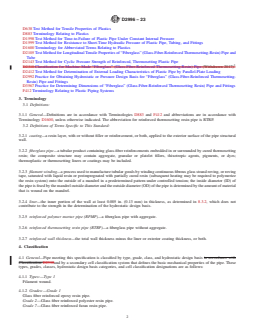
D618 Practice for Conditioning Plastics for Testing
filament winding process up to 60 in. nominal size. Included
D638 Test Method for Tensile Properties of Plastics
are a classification system and requirements for materials,
D883 Terminology Relating to Plastics
mechanical properties, dimensions, performance, methods of
D1598 Test Method for Time-to-Failure of Plastic Pipe
test, and marking.
Under Constant Internal Pressure
D1599 Test Method for Resistance to Short-Time Hydraulic
1.2 The values stated in inch-pound units are to be regarded
Pressure of Plastic Pipe, Tubing, and Fittings
as standard. The values given in parentheses are provided for
D1600 Terminology for Abbreviated Terms Relating to Plas-
information purposes only.
tics
1.3 The following safety hazards caveat pertains only to the
D2105 Test Method for Longitudinal Tensile Properties of
test method portion, Section 8, of this specification: This
“Fiberglass” (Glass-Fiber-Reinforced Thermosetting-
standard does not purport to address all of the safety concerns,
Resin) Pipe and Tube
if any, associated with its use. It is the responsibility of the user
D2143 Test Method for Cyclic Pressure Strength of
of this standard to establish appropriate safety, health, and
Reinforced, Thermosetting Plastic Pipe
environmental practices and determine the applicability of
D2412 Test Method for Determination of External Loading
regulatory limitations prior to use.
Characteristics of Plastic Pipe by Parallel-Plate Loading
D2992 Practice for Obtaining Hydrostatic or Pressure De-
NOTE 1—The term “fiberglass pipe” as described in Section 3 of this
specification applies to both reinforced thermosetting resin pipe (RTRP) sign Basis for “Fiberglass” (Glass-Fiber-Reinforced
and reinforced polymer mortar pipe (RPMP). This specification covers
Thermosetting-Resin) Pipe and Fittings
only reinforced thermosetting resin pipe (RTRP).
D3567 Practice for Determining Dimensions of “Fiberglass”
NOTE 2—There is no known ISO equivalent to this standard.
(Glass-Fiber-Reinforced Thermosetting Resin) Pipe and
NOTE 3—This specification is applicable to RTRP where the ratio of
Fittings
outside diameter to wall thickness is 10:1 or more.
F412 Terminology Relating to Plastic Piping Systems
NOTE 4—For the purposes of this standard, polymer does not include
natural polymers.
3. Terminology
1.4 This international standard was developed in accor-
dance with internationally recognized principles on standard- 3.1 Definitions:
ization established in the Decision on Principles for the
3.1.1 General—Definitions are in accordance with Termi-
Development of International Standards, Guides and Recom-
nologies D883 and F412 and abbreviations are in accordance
mendations issued by the World Trade Organization Technical
with Terminology D1600, unless otherwise indicated. The
Barriers to Trade (TBT) Committee.
abbreviation for reinforced thermosetting resin pipe is RTRP.
3.2 Definitions of Terms Specific to This Standard:
This specification is under the jurisdiction of ASTM Committee D20 on
Plastics and is the direct responsibility of Subcommittee D20.23 on Reinforced
Thermosetting Resin Piping Systems and Chemical Equipment. For referenced ASTM standards, visit the ASTM website, www.astm.org, or
Current edition approved Oct. 1, 2023. Published October 2023. Originally contact ASTM Customer Service at service@astm.org. For Annual Book of ASTM
approved in 1971. Last previous edition approved in 2017 as D2996 – 17. DOI: Standards volume information, refer to the standard’s Document Summary page on
10.1520/D2996-23. the ASTM website.
*A Summary of Changes section appears at the end of this standard
Copyright © ASTM International, 100 Barr Harbor Drive, PO Box C700, West Conshohocken, PA 19428-2959. United States
D2996 − 23
TABLE 1 Hydrostatic Design Basis Categories
3.2.1 coating—a resin layer, with or without filler or
reinforcement, or both, applied to the exterior surface of the Cyclic Test Method Static Test Method
pipe structural wall. Hoop Stress, psi Hoop Stress, psi
Designation (MPa) Designation (MPa)
3.2.2 fiberglass pipe—a tubular product containing glass-
fiber reinforcements embedded in or surrounded by cured
A 2 500 (17.2) Q 5 000 (34.5)
thermosetting resin; the composite structure may contain B 3 150 (21.7) R 6 300 (43.4)
C 4 000 (27.6) S 8 000 (55.2)
aggregate, granular or platelet fillers, thixotropic agents,
D 5 000 (34.5) T 10 000 (68.9)
pigments, or dyes; thermoplastic or thermosetting liners or
E 6 300 (43.4) U 12 500 (86.2)
coatings may be included. F 8 000 (55.2) W 16 000 (110)
G 10 000 (68.9) X 20 000 (138)
3.2.3 filament winding—a process used to manufacture tu-
H 12 500 (86.2) Y 25 000 (172)
Z 31 500 (217)
bular goods by winding continuous fibrous glass strand roving,
or roving tape, saturated with liquid resin or preimpregnated
with partially cured resin (subsequent heating may be required
to polymerize the resin system) onto the outside of a mandrel
in a predetermined pattern under controlled tension; the inside
4.1.3 Classes:—Class A
diameter (ID) of the pipe is fixed by the mandrel outside
No liner.
diameter and the outside diameter (OD) of the pipe is deter-
Class B—Polyester resin liner (nonreinforced).
mined by the amount of material that is wound on the mandrel.
Class C—Epoxy resin liner (nonreinforced).
3.2.4 liner—the inner portion of the wall at least 0.005 in.
Class E—Polyester resin liner (reinforced).
(0.13 mm) in thickness, as determined in 8.3.2, which does not
Class F—Epoxy resin liner (reinforced).
contribute to the strength in the determination of the hydro-
Class H—Thermoplastic resin liner (specify).
static design basis.
Class I—Furan resin liner (reinforced).
3.2.5 reinforced polymer mortar pipe (RPMP)—a fiberglass 4.1.4 Hydrostatic Design Basis—Two methods of classify-
pipe with aggregate.
ing the hydrostatic design basis of the pipe are provided. Pipe
meeting this specification shall be classified using either the
3.2.6 reinforced thermosetting resin pipe (RTRP)—a fiber-
cyclic test method or the static test method, or both, and the
glass pipe without aggregate.
designations as shown in Table 1. Appendix X1 explains how
3.2.7 reinforced wall thickness—the total wall thickness
these design basis categories are to be used.
minus the liner or exterior coating thickness, or both.
4.1.4.1 For pipe subjected to axial or end loads, the effect of
these loads shall be represented in the HDB testing. In the
4. Classification
designation code, the numeral 1 shall immediately follow the
4.1 General—Pipe meeting this specification is classified by
HDB letter class if free-end type closures were used and the
type, grade, class, and hydrostatic design basis and by a
numeral 2 shall immediately follow the HDB letter class if
secondary cell classification system that defines the basic
restrained-end type closures were used to establish the HDB.
mechanical properties of the pipe. These types, grades, classes,
4.1.5 Mechanical Properties—Table 2 presents a cell clas-
hydrostatic design basis categories, and cell classification
sification system for identifying the mechanical properties of
designations are as follows:
pipe covered by this specification.
4.1.1 Types:—Type 1
NOTE 5—For the purposes of this classification, polyester resins shall
Filament wound.
include vinylester resins, but the purchaser should consult with the
4.1.2 Grades:—Grade 1
manufacturer to determine which resin is applicable for the specific
Glass fiber reinforced epoxy resin pipe.
conditions in which the pipe will be used.
Grade 2—Glass fiber reinforced polyester resin pipe.
NOTE 6—All possible combinations covered by the above classification
Grade 7—Glass fiber reinforced furan resin pipe. system may not be commercially available.
TABLE 2 Physical Property Requirements
Cell Limits
Designation
Order Number Mechanical Property 0 1 2 3 4 5 6
1 Short-term rupture strength hoop . . . 10 000 30 000 40 000 50 000 60 000 70 000
tensile stress, min, psi
(MPa) . . . (68.9) (207) (276) (345) (414) (483)
2 Longitudinal tensile strength min, . . . 8000 15 000 25 000 35 000 45 000 55 000
psi
(MPa) . . . (55.2) (103) (172) (241) (310) (379)
3 Longitudinal tensile modulus, . . . 1 2 3 4 5 6
min, psi × 10
(MPa) . . . (6900) (13 000) (20 700) (27 600) (34 500) (41 400)
4 Pipe stiffness at 5 % deflection, . . . 5 9 18 36 72 144
min, psi
(kPa) . . . (34) (62) (124) (248) (496) (993)
D2996 − 23
TABLE 3 Dimensions and Tolerances for Outside Diameter (OD)
4.1.6 Designation Code—The pipe designation code shall
Series Pipe with Steel-Pipe-Equivalent (Iron Pipe Size)
consist of the abbreviation RTRP, followed by the type and
Nominal Pipe Size, in. in. (mm)
grade in Arabic numerals, the class and static or cyclic HDB
level in capital letters, the type of end closure used, and four
1 1.315 + 0.060 33.40 + 1.52
Arabic numbers identifying, respectively, the cell classification
−0.016 −0.41
designations of the short-term rupture strength, longitudinal
1 ⁄2 1.900 + 0.060 48.26 + 1.52
−0.018 −0.46
tensile strength, longitudinal tensile modulus, and pipe stiff-
2 2.375 + 0.060 60.32 + 1.52
ness.
−0.018 −0.46
Example: RTRP-11FA1-1334. Such a designation would 2 ⁄2 2.875 + 0.060 73.02 + 1.52
−0.018 −0.46
describe a filament-wound, glass-fiber reinforced, epoxy pipe
3 3.500 + 0.060 88.90 + 1.52
having a reinforced epoxy liner; a cyclic pressure strength
−0.018 −0.46
exceeding 2500 psi (17.2 MPa) using free-end closures; a 4 4.500 + 0.060 114.30 + 1.52
−0.018 −0.46
short-term rupture strength exceeding 10 000 psi (68.9 MPa);
6 6.625 + 0.066 168.28 + 1.68
a longitudinal tensile strength exceeding 25 000 psi (172
−0.028 −0.64
MPa); a longitudinal tensile modulus exceeding 3 × 10 psi 8 8.625 + 0.086 219.08 + 2.18
−0.040 −1.02
(20.7 × 10 MPa); and a pipe stiffness exceeding 36 psi (248
10 10.750 + 0.108 273.05 + 2.74
kPa).
−0.048 −1.22
12 12.750 + 0.128 323.85 + 3.25
−0.056 −1.42
5. Materials and Manufacture
14 14.000 + 0.145 355.60 + 3.68
−0.064 −1.63
5.1 General—The resins, reinforcements, colorants, fillers,
16 16.000 + 0.165 406.40 + 4.19
and other materials, when combined as a composite structure,
−0.074 −1.88
shall produce a pipe that shall meet the performance require-
A
Outside diameters other than listed in Tables 3 to 6 shall be permitted by
ments of this specification.
agreement between the manufacturer and the purchaser.
6. Physical Requirements
TABLE 4 Dimensions and Tolerances for Inside Diameter (ID)
6.1 Workmanship—The pipe shall be free of all defects Series Pipe
including indentations, delaminations, bubbles, pinholes, for-
Nominal Pipe Size, in. in. mm
eign inclusions, and resin-starved areas which, due to their
1 1.00 ± 0.06 25.4 ± 1.52
nature, degree, or extent, detrimentally affect the strength and
1 ⁄2 1.500 ± 0.06 38.1 ± 1.52
serviceability of the pipe. The pipe shall be as uniform as
2 2.000 ± 0.06 50.8 ± 1.52
commercially practicable in color, opacity, and other physical 1
2 ⁄2 2.500 ± 0.06 63.5 ± 1.52
3 3.000 ± 0.12 76.2 ± 3.05
properties. The pipe shall be round and straight and the bore of
4 4.000 ± 0.12 101.6 ± 3.05
the pipe shall be smooth and uniform. All pipe ends shall be cut
6 6.000 ± 0.25 152.4 ± 6.35
at right angles to the axis of the pipe and any sharp edges
8 8.000 ± 0.25 203.2 ± 6.35
10 10.000 ± 0.25 254.0 ± 6.35
removed.
12 12.000 ± 0.25 304.8 ± 6.35
6.2 Dimensions and Tolerances: 14 14.000 ± 0.25 355.6 ± 6.35
15 15.000 ± 0.25 381.0 ± 6.35
6.2.1 Inside and Outside Diameter—The inside and outside
16 16.000 ± 0.25 406.4
...
This document is not an ASTM standard and is intended only to provide the user of an ASTM standard an indication of what changes have been made to the previous version. Because
it may not be technically possible to adequately depict all changes accurately, ASTM recommends that users consult prior editions as appropriate. In all cases only the current version
of the standard as published by ASTM is to be considered the official document.
Designation: D2996 − 17 D2996 − 23
Standard Specification for
Filament-Wound “Fiberglass” (Glass-Fiber-Reinforced
Thermosetting-Resin) Pipe
This standard is issued under the fixed designation D2996; the number immediately following the designation indicates the year of
original adoption or, in the case of revision, the year of last revision. A number in parentheses indicates the year of last reapproval. A
superscript epsilon (´) indicates an editorial change since the last revision or reapproval.
1. Scope*
1.1 This specification covers machine-made reinforced thermosetting resin pressure pipe (RTRP) manufactured by the filament
winding process up to 60 in. nominal size. Included are a classification system and requirements for materials, mechanical
properties, dimensions, performance, methods of test, and marking.
1.2 The values stated in inch-pound units are to be regarded as standard. The values given in parentheses are provided for
information purposes only.
1.3 The following safety hazards caveat pertains only to the test method portion, Section 8, of this specification: This standard
does not purport to address all of the safety concerns, if any, associated with its use. It is the responsibility of the user of this
standard to establish appropriate safety, health, and environmental practices and determine the applicability of regulatory
limitations prior to use.
NOTE 1—The term “fiberglass pipe” as described in Section 3 of this specification applies to both reinforced thermosetting resin pipe (RTRP) and
reinforced polymer mortar pipe (RPMP). This specification covers only reinforced thermosetting resin pipe (RTRP).
NOTE 2—This specification is applicable to RTRP where the ratio of outside diameter to wall thickness is 10:1 or more.
NOTE 3—There is no known ISO equivalent to this standard.
NOTE 2—There is no known ISO equivalent to this standard.
NOTE 3—This specification is applicable to RTRP where the ratio of outside diameter to wall thickness is 10:1 or more.
NOTE 4—For the purposes of this standard, polymer does not include natural polymers.
1.4 This international standard was developed in accordance with internationally recognized principles on standardization
established in the Decision on Principles for the Development of International Standards, Guides and Recommendations issued
by the World Trade Organization Technical Barriers to Trade (TBT) Committee.
2. Referenced Documents
2.1 ASTM Standards:
D618 Practice for Conditioning Plastics for Testing
This specification is under the jurisdiction of ASTM Committee D20 on Plastics and is the direct responsibility of Subcommittee D20.23 on Reinforced Plastic
Thermosetting Resin Piping Systems and Chemical Equipment.
Current edition approved Aug. 1, 2017Oct. 1, 2023. Published August 2017October 2023. Originally approved in 1971. Last previous edition approved in 20152017 as
D2996 – 15.D2996 – 17. DOI: 10.1520/D2996-17.10.1520/D2996-23.
For referenced ASTM standards, visit the ASTM website, www.astm.org, or contact ASTM Customer Service at service@astm.org. For Annual Book of ASTM Standards
volume information, refer to the standard’s Document Summary page on the ASTM website.
*A Summary of Changes section appears at the end of this standard
Copyright © ASTM International, 100 Barr Harbor Drive, PO Box C700, West Conshohocken, PA 19428-2959. United States
D2996 − 23
D638 Test Method for Tensile Properties of Plastics
D883 Terminology Relating to Plastics
D1598 Test Method for Time-to-Failure of Plastic Pipe Under Constant Internal Pressure
D1599 Test Method for Resistance to Short-Time Hydraulic Pressure of Plastic Pipe, Tubing, and Fittings
D1600 Terminology for Abbreviated Terms Relating to Plastics
D2105 Test Method for Longitudinal Tensile Properties of “Fiberglass” (Glass-Fiber-Reinforced Thermosetting-Resin) Pipe and
Tube
D2143 Test Method for Cyclic Pressure Strength of Reinforced, Thermosetting Plastic Pipe
D2310 Classification for Machine-Made “Fiberglass” (Glass-Fiber-Reinforced Thermosetting-Resin) Pipe (Withdrawn 2017)
D2412 Test Method for Determination of External Loading Characteristics of Plastic Pipe by Parallel-Plate Loading
D2992 Practice for Obtaining Hydrostatic or Pressure Design Basis for “Fiberglass” (Glass-Fiber-Reinforced Thermosetting-
Resin) Pipe and Fittings
D3567 Practice for Determining Dimensions of “Fiberglass” (Glass-Fiber-Reinforced Thermosetting Resin) Pipe and Fittings
F412 Terminology Relating to Plastic Piping Systems
3. Terminology
3.1 Definitions:
3.1.1 General—Definitions are in accordance with Terminologies D883 and F412 and abbreviations are in accordance with
Terminology D1600, unless otherwise indicated. The abbreviation for reinforced thermosetting resin pipe is RTRP.
3.2 Definitions of Terms Specific to This Standard:
3.2.1 coating—a resin layer, with or without filler or reinforcement, or both, applied to the exterior surface of the pipe structural
wall.
3.2.2 fiberglass pipe—a tubular product containing glass-fiber reinforcements embedded in or surrounded by cured thermosetting
resin; the composite structure may contain aggregate, granular or platelet fillers, thixotropic agents, pigments, or dyes;
thermoplastic or thermosetting liners or coatings may be included.
3.2.3 filament winding—a process used to manufacture tubular goods by winding continuous fibrous glass strand roving, or roving
tape, saturated with liquid resin or preimpregnated with partially cured resin (subsequent heating may be required to polymerize
the resin system) onto the outside of a mandrel in a predetermined pattern under controlled tension; the inside diameter (ID) of
the pipe is fixed by the mandrel outside diameter and the outside diameter (OD) of the pipe is determined by the amount of material
that is wound on the mandrel.
3.2.4 liner—the inner portion of the wall at least 0.005 in. (0.13 mm) in thickness, as determined in 8.3.2, which does not
contribute to the strength in the determination of the hydrostatic design basis.
3.2.5 reinforced polymer mortar pipe (RPMP)—a fiberglass pipe with aggregate.
3.2.6 reinforced thermosetting resin pipe (RTRP)—a fiberglass pipe without aggregate.
3.2.7 reinforced wall thickness—the total wall thickness minus the liner or exterior coating thickness, or both.
4. Classification
4.1 General—Pipe meeting this specification is classified by type, grade, class, and hydrostatic design basis in accordance with
Classification D2310and by a secondary cell classification system that defines the basic mechanical properties of the pipe. These
types, grades, classes, hydrostatic design basis categories, and cell classification designations are as follows:
4.1.1 Types:—Type 1
Filament wound.
4.1.2 Grades:—Grade 1
Glass fiber reinforced epoxy resin pipe.
Grade 2—Glass fiber reinforced polyester resin pipe.
Grade 7—Glass fiber reinforced furan resin pipe.
D2996 − 23
4.1.3 Classes:—Class A
No liner.
Class B—Polyester resin liner (nonreinforced).
Class C—Epoxy resin liner (nonreinforced).
Class E—Polyester resin liner (reinforced).
Class F—Epoxy resin liner (reinforced).
Class H—Thermoplastic resin liner (specify).
Class I—Furan resin liner (reinforced).
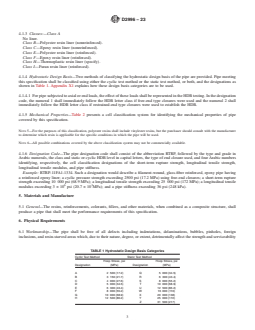
4.1.4 Hydrostatic Design Basis—Two methods of classifying the hydrostatic design basis of the pipe are provided. Pipe meeting
this specification shall be classified using either the cyclic test method or the static test method, or both, and the designations as
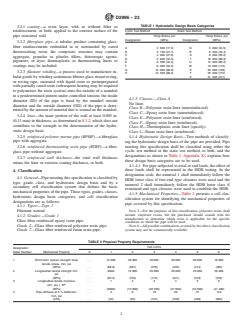
shown in Table 1. Appendix X1 explains how these design basis categories are to be used.
4.1.4.1 For pipe subjected to axial or end loads, the effect of these loads shall be represented in the HDB testing. In the designation
code, the numeral 1 shall immediately follow the HDB letter class if free-end type closures were used and the numeral 2 shall
immediately follow the HDB letter class if restrained-end type closures were used to establish the HDB.
4.1.5 Mechanical Properties—Table 2 presents a cell classification system for identifying the mechanical properties of pipe
covered by this specification.
NOTE 5—For the purposes of this classification, polyester resins shall include vinylester resins, but the purchaser should consult with the manufacturer
to determine which resin is applicable for the specific conditions in which the pipe will be used.
NOTE 6—All possible combinations covered by the above classification system may not be commercially available.
4.1.6 Designation Code—The pipe designation code shall consist of the abbreviation RTRP, followed by the type and grade in
Arabic numerals, the class and static or cyclic HDB level in capital letters, the type of end closure used, and four Arabic numbers
identifying, respectively, the cell classification designations of the short-term rupture strength, longitudinal tensile strength,
longitudinal tensile modulus, and pipe stiffness.
Example: RTRP-11FA1-1334. Such a designation would describe a filament-wound, glass-fiber reinforced, epoxy pipe having
a reinforced epoxy liner; a cyclic pressure strength exceeding 2500 psi (17.2 MPa) using free-end closures; a short-term rupture
strength exceeding 10 000 psi (68.9 MPa); a longitudinal tensile strength exceeding 25 000 psi (172 MPa); a longitudinal tensile
6 3
modulus exceeding 3 × 10 psi (20.7 × 10 MPa); and a pipe stiffness exceeding 36 psi (248 kPa).
5. Materials and Manufacture
5.1 General—The resins, reinforcements, colorants, fillers, and other materials, when combined as a composite structure, shall
produce a pipe that shall meet the performance requirements of this specification.
6. Physical Requirements
6.1 Workmanship—The pipe shall be free of all defects including indentations, delaminations, bubbles, pinholes, foreign
inclusions, and resin-starved areas which, due to their nature, degree, or extent, detrimentally affect the strength and serviceability
TABLE 1 Hydrostatic Design Basis Categories
Cyclic Test Method Static Test Method
Hoop Stress, psi Hoop Stress, psi
Designation (MPa) Designation (MPa)
A 2 500 (17.2) Q 5 000 (34.5)
B 3 150 (21.7) R 6 300 (43.4)
C 4 000 (27.6) S 8 000 (55.2)
D 5 000 (34.5) T 10 000 (68.9)
E 6 300 (43.4) U 12 500 (86.2)
F 8 000 (55.2) W 16 000 (110)
G 10 000 (68.9) X 20 000 (138)
H 12 500 (86.2) Y 25 000 (172)
Z 31 500 (217)
D2996 − 23
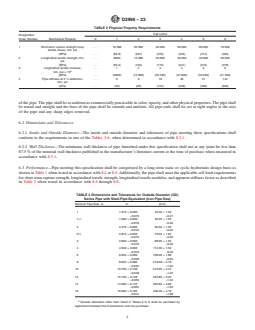
TABLE 2 Physical Property Requirements
Cell Limits
Designation
Order Number Mechanical Property 0 1 2 3 4 5 6
1 Short-term rupture strength hoop . . . 10 000 30 000 40 000 50 000 60 000 70 000
tensile stress, min, psi
(MPa) . . . (68.9) (207) (276) (345) (414) (483)
2 Longitudinal tensile strength min, . . . 8000 15 000 25 000 35 000 45 000 55 000
psi
(MPa) . . . (55.2) (103) (172) (241) (310) (379)
3 Longitudinal tensile modulus, . . . 1 2 3 4 5 6
min, psi × 10
(MPa) . . . (6900) (13 000) (20 700) (27 600) (34 500) (41 400)
4 Pipe stiffness at 5 % deflection, . . . 5 9 18 36 72 144
min, psi
(kPa) . . . (34) (62) (124) (248) (496) (993)
of the pipe. The pipe shall be as uniform as commercially practicable in color, opacity, and other physical properties. The pipe shall
be round and straight and the bore of the pipe shall be smooth and uniform. All pipe ends shall be cut at right angles to the axis
of the pipe and any sharp edges removed.
6.2 Dimensions and Tolerances:
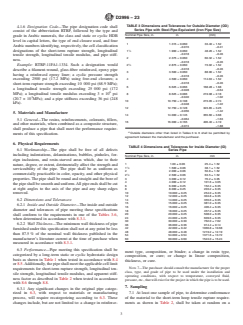
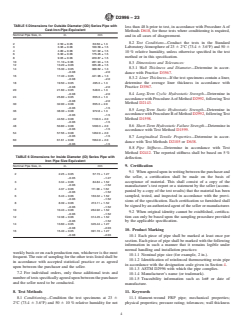
6.2.1 Inside and Outside Diameter—The inside and outside diameter and tolerances of pipe meeting these specifications shall
conform to the requirements in one of the Tables 3-6, when determined in accordance with 8.3.1.
6.2.2 Wall Thickness—The minimum wall thickness of pipe furnished under this specification shall not at any point be less than
87.5 % of the nominal wall thickness published in the manufacturer’s literature current at the time of purchase when measured in
accordance with 8.3.1.
6.3 Performance—Pipe meeting this specification shall be categorized by a long-term static or cyclic hydrostatic design basis as
shown in Table 1 when tested in accordance with 8.4 or 8.5. Additionally, the pipe shall meet the applicable cell limit requirements
for short-term rupture strength, longitudinal tensile strength, longitudinal tensile modulus, and apparent stiffness factor as described
in Table 2 when tested in accordance with 8.6 through 8.8.
TABLE 3 Dimensions and Tolerances for Outside Diameter (OD)
Series Pipe with Steel-Pipe-Equivalent (Iron Pipe Size)
Nominal Pipe Size, in. in. (mm)
1 1.315 + 0.060 33.40 + 1.52
−0.016 −0.41
1 ⁄2 1.900 + 0.060 48.26 + 1.52
...