

ASTM D3681-23
(Test Method)Standard Test Method for Chemical Resistance of “Fiberglass” (Glass–Fiber–Reinforced Thermosetting-Resin) Pipe in a Deflected Condition
General Information
- Abstract
SIGNIFICANCE AND USE
5.1 This test method evaluates the effect of a chemical environment on pipe when in a deflected condition. It has been found that effects of chemical environments can be accelerated by strain induced by deflection. This information is useful and necessary for the design and application of buried fiberglass pipe.
Note 4: Pipe of the same diameter but of different wall thicknesses will develop different strains with the same deflection. Also, pipes having the same wall thickness but different constructions making up the wall may develop different strains with the same deflection.
SCOPE
1.1 This test method covers the procedure for determining the chemical-resistant properties of fiberglass pipe in a deflected condition for diameters 4 in. (102 mm) and larger. Both glass–fiber–reinforced thermosetting resin pipe (RTRP) and glass–fiber–reinforced polymer mortar pipe (RPMP) are fiberglass pipes.
Note 1: For the purposes for this standard, polymer does not include natural polymers.
1.2 Inch-pound units are to be regarded as the standard. The values given in parentheses are for information only.
1.3 This standard does not purport to address all of the safety concerns, if any, associated with its use. It is the responsibility of the user of this standard to establish appropriate safety, health, and environmental practices and determine the applicability of regulatory limitations prior to use. Specific precautionary statements are given in 9.5.
Note 2: There is no known ISO equivalent to this standard.
1.4 This international standard was developed in accordance with internationally recognized principles on standardization established in the Decision on Principles for the Development of International Standards, Guides and Recommendations issued by the World Trade Organization Technical Barriers to Trade (TBT) Committee.
- Status
- Published
- Publication Date
- 30-Jun-2023
- Technical Committee
- D20 - Plastics
Buy Documents
ASTM D3681-23 - Standard Test Method for Chemical Resistance of “Fiberglass” (Glass–Fiber–Reinforced Thermosetting-Resin) Pipe in a Deflected Condition
REDLINE ASTM D3681-23 - Standard Test Method for Chemical Resistance of “Fiberglass” (Glass–Fiber–Reinforced Thermosetting-Resin) Pipe in a Deflected Condition
Overview
ASTM D3681-23 is the standard test method developed by ASTM International for assessing the chemical resistance of fiberglass (glass–fiber–reinforced thermosetting-resin) pipe in a deflected condition. This standard provides a critical evaluation of how chemical environments affect fiberglass pipes (including both reinforced thermosetting resin pipe [RTRP] and reinforced polymer mortar pipe [RPMP]) when subjected to sustained mechanical deflection. As chemical exposure combined with mechanical strain can significantly accelerate pipe degradation, this method offers valuable guidance for engineers and designers working with fiberglass piping systems-particularly for buried installations.
Key Topics
- Chemical Resistance Evaluation: The standard outlines procedures to determine the performance and longevity of fiberglass pipe under chemical exposure while under mechanical strain caused by deflection.
- Applicability: Designed for pipes with a diameter of 4 inches (102 mm) or larger, using inch-pound units as the standard.
- Test Procedure:
- Test specimens are deflected to specific levels.
- The interior surface is exposed to corrosive solutions.
- Time to failure (determined by fluid passage through the pipe wall or catastrophic failure) is measured.
- Strain Acceleration: The method demonstrates that chemical attack is intensified when the pipe is under strain from deflection, which can simulate buried or installed conditions.
- Safety and Environmental Considerations: Users must establish appropriate safety and health practices and confirm regulatory compliance prior to conducting tests.
Applications
- Pipeline Design and Specification: Engineers and designers use ASTM D3681-23 to select appropriate pipe materials and thicknesses for chemical service, particularly for underground applications where deflection due to soil loads is expected.
- Quality Assurance for Manufacturers: Pipe producers employ this test method to demonstrate the long-term chemical resistance and reliability of their fiberglass piping products under realistic mechanical loading conditions.
- Asset Management and Maintenance: Asset owners and maintenance teams utilize test data from this standard to inform timelines for inspection and replacement, based on extrapolated service life under specific chemical and mechanical environments.
- Regulatory and Compliance Documentation: Satisfies requirements for documentation and evidence of chemical resistance performance, supporting project specifications and regulatory submissions for infrastructure projects.
- Comparison and Benchmarking: Enables direct comparison of different pipe constructions (varying wall thicknesses or material layups) to find optimal solutions for challenging chemical environments.
Related Standards
- ASTM D883 - Terminology Relating to Plastics: Provides standard definitions used throughout the plastics and reinforced plastics industries.
- ASTM D1600 - Terminology for Abbreviated Terms Relating to Plastics: Covers the standardized abbreviations relevant to plastics materials and processes.
- ASTM D3567 - Practice for Determining Dimensions of Fiberglass Pipe and Fittings: Essential for accurate measurement of test specimens as required in ASTM D3681-23.
- No ISO Equivalent: At present, there is no directly corresponding ISO standard for this specific test method.
Keywords: ASTM D3681, chemical resistance, fiberglass pipe, strain-corrosion, glass–fiber–reinforced thermosetting resin, pipe deflection, regression analysis, chemical exposure, reinforced thermosetting resin pipe, reinforced polymer mortar pipe, pipe testing, mechanical strain, buried pipe, pipe standards, thermosetting-composites, corrosion resistance, ASTM standards.
Relations
- Effective Date
- 01-Feb-2024
- Effective Date
- 01-Nov-2023
- Effective Date
- 01-Jan-2020
- Effective Date
- 01-Aug-2019
- Effective Date
- 15-Apr-2019
- Effective Date
- 01-Feb-2019
- Effective Date
- 01-Dec-2018
- Effective Date
- 01-Nov-2018
- Refers
ASTM D1600-18 - Standard Terminology for Abbreviated Terms Relating to Plastics (Withdrawn 2024) - Effective Date
- 01-Jan-2018
- Effective Date
- 15-Aug-2017
- Effective Date
- 01-Feb-2014
- Effective Date
- 15-Apr-2013
- Effective Date
- 15-Nov-2012
- Effective Date
- 01-Dec-2011
- Effective Date
- 15-May-2011
Buy Documents
ASTM D3681-23 - Standard Test Method for Chemical Resistance of “Fiberglass” (Glass–Fiber–Reinforced Thermosetting-Resin) Pipe in a Deflected Condition
REDLINE ASTM D3681-23 - Standard Test Method for Chemical Resistance of “Fiberglass” (Glass–Fiber–Reinforced Thermosetting-Resin) Pipe in a Deflected Condition
Get Certified
Connect with accredited certification bodies for this standard

Institut za varilstvo d.o.o. (Welding Institute)
Slovenia's leading welding institute since 1952. ISO 3834, EN 1090, pressure equipment certification, NDT personnel, welder qualification. Only IIW Au
Sponsored listings
Frequently Asked Questions
ASTM D3681-23 is a standard published by ASTM International. Its full title is "Standard Test Method for Chemical Resistance of “Fiberglass” (Glass–Fiber–Reinforced Thermosetting-Resin) Pipe in a Deflected Condition". This standard covers: SIGNIFICANCE AND USE 5.1 This test method evaluates the effect of a chemical environment on pipe when in a deflected condition. It has been found that effects of chemical environments can be accelerated by strain induced by deflection. This information is useful and necessary for the design and application of buried fiberglass pipe. Note 4: Pipe of the same diameter but of different wall thicknesses will develop different strains with the same deflection. Also, pipes having the same wall thickness but different constructions making up the wall may develop different strains with the same deflection. SCOPE 1.1 This test method covers the procedure for determining the chemical-resistant properties of fiberglass pipe in a deflected condition for diameters 4 in. (102 mm) and larger. Both glass–fiber–reinforced thermosetting resin pipe (RTRP) and glass–fiber–reinforced polymer mortar pipe (RPMP) are fiberglass pipes. Note 1: For the purposes for this standard, polymer does not include natural polymers. 1.2 Inch-pound units are to be regarded as the standard. The values given in parentheses are for information only. 1.3 This standard does not purport to address all of the safety concerns, if any, associated with its use. It is the responsibility of the user of this standard to establish appropriate safety, health, and environmental practices and determine the applicability of regulatory limitations prior to use. Specific precautionary statements are given in 9.5. Note 2: There is no known ISO equivalent to this standard. 1.4 This international standard was developed in accordance with internationally recognized principles on standardization established in the Decision on Principles for the Development of International Standards, Guides and Recommendations issued by the World Trade Organization Technical Barriers to Trade (TBT) Committee.
SIGNIFICANCE AND USE 5.1 This test method evaluates the effect of a chemical environment on pipe when in a deflected condition. It has been found that effects of chemical environments can be accelerated by strain induced by deflection. This information is useful and necessary for the design and application of buried fiberglass pipe. Note 4: Pipe of the same diameter but of different wall thicknesses will develop different strains with the same deflection. Also, pipes having the same wall thickness but different constructions making up the wall may develop different strains with the same deflection. SCOPE 1.1 This test method covers the procedure for determining the chemical-resistant properties of fiberglass pipe in a deflected condition for diameters 4 in. (102 mm) and larger. Both glass–fiber–reinforced thermosetting resin pipe (RTRP) and glass–fiber–reinforced polymer mortar pipe (RPMP) are fiberglass pipes. Note 1: For the purposes for this standard, polymer does not include natural polymers. 1.2 Inch-pound units are to be regarded as the standard. The values given in parentheses are for information only. 1.3 This standard does not purport to address all of the safety concerns, if any, associated with its use. It is the responsibility of the user of this standard to establish appropriate safety, health, and environmental practices and determine the applicability of regulatory limitations prior to use. Specific precautionary statements are given in 9.5. Note 2: There is no known ISO equivalent to this standard. 1.4 This international standard was developed in accordance with internationally recognized principles on standardization established in the Decision on Principles for the Development of International Standards, Guides and Recommendations issued by the World Trade Organization Technical Barriers to Trade (TBT) Committee.
ASTM D3681-23 is classified under the following ICS (International Classification for Standards) categories: 23.040.20 - Plastics pipes. The ICS classification helps identify the subject area and facilitates finding related standards.
ASTM D3681-23 has the following relationships with other standards: It is inter standard links to ASTM D883-24, ASTM D883-23, ASTM D883-20, ASTM D883-19c, ASTM D883-19a, ASTM D883-19, ASTM D883-18a, ASTM D883-18, ASTM D1600-18, ASTM D883-17, ASTM D1600-14, ASTM D1600-13, ASTM D883-12e1, ASTM D3567-97(2011), ASTM D883-11. Understanding these relationships helps ensure you are using the most current and applicable version of the standard.
ASTM D3681-23 is available in PDF format for immediate download after purchase. The document can be added to your cart and obtained through the secure checkout process. Digital delivery ensures instant access to the complete standard document.
Standards Content (Sample)
This international standard was developed in accordance with internationally recognized principles on standardization established in the Decision on Principles for the
Development of International Standards, Guides and Recommendations issued by the World Trade Organization Technical Barriers to Trade (TBT) Committee.
Designation: D3681 − 23
Standard Test Method for
Chemical Resistance of “Fiberglass”
(Glass–Fiber–Reinforced Thermosetting-Resin) Pipe in a
Deflected Condition
This standard is issued under the fixed designation D3681; the number immediately following the designation indicates the year of
original adoption or, in the case of revision, the year of last revision. A number in parentheses indicates the year of last reapproval. A
superscript epsilon (´) indicates an editorial change since the last revision or reapproval.
1. Scope* D3567 Practice for Determining Dimensions of “Fiberglass”
(Glass-Fiber-Reinforced Thermosetting Resin) Pipe and
1.1 This test method covers the procedure for determining
Fittings
the chemical-resistant properties of fiberglass pipe in a de-
flected condition for diameters 4 in. (102 mm) and larger. Both
3. Terminology
glass–fiber–reinforced thermosetting resin pipe (RTRP) and
glass–fiber–reinforced polymer mortar pipe (RPMP) are fiber-
3.1 Definitions:
glass pipes.
3.1.1 General—Definitions are in accordance with Termi-
nology D883 and abbreviations are in accordance with Termi-
NOTE 1—For the purposes for this standard, polymer does not include
nology D1600 unless otherwise indicated.
natural polymers.
1.2 Inch-pound units are to be regarded as the standard. The 3.2 Definitions of Terms Specific to This Standard:
values given in parentheses are for information only. 3.2.1 end point—the passage of the fluid through the pipe
wall unless otherwise stated. The failure mode may be
1.3 This standard does not purport to address all of the
catastrophic, characterized by a sudden fracture through the
safety concerns, if any, associated with its use. It is the
pipe wall in the area of greatest strain, parallel to the axis of the
responsibility of the user of this standard to establish appro-
pipe, with the fiber reinforcement cleanly broken at the edge of
priate safety, health, and environmental practices and deter-
the fracture. Visual evidence of surface etching or pitting may
mine the applicability of regulatory limitations prior to use.
or may not be present.
Specific precautionary statements are given in 9.5.
3.2.2 fiberglass pipe—tubular product containing glass fiber
NOTE 2—There is no known ISO equivalent to this standard.
reinforcements embedded in or surrounded by cured thermo-
1.4 This international standard was developed in accor-
setting resin. The composite structure may contain aggregate,
dance with internationally recognized principles on standard-
granular or platelet fillers, thixotropic agents, pigments, or
ization established in the Decision on Principles for the
dyes. Thermoplastic or thermosetting liners or coatings may be
Development of International Standards, Guides and Recom-
included.
mendations issued by the World Trade Organization Technical
3.2.3 reinforced polymer mortar pipe (RPMP)—fiberglass
Barriers to Trade (TBT) Committee.
pipe with aggregate.
2. Referenced Documents
3.2.4 reinforced thermosetting resin pipe (RTRP)—
fiberglass pipe without aggregate.
2.1 ASTM Standards:
D883 Terminology Relating to Plastics
3.2.5 strain-corrosion—the failure of the pipe wall caused
D1600 Terminology for Abbreviated Terms Relating to Plas-
by the exposure of the inside surface, while in a strained
tics
condition, to a corrosive environment for a period of time.
4. Summary of Test Method
This test method is under the jurisdiction of ASTM Committee D20 on Plastics
and is the direct responsibility of Subcommittee D20.23 on Reinforced Thermoset-
4.1 This test method consists of exposing the interior of a
ting Resin Piping Systems and Chemical Equipment.
minimum of 18 specimens of pipe to a corrosive test solution
Current edition approved July 1, 2023. Published July 2023. Originally approved
while the pipe is constantly maintained in a deflected condition
in 1978. Last previous edition approved in 2018 as D3681 – 18. DOI: 10.1520/
D3681-23.
at differing induced initial ring flexural strain levels, and
For referenced ASTM standards, visit the ASTM website, www.astm.org, or
measuring the time to failure for each strain level. Test
contact ASTM Customer Service at service@astm.org. For Annual Book of ASTM
temperatures are obtained by testing in an air environment
Standards volume information, refer to the standard’s Document Summary page on
the ASTM website. where the temperature is controlled.
*A Summary of Changes section appears at the end of this standard
Copyright © ASTM International, 100 Barr Harbor Drive, PO Box C700, West Conshohocken, PA 19428-2959. United States
D3681 − 23
4.2 The long-term resistance of the pipe to the test solution run. The test specimens shall have a minimum length of one
is obtained by an extrapolation to 50 years of a log-log linear nominal pipe diameter or 12 in. (300 mm) 6 5 %, whichever
regression line for initial strain level versus time. is less.
NOTE 3—It is the consensus of Subcommittee D20.23 that the log–log
8. Test Conditions
linear regression analysis of test data is a conservative approach and is
representative of standard industry practice.
8.1 The standard temperature shall be 73.4 6 3.6°F (23 6
2°C).
5. Significance and Use
5.1 This test method evaluates the effect of a chemical
9. Procedure
environment on pipe when in a deflected condition. It has been
9.1 General—Determine the initial strain level induced in
found that effects of chemical environments can be accelerated
the pipe by calculation, or strain gage measurement, or both.
by strain induced by deflection. This information is useful and
Procedure A describes the determination of initial strain by
necessary for the design and application of buried fiberglass
calculation; Procedure B describes the determination of initial
pipe.
strain as obtained by use of foil-type resistance strain gages.
NOTE 4—Pipe of the same diameter but of different wall thicknesses
will develop different strains with the same deflection. Also, pipes having
9.2 Determination of Test Level:
the same wall thickness but different constructions making up the wall
9.2.1 Test Procedure A:
may develop different strains with the same deflection.
9.2.1.1 In accordance with Practice D3567 measure the wall
6. Apparatus thickness to the nearest 0.001 in. (0.025 mm) in at least five
equally spaced places along the bottom of the pipe specimen on
6.1 Use parallel plate apparatus suitable to maintain a
a line parallel with the pipe axis, and average the measure-
constant deflection on the pipe. In order to achieve uniform
ments.
strain along the pipe, use 0.25-in. (6-mm) thick elastomeric
9.2.1.2 In accordance with Practice D3567 measure the
pads between the parallel plate (channel) surfaces and the pipe
vertical inside diameter to the nearest 0.01 in. (0.25 mm) at
ring (see Note 5). Foil type, single element strain gages suitable
both ends prior to deflection and average the measurements.
for strain levels to 1.50 % strain and a length appropriate to the
diameter of the pipe are required when initial strain is to be
NOTE 7—It is recommended that the vertical inside diameter be
determined by Procedure B (see Note 6). An example of the measured with the axis vertical.
apparatus required is shown in Fig. 1.
9.2.1.3 Place the pipe specimen in the test apparatus (Fig. 1)
with the measured wall thicknesses at the bottom and apply
NOTE 5—Elastomeric pads with a hardness of Shore A15 to 70 have
been used successfully.
force to the apparatus to deflect the specimen while keeping the
1 1
NOTE 6—Strain gages of ⁄4 and ⁄2-in. (6 and 13-mm) length have been
top and bottom plates (channels) of the apparatus as near
found to be effective for pipe diameters 12 through 24 in. (305 through
parallel as possible. When the desired deflection is obtained,
610 mm). Consult the strain gage manufacturer for gage length recom-
lock the apparatus to maintain the specimen in the deflected
mendations for other pipe diameters.
condition.
7. Test Specimens
NOTE 8—Alignment of the specimen within the channels is critical. The
7.1 The test specimens shall be ring sections taken from a
channels shall not only be parallel with the load points 180° opposite, but
sample of pipe selected at random from a normal production the pipe shall be centered between the rods.
FIG. 1 Strain-Corrosion Test Apparatus
D3681 − 23
9.2.1.4 Measure the vertical inside diameter of the deflected 9.3 When using Procedure A, verify the strain level by using
pipe specimen at both ends to the nearest 0.01 in. (0.25 mm). strain gages as described in Procedure B for at least one
Average the measurements and determine the deflection by specimen in every nine. Conversely, when using Procedure B,
subtracting the average vertical inside diameter after deflection verify the strain level by measurement and calculation as
from the measurement determined in 9.2.1.2. described in Procedure A for at least one specimen in every
nine. If the calculated strain and the indicated strain do not vary
9.2.1.5 Calculate the initial strain level using the following
more than 10 %, consider the strain levels accurate within
equation which includes compensation for increased horizontal
normal experimental error.
diameter with increasing deflection.
ε 5 428 t Δ
~ !~ ! NOTE 12—Deflections in excess of 28 % of diameter may cause local
T
flattening of the pipe and lead to erratic strain distribution. For deflections
Δ
D 1
S D approaching 28 % improved accuracy is obtained by use of strain gages or
m
by establishing, for a typical pipe, a calibration of deflection versus
measured strain. This calibration technique is also useful at all deflection
where:
levels as a check of the calculations by 9.2.1.5, which assumes neutral axis
at pipe wall midpoint.
ε = initial strain, %,
T
9.4 After the initial strain is obtained using Procedure A or
t = average wall thickness at bottom, in. (mm),
B, install chemically inert dams using a flexible sealant so that
Δ = average deflection, in. (mm),
¯
only the interior surface of the pipe will be exposed to the test
D = mean diameter, in. (mm) D + t, and
m
¯
environment. The dams shall not add support to the pipe
D = average inside pipe diameter, free state, in. (mm).
specimen.
NOTE 9—The calculation assumes that the neutral axis is at the pipe
9.5 Place the apparatus containing the specimen in a chemi-
wall midpoint. For pipe wall constructions that produce an altered neutral
cally resistant trough or pan and introduce the test solution.
axis position, it may be necessary to evaluate results substituting 2 y¯ for
Care should be taken to work quickly, and the solution shall be
t. (y¯ is the distance from the inside pipe surface to the neutral axis.)
Neutral axis position must be determined with strain gage couples. See
added within a maximum of 30 minutes of locking the
also Note 11.
apparatus. The time shall be recorded from the addition of the
solution. (Warning—Since the failure mode could be
9.2.2 Procedure B:
catastrophic, precautions should be taken to contain any
9.2.2.1 Carefully align and attach three strain gages on the
sudden leakage that may occur. The use of spacers (such as,
inside bottom surface of the pipe specimen in the circumfer-
wooden blocks) under the apparatus is suggested to reduce
ential direction to measure initial circumferential strains. Place
attack of the apparatus after failure of the sample.)
the gages perpendicular to the pipe axis as follows: one in the
middle and the other two at the quarter points along the invert
NOTE 13—Especially for tests with expected short time-to-failure (that
of the specimen. The adhesive used to attach the gages shall not is, high strain tests), it is important to add the test solution quickly to
obtain the most accurate and consistent results.
cover more than 37 % of the pipe specimen length along the
invert. Zero-in the gages while the pipe is circular in shape.
9.6 Periodically check and maintain the test solution within
65 % of the specified strength or concentration for the
NOTE 10—It is recommended that the pipe specimen be placed with its
duration of the test. Maintain the level at a depth of not less
axis vertical to maintain roundness when the bridge is balanced to “zero”
the instrument. than 1 in. (25.4 mm) during the period of the test.
9.2.2.2 After installing the strain gages, place the specimen
NOTE 14—As some solutions become more concentrated with the
evaporation of water, care must be exercised in replenishment to prevent
in the test apparatus (see Fig. 1) with the strain gages at the
a build-up in strength. It may be necessary, with some reagents, to
bottom. Extreme care shall be taken to ensure that the gages are
periodically clean the deflected specimen and replace the test solution with
located at the point of maximum strain (6 o’clock position).
a fresh mixture. The use of plastic film, cut carefully to fit between the
dams and floated on the top of the test solution, has been found helpful in
NOTE 11—Alignment of the specimen within the channels is critical.
reducing evaporation.
The channels shall not only be parallel with the load points 180° opposite,
but the pipe shall be centered between the rods.
9.7 Record the following data:
9.2.2.3 Apply force to the apparatus to deflect the specimen 9.7.1 Average pipe wall thickness,
while keeping the top and bottom plates (channels) of the 9.7.2 Average inside pipe diameter before deflection,
apparatus as parallel as possible. When the desired strain level
9.7.3 Average inside pipe diameter after deflection,
is reached, lock the apparatus to maintain the specimen in the
9.7.4 Percent deflection,
deflected condition. Read the gages as soon as the apparatus is
9.7.5 Initial strain and method of determination,
locked. Initial strain shall be recorded within 2 min after
9.7.6 Type, location, and time of any distress of the pipe
locking the apparatus. At least two gages shall read within 5 %
wall, and
of each other for a valid experiment. If any gage reads more
9.7.7 Time to end point. Times are measured from the
than 5 % from the average of the other two gages, disregard the
addition of solution.
indication unless thickness verification implies the strain gage
reading was accurate. Average the valid gage indications, and 9.8 To determine the regression line and the lower confi-
record as initial (indicated) strain. In addition, measure and dence level for the report, a minimum of 18 samples is
record the deflection. required. Distribution of data points shall be as follows:
D3681 − 23
LCL. For 95 % prediction limits, there is a 2.5 % probability that
Hours Failure Points
individual data points may fall above the UPL and a 2.5 % probability that
10 to 1000 at least 4
1000 to 6000 at least 3 individual data points may fall below the LPL.
After 6000 at least 3
10.3 From the original regression line, select strain levels
After 10 000 at least 1
for at least two sets of specimens, each set consisting of three
9.9 Perform inspection of the test samples as follows:
or more specimens each to be tested at the same strain level as
Hours Inspect at Least
follows:
10 to 20 every 1 h
20 to 40 every 2 h
Hours to Failure (Average of Set) Failure Points
40 to 60 every 4 h
10 to 200 at least 3
60 to 100 every 8 h
More than 1000 at least 3
100 to 600 every 24 h
Total: at least 6
600 to 6000 every 48 h
For the purpose of reconfirm
...
This document is not an ASTM standard and is intended only to provide the user of an ASTM standard an indication of what changes have been made to the previous version. Because
it may not be technically possible to adequately depict all changes accurately, ASTM recommends that users consult prior editions as appropriate. In all cases only the current version
of the standard as published by ASTM is to be considered the official document.
Designation: D3681 − 18 D3681 − 23
Standard Test Method for
Chemical Resistance of “Fiberglass”
(Glass–Fiber–Reinforced Thermosetting-Resin) Pipe in a
Deflected Condition
This standard is issued under the fixed designation D3681; the number immediately following the designation indicates the year of
original adoption or, in the case of revision, the year of last revision. A number in parentheses indicates the year of last reapproval. A
superscript epsilon (´) indicates an editorial change since the last revision or reapproval.
1. Scope*
1.1 This test method covers the procedure for determining the chemical-resistant properties of fiberglass pipe in a deflected
condition for diameters 4 in. (102 mm) and larger. Both glass–fiber–reinforced thermosetting resin pipe (RTRP) and
glass–fiber–reinforced polymer mortar pipe (RPMP) are fiberglass pipes.
NOTE 1—For the purposes for this standard, polymer does not include natural polymers.
1.2 Inch-pound units are to be regarded as the standard. The values given in parentheses are for information only.
1.3 This standard does not purport to address all of the safety concerns, if any, associated with its use. It is the responsibility
of the user of this standard to establish appropriate safety, health, and environmental practices and determine the applicability of
regulatory limitations prior to use. Specific precautionary statements are given in 9.5.
NOTE 2—There is no known ISO equivalent to this standard.
1.4 This international standard was developed in accordance with internationally recognized principles on standardization
established in the Decision on Principles for the Development of International Standards, Guides and Recommendations issued
by the World Trade Organization Technical Barriers to Trade (TBT) Committee.
2. Referenced Documents
2.1 ASTM Standards:
D883 Terminology Relating to Plastics
D1600 Terminology for Abbreviated Terms Relating to Plastics
D3567 Practice for Determining Dimensions of “Fiberglass” (Glass-Fiber-Reinforced Thermosetting Resin) Pipe and Fittings
3. Terminology
3.1 Definitions:
This test method is under the jurisdiction of ASTM Committee D20 on Plastics and is the direct responsibility of Subcommittee D20.23 on Reinforced Plastic
Thermosetting Resin Piping Systems and Chemical Equipment.
Current edition approved Aug. 1, 2018July 1, 2023. Published August 2018July 2023. Originally approved in 1978. Last previous edition approved in 20122018 as
ɛ1
D3681 – 12D3681 – 18. . DOI: 10.1520/D3681-18.10.1520/D3681-23.
For referenced ASTM standards, visit the ASTM website, www.astm.org, or contact ASTM Customer Service at service@astm.org. For Annual Book of ASTM Standards
volume information, refer to the standard’s Document Summary page on the ASTM website.
*A Summary of Changes section appears at the end of this standard
Copyright © ASTM International, 100 Barr Harbor Drive, PO Box C700, West Conshohocken, PA 19428-2959. United States
D3681 − 23
3.1.1 General—Definitions are in accordance with Terminology D883 and abbreviations are in accordance with Terminology
D1600 unless otherwise indicated.
3.2 Definitions of Terms Specific to This Standard:
3.2.1 end point—the passage of the fluid through the pipe wall unless otherwise stated. The failure mode may be catastrophic,
characterized by a sudden fracture through the pipe wall in the area of greatest strain, parallel to the axis of the pipe, with the fiber
reinforcement cleanly broken at the edge of the fracture. Visual evidence of surface etching or pitting may or may not be present.
3.2.2 fiberglass pipe—tubular product containing glass fiber reinforcements embedded in or surrounded by cured thermosetting
resin. The composite structure may contain aggregate, granular or platelet fillers, thixotropic agents, pigments, or dyes.
Thermoplastic or thermosetting liners or coatings may be included.
3.2.3 reinforced polymer mortar pipe (RPMP)—fiberglass pipe with aggregate.
3.2.4 reinforced thermosetting resin pipe (RTRP)—fiberglass pipe without aggregate.
3.2.5 strain-corrosion—the failure of the pipe wall caused by the exposure of the inside surface, while in a strained condition, to
a corrosive environment for a period of time.
4. Summary of Test Method
4.1 This test method consists of exposing the interior of a minimum of 18 specimens of pipe to a corrosive test solution while the
pipe is constantly maintained in a deflected condition at differing induced initial ring flexural strain levels, and measuring the time
to failure for each strain level. Test temperatures are obtained by testing in an air environment where the temperature is controlled.
4.2 The long-term resistance of the pipe to the test solution is obtained by an extrapolation to 50 years of a log-log linear regression
line for initial strain level versus time.
NOTE 3—It is the consensus of Subcommittee D20.23 that the log–log linear regression analysis of test data is a conservative approach and is
representative of standard industry practice.
5. Significance and Use
5.1 This test method evaluates the effect of a chemical environment on pipe when in a deflected condition. It has been found that
effects of chemical environments can be accelerated by strain induced by deflection. This information is useful and necessary for
the design and application of buried fiberglass pipe.
NOTE 4—Pipe of the same diameter but of different wall thicknesses will develop different strains with the same deflection. Also, pipes having the same
wall thickness but different constructions making up the wall may develop different strains with the same deflection.
6. Apparatus
6.1 Use parallel plate apparatus suitable to maintain a constant deflection on the pipe. In order to achieve uniform strain along the
pipe, use 0.25-in. (6-mm) thick elastomeric pads between the parallel plate (channel) surfaces and the pipe ring (see Note 5). Foil
type, single element strain gages suitable for strain levels to 1.50 % strain and a length appropriate to the diameter of the pipe are
required when initial strain is to be determined by Procedure B (see Note 6). An example of the apparatus required is shown in
Fig. 1.
NOTE 5—Elastomeric pads with a hardness of Shore A15 to 70 have been used successfully.
1 1
NOTE 6—Strain gages of ⁄4 and ⁄2-in. (6 and 13-mm) length have been found to be effective for pipe diameters 12 through 24 in. (305 through 610 mm).
Consult the strain gage manufacturer for gage length recommendations for other pipe diameters.
D3681 − 23
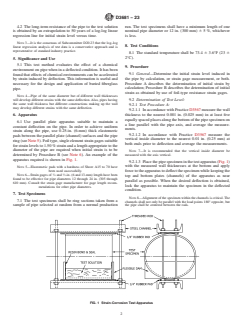
FIG. 1 Strain-Corrosion Test Apparatus
7. Test Specimens
7.1 The test specimens shall be ring sections taken from a sample of pipe selected at random from a normal production run. The
test specimens shall have a minimum length of one nominal pipe diameter or 12 in. (300 mm) 6 5 %, whichever is less.
8. Test Conditions
8.1 The standard temperature shall be 73.4 6 3.6°F (23 6 2°C).
9. Procedure
9.1 General—Determine the initial strain level induced in the pipe by calculation, or strain gage measurement, or both. Procedure
A describes the determination of initial strain by calculation; Procedure B describes the determination of initial strain as obtained
by use of foil-type resistance strain gages.
9.2 Determination of Test Level:
9.2.1 Test Procedure A:
9.2.1.1 In accordance with Practice D3567 measure the wall thickness to the nearest 0.001 in. (0.025 mm) in at least five equally
spaced places along the bottom of the pipe specimen on a line parallel with the pipe axis, and average the measurements.
9.2.1.2 In accordance with Practice D3567 measure the vertical inside diameter to the nearest 0.01 in. (0.25 mm) at both ends prior
to deflection and average the measurements.
NOTE 7—It is recommended that the vertical inside diameter be measured with the axis vertical.
9.2.1.3 Place the pipe specimen in the test apparatus (Fig. 1) with the measured wall thicknesses at the bottom and apply force
to the apparatus to deflect the specimen while keeping the top and bottom plates (channels) of the apparatus as near parallel as
possible. When the desired deflection is obtained, lock the apparatus to maintain the specimen in the deflected condition.
NOTE 8—Alignment of the specimen within the channels is critical. The channels shall not only be parallel with the load points 180° opposite, but the
pipe shall be centered between the rods.
9.2.1.4 Measure the vertical inside diameter of the deflected pipe specimen at both ends to the nearest 0.01 in. (0.25 mm). Average
the measurements and determine the deflection by subtracting the average vertical inside diameter after deflection from the
measurement determined in 9.2.1.2.
D3681 − 23
9.2.1.5 Calculate the initial strain level using the following equation which includes compensation for increased horizontal
diameter with increasing deflection.
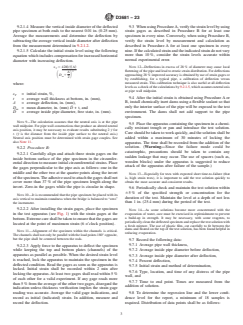
ε 5 428 t ∆
~ !~ !
T
∆
D 1
S D
m
where:
ε = initial strain, %,
T
t = average wall thickness at bottom, in. (mm),
Δ = average deflection, in. (mm),
D = mean diameter, in. (mm) D¯ + t, and
m
D¯ = average inside pipe diameter, free state, in. (mm).
NOTE 9—The calculation assumes that the neutral axis is at the pipe wall midpoint. For pipe wall constructions that produce an altered neutral axis
position, it may be necessary to evaluate results substituting 2 y¯ for t. (y¯ is the distance from the inside pipe surface to the neutral axis.) Neutral axis
position must be determined with strain gage couples. See also Note 11.
9.2.2 Procedure B:
9.2.2.1 Carefully align and attach three strain gages on the inside bottom surface of the pipe specimen in the circumferential
direction to measure initial circumferential strains. Place the gages perpendicular to the pipe axis as follows: one in the middle and
the other two at the quarter points along the invert of the specimen. The adhesive used to attach the gages shall not cover more
than 37 % of the pipe specimen length along the invert. Zero-in the gages while the pipe is circular in shape.
NOTE 10—It is recommended that the pipe specimen be placed with its axis vertical to maintain roundness when the bridge is balanced to “zero” the
instrument.
9.2.2.2 After installing the strain gages, place the specimen in the test apparatus (see Fig. 1) with the strain gages at the bottom.
Extreme care shall be taken to ensure that the gages are located at the point of maximum strain (6 o’clock position).
NOTE 11—Alignment of the specimen within the channels is critical. The channels shall not only be parallel with the load points 180° opposite, but the
pipe shall be centered between the rods.
9.2.2.3 Apply force to the apparatus to deflect the specimen while keeping the top and bottom plates (channels) of the apparatus
as parallel as possible. When the desired strain level is reached, lock the apparatus to maintain the specimen in the deflected
condition. Read the gages as soon as the apparatus is locked. Initial strain shall be recorded within 2 min after locking the
apparatus. At least two gages shall read within 5 % of each other for a valid experiment. If any gage reads more than 5 % from
the average of the other two gages, disregard the indication unless thickness verification implies the strain gage reading was
accurate. Average the valid gage indications, and record as initial (indicated) strain. In addition, measure and record the deflection.
9.3 When using Procedure A, verify the strain level by using strain gages as described in Procedure B for at least one specimen
in every nine. Conversely, when using Procedure B, verify the strain level by measurement and calculation as described in
Procedure A for at least one specimen in every nine. If the calculated strain and the indicated strain do not vary more than 10 %,
consider the strain levels accurate within normal experimental error.
NOTE 12—Deflections in excess of 28 % of diameter may cause local flattening of the pipe and lead to erratic strain distribution. For deflections
approaching 28 % improved accuracy is obtained by use of strain gages or by establishing, for a typical pipe, a calibration of deflection versus measured
strain. This calibration technique is also useful at all deflection levels as a check of the calculations by 9.2.1.5, which assumes neutral axis at pipe wall
midpoint.
9.4 After the initial strain is obtained using Procedure A or B, install chemically inert dams using a flexible sealant so that only
the interior surface of the pipe will be exposed to the test environment. The dams shall not add support to the pipe specimen.
D3681 − 23
9.5 Place the apparatus containing the specimen in a chemically resistant trough or pan and introduce the test solution. The
solution should be added within Care should be taken to work quickly, and the solution shall be added within a maximum of 30
minutes of locking the apparatus and the apparatus. The time shall be recorded from the addition of the solution. (Warning—Since
the failure mode could be catastrophic, precautions should be taken to contain any sudden leakage that may occur. The use of
spacers (such as, wooden blocks) under the apparatus is suggested to reduce attack of the apparatus after failure of the sample.)
NOTE 13—Especially for tests with expected short time-to-failure (that is, high strain tests), it is important to add the test solution quickly to obtain the
most accurate and consistent results.
9.6 Periodically check and maintain the test solution within 65 % of the specified strength or concentration for the duration of
the test. Maintain the level at a depth of not less than 1 in. (25.4 mm) during the period of the test.
NOTE 14—As some solutions become more concentrated with the evaporation of water, care must be exercised in replenishment to prevent a build-up
in strength. It may be necessary, with some reagents, to periodically clean the deflected specimen and replace the test solution with a fresh mixture. The
use of plastic film, cut carefully to fit between the dams and floated on the top of the test solution, has been found helpful in reducing evaporation.
9.7 Record the following data:
9.7.1 Average pipe wall thickness,
9.7.2 Average inside pipe diameter before deflection,
9.7.3 Average inside pipe diameter after deflection,
9.7.4 Percent deflection,
9.7.5 Initial strain and method of determination,
9.7.6 Type, location, and time of any distress of the pipe wall, and
9.7.7 Time to end point. Times are measured from the addition of solution.
9.8 To determine the regression line and the lower confidence level for the report, a minimum of 18 samples is required.
Distribution of data points shall be as follows:
Hours Failure Points
10 to 1000 at least 4
1000 to 6000 at least 3
After 6000 at least 3
After 10 000 at least 1
9.9 Perform inspection of the test samples as follows:
Hours Inspect at Least
10 to 20 every 1 h
20 to 40 every 2 h
40 to 60 every 4 h
60 to 100 every 8 h
100 to 600 every 24 h
600 to 6000 every 48 h
After 6000 every week
Record the time to end point for each specimen.
NOTE 15—The use of electronic timers is considered highly desirable in monitoring failure time particularly on short term tests.
9.10 Analyze the test results by using for each specimen, the logarithm of the strain in percent and the logarithm of the
time-to-failure in hours as described in Annex A1. Calculate the strain at 50 years (YL).
D3681 − 23
9.11 Those specimens that have not failed after more than 10 000 h are permitted to be included as failures to establish the
regression line. Use of these data points may result in a lower o
...