

ASTM D2924-24
(Test Method)Standard Test Method for External Pressure Resistance of “Fiberglass” (Glass-Fiber-Reinforced Thermosetting-Resin) Pipe
General Information
- Abstract
SIGNIFICANCE AND USE
5.1 The values obtained by this test method are applicable only to conditions that specifically duplicate the procedures used.
5.2 After a scaling constant is determined for one diameter, this may be used for calculating the external failure pressures of other diameters as long as the resin and reinforcement (if used), the wall thickness-to-diameter ratio, and the reinforcement pattern (if reinforcement is used) are the same.
Note 3: Based upon tests conducted on one size of pipe, a scaling constant is calculated according to 10.1 or 10.2. The appropriate constant is used to calculate failure pressure for other pipe diameters, but it can only be applied if the same resin and reinforcement are used, the wall thickness to diameter ratios are similar, and the reinforcement pattern is constant.
5.3 In the application of the following test requirements and recommendations, care must be exercised to ensure that the specimens tested are truly representative of the group being studied.
SCOPE
1.1 This test method covers determination of the resistance of fiberglass pipe to external pressure. It classifies failures as buckling, compressive, and leaking. Both glass-fiber-reinforced thermosetting-resin pipe (RTRP) and glass-fiber-reinforced polymer mortar pipe (RPMP) are fiberglass pipes.
Note 1: For the purposes of this standard, polymer does not include natural polymers.
1.2 The values stated in inch-pound units are to be regarded as standard. The SI units given in parentheses are for information only.
Note 2: There is no known ISO equivalent to this standard.
1.3 This standard does not purport to address all of the safety concerns, if any, associated with its use. It is the responsibility of the user of this standard to establish appropriate safety, health, and environmental practices and determine the applicability of regulatory limitations prior to use.
1.4 This international standard was developed in accordance with internationally recognized principles on standardization established in the Decision on Principles for the Development of International Standards, Guides and Recommendations issued by the World Trade Organization Technical Barriers to Trade (TBT) Committee.
- Status
- Published
- Publication Date
- 31-Jan-2024
- Technical Committee
- D20 - Plastics
Buy Documents

ASTM D2924-24 - Standard Test Method for External Pressure Resistance of “Fiberglass”<brk /> (Glass-Fiber-Reinforced Thermosetting-Resin) Pipe
REDLINE ASTM D2924-24 - Standard Test Method for External Pressure Resistance of “Fiberglass”<brk /> (Glass-Fiber-Reinforced Thermosetting-Resin) Pipe
Overview
ASTM D2924-24 is the internationally recognized Standard Test Method for External Pressure Resistance of Fiberglass (Glass-Fiber-Reinforced Thermosetting-Resin) Pipe. Developed by ASTM International, this standard defines the laboratory procedures used to determine the resistance of fiberglass pipes, including both glass-fiber-reinforced thermosetting-resin pipe (RTRP) and glass-fiber-reinforced polymer mortar pipe (RPMP), to external pressure. The method classifies possible failures as buckling, compressive, or leaking, and is essential for ensuring quality, durability, and suitability of fiberglass piping under external pressure loads.
Key Topics
- Scope of Testing: Covers both RTRP and RPMP fiberglass pipes for assessing resistance to external pressure.
- Failure Classification: Differentiates between buckling, compressive failure, and leaking, allowing for precise analysis and reporting.
- Test Methodology:
- Incrementally increasing external fluid pressure at controlled temperature.
- Specimen instrumented for accurate measurement of volume changes and fluid displacement.
- Classification of failure based on pressure-volume change data.
- Scaling Constants: After determination for one diameter, a scaling constant can be applied to other diameters if resin, reinforcement, wall thickness-to-diameter ratio, and reinforcement pattern remain consistent.
- Specimen Requirements: At least five representative specimens tested for reliable results.
- Reporting: Standardized reporting includes complete specimen identification, dimensions, test conditions, failure type, pressures, and calculation of scaling constants.
- Safety: Emphasizes that users must consider all applicable safety and regulatory practices before conducting tests.
Applications
ASTM D2924-24 serves multiple industries and applications where fiberglass pipe pressure resistance is a critical design and safety consideration. Common uses include:
- Municipal Water and Wastewater Systems: Verification of fiberglass pressure pipe reliability under soil and hydraulic external loads.
- Industrial Pipelines: Assurance of performance for chemical, process, and utility piping utilizing glass-fiber-reinforced thermosetting-resin systems.
- Energy Sector: Application in oil, gas, and power plant piping where pipes may be subjected to external pressure due to soil compaction or water table variations.
- Infrastructure and Construction: Critical for projects where underground fiberglass pipes must maintain integrity against external compressive forces.
By adhering to this ASTM standard, engineers and quality controllers ensure that only adequately tested and approved fiberglass piping is installed. This minimizes the risk of premature failure, ensures compliance with project specifications, and supports long-term infrastructure reliability.
Related Standards
For a comprehensive quality and specification program, ASTM D2924-24 is often used in conjunction with the following related standards:
- ASTM D883: Terminology relating to plastics, ensuring consistent use of technical terms.
- ASTM F412: Terminology relating to plastic piping systems.
- ASTM C33/C33M: Specification for concrete aggregates, relevant for RPMP pipes using aggregate.
- ASTM D618: Practice for conditioning plastics for testing, applied to ensure consistent test environmental conditioning.
Note: This standard is unique; it has no ISO equivalent as of this writing.
Practical Value
Implementing ASTM D2924-24 enables organizations to:
- Accurately assess external pressure resistance of fiberglass pipes.
- Predict performance and failure modes for long-term reliability.
- Satisfy regulatory and design requirements for safety and durability.
- Support infrastructure planning and system longevity by minimizing risk of catastrophic piping failures.
Using this test method enhances the quality assurance of glass-fiber-reinforced thermosetting-resin and polymer mortar pipe installations, supporting safe, robust, and sustainable engineering solutions.
Relations
- Effective Date
- 01-Feb-2024
- Effective Date
- 01-Feb-2024
- Effective Date
- 01-Nov-2023
- Effective Date
- 01-Feb-2024
- Effective Date
- 01-Feb-2024
Buy Documents
ASTM D2924-24 - Standard Test Method for External Pressure Resistance of “Fiberglass”<brk /> (Glass-Fiber-Reinforced Thermosetting-Resin) Pipe
REDLINE ASTM D2924-24 - Standard Test Method for External Pressure Resistance of “Fiberglass”<brk /> (Glass-Fiber-Reinforced Thermosetting-Resin) Pipe
Get Certified
Connect with accredited certification bodies for this standard

Institut za varilstvo d.o.o. (Welding Institute)
Slovenia's leading welding institute since 1952. ISO 3834, EN 1090, pressure equipment certification, NDT personnel, welder qualification. Only IIW Au
Sponsored listings
Frequently Asked Questions
ASTM D2924-24 is a standard published by ASTM International. Its full title is "Standard Test Method for External Pressure Resistance of “Fiberglass”<brk /> (Glass-Fiber-Reinforced Thermosetting-Resin) Pipe". This standard covers: SIGNIFICANCE AND USE 5.1 The values obtained by this test method are applicable only to conditions that specifically duplicate the procedures used. 5.2 After a scaling constant is determined for one diameter, this may be used for calculating the external failure pressures of other diameters as long as the resin and reinforcement (if used), the wall thickness-to-diameter ratio, and the reinforcement pattern (if reinforcement is used) are the same. Note 3: Based upon tests conducted on one size of pipe, a scaling constant is calculated according to 10.1 or 10.2. The appropriate constant is used to calculate failure pressure for other pipe diameters, but it can only be applied if the same resin and reinforcement are used, the wall thickness to diameter ratios are similar, and the reinforcement pattern is constant. 5.3 In the application of the following test requirements and recommendations, care must be exercised to ensure that the specimens tested are truly representative of the group being studied. SCOPE 1.1 This test method covers determination of the resistance of fiberglass pipe to external pressure. It classifies failures as buckling, compressive, and leaking. Both glass-fiber-reinforced thermosetting-resin pipe (RTRP) and glass-fiber-reinforced polymer mortar pipe (RPMP) are fiberglass pipes. Note 1: For the purposes of this standard, polymer does not include natural polymers. 1.2 The values stated in inch-pound units are to be regarded as standard. The SI units given in parentheses are for information only. Note 2: There is no known ISO equivalent to this standard. 1.3 This standard does not purport to address all of the safety concerns, if any, associated with its use. It is the responsibility of the user of this standard to establish appropriate safety, health, and environmental practices and determine the applicability of regulatory limitations prior to use. 1.4 This international standard was developed in accordance with internationally recognized principles on standardization established in the Decision on Principles for the Development of International Standards, Guides and Recommendations issued by the World Trade Organization Technical Barriers to Trade (TBT) Committee.
SIGNIFICANCE AND USE 5.1 The values obtained by this test method are applicable only to conditions that specifically duplicate the procedures used. 5.2 After a scaling constant is determined for one diameter, this may be used for calculating the external failure pressures of other diameters as long as the resin and reinforcement (if used), the wall thickness-to-diameter ratio, and the reinforcement pattern (if reinforcement is used) are the same. Note 3: Based upon tests conducted on one size of pipe, a scaling constant is calculated according to 10.1 or 10.2. The appropriate constant is used to calculate failure pressure for other pipe diameters, but it can only be applied if the same resin and reinforcement are used, the wall thickness to diameter ratios are similar, and the reinforcement pattern is constant. 5.3 In the application of the following test requirements and recommendations, care must be exercised to ensure that the specimens tested are truly representative of the group being studied. SCOPE 1.1 This test method covers determination of the resistance of fiberglass pipe to external pressure. It classifies failures as buckling, compressive, and leaking. Both glass-fiber-reinforced thermosetting-resin pipe (RTRP) and glass-fiber-reinforced polymer mortar pipe (RPMP) are fiberglass pipes. Note 1: For the purposes of this standard, polymer does not include natural polymers. 1.2 The values stated in inch-pound units are to be regarded as standard. The SI units given in parentheses are for information only. Note 2: There is no known ISO equivalent to this standard. 1.3 This standard does not purport to address all of the safety concerns, if any, associated with its use. It is the responsibility of the user of this standard to establish appropriate safety, health, and environmental practices and determine the applicability of regulatory limitations prior to use. 1.4 This international standard was developed in accordance with internationally recognized principles on standardization established in the Decision on Principles for the Development of International Standards, Guides and Recommendations issued by the World Trade Organization Technical Barriers to Trade (TBT) Committee.
ASTM D2924-24 is classified under the following ICS (International Classification for Standards) categories: 23.040.20 - Plastics pipes. The ICS classification helps identify the subject area and facilitates finding related standards.
ASTM D2924-24 has the following relationships with other standards: It is inter standard links to ASTM D2924-12(2023), ASTM D883-24, ASTM D883-23, ASTM F1173-01(2023), ASTM D2517-18(2023). Understanding these relationships helps ensure you are using the most current and applicable version of the standard.
ASTM D2924-24 is available in PDF format for immediate download after purchase. The document can be added to your cart and obtained through the secure checkout process. Digital delivery ensures instant access to the complete standard document.
Standards Content (Sample)
This international standard was developed in accordance with internationally recognized principles on standardization established in the Decision on Principles for the
Development of International Standards, Guides and Recommendations issued by the World Trade Organization Technical Barriers to Trade (TBT) Committee.
Designation: D2924 − 24
Standard Test Method for
External Pressure Resistance of “Fiberglass”
(Glass-Fiber-Reinforced Thermosetting-Resin) Pipe
This standard is issued under the fixed designation D2924; the number immediately following the designation indicates the year of
original adoption or, in the case of revision, the year of last revision. A number in parentheses indicates the year of last reapproval. A
superscript epsilon (´) indicates an editorial change since the last revision or reapproval.
1. Scope tics (Withdrawn 2024)
F412 Terminology Relating to Plastic Piping Systems
1.1 This test method covers determination of the resistance
of fiberglass pipe to external pressure. It classifies failures as
3. Terminology
buckling, compressive, and leaking. Both glass-fiber-
3.1 Definitions:
reinforced thermosetting-resin pipe (RTRP) and glass-fiber-
reinforced polymer mortar pipe (RPMP) are fiberglass pipes. 3.1.1 Definitions are in accordance with Terminology D883
or F412 and abbreviations are in accordance with Terminology
NOTE 1—For the purposes of this standard, polymer does not include
D1600, unless otherwise indicated.
natural polymers.
3.2 Definitions of Terms Specific to This Standard:
1.2 The values stated in inch-pound units are to be regarded
3.2.1 aggregate, n—a siliceous sand conforming to the
as standard. The SI units given in parentheses are for informa-
requirements of Specification C33/C33M, except that the
tion only.
requirements for gradation shall not apply.
NOTE 2—There is no known ISO equivalent to this standard.
3.2.2 buckling failure pressure—the external gage pressure
at which buckling occurs. Buckling is characterized by a sharp
1.3 This standard does not purport to address all of the
discontinuity in the pressure-volume change graph and subse-
safety concerns, if any, associated with its use. It is the
quent fracture in the test specimen appearing as an axially
responsibility of the user of this standard to establish appro-
oriented crack. Buckling is an elastic instability type of failure
priate safety, health, and environmental practices and deter-
and is normally associated with thin-wall pipe.
mine the applicability of regulatory limitations prior to use.
1.4 This international standard was developed in accor-
3.2.3 compressive failure pressure—the maximum external
dance with internationally recognized principles on standard-
gage pressure that the specimen will resist without transmis-
ization established in the Decision on Principles for the
sion of the testing fluid through the wall. Compressive failure
Development of International Standards, Guides and Recom-
pressure will not be associated with a sharp discontinuity in the
mendations issued by the World Trade Organization Technical
pressure-volume change graph nor lead to a fracture appearing
Barriers to Trade (TBT) Committee.
as a sharp axially oriented crack. It will appear as a fracture
which is the result of reaching the compressive strength limits
2. Referenced Documents
of the material and is normally associated with thick-wall pipe.
2 Failure is usually identified by a sudden drop in pressure.
2.1 ASTM Standards:
3.2.4 fiberglass pipe, n—a tubular product containing glass
C33/C33M Specification for Concrete Aggregates
fiber reinforcements embedded in or surrounded by cured
D618 Practice for Conditioning Plastics for Testing
thermosetting resin; the composite structure may contain
D883 Terminology Relating to Plastics
D1600 Terminology for Abbreviated Terms Relating to Plas- aggregate, granular, or platelet fillers, thixotropic agents,
pigments, or dyes; thermoplastic or thermosetting liners or
coatings may be included.
3.2.5 leaking pressure—the external gage pressure at which
This test method is under the jurisdiction of ASTM Committee D20 on Plastics
and is the direct responsibility of Subcommittee D20.23 on Reinforced Thermoset-
the test fluid is transmitted through the pipe wall. It is
ting Resin Piping Systems and Chemical Equipment.
characterized in this test by continuous volume change indica-
Current edition approved Feb. 1, 2024. Published February 2024. Originally
tions with no pressure increase.
approved in 1970. Last previous edition approved in 2023 as D2924 – 12 (2023).
DOI: 10.1520/D2924-24.
For referenced ASTM standards, visit the ASTM website, www.astm.org, or
contact ASTM Customer Service at service@astm.org. For Annual Book of ASTM
Standards volume information, refer to the standard’s Document Summary page on The last approved version of this historical standard is referenced on
the ASTM website. www.astm.org.
*A Summary of Changes section appears at the end of this standard
Copyright © ASTM International, 100 Barr Harbor Drive, PO Box C700, West Conshohocken, PA 19428-2959. United States
D2924 − 24
3.2.6 reinforced polymer mortar pipe (RPMP), n—a fiber-
glass pipe with aggregate.
3.2.7 reinforced thermosetting resin pipe (RTRP), n—a fi-
berglass pipe without aggregate.
4. Summary of Test Method
4.1 This test method consists of loading a specimen to
failure in a short time interval by means of incrementally
increasing external fluid pressure at a controlled constant
temperature. Fluid is also maintained inside the pipe, and
changes in the inside volume are monitored with a bleed hole
and fluid level tube. On Cartesian coordinates, pressure versus
change in volume is plotted and the failure pressure selected as
indicated by the graph. Scaling constants are presented for
extending the results to other diameters.
5. Significance and Use
5.1 The values obtained by this test method are applicable
only to conditions that specifically duplicate the procedures
used.
5.2 After a scaling constant is determined for one diameter,
this may be used for calculating the external failure pressures
of other diameters as long as the resin and reinforcement (if
used), the wall thickness-to-diameter ratio, and the reinforce-
ment pattern (if reinforcement is used) are the same.
NOTE 3—Based upon tests conducted on one size of pipe, a scaling
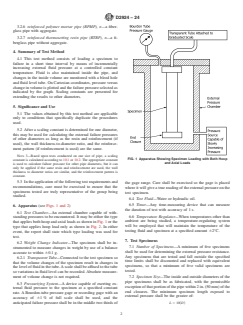
FIG. 1 Apparatus Showing Specimen Loading with Both Hoop
constant is calculated according to 10.1 or 10.2. The appropriate constant
and Axial Loads
is used to calculate failure pressure for other pipe diameters, but it can
only be applied if the same resin and reinforcement are used, the wall
thickness to diameter ratios are similar, and the reinforcement pattern is
constant.
5.3 In the application of the following test requirements and
the gage range. Care shall be exercised so the gage is placed
recommendations, care must be exercised to ensure that the
where it will give a true reading of the external pressure on the
specimens tested are truly representative of the group being
test specimen.
studied.
6.4 Test Fluid—Water or hydraulic oil.
6.5 Timer—Any time-measuring device that can measure
6. Apparatus (see Figs. 1 and 2)
the duration of test with accuracy of 1 s.
6.1 Test Chamber—An external chamber capable of with-
6.6 Temperature Regulator—When temperatures other than
standing pressures to be encountered. It may be either the type
ambient are being studied, a temperature-regulating system
that applies both hoop and axial loads as shown in Fig. 1 or the
will be employed that will maintain the temperature of the
type that applies hoop load only as shown in Fig. 2. In either
testing fluid and specimen at a specified amount 62°C.
event, the report shall state which type loading was used for
test.
7. Test Specimens
6.2 Weight Change Indicator—The specimen shall be in-
7.1 Number of Specimens—A minimum of five specimens
strumented to measure changes in weight by use of a balance
shal
...
This document is not an ASTM standard and is intended only to provide the user of an ASTM standard an indication of what changes have been made to the previous version. Because
it may not be technically possible to adequately depict all changes accurately, ASTM recommends that users consult prior editions as appropriate. In all cases only the current version
of the standard as published by ASTM is to be considered the official document.
Designation: D2924 − 12 (Reapproved 2023) D2924 − 24
Standard Test Method for
External Pressure Resistance of “Fiberglass”
(Glass-Fiber-Reinforced Thermosetting-Resin) Pipe
This standard is issued under the fixed designation D2924; the number immediately following the designation indicates the year of
original adoption or, in the case of revision, the year of last revision. A number in parentheses indicates the year of last reapproval. A
superscript epsilon (´) indicates an editorial change since the last revision or reapproval.
1. Scope
1.1 This test method covers determination of the resistance of fiberglass pipe to external pressure. It classifies failures as buckling,
compressive, and leaking. Both glass-fiber-reinforced thermosetting-resin pipe (RTRP) and glass-fiber-reinforced polymer mortar
pipe (RPMP) are fiberglass pipes.
NOTE 1—For the purposes of this standard, polymer does not include natural polymers.
1.2 The values stated in inch-pound units are to be regarded as standard. The SI units given in parentheses are for information only.
NOTE 2—There is no known ISO equivalent to this standard.
1.3 This standard does not purport to address all of the safety concerns, if any, associated with its use. It is the responsibility
of the user of this standard to establish appropriate safety, health, and environmental practices and determine the applicability of
regulatory limitations prior to use.
1.4 This international standard was developed in accordance with internationally recognized principles on standardization
established in the Decision on Principles for the Development of International Standards, Guides and Recommendations issued
by the World Trade Organization Technical Barriers to Trade (TBT) Committee.
2. Referenced Documents
2.1 ASTM Standards:
C33/C33M Specification for Concrete Aggregates
D618 Practice for Conditioning Plastics for Testing
D883 Terminology Relating to Plastics
D1600 Terminology for Abbreviated Terms Relating to Plastics (Withdrawn 2024)
F412 Terminology Relating to Plastic Piping Systems
3. Terminology
3.1 Definitions:
This test method is under the jurisdiction of ASTM Committee D20 on Plastics and is the direct responsibility of Subcommittee D20.23 on Reinforced Thermosetting
Resin Piping Systems and Chemical Equipment.
Current edition approved Nov. 1, 2023Feb. 1, 2024. Published November 2023February 2024. Originally approved in 1970. Last previous edition approved in 20172023
as D2924 – 12 (2017).(2023). DOI: 10.1520/D2924-12R23.10.1520/D2924-24.
For referenced ASTM standards, visit the ASTM website, www.astm.org, or contact ASTM Customer Service at service@astm.org. For Annual Book of ASTM Standards
volume information, refer to the standard’s Document Summary page on the ASTM website.
The last approved version of this historical standard is referenced on www.astm.org.
*A Summary of Changes section appears at the end of this standard
Copyright © ASTM International, 100 Barr Harbor Drive, PO Box C700, West Conshohocken, PA 19428-2959. United States
D2924 − 24
3.1.1 Definitions are in accordance with Terminology D883 or F412 and abbreviations are in accordance with Terminology D1600,
unless otherwise indicated.
3.2 Definitions of Terms Specific to This Standard:
3.2.1 aggregate, n—a siliceous sand conforming to the requirements of Specification C33/C33M, except that the requirements for
gradation shall not apply.
3.2.2 buckling failure pressure—the external gage pressure at which buckling occurs. Buckling is characterized by a sharp
discontinuity in the pressure-volume change graph and subsequent fracture in the test specimen appearing as an axially oriented
crack. Buckling is an elastic instability type of failure and is normally associated with thin-wall pipe.
3.2.3 compressive failure pressure—the maximum external gage pressure that the specimen will resist without transmission of the
testing fluid through the wall. Compressive failure pressure will not be associated with a sharp discontinuity in the pressure-volume
change graph nor lead to a fracture appearing as a sharp axially oriented crack. It will appear as a fracture which is the result of
reaching the compressive strength limits of the material and is normally associated with thick-wall pipe. Failure is usually
identified by a sudden drop in pressure.
3.2.4 fiberglass pipe, n—a tubular product containing glass fiber reinforcements embedded in or surrounded by cured
thermosetting resin; the composite structure may contain aggregate, granular, or platelet fillers, thixotropic agents, pigments, or
dyes; thermoplastic or thermosetting liners or coatings may be included.
3.2.5 leaking pressure—the external gage pressure at which the test fluid is transmitted through the pipe wall. It is characterized
in this test by continuous volume change indications with no pressure increase.
3.2.6 reinforced polymer mortar pipe (RPMP), n—a fiberglass pipe with aggregate.
3.2.7 reinforced thermosetting resin pipe (RTRP), n—a fiberglass pipe without aggregate.
4. Summary of Test Method
4.1 This test method consists of loading a specimen to failure in a short time interval by means of incrementally increasing external
fluid pressure at a controlled constant temperature. Fluid is also maintained inside the pipe, and changes in the inside volume are
monitored with a bleed hole and fluid level tube. On Cartesian coordinates, pressure versus change in volume is plotted and the
failure pressure selected as indicated by the graph. Scaling constants are presented for extending the results to other diameters.
5. Significance and Use
5.1 The values obtained by this test method are applicable only to conditions that specifically duplicate the procedures used.
5.2 After a scaling constant is determined for one diameter, this may be used for calculating the external failure pressures of other
diameters as long as the resin and reinforcement (if used), the wall thickness-to-diameter ratio, and the reinforcement pattern (if
reinforcement is used) are the same.
NOTE 3—Based upon tests conducted on one size of pipe, a scaling constant is calculated according to 10.1 or 10.2. The appropriate constant is used to
calculate failure pressure for other pipe diameters, but it can only be applied if the same resin and reinforcement are used, the wall thickness to diameter
ratios are similar, and the reinforcement pattern is constant.
5.3 In the application of the following test requirements and recommendations, care must be exercised to ensure that the specimens
tested are truly representative of the group being studied.
6. Apparatus (see Figs. 1 and 2)
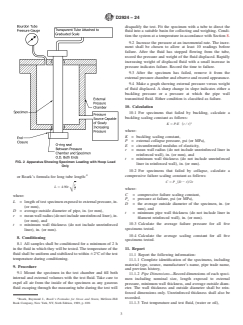
6.1 Test Chamber—An external chamber capable of withstanding pressures to be encountered. It may be either the type that
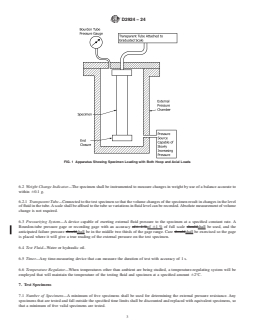
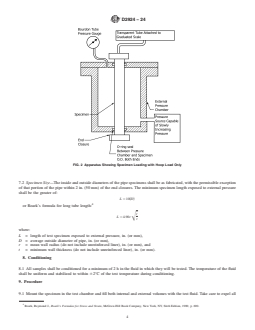
applies both hoop and axial loads as shown in Fig. 1 or the type that applies hoop load only as shown in Fig. 2. In either event,
the report shall state which type loading was used for test.
D2924 − 24
FIG. 1 Apparatus Showing Specimen Loading with Both Hoop and Axial Loads
6.2 Weight Change Indicator—The specimen shall be instrumented to measure changes in weight by use of a balance accurate to
within 60.1 g.
6.2.1 Transparent Tube—Connected to the test specimen so that the volume changes of the specimen result in changes in the level
of fluid in the tube. A scale shall be affixed to the tube so variations in fluid level can be recorded. Absolute measurement of volume
change is not required.
6.3 Pressurizing System—A device capable of exerting external fluid pressure to the specimen at a specified constant rate. A
Bourdon-tube pressure gage or recording gage with an accurac
...