

ASTM F1173-01(2023)
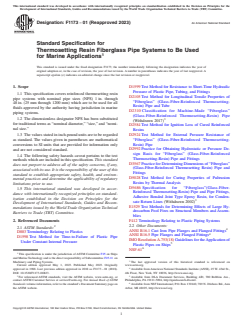
(Specification)Standard Specification for Thermosetting Resin Fiberglass Pipe Systems to Be Used for Marine Applications
General Information
- Abstract
ABSTRACT
This specification covers the classifications of and basic requirements for thermosetting fiberglass reinforced resin pipe systems with nominal pipe sizes (NPS) 1 through 48 in. (25 through 1200 mm) which are to be used for all fluids approved by the authority having jurisdiction in marine piping systems. The piping system shall adhere to specified requirements such as internal and external pressure, fire endurance, flame spread, smoke and other toxic products of combustion, temperature, material compatibility, electrical resistance, static charge shielding, potable water usage, glass content, and wall thickness.
SCOPE
1.1 This specification covers reinforced thermosetting resin pipe systems with nominal pipe sizes (NPS) 1 in. through 48 in. (25 mm through 1200 mm) which are to be used for all fluids approved by the authority having jurisdiction in marine piping systems.
1.2 The dimensionless designator NPS has been substituted for traditional terms as “nominal diameter,” “size,” and “nominal size.”
1.3 The values stated in inch-pound units are to be regarded as standard. The values given in parentheses are mathematical conversions to SI units that are provided for information only and are not considered standard.
1.4 The following safety hazards caveat pertains to the test methods which are included in this specification. This standard does not purport to address all of the safety concerns, if any, associated with its use. It is the responsibility of the user of this standard to establish appropriate safety, health, and environmental practices and determine the applicability of regulatory limitations prior to use.
1.5 This international standard was developed in accordance with internationally recognized principles on standardization established in the Decision on Principles for the Development of International Standards, Guides and Recommendations issued by the World Trade Organization Technical Barriers to Trade (TBT) Committee.
- Status
- Published
- Publication Date
- 30-Apr-2023
- Technical Committee
- F25 - Ships and Marine Technology
- Drafting Committee
- F25.11 - Machinery and Piping Systems
Overview
ASTM F1173-01(2023) is a comprehensive international standard developed by ASTM International for thermosetting resin fiberglass pipe systems designed for marine applications. The specification outlines the requirements for reinforced thermosetting resin pipe systems with nominal pipe sizes (NPS) from 1 inch to 48 inches (25 mm to 1200 mm), providing critical guidance for their use in marine piping systems carrying various fluids approved by the relevant authorities. It addresses key performance factors such as internal and external pressure, fire endurance, flame spread, smoke and toxicity, temperature constraints, material compatibility, electrical conductivity, potable water safety, glass content, and wall thickness.
Key Topics
- Pipe Classification and Types: Defines types of fiberglass pipes (filament wound, centrifugally cast, and molded fittings) and resin materials (epoxy, vinylester, polyester, phenolic, and customer-specified options).
- Pressure and Temperature Ratings: Specifies methods for determining both internal and external pressure ratings suitable for safe marine operation, using short-term and long-term test protocols.
- Fire and Smoke Performance: Outlines testing and classification specific to fire endurance, flame spread, and smoke and toxicity of combustion-meeting requirements for ships and offshore platforms.
- Material and Performance Requirements:
- Glass Content and Wall Thickness: Ensures reliable reinforcement and mechanical integrity.
- Electrical Resistance and Static Charge Shielding: Addresses conductivity for safety, especially in hazardous areas.
- Potable Water Use: Specifies compliance with health safety standards such as NSF-61 and FDA requirements for water-carrying applications.
- Inspection and Quality Assurance: Details rigorous procedures for testing, acceptance criteria, lot sampling, and certification including ISO 9001 quality management requirements.
- Product Marking: Requires clear marking for traceability, including manufacturer details, pressure rating, and date of manufacture.
Applications
ASTM F1173-01(2023) is specifically tailored for marine environments where robust, corrosion-resistant, and fire-safe fiberglass piping is essential. Typical applications include:
- Shipboard Piping Systems: Transporting water, fuel, chemical, and waste across ships, MODUs, and offshore oil and gas platforms.
- Offshore Infrastructure: Used in floating production units and drilling platforms where stringent performance under fire and hazardous conditions is critical.
- Potable Water Lines: Safe for use in systems delivering drinking water when compliant with applicable health standards.
- Hazardous Area Installations: Provides guidance on electrical conductivity to prevent static charge build-up in potentially explosive atmospheres.
The standard supports the design and procurement of piping for both new installations and retrofits, ensuring global compliance and broad acceptance by regulatory bodies.
Related Standards
ASTM F1173-01(2023) references and aligns with several key international and industry standards to ensure a robust framework for fiberglass pipe systems in marine environments. Notable related standards include:
- ASTM D1599, D2105, D2584, D2924, D2992, D3567, D5028: Various methods for testing and classifying fiberglass pipe and fittings.
- ANSI B16.1 and B16.5: Standards for pipe flanges and fittings.
- NSF/ANSI 61: Health effects for drinking water system components.
- IMO Resolutions (A.753(18), MSC.61(67)): International Maritime Organization codes for fire testing and the use of plastic pipes on ships.
- ISO 9001: Specifies quality management requirements for manufacturers.
- CFR Title 46, Part 56, and Subpart 56.60-25: U.S. regulations for nonmetallic piping in marine systems.
These and other referenced documents help ensure that fiberglass marine piping systems meet performance, safety, and regulatory requirements worldwide.
Keywords: ASTM F1173, fiberglass marine piping standard, thermosetting resin pipe, marine fire resistance piping, IMO fire testing, potable water piping, offshore platform piping, pipe pressure ratings, glass reinforced pipe, marine piping standards.
Relations
- Effective Date
- 01-Feb-2024
- Effective Date
- 01-Feb-2024
- Effective Date
- 01-Nov-2023
- Effective Date
- 01-Nov-2023
- Effective Date
- 01-Apr-2020
- Effective Date
- 01-Jan-2020
- Effective Date
- 15-Nov-2019
- Effective Date
- 01-Aug-2019
- Effective Date
- 15-Apr-2019
- Effective Date
- 01-Feb-2019
- Effective Date
- 01-Jan-2019
- Effective Date
- 01-Dec-2018
- Effective Date
- 01-Nov-2018
- Effective Date
- 15-Sep-2018
- Effective Date
- 01-Sep-2018
Get Certified
Connect with accredited certification bodies for this standard

Institut za varilstvo d.o.o. (Welding Institute)
Slovenia's leading welding institute since 1952. ISO 3834, EN 1090, pressure equipment certification, NDT personnel, welder qualification. Only IIW Au
Sponsored listings
Frequently Asked Questions
ASTM F1173-01(2023) is a technical specification published by ASTM International. Its full title is "Standard Specification for Thermosetting Resin Fiberglass Pipe Systems to Be Used for Marine Applications". This standard covers: ABSTRACT This specification covers the classifications of and basic requirements for thermosetting fiberglass reinforced resin pipe systems with nominal pipe sizes (NPS) 1 through 48 in. (25 through 1200 mm) which are to be used for all fluids approved by the authority having jurisdiction in marine piping systems. The piping system shall adhere to specified requirements such as internal and external pressure, fire endurance, flame spread, smoke and other toxic products of combustion, temperature, material compatibility, electrical resistance, static charge shielding, potable water usage, glass content, and wall thickness. SCOPE 1.1 This specification covers reinforced thermosetting resin pipe systems with nominal pipe sizes (NPS) 1 in. through 48 in. (25 mm through 1200 mm) which are to be used for all fluids approved by the authority having jurisdiction in marine piping systems. 1.2 The dimensionless designator NPS has been substituted for traditional terms as “nominal diameter,” “size,” and “nominal size.” 1.3 The values stated in inch-pound units are to be regarded as standard. The values given in parentheses are mathematical conversions to SI units that are provided for information only and are not considered standard. 1.4 The following safety hazards caveat pertains to the test methods which are included in this specification. This standard does not purport to address all of the safety concerns, if any, associated with its use. It is the responsibility of the user of this standard to establish appropriate safety, health, and environmental practices and determine the applicability of regulatory limitations prior to use. 1.5 This international standard was developed in accordance with internationally recognized principles on standardization established in the Decision on Principles for the Development of International Standards, Guides and Recommendations issued by the World Trade Organization Technical Barriers to Trade (TBT) Committee.
ABSTRACT This specification covers the classifications of and basic requirements for thermosetting fiberglass reinforced resin pipe systems with nominal pipe sizes (NPS) 1 through 48 in. (25 through 1200 mm) which are to be used for all fluids approved by the authority having jurisdiction in marine piping systems. The piping system shall adhere to specified requirements such as internal and external pressure, fire endurance, flame spread, smoke and other toxic products of combustion, temperature, material compatibility, electrical resistance, static charge shielding, potable water usage, glass content, and wall thickness. SCOPE 1.1 This specification covers reinforced thermosetting resin pipe systems with nominal pipe sizes (NPS) 1 in. through 48 in. (25 mm through 1200 mm) which are to be used for all fluids approved by the authority having jurisdiction in marine piping systems. 1.2 The dimensionless designator NPS has been substituted for traditional terms as “nominal diameter,” “size,” and “nominal size.” 1.3 The values stated in inch-pound units are to be regarded as standard. The values given in parentheses are mathematical conversions to SI units that are provided for information only and are not considered standard. 1.4 The following safety hazards caveat pertains to the test methods which are included in this specification. This standard does not purport to address all of the safety concerns, if any, associated with its use. It is the responsibility of the user of this standard to establish appropriate safety, health, and environmental practices and determine the applicability of regulatory limitations prior to use. 1.5 This international standard was developed in accordance with internationally recognized principles on standardization established in the Decision on Principles for the Development of International Standards, Guides and Recommendations issued by the World Trade Organization Technical Barriers to Trade (TBT) Committee.
ASTM F1173-01(2023) is classified under the following ICS (International Classification for Standards) categories: 23.040.20 - Plastics pipes. The ICS classification helps identify the subject area and facilitates finding related standards.
ASTM F1173-01(2023) has the following relationships with other standards: It is inter standard links to ASTM D883-24, ASTM D2924-24, ASTM D2924-12(2023), ASTM D883-23, ASTM F412-20, ASTM D883-20, ASTM D2105-01(2019), ASTM D883-19c, ASTM D883-19a, ASTM D883-19, ASTM F412-19, ASTM D883-18a, ASTM D883-18, ASTM D2584-18, ASTM D1599-18. Understanding these relationships helps ensure you are using the most current and applicable version of the standard.
ASTM F1173-01(2023) is available in PDF format for immediate download after purchase. The document can be added to your cart and obtained through the secure checkout process. Digital delivery ensures instant access to the complete standard document.
Standards Content (Sample)
This international standard was developed in accordance with internationally recognized principles on standardization established in the Decision on Principles for the
Development of International Standards, Guides and Recommendations issued by the World Trade Organization Technical Barriers to Trade (TBT) Committee.
Designation: F1173 − 01 (Reapproved 2023) An American National Standard
Standard Specification for
Thermosetting Resin Fiberglass Pipe Systems to Be Used
for Marine Applications
This standard is issued under the fixed designation F1173; the number immediately following the designation indicates the year of
original adoption or, in the case of revision, the year of last revision. A number in parentheses indicates the year of last reapproval. A
superscript epsilon (´) indicates an editorial change since the last revision or reapproval.
1. Scope D1599 Test Method for Resistance to Short-Time Hydraulic
Pressure of Plastic Pipe, Tubing, and Fittings
1.1 This specification covers reinforced thermosetting resin
D2105 Test Method for Longitudinal Tensile Properties of
pipe systems with nominal pipe sizes (NPS) 1 in. through
“Fiberglass” (Glass-Fiber-Reinforced Thermosetting-
48 in. (25 mm through 1200 mm) which are to be used for all
Resin) Pipe and Tube
fluids approved by the authority having jurisdiction in marine
D2310 Classification for Machine-Made “Fiberglass”
piping systems.
(Glass-Fiber-Reinforced Thermosetting-Resin) Pipe
1.2 The dimensionless designator NPS has been substituted
(Withdrawn 2017)
for traditional terms as “nominal diameter,” “size,” and “nomi-
D2584 Test Method for Ignition Loss of Cured Reinforced
nal size.”
Resins
1.3 The values stated in inch-pound units are to be regarded D2924 Test Method for External Pressure Resistance of
“Fiberglass” (Glass-Fiber-Reinforced Thermosetting-
as standard. The values given in parentheses are mathematical
conversions to SI units that are provided for information only Resin) Pipe
D2992 Practice for Obtaining Hydrostatic or Pressure De-
and are not considered standard.
sign Basis for “Fiberglass” (Glass-Fiber-Reinforced
1.4 The following safety hazards caveat pertains to the test
Thermosetting-Resin) Pipe and Fittings
methods which are included in this specification. This standard
D3567 Practice for Determining Dimensions of “Fiberglass”
does not purport to address all of the safety concerns, if any,
(Glass-Fiber-Reinforced Thermosetting Resin) Pipe and
associated with its use. It is the responsibility of the user of this
Fittings
standard to establish appropriate safety, health, and environ-
D5028 Test Method for Curing Properties of Pultrusion
mental practices and determine the applicability of regulatory
Resins by Thermal Analysis
limitations prior to use.
D5686 Specification for “Fiberglass”(Glass-Fiber-
1.5 This international standard was developed in accor-
Reinforced Thermosetting-Resin) Pipe and Pipe Fittings,
dance with internationally recognized principles on standard-
Adhesive Bonded Joint Type Epoxy Resin, for Conden-
ization established in the Decision on Principles for the
sate Return Lines (Withdrawn 2002)
Development of International Standards, Guides and Recom-
E1529 Test Methods for Determining Effects of Large Hy-
mendations issued by the World Trade Organization Technical
drocarbon Pool Fires on Structural Members and Assem-
Barriers to Trade (TBT) Committee.
blies
F412 Terminology Relating to Plastic Piping Systems
2. Referenced Documents
2 2.2 Other Documents:
2.1 ASTM Standards:
ANSI B16.1 Cast Iron Pipe Flanges and Flanged Fittings
D883 Terminology Relating to Plastics
ANSI B16.5 Pipe Flanges and Flanged Fittings
D1598 Test Method for Time-to-Failure of Plastic Pipe
IMO Resolution A.753(18) Guidelines for the Application of
Under Constant Internal Pressure
Plastic Pipes on Ships
NSF-61
This specification is under the jurisdiction of ASTM Committee F25 on Ships
and Marine Technology and is the direct responsibility of Subcommittee F25.11 on
Machinery and Piping Systems. The last approved version of this historical standard is referenced on
Current edition approved May 1, 2023. Published May 2023. Originally www.astm.org.
approved in 1988. Last previous edition approved in 2018 as F1173 – 01 (2018). Available from American National Standards Institute (ANSI), 25 W. 43rd St.,
DOI: 10.1520/F1173-01R23. 4th Floor, New York, NY 10036, http://www.ansi.org.
2 5
For referenced ASTM standards, visit the ASTM website, www.astm.org, or Available from DLA Document Services, Building 4/D, 700 Robbins Ave.,
contact ASTM Customer Service at service@astm.org. For Annual Book of ASTM Philadelphia, PA 19111-5094, http://quicksearch.dla.mil.
Standards volume information, refer to the standard’s Document Summary page on Available from NSF International, P.O. Box 130140, 789 N. Dixboro Rd., Ann
the ASTM website. Arbor, MI 48105, http://www.nsf.org.
Copyright © ASTM International, 100 Barr Harbor Drive, PO Box C700, West Conshohocken, PA 19428-2959. United States
F1173 − 01 (2023)
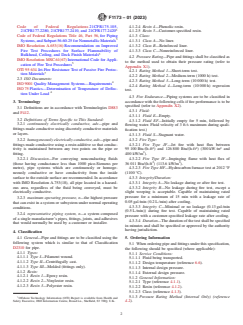
Code of Federal Regulations 21CFR175.105, 4.1.2.4 Resin 4—Phenolic resin.
21CFR177.2280, 21CFR177.2410, and 21CFR177.2420 4.1.2.5 Resin 5—Customer-specified resin.
Code of Federal Regulations Title 46, Part 56, for Piping 4.1.3 Class:
Systems, and Subpart 56.60-25 for Nonmetallic Materials 4.1.3.1 Class A—No liner.
IMO Resolution A.653(16) Recommendation on Improved 4.1.3.2 Class B—Reinforced liner.
Fire Test Procedures for Surface Flammability of 4.1.3.3 Class C—Nonreinforced liner.
Bulkhead, Ceiling, and Deck Finish Materials
4.2 Pressure Rating—Pipe and fittings shall be classified as
IMO Resolution MSC.61(67) International Code for Appli-
to the method used to obtain their pressure rating (refer to
cation of Fire Test Procedures
Appendix X1).
OTI 95 634 Jet-Fire Resistance Test of Passive Fire Protec-
4.2.1 Rating Method 1—Short-term test.
tion Materials
4.2.2 Rating Method 2—Medium-term (1000 h) test.
2.3 ISO Documents:
4.2.3 Rating Method 3—Long-term (10 000 h) test.
ISO 9001 Quality Management Systems—Requirements
4.2.4 Rating Method 4—Long-term (10 000 h) regression
ISO 75 Plastics—Determination of Temperature of Deflec-
test.
tion Under Load
4.3 Fire Endurance—Piping systems are to be classified in
accordance with the following cells if fire performance is to be
3. Terminology
specified (refer to Appendix X2).
3.1 Definitions are in accordance with Terminologies D883
4.3.1 Fluid:
and F412.
4.3.1.1 Fluid E—Empty.
3.2 Definitions of Terms Specific to This Standard:
4.3.1.2 Fluid EF—Initially empty for 5 min, followed by
3.2.1 continuously electrically conductive, adv—pipe and
flowing water. Fluid velocity of 3 ft ⁄s maximum during quali-
fittings made conductive using discretely conductive materials
fication test.)
or layers.
4.3.1.3 Fluid S—Stagnant water.
3.2.2 homogeneously electrically conductive, adv—pipe and 4.3.2 Fire Type:
fittings made conductive using a resin additive so that conduc- 4.3.2.1 Fire Type JF—Jet fire with heat flux between
2 2 2
tivity is maintained between any two points on the pipe or 95 100 Btu ⁄(h-ft ) and 126 800 Btu/(h-ft ) (300 kW ⁄m and
fitting. 400 kW/m ).
3.2.2.1 Discussion—For conveying nonconducting fluids 4.3.2.2 Fire Type IF—Impinging flame with heat flux of
2 2
(those having conductance less than 1000 pico-Siemens per 36 011 Btu/(h-ft ) (113.6 kW/m ).
metre), pipe systems which are continuously or homoge- 4.3.2.3 Fire Type HF—Hydrocarbon furnace test at 2012 °F
(1100 °C).
neously conductive or have conductivity from the inside
surface to the outside surface are recommended. In accordance 4.3.3 Integrity/Duration:
4.3.3.1 Integrity A—No leakage during or after fire test.
with IMO Resolution A.753(18), all pipe located in a hazard-
ous area, regardless of the fluid being conveyed, must be 4.3.3.2 Integrity B—No leakage during fire test, except a
slight weeping is acceptable. Capable of maintaining rated
electrically conductive.
pressure for a minimum of 15 min with a leakage rate of
3.2.3 maximum operating pressure, n—the highest pressure
0.05 gal ⁄min (0.2 L ⁄min) after cooling.
that can exist in a system or subsystem under normal operating
4.3.3.3 Integrity C—Minimal or no leakage (0.13 gal ⁄min
conditions.
(0.5 L ⁄min)) during fire test. Capable of maintaining rated
3.2.4 representative piping system, n—a system composed
pressure with a customer-specified leakage rate after cooling.
of a single manufacturer’s pipes, fittings, joints, and adhesives
4.3.3.4 Duration—The duration of the test shall be specified
that would normally be used by a customer or installer.
in minutes and shall be specified or approved by the authority
having jurisdiction.
4. Classification
5. Ordering Information
4.1 General—Pipe and fittings are to be classified using the
following system which is similar to that of Classification
5.1 When ordering pipe and fittings under this specification,
D2310 for pipe.
the following should be specified (where applicable):
4.1.1 Types:
5.1.1 Service Conditions:
4.1.1.1 Type I—Filament wound.
5.1.1.1 Fluid being transported.
4.1.1.2 Type II—Centrifugally cast.
5.1.1.2 Design temperature (reference 6.6).
4.1.1.3 Type III—Molded (fittings only).
5.1.1.3 Internal design pressure.
4.1.2 Resin:
5.1.1.4 External design pressure.
4.1.2.1 Resin 1—Epoxy resin.
5.1.2 General Information:
4.1.2.2 Resin 2—Vinylester resin.
5.1.2.1 Type (reference 4.1.1).
4.1.2.3 Resin 3—Polyester resin.
5.1.2.2 Resin (reference 4.1.2).
5.1.2.3 Class (reference 4.1.3).
7 5.1.3 Pressure Rating Method (Internal Only) (reference
Offshore Technology Information (OTI) Report is available from Health and
Safety Executive, HSE Information Centre, Broad Ln., Sheffield, S3 7HQ, U.K. 4.2).
F1173 − 01 (2023)
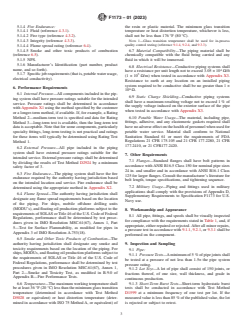
5.1.4 Fire Endurance: the resin or plastic material. The minimum glass transition
5.1.4.1 Fluid (reference 4.3.1). temperature or heat distortion temperature, whichever is less,
5.1.4.2 Fire type (reference 4.3.2). shall not be less than 176 °F (80 °C).
NOTE 1—Glass transition temperature shall be used for in-process
5.1.4.3 Integrity (reference 4.3.3).
quality control testing (reference 9.1.4, 9.2.4, and 9.3.3).
5.1.4.4 Flame spread rating (reference 6.4).
5.1.4.5 Smoke and other toxic products of combustion 6.7 Material Compatibility—The piping material shall be
(reference 6.5). chemically compatible with the fluid being carried and any
5.1.5 NPS. fluid in which it will be immersed.
5.1.6 Manufacturer’s Identification (part number, product
6.8 Electrical Resistance—Conductive piping systems shall
name, and so forth).
have a resistance per unit length not to exceed 3.05 × 10 Ω/ft
5.1.7 Specific job requirements (that is, potable water usage, 5
(1 × 10 Ω/m) when tested in accordance with Appendix X3.
electrical conductivity).
Resistance to earth at any location on an installed piping
system required to be conductive shall be no greater than 1 ×
6. Performance Requirements
10 Ω.
6.1 Internal Pressure—All components included in the pip-
6.9 Static Charge Shielding—Conductive piping systems
ing system shall have pressure ratings suitable for the intended
shall have a maximum resulting voltage not to exceed 1 % of
service. Pressure ratings shall be determined in accordance
the supply voltage induced on the exterior surface of the pipe
with Appendix X1 using the method specified by the customer
when tested in accordance with Appendix X3.
or a longer-term method, if available. If, for example, a Rating
6.10 Potable Water Usage—The material, including pipe,
Method 2—medium-term test is specified and data for Rating
fittings, adhesive, and any elastomeric gaskets required shall
Method 3—long-term test is available, then the long-term test
have no adverse effect on the health of personnel when used for
data is acceptable. Note that for some components, particularly
potable water service. Material shall conform to National
specialty fittings, long-term testing is not practical and ratings
for these items will typically be determined using Rating Test Sanitation Standard 61 or meet the requirements of FDA
Regulations 21 CFR 175.105 and 21 CFR 177.2280, 21 CFR
Method 1.
177.2410, or 21 CFR177.2420.
6.2 External Pressure—All pipe included in the piping
system shall have external pressure ratings suitable for the
7. Other Requirements
intended service. External pressure ratings shall be determined
7.1 Flanges—Standard flanges shall have bolt patterns in
by dividing the results of Test Method D2924 by a minimum
accordance with ANSI B16.5 Class 150 for nominal pipe sizes
safety factor of 3.
24 in. and smaller and in accordance with ANSI B16.1 Class
6.3 Fire Endurance—The piping system shall have the fire
125 for larger flanges. Consult the manufacturer’s literature for
endurance required by the authority having jurisdiction based
bolt length, torque specifications, and tightening sequence.
on the intended location and service. Fire endurance shall be
7.2 Military Usage—Piping and fittings used in military
determined using the appropriate method in Appendix X2.
applications shall comply with the provisions of Appendix D,
6.4 Flame Spread—The authority having jurisdiction shall
Supplementary Requirements to Specification F1173 for U.S.
designate any flame spread requirements based on the location
Navy use.
of the piping. For ships, mobile offshore drilling units
(MODU’s), and floating oil production platforms subject to the
8. Workmanship and Appearance
requirements of SOLAS or Title 46 of the U.S. Code of Federal
8.1 All pipe, fittings, and spools shall be visually inspected
Regulations, performance shall be determined by test proce-
for compliance with the requirements stated in Table 1, and, if
dures given in IMO Resolution MSC.61(67), Annex 1, Part
appropriate, either repaired or rejected. After all minor repairs,
5—Test for Surface Flammability, as modified for pipes in
a pressure test in accordance with 9.1.1, 9.2.1, or 9.3.1 shall be
Appendix 3 of IMO Resolution A.753(18).
performed on the component.
6.5 Smoke and Other Toxic Products of Combustion—The
authority having jurisdiction shall designate any smoke and 9. Inspection and Sampling
toxicity requirements based on the location of the piping. For
9.1 Pipe:
ships, MODUs, and floating oil production platforms subject to
9.1.1 Pressure Tests—A minimum of 5 % of pipe joints shall
the requirements of SOLAS or Title 46 of the U.S. Code of
be tested at a pressure of not less than 1.5× the pipe system
Federal Regulations, performance shall be determined by test
pressure rating.
procedures given in IMO Resolution MSC.61(67), Annex 1,
9.1.2 Lot Size—A lot of pipe shall consist of 150 joints, or
Part 2—Smoke and Toxicity Test, as modified in B.9.0 of
fractions thereof, of one size, wall thickness, and grade in
Appendix B—Fire Performance Tests.
continuous production.
6.6 Temperature—The maximum working temperature shall 9.1.3 Short-Term Burst Tests—Short-term hydrostatic burst
be at least 36 °F (20 °C) less than the minimum glass transition tests shall be conducted in accordance with Test Method
temperature (determined in accordance with Test Method D1599 at a minimum frequency of one test per lot. If the
D5028 or equivalent) or heat distortion temperature (deter- measured value is less than 85 % of the published value, the lot
mined in accordance with ISO 75 Method A, or equivalent) of is rejected or subject to retest.
F1173 − 01 (2023)
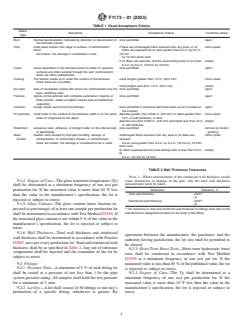
TABLE 1 Visual Acceptance Criteria
Defect
Description Acceptance Criteria Corrective Action
Type
Burn thermal decomposition indicated by distortion or discoloration of none permitted reject
the laminate surface
Chip small piece broken from edge or surface—if reinforcement if there are undamaged fibers exposed over any area; or no minor repair
fibers fibers are exposed but an area greater than 0.4 in. by 0.4 in.
are broken, the damage is considered a crack (10 mm
by 10 mm) lacks resin
if no fibers are exposed, and the area lacking resin is less than accept
0.4 in. by 0.4 in. (10 mm by 10 mm)
Crack actual separation of the laminate which is visible on opposite none permitted reject
surfaces and often extends through the wall; reinforcement
fibers are often visible/broken
Crazing fine hairline cracks at or under the surface of the laminate; crack lengths greater than 1.0 in. (25.4 mm) minor repair
white areas are not visible
crack lengths less than 1.0 in. (25.4 mm) accept
Dry spot area of incomplete surface film where the reinforcement has not none permitted reject
been wetted by resin
Fracture rupture of the laminate with complete penetration; majority of none permitted reject
fibers broken; visible as lighter colored area of interlaminar
separation
Inclusion foreign matter wound into the laminate none permitted in structural wall (treat same as pit if located at reject
the surface)
Pit (pinhole) small crater in the surface of the laminate; width is on the same diameter greater than 0.032 in. (0.8 mm) or depth greater than minor repair
order of magnitude as the depth 10 % of wall thickness, or both
diameter less than 0.032 in. (0.8 mm) and depth less than 10 % accept
of wall thickness
Restriction excessive resin, adhesive, or foreign matter on the internal wall none permitted remove by careful
of pipe/fittings grinding
Wear shallow mark caused by improper handling, storage, or undamaged fibers exposed over any area or no fibers are minor repair
scratch transportation, or combination thereof—if reinforcement exposed
fibers are broken, the damage is considered to be a crack but an area greater than 0.4 in. by 0.4 in. (10 mm by 10 mm)
lacks resin
no fibers exposed and the area lacking resin is less than 0.4 in. accept
by
0.4 in. (10 mm by 10 mm)
TABLE 2 Wall Thickness Tolerances
NOTE 1—Where measurement of the reinforced wall thickness would
9.1.4 Degree of Cure—The glass transition temperature (Tg) cause destruction or damage to the part, only the total wall thickness
measurement need be taken.
shall be determined at a minimum frequency of one test per
Dimension Tolerance, %
production lot. If the measured value is more than 10 °F less
A
Total wall thickness +22.5
than the value in the manufacturer’s specification, the lot is
−0
rejected or subject to retest. A
Reinforced wall thickness +22.5
−0
9.1.5 Glass Content—The glass content (mass fraction ex-
A
pressed as percentage) of at least one sample per production lot The tolerance on total and reinforced wall thickness for fittings shall refer to the
manufacturer’s designated location on the body of the fitting.
shall be determined in accordance with Test Method D2584. If
the measured glass content is not within 5 % of the value in the
manufacturer’s specification, the lot is rejected or subject to
retest.
9.1.6 Wall Thickness—Total wall thickness and reinforced
agreement between the manufacturer, the purchaser, and the
wall thickness shall be determined in accordance with Practice
authority having jurisdiction, the lot size shall be permitted to
D3567 once per every production lot. Total and reinforced wall
be altered.
thickness shall be as specified in Table 2. Any out of tolerance
9.2.3 Short-Term Burst Tests—Short-term hydrostatic burst
components shall be rejected and the remainder of the lot be
tests shall be conducted in accordance with Test Method
subject to retest.
D1599 at a minimum frequency of one test per lot. If the
9.2 Fittings: measured value is less than 85 % of the published value, the lot
9.2.1 Pressure Tests—A minimum of 5 % of each fitting lot
is rejected or subject to retest.
shall be tested at a pressure of not less than 1.5× the pipe 9.2.4 Degree of Cure—The Tg shall be determined at a
system pressure rating. All samples shall hold the test pressure
minimum frequency of one test per production lot. If the
for a minimum of 2 min. measured value is more than 10 °F less than the value in the
9.2.2 Lot Size—A lot shall consist of 50 fittings or one day’s manufacturer’s specification, the lot is rejected or subject to
production of a specific fitting, whichever is greater. By retest.
F1173 − 01 (2023)
9.2.5 Glass Content—The glass content (mass fraction ex- 9.4 Retest—If any test result in 9.1, 9.2, or 9.3, or combi-
pressed as percentage) of at least one sample per production lot nation thereof, fails to conform to the specified requirements,
shall be determined in accordance with Test Method D2584. If
the manufacturer shall be permitted to elect to reject the entire
the measured glass content is not within 5 % of the value in the lot, or retest two additional samples from the same lot. If both
manufacturer’s specification, the lot is rejected or subject to
of the retest specimens conform to the requirements, all items
retest.
in the lot shall be accepted except the sample which initially
9.2.6 Wall Thickness—Total wall thickness and reinforced
failed. If one or both of the retest samples fail to conform to the
wall thickness shall be determined in accordance with Practice
specified requirements, the manufacturer shall reject the entire
D3567 once per every production lot. Total and reinforced wall
lot or test individually the remaining samples in the lot in
thickness shall be as specified in Table 2. Any out of tolerance
accordance with 9.1.1, 9.2.1, or 9.3.1, as applicable. Note that
components shall be rejected.
in the final case, all samples need only be subjected to the tests
that the original samples failed.
9.3 Flanges and Mitered Fittings:
9.3.1 Pressure Tests—One mitered fitting from each lot shall
9.5 Production Quality Documentation—The manufacturer
be tested to a pressure equal to or greater than 1.5× the pipe
shall have manufacturing procedures for each component to be
system rating. All samples shall hold the pressure for a
supplied, raw material test certificates for each component to
minimum of 2 min.
be used in manufacturing, and production quality control
9.3.2 Lot Size—A lot shall consist of 20 flanges or 10
reports available for the procurement officer.
mitered fittings of any given configuration.
9.3.3 Degree of Cure—The Tg shall be determined at a
10. Certification
minimum frequency of one test per production lot. If the
10.1 The pipe manufacturer shall be registered by an ac-
measured value is more than 10 °F less than the value in the
manufacturer’s specification, the lot is rejected or subject to credited agency to meet the requirements of ISO 9001. For
purposes of this specification, the manufacture shall be con-
retest.
9.3.4 Glass Content—The glass content (mass fraction ex- sidered a “special process” as defined in ISO 9001, Section 4.9.
pressed as percentage) of at least one sample per production lot
shall be determined in accordance with Test Method D2584. If
11. Product Marking
the measured glass content is not within 5 % of the value in the
11.1 Pipe and fittings shall be marked with the name, brand,
manufacturer’s specification, the lot is rejected or subject to
or trademark of the manufacturer; NPS; manufacture date;
retest.
pressure rating; pressure rating method; and other information
9.3.5 Wall Thickness—Total wall thickness and reinforced
upon agreement between the manufacturer and the purchaser.
wall thickness shall be determined in accordance with Practice
D3567 once per every production lot. Total and reinforced wall
12. Keywords
thickness shall be as specified in Table 2. Any out-of-tolerance
components shall be rejected and the remainder of the lot be 12.1 epoxy resin fittings; epoxy resin pipe; marine piping;
subject to retest. nominal pipe size; thermoset epoxy resin pipe
APPENDIXES
(Nonmandatory Information)
X1. DETERMINATION OF INTERNAL PRESSURE RATING FOR PIPE, FITTINGS, AND JOINTS
X1.1 Internal pressure rating for a piping system shall be X1.1.2 Rating Method 2—Medium-Term (1000 h) Test—
determined using one of four methods. The method used to Two samples of each pipe, joint, fitting, or other component are
determine this rating shall be clearly identified by the manu- to be tested in accordance with Test Method D1598 for a period
facturer in published literature. of 1000 h at the rated temperature. Both specimens must
survive the exposure period without leakage. The maximum
X1.1.1 Rating Method 1—Short-Term Test Method—Two
rating for mitered (hand lay-up) fittings shall be determined by
samples of each pipe, joint, fitting, or other component shall be
dividing the test pressure by a safety factor of 2.5. The
tested in accordance with Test Method D1599 at ambient
maximum rating for all other components shall be determined
temperature. The maximum rating for mitered (hand lay-up)
by dividing the test pressure by a safety factor of 2.2.
fittings shall be determined by dividing the lesser result by a
safety factor of 5.0. The maximum rating for all other compo- X1.1.3 Rating Method 3—Long-Term (10 000 h) Test—Two
nents shall be determined by dividing the lesser result by a samples of each pipe, joint, fitting or other component are to be
safety factor of 4.0. tested in accordance with Test Method D1598 for a period of
F1173 − 01 (2023)
10 000 h at the rated temperature. Both specimens must survive a factor of 1.5. Scaling of the results is allowed for pipe bodies
the exposure period without leakage. The maximum rating for only in accordance with the ISO equation:
mitered (hand lay-up) fittings shall be determined by dividing
S × SF 5 P D 2 t /2t (X1.1)
~ !
r r
the test pressure by a safety factor of 2.0. The maximum rating
where:
for all other components shall be determined by dividing the
S = hoop stress, psi (kPa),
test pressure by a safety factor of 1.87.
SF = service factor,
X1.1.4 Rating Method 4—Long-Term (10 000 h) Regression D = mean reinforced diameter (OD − t) or (ID + t), in.
(mm),
Test—Pipe, fittings, and joints shall be tested in accordance
P = internal pressure psig (kPa), and
with Practice D2992 Procedure B at the rated temperature. The
t = minimum reinforced wall thickness, in. (mm).
r
pressure rating for all components shall be determined in
NOTE X1.1—Liner thickness is not to be used in determining inside
accordance with the hydrostatic design basis (HDB) and lower
diameter.
confidence limit (LCL) as calculated in the test method.
NOTE X1.2—Coating thickness is not to be used in determining outside
Ratings shall be determined by dividing the LCL at 20 years by diameter.
X2. FIRE PERFORMANCE TESTS
X2.1 Fire performance tests shall be performed at an inde- and tees need not be tested provided the same adhesive or
pendent third-party laboratory to the satisfaction of the author- method of joining utilized in straight piping tests will be used
ity having jurisdiction. in the actual application.
X2.4.2 Qualification of piping systems of sizes different
X2.2 Piping Material Systems:
than those tested shall be allowed as provided for in Table
X2.2.1 All fire endurance, flame spread, and smoke and X2.1. This applies to all pipe, fittings, system joints (including
joints between metal and fiberglass pipes and fittings), methods
toxicity testing, where required, shall be conducted on each
piping material system. of joining, and any internal or external liners, coverings, and
coatings required to comply with the performance criteria.
X2.2.2 Changes in either the type, amount, or architecture,
or combination thereof, of either the reinforcement materials, X2.4.3 No alterations to couplings, fittings, joints, fasteners,
resin matrix, liners, coatings, or manufacturing processes shall insulation, or other components shall be made after the
require separate testing in accordance with the requirements of commencement of the fire endurance testing. Flange bolts shall
this specification. not be retorqued after completion of the fire exposure testing,
before hydrostatic testing. Postfire hydrostatic testing shall be
conducted without altering the component in any way.
X2.3 Fire-Protective Coatings:
X2.3.1 Where a fire-protective coating is necessary for
X2.5 Fire Type JF–Jet Fire—This test is based upon Health
achieving the fire endurance, flame spread, or smoke and
& Safety Executive document OTI 95 634, except that is
toxicity criteria, the following requirements apply:
modified so that actual pipe, joints, and fittings are exposed to
X2.3.1.1 Pipes shall be delivered from the manufacturer
the flame.
with the protective coating on. On site application will be
X2.5.1 Equipment:
limited to what is physically necessary for installation (that is,
X2.5.1.1 A propane vaporization and propulsion system
joints).
capable of delivering 0.66 lb ⁄s 6 0.11 lb ⁄s (0.3 kg ⁄s 6
X2.3.1.2 The fire-protection properties (that is, fire
0.05 kg ⁄s) flow under controlled conditions into a backing
endurance, flame spread, smoke production, and so forth) of
“box” which has the test specimen mounted at the box’s front
the coating shall not be diminished when exposed to (1) salt
opening. The nozzle shall be a tapered, converging type,
water, oil, or bilge slops, (2) other environmental conditions
7.875 in. (200 mm) in length with an inlet diameter of 2.0 in.
such as high and low temperatures, high and low humidity, and
(52 mm) and an outlet diameter of 0.70 in. (17.8 mm). The
ultraviolet rays, or (3) vibration.
nozzle is to be located 3.281 ft (1.0 m) from the front of the
X2.3.1.3 The adhesion qualities of the coating shall be such
that the coating does not flake, chip, or powder, when subject
to an adhesion test.
TABLE X2.1 Qualification of Piping Systems of Different Sizes
X2.3.1.4 The fire-protective coating shall be resistant to
Size Tested [NPS], Minimum Size Maximum Size
impact and abrasion. It shall not be separated from the piping
in. (mm) Approved, Approved,
in. (mm) in. (mm)
during normal handling.
0 to 1.5 (0 to 40) size tested size tested
2 to 4 (50 to 100) size tested 4 (100)
X2.4 General Fire Endurance Test Requirements:
5 to 10 (125 to 250) size tested 10 (250)
12 to 22 (300 to 550) size tested 22 (550)
X2.4.1 All typical joints, including but not limited to pipe to
24 to 34 (600 to 850) size tested 34 (850)
pipe, fiberglass flange to fiberglass flange, and fiberglass flange
36 to 48 (900 to 1200) size tested 48 (1200)
to metallic flange intended to be used shall be tested. Elbows
F1173 − 01 (2023)
box, centered across the box, and mounted horizontally be- X2.5.4.3 It is acceptable to start the test using a small
tween 15 in. (375 mm) and 30 in. (750 mm) from the bottom of “pilot” flame to ensure safe ignition of the fuel before full flow
the box. The flow shall directly impinge on the test specimen. being established.
X2.5.4.4 Increase the flow to the rate as specified in
X2.5.1.2 Water-handling and timing equipment suitable for
X2.5.1.1. This rate has been shown to produce a heat flux
delivering sufficient quantities of water to produce a fluid
2 2
between 95 100 Btu ⁄(h-ft ) and 126 800 Btu ⁄(h-ft )
velocity of 3 ft/s (0.91 m/s) at the rated pressure of the piping
2 2
(300 kW ⁄m and 400 kW ⁄m ). Timing of the test is to begin
system being tested.
when the specimen is fully engulfed. Establish fully controlled
X2.5.1.3 Instrumentation to record fuel flow rate, water
flow within 30 s of the start of the test.
flow rate, temperatures in the specimen and in various loca-
X2.5.4.5 If Fluid E or S is specified in 4.3.1, then continue
tions in the backing panel, and water leakage rate from the pipe
the test for a minimum of 20 min under the initial conditions.
assembly or individual components.
X2.5.4.6 If Fluid EF in 4.3.1 is specified, take the following
X2.5.2 Test Specimen—The test specimen shall be prepared
steps:
with the joints, fittings, and fire-protection coverings, if any,
(1) Continue the test in the dry condition for 5 min.
intended for use in the proposed application. It is up to the
(2) After the 5 min dry period, introduce water at a flow
authority having jurisdiction to determine the number and size
velocity not to exceed 3.0 ft/s. Pressure in the system is to be
of test specimens, as well as requirements for the qualification
maintained at a minimum of 90 % of the rated pressure for the
of a range of pipe diameters.
system. These conditions are to be established within 1 min
after the flow of water begins.
X2.5.3 Test Conditions:
(3) Continue the test under flowing water conditions for a
X2.5.3.1 If fire-protective coatings or coverings contain or
minimum of 15 min.
are liable to absorb moisture, the test specimen shall not be
X2.5.4.7 Increased exposure times over those previously
tested until the insulation has reached an air-dry condition. This
specified are acceptable upon agreement between the manu-
condition is defined as equilibrium with an ambient tempera-
facturer and the buyer.
ture at 50 % relative humidity of 70 °F 6 10 °F (20 °C 6
X2.5.4.8 Upon completion of the fire exposure period,
5 °C). Where fire-protective coatings or coverings are required
discontinue the fuel flow, extinguish the flame, and allow the
to enable a pipe system to pass a fire endurance test, the
sample to cool (with flowing water, if desired) to room
coatings’ or coverings’ properties should not degrade over time
temperature.
or due to exposure to the environment as discussed in IMO
X2.5.4.9 After cooling, pressurize the specimen at it’s rated
FTP Code Res A.753(18) Paragraph 2.2.6, or both.
pressure for a minimum of 15 min with stagnant water
X2.5.3.2 The test specimen shall be planar and shall be
(make-up water is allowed). Measure overall leakage and
mounted flush to the opening of a 5 ft by 5 ft (1.5 m by 1.5 m)
leakage of each component and record after this period.
open-ended, steel box (closed back panel with a depth of
X2.5.5 Acceptance Criteria—Piping shall be deemed to
1.64 ft (0.5 m). Suitable auxiliary equipment shall be attached
have passed the test if the performance meets the criteria set by
to the box to ensure the box’s structural stability and to prevent
the authority having jurisdiction regarding integrity and dura-
any transient ambient conditions from significantly affecting
tion in 4.3.3. If no criteria is established, a maximum leakage
the testing. The purpose of the box is to provide a “backstop”
of 10 % of the rated flow will be used as the default limit.
to the flame and cause swirling of the fire to completely engulf
the sample.
X2.5.6 Report—Report the following information:
X2.5.3.3 If required to record temperature conditions during X2.5.6.1 Complete identification of the pipe or fitting tested
testing, mount thermocouples on the specimen and within the
including the manufacturer’s name and code.
box or its structure. X2.5.6.2 Description of fire-protective coating, if appli-
cable.
X2.5.3.4 The test building shall be suitably constructed to
X2.5.6.3 Diameter of pipe, fitting, or joint.
ensure there is not a hazardous amount of heat or smoke
X2.5.6.4 Endurance time.
allowed to accumulate during or after the test.
X2.5.6.5 Appearance of test specimen.
X2.5.3.5 Before conducting the test, calibration runs of the
X2.5.6.6 Date of test.
gas flow controls and water flow system shall be conducted.
X2.5.6.7 Leakage rate.
X2.5.3.6 Fuel used shall be commercial grade propane
delivered to the nozzle as a vapor without a liquid fraction.
X2.6 Fire Type HF–Hydrocarbon Furnace Test Method—
This test method covers the determination of the fire endurance
X2.5.4 Test Procedure:
of thermosetting resin fiberglass pipe, fittings, and joints to be
X2.5.4.1 Pressure test each test specimen to 1.5× its rated
used in marine applications. The procedure in Test Method
pressure prior to mounting in the test rig. No leakage is allowed
E1529 with additional steps as outlined shall be followed. This
during this test.
procedure is similar to IMO Assembly Resolution A.753(18),
X2.5.4.2 Unless Fluid S is specified, completely drain the
Appendix 1, which is an alternative to this test.
specimen of water after the initial test and secure into position.
Make all thermocouple and plumbing connections at this time. X2.6.1 Significance—This test method is intended to pro-
For Fluid S conditions, secure the specimen into position filled vide a basis for evaluating the time period during which
with water. fiberglass pipe will continue to perform its intended function
F1173 − 01 (2023)
when subjected to a controlled, standardized fire exposure. In X2.6.4 Procedure:
particular, the standard exposure condition of Test Method X2.6.4.1 Measure the dimensions of the specimen in accor-
E1529 simulates the condition of total continuous engulfment dance with Practice D3567. Include measurements of liner
of a pipe or piping system in the luminous flame (fire plume) thickness and external coatings, if applicable.
area of a large, free-burning hydrocarbon pool fire. The X2.6.4.2 Place specimen in the furnace.
standard fire exposure is defined in terms of the total flux X2.6.4.3 Pressurize specimens to be tested with Fluid E
incident on the test specimen together with the appropriate with nitrogen maintaining the pressure in accordance with
temperature conditions. X2.6.3.10. Specimens to be tested with Fluid EF shall be
initially filled with ambient air for 5 min and then with water
X2.6.2 Test Equipment:
flowing with a maximum velocity of 3 ft/s and 44 psi 6 7 psi
X2.6.2.1 Furnace—The setup and control of the test shall be
(3 bar 6 0.5 bar). Specimens to be tested with Fluid S shall be
as specified in Sections 6 through 11 of Test Method E1529.
filled with water at 44 psi 6 7 psi (3 bar 6 0.5 bar).
X2.6.2.2 Nitrogen tank with regulator or water circulating
X2.6.4.4 Subject the piping or piping system to the fire
system with flow meters.
exposure specified in Section 6 of Test Method E1529 for the
X2.6.3 Test Specimen: time specified by the authority having jurisdiction.
X2.6.4.5 After termination of the furnace test, allow the
X2.6.3.1 If fire-protective coatings or coverings contain or
specimen, together with any fire-protective coating, to cool in
are liable to absorb moisture, the test specimen shall not be
still air to ambient temperature and then test to the rated
tested until the insulation has reached an air-dry condition. This
pressure for 15 min.
condition is defined as equilibrium with an ambient tempera-
ture at 50 % relative humidity of 70 °F 6 10 °F (20 °C 6
X2.6.5 Acceptance Criteria—Pipe shall be deemed to pass
5 °C). Where fire-protective coatings or coverings are required
the test if the performance meets the customer specified
to enable a pipe system to pass a fire endurance test, the
integrity/duration in 4.3.3. Note that, to meet IMO A753(18),
coatings or coverings properties should not degrade over time
Level 1 or Level 2 requirements, Fluid E shall be tested and
or due to exposure to the environment as discussed in IMO
there shall be no nitrogen leakage during the test or water
FTP Code Res A.753(18) Paragraph 2.2.6, or both.
leakage during the hydrotest in X2.6.4.5. For Level 1 or Level
X2.6.3.2 Accelerated conditioning is permissible provided
2, the duration of the test is 60 min or 30 min, respectively.
the test method does not alter the properties of component
X2.6.6 Report—Report the following information:
materials.
X2.6.6.1 Complete identification of the pipe or fitting tested
X2.6.3.3 Special samples shall be used for moisture content
including manufacturer’s name and code.
determination and conditioned with the test specimen. Con-
X2.6.6.2 Description of fire-protective coating, if appli-
struct these samples in such a way as to represent the loss of
cable.
water vapor from the specimen by having similar thickness and
X2.6.6.3 Diameter of pipe, fitting, or joint.
exposed faces.
X2.6.6.4 Endurance time.
X2.6.3.4 Prepare the test specimen with the joints, fittings,
X2.6.6.5 Appearance of test specimen.
and fire-protection coverings, if any, intended for use in the
X2.6.6.6 Date of test.
proposed application.
X2.6.3.5 The number of specimens shall be sufficient to test
X2.7 Fire Type IF–Impinging Flame:
typical joints as noted in X2.4.1.
X2.7.1 Scope—This test method covers the determination of
X2.6.3.6 For specimens to be tested using Fluid E, the ends
the fire endurance of thermosetting resin fiberglass pipe,
of the specimen shall be closed with one end allowing
fittings, and joints to be used in marine applications. This test
pressurized nitrogen to be connected. Specimens to be tested
procedure is based on the IMO Assembly Resolution
with Fluid EF and S shall have both ends closed with means to
A.753(18) Appendix 2, which is an alternate procedure.
connect the water supply.
X2.7.2 Summary of Test Method—This test method subjects
X2.6.3.7 It is permissible for the pipe ends and closures to
2 2
a pipe sample to a constant 36 011-Btu ⁄(h-ft ) (113.6-kW/m )
be outside the furnace.
net flux to determine a pipe systems fire-endurance.
X2.6.3.8 The general orientation of the specimen shall be
horizontal and it shall be supported by one fixed support.
X2.7.3 Test Equipment:
Remaining supports shall allow free movement.
X2.7.3.1 Sievert No. 2942 Burner or Equivalent, which
X2.6.3.9 Special samples shall be used for moisture content
produces an air mixed flame. Propane with a minimum purity
determination and conditioned with the test specimen. Con-
of 95 % should be used.
struct these samples so as to represent the loss of water vapor
(1) The inner diameter of the burner heads shall be 1.14 in.
from the specimen by having similar thickness and exposed
(29 mm).
faces.
(2) The burner heads shall be mounted in the same plane
X2.6.3.10 When testing with Fluid E, nitrogen pressure and supplied with gas from a manifold (see Fig. X2.1).
inside the test specimen shall be maintained automatically at (3) Each burner shall be equipped with a valve, if
10.1 psi 6 1.5 psi (0.7 bar 6 0.1 bar) during the test. Means necessary, to adjust the flame height.
shall be provided to record the pressure inside the pipe and the (4) It is acceptable to use a burner stand or pipe supports
nitrogen flow into and out of the specimen to indicate leakage. with an adjustable height.
F1173 − 01 (2023)
FIG. X2.1 Basic Layout of a Jet Fire Test
(5) The distance between the burner heads and the pipe X2.7.5.3 Special samples shall be used for moisture content
shall be maintained at 5 in. 6 ⁄8 in. (125 mm 6 10 mm) during determination and conditioned with the test specimen. Con-
the test. struct these samples so as to represent the loss of water vapor
(6) The free length of pipe between supports shall be from the specimen by having similar thickness and exposed
31.5 in. 6 2 in. (800 mm 6 50 mm). faces.
X2.7.3.2 Thermocouples—Two thermocouples capable of
X2.7.5.4 The test shall be carried out in a sheltered test site
measuring up to 2012 ºF (1100 ºC).
to prevent any draft from influencing the test.
X2.7.3.3 Water.
X2.7.5.5 Specimens to be tested with Fluid E shall be
X2.7.3.4 Thermometer, to measure internal water tempera-
pressurized with nitrogen maintaining the pressure in accor-
ture.
dance with Appendix X2. Specimens to be tested with Fluid EF
X2.7.3.5 Pressure Gage, which is capable of reading up to
shall be initially filled with ambient air for 5 min and then with
73 psi (5 bar) 6 5 %.
water flowing with a maximum velocity of 3 ft/s and 44 psi 6
X2.7.3.6 V-shaped Pipe Supports, two.
7 psi (3 bar 6 0.5 bar). Specimens to be tested with Fluid S
shall be filled with water at 44 psi 6 7 psi (3 bar 6 0.5 bar).
X2.7.4 Test Specimen:
X2.7.4.1 The test specimen shall be 59 in. (1.5 m) long.
X2.7.5.6 The water temperature when testing with Fluids S
X2.7.4.2 Pipe with permanent joints or fittings intended for
and EF shall not be less than 59 °F (15 °C) at the start of the
use in marine applications shall be used in the specimen.
test and shall be measured at a maximum of 5 min intervals
X2.7.4.3 All joint types shall be tested as noted in X2.4.1.
during the test.
X2.7.4.4 The quantity of pipe specimens shall be sufficient
X2.7.5.7 Flame Temperature:
to test all typical joints and fittings.
(1) The exterior flame temperature shall be measured by
X2.7.4.5 A pressure relief valve shall be connected to one of
means of two thermocouples mounted not more than 1 in.
the end closures of the system.
(25 mm) from the pipe near the center span of the assembly.
(2) The thermocouples shall be mounted on the horizontal
X2.7.5 Test Conditions:
plane at the level of the pipe.
X2.7.5.1 If fire-protective coatings or coverings contain or
(3) The test temperature shall be taken as the average of the
are liable to absorb moisture, the test specimen shall not be
two thermocouple readings.
tested until the insulation has reached an air-dry condition. This
condition is defined as equilibrium with an ambient tempera-
X2.7.6 Procedure:
ture at 50 % relative humidity of 70 °F 6 10
...