

ASTM D2105-01(2019)
(Test Method)Standard Test Method for Longitudinal Tensile Properties of “Fiberglass” (Glass-Fiber-Reinforced Thermosetting-Resin) Pipe and Tube
General Information
- Abstract
SIGNIFICANCE AND USE
4.1 Tensile properties include modulus of elasticity, yield stress, elongation beyond yield point, tensile strength, elongation at break, and energy absorption. Materials possessing a low order of ductility may not exhibit a yield point. Stress-strain data at several levels of temperature, humidity, time, or other variables may be needed to furnish reasonably accurate indications of the behavior of the material.
4.2 Tension tests may provide data for research and development, engineering design, quality control, acceptance or rejection under specifications, and for special purposes (Note 3). The tests cannot be considered significant for applications differing widely from the load-time scale of the standard test (Note 4). Such applications require more suitable tests, such as impact, creep, and fatigue.
Note 3: It is realized that the method of preparation of a material is one of the many variables that affect the results obtained in testing a material. Hence, when comparative tests of materials per se are desired, the greatest care must be exercised to ensure that all samples are prepared in exactly the same way; similarly, for referee or comparative tests of any given series of specimens, care must be taken to secure the maximum degree of uniformity in details of preparation, treatment, and handling.
Note 4: Reinforcements of plastics with glass fiber offer wide opportunities for designing and producing products with markedly different responses to loading even when the basic geometry of the product is similar. For example, a tubular product may be designed to give maximum resistance to torsion loading, but such a product might develop a twist or bow if tested in tension or under internal pressure loading. In the case of pipe for general field use, internal pressure, as well as loads in tension, compression, torsion, and flexure must be resisted to some degree. Different pipe producers have chosen, by design, to offer products having different balances of ...
SCOPE
1.1 This test method covers the determination of the comparative longitudinal tensile properties of fiberglass pipe when tested under defined conditions of pretreatment, temperature, and testing machine speed. Both glass-fiber-reinforced thermosetting-resin pipe (RTRP) and glass-fiber-reinforced polymer mortar pipe (RPMP) are fiberglass pipes.
Note 1: For the purposes of this standard, polymer does not include natural polymer.
1.2 This test method is generally limited to pipe diameter of 6 in. (150 mm) or smaller. Larger sizes may be tested if required apparatus is available.
1.3 The values stated in inch-pound units are to be regarded as the standard. The values given in parentheses are provided for information purposes only.
1.4 This standard does not purport to address all of the safety concerns, if any, associated with its use. It is the responsibility of the user of this standard to establish appropriate safety, health, and environmental practices and determine the applicability of regulatory limitations prior to use.
Note 2: There is no known ISO equivalent to this standard.
1.5 This international standard was developed in accordance with internationally recognized principles on standardization established in the Decision on Principles for the Development of International Standards, Guides and Recommendations issued by the World Trade Organization Technical Barriers to Trade (TBT) Committee.
- Status
- Published
- Publication Date
- 14-Nov-2019
- Technical Committee
- D20 - Plastics
Overview
ASTM D2105-01(2019) is the Standard Test Method for Longitudinal Tensile Properties of “Fiberglass” (Glass-Fiber-Reinforced Thermosetting-Resin) Pipe and Tube. Published by ASTM International, this standard outlines procedures for determining the tensile properties of glass-fiber-reinforced thermosetting resin pipe (RTRP) and glass-fiber-reinforced polymer mortar pipe (RPMP), commonly known as fiberglass pipes. These properties are essential for ensuring the material’s suitability for industrial and engineering applications where strength and performance under tension are critical.
Key Topics
- Tensile Properties: The method assesses key mechanical characteristics such as modulus of elasticity, tensile strength, yield stress, elongation at break, and energy absorption. These values are central to understanding the behavior of fiberglass pipe under axial load.
- Applicability: The standard is generally used for pipes 6 inches (150 mm) in diameter or smaller, although it can be adapted for larger diameters with suitable equipment.
- Sample Preparation: The test emphasizes uniformity in specimen preparation, treatment, and handling to ensure valid, comparable results, which is especially important in referee and comparative testing scenarios.
- Test Conditions: Testing is performed under controlled conditions of temperature and humidity, and uses standardized testing machines to achieve repeatable and accurate results.
- Reporting: Comprehensive test reporting as per ASTM D2105 covers material identification, specimen details, ambient conditions, test speeds, tensile strength, elongation, modulus, and descriptions of failure modes.
Applications
- Product Development: Engineers and manufacturers use ASTM D2105 to select and optimize fiberglass pipe materials for specific tensile strength requirements.
- Quality Control: Routine production testing of fiberglass pipe ensures that manufactured lots meet defined mechanical property specifications before shipment or installation.
- Design Verification: Structural designers rely on precise tensile data to calculate service performance and safety margins for fiberglass piping systems used in industrial, municipal, and chemical processing applications.
- Comparative Analysis: The standard enables direct, fair comparison between products from different batches or suppliers, as long as sample preparation and testing procedures are uniform.
- Specification Compliance: This method provides clear criteria for acceptance or rejection of fiberglass pipes in contract procurement or certification programs.
Related Standards
- ASTM D618 - Practice for Conditioning Plastics for Testing
- ASTM D638 - Test Method for Tensile Properties of Plastics
- ASTM D3567 - Practice for Determining Dimensions of Fiberglass Pipe and Fittings
- ASTM D883 - Terminology Relating to Plastics
- ASTM F412 - Terminology Relating to Plastic Piping Systems
- ASTM E4 - Practices for Force Verification of Testing Machines
- ASTM E83 - Practice for Verification and Classification of Extensometer Systems
Note: ASTM D2105 does not have a direct ISO equivalent as of its latest publication.
Practical Value
Implementing ASTM D2105 ensures the consistent assessment of fiberglass pipe tensile properties, crucial for application in demanding environments that require reliable, high-strength piping solutions. Organizations benefit from standardized data for quality assurance, regulatory compliance, and improved confidence in product selection and system design. The standard supports international trade and technical communication by adhering to globally recognized principles for test method development.
Relations
- Effective Date
- 15-Nov-2019
- Effective Date
- 01-Feb-2024
- Effective Date
- 01-Nov-2023
- Effective Date
- 01-Apr-2020
- Effective Date
- 01-Jan-2020
- Effective Date
- 01-Aug-2019
- Effective Date
- 15-Apr-2019
- Effective Date
- 01-Feb-2019
- Effective Date
- 01-Jan-2019
- Effective Date
- 01-Dec-2018
- Effective Date
- 01-Nov-2018
- Refers
ASTM D1600-18 - Standard Terminology for Abbreviated Terms Relating to Plastics (Withdrawn 2024) - Effective Date
- 01-Jan-2018
- Effective Date
- 15-Aug-2017
- Effective Date
- 01-Aug-2017
- Effective Date
- 01-Feb-2017
Get Certified
Connect with accredited certification bodies for this standard

Institut za varilstvo d.o.o. (Welding Institute)
Slovenia's leading welding institute since 1952. ISO 3834, EN 1090, pressure equipment certification, NDT personnel, welder qualification. Only IIW Au
Sponsored listings
Frequently Asked Questions
ASTM D2105-01(2019) is a standard published by ASTM International. Its full title is "Standard Test Method for Longitudinal Tensile Properties of “Fiberglass” (Glass-Fiber-Reinforced Thermosetting-Resin) Pipe and Tube". This standard covers: SIGNIFICANCE AND USE 4.1 Tensile properties include modulus of elasticity, yield stress, elongation beyond yield point, tensile strength, elongation at break, and energy absorption. Materials possessing a low order of ductility may not exhibit a yield point. Stress-strain data at several levels of temperature, humidity, time, or other variables may be needed to furnish reasonably accurate indications of the behavior of the material. 4.2 Tension tests may provide data for research and development, engineering design, quality control, acceptance or rejection under specifications, and for special purposes (Note 3). The tests cannot be considered significant for applications differing widely from the load-time scale of the standard test (Note 4). Such applications require more suitable tests, such as impact, creep, and fatigue. Note 3: It is realized that the method of preparation of a material is one of the many variables that affect the results obtained in testing a material. Hence, when comparative tests of materials per se are desired, the greatest care must be exercised to ensure that all samples are prepared in exactly the same way; similarly, for referee or comparative tests of any given series of specimens, care must be taken to secure the maximum degree of uniformity in details of preparation, treatment, and handling. Note 4: Reinforcements of plastics with glass fiber offer wide opportunities for designing and producing products with markedly different responses to loading even when the basic geometry of the product is similar. For example, a tubular product may be designed to give maximum resistance to torsion loading, but such a product might develop a twist or bow if tested in tension or under internal pressure loading. In the case of pipe for general field use, internal pressure, as well as loads in tension, compression, torsion, and flexure must be resisted to some degree. Different pipe producers have chosen, by design, to offer products having different balances of ... SCOPE 1.1 This test method covers the determination of the comparative longitudinal tensile properties of fiberglass pipe when tested under defined conditions of pretreatment, temperature, and testing machine speed. Both glass-fiber-reinforced thermosetting-resin pipe (RTRP) and glass-fiber-reinforced polymer mortar pipe (RPMP) are fiberglass pipes. Note 1: For the purposes of this standard, polymer does not include natural polymer. 1.2 This test method is generally limited to pipe diameter of 6 in. (150 mm) or smaller. Larger sizes may be tested if required apparatus is available. 1.3 The values stated in inch-pound units are to be regarded as the standard. The values given in parentheses are provided for information purposes only. 1.4 This standard does not purport to address all of the safety concerns, if any, associated with its use. It is the responsibility of the user of this standard to establish appropriate safety, health, and environmental practices and determine the applicability of regulatory limitations prior to use. Note 2: There is no known ISO equivalent to this standard. 1.5 This international standard was developed in accordance with internationally recognized principles on standardization established in the Decision on Principles for the Development of International Standards, Guides and Recommendations issued by the World Trade Organization Technical Barriers to Trade (TBT) Committee.
SIGNIFICANCE AND USE 4.1 Tensile properties include modulus of elasticity, yield stress, elongation beyond yield point, tensile strength, elongation at break, and energy absorption. Materials possessing a low order of ductility may not exhibit a yield point. Stress-strain data at several levels of temperature, humidity, time, or other variables may be needed to furnish reasonably accurate indications of the behavior of the material. 4.2 Tension tests may provide data for research and development, engineering design, quality control, acceptance or rejection under specifications, and for special purposes (Note 3). The tests cannot be considered significant for applications differing widely from the load-time scale of the standard test (Note 4). Such applications require more suitable tests, such as impact, creep, and fatigue. Note 3: It is realized that the method of preparation of a material is one of the many variables that affect the results obtained in testing a material. Hence, when comparative tests of materials per se are desired, the greatest care must be exercised to ensure that all samples are prepared in exactly the same way; similarly, for referee or comparative tests of any given series of specimens, care must be taken to secure the maximum degree of uniformity in details of preparation, treatment, and handling. Note 4: Reinforcements of plastics with glass fiber offer wide opportunities for designing and producing products with markedly different responses to loading even when the basic geometry of the product is similar. For example, a tubular product may be designed to give maximum resistance to torsion loading, but such a product might develop a twist or bow if tested in tension or under internal pressure loading. In the case of pipe for general field use, internal pressure, as well as loads in tension, compression, torsion, and flexure must be resisted to some degree. Different pipe producers have chosen, by design, to offer products having different balances of ... SCOPE 1.1 This test method covers the determination of the comparative longitudinal tensile properties of fiberglass pipe when tested under defined conditions of pretreatment, temperature, and testing machine speed. Both glass-fiber-reinforced thermosetting-resin pipe (RTRP) and glass-fiber-reinforced polymer mortar pipe (RPMP) are fiberglass pipes. Note 1: For the purposes of this standard, polymer does not include natural polymer. 1.2 This test method is generally limited to pipe diameter of 6 in. (150 mm) or smaller. Larger sizes may be tested if required apparatus is available. 1.3 The values stated in inch-pound units are to be regarded as the standard. The values given in parentheses are provided for information purposes only. 1.4 This standard does not purport to address all of the safety concerns, if any, associated with its use. It is the responsibility of the user of this standard to establish appropriate safety, health, and environmental practices and determine the applicability of regulatory limitations prior to use. Note 2: There is no known ISO equivalent to this standard. 1.5 This international standard was developed in accordance with internationally recognized principles on standardization established in the Decision on Principles for the Development of International Standards, Guides and Recommendations issued by the World Trade Organization Technical Barriers to Trade (TBT) Committee.
ASTM D2105-01(2019) is classified under the following ICS (International Classification for Standards) categories: 23.040.20 - Plastics pipes. The ICS classification helps identify the subject area and facilitates finding related standards.
ASTM D2105-01(2019) has the following relationships with other standards: It is inter standard links to ASTM D2105-01(2014), ASTM D883-24, ASTM D883-23, ASTM F412-20, ASTM D883-20, ASTM D883-19c, ASTM D883-19a, ASTM D883-19, ASTM F412-19, ASTM D883-18a, ASTM D883-18, ASTM D1600-18, ASTM D883-17, ASTM F412-17a, ASTM F412-17. Understanding these relationships helps ensure you are using the most current and applicable version of the standard.
ASTM D2105-01(2019) is available in PDF format for immediate download after purchase. The document can be added to your cart and obtained through the secure checkout process. Digital delivery ensures instant access to the complete standard document.
Standards Content (Sample)
This international standard was developed in accordance with internationally recognized principles on standardization established in the Decision on Principles for the
Development of International Standards, Guides and Recommendations issued by the World Trade Organization Technical Barriers to Trade (TBT) Committee.
Designation: D2105 − 01 (Reapproved 2019)
Standard Test Method for
Longitudinal Tensile Properties of “Fiberglass” (Glass-Fiber-
Reinforced Thermosetting-Resin) Pipe and Tube
This standard is issued under the fixed designation D2105; the number immediately following the designation indicates the year of
original adoption or, in the case of revision, the year of last revision. A number in parentheses indicates the year of last reapproval. A
superscript epsilon (´) indicates an editorial change since the last revision or reapproval.
1. Scope D618 Practice for Conditioning Plastics for Testing
D638 Test Method for Tensile Properties of Plastics
1.1 This test method covers the determination of the com-
D638M Test Method for Tensile Properties of Plastics (Met-
parative longitudinal tensile properties of fiberglass pipe when
ric) (Withdrawn 1996)
tested under defined conditions of pretreatment, temperature,
D883 Terminology Relating to Plastics
and testing machine speed. Both glass-fiber-reinforced
D1600 Terminology forAbbreviatedTerms Relating to Plas-
thermosetting-resin pipe (RTRP) and glass-fiber-reinforced
tics
polymer mortar pipe (RPMP) are fiberglass pipes.
D3567 Practice for Determining Dimensions of “Fiberglass”
NOTE 1—For the purposes of this standard, polymer does not include
(Glass-Fiber-Reinforced Thermosetting Resin) Pipe and
natural polymer.
Fittings
1.2 This test method is generally limited to pipe diameter of
E4 Practices for Force Verification of Testing Machines
6 in. (150 mm) or smaller. Larger sizes may be tested if
E83 Practice for Verification and Classification of Exten-
required apparatus is available.
someter Systems
F412 Terminology Relating to Plastic Piping Systems
1.3 The values stated in inch-pound units are to be regarded
as the standard. The values given in parentheses are provided
3. Terminology
for information purposes only.
3.1 General—Definitions are in accordance with Terminol-
1.4 This standard does not purport to address all of the
ogy D883 and F412 and abbreviations are in accordance with
safety concerns, if any, associated with its use. It is the
Terminology D1600, unless otherwise indicated.
responsibility of the user of this standard to establish appro-
3.2 Other definitions of terms and symbols relating to
priate safety, health, and environmental practices and deter-
tension testing of plastics appear in theAnnex to Test Methods
mine the applicability of regulatory limitations prior to use.
D638 and D638M.
NOTE 2—There is no known ISO equivalent to this standard.
3.3 Definitions of Terms Specific to This Standard:
1.5 This international standard was developed in accor-
3.3.1 aggregate—a siliceous sand conforming to the re-
dance with internationally recognized principles on standard-
quirements of Specification C33, except that the requirements
ization established in the Decision on Principles for the
for gradation shall not apply.
Development of International Standards, Guides and Recom-
3.3.2 exterior surface resin layer—a resin layer, with or
mendations issued by the World Trade Organization Technical
without filler or reinforcement, or both, applied to the exterior
Barriers to Trade (TBT) Committee.
surface of the pipe structural wall.
2. Referenced Documents 3.3.3 fiberglass pipe—a tubular product containing glass
fiber reinforcement embedded in or surrounded by cured
2.1 ASTM Standards:
thermosetting resin; the composite structure may contain
C33 Specification for Concrete Aggregates
aggregate, granular or platelet fillers, thixotropic agents,
pigments, or dyes; thermoplastic or thermosetting liners may
This test method is under the jurisdiction ofASTM Committee D20 on Plastics
be included.
and is the direct responsibility of Subcommittee D20.23 on Reinforced Plastic
3.3.4 liner—the inner portion of the wall at least 0.005 in.
Piping Systems and Chemical Equipment.
(0.13 mm) in thickness, as determined in 9.1.2, which does not
Current edition approved Nov. 15, 2019. Published December 2019. Originally
approved in 1962. Last previous edition approved in 2014 as D2105 – 01(2014).
contribute to the strength in the determination of the hydro-
DOI: 10.1520/D2105-01R19.
static design basis.
For referenced ASTM standards, visit the ASTM website, www.astm.org, or
contact ASTM Customer Service at service@astm.org. For Annual Book of ASTM
Standards volume information, refer to the standard’s Document Summary page on The last approved version of this historical standard is referenced on
the ASTM website. www.astm.org.
*A Summary of Changes section appears at the end of this standard
Copyright © ASTM International, 100 Barr Harbor Drive, PO Box C700, West Conshohocken, PA 19428-2959. United States
D2105 − 01 (2019)
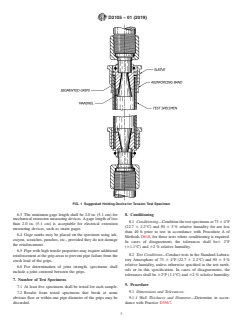
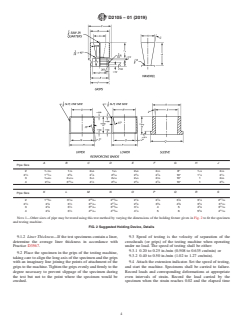
3.3.5 reinforced polymer mortar pipe (RPMP)—afiberglass 5.1.3 Grips—Grips for holding the test specimen between
pipe with aggregate. the fixed member and the movable member. The grips shall be
3.3.6 reinforced thermosetting resin pipe (RTRP)—a fiber- self-aligning; that is, they shall be attached to the fixed and
glass pipe without aggregate. movable member, respectively, in such a manner that they will
3.3.7 reinforced wall thickness—the total wall thickness movefreelyintoalignmentassoonasanyloadisapplied.With
minus the liner or exterior coating thickness, or both. this arrangement, the long axis of the test specimen will
coincide with the direction of the applied pull through the
4. Significance and Use
centerlineofthegripassembly.Thetestspecimenshallbeheld
in such a way that slippage relative to the grips is prevented
4.1 Tensile properties include modulus of elasticity, yield
insofar as possible. The grips shall be designed so that no
stress, elongation beyond yield point, tensile strength, elonga-
crushing load shall be applied to the pipe ends.Asuggested set
tion at break, and energy absorption. Materials possessing a
of grips and mandrels is shown in Fig. 1 and Fig. 2.
low order of ductility may not exhibit a yield point. Stress-
5.1.4 Drive Mechanism—A drive mechanism for imparting
strain data at several levels of temperature, humidity, time, or
to the movable member a uniform, controlled velocity with
other variables may be needed to furnish reasonably accurate
respect to the stationary member, this velocity to be regulated
indications of the behavior of the material.
as specified in 9.3.
4.2 Tension tests may provide data for research and
5.1.5 Load Indicator—A suitable load-indicating mecha-
development, engineering design, quality control, acceptance
nism capable of showing the total tensile load carried by the
or rejection under specifications, and for special purposes
test specimen when held by the grips.This mechanism shall be
(Note 3). The tests cannot be considered significant for
essentially free from inertia lag at the specified rate of testing
applications differing widely from the load-time scale of the
and shall indicate the load with an accuracy of 61 % of the
standard test (Note 4). Such applications require more suitable
indicated value, or better. The accuracy of the testing machine
tests, such as impact, creep, and fatigue.
shall be verified in accordance with Practice E4.
NOTE 3—It is realized that the method of preparation of a material is
NOTE 6—Experience has shown that many testing machines now in use
one of the many variables that affect the results obtained in testing a
material. Hence, when comparative tests of materials per se are desired, are incapable of maintaining accuracy for as long as the periods between
inspection recommended in Practice E4. Hence, it is recommended that
the greatest care must be exercised to ensure that all samples are prepared
in exactly the same way; similarly, for referee or comparative tests of any each machine be studied individually and verified as often as necessary. It
will frequently be necessary to perform this function daily.
given series of specimens, care must be taken to secure the maximum
degree of uniformity in details of preparation, treatment, and handling.
5.1.6 The fixed member, movable member, drive
NOTE 4—Reinforcements of plastics with glass fiber offer wide oppor-
mechanism, and grips shall be constructed of such materials
tunities for designing and producing products with markedly different
responses to loading even when the basic geometry of the product is and in such proportions that the total elastic longitudinal strain
similar.Forexample,atubularproductmaybedesignedtogivemaximum
of the system constituted by these parts does not exceed 1 % of
resistance to torsion loading, but such a product might develop a twist or
the total longitudinal strain between the two gage marks on the
bow if tested in tension or under internal pressure loading. In the case of
test specimen at any time during the test and at any load up to
pipe for general field use, internal pressure, as well as loads in tension,
the rated capacity of the machine.
compression, torsion, and flexure must be resisted to some degree.
Different pipe producers have chosen, by design, to offer products having
5.2 Extension Indicator—A suitable instrument for deter-
different balances of resistance to such stressing conditions.As a result, it
mining the distance between two fixed points located within
is important that the purchaser and the seller both have a clear under-
standing and agreement on the significance of this test method relative to
the gage length of the test specimen at any time during the test.
the intended use.
It is desirable, but not essential, that this instrument automati-
cally record this distance (or any change in it) as a function of
5. Apparatus
the load on the test specimen or of the elapsed time from the
5.1 Testing Machine—A testing machine of the constant- start of the test, or both. If only the latter is obtained, load-time
rate-of-crosshead-movement type (Note 5) and comprising
data must also be taken. This instrument shall be free of inertia
essentially the following: lag at the specified speed of testing and shall be accurate to6
1 % of strain or better.
NOTE 5—It is recognized that the constant rate-of-crosshead-movement
type of test leaves much to be desired from a theoretical standpoint, that
NOTE 7—Reference is made to Practice E83.
wide differences may exist between gage marks on the specimen, and that
the testing speeds specified disguise important effects characteristic of
5.3 Micrometers—Suitable micrometers, reading to at least
materials in the plastic state. Further, it is realized that variations in the
0.001in.(0.025mm),formeasuringthediameterandthickness
thicknesses of test specimens, which are permitted by these procedures,
of the test specimens.
produce variations in the surface-volume ratios of such specimens, and
that these variations may influence the test results. Hence, where directly
comparable
...