

ASTM D5685-19
(Specification)Standard Specification for “Fiberglass” (Glass-Fiber-Reinforced Thermosetting-Resin) Pressure Pipe Fittings
General Information
- Abstract
ABSTRACT
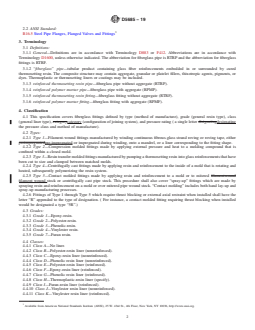
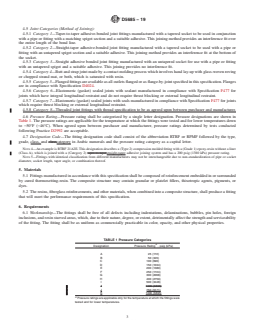
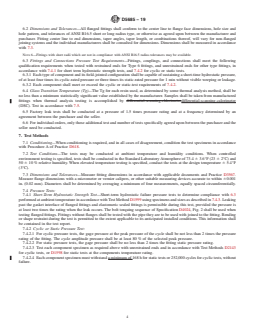
This specification covers "fiberglass" (glass-fiber-reinforced thermosetting-resin) pressure pipe fittings for use with filament wound or centrifugally cast fiberglass pipe. The fibreglass fittings are defined by type, grade, class, category, and pressure rating: type 1 - filament-wound fittings, type 2 - compression moulded fittings, type 3 - resin transfer molded fittings, type 4 - centrifugally cast fittings, and type 5 - contact molded fittings; grade 1 - epoxy-resin, grade 2 - polyester-resin, grade 3 - phenolic-resin, grade 4 - vinylester resin, and grade 7 - furan resin; class A - no liner, class B - polyester-resin liner (nonreinforced), class C - epoxy-resin liner (nonreinforced), class D - phenolic resin liner (nonreinforced), class E - polyester-resin liner (reinforced), class F - epoxy-resin liner (reinforced), class G - phenolic resin liner, class H - thermoplastic-resin liner, class I - furan-resin liner (reinforced), class J - vinylester resin liner (nonreinforced), and class K - vinylester resin liner (reinforced); category 1 - taper-to-taper adhesive bonded joint fittings, category 2 - straight-taper adhesive-bonded joint fitting, category 3 - straight adhesive bonded joint fitting, category 5 - flanged fittings, category 6 - elastomeric sealed joints with sealant, and category 7 - elastomeric sealed joints with seals. Short-term hydrostatic strength test and cyclic or static pressure test shall be performed to meet the requirements prescribed.
SCOPE
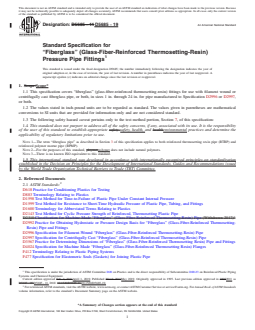
1.1 This specification covers “fiberglass” (glass-fiber-reinforced thermosetting-resin) fittings for use with filament wound or centrifugally cast fiberglass pipe, or both, in sizes 1 in. through 24 in. for pipe manufactured to Specification D2996 or D2997, or both.
1.2 The values stated in inch-pound units are to be regarded as standard. The values given in parentheses are mathematical conversions to SI units that are provided for information only and are not considered standard.
1.3 The following safety hazard caveat pertains only to the test method portion, Section 7, of this specification:
1.4 This standard does not purport to address all of the safety concerns, if any, associated with its use. It is the responsibility of the user of this standard to establish appropriate safety, health, and environmental practices and determine the applicability of regulatory limitations prior to use.
Note 1: The term “fiberglass pipe” as described in Section 3 of this specification applies to both reinforced thermosetting resin pipe (RTRP) and reinforced polymer mortar pipe (RPMP).
Note 2: For the purposes of this standard, polymer does not include natural polymers.
Note 3: There is no known ISO equivalent to this standard.
1.5 This international standard was developed in accordance with internationally recognized principles on standardization established in the Decision on Principles for the Development of International Standards, Guides and Recommendations issued by the World Trade Organization Technical Barriers to Trade (TBT) Committee.
- Status
- Published
- Publication Date
- 31-Mar-2019
- Technical Committee
- D20 - Plastics
Buy Documents
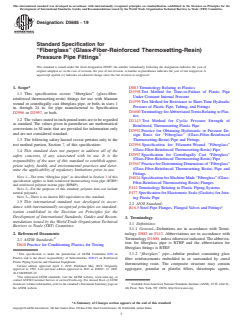
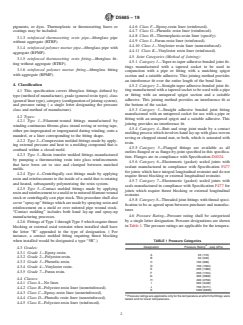
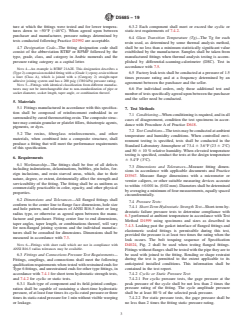
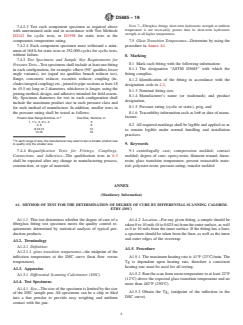
ASTM D5685-19 - Standard Specification for “Fiberglass” (Glass-Fiber-Reinforced Thermosetting-Resin) Pressure Pipe Fittings
REDLINE ASTM D5685-19 - Standard Specification for “Fiberglass” (Glass-Fiber-Reinforced Thermosetting-Resin) Pressure Pipe Fittings
Overview
ASTM D5685-19 is the Standard Specification for Fiberglass (Glass-Fiber-Reinforced Thermosetting-Resin) Pressure Pipe Fittings, published by ASTM International. This specification establishes requirements for the materials, workmanship, dimensions, and pressure ratings of glass-fiber-reinforced thermosetting-resin (commonly referred to as "fiberglass") fittings used with filament-wound or centrifugally cast fiberglass piping systems. Applicable for pipes sized 1 to 24 inches, this standard is widely recognized in the water, wastewater, industrial, and municipal sectors where durability and corrosion resistance are critical.
Key Topics
Fiberglass Pipe Fittings Types
- Type 1: Filament-wound fittings
- Type 2: Compression molded fittings
- Type 3: Resin transfer molded fittings
- Type 4: Centrifugally cast fittings
- Type 5: Contact molded fittings
Grades and Liners
- Resin Grades: Epoxy, polyester, phenolic, vinylester, and furan
- Liner Options: Nonreinforced and reinforced liners, using various resin systems or thermoplastics
Joint Categories
- Adhesive-bonded Joints: Taper-to-taper, straight-taper, and straight
- Flanged Fittings: In compliance with appropriate standards
- Elastomeric Sealed Joints: With or without longitudinal restraint
- Threaded Joints: As specified by agreement between purchaser and manufacturer
Pressure Ratings
- Pressure categories range from 25 psi (172 kPa) up to 1000 psi (6895 kPa), designated by letter codes
Testing and Quality Assurance
- Hydrostatic Strength and Pressure Testing: Ensures fittings can sustain short-term and cyclic/static pressures as required
- Glass Transition Temperature (Tg): Monitored to verify cure and quality of resin systems
- Factory Leak Testing: Regular tests at 1.5 times rated pressure
Identification and Marking
- Fittings must be clearly marked with standard designation, type, grade, class, joint category, pressure rating, manufacturer, and traceability information
Applications
ASTM D5685-19 fittings are essential in piping systems where corrosion resistance, pressure integrity, and lightweight materials are required. Common applications include:
- Municipal Water and Wastewater Systems: Transport of potable water, sewage, and greywater
- Industrial Processes: Chemical conveyance, process water, and corrosive fluid handling
- Power Plants: Cooling water lines and chemical injection systems
- Marine and Offshore Installations: Saltwater service lines
- Agricultural Irrigation: High-pressure water distribution
These fiberglass fittings are compatible with pipes manufactured according to ASTM D2996 and D2997, supporting system integrity and performance in challenging environments.
Related Standards
For complete compliance and optimal system design, users of ASTM D5685-19 should consider the following related standards:
- ASTM D2996: Specification for Filament-Wound “Fiberglass” Pipe
- ASTM D2997: Specification for Centrifugally Cast “Fiberglass” Pipe
- ASTM D618: Practice for Conditioning Plastics for Testing
- ASTM D1598 / D1599: Test Methods for Pressure Testing of Plastic Piping Systems
- ASTM F477: Specification for Elastomeric Seals (Gaskets) for Joining Plastic Pipe
- ASTM D3567: Practice for Determining Dimensions of “Fiberglass” Pipe and Fittings
- ANSI B16.5: Standard for Steel Pipe Flanges and Flanged Fittings (dimension reference for flanged fiberglass fittings)
No ISO equivalent currently exists for this standard, positioning ASTM D5685-19 as a leading reference for fiberglass pressure pipe fitting manufacturing and selection worldwide.
Keywords: fiberglass pressure pipe fittings, glass-fiber-reinforced thermosetting-resin, ASTM D5685-19, filament-wound fittings, compression molded fittings, hydrostatic strength, reinforced thermosetting resin pipe, corrosion-resistant pipe fittings, ASTM standards for fiberglass pipe, industrial pipe fittings.
Relations
- Effective Date
- 01-Apr-2019
- Effective Date
- 01-Feb-2024
- Effective Date
- 01-Nov-2023
- Effective Date
- 01-Oct-2023
- Effective Date
- 01-Apr-2020
- Effective Date
- 01-Jan-2020
- Effective Date
- 01-Aug-2019
- Effective Date
- 15-Apr-2019
- Effective Date
- 01-Feb-2019
- Effective Date
- 01-Jan-2019
- Effective Date
- 01-Dec-2018
- Effective Date
- 01-Nov-2018
- Effective Date
- 01-Sep-2018
- Refers
ASTM D1600-18 - Standard Terminology for Abbreviated Terms Relating to Plastics (Withdrawn 2024) - Effective Date
- 01-Jan-2018
- Effective Date
- 15-Aug-2017
Buy Documents
ASTM D5685-19 - Standard Specification for “Fiberglass” (Glass-Fiber-Reinforced Thermosetting-Resin) Pressure Pipe Fittings
REDLINE ASTM D5685-19 - Standard Specification for “Fiberglass” (Glass-Fiber-Reinforced Thermosetting-Resin) Pressure Pipe Fittings
Get Certified
Connect with accredited certification bodies for this standard

Institut za varilstvo d.o.o. (Welding Institute)
Slovenia's leading welding institute since 1952. ISO 3834, EN 1090, pressure equipment certification, NDT personnel, welder qualification. Only IIW Au
Sponsored listings
Frequently Asked Questions
ASTM D5685-19 is a technical specification published by ASTM International. Its full title is "Standard Specification for “Fiberglass” (Glass-Fiber-Reinforced Thermosetting-Resin) Pressure Pipe Fittings". This standard covers: ABSTRACT This specification covers "fiberglass" (glass-fiber-reinforced thermosetting-resin) pressure pipe fittings for use with filament wound or centrifugally cast fiberglass pipe. The fibreglass fittings are defined by type, grade, class, category, and pressure rating: type 1 - filament-wound fittings, type 2 - compression moulded fittings, type 3 - resin transfer molded fittings, type 4 - centrifugally cast fittings, and type 5 - contact molded fittings; grade 1 - epoxy-resin, grade 2 - polyester-resin, grade 3 - phenolic-resin, grade 4 - vinylester resin, and grade 7 - furan resin; class A - no liner, class B - polyester-resin liner (nonreinforced), class C - epoxy-resin liner (nonreinforced), class D - phenolic resin liner (nonreinforced), class E - polyester-resin liner (reinforced), class F - epoxy-resin liner (reinforced), class G - phenolic resin liner, class H - thermoplastic-resin liner, class I - furan-resin liner (reinforced), class J - vinylester resin liner (nonreinforced), and class K - vinylester resin liner (reinforced); category 1 - taper-to-taper adhesive bonded joint fittings, category 2 - straight-taper adhesive-bonded joint fitting, category 3 - straight adhesive bonded joint fitting, category 5 - flanged fittings, category 6 - elastomeric sealed joints with sealant, and category 7 - elastomeric sealed joints with seals. Short-term hydrostatic strength test and cyclic or static pressure test shall be performed to meet the requirements prescribed. SCOPE 1.1 This specification covers “fiberglass” (glass-fiber-reinforced thermosetting-resin) fittings for use with filament wound or centrifugally cast fiberglass pipe, or both, in sizes 1 in. through 24 in. for pipe manufactured to Specification D2996 or D2997, or both. 1.2 The values stated in inch-pound units are to be regarded as standard. The values given in parentheses are mathematical conversions to SI units that are provided for information only and are not considered standard. 1.3 The following safety hazard caveat pertains only to the test method portion, Section 7, of this specification: 1.4 This standard does not purport to address all of the safety concerns, if any, associated with its use. It is the responsibility of the user of this standard to establish appropriate safety, health, and environmental practices and determine the applicability of regulatory limitations prior to use. Note 1: The term “fiberglass pipe” as described in Section 3 of this specification applies to both reinforced thermosetting resin pipe (RTRP) and reinforced polymer mortar pipe (RPMP). Note 2: For the purposes of this standard, polymer does not include natural polymers. Note 3: There is no known ISO equivalent to this standard. 1.5 This international standard was developed in accordance with internationally recognized principles on standardization established in the Decision on Principles for the Development of International Standards, Guides and Recommendations issued by the World Trade Organization Technical Barriers to Trade (TBT) Committee.
ABSTRACT This specification covers "fiberglass" (glass-fiber-reinforced thermosetting-resin) pressure pipe fittings for use with filament wound or centrifugally cast fiberglass pipe. The fibreglass fittings are defined by type, grade, class, category, and pressure rating: type 1 - filament-wound fittings, type 2 - compression moulded fittings, type 3 - resin transfer molded fittings, type 4 - centrifugally cast fittings, and type 5 - contact molded fittings; grade 1 - epoxy-resin, grade 2 - polyester-resin, grade 3 - phenolic-resin, grade 4 - vinylester resin, and grade 7 - furan resin; class A - no liner, class B - polyester-resin liner (nonreinforced), class C - epoxy-resin liner (nonreinforced), class D - phenolic resin liner (nonreinforced), class E - polyester-resin liner (reinforced), class F - epoxy-resin liner (reinforced), class G - phenolic resin liner, class H - thermoplastic-resin liner, class I - furan-resin liner (reinforced), class J - vinylester resin liner (nonreinforced), and class K - vinylester resin liner (reinforced); category 1 - taper-to-taper adhesive bonded joint fittings, category 2 - straight-taper adhesive-bonded joint fitting, category 3 - straight adhesive bonded joint fitting, category 5 - flanged fittings, category 6 - elastomeric sealed joints with sealant, and category 7 - elastomeric sealed joints with seals. Short-term hydrostatic strength test and cyclic or static pressure test shall be performed to meet the requirements prescribed. SCOPE 1.1 This specification covers “fiberglass” (glass-fiber-reinforced thermosetting-resin) fittings for use with filament wound or centrifugally cast fiberglass pipe, or both, in sizes 1 in. through 24 in. for pipe manufactured to Specification D2996 or D2997, or both. 1.2 The values stated in inch-pound units are to be regarded as standard. The values given in parentheses are mathematical conversions to SI units that are provided for information only and are not considered standard. 1.3 The following safety hazard caveat pertains only to the test method portion, Section 7, of this specification: 1.4 This standard does not purport to address all of the safety concerns, if any, associated with its use. It is the responsibility of the user of this standard to establish appropriate safety, health, and environmental practices and determine the applicability of regulatory limitations prior to use. Note 1: The term “fiberglass pipe” as described in Section 3 of this specification applies to both reinforced thermosetting resin pipe (RTRP) and reinforced polymer mortar pipe (RPMP). Note 2: For the purposes of this standard, polymer does not include natural polymers. Note 3: There is no known ISO equivalent to this standard. 1.5 This international standard was developed in accordance with internationally recognized principles on standardization established in the Decision on Principles for the Development of International Standards, Guides and Recommendations issued by the World Trade Organization Technical Barriers to Trade (TBT) Committee.
ASTM D5685-19 is classified under the following ICS (International Classification for Standards) categories: 23.040.45 - Plastics fittings. The ICS classification helps identify the subject area and facilitates finding related standards.
ASTM D5685-19 has the following relationships with other standards: It is inter standard links to ASTM D5685-11, ASTM D883-24, ASTM D883-23, ASTM D2996-23, ASTM F412-20, ASTM D883-20, ASTM D883-19c, ASTM D883-19a, ASTM D883-19, ASTM F412-19, ASTM D883-18a, ASTM D883-18, ASTM D1599-18, ASTM D1600-18, ASTM D883-17. Understanding these relationships helps ensure you are using the most current and applicable version of the standard.
ASTM D5685-19 is available in PDF format for immediate download after purchase. The document can be added to your cart and obtained through the secure checkout process. Digital delivery ensures instant access to the complete standard document.
Standards Content (Sample)
This international standard was developed in accordance with internationally recognized principles on standardization established in the Decision on Principles for the
Development of International Standards, Guides and Recommendations issued by the World Trade Organization Technical Barriers to Trade (TBT) Committee.
Designation: D5685 −19
Standard Specification for
“Fiberglass” (Glass-Fiber-Reinforced Thermosetting-Resin)
Pressure Pipe Fittings
This standard is issued under the fixed designation D5685; the number immediately following the designation indicates the year of
original adoption or, in the case of revision, the year of last revision.Anumber in parentheses indicates the year of last reapproval.A
superscript epsilon (´) indicates an editorial change since the last revision or reapproval.
1. Scope* D883Terminology Relating to Plastics
D1598Test Method for Time-to-Failure of Plastic Pipe
1.1 This specification covers “fiberglass” (glass-fiber-
Under Constant Internal Pressure
reinforced thermosetting-resin) fittings for use with filament
D1599Test Method for Resistance to Short-Time Hydraulic
wound or centrifugally cast fiberglass pipe, or both, in sizes 1
Pressure of Plastic Pipe, Tubing, and Fittings
in. through 24 in. for pipe manufactured to Specification
D1600TerminologyforAbbreviatedTermsRelatingtoPlas-
D2996 or D2997, or both.
tics
1.2 Thevaluesstatedininch-poundunitsaretoberegarded
D2143 Test Method for Cyclic Pressure Strength of
as standard. The values given in parentheses are mathematical
Reinforced, Thermosetting Plastic Pipe
conversions to SI units that are provided for information only
D2992Practice for Obtaining Hydrostatic or Pressure De-
and are not considered standard.
sign Basis for “Fiberglass” (Glass-Fiber-Reinforced
Thermosetting-Resin) Pipe and Fittings
1.3 The following safety hazard caveat pertains only to the
test method portion, Section 7, of this specification: D2996 Specification for Filament-Wound “Fiberglass”
(Glass-Fiber-Reinforced Thermosetting-Resin) Pipe
1.4 This standard does not purport to address all of the
D2997Specification for Centrifugally Cast “Fiberglass”
safety concerns, if any, associated with its use. It is the
(Glass-Fiber-Reinforced Thermosetting-Resin) Pipe
responsibility of the user of this standard to establish appro-
D3567PracticeforDeterminingDimensionsof“Fiberglass”
priate safety, health, and environmental practices and deter-
(Glass-Fiber-Reinforced Thermosetting Resin) Pipe and
mine the applicability of regulatory limitations prior to use.
Fittings
NOTE 1—The term “fiberglass pipe” as described in Section 3 of this
D4024SpecificationforMachineMade“Fiberglass”(Glass-
specification applies to both reinforced thermosetting resin pipe (RTRP)
Fiber-Reinforced Thermosetting Resin) Flanges
and reinforced polymer mortar pipe (RPMP).
F412Terminology Relating to Plastic Piping Systems
NOTE 2—For the purposes of this standard, polymer does not include
F477Specification for Elastomeric Seals (Gaskets) for Join-
natural polymers.
NOTE 3—There is no known ISO equivalent to this standard.
ing Plastic Pipe
1.5 This international standard was developed in accor-
2.2 ANSI Standard:
dance with internationally recognized principles on standard-
B16.5Steel Pipe Flanges, Flanged Valves and Fittings
ization established in the Decision on Principles for the
Development of International Standards, Guides and Recom-
3. Terminology
mendations issued by the World Trade Organization Technical
3.1 Definitions:
Barriers to Trade (TBT) Committee.
3.1.1 General—Definitions are in accordance with Termi-
2. Referenced Documents nology D883 or F412. Abbreviations are in accordance with
TerminologyD1600,unlessotherwiseindicated.Theabbrevia-
2.1 ASTM Standards:
tion for fiberglass pipe is RTRP and the abbreviation for
D618Practice for Conditioning Plastics for Testing
fiberglass fittings is RTRF.
This specification is under the jurisdiction of ASTM Committee D20 on 3.1.2 “fiberglass” pipe—tubular product containing glass
Plastics and is the direct responsibility of Subcommittee D20.23 on Reinforced
fiber reinforcements embedded in or surrounded by cured
Plastic Piping Systems and Chemical Equipment.
thermosetting resin. The composite structure may contain
Current edition approved April 1, 2019. Published May 2019. Originally
aggregate, granular or platelet fillers, thixotropic agents,
approved in 1995. Last previous edition approved in 2011 as D5685-11. DOI:
10.1520/D5685-19.
For referenced ASTM standards, visit the ASTM website, www.astm.org, or
contact ASTM Customer Service at service@astm.org. For Annual Book of ASTM
Standards volume information, refer to the standard’s Document Summary page on Available fromAmerican National Standards Institute (ANSI), 25 W. 43rd St.,
the ASTM website. 4th Floor, New York, NY 10036, http://www.ansi.org.
*A Summary of Changes section appears at the end of this standard
Copyright © ASTM International, 100 Barr Harbor Drive, PO Box C700, West Conshohocken, PA 19428-2959. United States
D5685 − 19
pigments, or dyes. Thermoplastic or thermosetting liners or 4.4.6 Class F—Epoxy-resin liner (reinforced).
coatings may be included. 4.4.7 Class G—Phenolic resin liner (reinforced).
4.4.8 Class H—Thermoplastic-resin liner (specify).
3.1.3 reinforced thermosetting resin pipe—fiberglass pipe
4.4.9 Class I—Furan-resin liner (reinforced).
without aggregate (RTRP).
4.4.10 Class J—Vinylester resin liner (nonreinforced).
3.1.4 reinforced polymer mortar pipe—fiberglass pipe with
4.4.11 Class K—Vinylester resin liner (reinforced).
aggregate (RPMP).
4.5 Joint Categories (Method of Joining):
3.1.5 reinforced thermosetting resin fitting—fiberglass fit-
4.5.1 Category 1—Taper-to-taper adhesive-bonded joint fit-
ting without aggregate (RTRF).
tings manufactured with a tapered socket to be used in
3.1.6 reinforced polymer mortar fitting—fiberglass fitting
conjunction with a pipe or fitting with a matching spigot
with aggregate (RPMF).
section and a suitable adhesive. This joining method provides
an interference fit over the entire length of the bond line.
4. Classification
4.5.2 Category 2—Straight-taper adhesive-bonded joint fit-
ting manufactured with a tapered socket to be used with a pipe
4.1 This specification covers fiberglass fittings defined by
or fitting with an untapered spigot section and a suitable
type(methodofmanufacture),grade(generalresintype),class
adhesive. This joining method provides an interference fit at
(generallinertype),category(configurationofjoiningsystem),
the bottom of the socket.
and pressure rating ( a single letter designating the pressure
4.5.3 Category 3—Straight adhesive bonded joint fitting
class and method of manufacture).
manufactured with an untapered socket for use with a pipe or
4.2 Types:
fitting with an untapered spigot and a suitable adhesive. This
4.2.1 Type 1—Filament-wound fittings manufactured by
joining provides no interference fit.
winding continuous fibrous-glass strand roving or roving tape,
4.5.4 Category 4—Butt and strap joint made by a contact
either pre-impregnated or impregnated during winding, onto a
moldingprocesswhichinvolveshandlay-upwithglass-woven
mandrel, or a liner corresponding to the fitting shape.
roving or chopped strand mat, or both, which is saturated with
4.2.2 Type 2—Compression molded fittings made by apply-
resin.
ing external pressure and heat to a molding compound that is
4.5.5 Category 5—Flanged fittings are available as all
confined within a closed mold.
outlets flanged or as flange-by-joint specified in this specifica-
4.2.3 Type 3—Resin transfer molded fittings manufactured
tion. Flanges are in compliance with Specification D4024.
by pumping a thermosetting resin into glass reinforcements
4.5.6 Category 6—Elastomeric (gasket) sealed joints with
that have been cut to size and clamped between matched
sealant manufactured in compliance with Specification F477
molds.
for joints which have integral longitudinal restraint and do not
4.2.4 Type 4—Centrifugally cast fittings made by applying
require thrust blocking or external longitudinal restraint.
resin and reinforcement to the inside of a mold that is rotating
4.5.7 Category 7—Elastomeric (gasket) sealed joints with
and heated, subsequently polymerizing the resin system.
seals manufactured in compliance with Specification F477 for
4.2.5 Type 5—Contact molded fittings made by applying
joints which require thrust blocking or external longitudinal
resinandreinforcementtoamoldortomiteredfilamentwound
restraint.
stockorcentrifugallycastpipestock.Thisprocedureshallalso
4.5.8 Category 8—Threaded joint fittings with thread speci-
cover“spray-up”fittingswhicharemadebysprayingresinand
fication to be as agreed upon between purchaser and manufac-
reinforcement on a mold or over mitered pipe wound stock.
turer.
“Contact molding” includes both hand lay-up and spray-up
4.6 Pressure Rating—Pressure rating shall be categorized
manufacturing processes.
by a single letter designation. Pressure designations are shown
4.2.6 FittingsofType1throughType5whichrequirethrust
in Table 1.The pressure ratings are applicable for the tempera-
blocking or external axial restraint when installed shall have
the letter “R” appended to the type of designation. ( For
instance, a contact molded fitting requiring thrust blocking
when installed would be designated a type “5R”.) TABLE 1 Pressure Categories
A
Designation Pressure Rating , psig (kPa)
4.3 Grades:
4.3.1 Grade 1—Epoxy-resin.
A 25 (172)
4.3.2 Grade 2—Polyester-resin.
B 50 (345)
C 100 (690)
4.3.3 Grade 3—Phenolic-resin.
D 150 (1034)
4.3.4 Grade 4—Vinylester resin.
E 200 (1380)
4.3.5 Grade 7—Furan resin.
F 250 (1724)
G 300 (2068)
4.4 Classes:
H 400 (2759)
4.4.1 Class A—No liner. I 500 (3448)
J 750 (5171)
4.4.2 Class B—Polyester-resin liner (nonreinforced).
K 1000 (6895)
4.4.3 Class C—Epoxy-resin liner (nonreinforced).
A
Pressureratingsareapplicableonlyforthetemperatureatwhichthefittingswere
4.4.4 Class D—Phenolic resin liner (nonreinforced).
tested and for lower temperatures.
4.4.5 Class E—Polyester-resin liner (reinforced).
D5685 − 19
ture at which the fittings were tested and for lower tempera- 6.3.2 Each component shall meet or exceed the cyclic or
tures down to −50°F (−46°C). When agreed upon between static-test requirements of 7.4.2.
purchaser and manufacturer, pressure ratings determined by
6.4 Glass Transition Temperature (Tg)—The Tg for each
tests conducted following Practice D2992 are acceptable.
resin used, as determined by some thermal analysis method,
4.7 Designation Code—The fitting designation code shall
shall be no less than a minimum statistically significant value
consist of the abbreviation RTRF or RPMF followed by the established by the manufacturer. Samples shall be taken from
type, grade, class, and category in Arabic numerals and the manufactured fittings when thermal analysis testing is accom-
pressure rating category as a capital letter. plished by differential-scanning-calorimeter (DSC). Test in
accordance with 7.5.
NOTE 4—An example is RTRF 21A2E. This designation describes a
(Type2)compressionmoldedfittingwitha(Grade1)epoxy-resinwithout
6.5 Factoryleaktestsshallbeconductedatapressureof1.5
a liner (Class A), which is joined with a (Category 2) straight-taper
times pressure rating and at a frequency determined by an
adhesive joining system and has a 200 psig (1380 kPa) pressure rating.
agreement between the purchaser and the seller.
NOTE 5—Fittings with identical classification from different manufac-
turers may not be interchangeable due to non-standardization of pipe or
6.6 For individual orders, only those additional test and
socket diameter, socket len
...
This document is not an ASTM standard and is intended only to provide the user of an ASTM standard an indication of what changes have been made to the previous version. Because
it may not be technically possible to adequately depict all changes accurately, ASTM recommends that users consult prior editions as appropriate. In all cases only the current version
of the standard as published by ASTM is to be considered the official document.
Designation: D5685 − 11 D5685 − 19 An American National Standard
Standard Specification for
“Fiberglass” (Glass-Fiber-Reinforced Thermosetting-Resin)
Pressure Pipe Fittings
This standard is issued under the fixed designation D5685; the number immediately following the designation indicates the year of
original adoption or, in the case of revision, the year of last revision. A number in parentheses indicates the year of last reapproval. A
superscript epsilon (´) indicates an editorial change since the last revision or reapproval.
1. Scope Scope*
1.1 This specification covers “fiberglass” (glass-fiber-reinforced thermosetting-resin) fittings for use with filament wound or
centrifugally cast fiberglass pipe, or both, in sizes 1 in. through 24 in. for pipe manufactured to Specification D2996 or D2997,
or both.
1.2 The values stated in inch-pound units are to be regarded as standard. The values given in parentheses are mathematical
conversions to SI units that are provided for information only and are not considered standard.
1.3 The following safety hazard caveat pertains only to the test method portion, Section 7, of this specification:
1.4 This standard does not purport to address all of the safety concerns, if any, associated with its use. It is the responsibility
of the user of this standard to establish appropriate safety safety, health, and healthenvironmental practices and determine the
applicability of regulatory limitations prior to use.
NOTE 1—The term “fiberglass pipe” as described in Section 3 of this specification applies to both reinforced thermosetting resin pipe (RTRP) and
reinforced polymer mortar pipe (RPMP).
NOTE 2—For the purposes of this standard, ploymerpolymer does not include natural polymers.
NOTE 3—There is no known ISO equivalent to this standard.
1.5 This international standard was developed in accordance with internationally recognized principles on standardization
established in the Decision on Principles for the Development of International Standards, Guides and Recommendations issued
by the World Trade Organization Technical Barriers to Trade (TBT) Committee.
2. Referenced Documents
2.1 ASTM Standards:
D618 Practice for Conditioning Plastics for Testing
D883 Terminology Relating to Plastics
D1598 Test Method for Time-to-Failure of Plastic Pipe Under Constant Internal Pressure
D1599 Test Method for Resistance to Short-Time Hydraulic Pressure of Plastic Pipe, Tubing, and Fittings
D1600 Terminology for Abbreviated Terms Relating to Plastics
D2143 Test Method for Cyclic Pressure Strength of Reinforced, Thermosetting Plastic Pipe
D2310 Classification for Machine-Made “Fiberglass” (Glass-Fiber-Reinforced Thermosetting-Resin) Pipe (Withdrawn 2017)
D2992 Practice for Obtaining Hydrostatic or Pressure Design Basis for “Fiberglass” (Glass-Fiber-Reinforced Thermosetting-
Resin) Pipe and Fittings
D2996 Specification for Filament-Wound “Fiberglass” (Glass-Fiber-Reinforced Thermosetting-Resin) Pipe
D2997 Specification for Centrifugally Cast “Fiberglass” (Glass-Fiber-Reinforced Thermosetting-Resin) Pipe
D3567 Practice for Determining Dimensions of “Fiberglass” (Glass-Fiber-Reinforced Thermosetting Resin) Pipe and Fittings
D4024 Specification for Machine Made “Fiberglass” (Glass-Fiber-Reinforced Thermosetting Resin) Flanges
F412 Terminology Relating to Plastic Piping Systems
F477 Specification for Elastomeric Seals (Gaskets) for Joining Plastic Pipe
This specification is under the jurisdiction of ASTM Committee D20 on Plastics and is the direct responsibility of Subcommittee D20.23 on Reinforced Plastic Piping
Systems and Chemical Equipment.
Current edition approved Feb. 1, 2011April 1, 2019. Published March 2011May 2019. Originally approved in 1995. Last previous edition approved in 20052011 as
D5685 - 05.D5685 - 11. DOI: 10.1520/D5685-11.10.1520/D5685-19.
For referenced ASTM standards, visit the ASTM website, www.astm.org, or contact ASTM Customer Service at service@astm.org. For Annual Book of ASTM Standards
volume information, refer to the standard’s Document Summary page on the ASTM website.
*A Summary of Changes section appears at the end of this standard
Copyright © ASTM International, 100 Barr Harbor Drive, PO Box C700, West Conshohocken, PA 19428-2959. United States
D5685 − 19
2.2 ANSI Standard:
B16.5 Steel Pipe Flanges, Flanged Valves and Fittings
3. Terminology
3.1 Definitions:
3.1.1 General—Definitions are in accordance with Terminology D883 or F412. Abbreviations are in accordance with
Terminology D1600, unless otherwise indicated. The abbreviation for fiberglass pipe is RTRP and the abbreviation for fiberglass
fittings is RTRF.
3.1.2 “fiberglass” pipe—tubular product containing glass fiber reinforcements embedded in or surrounded by cured
thermosetting resin. The composite structure may contain aggregate, granular or platelet fillers, thixotropic agents, pigments, or
dyes. Thermoplastic or thermosetting liners or coatings may be included.
3.1.3 reinforced thermosetting resin pipe—fiberglass pipe without aggregate (RTRP).
3.1.4 reinforced polymer mortar pipe—fiberglass pipe with aggregate (RPMP).
3.1.5 reinforced thermosetting resin fitting—fiberglass fitting without aggregate (RTRF).
3.1.6 reinforced polymer mortar fitting—fiberglass fitting with aggregate (RPMF).
4. Classification
4.1 This specification covers fiberglass fittings defined by type (method of manufacture), grade (general resin type), class
(general liner type), catagorycategory (configuration of joining system), and pressure rating ( a single letter disignatingdesignating
the pressure class and method of manufacture).
4.2 Types:
4.2.1 Type 1—Filament-wound fittings manufactured by winding continuous fibrous-glass strand roving or roving tape, either
preimpregnatedpre-impregnated or impregnated during winding, onto a mandrel, or a liner corresponding to the fitting shape.
4.2.2 Type 2—Compression molded fittings made by applying external pressure and heat to a molding compound that is
confined within a closed mold.
4.2.3 Type 3—Resin transfer molded fittings manufactured by pumping a thermosetting resin into glass reinforcements that have
been cut to size and clamped between matched molds.
4.2.4 Type 4—Centrifugally cast fittings made by applying resin and reinforcement to the inside of a mold that is rotating and
heated, subsequently polymerizing the resin system.
4.2.5 Type 5—Contact molded fittings made by applying resin and reinforcement to a mold or to mitered filamentwound
filament wound stock or centrifugally cast pipe stock. This procedure shall also cover “spray-up” fittings which are made by
spraying resin and reinforcement on a mold or over mitered pipe wound stock. “Contact molding” includes both hand lay-up and
spray-up manufacturing processes.
4.2.6 Fittings of Type 1 through Type 5 which require thrust blocking or external axial restraint when installed shall have the
letter “R” appended to the type of designation. ( For instance, a contact molded fitting requiring thrust blocking when installed
would be designated a type “5R”.)
4.3 Grades:
4.3.1 Grade 1—Epoxy-resin.
4.3.2 Grade 2—Polyester-resin.
4.3.3 Grade 3—Phenolic-resin.
4.3.4 Grade 4—Vinylester resin.
4.3.5 Grade 7—Furan resin.
4.4 Classes:
4.4.1 Class A—No liner.
4.4.2 Class B—Polyester-resin liner (nonreinforced).
4.4.3 Class C—Epoxy-resin liner (nonreinforced).
4.4.4 Class D—Phenolic resin liner (nonreinforced).
4.4.5 Class E—Polyester-resin liner (reinforced).
4.4.6 Class F—Epoxy-resin liner (reinforced).
4.4.7 Class G—Phenolic resin liner (reinforced).
4.4.8 Class H—Thermoplastic-resin liner (specify).
4.4.9 Class I—Furan-resin liner (reinforced).
4.4.10 Class J—Vinylester resin liner (nonreinforced).
4.4.11 Class K—Vinylester resin liner (reinforced).
Available from American National Standards Institute (ANSI), 25 W. 43rd St., 4th Floor, New York, NY 10036, http://www.ansi.org.
D5685 − 19
4.5 Joint Categories (Method of Joining):
4.5.1 Category 1—Taper-to-taper adhesive-bonded joint fittings manufactured with a tapered socket to be used in conjunction
with a pipe or fitting with a matching spigot section and a suitable adhesive. This joining method provides an interference fit over
the entire length of the bond line.
4.5.2 Category 2—Straight-taper adhesive-bonded joint fitting manufactured with a tapered socket to be used with a pipe or
fitting with an untapered spigot section and a suitable adhesive. This joining method provides an interference fit at the bottom of
the socket.
4.5.3 Category 3—Straight adhesive bonded joint fitting manufactured with an untapered socket for use with a pipe or fitting
with an untapered spigot and a suitable adhesive. This joining provides no interference fit.
4.5.4 Category 4—Butt and strap joint made by a contact molding process which involves hand lay-up with glass-woven roving
or chopped strand mat, or both, which is saturated with resin.
4.5.5 Category 5—Flanged fittings are available as all outlets flanged or as flange-by-joint specified in this specification. Flanges
are in compliance with Specification D4024.
4.5.6 Category 6—Elastomeric (gasket) sealed joints with sealant manufactured in compliance with Specification F477 for
joints which have integral longitudinal restraint and do not require thrust blocking or external longitudinal restraint.
4.5.7 Category 7—Elastomeric (gasket) sealed joints with seals manufactured in compliance with Specification F477 for joints
which require thrust blocking or external longitudinal restraint.
4.5.8 Category 8—Threaded joint fittings with thread specification to be as agreed upon between purchaser and manufacturer.
4.6 Pressure Rating—Pressure rating shall be categorized by a single letter designation. Pressure designations are shown in
Table 1. The pressure ratings are applicable for the temperature at which the fittings were tested and for lower temperatures down
to −50°F (−46°C). When agreed upon between purchaser and manufacturer, pressure ratings determined by tests conducted
following Practice D2992 are acceptable.
4.7 Designation Code—The fitting designation code shall consist of the abbreviation RTRF or RPMF followed by the type,
grade, class, and classcategory in Arabic numerals and the pressure rating category as a capital letter.
NOTE 4—An example is RTRF 21A2E. This designation describes a (Type 2) compression molded fitting with a (Grade 1) epoxy-resin without a liner
(Class A), which is joined with a (Category 2) taper-to-taperstraight-taper adhesive joining system and has a 200 psig (1380 kPa) pressure rating.
NOTE 5—Fittings with identical classification from different manufacturers may not be interchangeable due to non-standardization of pipe or socket
diameter, socket length, taper angle, or combination thereof.
5. Materials
5.1 Fittings manufactured in accordance with this specification shall be composed of reinforcement embedded in or surrounded
by cured thermosetting-resin. The composite structure may contain granular or platelet fillers, thixotropic agents, pigments, or
dyes.
5.2 The resins, fiberglass reinforcements, and other materials, when combined into a composite structure, shall produce a fitting
that will meet the performance requirements of this specification.
6. Requirements
6.1 Workmanship—The fittings shall be free of all defects including indentations, delaminations, bubbles, pin holes, foreign
inclusions, and resin starved areas, which, due to their nature, degree, or extent, detrimentally affect the strength and serviceability
of the fitting. The fitting shall be as uniform as commercially practicable in color, opacity, and other physical properties.
TABLE 1 Pressure Categories
A
Designation Pressure Rating , psig (kPa)
A 25 (172)
B 50 (345)
C 100 (690)
D 150 (1034)
E 200 (1380)
F 250 (1724)
G 300 (2068)
H 400 (2759)
I 500 (3448)
J 1000 (6896)
J 750 (5171)
K 1000 (6895)
A
Pressure ratings are applicable only fo
...