

ASTM F3110-14(2024)
(Practice)Standard Practice for Proper Use of Mechanical Trenchless Point Repair Sleeve with Locking Gear Mechanism for Pipes of Varying Inner Diameter and Offset Joints
General Information
- Abstract
SIGNIFICANCE AND USE
4.1 This practice is for use by design engineers, specifiers, regulatory agencies, owners, installers, and inspection organizations who are involved in the rehabilitation of pipes through the use of a Mechanical Trenchless Point Repair Sleeve with a Locking Gear Mechanism for Pipes of Varying Inner Diameter and Offset Joints within a damaged existing pipe.
4.2 This practice applies to the following types of defects in pipe that can be repaired: longitudinal, radial and circumferential cracks, fragmentation, leaking joints, displacement or joint misalignment, closing or sealing unused laterals, corrosion, spalling, wear, leaks in the barrel of the pipe, deformation in the pipe and root penetration. There are no limitations on the diameters of the laterals that can be sealed. The degree of deformation that can be repaired is dependent on the minimum and maximum diameters for which the sleeve is applicable as listed in the tables of dimensions shown in Appendix X1 but shall never exceed 5 %.
4.3 This practice applies to pipes made of vitrified clay, concrete, reinforced concrete, plastics, glass reinforced plastics, cast iron, ductile iron and steel for both pressure and non-pressure applications.
4.4 In this practice, no issues of snagging waste or build-up of sludge or sediment have been recorded to date; the performance of this sleeve, however, depends on many factors; therefore, past operational records may not include all possible future conditions under which the user may install these sleeves.
4.5 The suitability of the technology covered in this practice for a particular application shall be jointly decided by the authority, the engineer and the installer.
SCOPE
1.1 This practice establishes minimum requirements for good practices for the materials and installation of mechanical trenchless repair sleeve with a locking gear mechanism for pipes of varying inner diameter and offset joints in the range of 6 in. to 72 in. (150 mm to 1800 mm).
1.2 This practice applies to storm, potable water, wastewater and industrial pipes, conduits and drainage culverts.
1.3 When the specified materials are used in manufacturing the sleeve and installed in accordance with this practice, the sleeve shall extend over a predetermined length of the host pipe as a continuous, tight fitting, corrosion resistant and verifiable non-leaking pipe repaired using one or more pieces of the repair sleeve mechanism. The maximum internal pressure this sleeve can carry depends on the diameter and the wall thickness, ranging from 10 to 15 bars; the external pressure shall not exceed 1.5 bars.
1.4 All materials in contact with potable water shall be certified to meet NSF/ANSI 61/372.
1.5 The values stated in inch-pound units are to be regarded as standard. The values given in parentheses are mathematical conversions to SI units that are provided for information only and are not considered standard.
1.6 This standard does not purport to address all of the safety concerns, if any, associated with its use. It is the responsibility of the user of this standard to establish appropriate safety, health, and environmental practices and determine the applicability of regulatory limitations prior to use. Particular attention is drawn to those safety regulations and requirements involving entering into and working in confined spaces.
1.7 This international standard was developed in accordance with internationally recognized principles on standardization established in the Decision on Principles for the Development of International Standards, Guides and Recommendations issued by the World Trade Organization Technical Barriers to Trade (TBT) Committee.
- Status
- Published
- Publication Date
- 31-Jan-2024
- Technical Committee
- F36 - Technology and Underground Utilities
- Drafting Committee
- F36.20 - Inspection and Renewal of Water and Wastewater Infrastructure
Overview
ASTM F3110-14(2024) establishes minimum requirements and practical procedures for the use of mechanical trenchless point repair sleeves incorporating a locking gear mechanism for the rehabilitation of pipes with varying inner diameters and offset joints. Developed by ASTM International, this standard is designed to serve engineers, utility owners, installers, regulatory agencies, and inspection organizations involved in extending the service life of damaged pipelines using trenchless, no-dig technology. The standard covers pipe materials including vitrified clay, concrete, reinforced concrete, plastics, glass reinforced plastics, cast iron, ductile iron, and steel in both pressure and non-pressure applications.
Key Topics
Scope of Repairs: The standard applies to storm, potable water, wastewater, industrial pipes, conduits, and drainage culverts ranging from 6 to 72 inches (150–1800 mm) in diameter. It addresses repairs for a wide variety of pipe defects, including:
- Longitudinal, radial, and circumferential cracks
- Fragmentation
- Leaking or misaligned joints
- Closing unused laterals
- Corrosion, wear, spalling
- Leaks and deformation
- Root penetration
Practice Requirements:
- Selection, sizing, and installation procedures for repair sleeves
- Materials selection, requiring that products in contact with potable water meet NSF/ANSI 61/372 standards
- Required inspections and cleaning prior to installation
- Use of equipment such as packers, inspection cameras, and high-pressure jetting tools
Safety and Regulatory Compliance:
- Emphasizes the need for users to establish appropriate safety, health, and environmental procedures
- Special considerations for confined space entry and local regulations
Applications
- Trenchless Rehabilitation: The sleeve system enables targeted, non-invasive repairs, reducing the need for excavation and minimizing surface disruptions in urban and rural settings.
- Versatile Pipe Compatibility: Suited for a wide range of pipe materials and diameters, allowing utilities to address both small-diameter service laterals and large trunk lines within stormwater, drinking water, and wastewater systems.
- Defect Remediation: Used to restore structural integrity and hydraulic performance by sealing cracks, repairing joint misalignments, and stopping leaks or root intrusion without complete pipe replacement.
- Pressure and Non-Pressure Use: Applicable where internal pipe pressures range from 10 to 15 bars, and external pressures do not exceed 1.5 bars, making it suitable for both gravity and pressure pipelines.
- Zero Leakage: Designed to provide a continuous, tight-fitting, corrosion-resistant, and verifiable non-leaking repair.
Related Standards
Referenced ASTM Standards:
- ASTM A240/A240M: Chromium and Chromium-Nickel Stainless Steel Plate, Sheet, and Strip
- ASTM A666: Annealed or Cold-Worked Austenitic Stainless Steel Sheet, Strip, Plate, and Flat Bar
NASSCO Guidelines:
- Specifications for Sewer Collection System Rehabilitation
European Standards:
- EN 681-1: Elastomeric seals for pipe joint seals in water and drainage systems
NSF/ANSI Standards:
- NSF/ANSI 61: Drinking water system components
- NSF/ANSI 372: Drinking water system components for lead content
Practical Value
ASTM F3110-14(2024) ensures consistency and reliability in trenchless pipe repair, facilitating cost-effective maintenance for utilities and reducing disruptions to the public. By following this standard practice, project stakeholders can:
- Maximize asset life and service reliability
- Ensure compliance with safety, health, and environmental regulations
- Meet stringent water quality standards
- Document repairs for regulatory acceptance and future inspections
For municipal, industrial, and regulatory professionals, adhering to ASTM F3110-14(2024) enables efficient, minimally invasive pipe rehabilitation across a wide range of infrastructure scenarios.
Relations
- Effective Date
- 01-Feb-2024
- Effective Date
- 01-Mar-2023
Get Certified
Connect with accredited certification bodies for this standard

Institut za varilstvo d.o.o. (Welding Institute)
Slovenia's leading welding institute since 1952. ISO 3834, EN 1090, pressure equipment certification, NDT personnel, welder qualification. Only IIW Au
Sponsored listings
Frequently Asked Questions
ASTM F3110-14(2024) is a standard published by ASTM International. Its full title is "Standard Practice for Proper Use of Mechanical Trenchless Point Repair Sleeve with Locking Gear Mechanism for Pipes of Varying Inner Diameter and Offset Joints". This standard covers: SIGNIFICANCE AND USE 4.1 This practice is for use by design engineers, specifiers, regulatory agencies, owners, installers, and inspection organizations who are involved in the rehabilitation of pipes through the use of a Mechanical Trenchless Point Repair Sleeve with a Locking Gear Mechanism for Pipes of Varying Inner Diameter and Offset Joints within a damaged existing pipe. 4.2 This practice applies to the following types of defects in pipe that can be repaired: longitudinal, radial and circumferential cracks, fragmentation, leaking joints, displacement or joint misalignment, closing or sealing unused laterals, corrosion, spalling, wear, leaks in the barrel of the pipe, deformation in the pipe and root penetration. There are no limitations on the diameters of the laterals that can be sealed. The degree of deformation that can be repaired is dependent on the minimum and maximum diameters for which the sleeve is applicable as listed in the tables of dimensions shown in Appendix X1 but shall never exceed 5 %. 4.3 This practice applies to pipes made of vitrified clay, concrete, reinforced concrete, plastics, glass reinforced plastics, cast iron, ductile iron and steel for both pressure and non-pressure applications. 4.4 In this practice, no issues of snagging waste or build-up of sludge or sediment have been recorded to date; the performance of this sleeve, however, depends on many factors; therefore, past operational records may not include all possible future conditions under which the user may install these sleeves. 4.5 The suitability of the technology covered in this practice for a particular application shall be jointly decided by the authority, the engineer and the installer. SCOPE 1.1 This practice establishes minimum requirements for good practices for the materials and installation of mechanical trenchless repair sleeve with a locking gear mechanism for pipes of varying inner diameter and offset joints in the range of 6 in. to 72 in. (150 mm to 1800 mm). 1.2 This practice applies to storm, potable water, wastewater and industrial pipes, conduits and drainage culverts. 1.3 When the specified materials are used in manufacturing the sleeve and installed in accordance with this practice, the sleeve shall extend over a predetermined length of the host pipe as a continuous, tight fitting, corrosion resistant and verifiable non-leaking pipe repaired using one or more pieces of the repair sleeve mechanism. The maximum internal pressure this sleeve can carry depends on the diameter and the wall thickness, ranging from 10 to 15 bars; the external pressure shall not exceed 1.5 bars. 1.4 All materials in contact with potable water shall be certified to meet NSF/ANSI 61/372. 1.5 The values stated in inch-pound units are to be regarded as standard. The values given in parentheses are mathematical conversions to SI units that are provided for information only and are not considered standard. 1.6 This standard does not purport to address all of the safety concerns, if any, associated with its use. It is the responsibility of the user of this standard to establish appropriate safety, health, and environmental practices and determine the applicability of regulatory limitations prior to use. Particular attention is drawn to those safety regulations and requirements involving entering into and working in confined spaces. 1.7 This international standard was developed in accordance with internationally recognized principles on standardization established in the Decision on Principles for the Development of International Standards, Guides and Recommendations issued by the World Trade Organization Technical Barriers to Trade (TBT) Committee.
SIGNIFICANCE AND USE 4.1 This practice is for use by design engineers, specifiers, regulatory agencies, owners, installers, and inspection organizations who are involved in the rehabilitation of pipes through the use of a Mechanical Trenchless Point Repair Sleeve with a Locking Gear Mechanism for Pipes of Varying Inner Diameter and Offset Joints within a damaged existing pipe. 4.2 This practice applies to the following types of defects in pipe that can be repaired: longitudinal, radial and circumferential cracks, fragmentation, leaking joints, displacement or joint misalignment, closing or sealing unused laterals, corrosion, spalling, wear, leaks in the barrel of the pipe, deformation in the pipe and root penetration. There are no limitations on the diameters of the laterals that can be sealed. The degree of deformation that can be repaired is dependent on the minimum and maximum diameters for which the sleeve is applicable as listed in the tables of dimensions shown in Appendix X1 but shall never exceed 5 %. 4.3 This practice applies to pipes made of vitrified clay, concrete, reinforced concrete, plastics, glass reinforced plastics, cast iron, ductile iron and steel for both pressure and non-pressure applications. 4.4 In this practice, no issues of snagging waste or build-up of sludge or sediment have been recorded to date; the performance of this sleeve, however, depends on many factors; therefore, past operational records may not include all possible future conditions under which the user may install these sleeves. 4.5 The suitability of the technology covered in this practice for a particular application shall be jointly decided by the authority, the engineer and the installer. SCOPE 1.1 This practice establishes minimum requirements for good practices for the materials and installation of mechanical trenchless repair sleeve with a locking gear mechanism for pipes of varying inner diameter and offset joints in the range of 6 in. to 72 in. (150 mm to 1800 mm). 1.2 This practice applies to storm, potable water, wastewater and industrial pipes, conduits and drainage culverts. 1.3 When the specified materials are used in manufacturing the sleeve and installed in accordance with this practice, the sleeve shall extend over a predetermined length of the host pipe as a continuous, tight fitting, corrosion resistant and verifiable non-leaking pipe repaired using one or more pieces of the repair sleeve mechanism. The maximum internal pressure this sleeve can carry depends on the diameter and the wall thickness, ranging from 10 to 15 bars; the external pressure shall not exceed 1.5 bars. 1.4 All materials in contact with potable water shall be certified to meet NSF/ANSI 61/372. 1.5 The values stated in inch-pound units are to be regarded as standard. The values given in parentheses are mathematical conversions to SI units that are provided for information only and are not considered standard. 1.6 This standard does not purport to address all of the safety concerns, if any, associated with its use. It is the responsibility of the user of this standard to establish appropriate safety, health, and environmental practices and determine the applicability of regulatory limitations prior to use. Particular attention is drawn to those safety regulations and requirements involving entering into and working in confined spaces. 1.7 This international standard was developed in accordance with internationally recognized principles on standardization established in the Decision on Principles for the Development of International Standards, Guides and Recommendations issued by the World Trade Organization Technical Barriers to Trade (TBT) Committee.
ASTM F3110-14(2024) is classified under the following ICS (International Classification for Standards) categories: 23.040.60 - Flanges, couplings and joints. The ICS classification helps identify the subject area and facilitates finding related standards.
ASTM F3110-14(2024) has the following relationships with other standards: It is inter standard links to ASTM F3110-14(2018), ASTM A666-23. Understanding these relationships helps ensure you are using the most current and applicable version of the standard.
ASTM F3110-14(2024) is available in PDF format for immediate download after purchase. The document can be added to your cart and obtained through the secure checkout process. Digital delivery ensures instant access to the complete standard document.
Standards Content (Sample)
This international standard was developed in accordance with internationally recognized principles on standardization established in the Decision on Principles for the
Development of International Standards, Guides and Recommendations issued by the World Trade Organization Technical Barriers to Trade (TBT) Committee.
Designation: F3110 − 14 (Reapproved 2024)
Standard Practice for
Proper Use of Mechanical Trenchless Point Repair Sleeve
with Locking Gear Mechanism for Pipes of Varying Inner
Diameter and Offset Joints
This standard is issued under the fixed designation F3110; the number immediately following the designation indicates the year of
original adoption or, in the case of revision, the year of last revision. A number in parentheses indicates the year of last reapproval. A
superscript epsilon (´) indicates an editorial change since the last revision or reapproval.
1. Scope ization established in the Decision on Principles for the
Development of International Standards, Guides and Recom-
1.1 This practice establishes minimum requirements for
mendations issued by the World Trade Organization Technical
good practices for the materials and installation of mechanical
Barriers to Trade (TBT) Committee.
trenchless repair sleeve with a locking gear mechanism for
pipes of varying inner diameter and offset joints in the range of
2. Referenced Documents
6 in. to 72 in. (150 mm to 1800 mm).
2.1 ASTM Standards:
1.2 This practice applies to storm, potable water, wastewater
A240/A240M Specification for Chromium and Chromium-
and industrial pipes, conduits and drainage culverts.
Nickel Stainless Steel Plate, Sheet, and Strip for Pressure
Vessels and for General Applications
1.3 When the specified materials are used in manufacturing
A666 Specification for Annealed or Cold-Worked Austenitic
the sleeve and installed in accordance with this practice, the
Stainless Steel Sheet, Strip, Plate, and Flat Bar
sleeve shall extend over a predetermined length of the host pipe
2.2 NASSCO Guidelines:
as a continuous, tight fitting, corrosion resistant and verifiable
Specifications for Sewer Collection System Rehabilitation
non-leaking pipe repaired using one or more pieces of the
2.3 European Standard:
repair sleeve mechanism. The maximum internal pressure this
EN 681-1 Elastomeric seals—Materials requirement for pipe
sleeve can carry depends on the diameter and the wall
joint seals used in water and drainage applications—Part
thickness, ranging from 10 to 15 bars; the external pressure
1: Vulcanized rubber
shall not exceed 1.5 bars.
2.4 NSF/ANSI Standards:
1.4 All materials in contact with potable water shall be
NSF/ANSI 61 Drinking water system components
certified to meet NSF/ANSI 61/372.
NSF/ANSI 372 Drinking water system components
1.5 The values stated in inch-pound units are to be regarded
3. Terminology
as standard. The values given in parentheses are mathematical
conversions to SI units that are provided for information only
3.1 Definitions of Terms Specific to This Standard:
and are not considered standard.
3.1.1 access point, n—upstream or downstream locations
that serve as the point of entry or exit for the point repair of the
1.6 This standard does not purport to address all of the
existing pipe.
safety concerns, if any, associated with its use. It is the
responsibility of the user of this standard to establish appro-
3.1.2 bladder, n—an apparatus, when pressurized, inflates a
priate safety, health, and environmental practices and deter-
tube that presses against the inner pipe walls.
mine the applicability of regulatory limitations prior to use.
3.1.3 EPDM rubber, n—ethylene propylene diene monomer
Particular attention is drawn to those safety regulations and
rubber formed to yield wide ranging engineering properties
requirements involving entering into and working in confined
using a synthetic process.
spaces.
1.7 This international standard was developed in accor-
For referenced ASTM standards, visit the ASTM website, www.astm.org, or
dance with internationally recognized principles on standard-
contact ASTM Customer Service at service@astm.org. For Annual Book of ASTM
Standards volume information, refer to the standard’s Document Summary page on
the ASTM website.
1 3
This practice is under the jurisdiction of ASTM Committee F36 on Technology Available from National Association of Sewer Service Companies (NASSCO),
and Underground Utilities and is the direct responsibility of Subcommittee F36.20 2470 Longstone Lane, Suite M, Marriottsville, MD 21104, http://www.nassco.org.
on Inspection and Renewal of Water and Wastewater Infrastructure. Available from European Committee for Standardization (CEN), Avenue
Current edition approved Feb. 1, 2024. Published February 2024. Originally Marnix 17, B-1000, Brussels, Belgium, http://www.cen.eu.
approved in 2014. Last previous edition approved in 2018 as F3110 – 14 (2018). Available from American National Standards Institute (ANSI), 25 W. 43rd St.,
DOI: 10.1520/F3110-14R24. 4th Floor, New York, NY 10036, http://www.ansi.org.
Copyright © ASTM International, 100 Barr Harbor Drive, PO Box C700, West Conshohocken, PA 19428-2959. United States
F3110 − 14 (2024)
3.1.4 finished thickness, n—the finished sleeve thickness 4.5 The suitability of the technology covered in this practice
after installation. for a particular application shall be jointly decided by the
authority, the engineer and the installer.
3.1.5 hydrophilic, n—a material that is moisture activated
with expansion characteristics of 5 to 8 times its original
5. Essential Components Forming the Sleeve and Their
thickness.
Functions
3.1.6 locking gear, n—gears that alter the diameter of the
5.1 Stainless Steel Sleeve:
sleeve that can be locked to retain a desired diameter for the
5.1.1 Flared End—The flared end faces the direction of flow
sleeve when put into service.
and improves the hydrodynamics, prevents solids from
3.1.7 NBR, n—nitrile butadiene rubber.
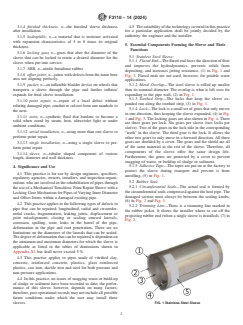
depositing, and increases jetting resistance, (1) in Fig. 1 and
3.1.8 offset joints, n—joints with defects from the inner bore
Fig. 3. Flared ends are not used, however, for potable water
area not aligning perfectly.
applications.
5.1.2 Metal Overlap—The steel sleeve is rolled up smaller
3.1.9 packer, n—an inflatable bladder device on wheels that
than its nominal diameter. The overlap is what is left over for
transports a sleeve through the pipe and further inflates/
expands for final sleeve installation. expanding to the pipe wall, (2) in Fig. 1.
5.1.3 Toothed Strip—The locks that keep the sleeve ex-
3.1.10 point repair, n—repair of a local defect without
panded run along the toothed strip, (3) in Fig. 1.
relining damaged pipe, conduit or culvert from one manhole to
5.1.4 Lock—The lock is a small set of gears that only moves
the next.
in one direction, thus keeping the sleeve expanded, (4) in Fig.
3.1.11 resin, n—synthetic fluid that hardens to become a
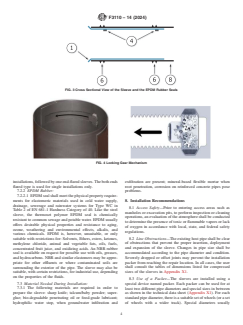
1 and Fig. 3. The locking gears are also shown in Fig. 4. There
solid when cured by steam, heat, ultraviolet light or under
are three gears per lock. Six gears per sleeve (two locks per
ambient conditions.
sleeve). Two of the gears in the lock ride in the corresponding
3.1.12 serial installation, n—using more than one sleeve to
“teeth” in the sleeve. The third gear is the lock. It allows the
perform point repair.
other two gears to only move in a forward direction. All three
gears are shielded by a cover. The gears and the shield are all
3.1.13 single installation, n—using a single sleeve to per-
of the same material as the rest of the sleeve. Therefore, all
form point repair.
components of the sleeve offer the same design life.
3.1.14 sleeve, n—tubular shaped component of various
Furthermore, the gears are protected by a cover to prevent
length, diameter and wall thickness.
snagging of waste, or buildup of sludge or sediment.
5.1.5 Adhesive Tape—The tapes are put on at the factory to
4. Significance and Use
protect the sleeve during transport and prevent it from
4.1 This practice is for use by design engineers, specifiers,
unrolling, (5) in Fig. 1.
regulatory agencies, owners, installers, and inspection organi-
5.2 Rubber Seal:
zations who are involved in the rehabilitation of pipes through
5.2.1 Circumferential Seals—The actual seal is formed by
the use of a Mechanical Trenchless Point Repair Sleeve with a
the circumferential seals compressed against the host pipe. The
Locking Gear Mechanism for Pipes of Varying Inner Diameter
damaged section must always be between the sealing knobs,
and Offset Joints within a damaged existing pipe.
(6) in Fig. 2 and Fig. 3.
4.2 This practice applies to the following types of defects in
5.2.2 Trimming Line—There is a trimming line marked in
pipe that can be repaired: longitudinal, radial and circumfer-
the rubber jacket. It shows the installer where to cut off the
ential cracks, fragmentation, leaking joints, displacement or
projecting rubber end (when a single sleeve is installed), (7) in
joint misalignment, closing or sealing unused laterals,
Fig. 2.
corrosion, spalling, wear, leaks in the barrel of the pipe,
deformation in the pipe and root penetration. There are no
limitations on the diameters of the laterals that can be sealed.
The degree of deformation that can be repaired is dependent on
the minimum and maximum diameters for which the sleeve is
applicable as listed in the tables of dimensions shown in
Appendix X1 but shall never exceed 5 %.
4.3 This practice applies to pipes made of vitrified clay,
concrete, reinforced concrete, plastics, glass reinforced
plastics, cast iron, ductile iron and steel for both pressure and
non-pressure applications.
4.4 In this practice, no issues of snagging waste or build-up
of sludge or sediment have been recorded to date; the perfor-
mance of this sleeve, however, depends on many factors;
therefore, past operational records may not include all possible
future conditions under which the user may install these
sleeves. FIG. 1 Stainless Steel Sleeve
F3110 − 14 (2024)
methods are commenced in situations where the structural
integrity of the existing pipe may be compromised. The
engineer shall conduct a structural condition evaluation and
shall set appropriate limits on the depth of milling allowed.
Depending on the quantity of flow present, bypassing in
accordance with the authority’s requirements may be neces-
sary.
6.3 Measuring the Internal Diameter of Existing Pipe:
6.3.1 Prior to installation, the internal diameter of the
existing pipe to be repaired shall be measured to ascertain
correct sizing of the sleeve in accordance with the manufac-
turer’s recommendations. Such measurements shall be taken at
both ends of the pipe segment being repaired along both
diameters: 6 o’clock to 12 o’clock and 3 o’clock to 9 o’clock
orientations.
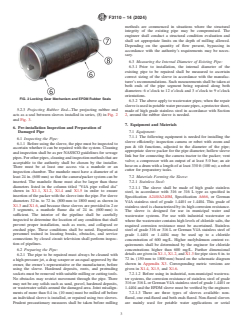
FIG. 2 Locking Gear Mechanism and EPDM Rubber Seals
6.3.2 The above apply to wastewater pipes; when the repair
sleeve is used in potable water pressure pipes, a protector sheet,
5.2.3 Projecting Rubber End—The projecting rubber end
made of high grade stainless steel in accordance with Section
acts as a seal between sleeves installed in series, (8) in Fig. 2
2, around the rubber sleeve is needed.
and Fig. 3.
7. Equipment and Materials
6. Pre-installation Inspection and Preparation of
7.1 Equipment:
Damaged Pipe
7.1.1 The following equipment is needed for installing the
6.1 Inspecting the Pipe:
sleeve efficiently: inspection camera or robot with zoom and
6.1.1 Before using the sleeve, the pipe must be inspected to
pan & tilt functions, adjusted to the diameter of the pipe;
ascertain whether it can be repaired with the system. Cleaning
appropriate sleeve packer for the pipe diameter; hollow sleeve
and inspection shall be as per NASSCO guidelines for sewage
link bar for connecting the camera tractor to the packer; vent
pipes. For other pipes, cleaning and inspection methods that are
valve; a compressor with an output of at least 5.0 bar; an air
acceptable to the authority shall be chosen by the installer.
hose on a drum with a length of at least 330 ft (100 m); a robot
There must be at least one access via a manhole or an
cutter for preparatory tasks.
inspection chamber. The manhole must have a diameter of at
least 24 in. (600 mm) so that the camera/packer system can be 7.2 Materials Forming the Sleeve:
inserted. The manhole flume must also be larger than those
7.2.1 Stainless Steel:
diameters listed in the column titled “V4A pipe rolled dia”
7.2.1.1 The sleeve shall be made of high grade stainless
shown in X1.1, X1.2, X1.4 and X1.5 in order to ensure
steel, in accordance with 316 or 316 L type as specified in
insertion of the packer with the sleeve into the pipe. For sleeve
Specification A240/A240M, Specification A666, or German
diameters 32 in. to 72 in. (800 mm to 1800 mm) as shown in
V4A stainless steel of grade 1.4401 or 1.4404. This grade of
X1.3 and X1.6, and because these sleeves are provided in 2 or
stainless steel is characterized by its high corrosion resistance.
3 segments, a manhole flume dia of 24 in. (600 mm) is
The sleeve is designed for use in municipal water and
sufficient. The interior of the pipeline shall be carefully
wastewater systems. For use with industrial wastewater or
inspected to determine the location of any condition that shall
where the wastewater contains high levels of chloride salts, the
prevent proper installation, such as roots, and collapsed or
required corrosion resistance must be ascertained. Stainless
crushed pipe. These conditions shall be noted. Experienced
steel of grade 316 or 316 L or German V4A stainless steel of
personnel trained in locating breaks, obstacles, and service
grade 1.4401 or 1.4404 may be used up to a chloride
connections by closed circuit television shall perform inspec-
concentration of 600 mg/L. Higher molybdenum content re-
tion of pipelines.
quirements shall be determined by the engineer for chloride
concentrations higher than 600 mg/L. Further dimensional
6.2 Preparing the Pipe:
details are given in X1.1, X1.2, and X1.3 for pipe sizes 6 in. to
6.2.1 The pipe to be repaired must always be cleaned with
72 in. (150 mm to 1800 mm) based on the schematic diagram
a high-pressure jet, a drag scraper or an equal approved by the
shown in Appendix X3. Corresponding metric versions are
owner, the owner’s representative or the manufacturer, before
given in X1.4, X1.5, and X1.6.
using the sleeve. Hardened deposits, roots, and protruding
7.2.1.2 Before using in industrial, non-municipal wastewa-
sockets must be removed with suitable milling or cutting tools.
ter systems, the corrosion resistance of stainless steel of grade
No obstacles may restrict movement through the pipe. There
316 or 316 L or German V4A stainless steel of grade 1.4401 or
may not be any solids such as sand, gravel, hardened deposits,
1.4404 and the EPDM sleeve must be verified by the engineer.
or wastewater solids around the damaged area. Joint misalign-
ments of more than 0.4 in. (10 mm) must be milled off before 7.2.1.3 There are three types of sleeves available: non-
an individual sleeve is installed, or repaired using two sleeves. flared, one end-flared and both ends flared. Non-flared sleeves
Prudent precautionary measures shall be taken before milling are mainly used for potable water applications or serial
F3110 − 14 (2024)
FIG. 3 Cross Sectional View of the Sleeve and the EPDM Rubber Seals
FIG. 4 Locking Gear Mechanism
installations, followed by one end-flared sleeves. The both ends exfiltration are present; mineral-based flexible mortar when
flared type is used for single installations only. root penetration, corrosion on reinforced concrete pipes pose
7.2.2 EPDM Rubber: problems.
7.2.2.1 EPDM seal shall meet the physical property require-
ments for elastomeric materials used in cold water supply,
8. Installation Recommendations
drainage, sewerage and rainwater systems for Type WC in
8.1 Access Safety—Prior to entering access areas such as
Table 2 of EN 681-1 Hardness Category of 40. Like the steel
manholes or excavation pits, to perform inspection or cleaning
sleeve, the thermoset polymer EPDM seal is chemically
operations, an evaluation of the atmosphere shall be conducted
resistant to common sewage and potable water. EPDM usually
to determine the presence of toxic or flammable vapors or lack
offers desirable physical properties and resistance to aging,
of oxygen in accordance with local, state, and federal safety
ozone, weathering and environmental effects, alkalis, and
regulations.
various chemicals. EPDM is, however, unsuitable, or only
8.2 Line Obstructions—The existing host pipe shall be clear
suitable with restrictions for: Solvents, Ethers, esters, ketones,
of obstructions that prevent the proper insertion, deployment
methylene chloride, animal and vegetable fats, oils, fuels,
and expansion of the sleeve. Changes in pipe size shall be
concentrated fruit juice, and oxidizing acids. An NBR rubber
accommodated according to the pipe diameter and condition.
seal is available on request for possible use with oils, greases,
Severely dropped or offset joints may prevent the installation
and hydrocarbons. NBR and similar elastomers may be appro-
packer from reaching the repair location. In all cases, the user
priate for other effluents or where contaminated soils are
shall consult the tables of dimensions listed for compressed
surrounding the exterior of the pipe. The sleeve may also be
sizes of the sleeves in Appendix X1.
suitable, with certain restrictions, for industrial use, depending
on the properties of the fluids.
8.3 Use of a Packer—The sleeves are installed using a
7.3 Material Needed During Installation: special device named packer. Each packer can be used for at
7.3.1 The following materials are required in order to least two different pipe diameters and special sizes in between
prepare the sleeve: sharp knife; talcum/baby powder; super- as shown in the technical data sheet (Appendix X1). For each
glue; bio-degradable penetrating oil or food-grade lubricant; standard pipe diameter, there is a suitable set of wheels (or a set
hydrophilic water stop, when groundwater infiltration and of wheels with a wider track). Special diameters usually
F3110 − 14 (2024)
require special sets of wheels, which are available on request. 8.5.2 The sleeve opens more easily if the metal overlap and
The maximum installation pressures are listed in Appendix X2. gear are lubricated. Particularly in 18 in. to 32 in. (450 mm to
The packer is usually connected to the camera or robot via a
800 mm) pipes, the sleeve needs more time to open the full
bracket and a hollow link bar with ball joints at each end. For
expansion. Increase the pressure to the sleeve in stages and let
repairs more than 20 ft (6 m) into the line the sleeve is installed
it expand to the fullest extent for each stage. If the installer
most efficiently and accurately when the packer is positioned
notices that the sleeve is obstructed or not opening smoothly,
by using a crawler camera equipped with an accurate distance
reduce the application pressure and reposition the packer so
counter. For repairs closer to the manhole, telescopic poles or
that the middle of the bladder is in line with the middle of the
other insertion apparatus can also be used. Either way, a
sleeve. If the sleeve is expanded eccentrically it can produce
camera is recommended to observe the installation.
torsion which may damage the lock or the toothed strips. Let
the sleeve expand to the wall of the pipe with a positioning
8.4 Positioning the Sleeve on the Packer—Select the correct
pressure of approximately 2.0–2.5 bar. Deflate the packer
set of wheels for the pipe diameter (see Appendix X1). The
sleeve is usually positioned on the packer while in the bladder slightly so that the installer can position it in the middle
of the sleeve. Now apply the appropriate application pressure
manhole. When installing flared sleeves, the flared end should
face against the direction of flow. Position the sleeve on the of 3.0–5.0 bar (Appendix X2), depending on the type of
packer so that it is flush with the front of the packer. If the
damage and pipe diameter. For longitudinal cracks and
installer is using a packer equipped with a laser, position the
fragmentation, particularly in vitrified clay pipes, do not
sleeve so that the laser beam is reflected both on the edge of the
expand the packer outside the sleeve, because this can damage
sleeve and the host pipe. In both cases, the camera gives a good
(burst) the host pipe.
view of the edge of the sleeve. Depending on which direction
8.5.3 With a camera, check that the sleeve is corr
...