

ASTM C1500-08(2017)
(Test Method)Standard Test Method for Nondestructive Assay of Plutonium by Passive Neutron Multiplicity Counting
General Information
- Abstract
SIGNIFICANCE AND USE
5.1 This test method is useful for determining the plutonium content of items such as impure Pu oxide, mixed Pu/U oxide, oxidized Pu metal, Pu scrap and waste, Pu process residues, and weapons components.
5.2 Measurements made with this test method may be suitable for safeguards or waste characterization requirements such as:
5.2.1 Nuclear materials accountability,
5.2.2 Inventory verification (7),
5.2.3 Confirmation of nuclear materials content (8),
5.2.4 Resolution of shipper/receiver differences (9),
5.2.5 Excess weapons materials inspections (10, 11),
5.2.6 Safeguards termination on waste (12, 13),
5.2.7 Determination of fissile equivalent content (14).
5.3 A significant feature of neutron multiplicity counting is its ability to capture more information than neutron coincidence counting because of the availability of a third measured parameter, leading to reduced measurement bias for most material categories for which suitable precision can be attained. This feature also makes it possible to assay some in-plant materials that are not amenable to conventional coincidence counting, including moist or impure plutonium oxide, oxidized metal, and some categories of scrap, waste, and residues (10).
5.4 Calibration for many material types does not require representative standards. Thus, the technique can be used for inventory verification without calibration standards (7), although measurement bias may be lower if representative standards were available.
5.4.1 The repeatability of the measurement results due to counting statistics is related to the quantity of nuclear material, interfering neutrons, and the count time of the measurement (15) .
5.4.2 For certain materials such as small Pu, items of less than 1 g, some Pu-bearing waste, or very impure Pu process residues where the (α,n) reaction rate overwhelms the triples signal, multiplicity information may not be useful because of the poor counting statistics of the triple coinci...
SCOPE
1.1 This test method describes the nondestructive assay of plutonium in forms such as metal, oxide, scrap, residue, or waste using passive neutron multiplicity counting. This test method provides results that are usually more accurate than conventional neutron coincidence counting. The method can be applied to a large variety of plutonium items in various containers including cans, 208-L drums, or 1900-L Standard Waste Boxes. It has been used to assay items whose plutonium content ranges from 1 g to 1000s of g.
1.2 There are several electronics or mathematical approaches available for multiplicity analysis, including the multiplicity shift register, the Euratom Time Correlation Analyzer, and the List Mode Module, as described briefly in Ref. (1).2
1.3 This test method is primarily intended to address the assay of 240Pu-effective by moments-based multiplicity analysis using shift register electronics (1, 2, 3) and high efficiency neutron counters specifically designed for multiplicity analysis.
1.4 This test method requires knowledge of the relative abundances of the plutonium isotopes to determine the total plutonium mass (See Test Method C1030).
1.5 This test method may also be applied to modified neutron coincidence counters (4) which were not specifically designed as multiplicity counters (that is, HLNCC, AWCC, etc), with a corresponding degradation of results.
1.6 The values stated in SI units are to be regarded as standard. No other units of measurement are included in this standard.
1.7 This standard does not purport to address all of the safety concerns, if any, associated with its use. It is the responsibility of the user of this standard to establish appropriate safety and health practices and determine the applicability of regulatory limitations prior to use.
- Status
- Published
- Publication Date
- 31-Dec-2016
- Technical Committee
- C26 - Nuclear Fuel Cycle
- Drafting Committee
- C26.10 - Non Destructive Assay
Overview
ASTM C1500-08(2017) – Standard Test Method for Nondestructive Assay of Plutonium by Passive Neutron Multiplicity Counting is a key international standard from ASTM International addressing the nondestructive analysis of plutonium (Pu) in diverse material forms. Using passive neutron multiplicity counting, this method enhances the accuracy of plutonium content determination over conventional neutron coincidence counting, particularly for complex or heterogeneous samples. Its scope covers wide-ranging applications, including impure Pu oxides, mixed Pu/U oxides, oxidized Pu metals, process residues, nuclear scrap, waste streams, and weapons-related materials.
By leveraging advanced neutron detection electronics and mathematical multiplicity analyses, the method minimizes calibration dependencies, supports nuclear safeguards, and streamlines inventory verification for materials stored in a variety of containers, from small cans to large drums.
Key Topics
- Multiplicty Counting Principle: Measures the probability distribution of neutron emission events ("singles," "doubles," and "triples") to deduce Pu-240 effective mass, self-multiplication, and (α,n) reaction ratios.
- Nondestructive Assay (NDA): Enables plutonium quantification without altering or destroying the item, preserving the integrity of nuclear materials.
- Material Versatility: Suitable for metals, oxides, mixed U/Pu materials, scrap, waste, and residues, even those with significant impurities or complex matrices.
- Advanced Detection Systems: Utilizes high-efficiency neutron detectors and specialized electronics (e.g., multiplicity shift registers, time correlation analyzers, list mode modules).
- Calibration Flexibility: For many material types, representative calibration standards are not required, permitting efficient inventory verification and measurement with reduced bias.
- Bias and Uncertainty: The technique provides reduced measurement bias compared to coincidence counting, especially for materials where the traditional approach is less effective.
- Safeguard Support: Meets requirements for nuclear material accountability, inventory verification, confirmation of contents, resolution of shipper/receiver discrepancies, inspections of excess weapons material, and waste characterization.
Applications
Passive neutron multiplicity counting, as standardized in ASTM C1500-08(2017), is widely employed in:
- Nuclear Safeguards and Accountancy: Ensuring accurate reporting and control of plutonium holdings within nuclear facilities to meet regulatory and treaty obligations.
- Inventory Verification: Periodic and ad hoc checks of stored plutonium materials for mass confirmation and integrity assurance, key for both operational and regulatory audit trails.
- Waste Characterization: Assaying plutonium in process waste streams and residues for compliance with disposal regulations and safeguards termination.
- Process Control: Monitoring plutonium content in recycled, reclaimed, or processed material to enhance operational efficiency and safety.
- Shipper/Receiver Discrepancy Resolution: Verifying shipment content upon receipt to detect and resolve any potential differences.
Related Standards
To support conformity, competency, and quality assurance in NDA of plutonium, the following ASTM standards are relevant:
- ASTM C1030: Determination of Plutonium Isotopic Composition by Gamma-Ray Spectrometry
- ASTM C1207: Nondestructive Assay of Plutonium in Scrap and Waste by Passive Neutron Coincidence Counting
- ASTM C1458: Nondestructive Assay of Plutonium, Tritium, and Americium by Calorimetric Assay
- ASTM C1490: Guide for the Selection, Training, and Qualification of NDA Personnel
- ASTM C1592: Guide for Making Quality Nondestructive Assay Measurements
- ASTM C1673: Terminology for Nondestructive Assay Methods
Practical Value
Implementation of ASTM C1500-08(2017) delivers:
- Improved accuracy in plutonium mass measurement for a broad spectrum of nuclear material types, even with variable chemical states or container geometries.
- Reduction in analytical bias and enhanced repeatability, particularly for difficult-to-measure materials.
- Reduced reliance on representative calibration standards, decreasing preparation time and allowing rapid deployment for routine or urgent measurements.
- Direct support of nuclear safeguards, regulatory compliance, and non-proliferation goals through reliable, traceable, and well-documented nondestructive assay practices.
By adhering to this standard, organizations strengthen nuclear material control, enable transparent reporting, and sustain high-integrity nuclear operations-all vital facets of modern nuclear material management.
Relations
- Effective Date
- 01-Apr-2018
- Effective Date
- 01-Apr-2018
- Effective Date
- 01-Apr-2018
- Effective Date
- 01-Mar-2016
- Effective Date
- 01-Nov-2010
- Effective Date
- 01-Nov-2010
- Effective Date
- 01-Oct-2010
- Effective Date
- 01-Jun-2010
- Effective Date
- 01-Jun-2010
- Effective Date
- 01-Feb-2009
- Effective Date
- 01-Feb-2009
- Effective Date
- 01-Jun-2007
- Effective Date
- 01-Jun-2007
- Effective Date
- 01-Feb-2004
- Effective Date
- 01-Feb-2004
Get Certified
Connect with accredited certification bodies for this standard

CIS Institut d.o.o.
Personal Protective Equipment (PPE) certification body. Notified Body NB-2890 for EU Regulation 2016/425 PPE.

Kiwa BDA Testing
Building and construction product certification.
Kmetijski inštitut Slovenije
Agricultural Institute of Slovenia. Soil testing, plant health, agricultural product analysis.
Sponsored listings
Frequently Asked Questions
ASTM C1500-08(2017) is a standard published by ASTM International. Its full title is "Standard Test Method for Nondestructive Assay of Plutonium by Passive Neutron Multiplicity Counting". This standard covers: SIGNIFICANCE AND USE 5.1 This test method is useful for determining the plutonium content of items such as impure Pu oxide, mixed Pu/U oxide, oxidized Pu metal, Pu scrap and waste, Pu process residues, and weapons components. 5.2 Measurements made with this test method may be suitable for safeguards or waste characterization requirements such as: 5.2.1 Nuclear materials accountability, 5.2.2 Inventory verification (7), 5.2.3 Confirmation of nuclear materials content (8), 5.2.4 Resolution of shipper/receiver differences (9), 5.2.5 Excess weapons materials inspections (10, 11), 5.2.6 Safeguards termination on waste (12, 13), 5.2.7 Determination of fissile equivalent content (14). 5.3 A significant feature of neutron multiplicity counting is its ability to capture more information than neutron coincidence counting because of the availability of a third measured parameter, leading to reduced measurement bias for most material categories for which suitable precision can be attained. This feature also makes it possible to assay some in-plant materials that are not amenable to conventional coincidence counting, including moist or impure plutonium oxide, oxidized metal, and some categories of scrap, waste, and residues (10). 5.4 Calibration for many material types does not require representative standards. Thus, the technique can be used for inventory verification without calibration standards (7), although measurement bias may be lower if representative standards were available. 5.4.1 The repeatability of the measurement results due to counting statistics is related to the quantity of nuclear material, interfering neutrons, and the count time of the measurement (15) . 5.4.2 For certain materials such as small Pu, items of less than 1 g, some Pu-bearing waste, or very impure Pu process residues where the (α,n) reaction rate overwhelms the triples signal, multiplicity information may not be useful because of the poor counting statistics of the triple coinci... SCOPE 1.1 This test method describes the nondestructive assay of plutonium in forms such as metal, oxide, scrap, residue, or waste using passive neutron multiplicity counting. This test method provides results that are usually more accurate than conventional neutron coincidence counting. The method can be applied to a large variety of plutonium items in various containers including cans, 208-L drums, or 1900-L Standard Waste Boxes. It has been used to assay items whose plutonium content ranges from 1 g to 1000s of g. 1.2 There are several electronics or mathematical approaches available for multiplicity analysis, including the multiplicity shift register, the Euratom Time Correlation Analyzer, and the List Mode Module, as described briefly in Ref. (1).2 1.3 This test method is primarily intended to address the assay of 240Pu-effective by moments-based multiplicity analysis using shift register electronics (1, 2, 3) and high efficiency neutron counters specifically designed for multiplicity analysis. 1.4 This test method requires knowledge of the relative abundances of the plutonium isotopes to determine the total plutonium mass (See Test Method C1030). 1.5 This test method may also be applied to modified neutron coincidence counters (4) which were not specifically designed as multiplicity counters (that is, HLNCC, AWCC, etc), with a corresponding degradation of results. 1.6 The values stated in SI units are to be regarded as standard. No other units of measurement are included in this standard. 1.7 This standard does not purport to address all of the safety concerns, if any, associated with its use. It is the responsibility of the user of this standard to establish appropriate safety and health practices and determine the applicability of regulatory limitations prior to use.
SIGNIFICANCE AND USE 5.1 This test method is useful for determining the plutonium content of items such as impure Pu oxide, mixed Pu/U oxide, oxidized Pu metal, Pu scrap and waste, Pu process residues, and weapons components. 5.2 Measurements made with this test method may be suitable for safeguards or waste characterization requirements such as: 5.2.1 Nuclear materials accountability, 5.2.2 Inventory verification (7), 5.2.3 Confirmation of nuclear materials content (8), 5.2.4 Resolution of shipper/receiver differences (9), 5.2.5 Excess weapons materials inspections (10, 11), 5.2.6 Safeguards termination on waste (12, 13), 5.2.7 Determination of fissile equivalent content (14). 5.3 A significant feature of neutron multiplicity counting is its ability to capture more information than neutron coincidence counting because of the availability of a third measured parameter, leading to reduced measurement bias for most material categories for which suitable precision can be attained. This feature also makes it possible to assay some in-plant materials that are not amenable to conventional coincidence counting, including moist or impure plutonium oxide, oxidized metal, and some categories of scrap, waste, and residues (10). 5.4 Calibration for many material types does not require representative standards. Thus, the technique can be used for inventory verification without calibration standards (7), although measurement bias may be lower if representative standards were available. 5.4.1 The repeatability of the measurement results due to counting statistics is related to the quantity of nuclear material, interfering neutrons, and the count time of the measurement (15) . 5.4.2 For certain materials such as small Pu, items of less than 1 g, some Pu-bearing waste, or very impure Pu process residues where the (α,n) reaction rate overwhelms the triples signal, multiplicity information may not be useful because of the poor counting statistics of the triple coinci... SCOPE 1.1 This test method describes the nondestructive assay of plutonium in forms such as metal, oxide, scrap, residue, or waste using passive neutron multiplicity counting. This test method provides results that are usually more accurate than conventional neutron coincidence counting. The method can be applied to a large variety of plutonium items in various containers including cans, 208-L drums, or 1900-L Standard Waste Boxes. It has been used to assay items whose plutonium content ranges from 1 g to 1000s of g. 1.2 There are several electronics or mathematical approaches available for multiplicity analysis, including the multiplicity shift register, the Euratom Time Correlation Analyzer, and the List Mode Module, as described briefly in Ref. (1).2 1.3 This test method is primarily intended to address the assay of 240Pu-effective by moments-based multiplicity analysis using shift register electronics (1, 2, 3) and high efficiency neutron counters specifically designed for multiplicity analysis. 1.4 This test method requires knowledge of the relative abundances of the plutonium isotopes to determine the total plutonium mass (See Test Method C1030). 1.5 This test method may also be applied to modified neutron coincidence counters (4) which were not specifically designed as multiplicity counters (that is, HLNCC, AWCC, etc), with a corresponding degradation of results. 1.6 The values stated in SI units are to be regarded as standard. No other units of measurement are included in this standard. 1.7 This standard does not purport to address all of the safety concerns, if any, associated with its use. It is the responsibility of the user of this standard to establish appropriate safety and health practices and determine the applicability of regulatory limitations prior to use.
ASTM C1500-08(2017) is classified under the following ICS (International Classification for Standards) categories: 13.030.30 - Special wastes. The ICS classification helps identify the subject area and facilitates finding related standards.
ASTM C1500-08(2017) has the following relationships with other standards: It is inter standard links to ASTM C1030-10(2018), ASTM C1673-10a(2018), ASTM C1207-10(2018), ASTM C1458-16, ASTM C1673-10ae1, ASTM C1673-10a, ASTM C1490-04(2010), ASTM C1673-10, ASTM C1207-10, ASTM C1458-09, ASTM C1458-09e1, ASTM C1673-07, ASTM C1673-07e1, ASTM C1490-04, ASTM C1592-04. Understanding these relationships helps ensure you are using the most current and applicable version of the standard.
ASTM C1500-08(2017) is available in PDF format for immediate download after purchase. The document can be added to your cart and obtained through the secure checkout process. Digital delivery ensures instant access to the complete standard document.
Standards Content (Sample)
This international standard was developed in accordance with internationally recognized principles on standardization established in the Decision on Principles for the
Development of International Standards, Guides and Recommendations issued by the World Trade Organization Technical Barriers to Trade (TBT) Committee.
Designation: C1500 − 08 (Reapproved 2017)
Standard Test Method for
Nondestructive Assay of Plutonium by Passive Neutron
Multiplicity Counting
This standard is issued under the fixed designation C1500; the number immediately following the designation indicates the year of
original adoption or, in the case of revision, the year of last revision. A number in parentheses indicates the year of last reapproval. A
superscript epsilon (´) indicates an editorial change since the last revision or reapproval.
1. Scope priate safety, health, and environmental practices and deter-
mine the applicability of regulatory limitations prior to use.
1.1 This test method describes the nondestructive assay of
plutonium in forms such as metal, oxide, scrap, residue, or
2. Referenced Documents
waste using passive neutron multiplicity counting. This test
2.1 ASTM Standards:
method provides results that are usually more accurate than
C1030 Test Method for Determination of Plutonium Isotopic
conventional neutron coincidence counting. The method can be
Composition by Gamma-Ray Spectrometry
applied to a large variety of plutonium items in various
C1207 Test Method for Nondestructive Assay of Plutonium
containers including cans, 208-L drums, or 1900-L Standard
in Scrap and Waste by Passive Neutron Coincidence
Waste Boxes. It has been used to assay items whose plutonium
Counting
content ranges from 1 g to 1000s of g.
C1458 Test Method for Nondestructive Assay of Plutonium,
1.2 There are several electronics or mathematical ap- 241
Tritium and Am by Calorimetric Assay
proaches available for multiplicity analysis, including the
C1490 Guide for the Selection, Training and Qualification of
multiplicity shift register, the Euratom Time Correlation
Nondestructive Assay (NDA) Personnel
Analyzer, and the List Mode Module, as described briefly in
C1592 Guide for Making Quality Nondestructive Assay
Ref. (1).
Measurements
1.3 This test method is primarily intended to address the C1673 Terminology of C26.10 Nondestructive Assay Meth-
assay of Pu-effective by moments-based multiplicity analy- ods
sis using shift register electronics (1, 2, 3) and high efficiency
3. Terminology
neutron counters specifically designed for multiplicity analysis.
3.1 Definitions:
1.4 This test method requires knowledge of the relative
3.1.1 Terms shall be defined in accordance with Terminol-
abundances of the plutonium isotopes to determine the total
ogy C1673 except for the following:
plutonium mass (See Test Method C1030).
3.1.2 gate fractions, n—the fraction of the total coincidence
1.5 This test method may also be applied to modified
events that occur within the coincidence gate.
neutron coincidence counters (4) which were not specifically
3.1.2.1 doubles gate fraction (f ), n—the fraction of the
d
designed as multiplicity counters (that is, HLNCC, AWCC,
theoretical double coincidences that can be detected within the
etc), with a corresponding degradation of results.
coincidence gate (see Eq 1).
1.6 The values stated in SI units are to be regarded as
3.1.2.2 triples gate fraction (f ), n—the fraction of the
t
standard. No other units of measurement are included in this
theoretical triple coincidences that can be detected within the
standard.
coincidence gate (see Eq 2).
1.7 This standard does not purport to address all of the
3.1.3 factorial moment of order, n—this is a derived quantity
safety concerns, if any, associated with its use. It is the
calculated by summing the neutron multiplicity distribution
responsibility of the user of this standard to establish appro-
weighted by ν!/(ν – n)! where n is the order of the moment.
3.1.4 induced fission neutron multiplicities (ν , ν , ν ),
i1 i2 i3
n—the factorial moments of the induced fission neutron mul-
This test method is under the jurisdiction of ASTM Committee C26 on Nuclear
tiplicity distribution. Typically multiplicity analysis will utilize
Fuel Cycle and is the direct responsibility of Subcommittee C26.10 on Non
Destructive Assay.
Current edition approved Jan. 1, 2017. Published January 2017. Originally
approved in 2002. Last previous edition approved in 2008 as C1500 – 08. DOI: For referenced ASTM standards, visit the ASTM website, www.astm.org, or
10.1520/C1500-08R17. contact ASTM Customer Service at service@astm.org. For Annual Book of ASTM
The boldface numbers in parentheses refer to the list of references at the end of Standards volume information, refer to the standard’s Document Summary page on
this standard. the ASTM website.
Copyright © ASTM International, 100 Barr Harbor Drive, PO Box C700, West Conshohocken, PA 19428-2959. United States
C1500 − 08 (2017)
the data from fast neutron-induced fission of Pu to calculate 5.2 Measurements made with this test method may be
these moments (5, 6). suitable for safeguards or waste characterization requirements
such as:
4. Summary of Test Method
5.2.1 Nuclear materials accountability,
4.1 The item is placed in the sample chamber or “well” of 5.2.2 Inventory verification (7),
5.2.3 Confirmation of nuclear materials content (8),
the multiplicity counter, and the emitted neutrons are detected
5.2.4 Resolution of shipper/receiver differences (9),
by the He tubes that surround the well.
5.2.5 Excess weapons materials inspections (10, 11),
4.2 The detected neutron multiplicity distribution is pro-
5.2.6 Safeguards termination on waste (12, 13),
cessed by the multiplicity shift register electronics package to
5.2.7 Determination of fissile equivalent content (14).
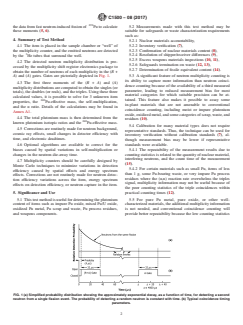
obtain the number of neutrons of each multiplicity in the (R +
A) and (A) gates. Gates are pictorially depicted in Fig. 1. 5.3 A significant feature of neutron multiplicity counting is
its ability to capture more information than neutron coinci-
4.3 The first three moments of the (R + A) and (A)
dence counting because of the availability of a third measured
multiplicity distributions are computed to obtain the singles (or
parameter, leading to reduced measurement bias for most
totals), the doubles (or reals), and the triples. Using these three
material categories for which suitable precision can be at-
calculated values, it is possible to solve for 3 unknown item
240 tained. This feature also makes it possible to assay some
properties, the Pu-effective mass, the self-multiplication,
in-plant materials that are not amenable to conventional
and the α ratio. Details of the calculations may be found in
coincidence counting, including moist or impure plutonium
Annex A1.
oxide, oxidized metal, and some categories of scrap, waste, and
4.4 The total plutonium mass is then determined from the
residues (10).
known plutonium isotopic ratios and the Pu-effective mass.
5.4 Calibration for many material types does not require
4.5 Corrections are routinely made for neutron background,
representative standards. Thus, the technique can be used for
cosmic ray effects, small changes in detector efficiency with
inventory verification without calibration standards (7), al-
time, and electronic deadtimes.
though measurement bias may be lower if representative
4.6 Optional algorithms are available to correct for the standards were available.
biases caused by spatial variations in self-multiplication or 5.4.1 The repeatability of the measurement results due to
changes in the neutron die-away time. counting statistics is related to the quantity of nuclear material,
interfering neutrons, and the count time of the measurement
4.7 Multiplicity counters should be carefully designed by
(15).
Monte Carlo techniques to minimize variations in detection
5.4.2 For certain materials such as small Pu, items of less
efficiency caused by spatial effects and energy spectrum
than 1 g, some Pu-bearing waste, or very impure Pu process
effects. Corrections are not routinely made for neutron detec-
residues where the (α,n) reaction rate overwhelms the triples
tion efficiency variations across the item, energy spectrum
signal, multiplicity information may not be useful because of
effects on detection efficiency, or neutron capture in the item.
the poor counting statistics of the triple coincidences within
practical counting times (12).
5. Significance and Use
5.1 This test method is useful for determining the plutonium 5.5 For pure Pu metal, pure oxide, or other well-
content of items such as impure Pu oxide, mixed Pu/U oxide, characterized materials, the additional multiplicity information
oxidized Pu metal, Pu scrap and waste, Pu process residues, is not needed, and conventional coincidence counting will
and weapons components. provide better repeatability because the low counting statistics
FIG. 1 (a) Simplified probability distribution showing the approximately exponential decay, as a function of time, for detecting a second
neutron from a single fission event. The probability of detecting a random neutron is constant with time. (b) Typical coincidence timing
parameters.
C1500 − 08 (2017)
of the triple coincidences are not used. Conventional coinci- hardware. The relative effect is greatest on the triples, and next
dence information can be obtained either by changing to greatest on the doubles. Cosmic ray effects increase in signifi-
coincidence analyzer mode, or analyzing the multiplicity data cance for assay items containing large quantities of high atomic
in coincidence mode. number matrix constituents and small gram quantities of
plutonium. Multiplicity data analysis software packages should
5.6 The mathematical analysis of neutron multiplicity data
include correction algorithms for count bursts caused by
is based on several assumptions that are detailed in Annex A1.
cosmic rays.
The mathematical model considered is a point in space, with
assumptions that neutron detection efficiency, die-away time, 6.7 Other spontaneous fission nuclides (for example, curium
and multiplication are constant across the entire item (16, 17).
or californium) will increase the coincident neutron count
As the measurement deviates from these assumptions, the rates, causing a positive bias in the plutonium assay that
biases will increase.
multiplicity counting does not correct for. The triples/doubles
5.6.1 Bias in passive neutron multiplicity measurements is
ratio can sometimes be used as a warning flag.
related to deviations from the “point model” such as variations
6.8 Total counting rates should be limited to about 900 kHz
in detection efficiency, matrix composition, or distribution of
to limit the triples deadtime correction to about 50 % and to
nuclear material in the item’s interior.
ensure that less than 25 % of the shift register steps are
5.6.2 Heterogeneity in the distribution of nuclear material,
occupied. Otherwise incorrect assay results may be obtained
neutron moderators, and neutron absorbers may introduce
due to inadequate electronic deadtime corrections.
biases that affect the accuracy of the results. Measurements
6.9 Unless instrument design takes high gamma-ray field
made on items with homogeneous contents will be more
into account, high gamma-ray exposure levels from the item
accurate than those made on items with inhomogeneous
may interfere with the neutron measurement through pile-up
contents.
effects if the dose is higher than about 1 R/h at the He tubes.
6. Interferences
6.1 For measurements of items containing one or more 7. Apparatus
lumps that are each several hundred grams or more of
7.1 Multiplicity Counters:
plutonium metal, multiplication effects are not adequately
7.1.1 Neutron multiplicity counters are similar in design and
corrected by the point model analysis (18). Variable-
construction to conventional neutron coincidence counters, as
multiplication bias corrections must be applied.
described in Test Method C1207. Both are thermal neutron
6.2 For items with high (α,n) reaction rates, the additional
detector systems that utilize polyethylene-moderated He pro-
uncorrelated neutrons will significantly increase the accidental
portional counters. However, multiplicity counters are de-
coincidence rate. The practical application of multiplicity
signed to maximize neutron counting efficiency and minimize
counting is usually limited to items where the ratio of (α,n) to
neutron die-away time, with detection efficiencies that are
spontaneous fission neutrons (α) is low, that is, less than 10 (7).
much less dependent on neutron energy. Cylindrical multiplic-
ity well counters typically have 3 to 5 rings of He tubes and
6.3 For measurement of large items with high (α,n) reaction
absolute neutron detection efficiencies of 40 to 60 %, whereas
rates, the neutrons from (α,n) reactions can introduce biases if
conventional coincidence counters typically have 1 or 2 rings
their energy spectra are different from the spontaneous fission
of He tubes and efficiencies of 15 to 25 %. A multiplicity
energy spectrum. The ratio of the singles in the inner and outer
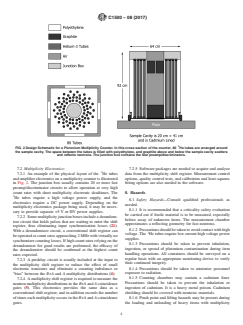
counter for the assay of cans of plutonium is illustrated in Fig.
rings can provide a warning flag for this effect (19).
2 (20).
6.3.1 High mass, high α items will produce large count rates
7.1.2 Multiplicity counters are designed to keep the radial
with large accidental coincidence rates. Sometimes this pre-
and axial efficiency profile of the sample cavity as flat as
vents obtaining a meaningful result.
possible (within several percent) to minimize the effects of
6.4 Neutron moderation by low atomic mass materials in the
item placement or item size in the cavity. Provision for
item affects neutron detection efficiency, neutron multiplication
reproducible item positioning in the cavity is still recom-
in the item, and neutron absorption by poisons. For nominal
mended for best results.
levels of neutron moderation, the multiplicity analysis will
7.1.3 Multiplicity counters are designed with a nearly flat
automatically correct the assay for changes in multiplication.
neutron detection efficiency as a function of the neutron energy
The presence of neutron poisons or other absorbers in the
spectrum, largely through the use of multiple rings of He
measurement item will introduce bias. Determination of the
tubes placed at different depths in the polyethylene moderator
correction factors required for these items will have to be
material.
individually determined.
7.1.4 Multiplicity counters usually have a thick external
6.5 It is important to keep neutron background levels from
layer of polyethylene shielding to reduce the contribution of
external sources as low and constant as practical for measure-
background neutrons from external sources.
ment of low Pu mass items. High backgrounds may produce a
7.1.5 Existing conventional neutron coincidence counters
bias during measurement. This becomes important as pluto-
are sometimes used for multiplicity analysis. The quality of the
nium mass decreases.
multiplicity results will depend on the extent to which the
6.6 Cosmic rays can produce single, double, and triple converted counters meet the multiplicity design criteria given
neutrons from spallation events within the detector or nearby above.
C1500 − 08 (2017)
FIG. 2 Design Schematic for a Plutonium Multiplicity Counter. In this cross section of the counter, 80 He tubes are arranged around
the sample cavity. The space between the tubes is filled with polyethylene, and graphite above and below the sample cavity scatters
and reflects neutrons. The junction box contains the fast preamp/discriminators.
7.2 Multiplicity Electronics: 7.2.5 Software packages are needed to acquire and analyze
7.2.1 An example of the physical layout of the He tubes data from the multiplicity shift register. Measurement control
and amplifier electronics on a multiplicity counter is illustrated options, quality control tests, and calibration and least-squares
in Fig. 2. The junction box usually contains 20 or more fast fitting options are also needed in the software.
preamp/discriminator circuits to allow operation at very high
count rates with short multiplicity electronic deadtimes. The
8. Hazards
He tubes require a high voltage power supply, and the
8.1 Safety Hazards—Consult qualified professionals as
electronics require a DC power supply. Depending on the
needed.
multiplicity electronics package being used, it may be neces-
8.1.1 It is recommended that a criticality safety evaluation
sary to provide separate +5 V or HV power supplies.
be carried out if fissile material is to be measured, especially
7.2.2 Some multiplicity junction boxes include a derandom-
before assay of unknown items. The measurement chamber
izer circuit that holds pulses that are waiting to enter the shift
approximates a reflecting geometry for fast neutrons.
register, thus eliminating input synchronization losses (21).
8.1.2 Precautions should be taken to avoid contact with high
With a derandomizer circuit, a conventional shift register can
voltage. The He tubes require low current high voltage power
be operated at count rates approaching 2 MHz with virtually no
supplies.
synchronizer counting losses. If high count rates relying on the
8.1.3 Precautions should be taken to prevent inhalation,
derandomizer for good results are performed, the efficacy of
ingestion, or spread of plutonium contamination during item
the derandomizer should be confirmed at the highest count
handling operations. All containers should be surveyed on a
rates expected.
regular basis with an appropriate monitoring device to verify
7.2.3 A predelay circuit is usually included at the input to
their continued integrity.
the multiplicity shift register to reduce the effect of small
8.1.4 Precautions should be taken to minimize personnel
electronic transients and eliminate a counting imbalance or
exposure to radiation.
“bias” between the R+A and A multiplicity distributions (4).
8.1.5 Counting chambers may contain a cadmium liner.
7.2.4 A multiplicity shift register is required to measure the
Precautions should be taken to prevent the inhalation or
neutron multiplicity distributions in the R+A and A coincidence
ingestion of cadmium. It is a heavy metal poison. Cadmium
gates (5). This electronics provides the same data as a
shielding should be covered with nontoxic materials.
conventional shift-register, and in addition records the number
of times each multiplicity occurs in the R+A and A coincidence 8.1.6 Pinch point and lifting hazards may be present during
gates. the loading and unloading of heavy items with multiplicity
C1500 − 08 (2017)
counters. Mechanical aids, such as a hoist, should be used for yield somewhat different die-away times with different choices
movement of heavy items. of gate length. The most appropriate choice of gate lengths for
8.1.7 The weight of the instrument may exceed facility floor this test are those that bracket the expected die-away time.
loading capacities. Check for adequate floor loading capacity 9.2.5 Verify that the coincidence gate width G is set close to
before installation. 1.27τ to obtain the minimum relative error for the assay (22).
At high count rates, it may be necessary to set the gate width
to a smaller value to keep the highest observed multiplicities in
9. Preparation of Instruments
the (R + A) and (A) distributions under 128 to minimize the
9.1 Perform initial multiplicity counter setup.
multiplicity deadtime correction (6, 23, 24).
9.1.1 It is recommended that the counter be set up and used
9.2.6 It is strongly recommended that the coincidence and
in an area with a range of temperature and humidity typical of
multiplicity deadtime coefficients be checked if feasible be-
an air-conditioned office environment, although newer elec-
cause multiplicity data analysis requires careful deadtime
tronics packages are specified to operate over the range of 0 to
corrections for the singles, doubles, and triples count rates. Ref.
50°C, and 0 to 95 % humidity. Movement of radioactive
(1) provides an example of typical deadtime correction equa-
material in the vicinity of the counter should be avoided while
tions and a common procedure for determining them. For
measurements are in progress if the background count rates can
multiplicity counters, typical values for the doubles deadtime
change by 10 % or more.
coefficient are in the range of 0.1 to 0.6 μs, and typical values
9.1.2 Set up the initial detector, data collection, and data
for the triples deadtime coefficient are in the range of 25 to 170
analysis parameters in the software code as recommended by
ns.
the supplier. Turn on the quality-control tests in the analysis
9.2.7 A series of 40 or more precision runs with the same
code, as described in Section 11.
item left in the counter can be carried out. This will provide
9.1.3 For all measurements, split up the available count time
some indication of the run-to-run stability of the electronics,
into a series of multiple smaller runs of equal duration.
and check that the statistical error propagation is being done
9.2 Perform detector characterization measurements. These
correctly.
initial measurements will provide some of the initial detector
10. Calibration
parameters needed for setup.
9.2.1 Measure the room background singles, doubles, and
10.1 Physical standards are usually not available for a wide
triples rates to make sure that they are reasonable and no He variety of sources and matrices. Instead, the singles, doubles,
detector breakdown is indicated. These count rates can be used
and triples equations are solved directly for multiplication M,
as initial measurement control values. Typical singles, doubles, α, and effective Pu mass m using a series of measured
eff
and triples count rates are 100 to 1000 cps, 1 to 2 cps, and 0.1
detector parameters (1). The solution will provide an accurate
to 0.2 cps, resp. assay to the extent that the plutonium items satisfy the
9.2.2 Perform an initial neutron source measurement to
assumptions used in multiplicity analysis, as described in
provide a reference value that can be used for measurement Annex A1.
control purposes. This can be done with a Cf reference 252
10.2 It is acceptable to use Cf as an experimental surro-
source that will be readily available in the future, or with a
gate. Adjust the detection efficiency ε for the difference in
physical standard that is not likely to change its shape, density
efficiency between californium and plutonium by Monte Carlo
252 250
or chemical form. If a Cf source is used, the Cf content
calculations or by measurement of a non-multiplying represen-
should be low enough to allow decay corrections using the
tative standard. The magnitude of the adjustment will depend
known half-life of Cf alone. The source or standard should
on the actual multiplicity detector being used, but will typically
be placed in a reproducible location within the normal assay
be in the range of 1 to 2 %.
volume of the measurement chamber.
10.3 Determine the actual fraction of the doubles that are
9.2.3 Using the reference source of known neutron yield,
counted within the gate width G. The doubles gate fraction f
d
determine the neutron detection efficiency ε of the multiplicity
is calculated from the singles and doubles rates measured with
counter (See Ref. (1) for equations). The isotopic data and
a Cf reference source (the parameters are defined in Section
neutron yield for the Cf source should be certified to a
3):
national standard. The neutron singles rate should be corrected
2ν D
for background, electronic deadtime, and source decay. This is
s1
ƒ 5 (1)
d
an excellent diagnostic that tests the He detectors, the fast εν S
s2
preamp/discriminator electronics chain, all hardware and soft-
10.4 Determine a preliminary value for the fraction of the
ware configurations, the counter’s design specifications, and
triples that are counted within the gate width G. The triples gate
any effect of the detector’s surroundings. The detection effi-
fraction f is calculated from the doubles and triples rates
t
ciency is also used later as part of the calibration process.
measured with a Cf reference source (the parameters are
9.2.4 Verify that the detector die-away time τ is as expected
defined in Section 3):
from the manufacturer or from Monte Carlo calculations by
252 3ƒ ν T
d s2
re-measuring the Cf reference source at a different gate
ƒ 5 (2)
t
εν D
s3
length that differs by a factor of 2 (See Ref. (1) for equations).
Some multiplicity counters will have more than one significant The triples gate fraction is close to the square of the doubles
component to their die-away curves, so this calculation may gate fraction, but not exactly equal unless the counter has a
C1500 − 08 (2017)
single exponential die-away time and the item to be measured settings, these can be used to validate the calibration process to
satisfies the assumptions of the point model. ensure that correct assay values are obtained on known
standards.
10.5 Set the parameters for the variable-multiplication bias
10.6.5 When the calibration process is completed, verify the
correction in the analysis software. This will correct multiplic-
applicability of the multiplicity counting technique by measur-
ity assays for the nonuniform probability of fission inside large
ing a series of materials to which the technique is going to be
metal plutonium items. The correction factor (CF) has the form
applied. The measurements should be verified relative to
CF 5 11a~M 2 1!1b~M 2 1! (3)
calorimetric assay or some other established performance
comparison process.
where M is the item multiplication, and the coefficients a and
b are determined empirically or by Monte Carlo calculation.
10.7 The multiplicity calibration procedure does not need to
An empirical set of coefficients appropriate for metal items in be repeated unless there is a significant change to the physical
several different multiplicity counters is a=0.07936 and
configuration of the counter, new electronics are installed, or
b=0.13857 (18). The correction factor approaches 1 as M measurement control limits cannot be maintained. If new
approaches 1, so it can be left on even if the multiplicity
material categories need to be measured that may not be
counter is only used to assay non-metallic items, or only small appropriate for multiplicity counting, some fraction of the
metal items. Or, it can be turned off by setting a=0 and b=0 in
measurements should be verified relative to calorimetric assay
the analysis software.
or some other established performance comparison process.
For example, the ratio of counts in the inner and outer detector
10.6 Provide physical standards for calibration, if available.
rings is a good indicator for neutron energy spectrum shifts that
Although the use of standards is not essential, the accuracy or
may bias the assay.
reliability of the measurements can be increased. A complete
set of standards would consist of the following:
252 11. Measurement Control
(1) A series of Cf sources of known isotopics and
known relative strength that are referenced to a national
11.1 Measurement control procedures shall be implemented
standard, for deadtime measurements, to verify proper operation of the multiplicity counter. These
(2) A Cf source or small metal Pu standard referenced to
procedures are installation specific and should be determined
a national standard for determination of efficiency and gate according to facility needs. Some of these procedures should
fractions,
be conducted on a daily basis, and records should be main-
(3) A plutonium oxide standard, preferably referenced to a tained to archive and monitor the measurement control results
national standard if available, for adjustment of the triples gate
and to provide a basis for decisions about the need for
fraction, and re-calibration or maintenance. References (23, 24) describe
(4) A large Pu metal standard to normalize or verify the
these tests.
variable-multiplication correction if Pu metal is to be mea-
11.2 The quality-control tests that are commonly imple-
sured.
mented usually include a checksum test on the shift register
(5) It is conservative, but not essential, to have additional
electronics, the accidentals/singles test, an outlier test which
physical standards whose plutonium mass loadings span the
rejects runs that lie outside a limit, a measurement control
range of loadings expected in the items to be assayed.
chi-squared limit, a declared-minus-assay quality check limit,
If one or more representative physical standards are
and a high voltage test limit. The tests should be selected as
available, the calibration can be improved by following the
appropriate for the system hardware, and should include test
steps described below.
limits that the operator can set. Runs that fail the test limits
10.6.1 Adjust the measured triples gate fraction f to obtain
t shall be rejected and identified as failed runs.
the best assay results for the standards. This corrects for
252 11.3 For all measurements, the count time should be split up
uncertainties in the nuclear data parameters of Cf and
into a minimum of 10 runs, with an individual length of 10 to
plutonium, and for differences between the actual items to be
100 s. This makes it easier to diagnose electronic noise or
assayed and the assumptions of the point model. The adjust-
instrument drift problems, and makes it possible to use quality
ment to f may be on the order of 10 %.
t
control outlier tests. The outlier tests can reject runs with
10.6.2 If the M or α values of the physical standards are
unusually large double or triple coincidence bursts due to
known, it may be helpful to vary ε or f also and obtain the best
d
cosmic rays.
agreement with the known M, α, and mass values. This
11.4 Background runs should be done daily when the
approach can only be helpful if the M or α values are well
instrument is in use, or more frequently if there is reason to
known. Otherwise, the procedure will introduce a bias into the
believe that the room background is changing significantly.
assay of actual items that will increase as M or α increases.
10.6.3 As a general guideline, if there is no independent
11.5 Normalization runs should be done daily, using the
information on the M or α values of the standards that would
same item described in 9.2.3, to ensure that the counter is
provide a physical basis for adjustment, changes to the gate
operating correctly. Because the He detectors are very stable,
fractions are generally not advisable.
the normalization constant is normally set to 1 (no correction),
10.6.4 If additional calibration standards are available that and rarely deviates by more than 0.5 %, unless one or more fast
are not needed to optimize the efficiency or gate fraction preamp/discriminator circuits fails. Due to the stability of these
C1500 − 08 (2017)
systems, if a statistically significant deviation from the ex- 12.4 Carry out the item measurement. Appropriate person-
pected value is obtained, the system should be taken out of nel should review the data printout for data entry errors, quality
service until the cause has been determined. control test failures, outlier test failures, and any unusual
measured or calculated results.
11.6 Occasional verification measurement of a known item
or known representative standard is a good practice for
12.5 The multiplicity counter’s data acquisition and analysis
long-term measurement control. This verifies system operation,
software should compute the measured Pu effective mass
data analysis, and large corrections like the variable-
m . If the item’s isotopic composition has been entered, the
eff
multiplication correction for metal.
total Pu mass should be calculated from the equation:
m
eff
12. Assay Procedure Pu 5 (4)
~2.52ƒ 1ƒ 11.68ƒ !
238 240 242
12.1 Center the item both vertically and horizontally in the
where ƒ , ƒ , and ƒ are the mass fractions of the even
238 240 242
counting chamber if possible, to minimize position effects.
plutonium isotopes present in the item. The mass factions are
Avoid placing items against the edges, where efficiency varia-
usually obtained by analytical chemistry or by gamma-ray
tions may affect assay results. This counting geometry should
spectroscopy. The latter approach is described in Test Method
be maintained for all standards and assay items.
C1030. The coefficients 2.52 and 1.68 are the ratios of the
12.2 Select a count time sufficient to provide the desired
spontaneous fission decay rates and second factorial moments.
measurement repeatability. This can be estimated from Fig. 3.
The available nuclear data on these coefficients has an RSD of
Alternatively, select the software option that allows counting to
about 2 to 3 % (25).
a preset precision, if available. One percent RSD on the triple
12.6 If a previously declared mass value has been entered
coincidence counts is commonly used, which typically requires
into the database, the assay Pu mass can be compared to the
1000 to 1800 s of counting time. This will result in a final assay
declared Pu mass, and the absolute and percent difference can
precision of about 1 % (1σ) for items with α less than 2, and
be calculated.
about 20 % (1σ) for items with α close to 7 (15).
12.3 Enter the item identification, isotopic composition, and
13. Precision and Bias
declared Pu mass, if these are known. If data by other methods,
such as passive coincidence counting, Known-M, or Known-α 13.1 Multiplicity counter assay precision is determined
analysis is also desired these can be selected if available in the primarily by the statistical uncertainty in the singles, doubles,
software, and if the appropriate calibration coefficients have and triples count, and the reproducibility of item placement.
been entered (6, 23). The dominant source of uncertainty usually comes from the
FIG. 3 Estimated precision for both multiplicity and conventional coincidence assay using a multiplicity counter with a detector effi-
ciency of 50 %, a gate width of 64 μs, a die-away time of 50 μs, and a predelay of 3 μs. The background rate is 100 counts/s, and the
counting time is 1000 s.
C1500 − 08 (2017)
triples, and is determined primarily by detector efficiency, the multiplicity analysis software (see 13.2). The “Pu-240
die-away time, counting time, and the (α,n) rate of the item. effective RSD” is the repeatability of the gamma-ray isotopic
analysis of the Pu mass fraction. The “Assay Total RSD”
eff
13.2 The propagated assay uncertainty in the plutonium
is the combination of these two repeatabilities in quadrature.
mass is usually estimated by the analysis software in one of
The (Assay-Reference)/Reference uncertainty is usually within
two ways: from the statistical scatter between the short
the calculated “Assay Total RSD” uncertainty. More detailed
multiple runs that make up a single assay, or from theoretical
estimates of bias are given in Table 2.
estimation methods that have been benchmarked against mea-
surements of the observed scatter (15). See the supplier’s user
13.5 Assay bias for multiplicity counting is very low for
manual for details (6, 23). In either case, the quoted error is not
items that meet the mathematical assumptions used in multi-
a Total Measurement Uncertainty (TMU) that includes all
plicity analysis. However, in practice container and matrix
possible sources of error. Rather, it consists only of counting
factors may yield noticeable biases. Table 2 provides a broad
statistics and any calibration uncertainties that may be propa-
summary of past performance for multiplicity assay of many of
gated.
the nuclear materials commonly found in DOE facilities, and
13.3 Fig. 3 provides rough estimates of the predicted assay
can be used to estimate performance for other similar applica-
repeatability due to counting statistics for Pu metal (α=0),
tions. Table 2 also estimates the expected assay repeatability
oxide (α=1), scrap (α=5), and residues (α=20) for a high-
and bias (including the uncertainty from gamma-ray isotopics)
efficiency multiplicity counter (15). The actual α values of such
relative to calorimetric assay or destructive analysis.
materials will vary, but the values selected here are represen-
13.6 Multiplicity counting measures the even isotopes of
tative. The item multiplication is estimated from typical values
plutonium. Biases in the determination of the plutonium
for plutonium oxide in cans. The curves in Fig. 3 are based on
isotopic composition will result in significant bias in the
calculations that are usually within 15 to 25 % of actual
calculated total mass of plutonium. A fractional bias in m
eff
observed uncertainties. Note that the repeatability due to
propagates to the same fractional bias in the total plutonium
counting statistics is always better for conventional coinci-
mass.
dence counting than for multiplicity analysis.
13.7 Changes in background can affect the assay by roughly
13.4 Examples of single measurements of a wide range of
1 % for every 1 % change in the total count rate, depending on
plutonium standard cans and inventory items are given in Table
the item’s mass and self-multiplication.
1 (7). The measurements were made in a processing facility
with a multiplicity counter of approximately 57 % detection
13.8 The coincidence background of spallation neutrons
efficiency and 47 μs die-away time. The measured items were
from cosmic ray interactions can be significant for small
in cans of 4 to 6-in. diameter, and 5 to 8-in. height. Most of the
plutonium loadings in cans with several kg of high atomic
items were assayed only once, so that “precision” in this table
number matrix materials. For example, 100 kg of iron yields a
is just the repeatability due to counting statistics. Most items
doubles rate roughly equivalent to 20 mg Pu, and 100 kg of
were counted for 1800 s or for 3600 s, although the MSE salt 240
lead yields a doubles rate roughly equivalent to 120 mg Pu
was counted for 5400 s to reduce the counting statistics
at 2200 m altitude. The bias is reduced to approximately one
uncertainty due to the high α value. Except for the standards,
half of these values at sea level.
the reference Pu total mass is based on calorimetric assay, with
a typical RSD of 0.6 %. The Pu mass fraction was 13.9 If the detection efficiency is not constant over the assay
eff
obtained from 1 to 2 h FRAM gamma-ray isotopic volume, bias effects can occur due to item positioning or
measurements, with a repeatability in the range of 1.1 to 4.6 %. varying fill heights in the container. For a well-designed
The “Multiplicity Assay RSD” is the repeatability computed by multiplicity counter these effects are usually about 1 % (1σ) for
TABLE 1 Measurement Results for Multiplicity Counter Assay of Some Plutonium Items (Ref. 7)
Pu Pu Item Multiplicity Pu240 Assay (Assay−Reference)/
Material Item
Reference Mass Assay Mass Multiplication Assay Effective Fraction Total Reference
Type alpha
(g) (g) M RSD RSD RSD (%)
A
Calex Std 398 394 1.102 0.9 0.2 % 0.2 % -0.4
A
Oxide Std 874 877 1.084 0.7 0.8 % 0.8 % 0.3
Impure Oxide 865 855 1.074 0.9 0.6 % 2.3 % 2.3 % -1.1
Impure Metal 2417 2463 1.483 0.0 0.3 % 3.0 % 3.0 % 1.9
Impure Metal 4074 4200 2.281 0.3 0.2 % 4.5 % 4.5 % 3.1
Pure Metal 4190 4169 2.125 0.3 0.3 % 3.6 % 3.6 % -0.5
Filter Residue 607 626 1.057 1.6 1.5 % 1.3 % 1.9 % 3.1
MgO Crucible 130 131 1.022 2.5 0.8 % 4.0 % 4.1 % 1.0
ER Salt 493 442 1.071 3.9 0.9 % 1.9 % 2.1 % -10.4
Sand and Slag 119 123 1.012 7.5 4.2 % 2.8 % 5.1 % 3.7
Filter Residue 339 325 1.028 10.5 9.0 % 2.6 % 9.4 % -4.1
Impure Oxygen 314 266 1.038 30.1 44.1 % 3.0 % 44.2 % -15.3
Inciner Ash 161 99 1.026 30.1 47.1 % 2.0 % 47.1 % -38.3
MSE Salt 263 188 1.021 34.2 38.9 % 3.0 % 39.0 % -28.5
A
Used reference isotopic values.
C1500 − 08 (2017)
TABLE 2 Summary of Past or Expected Multiplicity Counter Performance on Various Nuclear Material Categories
Nuclear Material No. of Ref. Pu Mass (α,n)/sf Count Time RSD Bias
Refs.
Category Items Technique (g) Rate α (s) (%) (%)
Pu Metal 13 Cal/iso 200–4000 0 to 1.3 1800 4.6 1.3 (7)
14 Cal/iso 1500–5000 0 1800 2.7 -0.1 (9)
5 Cal/iso 300–3700 0 to 0.3 3000 5.1 -4.7 (26)
Calex Std. 1 DA 398 1 1800 1.3 0.3 (7)
Calex Std. 1 DA 398 1 1800 1.37 0.77 (27)
Pu Oxide 45 Cal/iso 500–5000 1 1800 2.2 0.0 (9)
5 DA 400–1800 0.7–1.1 3000 0.8 -2.7 (26)
Impure Pu Oxide 12 DA 20–875 0.7–4.3 1000 2–3 0.8 (28)
Pu Scrap 16 Cal/iso 80–1175 1–6 3600 5.7 -1.6 (7)
67 Cal/iso 300–1000 1–10 1200 8 0.0 (10)
24 DA 2000 1–6 1800 5.8 -1.0 (11)
Pu Residue 8 Cal/iso 161–339 7–34 3600 18.8 -9.2 (7)
10 Cal/iso 37–300 9–32 3000 4.8 0.9 (26)
Mixed U/Pu Oxide 8 DA 200–800 1–2 1000 1–2 1–3 (29)
Note that the observed repeatability and bias estimates include the uncertainties from the neutron counting, the gamma-ray isotopic analysis of the Pu effective
fraction, and the calorimetric assay reference values. For the Calex standard, Ref. (7) reports precision (repeatability and reproducibility) on 8 measurements, and Ref.
(27) reports a combination of precision on about 100 measurements and repeatability on about 150 measurements. Calorimetric assay and DA refers to destructive
analysis traceable to the national measurement system.
244 252
singles, 2 % (1σ) for doubles, and 3 % (1σ) for triples, and 3 % of Cm or 5 ng of Cf is equivalent to the neutron output
(1σ) or less for the final assay result. from 10 g of Pu. If there is enough curium or californium to
dominate the coincident signal, then the average observed
13.10 The moisture content of an assay item increases α,
multiplicity per fission will be higher, and the triples/doubles
increases self-multiplication, and alters the detection efficiency
ratio can be used as a warning for this condition.
of the counter. The first two effects are calculated and auto-
matically corrected for by the multiplicity assay, and the third
13.15 The response of the He tubes, fast preamp/
can be detected by the inner/outer ring ratio if it is significant.
discriminators, and multiplicity electronics is usually stable to
Several wt % moisture will affect the detection efficiency of a
better than 0.1 % (1σ), and contributes a negligible bias to the
well-designed multiplicity counter by 1 % or less.
assay.
13.11 Item container wall effects may bias individual mul-
13.16 The average Pu mass calculated from a series of short
tiplicity assay results by about 1 % for wall thicknesses of
assays may not be exactly equal to the Pu mass calculated from
roughly 3 to 5 mm.
the average of the rates because the solution of the multiplicity
analysis equations involves a non-linear cubic equation. This
13.12 Large quantities of moderator in the container can
condition becomes more pronounced as the (α, n) rate
change the die-away time of the counter and bias the assay if
increases, but is typically less than 0.1 %.
there is no cadmium liner in the assay chamber. This effect is
too counter- and matrix-specific to quantify. Monitoring the
13.17 Care must be taken to ensure that all sources of
die-away time with a second gate length can provide a flag, and
uncertainty are included in the final reported mass value. There
this option is usually available in the multiplicity hardware and
are several uncertainties that may not be calculated by the data
software package.
analysis software, including the following:
(1) About 2 % (1σ) uncertainties in the nuclear data coef-
13.13 Neutron poisons (at the level of several percent by
ficients used to solve the multiplicity equations (these have
weight) have no effect unless there is also enough moderator to
very little effect because the calibration process compensates
reduce the average energy of the neutrons to the point where
for them).
the poison’s capture probability becomes high. At this mod-
(2) About 0.5 to 2 % (1σ) uncertainties in the strength of
erator level (greater than 0.1 g/cm of water or equivalent) the
NIST-traceable Cf sources (This will affect the assay by
slower moderated neutrons tend to fall outside the coincidence
about 1.5 %, unless a physical standard is available to remove
counting interval. As a result, the loss of coincidence signal is
the uncertainty.)
no more than would be expected from the neutron detection
(3) About 5 % (1σ) uncertainty in the variable-
efficiency change. This bias is seldom observed and is ha
...