

ASTM D2097-03(2023)
(Test Method)Standard Test Method for Flex Testing of Finish on Upholstery Leather
General Information
- Abstract
SIGNIFICANCE AND USE
4.1 This test method simulates the flexing received by upholstery leather in service, and correlation with service is believed to be good. Both the resistance of the finish to cracking and adhesion of the finish to the leather can be evaluated.
4.2 The flexing action received by the leather in this method is more severe than that given by methods for shoe upper leather. The less severe tests have little utility in the evaluation of upholstery leather finishes.
4.3 This test method is suitable, and has been useful, in research, development, and manufacturing control. It is used as a method of test for specification acceptance. Since this is a subjective test, proper correlation should be established by interlaboratory experience prior to use for specification acceptance.
SCOPE
1.1 This test method covers the determination of the flexibility and adhesion of a finish on upholstery leather.2 This test method does not apply to wet blue.
1.2 The values stated in inch-pound units are to be regarded as the standard. The values given in parentheses are for information only.
1.3 This standard does not purport to address all of the safety concerns, if any, associated with its use. It is the responsibility of the user of this standard to establish appropriate safety, health, and environmental practices and determine the applicability of regulatory limitations prior to use.
1.4 This international standard was developed in accordance with internationally recognized principles on standardization established in the Decision on Principles for the Development of International Standards, Guides and Recommendations issued by the World Trade Organization Technical Barriers to Trade (TBT) Committee.
- Status
- Published
- Publication Date
- 31-Dec-2022
- Technical Committee
- D31 - Leather
- Drafting Committee
- D31.05 - Upholstery


Overview
ASTM D2097-03(2023), Standard Test Method for Flex Testing of Finish on Upholstery Leather is an internationally recognized standard developed by ASTM International. This test method evaluates the flexibility and adhesion of finishes applied to upholstery leather, simulating the flexing conditions typically experienced during service life. It is specifically designed for upholstery leathers and is not intended for wet blue leather.
The standard provides a framework for evaluating both the resistance of the leather finish to cracking and the adhesion of the finish under repeated flexing. Through this process, manufacturers, researchers, and quality control professionals can objectively assess the durability of upholstered leather products.
Key Topics
- Flex Testing Simulation: The method replicates the severe flexing that upholstery leather undergoes in real-world applications, offering a reliable correlation to in-service performance.
- Finish Evaluation: It enables assessment of two critical attributes:
- Resistance to cracking of the finish
- Adhesion of the finish to the leather substrate
- Test Severity: The flexing action in this test is more challenging than methods intended for shoe upper leathers, making it suitable for the thicker, more robust nature of upholstery leather.
- Research and Manufacturing Applications: The method supports research, product development, and quality control, and is a key component in specification acceptance testing.
- Subjectivity and Correlation: As some aspects of the evaluation are subjective, the standard encourages interlaboratory studies to ensure consistent interpretation of results.
Applications
ASTM D2097 is widely used across industries where high-performance upholstery leather is specified:
- Furniture Manufacturing: Assures that leather sofas, chairs, and seating maintain appearance and integrity under repeated use.
- Automotive Interiors: Ensures automotive upholstery leather meets tough durability requirements before vehicles reach the market.
- Aviation and Public Transport: Applied to leather seating and panels subjected to frequent flexing and heavy usage.
- Quality Assurance and Specification Compliance: Used by tanneries, suppliers, and buyers for product acceptance based on durability standards.
- Research and Development: Supports material scientists and engineers in formulating, testing, and improving leather finish systems.
By following ASTM D2097, industry stakeholders can confidently guarantee their leather products meet specified durability and performance criteria, reducing the risk of premature product failure and improving customer satisfaction.
Related Standards
Professionals utilizing ASTM D2097 may also reference the following related standards to ensure comprehensive leather testing and performance:
- ASTM D1610: Practice for Conditioning Leather and Leather Products for Testing
- Other relevant upholstery and leather finish test methods within the ASTM D31 Committee on Leather
Compliance with ASTM D2097 aligns with international trade best practices, reflecting globally recognized principles as outlined by the World Trade Organization Technical Barriers to Trade (TBT) Committee. Adopting this standard promotes product integrity and market acceptance, supporting manufacturers and suppliers in achieving competitive quality in the upholstery leather sector.
Keywords: Upholstery leather, flex testing, leather finish, ASTM D2097, leather durability, adhesion, cracking resistance, quality control, specification acceptance.
Relations
- Refers
ASTM D1610-01(2013) - Standard Practice for Conditioning Leather and Leather Products for Testing - Effective Date
- 01-May-2013
- Refers
ASTM D1610-01(2007) - Standard Practice for Conditioning Leather and Leather Products for Testing - Effective Date
- 01-Apr-2007
- Effective Date
- 10-May-2001
- Effective Date
- 10-May-2001
Get Certified
Connect with accredited certification bodies for this standard

Control Union Certifications
Global certification for agriculture and sustainability.

Hohenstein Institut
Textile testing and certification.

Bureau Veritas Bangladesh
Bureau Veritas certification services in Bangladesh.
Sponsored listings
Frequently Asked Questions
ASTM D2097-03(2023) is a standard published by ASTM International. Its full title is "Standard Test Method for Flex Testing of Finish on Upholstery Leather". This standard covers: SIGNIFICANCE AND USE 4.1 This test method simulates the flexing received by upholstery leather in service, and correlation with service is believed to be good. Both the resistance of the finish to cracking and adhesion of the finish to the leather can be evaluated. 4.2 The flexing action received by the leather in this method is more severe than that given by methods for shoe upper leather. The less severe tests have little utility in the evaluation of upholstery leather finishes. 4.3 This test method is suitable, and has been useful, in research, development, and manufacturing control. It is used as a method of test for specification acceptance. Since this is a subjective test, proper correlation should be established by interlaboratory experience prior to use for specification acceptance. SCOPE 1.1 This test method covers the determination of the flexibility and adhesion of a finish on upholstery leather.2 This test method does not apply to wet blue. 1.2 The values stated in inch-pound units are to be regarded as the standard. The values given in parentheses are for information only. 1.3 This standard does not purport to address all of the safety concerns, if any, associated with its use. It is the responsibility of the user of this standard to establish appropriate safety, health, and environmental practices and determine the applicability of regulatory limitations prior to use. 1.4 This international standard was developed in accordance with internationally recognized principles on standardization established in the Decision on Principles for the Development of International Standards, Guides and Recommendations issued by the World Trade Organization Technical Barriers to Trade (TBT) Committee.
SIGNIFICANCE AND USE 4.1 This test method simulates the flexing received by upholstery leather in service, and correlation with service is believed to be good. Both the resistance of the finish to cracking and adhesion of the finish to the leather can be evaluated. 4.2 The flexing action received by the leather in this method is more severe than that given by methods for shoe upper leather. The less severe tests have little utility in the evaluation of upholstery leather finishes. 4.3 This test method is suitable, and has been useful, in research, development, and manufacturing control. It is used as a method of test for specification acceptance. Since this is a subjective test, proper correlation should be established by interlaboratory experience prior to use for specification acceptance. SCOPE 1.1 This test method covers the determination of the flexibility and adhesion of a finish on upholstery leather.2 This test method does not apply to wet blue. 1.2 The values stated in inch-pound units are to be regarded as the standard. The values given in parentheses are for information only. 1.3 This standard does not purport to address all of the safety concerns, if any, associated with its use. It is the responsibility of the user of this standard to establish appropriate safety, health, and environmental practices and determine the applicability of regulatory limitations prior to use. 1.4 This international standard was developed in accordance with internationally recognized principles on standardization established in the Decision on Principles for the Development of International Standards, Guides and Recommendations issued by the World Trade Organization Technical Barriers to Trade (TBT) Committee.
ASTM D2097-03(2023) is classified under the following ICS (International Classification for Standards) categories: 59.140.35 - Leather products. The ICS classification helps identify the subject area and facilitates finding related standards.
ASTM D2097-03(2023) has the following relationships with other standards: It is inter standard links to ASTM D1610-01(2013), ASTM D1610-01(2007), ASTM D1610-01, ASTM D1610-00. Understanding these relationships helps ensure you are using the most current and applicable version of the standard.
ASTM D2097-03(2023) is available in PDF format for immediate download after purchase. The document can be added to your cart and obtained through the secure checkout process. Digital delivery ensures instant access to the complete standard document.
Standards Content (Sample)
This international standard was developed in accordance with internationally recognized principles on standardization established in the Decision on Principles for the
Development of International Standards, Guides and Recommendations issued by the World Trade Organization Technical Barriers to Trade (TBT) Committee.
Designation: D2097 − 03 (Reapproved 2023)
Standard Test Method for
Flex Testing of Finish on Upholstery Leather
This standard is issued under the fixed designation D2097; the number immediately following the designation indicates the year of
original adoption or, in the case of revision, the year of last revision.Anumber in parentheses indicates the year of last reapproval.A
superscript epsilon (´) indicates an editorial change since the last revision or reapproval.
1. Scope 4. Significance and Use
4.1 This test method simulates the flexing received by
1.1 This test method covers the determination of the flex-
upholstery leather in service, and correlation with service is
ibility and adhesion of a finish on upholstery leather. This test
believed to be good. Both the resistance of the finish to
method does not apply to wet blue.
cracking and adhesion of the finish to the leather can be
1.2 The values stated in inch-pound units are to be regarded
evaluated.
as the standard. The values given in parentheses are for
4.2 Theflexingactionreceivedbytheleatherinthismethod
information only.
is more severe than that given by methods for shoe upper
1.3 This standard does not purport to address all of the
leather.The less severe tests have little utility in the evaluation
safety concerns, if any, associated with its use. It is the
of upholstery leather finishes.
responsibility of the user of this standard to establish appro-
4.3 This test method is suitable, and has been useful, in
priate safety, health, and environmental practices and deter-
research,development,andmanufacturingcontrol.Itisusedas
mine the applicability of regulatory limitations prior to use.
a method of test for specification acceptance. Since this is a
1.4 This international standard was developed in accor-
subjective test, proper correlation should be established by
dance with internationally recognized principles on standard-
interlaboratory experience prior to use for specification accep-
ization established in the Decision on Principles for the
tance.
Development of International Standards, Guides and Recom-
mendations issued by the World Trade Organization Technical
5. Apparatus
Barriers to Trade (TBT) Committee.
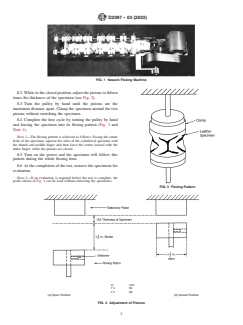
5.1 Newark Flexing Machine—This machine, illustrated in
Fig. 1, consists basically of two pistons, one of which is
2. Referenced Documents
stationary, the other capable of moving at 500 rpm with a
stroke of 1 ⁄4 in. (32 mm). The movable piston is also
2.1 ASTM Standards:
adjustableonitsshaftinordertovarythedistancebetweenthe
D1610Practice for Conditioning Leather and Leather Prod-
two pistons.
ucts for Testing
6. Test Specimen
3. Summary of Test Method
6.1 The test specimen shall be 3in. by 4 ⁄2 in. (76mm by
3.1 Theleatherismechanicallyflexedalternatelyfromaflat
114 mm) in size.
position into a single or double bend. At the end of a
7. Conditioning
predetermined number of flexing cycles, the leather is visually
inspected for finish cracks.
7.1 Bring all test specimens to equilibrium as described in
Practice D1610. Usually, maintaining the specimen for 24 h
under these conditions will adequately satisfy the equilibrium
1 conditions.
ThistestmethodisunderthejurisdictionofASTMCommitteeD31onLeather
and is the direct responsibility of Subcommittee D31.05 on Upholstery. This test
7.2 The test shall also be conducted under the above
method was developed in cooperation with the American Leather Chemists Assn.
conditions, described in Practice D1610.
Current edition approved Jan. 1, 2023. Published January 2023. Originally
approved in 1962. Last previous edition approved in 2016 as D2097–03 (2016).
8. Procedure
DOI: 10.1520/D2097-03R23.
Several methods of evaluating the resistance of an upholstery leather finish to
8.1 Measure the thickness of the specimen to be tested.
flexinghavebeeninvestigated.Thismethod,asdescribedhere,hasbeenadoptedas
standard by the Upholstery Leather Group, Tanners’ Council of America.
3 4
For referenced ASTM standards, visit the ASTM website, www.astm.org, or Amachine meeting the requirements of this method is available commercially
contact ASTM Customer Service at service@astm.org. For Annual Book of ASTM from the Aim Tool & Die Co., 14324 172nd St., Grand Haven, MI 49417. Two
Standards volume information, refer to the standard’s Document Summary page on versions of this machine are made by Aim Tool & Die Co. Only the standard
the ASTM website. flexotest machine meets the requirements of this method.
Copyright © ASTM International, 100 Barr Harbor Drive, PO Box C700, West Conshohocken, PA 19428-2959. United States
D2097 − 03 (2023)
FIG. 1 Newark Flexing Machine
8.2 Whileintheclosedposition,adjustthepistonstofifteen
times the thickness of the specimen (see Fig. 2).
8.3 Turn the pulley by hand until the pistons are the
maximum distance apart. Clamp the specimen arou
...